O
RIGINALA
RTICLE Revista Brasileira de FisioterapiaImpact of static stretching on the gain in
knee-extensor strength of community-dwelling
older women after a training program
Impacto do alongamento estático no ganho de força muscular dos extensores de
joelho em idosas da comunidade após um programa de treinamento
Lygia P. Lustosa1,2, Marina G. M. Pacheco3, Andrea L. Liu3, Wanessa S. Gonçalves3, Juscélio P. Silva3, Leani S. M. Pereira4
Abstract
Background: The decrease in muscle strength in older adults has an impact on functionality. Muscle strengthening programs have been proposed, however there is some controversy surrounding the effects of stretching prior to strengthening exercises on muscle strength gain. Objective:To verify the impact of static stretching on the gain in knee-extensor strength of community-dwelling elderly women after a training program. Methods:This was a quasi-experimental study that included a ten-week knee-extensor strengthening program and a final assessment of 12 community-dwelling elderly women divided into two groups: group SE – strengthening exercises with prior static stretching in all sessions, mean age 73.8 (±5.36) years; and group E – same strengthening exercises as SE without prior stretching, mean age 72.14 (±5.43) years. To measure knee-extensor strength gains, we used the isokinetic dynamometer Biodex System 3 Pro, in concentric mode at angular velocities of 60° and 180°/s, and for statistical analysis we used the difference between pre- and post-intervention means
of work adjusted by body weight. Results: The data showed normality in the Shapiro-Wilk test (p>0.266). When comparing the differences between the pre- and post-intervention means using the t test for independent samples, there was no significant difference in any of the limbs at the velocities evaluated (p>0.383). Conclusion:Previous static stretching did not interfere in muscle strength gain following a ten-week muscle strengthening program in the population studied.
Article registered in the ISRCTN register under number ISRCTN62824599.
Key words: aging; elderly; stretching; muscle strength; knee.
Resumo
Contextualização: A diminuição da força muscular em idosos tem impacto na funcionalidade. Programas de reforço muscular são propostos, porém existem controvérsias quanto ao efeito de alongamentos prévios no ganho de força muscular. Objetivo:Verificar o impacto do alongamento estático no ganho de força dos músculos extensores de joelho em idosas da comunidade após programa de treinamento.
Métodos:Trata-se de um estudo quase-experimental, em que se realizou um programa de exercícios de fortalecimento muscular dos extensores de joelho durante 10 semanas, com avaliação final de 12 idosas da comunidade divididas em dois grupos: AE - exercícios com carga e alongamentos prévios em todas as sessões, média de idade de 73,8 (±5,36) anos e E - mesmos exercícios com carga do grupo acima, sem a realização de alongamentos prévios, média de idade de 72,14 (±5,43) anos. Para avaliar o ganho de força muscular dos extensores de joelho, utilizou-se o dinamômetro isocinético Biodex System 3 Pro, no modo concêntrico, na velocidade de movimento angular de 60 e 1800/segundos (s) e, para a análise, a diferença das médias da pré e da pós-intervenção da variável trabalho, normalizada
pelo peso corporal. Resultados: Os dados apresentaram-se normais pelo teste de Shapiro-Wilk (p>0,266). Quando comparadas as médias da diferença da pré e da pós-intervenção pelo teste t para amostras independentes, não houve diferença significativa em nenhum dos membros e nas velocidades avaliadas (p>0,383). Conclusão:O alongamento estático prévio não interferiu no ganho de força muscular após um programa de fortalecimento de 10 semanas na população estudada.
Artigo registrado no ISRCTN register sob o número ISRCTN62824599.
Palavras-chave: envelhecimento; idoso; alongamento; força muscular; joelho.
Received: 09/10/2009 – Revised: 20/02/2010 – Accepted: 11/05/2010
1 Physical Therapy Department, Centro Universitário de Belo Horizonte (UNI-BH), Belo Horizonte, MG, Brazil 2 Centro Universitário Newton Paiva, Belo Horizonte, MG, Brazil
3 Physical Therapist
4 Physical Therapy Department, Universidade Federal de Minas Gerais (UFMG), Belo Horizonte, MG, Brazil
Correspondence to: Lygia Paccini Lustosa, Rua Álvares de Azevedo, 122, Colégio Batista, CEP 31.110-290, Belo Horizonte, MG, Brasil, e-mail: [email protected]
Introduction
Demographic studies have shown a fast and significant growth of the world’s elderly population, which is the result of a progressive decrease in fertility and mortality rates and an increase in people’s life expectancy. It is estimated that, in 2050, there will be two billion elderly people worldwide, two-thirds of them living in developing countries1. Due to
this increase in the proportion of elderly people, there is a great need to establish ways to avoid or prevent morbidity and maintain quality of life2,3. Approximately 18% of people
over 65 years of age are dependent in one or more activi-ties of daily living (ADLs)4 and have muscular and balance
changes5.
Regarding the muscle changes that occur in the elderly, there is a slow and progressive decrease in muscle mass, in which precious muscle tissue is replaced by collagen and fat with a consequent reduction in strength and speed contraction6,7. his decline is greater in the lower limbs, which
demonstrates the importance of muscle to balance, standing, gait, and ADLs7. here is also a decrease in the synthetic and
proliferative capacity of cells, an increase in ibrous tissues, and changes in the extracellular matrix responsible for the loss of lexibility8,9.
As a way of dealing with these changes, recent studies have emphasized the importance of multimodal exercises, includ-ing strengtheninclud-ing, lexibility, resistance, and balance, with consequent improvement in physical function and quality of life due to the decrease in dependency and the promotion of socialization10-13. In this context, therapists recommend
stretching before strengthening exercises or muscle strength tests in order to improve performance. However, this theoreti-cal assumption has been the focus of much discussion in the literature14-18. Some systematic reviews14,15 and clinical trials16-18
suggest that pre-exercise stretching impairs the production of muscle strength, especially in the short term, which could inluence the clinical decision to increase the load used during a rehabilitation program. In contrast, some authors airm that regular stretching exercises improve the maximum speed of muscle contraction and, consequently, eccentric and concen-tric muscle strength15.
Thus, in the absence of consensus regarding the use of stretching exercises prior to muscle strengthening and given the indication of both types of exercise for the elderly population due to the muscle changes associated with ag-ing, the purpose of this study was to verify the impact of static stretching on the gain in knee-extensor strength in a group of community-dwelling elderly women after a ten-week strengthening program. The hypothesis of the study came from the presupposition that stretching prior to
strengthening exercises can influence the gain in muscle strength due to likely changes in muscle compliance and in the force-velocity relationship.
Methods
his was a quasi-experimental study design study approved by the Research Ethics Committee of Universidade Federal de Minas Gerais (UFMG), Belo Horizonte, MG, Brazil, protocol number 321/2007, and it formed part of a pilot study of one of the author’s doctoral thesis. All the participants signed an informed consent form and agreed to participate in the study. he participants were aware of all the stages, including the ex-istence of two distinct groups.
Twenty-ive community-dwelling elderly women aged 65 years and over were invited to participate in the study without restriction as to race and/or social status. hey were on a waiting list for physical activity at a private university and were randomly invited by telephone. he exclusion cri-teria adopted were: participants who reported worsening of musculoskeletal pain, decompensated chronic diseases (hypertension, diabetes, heart disease), neurological diseases (Parkinson’s, stroke), as well as those who performed lower than expected for their education level in the Mini-Mental State Examination (MMSE), according to Bertolucci et al.19.
Another exclusion criterion was absence from more than two consecutive sessions over the course of the study to avoid inluence on muscle strength gain. All participants under-went an initial evaluation that consisted of a questionnaire to characterize the sample and a muscle performance test carried out on the isokinetic dynamometer Biodex System 3 Pro. he questionnaire was speciically designed for this study and contained questions about clinical and socioeconomic conditions.
During the muscle strength test, the participant was seated on the dynamometer chair with the hip at 80° of lexion and trunk secured with straps. Next, knee lexor and extensor strength was assessed in the concentric mode at the angular velocities of 60° and 180°/s. Each participant received instructions on the test and the need to carry out maximum efort.
At each velocity, the participants performed three replica-tions for familiarization, always in the same order of angular velocity. After familiarization, the isokinetic evaluation was performed with the measurement of ive repetitions at maxi-mum efort for each set velocity – 60° and 180°/s. Applause and
incentive phrases – e.g. “Come on! Push. Harder. Keep going. Harder!” – were used. he test was reproduced according to a protocol developed in previous studies20. No participants
showed signs of fatigue or complained of pain during the tests. he analyzed variable was knee-extensor work adjusted by body weight at the tested velocities. he evaluations were always conducted by researchers who had no contact with the intervention and had no knowledge of the participants’ intervention group allocation. he intervention was carried out by researchers who were unaware of the outcomes of the evaluations.
After this initial assessment, the participants were randomly divided into two groups: one group that performed resistance exercises and prior static stretching in all sessions (SE), and an-other that performed only resistance exercises (E). SE started with 13 participants, and E with 12. In SE, ive participants completed the entire program, while in E seven completed the program. his decrease in the number of participants in each group was due to the exclusion criterion of absence from more than two consecutive sessions. he justiications for the ab-sences were: urinary tract infection, uveitis, inluenza, allergic processes, and travel with the family.
he exercise program consisted of 30 sessions carried out over a ten-week period (three sessions per week, on alternate days, with duration of 50 minutes each) at the university clinic of Centro Universitário de Belo Horizonte (UNI-BH), Belo Horizonte, MG, Brazil. Before the exercises, all participants in groups SE and E performed a ten-minute warm-up walk. Next, those who were selected for group SE performed static stretching exercises ( four repetitions of 20s each)21,22 for the hip
lexors, knee extensors and lexors, and plantar lexors prior to the resistance exercises.
The strengthening exercises were performed concen-trically with ankle weights, in open kinetic chain for knee extension (as described below for the one-repetition test with maximum load – 1RM) and in closed kinetic chain, through mini-squats. To calculate the load to be used by each participant in the open-chain exercises, the 1RM test was carried out. This test was repeated every two weeks to adjust the load. For the test, the participants were seated with feet flat on the floor, maintaining 80º of hip flexion and 90º of knee flexion. A 2-kg ankle weight was strapped around the distal tibia, and the participant was instructed to perform the knee extension, returning to the initial position. Each movement was observed by the examiner and considered adequate when performed in the expected range with no signs of fatigue and/or compensation. In this case, a 90-s interval was allowed, and the load was in-creased by 1kg. This procedure was repeated until the pos-sible maximum load was reached without sign of fatigue an/or compensation, with a maximum of five attempts23,24.
Once the maximum load for knee extension was estab-lished for each participant, the exercise program began with
50% of 1RM in the irst two weeks, progressing to 75% of 1RM in the following weeks and maintaining three sets of eight repetitions for each exercise. Every two weeks, the 1RM was recalculated to adjust the load percentage. his strengthening program, adapted by the authors for use in the clinical setting, was based on previous studies by Kryger et al.24, which found
muscle changes in elderly participants through strength gain and muscle biopsy.
All participants performed the same exercises, varying only the individual load, according to the calculation of the 1RM. he exercises were supervised by researchers in order to avoid compensation and/or injury. No more than three to ive days after the last session, the participants’ muscle strength was reassessed on the isokinetic dynamometer as previously de-scribed and following the same parameters of the initial assess-ment. Again, the evaluators were unaware of the participants’ group allocation.
Statistical analysis
he results were analyzed using the Statistical Package for Social Sciences (SPSS) 13.0 for Windows. he Shapiro-Wilk test was used to verify the normal distribution of data. he vari-ables age and work adjusted by body weight were compared using the ttest for independent samples to verify diferences between groups SE and E. he level of signiicance was α=0.05. he characteristics of race, marital status, and education level were shown descriptively.
Results
Twelve elderly women, ive from group SE and seven from group E, completed the study. he mean age was 73.8 (±5.36) years in SE and 72.14 (±5.43) years in E, with no statistical dif-ference between groups (p=0.612). Regarding the character-istics of the studied population, most of them reported to be multiracial, widowed, and to have at least two years of school-ing. he body mass index (BMI) was 30.53 (±3.3) Kg/m2 for SE
and 29.36 (±4.75) Kg/m2 for E, therefore no statistical diference
was found between the groups (p=0.65).
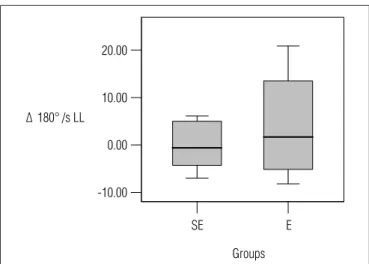
he diference between the pre- and post-intervention values of work adjusted by body weight at the angular veloci-ties of 60 and 180°/s was used to compare groups SE and E as
to strength. he data showed normality in the Shapiro-Wilk test (p>0.266). he comparison between groups showed no signiicant diference in any of the limbs at the velocities eval-uated (p>0.383; Figures 1-4). he mean diference between pre- and post-intervention, as well as the p values, is shown in Table 1.
Figure 1. Work/body weight at 60°/s, right-leg. Difference between SE
and E groups.
E SE
Groups 20.00
10.00
0.00
-10.00
-20.00
-30.00
-40.00 ∆ 60˚ /s RL
Figure 2. Work/body weight at 60°/s, left-leg. Difference between SE
and E groups.
E SE
Groups 20.00
10.00
0.00
-10.00 ∆ 60˚ /s LL
Figure 3. Work/body weight at 180°/s, right-leg. Difference between
SE and E groups.
E SE
Groups 20.00
10.00
0.00
-10.00 ∆ 180° /s RL
Figure 4. Work/body weight at 180°/s, left-leg. Difference between SE
and E groups.
E SE
Groups 20.00
10.00
0.00
-10.00 ∆ 180° /s LL
Table 1. Mean (SD) of pre- and post-intervention work/body weight at
60 and 180°/s, right-leg and left-leg, SE and E groups and significant
difference.
Group SE (n=5) E (n=7) P
60°/ s 180°/ s 60°/ s 180°/ s
Right leg 2.83
(±17.64)
2.16 (±7.29)
-4.53 (±21.11)
4.03 (±13.95)
p>0.528
Left leg 0.52
(±11.65)
-0.16 (±5.69)
1.64 (±8.33)
4.44 (±11.47)
p>0.383
SE=stretching + exercise group; E=exercise group.
Discussion
The present study aimed to determine whether there is a difference in knee-extensor strength in elderly women after a muscle strengthening program by comparing a group that performed static stretching exercises prior to the strength-ening exercises with another that did not perform static stretching. The results demonstrated no significant differ-ence in muscle strength between groups, considering the difference of the pre- and post-intervention values of work adjusted by body weight.
There are no studies in the literature with similar methodology to the one used in the present research, i.e. a comparison between a ten-week strengthening exercise program combined with stretching (SE) and the same pro-gram with no stretching (E) in elderly women. However, several authors who investigated the acute effect of stretch-ing on muscle strength, without a specific strengthenstretch-ing program, observed that stretching had an effect on muscle strength16-18,25,26.
Within this context, Cramer et al.16,17 observed a
de-crease in muscle strength and suggested two theories to explain this reduction induced by stretching. The first refers
to mechanical factors and the viscoelastic properties of muscles. In this case, the decrease in force induced by the stretching could be related to an increase in muscular com-pliance that would alter the length-tension relationship, which, in turn, would decrease the strength production due to the force-velocity relationship. The second theory, suggested by the authors, refers to neural factors that alter the strategies of motor control or reflex response16,17.
Cor-roborating this group, Fowles, Sale, and MacDougall18
veri-fied a reduction of 25% in the production of muscle strength after stretching of the plantar flexor muscles in humans and suggested that this change could be associated with both a decrease in muscle activation, through the neural compo-nents, and mechanical factors of the muscle tissue itself18.
These changes could be dependent on the duration of stretching21,22. Although these principles explain the change
in muscle strength, this condition was not observed in the present study, possibly because strength was not measured immediately after stretching and because there was no vari-ability in its duration. In that case, it can be supposed that the duration of stretching (20s) and its long-term effects were not enough to cause tissue changes that would influ-ence muscle strength.
Evetovich et al.25 and Marek et al.26 observed a decrease
in muscle strength after stretching exercises and related this phenomenon to less stiffness of the muscle-tendon unit, suggesting an interference in the ability to recruit mo-tor units. This hypothesis was based on the observation of a decrease in muscle activation and excitability, measured by the Hoffman reflex, during stretching. However, the au-thors emphasized that it is unclear how long the decrease in motor neuron excitability lasts after stretching, what kind of stretching protocol leads to this decrease, includ-ing the duration of stretchinclud-ing, and/or what the role of stretching-induced autogenic inhibition may be on muscle performance25,26. This assumption could explain the lack of
difference between groups in the present study, suggesting that there are different responses when assessing the acute effect of stretching and the cumulative effect of the inter-vention, as well as the variability in the duration of stretch-ing, which was not the object of this study.
The population investigated in the present study con-sisted of elderly women, with a mean age over 70 years. It is known that people over 60 years of age undergo significant physiological changes that affect the muscle tissue and the nervous system27-29. In relation to the connective tissue,
during the aging process there is non-specific binding me-diated by the condensation of a small sugar molecule with an amino group, resulting in an accumulation of advanced glycation end-products (AGEs) in the tendons, making
them more rigid. This condition, which occurs mainly after age 65, may have an impact on muscle strength genera-tion30. Thus, it can be supposed that stretching exercises
are beneficial and indicated for the elderly, possibly due to the improvement in flexibility, with a consequent impact on muscle strength. However, the fact that no difference was observed among the groups suggests that stretching exercises performed during 10 weeks were not enough to influence tissue changes.
Also during the aging process, changes occur in muscle spindle morphology, such as thickening of its capsule and loss of intrafusal fibers, which will contribute to reduce static and dynamic sensitivity, compromising function30.
Similarly, the Golgi tendon organ and other joint receptors will also show a decline, jeopardizing information31. Again,
it can be inferred that stretching should be indicated for elderly individuals, however it is still unclear what the most adequate volume and intensity are for the performance of stretching.
Shrier15, after a systematic review, proposed that there
are two effects of stretching: an acute effect and a chronic or long-term effect. According to the author, the acute effect of stretching was a reduction in muscle strength as previously reported16-18,25-27. In the long term, the author supports the
beneficial action of stretching, pointing to an improvement in muscle performance. This could be explained by the in-creased strength and speed of contraction observed in indi-viduals who followed stretching programs combined with strengthening exercises for a few months15. However, this
effect was not observed in the results of the present study, which suggests that stretching only three times a week for 10 weeks may not have been sufficient to produce such changes in the long term. Therefore, future studies with programs that vary in relation to weekly frequency, number of weeks, and duration of stretching must be carried out to determine the influence of these factors.
A possible limitation of the present study was the small number of participants who completed the intervention program. It should be considered that elderly people are usually susceptible to a greater number of health compli-cations, which should not be overlooked. However, social and family interaction should be encouraged as a means of personal involvement, filling the void left by retirement, seclusion, and/or widowhood32. Additionally, although the
sample was selected at random, the small number of par-ticipants limits the generalization of the results to other regions and social, economic, and cultural contexts. How-ever, as there are no studies with a similar program, the results allow statistical sample calculations to determine future studies with greater external validity. Also despite
the limitations of the study that do not allow the general-ization of results, in terms of clinical applicability, it can be supposed that a strengthening program of up to 10 weeks with stretching prior to resistance exercises can be indi-cated for elderly individuals as it will probably not interfere in muscle strength gain.
Conclusion
he results of this study demonstrated that, in the studied population, prior static stretching did not interfere in the gain in knee-extensor strength after the completion of a ten-week muscle strengthening program.
1. Duarte YAO. Indicadores de fragilização na velhice para o estabelecimento de medidas preventivas. A Terceira Idade SESCSP. 2007;18(38):7-24.
2. Grant S, Corbett K, Todd K, Davies C, Aitchison T, Mutrie N, et al. A comparison of physiological responses and rating of perceived exertion in two modes of aerobic exercise in men and women over 50 years of age. Br J Sports Med. 2002;36(4):276-81.
3. Reid KF, Naumova EN, Carabello RJ, Phillips EM, Fielding RA. Lower extremity muscle mass predicts functional performance in mobility-limited elders. J Nutr Health Aging. 2008;12(7):493-8.
4. Eyigor S, Karapolat H, Durmaz B. Effects of a group-based exercise program on the physical performance, muscle strength and quality of life in older women. Arch Gerontol Geriatr. 2007;45(3):259-71. Epub 2007 Feb 15.
5. Brach JS, Simonsick EM, Kritchevsky S, Yaffe K, Newman AB. The association between physical function and lifestyle activity and exercise in the health, aging and body composition study. J Am Geriatr Soc. 2004;52(4):505-9.
6. Sayer AA, Dennison EM, Syddall HE, Jameson K, Martin HJ, Cooper C. The developmental origins of sarcopenia: using peripheral quantitative computed tomography to assess muscle size in older people. J Gerontol A Biol Sci Med Sci. 2008;63(8):835-40.
7. Puthoff ML, Nielsen DH. Relationships among impairments in lower-extremity strength and power, functional limitations, and disability in older adults. Phys Ther. 2007;87(10):1334-47.
8. Buckwalter JA, Woo SL, Goldberg VM, Hadley EC, Booth F, Oegema TR, et al. Soft-tissue aging and musculoskeletal function. J Bone Joint Surg Am. 1993;75(10):1533-48.
9. Feland JB, Myrer JW, Schulthies SS, Fellingham GW, Measom GW. The effect of duration of stretching of the hamstring muscle group for increasing range of motion in people aged 65 years or older. Phys Ther. 2001;81(5):1110-7.
10. Baker MK, Atlantis E, Fiatarone Singh MA. Multi-modal exercise programs for older adults. Age Ageing 2007;36(4):375-81. Epub 2007 May 30.
11. White SM, Wójcicki TR, McAuley E. Physical activity and quality of life in community dwelling older adults. Health Qual Life Outcomes. 2009;7:1-7.
12. Nelson ME, Rejeski WJ, Blair SN, Duncan PW, Judge JO, King AC, et al. Physical activity and public health in older adults: recommendation from the American College of Sports Medicine and the American Heart Association. Circulation. 2007;116(9):1094-105. Epub 2007 Aug 1.
13. Cress ME, Buchner DM, Prohaska T, Rimmer J, Brown M, Macera C, et al. Best practices statement: physical activity programs and behavior counseling in older adult populations. Med Sci Sports Exerc. 2004;36(11):1997-2003.
14. Thacker SB, Gilchrist J, Stroup DF, Kimsey CD Jr. The impact of stretching on sports injury risk: a systematic review of the literature. Med Sci Sports Exerc. 2004;36(3):371-8.
15. Shrier I. Does stretching improve performance? A systematic and critical review of the literature. Clin J Sport Med. 2004;14(5):267-73.
16. Cramer JT, Housh TJ, Johnson GO, Miller JM, Coburn JW, Beck TW. Acute effects of static stretching on peak torque in women. J Strength Cond Res. 2004;18(2):236-41.
17. Cramer JT, Beck TW, Housh TJ, Massey LL, Marek SM, Danglemeier S, et al. Acute effects of static stretching on characteristics of the isokinetic angle – torque relationship, surface electromyography, and mechanomyography. J Sports Sci. 2007;25(6):687-98.
18. Fowles JR, Sale DG, MacDougall JD. Reduced strength after passive stretch of the human plantarflexors. J Appl Physiol. 2000;89(3):1179-88.
19. Bertolucci PHF, Brucki SMD, Campacci SR, Juliano Y. Mini exame do estado mental em uma população geral. Impacto da escolaridade. Arq Neuropsiquiatr. 1994;52:1-7.
20. Oliveira DMG. Índices plasmáticos de interleucina-6, força muscular e capacidade funcional em idosas da comunidade [dissertação]. Belo Horizonte (MG): UFMG; 2006.
21. Chagas MH, Bhering EL, Bergamini JC, Menzel HJ. Comparação de duas diferentes intensidades de alongamento na amplitude de movimento. Rer Bras Med Esporte. 2008;14(2): 99-103.
22. Zakas A, Balaska P, Grammatikopoulou MG, Zakas N, Vergou A. Acute effects of stretching duration on the range of motion of elderly women. J Bodyw Mov Ther. 2005;9(4):270-6.
23. Brown LE, Weir JP. ASEP procedures recommendation I: accurate assessment of muscular strength and power. J Exerc Physiol online. 2001;4(3):1-21.
24. Kryger AI, Andersen JL. Resistance training in the oldest old: consequences for muscle strength, fiber types, fiber size, and MHC isoforms. Scand J Med Sci Sports. 2007;17(4):422-30. Epub 2007 May 9.
25. Evetovich TK, Nauman NJ, Conley DS, Todd JB. Effect of static stretching of the biceps brachii on torque, electromyography, and mechanomyography during concentric isokinetic muscle actions. J Strength Cond Res. 2003;17(3):484-8.
26. Marek SM, Cramer JT, Fincher AL, Massey LL, Dangelmaier SM, Purkayastha S, et al. Acute effects of static and proprioceptive neuromuscular facilitation stretching on muscle strength and power output. J Athl Train. 2005;40(4):94-103.
27. Degens H. Age-related skeletal muscle dysfunction: causes and mechanisms. J Musculoskelet Neuronal Interact. 2007;7(3):246-52.
28. Forrest KYZ, Zmuda JM, Cauley JA. Correlates of decline in lower extremity performance in older women: a 10-year follow-up study. J Gerontol A Biol Sci Med Sci. 2006;61(11): 1194-200.
29. Martel GF, Roth SM, Ivey FM, Lemmer JT, Tracy BL, Hurlbut DE, et al. Age and sex affect human muscle fiber adaptations to heavy-resistance strength training. Exp Physiol. 2006;91: 457-64.
30. Kjaer M. Role of extracellular matrix in adaptation of tendon and skeletal muscle to mechanical loading. Physiol Rev. 2004;84(2):649-98.
31. Shaffer SW, Harrison AL. Aging of the somatosensory system: a translational perspective. Phys Ther. 2007;87(2):193-207. Epub 2007 Jan 23.
32. Souza LM, Morais EP, Barth QCM. Características demográficas, socioeconômicas e situação de saúde de idosos de um programa de saúde da família de Porto Alegre, Brasil. Rev Latinoam Enferm. 2006;14(6):79-85.
502