JSCS–4360 547.269.3–165:54–77
Original scientific paper
Cobalt(II) and cadmium(II) compounds with
adamantane-1-sulfonic acid
MILENA ĐORĐEVIĆ1, DEJAN JEREMIĆ1#, KATARINA ANĐELKOVIĆ1*#,
MAJA GRUDEN-PAVLOVIĆ1, VLADIMIR DIVJAKOVIĆ2,
MAJA ŠUMAR RISTOVIĆ1# AND ILIJA BRČESKI1#
1Faculty of Chemistry, University of Belgrade, Studentski trg 12–16, 11000 Belgrade, Serbia
and 2Faculty of Sciences, University of Novi Sad, Trg D. Obradovića 4,
21000 Novi Sad, Serbia
(Received 12 April, revised 11 May 2012)
Abstract: In this work, the syntheses and characterization of two novel
com-pounds of adamantane-1-sulfonic acid (1-AdSO3H) with cobalt(II) and
cad-mium(II) are reported. The results of single crystal X-ray analysis of the compounds revealed that adamantane-1-sulfonate (1-AdSO3-) in the
monoan-ionic form plays different roles in the investigated compounds. Namely, while in compound [Co(H2O)6](1-AdSO3)2, six water molecules are coordinated to
the cobalt(II) ion and 1-AdSO3- serves as a counter ion, in compound
[Cd(H2O)4(1-AdSO3)2], two molecules of 1-AdSO3- are trans-coordinated to
the cadmium(II) ion as a monodentate (O)-ligand and the other coordination sites are occupied by water molecules. The obtained compounds showed moderate activity against Artemia salina.
Keywords: X-ray structure determination; transition metal compounds; metal
complexes; adamantane-1-sulfonate derivatives.
INTRODUCTION
Selective and efficient activation of C–H bonds in aliphatic hydrocarbons is
one of the major challenges in chemistry and is the subject of extensive
re-search.
1Nevertheless, sulfoxidation of saturated hydrocarbons, as well as their
possible application, has seen much slower progress, although the resulting
pro-ducts are stable compounds, suitable to serve as ligands and to form a
coordi-nation bond
via
oxygen.
As a part of on-going efforts to investigate the coordination behavior of
al-kane sulfonates,
2,3two novel compounds of 1-AdSO
3H with cobalt(II) (
1
) and
cadmium(II) (
2
) are presented in this work.
* Corresponding author. E-mail: [email protected]
# Serbian Chemical Society member.
Adamantane and its derivatives have gained much attention in the recent
years, due to their significant biological activity.
4Coordination compounds of
1-adamantane derivatives are known only for the amino (–NH
2),
5,6and mercapto-
(–SH) derivatives.
7,8It is noteworthy that information about compounds of 1-
-AdSO
3H with metal ions, both salts and coordination compounds, are very sparse.
9Therefore, to the best of our knowledge and according to the Cambridge
Struc-tural Database (CSD), herein the first crystal structures of any of the compounds
of 1-AdSO
3H are presented. Evaluation of the biological activity of the
synthe-sized compounds also formed part of this study.
EXPERIMENTAL
General procedures
For the synthesis of 1-AdSO3H, the method of sulfoxidation of alkane using an SO2/O2
mixture in the presence of a catalytic amount of vanadium(IV) species [VO(acac)2] was
employed.10 This method was modified. Hence, unlike the original procedure, the gas was
continuously blown through the mixture. Yield: 64 %.
1-AdSO3H·H2O (1.0 g, 4.2 mmol) was dissolved in methanol of technical purity. Into the
clear solution of 1-AdSO3H, cobalt(II) acetylacetonate (0.64 g, 2.5 mmol) was added. The obtained suspension was digested for 10 min on an ultrasonic bath at 20 °C. The reaction mixture was filtered and the filtrate was left for 7 days to crystallize at room temperature. The obtained brick-red crystals of the cobalt(II) complex had grown to a size of 5 mm and were suitable for crystallographic analyses. Yield of complex 1: 58 %.
The cadmium(II) complex was prepared by the same procedure except cadmium(II) acetylacetonate (3) (0.78 g, 2.5 mmol) was added into the clear solution of 1-AdSO3H. After 7
days of crystallization at room temperature, the obtained colorless crystals of the cadmium(II) complex had grown to a size of 1 mm and were suitable for crystallographic analyses. Yield of complex 2: 57 %.
Elemental analyses (C and H) were performed by standard micro-methods using an ELEMENTARVario ELIII C.H.N.S O analyzer.
X-ray crystallography
The selected single crystals of the title compounds 1 and 2 were glued onto glass threads. The diffraction data were collected on an Oxford Diffraction KM4 four-circle goniometer equipped with Sapphire CCD detector. The crystal to detector distance in both cases was 45.0 mm and graphite monochromated MoKα ( = 0.71073 Å) X-radiation was employed in the measurements. A frame width of 1° in ω, for 21.7 and 20.3 s, was used to acquire each frame for 1 and 2, respectively. More than a hemisphere of three-dimensional data was collected in all measurements. The data were reduced using the Oxford Diffraction Program CrysAlisPro.11
A semi-empirical absorption correction based upon the intensities of equivalent reflections was applied, and the data were corrected for Lorentz, polarization, and background effects. The scattering curves for neutral atoms, together with anomalous-dispersion corrections, were taken from International Tables for X-ray Crystallography.12 The structures were solved by
direct methods,13 and the figures were drawn using Mercury.14 The refinements were based on
the F2 values and performed by full-matrix least-squares15 with all non-H atoms anisotropic.
atoms were found from the inspection of the difference Fourier maps. The final refinement included atomic positional and displacement parameters for all non-H atoms.
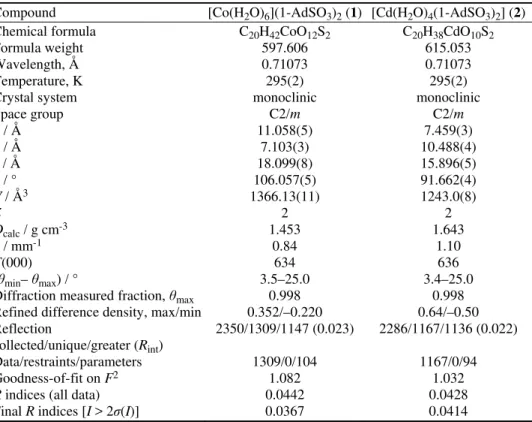
The non-H atoms were refined anisotropically, while H sites of the water molecules were refined with isotropic displacement parameters. However, at the final stage of the refinement, H atoms belonging to the corresponding ligand were positioned geometrically (C−H, 0.97– –0.98 Å) and refined using a riding model with fixed isotropic displacement parameters. The crystal data and refinement parameters are listed in Table I.
TABLE I. Crystal data and structure refinement for the obtained compounds
Compound [Co(H2O)6](1-AdSO3)2 (1) [Cd(H2O)4(1-AdSO3)2] (2)
Chemical formula C20H42CoO12S2 C20H38CdO10S2
Formula weight 597.606 615.053
Wavelength, Å 0.71073 0.71073
Temperature, K 295(2) 295(2)
Crystal system monoclinic monoclinic
Space group C2/m C2/m
a / Å 11.058(5) 7.459(3)
b / Å 7.103(3) 10.488(4)
c / Å 18.099(8) 15.896(5)
β / ° 106.057(5) 91.662(4)
V / Å3 1366.13(11) 1243.0(8)
Z 2 2
Dcalc / g cm-3 1.453 1.643
/ mm-1 0.84 1.10
F(000) 634 636
(θmin–θmax) / ° 3.5–25.0 3.4–25.0
Diffraction measured fraction, θmax 0.998 0.998
Refined difference density, max/min 0.352/–0.220 0.64/–0.50 Reflection
collected/unique/greater (Rint)
2350/1309/1147 (0.023) 2286/1167/1136 (0.022)
Data/restraints/parameters 1309/0/104 1167/0/94
Goodness-of-fit on F2 1.082 1.032
R indices (all data) 0.0442 0.0428
Final R indices [I > 2σ(I)] 0.0367 0.0414
CCDC-844771 (2) and CCDC-844772 (1) contain the supplementary crystallographic data for this paper. These data can be obtained free of charge from The Cambridge Crys-tallographic Data Centre via www.ccdc.cam.ac.uk/data_request/cif.
Biological activity evaluation – the brine shrimp test
A teaspoon of lyophilized eggs of the brine shrimp Artemia salina was added to 1 L of
artificial sea water containing several drops of yeast suspension (3 mg of dry yeast in 5 mL distilled water), and air was passed through the suspension thermostated at 28 °C, under illumination for 24 h. Complex 2 and Cd(acac)2 (3)were dissolved in DMSO. Since complex
three determinations were performed. The vials were left at room temperature under illu-mination for 24 h, and afterwards the surviving nauplii were counted. The lethal concentration 50 (LC50) was defined as the concentration of a substance that causes the death of 50 % of the
nauplii. DMSO was inactive under the applied conditions. RESULTS AND DISCUSSION
According to the procedure described in experimental section, 1-AdSO
3H as
well as its derivates with cobalt(II)
1
and cadmium(II)
2
were synthesized
(Scheme 1) and characterized.
Scheme 1. Reaction of 1-AdSO3H with the starting Co(II) and Cd(II) compounds.
1-AdSO
3H
. Anal. Calcd. for C
10H
16O
3S: C, 55.56; H, 7.41 %. Found: C,
56.58; H, 7.39 %.
Cobalt complex
1
. Anal. Calcd. for C
20H
42CoO
12S
2: C, 40.20; H, 7.04 %.
Found: C, 40.24; H, 7.01 %.
Cadmium complex
2
. Anal. Calcd. for C
20H
38CdO
10S
2: C, 39.06; H, 6.18 %.
Found: C, 39.10; H, 6.12 %.
X-ray analysis
The results of the single crystal X-ray analysis revealed that the structural
units of
1
are [Co(H
2O)
6]
2+and 1-AdSO
3–additionally connected by strong
hyd-rogen bonds, while the structural units of
2
are neutral [Cd(H
2O)
4(1-AdSO
3)
2]
complex molecules mutually well separated, in which two 1-AdSO
3–coordinate
as monodentate (O)-ligands in the
trans
position. The structural units in
1
and
2
are involved in the formation of 2D networks of hydrogen bonds. In both
com-pounds, the central ions are in a slightly distorted octahedral environment,
con-sisting of six O-atoms of water molecules in
1
,
or four O-atoms of water
molecu-les and two O-atoms of sulfonate fragments in
2
. Structural units in both
com-pounds exhibit a high degree of internal symmetry, as the majority of atoms that
build up the 1-AdSO
3–in
1
and
2
occupy a special position 4
i
(
m
), while the
cen-tral ions are placed in positions 2
b
and 2
d (
2/
m)
of the
C
2/
m
space group,
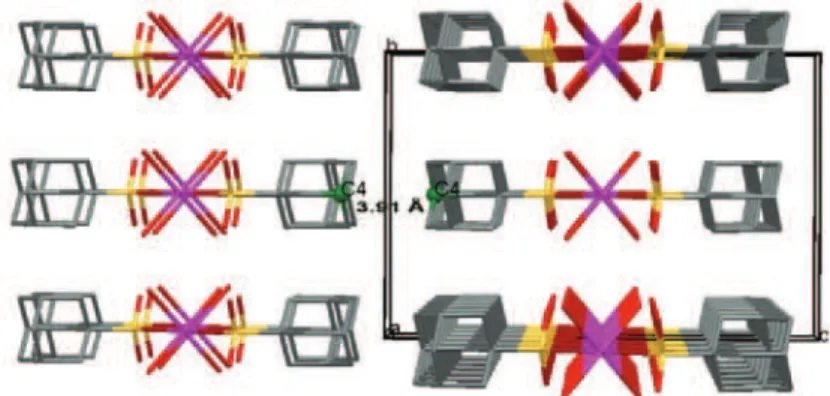
the sulfonate fragment, building a 2D network of hydrogen bonds both along the
a
and
b
axes. As a result, along the
c
axis, “sandwiches” of thickness less than
the size of axis
c
can be distinguished (Figs. 3 and 4). These “sandwiches” are on
both outer sides covered with Ad-fragments, on which proper SO
3groups are
at-tached and oriented towards the core of the “sandwich”. The core consists of
me-tal ions that are in
1
coordinated with six H
2O molecules, whereas in
2
the metal
ions are coordinated with two O atoms from monodentate AdSO
3ligands in the
apical positions and four H
2O molecules in the equatorial plane. The distances
between the “sandwiches” correspond to the C–C van der Waals contacts between
the opposing Ad-fragments.
Fig. 1. Hexaaquacobalt(II)adamantane-1-sulfonate (1).
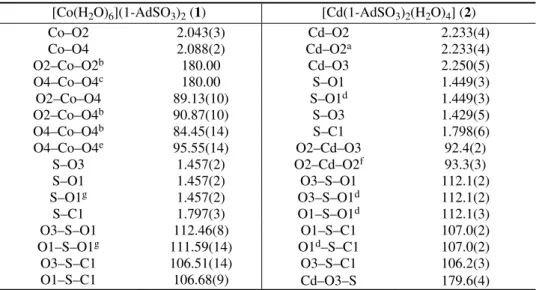
TABLE II. Selected bond lengths, Å, and angles, °, for complexes 1 and 2
[Co(H2O)6](1-AdSO3)2 (1) [Cd(1-AdSO3)2(H2O)4] (2)
Co–O2 2.043(3) Cd–O2 2.233(4)
Co–O4 2.088(2) Cd–O2a 2.233(4)
O2–Co–O2b 180.00 Cd–O3 2.250(5)
O4–Co–O4c 180.00 S–O1 1.449(3)
O2–Co–O4 89.13(10) S–O1d 1.449(3)
O2–Co–O4b 90.87(10) S–O3 1.429(5)
O4–Co–O4b 84.45(14) S–C1 1.798(6)
O4–Co–O4e 95.55(14) O2–Cd–O3 92.4(2)
S–O3 1.457(2) O2–Cd–O2f 93.3(3)
S–O1 1.457(2) O3–S–O1 112.1(2)
S–O1g 1.457(2) O3–S–O1d 112.1(2)
S–C1 1.797(3) O1–S–O1d 112.1(3)
O3–S–O1 112.46(8) O1–S–C1 107.0(2)
O1–S–O1g 111.59(14) O1d–S–C1 107.0(2)
O3–S–C1 106.51(14) O3–S–C1 106.2(3) O1–S–C1 106.68(9) Cd–O3–S 179.6(4) a–
x+1, y, –z+1; b–x+1, y, –z; c–x+1, –y+2,–z; dx,–y, z;ex, –y+2, z; f–x+1, y, –z+1; gx, –y+1, z
TABLE III. Hydrogen bonding in complexes 1 and 2
Bond D–H, Å H⋅⋅⋅A, Å D⋅⋅⋅A, Å D–H–A, ° Symmetry operation
1
O4–HA…O3 0.74(3) 2.04(3) 2.770(3) 171(3) (–x+1, –y+1, –z)
O4–HB…O1 0.78(3) 2.05(3) 2.815(3) 170(3) (–x+1/2, y+1/2, –z)
O2–HC…O1 0.76(3) 1.99(3) 2.742(3) 167(3) (x, y+1, z)
2
O2–H1…O1 0.73(6) 2.08(6) 2.802(6) 167(6) (x–1/2, y–1/2, z)
O2–H2…O1 0.82(6) 1.92(6) 2.739(6) 176(6) (x–1, –y, z)
Fig. 4. Packing of the coordination units in 2 along the axis a.
Biological activity
In the
A. salina
test, which shows a good correlation with cytotoxic
acti-vity,
16all the substances had
LC
50values in either the millimolar range or high
micromolar range (Table IV). The
tetraaquabis(adamantane-1-sulfonato)cad-mium(II) complex (
2
) was more active than the starting Cd(II) compound
3
,
pro-bably due to its higher lipophilicity.
TABLE IV. Toxic effect (expressed as LC50 values) of the investigated compounds against A. salina
Compound LC50 / mM
[Co(H2O)6](1-AdSO3)2 (1) 3.05
[Cd(H2O)4(1-AdSO3)2] (2) 0.74
Cd(acac)2 (3) 3.03
CONCLUSIONS
In this work, the first crystal structures of inorganic compounds of 1-AdSO
3H
were reported. While in compound [Co(H
2O)
6](1-AdSO
3)
2, six water molecules
are coordinated to the cobalt(II) ion and 1-AdSO
3–serves as a counter ion, in the
[Cd(H
2O)
4(1-AdSO
3)
2] compound, 1-AdSO
3–acts as monodentate ligand and
coordinates to the cadmium(II) ion through the oxygen atom in a monoanionic
form. The phenomenon that 1-AdSO
3–accomplished coordination with the Cd(II)
ion but not with Co(II) can perhaps be explained by hard–soft-acid–base
prin-ciple.
17–19In fact, it is more likely that the soft cadmium can make a
coordi-nation bond with a relatively soft alkane sulfonate group (much softer than the
sulfate group), as opposed to the harder cobalt. Rigidity and hydrophobicity of
the adamantane residue proved to be a difficulty in further attempts to synthesize
adamantane-1-sulfonate compounds. The obtained compounds were tested against
Acknowledgement. The authors are grateful to the Ministry of Education, Science and
Technological Development of the Republic of Serbia for financial support (Project No. 172017).
И З В О Д
НОВАЈЕДИЊЕЊАКОБАЛТА(II) ИКАДМИЈУМА(II) СА
АДАМАНТАН-1-СУЛФОНСКОМКИСЕЛИНОМ
МИЛЕНАЂОРЂЕВИЋ1
, ДЕЈАНЈЕРЕМИЋ1
, КАТАРИНААНЂЕЛКОВИЋ1
, МАЈАГРУДЕН-ПАВЛОВИЋ1
,
ВЛАДИМИРДИВЈАКОВИЋ2
, МАЈАШУМАРРИСТОВИЋ1
иИЛИЈАБРЧЕСКИ1
1Хемијскифакултет, УниверзитетуБеограду, Студентскитрг 12–16, 11000 Београди2Природно
-математичкифакултет, УниверзитетуНовомСаду, ТргД. Обрадовића 4, 21000 НовиСад
Уовомрадуприказанајесинтезаикарактеризацијадвановаједињењаадамантан- -1-сулфонскекиселине (1-AdSO3H) сакобалтом(II) икадмијумом(II). Резултатиренд
-генскеструктурнеанализедатихједињењауказујудамоноанјонадамантан-1-сулфоната (1-AdSO3показујеразличит афинитетпрема Co(II) и Cd(II) јонима). У комплексу [Co(H2O)6](1-AdSO3)2, шестмолекулаводесекоординујеза Co(II) јон, док 1-AdSO3има
улогуконтрајона. Укомплексу [Cd(H2O)4(1-AdSO3)2] двајона 1-AdSO3сукоординована
за Cd(II) јонкаомонодентатиуtransположајупрекокисеониковихатома, доксуостала
координационаместазаузетамолекулимаводе. Добијенаједињењасупоказалаумерену активностнаArtemia salina.
(Примљенo 12. априла, ревидирано 11. маја 2012)
REFERENCES
1. F. Parrino, A. Ramakrishnan, H. Kisch, Angew. Chem. Int. Ed.47 (2008) 7107
2. D. A. Jeremić, G. N. Kaluđerović, S. Gómez-Ruiz, I. D. Brčeski, B. Kasalica, V. M. Leovac, Cryst. Growth Des.10 (2010) 559
3. D. A. Jeremić, G. N. Kaluđerović, S. Gómez-Ruiz, I. D. Brčeski, K. Andelković, Acta Crystalogr. C65 (2009) m143
4. A. Kozubík, A. Vaculová, K. Souček, J. Vondráček, J. Turánek, J. Hofmanová, Met.-Based Drugs2008(2008) 417897
5. F. D. Rochon, M. Doyon, I. S. Butler, Inorg. Chem.32 (1993) 2717
6. M. Westerhausen, T. Bollwein, A. Pfitzner, T. Nilges, H. J. Deiseroth, Inorg. Chim. Acta
312 (2001) 239
7. A. P. Purdy, A. D. Berry, C. F. George, Inorg. Chem.36 (1997) 3370
8. Y. Matsunaga, K. Fujisawa, N. Ibi, M. Fujita, T. Ohashi, N. Amir, Y. Miyashita, K. Aika, Y. Izumi, K. Okamoto, J. Inorg. Biochem.100 (2006) 239
9. I. Hitoshi, Y. Hiroshi, E. Hiroyuki, S. Masaharu, A. Kimisuke, (Nippon Electric Co, Jpn. Kokai Tokkyo Koho), JKXXAF JP 07070312 A 19950314 (1995)
10. Y. Ishii, K. Matsunaka, S. Sakaguchi, J. Am. Chem. Soc.122 (2000) 7390
11. CrysAlis CCD and CrysAlis RED software (Version 1.171), Oxford Diffraction, Yarnton, Oxfordshire, UK, 2000
12. J. A. Ibers, W. C. Hammilton, Eds., International tables for X-ray crystallography,vol. 4,
Kynoch, Birmingham, UK, 1974
Crys-tal Structures, Istituto di Ricerca per lo Sviluppo di Metodologie Crystallografiche CNR,
Bari,1997
14. I. J. Bruno, J. C. Cole, P. R. Edgington, M. K. Kessler, C. F. Macrae, P. McCabe, J. Pearson, R. Taylor, Acta Crystallogr., Sect. B 58 (2002) 389
15. G. M. Sheldrick, Acta Crystallogr., Sect. A64 (2008) 112
16. B.N. Meyer, N.R. Ferrigni, J.E. Putnam, L.B. Jacobsen, D.E. Nichols, J.L. McLaughlin,
Planta Med.45 (1982) 31