ORIGINAL RESEARCH PAPER
EFFECTS OF ULTRASOUND ASSISTED THAWING ON MICROBIOLOGICAL, CHEMICAL AND TECHNOLOGICAL
PROPERTIES OF UNPACKAGED PORK LONGISSIMUS DORSI
CORINA GAMBUTEANUa*, PETRU ALEXEa
a Faculty of Food Science and Engineering, Dunărea de Jos University of Galati, 111, Domnească Street, 800201, Romania.
*Corresponding author: [email protected]
Received on 7th August 2013 Revised on 9 th September 2013
A comparison between the physical, chemical, microbiological and technological properties of unpackaged pork Longissimus dorsi thawed at low ultrasound intensities and the properties of pork thawed by immersion in water (control) was carried out. Concurrently, the microbiological aspects of thawed meat were analysed. Ultrasound thawing was done at a constant frequency of 25 kHz and at low ultrasound intensities of 0.2W/cm2 and 0.4W/cm2. Results show that after ultrasound thawing there are no significant chemical, microbiological and textural differences between the meat thawed by immersion in water and the meat thawed by ultrasound.
Keywords:ultrasound, thawing,pork, total loss, firmness
Introduction
Recent studies have shown the influence of the thawing regime on the sensorial and technological properties of meat. Consequently, researchers have been concerned with finding alternative thawing technologies by means of high pressure (Cheftel et al., 2000), microwaves (Kondratowicz et al., 2008), ohmic (Icier et al., 2010) or ultrasound (Kisam, 1984; Miles et al., 1999) procedures. Thawing can be faster by generating heat within the product in case of dielectric thawing or by use of microwaves. Anyway, there are still limitations in regard to parameters selection as rapid and preferential heating of product surface may occur (Chemat et al., 2011). The use of ultrasound in liquid medium is advantageous in terms of attenuating ultrasound energy, unlike the use of ultrasound directly on meat sample in which case surface heating occurs.
thawing and low frequencies in order to minimise the quantity of hydroxyl radicals in sonicated water (Ashokkumar et al., 2008).
Therefore, the main purpose of the present study was to analyse whether there is a significant difference between the chemical composition and textural properties of the unpackaged pork thawed by low intensity ultrasound and the properties of pork thawed by immersion in water, as well as whether there are any influences of thawing treatment on microbiological count.
Materials and methods Preparation of samples
In this experiment were used 8 pieces of Longissimus dorsi cut from pork carcasses of the same weight which had been stored for 24 hours at 4°C after slaughtering, then being taken from a slaughter house near Galati to the meat pilot station at “Dunarea de Jos” University in Galați, Romania. Each sample of Longissimus dorsi was cut into pieces of the same size (120 X 60 X 35 mm) and weight (about 160g). Each sample was wrapped with polyethylene film and then frozen for 24 hours at 18°C in a freezer (Electrolux), until the meat reached the temperature of -15°C at the core. The samples were then subjected to a conventional thawing by water immersion (control) and also to ultrasound-assisted thawing at intensities of 0.2W/cm2, 0.4W/cm2. The samples were unwrapped before thawing. The experiment was performed in duplicate and each measurement was carried out in triplicate.
Meat thawing
For ultrasound assisted thawing a special piece of equipment was used. It consists of an ultrasound generator, a transducer and a water bath. The ultrasound is transmitted through the liquid medium from the generator (Clangsonic), by means of the plate transducer located above the water bath. As plate transducers are mounted on the bath they allow for saving space and uniform spread of ultrasound, thus securing even thawing of the entire meat sample. The ultrasound used in our experiment was of constant frequency (25 kHz), the variable parameter being the intensity applied, in this case of 0.2W/cm2 and 0.4W/cm2. The initial temperature of water in the bath was 15°C while thawing lasted up to 2°C at sample core. The temperature at core sample was monitored with a Sika Electronics thermocouple. The control samples were thawed by immersion in water at 15°C. Before thawing, the samples were taken out of polyethylene film.
Chemical Analysis
The chemical analysis of the meat was carried out by the following methods: (1) the content of proteins was determined according to the method by Kjeldahl (STAS 9064/4-81).
(2) the content of fat was determined according to the method by Soxhlet (STAS 9065/10-75)
(3) the content of moisture was determined by rapid drying sample with thermobalance (Precisa XM60).
(4) the content of ash was determined by subjecting samples to a temperature of +600°C in a muffle furnace (Laboratory Furnace LMH07/12).
pH value
A ten-gram minced sample was blended with 100 ml distilled water. The pH was measured in duplicate by means of a Methrom pH meter.
Expressible moisture (EM)
The expressible moisture was determined by centrifugal method described by Fernandez et al. (2007). Briefly, three meat discs of known weight were placed on filter paper in 250 ml tubes and centrifuged for 20 min at 3500rot/min and 4°C using the refrigerated Centrifuge TGL-16M. Discs were then reweighted (once filter paper dried) and the expressible moisture was calculated as percentage of humidity lost from the initial weight of the sample after centrifugation:
EM = (EM0-EM1)100/EM0 where EM0 is the weight of sample before centrifugation, and EM1 is the weight of sample after centrifugation.
Total loss
The samples were weighed after freezing (W0) and then the samples were subjected to a conventional thawing and also to ultrasound assisted thawing. After thawing, the samples packed individually in plastic bags and thermally treated by immersion in water bath at 85°C until the temperature of the inner sample reached 70°C. A thermometer inserted into sample core monitored meat temperature. After boiling, the samples were cooled in tap water jet for 30 min, dried by paper dabbing and weighed (W1). The total loss were calculated according to the following equations: Total loss (%) = (W0-W1)100/W0
where W0 is the weight of frozen meat, and W1 is the weight of boiled meat.
Firmness measurement
and cooling of samples. The measurements were repeated 8 times on two opposite sides, the result being the arithmetic mean of all determinations.
Lipid oxidation (TBARS)
The distillation TBARS method was performed as described by Tarladgis et al. (1960). The minced meat sample (10 g) was transferred to a Kjeldahl flask and homogenized with 97.5 ml of distillated water and 2.5 ml of 4 N HCl. This sample was then distilled and the first 50 ml of distillate collected. Next, 5 ml of the distillate were added to 5 ml of 0.02 M thiobarbituric acid and heated in a boiling water bath for 35 minutes for colour development. The absorbance was determined at 532 nm. The TBARS were calculated from a standard curve of malonaldehyde and expressed as mg MDA/Kg of meat sample.
Microbiological methods
Ten-gram of thawed meat samples were prepared under sterile conditions and homogenized with 90 mL sterilized water for 2 min. Subsequently, aliquots of 1 ml of each dilution were placed on a plate of Plate Count Agar, PCA in triplicate and incubated at 37 °C for 48 h. Total aerobic counts were reported as cfu/g.
Statistical analysis
The statistical analysis of results was operated by means of Anova Single Factor. Analysis of variance was done to determine the significance of the main effects. The results are displayed as average values together with standard deviations.
Results and discussion Thawing time
The time required for thawing the meat samples from -15°C to 2°C was measured. The results indicate that the ultrasound assisted thawing occurred within a shorter interval than thawing by immersion in water (2 times shorter). Furthermore, as regards stimulating thermal transfer at phase change (from -5°C to -1°C), the time was reduced 2.5 times in the case of ultrasound assisted thawing at 0.2W/cm2, respectively 3.3 times at 0.4W/cm2 compared to the immersion in water (control). (Gambuteanu and Alexe, Comparison of thawing assisted by low-intensity ultrasound on technological properties of pork Longissimus dorsi muscle, unpublished).
Chemical Analysis
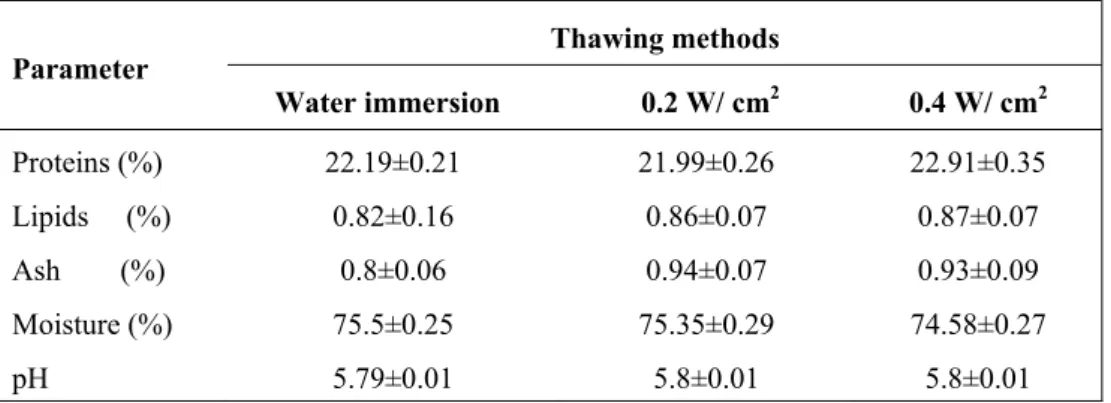
obtained by Kissam (1984) who thawed fish blocks by 1.5 kHz frequency and 60W power ultrasound and who did not record any chemical and sensorial changes between the fish thawed in water and the fish thawed by ultrasound. Therefore, the results showed that compared to thawing by water, ultrasound thawing does not change significantly the chemical composition of the meat.
Table 1. Influence of thawing treatment on proteins, lipids, ash, moisture and pH
Thawing methods Parameter
Water immersion 0.2 W/ cm2 0.4 W/ cm2
Proteins (%) 22.19±0.21 21.99±0.26 22.91±0.35
Lipids (%) 0.82±0.16 0.86±0.07 0.87±0.07
Ash (%) 0.8±0.06 0.94±0.07 0.93±0.09
Moisture (%) 75.5±0.25 75.35±0.29 74.58±0.27
pH 5.79±0.01 5.8±0.01 5.8±0.01
Mean values are presented together with standard deviation
pH measurement
As Table 1 shows, there are no significant differences between control and ultrasound thawed samples. As experiments conducted by Dolatowski et al. (2000); Dolatowski et al. (2007); Stadnik et al. (2008) show ultrasound treatment did not change this parameter.
Expressible moisture
Figure 1 shows that expressible moisture is not influenced by ultrasound low intensity. These results are correlated with those obtained after the chemical analysis of the meat thawed by ultrasounds when the moisture values were not changed no matter the intensity of the ultrasound used. This result could be a consequence of the fact that the ultrasound did not cause any alterations of the meat structure during thawing and the water released in centrifugation did not differ significantly in any of the two thawing cases. Therefore, one can consider that water migration mechanism as a result of the changes in meat ultrastructures following the ultrasound treatment remains unchanged.
Total loss
ultrasounds. Previous experiments which analysed total loss in sonicated beef obtained similar results regardless of the way of applying the ultrasound or the intensity used. Hence, Pohlman et al. (1997a), who used a low ultrasound bath (1.55W/cm2), did not notice any total loss changes between the sonicated samples and the control ones, regardless of the sonication time applied to the beef (8-24 min). Similar results were also obtained by Pohlman et al. (1997b) even if high ultrasound intensity was used (22W/cm2) and the ultrasound treatment was applied in a cool ultrasonic chamber. Moreover, these results are consistent with those related to expressible moisture, which suggest that the protein structure level did not record any changes after ultrasound thawing in comparison with thawing in water. Likewise, the fact that no changes of total loss, which also includes cooking loss, were recorded between the two types of thawing (conventional and ultrasound) can mean that no protein degradation occurred, protein degradation which could have caused the meat to lose its ability to retain water, as Shanks et al. (2002) have showed.
0 5 10 15 20 25
1 2 3
Thaw ing type
E
xp
res
si
b
le m
o
ist
u
re
(
%
)
Figure1. Expressible moisture depending on thawing type: 1) thawing control; 2) thawing at 0.2 W/ cm2; 3) thawing at 0.4 W/ cm2
Firmness measurement
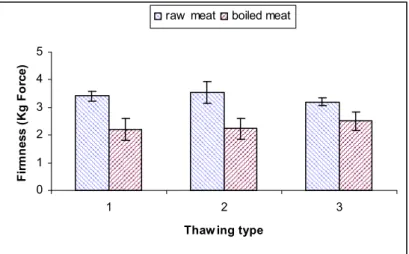
72h after slaughtering but not for those at 24h after slaughtering. No significant differences in terms of firmness were noticed in the case of cooked
meat regardless of the thawing method (ultrasound or conventional). These results are consistent with other scientific results published so far which show no improvement of meat texture after ultrasound treatment no matter the ultrasound parameters or the way it was applied (Pohlman et al., 1997a; Pohlman et al., 1997b), but are inconsistent with those scientific results which show the improvement of meat texture (Smith et al., 1991; Jayasooriya et al., 2007).
0 5 10 15 20 25 30
1 2 3
Thaw ing type
T
o
ta
l lo
ss
(%
)
Figure 2. Total loss depending on thawing type: 1- control; 2 - thawing at 0.2 W/ cm2; 3 - thawing at 0.4 W/ cm2
Figure 3. Firmness depending on thawing type: 1- control; 2 - thawing at 0.2 W/ cm2; 3- thawing at 0.4 W/ cm2
0 1 2 3 4 5
1 2 3
Thaw ing type
Fi
rm
ne
s
s
(
K
g
F
or
c
e
)
Lipid oxidation (TBARS)
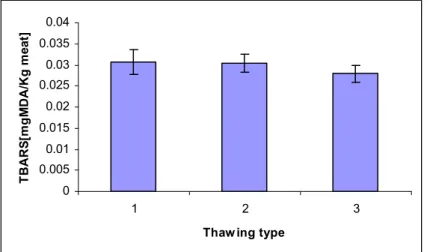
The degree of lipid oxidation of the unpacked meat samples processed through different thawing methods (water or ultrasound) is shown in figure 4. There are no significant differences between control and meat samples thawed by means of ultrasounds. In addition, all TBARS values of the thawed samples are quite low, being below rancidity threshold 1-2 mg MDA/meat kg (Vieira et al., 2009).
0 0.005 0.01 0.015 0.02 0.025 0.03 0.035 0.04
1 2 3
Thaw ing type
T
BARS
[m
g
M
DA/
Kg
m
e
a
t]
Figure 4. TBARS of meat depending on thawing type: 1 - control; 2 - thawing at 0.2 W/cm2; 3- thawing at 0.4 W/ cm2
Microbiological aspects
Table 2 shows the results of microbiological analysis for the meat thawed by immersion in water (control) and by low intensity ultrasound (0.2 W/ cm2; 0.4 W/ cm2). A low decrease in the total aerobic count was registered in the case of the meat samples thawed by means of ultrasounds compared to the control samples. Also, aerobic bacteria were not detected in water used for thawing. Furthermore, there was no difference in the total count of aerobic bacteria regardless of the intensity of ultrasound applied. These results are consistent with other reports from the literature indicating that sonication applied alone is not very effective for inactivating microorganisms (Piyasena et al., 2003; Knorr et al., 2004).
Table 2. Influence of thawing type on microbiological count
Thawing type Total aerobic count, cfu/g
Conclusions
Results from this study suggest that thawing by low intensity ultrasound had no effect on physical, chemical, microbiological and technological properties of unpackaged pork. Moreover, the parameters used in the present study (25kHz; 0.2; 0.4W/cm2) can be applied in thawing the pork meat, in order to reduce the thawing time. Hence, no significant differences between the control (immersion in water) and ultrasound treatments were observed in terms of pH, expressible moisture, total loss, microbial growth and TBARs values, suggesting that ultrasound treatment does not affect the quality of unpackaged frozen pork meat after thawing. The results of this study highlight a potential application for ultrasound treatment in the thawing of unpackaged frozen meat. As alternative thawing technologies are important for meat industry, the benefits of an ultrasonic system justifies further research in this subject.
References
Ashokkumar, M., Sunartio, D., Kentish, S., Mawson, R., Simons, L., Vilkhu, K., and Versteeg, C. 2008. Modification of food ingredients by ultrasound to improve functionality: A preliminary study on a model system. Innovative Food Science and
Emerging Technologies, 9, 155–160.
Chang, H., Xu, X., Zhou, G. ,Li, C., and Huang, M. 2009. Effects of characteristics changes of collagen on meat physicochemical properties of beef semitendinosus muscle during ultrasonic processing. Food Bioprocess Technology, 5, 285-297.
Cheftel, J.C., Levy, J., Dumay, E. 2000. Pressure-assisted freezing and thawing: principles and potential aplications. Food Reviews International, 16, 453–483.
Chemat, F., Zill-e-Huma, and Khan, M.K. 2011. Applications of ultrasound in food technology: Processing, preservation and extraction. Ultrasonics Sonochemistry, 18, 813–835.
Dolatowski, Z.J, Stadnik, J.J,2007. Effect of sonication on technological properties of beef.
Faculty of Food Sciences and Biotechnology. Lublin, Poland
Dolatowski, Z., Stasiak, D.M., and Latoch, A. 2000. Effect of ultrasound processing of meat before freezing on its texture after thawing. Electronic Journal of Polish
Agricultural Universities, 3(2) http://www.eipau.media.pl.
Fernandez, P.P., Sanz, P.D., Molina-Garcia, A.D., Otero, L., Guignon, B., and Vaudagna S.R. 2007. Conventional freezing plus high pressure–low temperature treatment: physical properties, microbial quality and storage stability of beef meat. Meat Science,
77, 616–625.
Icier, F., Izzetoglu, G.T., Bozkurt, H., and Ober, A. 2010. Effects of ohmic thawing on histological and textural properties of beef cuts, Journal of Food Engineering, 99, 360–365.
Jayasooriya, S.D., Torley, P.J., D’Arcy, B.R., and Bhandari, B.R. 2007. Effect of high power ultrasound and ageing on the physical properties of bovine Semitendinosus and Longissimus muscles. Meat Science, 75, 628–639.
Knorr, D., Zenker, M., Heinz, V., and Lee, D. U. 2004. Applications and potential of ultrasonics in food processing. Trends in Food Science and Technology, 15, 261–266.
Kondratowicz, J., Chwastowska-Siwiecka, I., and Burczyk, E. 2008. Technological properties of pork thawed in the atmospheric air or in the microwave oven as determined during a six-month deep-freeze storage. Animal Science Papers and
Reports, 26(3), 175-181.
Lyng, J.G., Allen, P., and McKenna, B.M. 1997. The influence of high intensity ultrasound baths on aspects of beef tenderness. Journal of Muscle Foods, 8, 237-249.
Lyng, J.G., Allen, P., and McKenna, B.M. 1998. The effect on aspects of beef tenderness of pre- and post-rigor exposure to a high intensity ultrasound probe. Journal of the
Science of Food and Agriculture, 78(3), 308–314.
Miles, C.A., Morley, M.J., and Rendell M. 1999. High power ultrasonic thawing of frozen foods. Journal of Food Engineering, 39, 151- 159.
Piyasena, P., Mohareb, E., and McKellar, R. C. 2003. Inactivation of microbes using ultrasound: a review. International Journal of Food Microbiology, 87, 207–216.
Pohlman, F.W., Dikeman, M.E., and Zayas, J.F. 1997a. The effect of low-intensity ultrasound treatment on shear properties, color stability and shelf life of vacuum packaged beef semitendinosus and biceps femoris muscles. Meat Science, 45(3), 329– 337.
Pohlman, F.W., Dikeman, M.E., and Kropf, D.H. 1997b. Effects of high intensity ultrasound treatment, storage time and cooking method on shear, sensory, instrumental color and cooking properties of packaged and unpackaged beef pectoralis muscle. Meat Science, 46(1), 89–100.
Shanks, B.C., Wulf, D M., and Maddock, R J. 2002. Technical note: The effect of freezing on Warner-Bratzler shear force values of beef longissimus steaks across several post-mortem aging periods. Journal of Animal Science, 80, 2122–2125. Smith, N. B., Cannon, J. E., Novakofski, J. E., McKeith, F. K., and O’Brien, W. D. 1991.
Tenderization of Semitendinosus muscle using high intensity ultrasound. In Proceedings of the IEEE ultrasonics symposium, Orlando, FL, USA.
Stadnik, J., Dolatowski, Z.J., and Baranowska, H.M. 2008. Effect of ultrasound treatment on water holding properties and microstructure of beef (m. semimembranosus) during ageing. Food Science and Technology, 41, 2151- 2158.
Tarladgis, B.G., Watts, B.M., Younathan, M.T., and Dugan, L.R. 1960. A distillation method for the quantitative determination of malonaldehyde in rancid foods. Journal of American Oil Chemists Society, 37, 44–48.