17
CLINICS 60(1):17-20, 2005
From the Colorectal Unit, Hospital das Clínicas, Faculty of Medicine, University of São Paulo – São Paulo/SP, Brazil.
E-mail: [email protected]
Received for publication on April 06, 2004. Accepted for publication on June 28, 2004.
ORIGINAL RESEARCH
SURGICAL TREATMENT OF ANAL STENOSIS:
ASSESSMENT OF 77 ANOPLASTIES
Angelita Habr-Gama, Carlos Walter Sobrado, Sergio Eduardo Alonso de Araújo, Sergio Carlos Nahas, Ingrid Birbojm, Caio Sergio Rizkallah Nahas and Desidério Roberto Kiss
HABR-GAMA A et al. Surgical treatment of anal stenosis: assessment of 77 anoplasties. CLINICS 60(1):17-20, 2005.
PURPOSE: Anal stenosis is a rare, incapacitating, and challenging condition, occurring mainly after hemorrhoidectomy, for which several surgical techniques have been devised. The purpose of this study was to describe early and late (1 year) results of 77 anoplasty operations performed in the Colorectal Unit of our institution.
METHODS: From 1977 to 2002, 77 patients with moderate to severe anal stenosis underwent surgery using two sliding graft techniques: 58 underwent Sarner´s operation and 19 underwent Musiari´s technique. Bilateral flaps were used in 7 patients.
RESULTS: Early morbidity was due to pruritus occurring in 2 patients, urinary infection in 1, and temporary incontinence in 1 patient. One patient needed early reoperation following suture line dehiscence. Late results (1 year) were classified as good in 67 cases (87%). There was no reoperation due to recurrence of stenosis.
Conclusion: The ease of performance, good functional results, and lack of severe complications show that Sarner´s and Musiari´s flap advancement techniques are effective and safe methods for surgical correction of anal stenosis, particularly when cutaneous fibrosis plays a major role in its etiology.
KEYWORDS: Anal stenosis. Anoplasty. Flap advancement.
Anal stenosis is an uncommon and disabling condition. It represents an abnormal narrowing of the anal canal to a varying extent due to stricture of the epithelial lining that has been replaced by fibrous connective tissue.1 Although
anal stenosis may occur without previous anorectal surgery, it usually results from surgical procedures carried out over-zealously without the required technical knowledge, most commonly after hemorrhoidectomy.2,3
Effective management of anal stenosis is challenging. Symptomatic mild stenosis may be conservatively managed with diet changes, fiber supplements, and stool softeners. Numerous surgical techniques have been devised for the treatment of moderate to severe anal stenosis that is refrac-tory to conservative treatment, with good results reported
in several series.1,4-21 They include partial anal
sphincter-otomy with stricture release and several forms of plastic sur-gery through advancement and rotational flaps involving skin, mucosa, or both.
In this study, early and late results are presented regard-ing 77 consecutive patients treated for severe cicatricial stricture of the anus who underwent sliding skin grafts from 1977 to 2002 using techniques developed by Sarner6 and
Musiari.4 The surgical team performed either technique
ac-cording to its preference, surgical conditions, and previous experience.8,16
MATERIALS AND METHODS
The study included 77 consecutive patients with anal stenosis who underwent anoplasty for anal stenosis from 1977 to 2002.
18
CLINICS 60(1):17-20, 2005 Surgical treatment of anal stenosis: Assessment of 77 anoplasties
Habr-Gama A et al.
There were 49 women and 28 men ranging in age from 25 to 83 (mean age, 44).
In all patients, digital examination was not possible. Fifty-nine (77%) complained of obstructive defecation, 53 (69%) of painful evacuation, and 18 (23%) of frequent epi-sodes of bleeding during defecation.
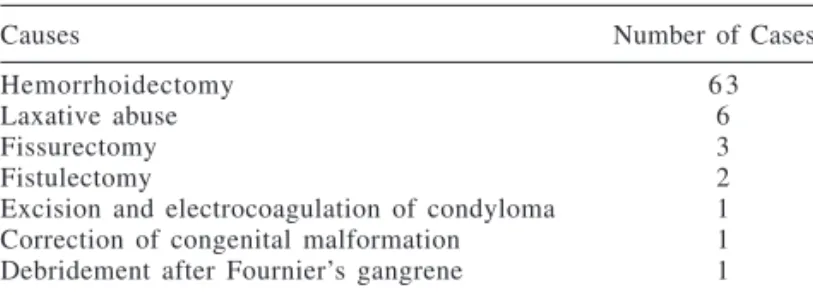
Hemorrhoidectomy was the most common cause for the stenosis (Table 1). The time elapsed from hemorrhoi-dectomy to anoplasty varied from 2 months to 15 years. None of the patients who had a previous hemorrhoidectomy had undergone that surgery at our institution.
The night before surgery, all patients had a cleansing en-ema. A complete proctologic examination was carried out soon after anesthesia was administered, when possible. All patients underwent surgery in the lithotomy position under regional anesthesia. Antibiotic prophylaxis was routinely used (chloramphenicol or cefoxitin) for a 24-hour period.
The operation was initiated by the evaluation and excision of the distal transitional zone and anal scars with underlying partial internal sphincterotomy, the extent of which varied ac-cording to the longitudinal length of the scar. A rectangular flap was then planned. Its cranial margin was at the scar excision. The flap was at least 1 cm wide, and its length did not measure more than 3 times the width to prevent necrosis. The flap was then mobilized to replace the lining at the original scar loca-tion. Its cranial border was sutured without tension to the distal rectal mucosa margin. Hemostasis was carefully attended to. At the surgeon’s choice, lateral margins were sutured or not and the caudal margin of the flap was incised (Sarner´s technique — Figure 1) or not (Musiari´s technique — Figure 2). In cases in which the skin flap was not tension-free while the surgeon tried to perform Musiari´s technique, it was converted to Sarner´s technique to avoid flap dehiscence and contracture. Estimates of blood supply and degree of tension in the flap were the main determinants of these suturing options.
Sarner´s anoplasty was performed in 58 patients, and Musiari´s technique was used in 19. Depending upon the degree of anal opening after the mobilization and fixation of the first flap, a second contralateral flap (sagittal or coro-nal) was sometimes used. Bilateral flaps were used in 7 pa-tients who underwent Sarner´s operation.
Table 1 - Etiology of Anal Stenosis.
Causes Number of Cases
Hemorrhoidectomy 6 3
Laxative abuse 6
Fissurectomy 3
Fistulectomy 2
Excision and electrocoagulation of condyloma 1 Correction of congenital malformation 1 Debridement after Fournier’s gangrene 1
Patients were discharged 48 hours after the procedure. A high-fiber diet combined with bulk laxatives was recommended After discharge, all patients were evaluated on a weekly basis until complete operative wound closure was obtained. All patients were seen after 6 months and after 1 year. Im-mediate postoperative pain was minimal in the majority of patients.
Results were considered good (successful outcome) when spontaneous evacuation following high-fiber meals or bulk laxatives was observed. Results were considered unsatisfactory (unsuccessful outcome) when patients re-ported frequent painful evacuation for whom oral osmotic laxatives, suppositories, or enema administration were re-quired and for those who rere-quired a late reoperation.
RESULTS
Temporary incontinence with gas and liquid stool last-ing up to 3 months was observed in 1 patient. Urinary in-fection was observed in another. Moderate pruritus that sub-sided after 3 weeks was observed in 2 patients. Suture flap Figure 1 - Sarner´s anoplasty. After dissection of a rectangular cutaneous flap, its distal border is incised and the proximal border is sutured to the fibrotic tissue resection line.
19
CLINICS 60(1):17-20, 2005 Surgical treatment of anal stenosis: Assessment of 77 anoplasties Habr-Gama A et al.
dehiscence with ischemic contracture was observed in 1 pa-tient who received a Sarner´s flap. This papa-tient underwent early reoperation. Excision of the ischemic border and new suturing of the flap was performed.
The mean time until complete wound healing was 4 weeks, varying from 3 to 6 weeks. Complete wound clo-sure was observed in all patients.
Results were considered good when spontaneous evacu-ation following high-fiber meals or bulk laxatives was served. In this consecutive series, good results were ob-served in 51 (88%) patients after Sarner´s operation and in 16 (84%) patients after Musiari´s operation, an overall 87% success rate (Table 2). Seven patients in the Sarner´s opera-tion group and 3 in the Musiari´s group were included in the unsuccessful outcome group.
DISCUSSION
Anal stenosis, although rare, is one of the most feared and disabling complications of anorectal surgery. Most cases of mild to moderate narrowing can be managed con-servatively. Nevertheless, when conservative treatment is not effective in facilitating evacuation and reducing pain, sur-gical treatment is warranted.
A number of corrective surgical procedures have been designed aiming to bring a healthy lining to the narrowed portion of the anal canal4-21 (Table 3). Since more complex
techniques (such as S-plasty)5 have now been abandoned
due to high morbidity and longer hospital stay, easier tech-niques are still being performed with good results (Table 3). The ideal procedure should be simple, should lead to no or minimal early and late morbidity, and should restore anal function with a good long-term outcome.21 In patients
with a moderate degree of stenosis, a single sphincterotomy may be sufficient treatment; however, when fibrosis is in-tense, it might be an obstacle to the physiologic anal dila-tion occurring during evacuadila-tion, indicating the need for the interposition of normal tissue.
In this study, results obtained in 77 patients with severe anal stenosis who underwent anoplasty with a skin flap ad-vancement were presented. None of the 63 patients who had a previous hemorrhoidectomy had undergone that surgery at our institution. They had undergone surgery over a period of 25 years, which partially explains the time interval required for operating on a relatively small number of patients, and made adequate follow-up a difficult task. Notwithstanding, a one-year follow-up was obtained for all patients.
Musiari´s4 and Sarner´s6 techniques for anoplasty are
simple and undemanding operations associated with low morbidity and good functional results.8,15,16,20
Complications from these procedures include flap necro-sis from loss of vascular supply, suture line dehiscence from excessive tension, donor site problems, local infection, uri-nary tract infection, incontinence, and re-stenosis. In this se-ries, only minor complications (pruritus in 2 patients and tem-porary anal incontinence in 1) were observed. One patient underwent early reoperation due to suture line dehiscence in order to prevent flap contracture. After 1 year, good re-sults were observed in 67 (87%) patients. Although rere-sults were suboptimal for 10 (13%) patients, medical management offered good palliation, and reoperation was judged unnec-essary by the patients themselves. No patient required out-patient or hospital dilation over the 1-year follow-up, since finger examination was possible in all patients.
Table 3 - Summary of literature review of anoplasty operations for anal stenosis.
Author, year Technique Number of cases Mean Follow-up (months) Good results
Gonzalez et al.,1 1995 S-plasty and advancement flaps 1 7 1 8 94%
Sarner,6 1969 Sarner´s flap 2 1 Nr 100%
Oh & Zinberg,9 1982 C-plasty 1 2 1 2 92%
Khubchandani,10 1985 Mucosal flap 5 3 Nr 94.1%
Gingold & Arvanitis,11 1986 Y-V 1 4 Nr 100%
Milson & Mazier,12 1986 V-Y (1) and Sarner´s (2) flap 2 4 Minimum: 1 90% (1)75% (2)
Caplin & Kodner,13 1986 Diamond flap 7 Nr 100%
Pearl et al., 199015 Island flaps (U or diamond) 2 5 1 9 92%
Habr-Gama et al., 199116 Sarner´s and Musiari´s flaps 6 1 1 9 92%
Angelchik et al.,199317 Y-V anoplasty or diamond flap 1 4 1 2 100%
Pidala et al., 199418 Island flap 2 8 3 6 91%
Sentovich et al.,199619 House flap 2 1 2 8 90%
Medeiros, 199720 Sarner´s flap 3 0 Nr 100%
Maria et al., 199821 Y-V anoplasty or diamond flap 4 2 2 4 93%
Rakhmanine et al., 200222 Mucosal flap 9 5 5 0 90%
Nr: not reported
Table 2 - Early and late (1 year) results after anoplasty.
Sarner´s Musiari´s
Anoplasty Anoplasty
Healing 58 (100%) 19 (100%)
Early reoperation 1 (1.7%) 0
Late reoperation 0 0
20
CLINICS 60(1):17-20, 2005 Surgical treatment of anal stenosis: Assessment of 77 anoplasties
Habr-Gama A et al.
RESUMO
HABR-GAMA e col. Tratamento cirúrgico da estenose anal: Resultados de 77 anoplastias. CLINICS 60(1):17-20, 2005.
OBJETIVO: A estenose anal é uma condição rara,
incapacitante e desafiadora que ocorre principalmente após hemorroidectomia, para a qual diversas técnicas cirúrgicas reparadoras foram desenvolvidas. O objetivo deste estudo é descrever os resultados precoces e tardios (um ano) de 77 anoplastias realizadas no Serviço de Cirurgia Colorretal.
MÉTODOS: No período de 1977 a 2002, 77 pacientes
com estenose anal moderada ou grave foram operados, utilizando-se duas técnicas diferentes de avanço de retalho: 58 foram submetidos à técnica de Sarner e 18 submetidos à Técnica de Musiari. Avanços bilaterais foram utilizados em sete pacientes.
RESULTADOS: As complicações precoces foram: prurido
em dois pacientes, infecção urinária em um paciente e incontinência fecal temporária em outro. Um paciente neces-sitou reoperação precoce por deiscência de linha de sutura. Os resultados tardios foram classificados como bons em 67 (87%). Não houve reoperação por recorrência de estenose.
CONCLUSÃO: A facilidade técnica, os bons resultados
funcionais e a ausência de complicações graves demons-traram que as técnicas de avanço de retalho de Sarner e Musiari são efetivas e seguras para correção de estenose anal, particularmente nos casos em que a fibrose cutânea é o principal fator etiológico.
UNITERMOS: Estenose anal. Anoplastia. Retalho de
avanço.
REFERENCES
1 . González AR, de oliveira O, Verzaro R, Nogueras J, Wexner SD. Anoplasty for stenosis and other anorectal defects. Am Surg 1995;61:526-9.
2 . Lucthefeld M. Anal stenosis. Probl Gen Surg 2001;18:17-23. 3 . Liberman H, Thorson AG. How I do it. Anal stenosis. Am J Surg
2000;179:325-9.
4 . Musiari JP. Estenosis de ano. Sem Méd 1954;104:803-4. 5 . Hudson AT. S-plasty repair of Whitehead deformity of the anus.
Dis Colon Rectum 1967;10:57-60.
6 . Sarner JB. Plastic relief of anal stenosis. Dis Colon Rectum 1969;12:277-80.
7 . Corman ML, Veidenheimer MC, Coller JA. Anoplasty for anal stricture. Surg Clin North Am 1976;56:727-31.
8 . Habr-Gama A, Alves PRA, Corsi A, Jatobá P, Teixeira MG, D’Albuquerque LA, et al. Sliding skin grafts in the treatment of anal strictures. Chir Gastroenterol 1978;12:277-83. 9 . Oh C, Zinberg J. Anoplasty for anal stricture. Dis Colon Rectum
1982;25:809-10.
10. Khubchandani IT. Mucosal advancement anoplasty. Dis Colon Rectum 1985;28:194-6.
11. Gingold BS, Arvanitis M. Y-V anoplasty for treatment of anal stricture. Surg Gynecol Obstet 1986;162:241-2.
12. Milson JW, Maziew WP. Classification and management of postsurgical anal stenosis. Surg Gynecol Obstet 1986;163:60-4.
13. Caplin DA, Kodner IJ. Repair of anal stricture and mucosal ectropion by simple flap procedures. Dis Colon Rectum 1986;29:92-4. 14. Ramanujan PS, Venkatesh KS, Cohen M. Y-V anoplasty for severe
anal stenosis. Contemp Surg 1988;33:62-8.
15. Pearl RK, Hooks VH, Abcarian H, Orsay CP, Nelson RL. Island flap anoplasty for the treatment of anal stricture and mucosal ectropion. Dis Colon Rectum 1990;33:581-3.
16. Habr-Gama A, Alves PRA, Rodrigues LV, Vieira MJF. Anoplastia para tratamento da estenose anal. Rev Bras Colo-proctol 1991;11:15-8.
17. Angelchik PD, Harms BA, Starling JR. Repair of anal stricture and mucosal ectropion with Y-V or pedicle flap anoplasty. Am J Surg 1993;166:55-9.
18. Pidala MJ, Slezak FA, Porter JA. Island flap anoplasty for anal canal stenosis and mucosal ectropion. Am Surg 1994;60:194-6. 19. Sentovich SM, Falk PM, Christensen MA, Thorson AG, Blatchford
GJ, Pitsch RM. Operative results of House advancement anoplasty. Br J Surg 1996;83:1242-4.
20. Medeiros RR. Estenose anal: análise de 30 casos. Rev Bras Colo-proctol 1997;17:24-6.
21. Maria G, Brisinda G, Civello IM. Anoplasty for the treatment of anal stenosis. Am J Surg 1998;175:158-60.
22. Rakhmanine M, Rosen L, Khubchandani I, Stasik J, Riether RD. Lateral mucosal advancement anoplasty for anal stricture. Br J Surg 2002;89:1423-4.
CONCLUSION
The ease of performance, good functional results, and lack of severe complications demonstrate that Sarner´s and