Original Article
Artigo Original
Questionnaire validation – PEACH on
Brazilian Portuguese
Validação do questionário Parent’s Evaluation
of Aural/Oral Performance of Children –
PEACH em língua portuguesa brasileira
Cilmara Cristina Alves da Costa Levy1
Lyvia Christina Camarotto Battiston Rodrigues-Sato1
Keywords
Deafness Questionnaires Validation Studies Family Habilitation
Descritores
Surdez Questionário Estudos de Validação Família Reabilitação
Correspondence address:
Cilmara Cristina Alves da Costa Levy Irmandade da Santa Casa de Misericórdia de São Paulo
Rua Apinajes, 1818, complemento 72, Bairro Sumaré, São Paulo (SP), Brazil, CEP: 01258-000.
E-mail: [email protected]
Received: June 16, 2015
Accepted: September 24, 2015
Study carried out at Audiology Section of Department of Otorhinolaryngology of Irmandade da Santa Casa de Misericórdia de São Paulo - São Paulo (SP), Brazil.
1 Irmandade da Santa Casa de Misericórdia de São Paulo - São Paulo (SP), Brazil.
Financial support: nothing to declare. Conlict of interests: nothing to declare. ABSTRACT
Purpose: Translate, adapt and validate the Parent’s Evaluation of Aural/Oral Performance of Children questionnaire to Brazilian Portuguese, as well as analyzing the interaction between parents/caregivers and children. Methods: After translated, back translated and adapted this questionnaire was administered to 13 parents or guardians of children with moderate to severe hearing loss that were treated in the ambulatory of audiology
of the Institution. Parents should ill out the diary, answering the questionnaire, giving as many examples of
observed behaviors for each question and return for follow-up after a week for an interview with the evaluator or child’s therapist. Results: Data are presented in frequency and percentage. We used chi-square test with a
5% signiicance level (p). Two questions were culturally adapted to Brazilian Portuguese. The questionnaires
were answered by mothers most of the time (69.2%). Conclusions: The questionnaire was translated and adapted respecting the cultural aspects of the Brazilian population. It was observed that, for some questions, it is necessary care when analyzing the answers that parents provide, taking into consideration the child’s age and linguistic content that is required for the observed behavior, avoiding erroneous interpretations made on the
quality of ampliication and the use of hearing aids or CI due to this. The questionnaire is of great importance
since it measures the performance of children in their daily life situations.
RESUMO
Objetivo: Traduzir, adaptar e validar o questionário Parent’s Evaluation of Aural/Oral Performance of Children para a língua portuguesa brasileira, aplicar o questionário e analisar a interação entre pais/cuidadores e crianças.
Métodos: Após ser traduzido, retrotraduzido e adaptado, o PEACH foi aplicado a 13 pais ou responsáveis por
crianças deicientes auditivas de grau moderado a profundo atendidas no Ambulatório de Audiologia Educacional
da instituição. Pediu-se aos pais que preenchessem o diário, respondessem ao questionário fornecendo o maior
número de exemplos de comportamentos observados em cada questão e comparecessem ao retorno, após uma
semana, para entrevista com a avaliadora ou terapeuta da criança. Resultados: Os dados são apresentados em
frequência e porcentagem. Usou-se o teste de qui-quadrado, tendo-se adotado 5% como nível de signiicância
(p). Duas questões sofreram adaptação cultural para a língua portuguesa brasileira; as mães foram as pessoas que mais responderam ao questionário (69,2%). Conclusão: O questionário foi traduzido e adaptado respeitando os aspectos culturais da população brasileira. Em algumas questões deve-se tomar cuidado ao analisar as
respostas dos pais, levando-se em conta a idade da criança e o conteúdo linguístico exigido para que se observe o comportamento, evitando interpretações errôneas quanto à qualidade da ampliicação e do uso do AASI/IC. A aplicação do questionário é de grande importância, visto que mede o desempenho das crianças em situações
INTRODUCTION
Hearing health is critical for the normal development of the child, since it is known that in hearing loss cases detected late(1-3) may present dificulties in social, cognitive, educational, linguistic, cultural and economic aspects.
Currently, due to scientiic and technological advances in early diagnosis, hearing loss has been identiied in younger children,
and these have come to call centers almost always on time(4-6). Many children with bilateral or unilateral hearing loss
beneit from the use of individual hearing aids (HA). The goal
of hearing aid in the baby or children with hearing impairment is to promote, in a safe and comfortable way, as much as possible access to stimuli that constitute the information of speech - that
is, ampliied speech needs to be comfortably above the child’s
hearing thresholds but below the level of discomfort in both ears(7).
The effective ampliication is a vital component in enabling
the hearing of hearing impaired children, and it must be effective, as the child depends on adequate auditory stimuli to develop speech and language skills(8).
As small children are not able to respond alone on the effects of hearing aids and parents have many opportunities
to observe the children’s responses to the ampliication, they
can give important information to the audiologist responsible for adapting(8).
For some authors(9), it is critical for audiologist job to share the parents’ knowledge about the children hearing, so that one of the means of assessing the performance of the use of hearing aids (HA) or cochlear implant (CI) is the use of questionnaires.
There are several questionnaires through which it is possible
to subjectively evaluate the beneit of hearing aids and CI,
hearing and language skills and speech perception. Most of these questionnaires mainly aim to involve parents in the rehabilitation process. Questionnaires as MUSS(10), MAIS(11), APHAB(12), IT-MAIS(13), CHILD(14), ABEL(15) and LIFE(16) contribute to the validation of the use of electronic devices.
The Parent’s Evaluation of Aural/Oral Performance of Children – PEACH(6) was developed to assess the effectiveness of
ampliication in young children with hearing loss by systematic
observation of parents and their information about listening in quiet or noisy environment and the perception of speech, as well as on the understanding of spoken language, also in a quiet or noisy environment, a subjective measure by which to
measure the effectiveness of sound ampliication in everyday
life(6) of children of different ages and degrees of hearing loss. Some studies(6) report the need for a common longitudinal monitoring to document the results with children, as their maturity
and their overall development can inluence the type of response that is required. Furthermore, responses to the ampliication
may take longer in children than in adults.
OBJECTIVES
Based on these, the objectives were to translate, adapt and validate the questionnaire PEACH - Parent’s Evaluation of Aural/ Oral Performance of Children for Brazilian Portuguese, apply the PEACH questionnaire in a group of parents of hearing aid
or CI users and examine how parents watch their children as
well as their commitment to follow this process.
METHODS
Work approved by the Research Ethics Committee of the Irmandade da Santa Casa de Misericórdia de São Paulo on December 16, 2009 - Protocol No. 436/2009.
The work was performed in two parts, which are explained
below: translation and adaptation of PEACH questionnaire and application to obtain data to validate the PEACH protocol.
Initially, the PEACH questionnaire(6) was translated and adapted to Brazilian Portuguese. Both the translation and cultural adaptation were authorized by one of its authors, Dr. Teresa Y. C. Ching, a researcher at the National Acoustic Laboratories (NAL), Australia.
Translation and adaptation of the questionnaire followed the following steps:
1. Two Brazilian researchers who already knew the work translated the questionnaire from English into Brazilian Portuguese; after reviewed, these two versions generated a unique;
2. The version of the questionnaire translated into Brazilian Portuguese was sent to an native English speaker with knowledge of Brazilian Portuguese, for a back translation and
subsequent analysis and adaptation of terms and expressions,
ensuring a translation faithful to the purposes of the authors of the original version (in English).
Following these steps, the questionnaire was applied to obtain the data for validation.
As inclusion criteria, children with conductive or mixed
sensorineural hearing loss were selected, moderate to profound degree (according to criteria established(17)), aged between 13 and 84 months and assisted in the Educational Audiology sector of the Department of Otorhinolaryngology of the Irmandade da Santa Casa de Misericórdia de São Paulo, hearing aids or CI
users. As exclusion criteria, children with multiple disabilities
were withdrawn from the sample. The sample consisted of parents and/or guardians of 13 children who met the inclusion criteria described.
All parents or guardians were aware of the study procedures, and signed the Informed Consent Form, in accordance with the guidelines of the Research Ethics Committee of the institution.
The routine of hearing aid selection and itting process
included anamnesis, pre-molding, testing through behavioral
observation, the hearing aid veriicaction and Real-Ear to Coupler Difference - RECD with hearing aids and also home experiences.
After performing these tests and hearing aids being suitable
for the child, it was ordered via the Uniied Health System
(SUS) - National Policy of Hearing Health - Ordinance GM n. 2.073/2004.
The PEACH questionnaire was developed as a measure of functional performance in situations of daily life in the form of a directed journal, based on the systematic observation of the child hearing behavior in different environments attended.
Parents should note in the journal examples of when and where
the hearing behavior occurred.
Items include questions on use of hearing aids/CI, listening comfort, situations in silence, in noisy situations and attention/recognition of environmental sounds and speech
(Annex A).
The work authors and therapists of the participating children handed to the parents or caregivers a copy of the questionnaire
and the observation journal containing the questions and examples
of observable behaviors that should be recorded at each situation
and explained some pre-selected questions to clarify what was
asked. Parents were asked to observe and record the behavior of children in everyday situations that are relevant to each questionnaire item for a week, as suggested by the authors of the original questionnaire(6).
After a week of observation, parents and children should attend the speech therapy session taking the completed journal and also the questionnaire. The questionnaire was then applied in an interview between the therapists and/or author with the parents/caregivers, to better punctuate the children behavior in each situation observed and compare the responses that parents provided with that would be obtained based on the journal notes.
During this interview the therapist/author noted the examples
of each item provided by the parents, paying attention to detail
and considering speciic situations where behavior could be
observed or not. The parents were always asked to provide the largest possible amount of information about the routine of the child wearing the hearing aids/CI and if he/she presented
attention/behavior modiication when the hearing aids/CI did not
work properly. The therapist/author then complemented what parents had observed and noted in the journal for the week, to make new questionnaire score, this time based on the responses of parents associated with the observations described in the journal and the prior completion of the questionnaire, which the parents had done during the week.
The more examples parents provided for each question, the
higher the score.
According to the suggestion of the authors for the score, each question has 5-point scale (0-4), distributed as follows:
0 = never (the child never presented certain behavior, no example
provided), 1 = seldon (the child shows the behavior about 25%
of the time, 1 or 2 examples provided), 2 = sometimes (the child shows the behavior about 50% of the time, 3 or 4 examples
provided), 3 = often (the child shows the behavior about 75%
of the time, 5 or 6 examples provided) e 4 = always (the child
shows the behavior more than 75% of the time, more than
6 examples provided) (Table 1).
The score considered was calculated by therapists / authors after interviews with the responsible and association between parental response in the prior completion of the questionnaire, observations in the journal and added comments that parents occasionally did not write in the journal, which were added by the therapists/authors during the interview for each question.
Data are presented in frequency and percentage, igures and
tables. To evaluate the correlation between quantitative variables
of the study group we used the chi-square test with signiicance
level of 5% (p). Software used for the analysis were SPSS and
Epi-info and graphics were done in Excel.
RESULTS AND DISCUSSION
The translation and adaptation of the PEACH questionnaire(6) for its application in health services facilitates the visualization of device usage conditions for the child, since it can condense different characteristics of other questionnaires already translated and adapted to Brazilian Portuguese, covering observation items such as use of hearing aids / CI, listening comfort, situations in silence, the noise situations and attention/recognition of environmental sounds. All of these items are mentioned in the literature, however it is observed that most questionnaires applied not always observe all these features and joint concerns in only one of them, and therefore it is necessary to complement with the application of more than one questionnaire. As for the auditive comfort it is possible to observe the same concern in the APHAB questionnaire(12); as for the child auditive performance in silence and noisy situations, as PEACH(6) also showed this concern with the scale MAIS(10), APHAB questionnaire(12), the LIFE questionnaire(16) and a questionnaire used by other authors(18).
A common feature between the PEACH(6) and the questionnaires MUSS(10), MAIS(11), APHAB(12), IT-MAIS(13), CHILD(14), ABEL(15) and the proposed in some authors studies(19) is attention when analyzing measures of functional performance of children in daily life situations, which shows the importance of parents and/or guardians observation.
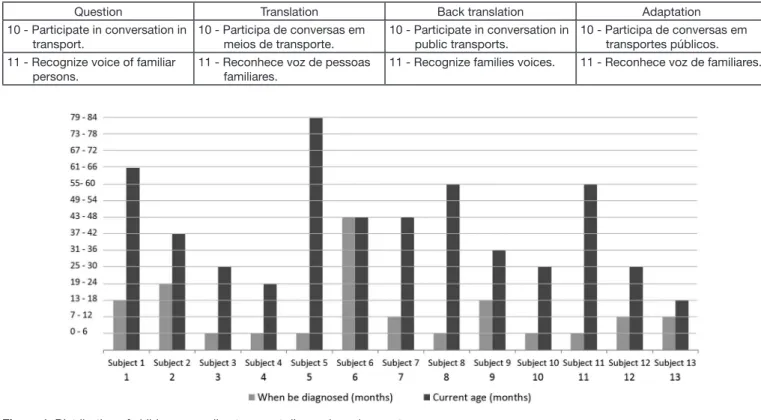
Among the 13 questions, only two were adapted for Brazilian Portuguese after translation and back translation, one of them being on behavior in noisy environment and the other on silence environment (questions 10 and 11, respectively), in order to transmit its content to the population (Chart 1).
The PEACH questionnaire(6) was applied in a group of 13 children assisted in the Educational Audiology Sector of the Institution, whose parents/guardians agreed and signed the
Table 1. Score for the PEACH questionnaire
Score Meaning Interpretation Example
0 Never Child never presents such behavior None
1 Seldom Child presents such behavior approximately 25% of time 1 or 2
2 Sometimes Child presents such behavior approximately 50% of time 3 or 4
3 Often Child presents such behavior approximately 75% of time 5 or 6
Informed Consent Form. Children participating in the study were between 13 and 84 months old and most have been recently diagnosed(7,20) (Figure 1).
As for the families who answered the questionnaire (Figure 2), it can be said that the mother (69.2%) was the person in the family that is most involved in the child’s rehabilitation
process, which corroborates indings of previous studies(21,22). In other studies, researchers(23,24) added that in addition to the early intervention(7,20), the family participation is crucial in the successful rehabilitation of children with hearing impairment. The application of questionnaires to parents for analysis of children with hearing impairment of performance is critical to
the speech therapy, which can be inluenced by the representation
that parents have their children in situations of daily life(25,26). The observation of family dynamics is also very important to
help them effectively in stimulating their children by providing model as to how to act with them(27).
Although mothers participate more in the monitoring process/hearing rehabilitation of children than fathers, and
even staying longer with them, still had dificulties to watch
them effectively, being of great importance the intervention of professional audiologist in counseling and welcoming. Often, this
dificulty was related to the acceptance of the child’s deafness,
reported by most of the mothers, and the lack of time, since the majority needed to work and the children were in the care of kindergartens and daycare teachers.
As observed in Table 2, regarding the answers to question 1 of PEACH, the four children that didn’t had “always” used its HA/CI shared the fact that received intervention right after the diagnosis, but also presented important behavioral issues.
Chart 1. Adaptation of two questions to Brazilian Portuguese
Question Translation Back translation Adaptation
10 - Participate in conversation in transport.
10 - Participa de conversas em meios de transporte.
10 - Participate in conversation in public transports.
10 - Participa de conversas em transportes públicos. 11 - Recognize voice of familiar
persons.
11 - Reconhece voz de pessoas familiares.
11 - Recognize families voices. 11 - Reconhece voz de familiares.
Figure 1. Distribution of children according to age at diagnosis and current age
As for the answers to question 2 (Table 3), we observed that four children reported discomfort with loud sounds when using the HA/CI, all with severe hearing loss. These children were assessed regarding this aspect, which highlights the importance of the questionnaire, since many times these situations don’t happen during the therapy session to verify the discomfort.
The remaining questions speciic to daily situations in silence
or noisy environment allowed the audiologist to suggest possible alterations in the electronic device programming, in addition to offer the parents special moments in the affective relationship.
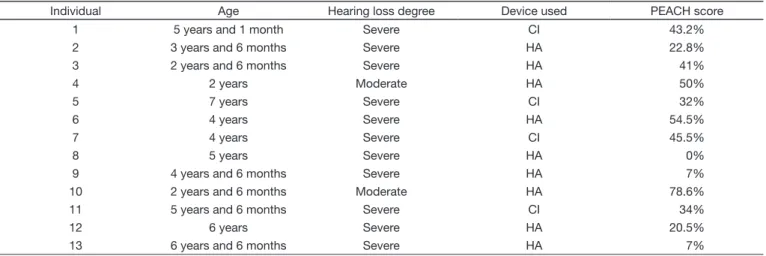
Chart 2 shows a cutout of the survey results application, as well as the detailed description of the sample. When necessary further amendments in the regulation, the use of the questionnaire was suggested for comparative purposes.
CONCLUSION
The PEACH – Parent’s Evaluation of Aural/Oral Performance of Children was translated and adapted to the Brazilian Portuguese language considering all the cultural aspects involved to facilitate the understanding of all issues by the population studied.
The PEACH was applied to a group of parents and it was observed that mothers accompanied their children more often, showing greater commitment to the rehabilitation process.
The PEACH questionnaire is very important in speech therapy of children with hearing loss, as well as scoring the frequency of their responses to sound stimuli in everyday silent or noisy environment implies the effective participation of the mother and/or family members in the daily observations, helping
professionals to validate the beneits of HA/CI.
ACKNOWLEDGEMENTS
After the development and completion of the work, we obtained the support of the Children’s Program of Phonak, who became interested in publicity and sponsorship of the product for free distribution to the Hearing Health Centers. Visit the Children’s Program of Phonak in order to obtain the full questionnaire.
REFERENCES
1. WHO: World Health Organization [Internet]. Media centre: deafness and hearing loss. Switzerland: WHO; 2010 [citado em 2010 Jun 12]. Disponível
em: http://www.who.int/mediacentre/factsheets/fs300/en/index.html
2. Levy CCAC. Avaliação auditiva, benefício da utilização de próteses auditivas e discussão das variantes clínicas em crianças com encefalopatias crônicas não evolutivas [dissertação]. São Paulo: Faculdade de Ciências Médicas da Santa Casa de São Paulo; 2007.
3. Andrade IFC, Lewis DR. A negligência mundial sobre a deficiência auditiva infantil em países em desenvolvimento. Disturb Comun. 2008;20(2):279-81.
4. Bevilacqua MC, Formigone GMP. Uma opção terapêutica para a criança deficiente auditiva. Barueri: Pró-Fono Departamento de Editorial; 2003. 5. Martinez MANS. Avaliação audiológica infantil. In Fernandes FDM,
Mendes BCA, Navas ALPGP. Tratado de Fonoaudiologia. São Paulo: Roca; 2009. p. 118-24.
6. Ching TY, Hill M. The Parents’ Evaluation of Aural/Oral Performance of Children (PEACH) Scale: NORMATIVE DATA. J Am Acad Audiol. 2007;18(3):220-35. http://dx.doi.org/10.3766/jaaa.18.3.4. PMid:17479615. 7. American Academy of Pediatrics. Joint Committee on Infant Hearing.
Year 2007 Position statement: principles and guidelines for early hearing detection and intervention programs. Pediatrics. 2007;120(4):898-921.
http://dx.doi.org/10.1542/peds.2007-2333. PMid:17908777.
Chart 2. Description of sample and PEACH score
Individual Age Hearing loss degree Device used PEACH score
1 5 years and 1 month Severe CI 43.2%
2 3 years and 6 months Severe HA 22.8%
3 2 years and 6 months Severe HA 41%
4 2 years Moderate HA 50%
5 7 years Severe CI 32%
6 4 years Severe HA 54.5%
7 4 years Severe CI 45.5%
8 5 years Severe HA 0%
9 4 years and 6 months Severe HA 7%
10 2 years and 6 months Moderate HA 78.6%
11 5 years and 6 months Severe CI 34%
12 6 years Severe HA 20.5%
13 6 years and 6 months Severe HA 7%
Table 2. Distributions of answers to question 1 of PEACH questionnaire
1. Is the child using the individual hearing aid/cochlear implant?
N %
Sometimes 2 15.4%
Often 2 15.4%
Always 9 69.2%
Total 13 100%
Table 3. Distributions of answers to question 2 of PEACH questionnaire 2. Does your child feel uncomfortable with loud sound?
N %
Never 9 69.2%
Seldon 4 30.8%
8. Ching TYC, Hill M. Hearing aid outcome measures in children or How effective is amplification in real life? In: Hearing Aid Outcome Measures Meeting. Indiana: Indiana University; 2001.
9. Boscolo CC, Santos TMM. A deficiência auditiva e a família: sentimentos
e expectativas de um grupo de pais de crianças com deficiência da audição.
Disturb Comun. 2005;17(1):69-75.
10. Robbins AM, Osberger MJ. Meaningful Use of Speech Scale (MUSS) [dissertação]. Indianopolis: University of Indiana School of Medicine; 1990.
11. Robbins AM, Renshaw JJ, Berry SW. Evaluating meaningful auditory integration in profoundly hearing-impaired children. Am J Otol. 1991;12(Supl):144-50. PMid:2069175.
12. Cox RM, Alexander GC. The abbreviated profile of hearing aid benefit. Ear Hear. 1995;16(2):176-86. http://dx.doi.org/10.1097/00003446-199504000-00005. PMid:7789669.
13. Zimmerman-Phillips S, Osberger MJ, Robbins AM. Infant-Toddler: Meaningful Auditory Integration Scale (IT-MAIS). In: Estabrooks W.
Cochlear implants for kids. Washington, DC: Alexander Graham Bell
Association for the Deaf; 1998.
14. Anderson KL, Smaldino J. Children’s Home Inventory for Listening Difficulties (CHILD). Educational Audiology Review. 2000;17(3 Supl). 15. Purdy SC, Farrington DR, Moran CA, Chard LL, Hodgson SA. A parental
questionnaire to evaluate children’s Auditory Behavior in Everyday Life (ABEL). Am J Audiol. 2002;11(2):72-82. http://dx.doi.org/10.1044/1059-0889(2002/010). PMid:12691217.
16. Anderson KL, Smaldino J. Listening Inventories for Education: a classroom measurement tool. Hear J. 1999;52(10):74-6. http://dx.doi. org/10.1097/00025572-199910000-00009.
17. Nothern JL, Downs MP. Audição em crianças. São Paulo: Guanabara Koogan; 2005.
18. Bevilacqua MC, Lima FM, Almeida K, Russo ICP. O uso de aparelhos digitais superpotentes. Distúrb Comun. 2005;17(1):77-85.
19. Boscolo CC, Costa MPR, Domingos CMP, Perez FC. Avaliação dos
benefícios proporcionados pelo AASI em crianças e jovens da faixa
etária de 7 a 14 anos. Rev Bras Ed Esp. 2006;12(2):255-68. http://dx.doi. org/10.1590/S1413-65382006000200008.
20. CBPAI: Comitê Brasileiro Sobre Perdas Auditivas na Infância. Período
neonatal. J Pediatr. 2000;77(1).
21. Canho PGM, Neme CMB, Yamada MO. A vivência do pai no processo de reabilitação da criança deficiente auditiva. Estud Psicol. 2006;23(3):261-9. 22. Caldas FF, Lemos AB, Tschiedel RS. O envolvimento do pai no processo
de (re)habilitação auditiva de seu filho deficiente auditivo. Comun. Ciênc. Saúde. 2009;20(1):17-28.
23. Novaes BCAC, Balieiro CR. Terapia fonoaudiológica da criança surda. In: Ferreira LP, Befi-Lopes DM, Limongi SCO. Tratado de Fonoaudiologia. São Paulo: Roca; 2004. p. 732-9.
24. Iorio MCM, Menegotto IH. Seleção e adaptação de próteses auditivas na criança. In Fernandes FDM, Mendes BCA, Navas ALPGP. Tratado de Fonoaudiologia. São Paulo: Roca; 2009. p. 169-80.
25. Beltrami PB. Aplicabilidade do instrumento PEACH na avaliação de crianças usuárias de prótese auditiva [dissertação]. Canoas: Universidade Luterana do Brasil; 2006.
26. Levy CCAC, Rosemberg S. Children with chronic non-progressive encephalopathy: hearing evaluation and hearing aids. Pro Fono. 2009;21(3):237-42. PMid:19838571.
27. Fortes PC. Satisfação de pais de crianças deficientes auditivas quanto ao desenvolvimento auditivo e de linguagem: construindo indicadores de qualidade em um serviço de saúde auditiva [dissertação]. São Paulo: Universidade Católica de São Paulo; 2009.
Author contributions
Annex A. PEACH questionnaire.
Questionário PEACH Nome da criança:
Nome e parentesco de quem respondeu ao teste:
PEACH - Parent’s Evaluation of Aural/Oral Performance of Children
Nunca 0%
Raramente 25%
Algumas vezes 50%
Frequentemente 75%
Sempre 100% 1. A criança está usando o aparelho de amplificação
sonora individual/implante coclear? 2. Seu filho se incomoda com som alto? PEACH itens
número. escala. item
3. S. Responde para o nome quando chamado em ambiente silencioso
4. S. Atende a ordens simples em ambiente silencioso 5. R. Responde para o nome quando chamado em ambiente ruidoso
6. R. Atende a ordens simples em ambiente ruidoso 7. S. Acompanha histórias lidas em voz alta 8. S. Participa de conversas em ambiente silencioso 9. R. Participa de conversas em ambiente ruidoso 10. R. Participa de conversas em transporte público 11. S. Reconhece voz de familiares
12. S. Conversa ao telefone 13. R. Reconhece sons ambientais
Silencioso/subescala/escore: (1+2+5+6+9+10)/24*100 Ruidoso/sub-escala/escore: (3+4+7+8+11)/20*100 total PEACH escore: somatória/44*100