AR
TIGO ORIGINAL / ORIGINAL AR
TICLE
INTRODUCTION
Since its discovery in 1989, hepatitis C virus (HCV) has been recognized as the leading cause of chronic liver disease in the world. Approximately 3% of the world population suffers from chronic hepatitis C(3, 22).
Viral replication in the liver for a prolonged period of time can have severe clinical consequences such as ibrosis, cirrhosis, and hepatocellular carcinoma(5, 13). Host genetic factors have been implicated in the persistence of HCV infection. In this respect, two polymorphisms in the promoter region of the inter-leukin 18 (IL-18) gene have been shown to inluence the expression of this gene(1).
IL-18, also called interferon gamma (IFN-γ) inducing factor, is a proinlammatory cytokine that
ANALYSIS OF POLYMORPHISMS IN THE
INTERLEUKIN 18 GENE PROMOTOR (-137
G/C AND -607 C/A) IN PATIENTS INFECTED
WITH HEPATITIS C VIRUS FROM THE
BRAZILIAN AMAZON
Kemper Nunes dos SANTOS, Marcella Kelly Costa de ALMEIDA, Amanda Alves FECURY,
Carlos Araújo da COSTA and Luísa Caricio MARTINS
Received 20/2/2015 Accepted 27/4/2015
ABSTRACT - Background - The hepatitis C virus has been recognized as the leading cause of chronic liver disease in the world. Host genetic factors have been implicated in the persistence of hepatitis C virus infection. Single nucleotide polymorphisms at positions -607 C/A (rs1946518) and -137 G/C (rs187238) in the IL-18 gene promoter have been suggested to be associated with delayed hepatitis C virus clearance and persistence of the disease. Objective - Identify these polymorphisms in a population infected with hepatitis C virus from the Brazilian Amazon region. Methods - In a cross-sectional analytical study conducted in Belém, Pará, Brazil, 304 patients infected with hepatitis C virus were divided into two groups: group A, patients with persistent infection; group B, patients with spontaneous clearance. The control group consisted of 376 volunteers not infected with hepatitis C virus. Samples were analyzed by RT-PCR for the detection of viral RNA and by RFLP-PCR to evaluate the presence of the -137 G/C and -607 C/A IL-18 gene promoter polymorphisms. Results - Comparison of polymorphism allele frequencies between the patient and control groups showed a higher frequency of allele C at position -607 among patients (P=0.02). When the association between the polymorphisms and viral infection was analyzed, patients carrying genotype C/A at position -607 were found to be at higher risk of persistent hepatitis C virus infection (P=0.03). Conclusion - the present results suggest a possible role of the -607 IL-18 gene promoter polymorphism in the pathogenesis of hepatitis C virus infection.
HEADINGS - Single nucleotide polymorphism. Interleukin-18. Hepatitis C. Hepacivirus.
Declared conflict of interest of all authors: none Disclosure of funding: no funding received
Laboratório de Patologia Clínica das Doenças Tropicais, do Núcleo de Medicina Tropical, Universidade Federal do Pará, Belém, PA, Brasil.
Correspondence: Luísa Caricio Martins. Núcleo de Medicina Tropical. Av. Generalissimo Deodoro, 92 - Umarizal - CEP: 66000-000 - Belém, PA, Brasil. E-mail: [email protected] plays an important role in both Th1 and Th2 respons-es(13, 15). Immune responses and genetic factors are known to inluence the prognosis of HCV infection(8). Cytokines play a critical role in the pathogenesis of HCV infection, with different clinical outcomes. Evidence indicates that genetic variants of IL-18 can inluence host susceptibility, viral persistence or clearance, tissue injury, and the response to antiviral treatment(23). Two single nucleotide polymorphisms (SNP) identiied at positions -607 C/A (rs1946518) and -137 G/C (rs187238) in the IL-18 promoter region seem to inluence the promoter transcription activity of IL-18 and, potentially, of IFN-γ, and have been associated with delayed clearance of HCV and per-sistence of the disease(1).
investigated the association between the -607 C/A (rs1946518) and -137 G/C (rs187238) SNPs in the IL-18 gene promoter and the outcomes of HCV infection. The objective of the present study was to identify these poly-morphisms in a population infected with HCV from the Brazilian Amazon region.
METHODS
Sample characterization
A total of 304 patients of Tropical Medicine Center of the viral hepatitis program, were selected and divided into 2 groups: Group A - 174 patients with persistent infection, with anti-HCV and HCV polymerase chain reaction (PCR) positive for more than 6 months. Group B - 130 patients with spontaneous clearance, characterized by positive anti-HCV and HCV PCR negative. Viral clearance was deined when anti-HCV serology was positive and HCV RNA was unde-tectable in serum over a period of 6 months or less in the absence of speciic HCV treatment (Figure 1). For the control group, 376 anti-HCV-negative volunteers with negative HCV PCR were selected at random.
None of the patients was co-infected with hepatitis B virus (HBV surface antigen negative) or Human Immu-nodeiciency Virus (HIV), none of the patients consumed alcoholic beverages, and all were treatment naive. All patients received detailed information about the study and signed a consent form.
All results of serology conirmed by at least these pa-rated serological tests within consecutive 6 months during the follow-up. All subjects were diagnosed by experienced physicians on the basis of clinical and laboratory indings and internationally accepted criteria(18).
All subjects included (patients and control) were of the same socioeconomic status and had similar cultural habits. In addition, all subjects were born in Pará state and had the same ethnic origin, approximately 50% Portuguese, 40% Amerindian, and 10% African(20).
The study was approved by the Ethics Committee of the Tropical Medicine Center, Federal University of Para (Núcleo de Medicina Tropical, Universidade Federal do Pará - NMT/ UFPA), Belém, PA, Brazil (Permit No. 042/2011). All patients gave their informed consent to participate in the study.
Serological testing and HCV genotyping
Peripheral venous blood (5 mL) was collected from each participant into EDTA tubes. Plasma was isolated by centrifugation and stored at -80oC until assayed. Serologi-cal markers of HCV infection (anti-HCV antibodies) were investigated using the ETI-ABHCVK-4 kit from Diasorin (Saluggia, Italy).
RNA was extracted from all samples using the QIAamp Viral RNA kit (Hilden, Germany). HCV RNA was investi-gated by nested PCR using primers that target the 5’-UTR region. The irst reaction consisted of the synthesis and am-pliication of cDNA in a single step using 1 mL of the k10
(5’-GGC GAC ACT CCA CCA TRR-3’) and k11 (5’-GGT GCA CGG TCT ACG AGA CC-3’) primers, 5 mL DNAse-free ultrapure water, 5 mL RNAse, and 1 mL One-Step Taq DNA Polymerase (Invitrogen, São Paulo, Brazil).
The samples were incubated in a thermocycler at 42oC for 45 min. The ampliication conditions were initial denatur-ation at 94oC for 2 min, followed by 35 cycles of denaturation at 94oC for 30 s, annealing at 54oC for 30 s, and extension at 72oC for 45 s. A inal extension was performed at 72oC for 7 min and the samples were cooled to 4oC.
The second reaction mixture contained 2.5 mL buffer, 4
mL dNTPs, 1.5 mL MgCl2, 1 mL k15 (5’-ACC ATR RAT
CAC TCC CCT GT-3’) and k16 (5’-CAA GCA CCC TAT CAG GCA GT-3’) primers, 12.5 mL DNAse- and RNAse-free ultrapure water, and 0.5 mL Platinum Taq DNA Poly-merase (Invitrogen).
The virus was genotyped by the restriction fragment length polymorphism (RFLP) technique using Ava II and Rsa I restriction enzymes. Positive and negative controls were included in all reactions(12).
Detection of the IL-18 gene polymorphisms (-137 G/C and -607 C/A)
Human DNA was isolated from whole blood samples (patients and controls) using the PureLinkTM Genomic DNA kit (Invitrogen).
Specific primers were used for the polymorphisms at
position -137 G/C: (forward) 5’
-TGCTTCTAATGGACTA-AGGAGGTG-3’ and (reverse) 5’-CTTCTTTTAATG-TAATATCACTATTTTCATGAGA-3’, and at position -607 C/A: (forward) 5’-TTCTGTTGCAGAAAGTGTA-AAAATTTT-3’ and (reverse) 5’-AAAGGATAGTTGATA-CAGGCCATT-3’.
The IL-18 gene polymorphisms were identiied as de-scribed by An et al.(2). For RFLP-PCR, the restriction en-zymes Bgl II and Dra I were used to detect the -137 and -607 polymorphisms, respectively. Digestion with Bgl II produces a single band of 141 bp for allele C and two bands of 105 and 36 bp for allele G (Figure 1). Digestion with Dra I produces a single band of 154 bp for allele C and two bands of 125 and 28 bp for allele A.
Histopathology analysis
A liver biopsy were obtained from all patients anti-HCV positive. The biopsies were ixed in 10% buffered formalin, submitted to routine processing, and embedded in parafin. The parafin blocks were cut and the sections were stained with hematoxylin-eosin and analyzed by a pathologist.
Fibrosis staging and inlammatory activity grading were used for the classiication of chronic hepatitis(23). Fibrosis was staged as follows: 0: no ibrosis, 1: portal ibrosis without septa, 2: few septa, 3: numerous septa delineating nodules without cirrhosis, and 4: cirrhosis. Inlammatory activity was graded taking into account activities in the portal tract and in the periportal and lobular regions: 0: no histological activity, 1: minimal damage, 2: mild activity, 3: moderate activity and 4: severe activity.
Statistical analysis
The results were analyzed using the BioEstat 5.0 pro-gram(4). The chi-square test was used to compare frequencies between groups. The frequency distribution of the variables is expressed as percentage and odds ratios (OR) were calcu-lated. A level of signiicance of 95% was adopted.
RESULTS
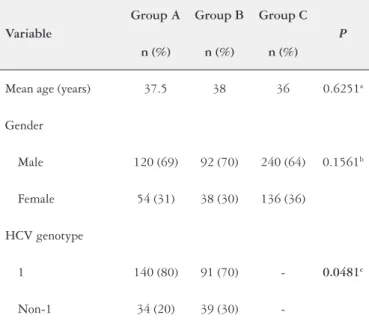
Table 1 shows the demographic data of each group. No signiicant difference in mean age or gender distribution was observed between the three groups studied. However, comparison of the frequency of HCV genotypes showed a higher prevalence of genotype 1 in patients with persistent infection (group A) compared to the group with spontaneous clearance (group B).
Histological analysis revealed the presence of chronic hepatitis in all patients. Grade 0 or 1 necroinlammatory activity was observed in 93% (284/304) of these patients and grade 2 or 3 in 7% (20/304). Regarding the stage of ibrosis, 90% (275/304) of the patients had stage 0 or 1 and 10% (29/304) stage 2. Analysis of histopathological alterations between the groups A and B showed no statistically signii-cant difference (P>0.05).
TABLE 1. Demographic and clinical characteristics of HCV-infected patients with persistent infection and spontaneous clearance and controls
Variable
Group A Group B Group C P
n (%) n (%) n (%)
Mean age (years) 37.5 38 36 0.6251a
Gender
Male 120 (69) 92 (70) 240 (64) 0.1561b
Female 54 (31) 38 (30) 136 (36)
HCV genotype
1 140 (80) 91 (70) - 0.0481c
Non-1 34 (20) 39 (30)
-Group A: patients with persistent infection; -Group B: patients with spontaneous clearance; Group C: control group. a: one-way ANOVA; b: Kruskal-Wallis test; c: X2 test.
Distribution of the IL-18 gene promoter polymor-phisms in patients and controls
Association of IL-18 gene polymorphisms with the resolution of HCV infection
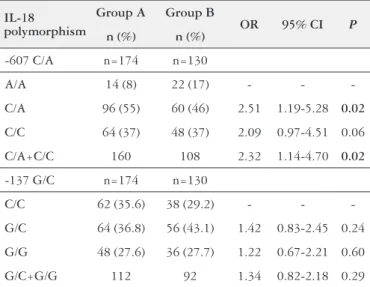
To evaluate the inluence of the IL-18 gene promoter polymorphisms (-137 G/C and -607 C/A) on the course of HCV infection, we compared allele frequencies between the patient groups: group A (persistent infection) and group B (spontaneous clearance). The frequency of allele C at po-sition -607 was higher in patients with persistent infection than in those with spontaneous clearance (Table 3). No signiicant difference between patients was observed for the allele distribution at position -137.
DISCUSSION
Progression of hepatitis C varies between patients. There is suficient evidence suggesting that the cause of progres-sion is multifactorial and includes viral, immunological and genetic factors(13).
Among viral factors, the infecting HCV genotype seems to play an important role. In the present study, a higher frequency of genotype 1 was observed in the population studied. In addition, the prevalence of genotype 1 was higher among patients with persistent infection compared to those with spontaneous clearance.
Differences in the distribution of HCV genotypes between different geographic areas have been demonstrated. In Brazil, genotype 1 is the most frequent, followed by genotypes 3 and 2 (7). Similar results have been reported for the state of Pará(17, 19).
Studies conducted in different countries suggest that the genomic heterogeneity of HCV has a signiicant impact on the severity of liver disease and on the response to treatment. In this respect, genotype 1 has been associated with severe liver damage(14, 16, 21).
Cytokines play a crucial role in the differentiation, mat-uration and functional activation of immune cells, as well as in the regulation of the immune response that controls the clearance or persistence of HCV(1, 13). The main genes involved in the progression of disease and persistence of HCV are related to viral replication and to triggering the immune response(13). Host genetic factors have been implicated in the persistence of HCV infection.
The inlammatory cytokine IL-18 has been indicated as a marker of inlammation and liver damage(6, 9). Two SNPs have been described in the promoter region of the IL-18 gene at positions -607 C/A (rs1946518) and -137 G/C (rs187238).
TABLE 2. Distribution of the IL-18 gene promoter polymorphisms (-137 G>C, -607 C>A) in patients and controls
SNP/ genotype Patients (n=304) Controls (n=376) OR 95% CI P
n (%) n (%)
-607 C/A
A/A 36 (11.8) 68 (18.1) - -
-C/A 156 (51.3) 192 (51.1) 1.53 0.97-2.42 0.08
C/C 112 (36.9) 116 (30.8) 1.82 1.12-2.94 0.01
C/A+C/C 268 308 1.64 1.06-2.54 0.03
Alleles
A 228 (37.5) 328 (43) - -
C 380 (62.5) 424 (57) 1.28 1.03-1.6 0.02
-137 G/C
C/C 100 (32.9) 128 (34) - -
-G/C 120 (39.5) 132 (35.1) 1.16 0.81-1.66 0.46
G/G 84 (27.6) 116 (30.9) 0.92 0.63-1.36 0.77
GC +GG 204 248 1.05 0.76-1.45 0.81
Alleles
C 320 (52.6) 388 (51.5) - -
G 288 (47.4) 364 (48.5) 0.95 0.77-1.18 0.74
OR: odds ratio; 95% CI: 95% conidence interval.
TABLE 3. Association between IL-18 gene polymorphisms and PCR results
IL-18 polymorphism
Group A Group B
OR 95% CI P n (%) n (%)
-607 C/A n=174 n=130
A/A 14 (8) 22 (17) - -
-C/A 96 (55) 60 (46) 2.51 1.19-5.28 0.02
C/C 64 (37) 48 (37) 2.09 0.97-4.51 0.06
C/A+C/C 160 108 2.32 1.14-4.70 0.02
-137 G/C n=174 n=130
C/C 62 (35.6) 38 (29.2) - -
-G/C 64 (36.8) 56 (43.1) 1.42 0.83-2.45 0.24
G/G 48 (27.6) 36 (27.7) 1.22 0.67-2.21 0.60
G/C+G/G 112 92 1.34 0.82-2.18 0.29
These polymorphisms are associated with the transcription activity of the IL-18 promoter and cause a reduction in serum IL-18 levels(2, 10).
Some research groups suggested that these polymorphisms inluence the clinical evolution of HCV infection. In the present study, comparison of the -607 C/A and -137 G/C polymor-phisms between HCV-infected patients and controls showed a higher frequency of allele C at position -607 in the patient group. In addition, genotype C/A at position -607 was associated with a higher risk of persistent infection with HCV (OR=2.51). Similar studies conducted in America(1), India(13), and Europe(11) also showed that the mutation from C to A at po-sition -607 was associated with viral clearance and protection against severe liver disease in the populations studied.
CONCLUSION
The importance of -607 and -137 polymorphisms in the IL-18 gene promoter for HCV infection should be further studied, but our studies suggest an association between the polymorphism -607 and the persistence of viral infection.
Authors’ contributions
Santos KN e Almeida MKC: realization of tests for molecular detection of IL-18 polymorphism. Fecury AA: realization of serological and molecular testing for HCV infection. Costa CA:clinical monitoring of patients. Martins LC: writing and statistical analysis of the article.
Santos KN, Almeida MKC, Fecury AA, Costa CA, Martins LC. Análise do polimorismo na região promotora do gene da interleucina 18 (-137 G/C e -607 C/A) em pacientes portadores do vírus da hepatite C na Amazônia Brasileira. Arq Gastroenterol. 2015,52(3):222-7.
RESUMO - Contexto - O vírus da hepatite C é reconhecido como a maior causa de doença hepática crônica no mundo. Fatores genéticos do hospedeiro têm sido implicados na persistência da infecção pelo vírus da hepatite C. Polimorismos de nucleotídeos únicos na posição -607 C/A (rs1946518) e -137 G/C (rs187238) na região promotora do gene da IL-18 têm sido evidenciados em alguns estudos que sugerem sua associação ao atraso na depu-ração do vírus da hepatite C e na persistência da doença. Objetivo - O presente estudo pretende identiicar esses polimorismos em uma população da região da Amazônia Brasileira infectada pelo vírus da hepatite C. Métodos - Estudo do tipo transversal analítico no município de Belém-PA foi realizado em 304 pacientes infectados pelo vírus da hepatite C, divididos em: grupo A, pacientes com infecção persistente; grupo B, pacientes que apresentaram clareamento viral. Como grupo controle participaram 376 voluntários não infectados pelo vírus da hepatite C. As amostras foram submetidas à RT-PCR, para detecção do RNA viral e, posteriormente, à RFLP-PCR para avaliação do polimorismo na região promotora do gene da IL-18, nas posições -137 G/C e -607 C/A. Resultados - A comparação das frequências dos polimorismos no grupo de pacientes com o grupo controle demonstrou uma maior frequência do alelo C na posição -607 entre os pacientes (P=0,02) que no grupo controle. Na análise da associação dos polimorismos com a infecção viral foi obtido que portadores do genótipo C/A na posição -607 possuíam maior risco de infecção persistente pelo vírus da hepatite C (P=0,03). Conclusão - Nossos resultados sugerem uma possível implicação do polimorismo da região promotora -607 do gene IL-18 na patogenia da infecção pelo vírus da hepatite C.
REFERENCES
1. An P, Thio CL, Kirk GD, Donield S, Goedert JJ, Winkler CA. Regulatory
polymorphisms in the interleukin-18 promoter are associated with hepatitis C virus clearance. J Infect Dis. 2008;198(8):1159-65.
2. Arimitsu J, Hirano T, Higa S, Kawai M, Naka T, Ogata A, et al. IL-18 gene poly-morphisms affect IL-18 production capability by monocytes. Biochem Biophys Res Commun. 2006;342(4):1413–6.
3. Asselah T, Estrabaud E, Bieche I, Lapalus M, De Muynck S, Vidaud M, et al.
Hepatitis C: viral and host factors associated with non-response to pegylated interferon plus ribavirin. Liver Int. 2010;30(9):1259-69.
4. Ayres M, Ayres Junior M, Ayres DM, Dos Santos AS. Bio Estat 5.0: aplicações
estatísticas das ciências biológicas e médicas, 5. ed. Belém: Sociedade Civil Ma-mirauá. MCTCNPq, 2007.
5. Baldick CJ, Wichroski MJ, Pendri A, Walsh AW, Fang J, Mazzucco CE, et
al. A novel small lmolecule inibhitor of hepatitis C vírus entry. PLoS Pathog. 2010;6(9):e1001086.
6. Bouzgarrou N, Hassen E, Schvoerer E, Stool-Keller F, Bahri O, Gabbouj S, et al. Association of Interleukin-18 polymorphisms and plasma level with the outcome of chronic HCV infection. J Med Virol. 2008;80(40):607-14.
7. Campiotto S, Pinho JRR, Carrilho FJ, Da Silva LC, Souto FJD, Spinelli V, et
al. Geographic distribution of hepatitis C vírus genotypes in Brazil. Braz J Med Biol Res. 2005;38(1):41-9.
8. Castello G1, Scala S, Palmieri G, Curley SA, Izzo F. HCV-related hepatocellular carcinoma: from chronic inlammation to cancer. Clin Immunol. 2010;134(3): 237-50.
9. Giedraitis V, He B, Huang W-X, Hillert J. Cloning and mutation analysis of the human IL-18 promoter: a possible role of polymorphisms in expression regulation. J Neuroimmunol. 2001;112(1-2):146-52.
10. Haas SL, Weiss C, Bugert P, Gundt J, Witt H, Singer MV, et al. Interleukin 18 promoter variants (-137G>C and -607C>A) in patients with chronic hepatitis C: association with treatment response. J Clin Immunol. 2009;29(5):620-8. 11. Hazari S, Acharya SK, Panda SK. Development and evaluation of a
quantita-tive competiquantita-tive reverse transcription polymerase chain reaction (RT-PCR) for hepatitis C virus RNA in serum using transcribed thio-RNA as internal control. J Virol Methods. 2004;116(1):45-54.
12. Manohar K, Suneetha PV, Sukriti Pati NT, Gupta AC, Hissar S, Sakhuja P, Sarin SK. Associationof IL-18 promoter polymorphism with liver disease severity in HCV-infected patients. Hepatology International. 2009;3(2):371-7.
13. Mihm S, Fayyazi A, Hartmann H, Ramadori G. Analysis of histopathological manifestations of chronic hepatitis C virus infection with respect to virus genotype. Hepatology. 1997;25(3):735-9.
14. Morales RJP, Rodriguez TRV, Torres O, Morado IC, Castañeda S, Filloy JAM, et al. Association between IL-18 gene polymorphisms and biopsy-proven giant cell arteritis. Arthritis Res Ther. 2010;12(2):1-7.
15. Nousbaum J-B, Pol S, Nalpas B, Landais P, Berthelot P, Brechot C. Hepatitis C virus type 1b (II) infection in France and Italy. Ann Intern Med. 1995;122(3):161-8. 16. Oliveira CSF de, Silva AV, Santos KN, Fecury AA, Almeida MKC de, Fernades AP, et al. Hepatitis B and C virus infection among Brazilian Amazon riparians. Rev Soc Bras Med Trop. 2011;44(5):546-50.
17. Puoti C, Guarisco R, Bellis L, Spilabotti L. Diagnosis, management, and treatment of hepatitis C. Hepatology. 2009;50(1):322.
18. Sawada L, Pinheiro AC, Locks D, Pimenta A do S, Rezende PR, et al. Distribution of hepatitis C virus genotypes among different exposure categories in the State of Pará, Brazilian Amazon. Rev Soc Med Trop. 2011;44(1):8-12.
19. Shin HD, Kim LH, Park BL, Choi YH, Park HS, Hong SJ, et al. Association of interleukin 18 (IL18) polymorphisms with speciic IgE levels to mite allergens among asthmatic patients. Allergy. 2005;60(7):900–6.
20. Singh S, Gupta R, Malhotra V, Sarin SK. Predictors of histological activity and ibrosis in chronic hepatitis C infection: a study from North India. Ind J Pathol Microbiol. 2010;53(2):238-43.
21. Tomanovic NR, Boricic IV, Brasanac DC, Stojsic ZM, Delic DS, Brmbolic BJ. Activated liver stellate cells in chronic viral C hepatitis: histopathological and immunohistochemical study. Journal Gastrointestinal Liver Diseases. 2009;18(2): 163-7.
22. Viso ATR, Barbosa TC, Yamamoto L, Pagliari C, Fernandes ER, Brasil RA, Andrade Junior HF, Duarte MIS, Barone AA. Portal CD4+ and CD8+ T lym-phocyte correlate to intensity of interface hepatitis in chronic hepatitis C. Rev Inst Med trop S Paulo, 2007;49(6):371-8.