Protein requirements, morbidity and mortality in
critically ill patients: fundamentals and applications
Necessidades proteicas, morbidade e mortalidade no paciente
grave: fundamentos e atualidades
INTRODUCTION
Protein: a fundamental element of metabolism in seriously ill patients
he state of stress, which is associated with trauma, sepsis, and advanced cancer, is accompanied by multisystemic alterations, changes in macronutrient metabolism, and endocrine-metabolic activities and immunological responses. Characteristically, the stress response involves increases in energy expenditure (EE) and in the use of protein reserves, primarily in the myoibrils (actin and myosin) of skeletal muscle protein.(1,2)
he mobilization of these reserves is not a unidirectional catabolic process but rather the result of an imbalance between protein synthesis and degradation, both of which are increased compared to the equilibrium state and can become as high as 45% and 80% above normal, respectively,(3,4)
depending the magnitude of the trauma. he resulting negative protein balance may be associated with immunosuppression, poor wound healing and muscle weakness, reducing the survival likelihood of critically ill patients and increasing the length of hospitalization and the accompanying costs. Preserving lean mass is one of the main goals of nutrition therapy (NT) for critically ill patients. In practice, this goal is achieved by adding adequate quantities of protein to
Haroldo Falcão Ramos da Cunha1,2, Eduardo Eiras Moreira da Rocha3, Monica Hissa2,4
1. Nutritional Therapy Services, Clínica São Vicente - Rio de Janeiro (RJ), Brazil. 2. Nutritional Therapy Services, Hospital da UNIMED - Rio de Janeiro (RJ), Brazil. 3. Nutritional Therapy Services, Hospital Copa D’Or - Rio de Janeiro (RJ), Brazil.
4. Nutritional Therapy Services, Hospital Federal dos Servidores do Estado - Rio de Janeiro (RJ), Brazil.
ABSTRACT
Recent evidence suggests that a negative protein balance secondary to severe disease is associated with increased morbidity. A loss of total body protein is inevitable in this scenario, even with an aggressive nutritional approach, primarily due to the catabolism of skeletal muscle fibers. The ubiquitin-proteasome system is the primary metabolic and biochemical mechanism involved in this process; paradoxically, this system consumes adenosine triphosphate as its energy source. It is possible that a neutral protein balance in these clinical situations is important for improving outcomes and achieving
the caloric goals estimated or measured by indirect calorimetry. Recent studies have suggested that the use of higher protein concentrations in nutritional therapy for critically ill patients may help to reduce mortality. he purpose of this study was to review some of the nutrition therapy principles related to protein metabolism, evaluate the main assertions of the guidelines of specialty societies and review the recent studies that address these issues using critical insights from the authors’ clinical experience.
Keywords: Nutrition therapy; Intensive care; Enteral nutrition; Parenteral nutrition; Dietary proteins; Nitrogen; Morbidity; Mortality
Conflicts of interest: None.
Submitted on December 19, 2012 Accepted on February 25, 2013
Corresponding author:
Haroldo Falcão Ramos da Cunha Rua Raimundo Corrêa, 39, apto. 1.102 - Copacabana
CEP: 22040-041 - Rio de Janeiro (RJ), Brazil E-mail: haroldo.cunha@
the NT administered during the acute phase of disease. Skeletal muscle is used here as a synonym for “lean mass” or “cellular body mass” to refer to the tissue components of the body that exchange oxygen, are rich in potassium, oxidize glucose and perform work.(5)
he perception that the provision of dietary protein could participate in preserving lean mass is not limited to experimental settings; clinical data was published in the 1970s. Moore and Brennan(6) noted that in multiple trauma
surgical patients and patients with parenteral glucose levels of 5%, protein loss could reach 1.250 g after 2 weeks, which is equivalent to 6 kg of muscle or 21% of the total body muscle mass. he administration of 3000 mL per day of a solution containing 3.5% hydrolyzed protein and 18% glucose (approximately 105 g of protein and 2580 kcal) was able to reduce this muscle loss. Although these authors did not provide the number of observations, the weights of the evaluated patients or further details about the study population, this study was one of the irst to mention (recognized by the American College of Surgeons) the use of amino acids/proteins in clinical settings to conserve lean mass.
Monk et al. and Plank et al. observed similar behavior in polytrauma patients(7) and in septic patients,(8) respectively,
receiving enteral nutrition and reported even greater losses, approximately 1.09 kg of protein (4.36 kg of lean mass) in 21 days. Measurements of urinary 3-hydroxyproline in these cohorts indicated that two-thirds of the nitrogen losses in the irst 2 weeks following the injury were from the skeletal muscle, which constitutes an important source of nitrogen (up to 70% of total nitrogen input).
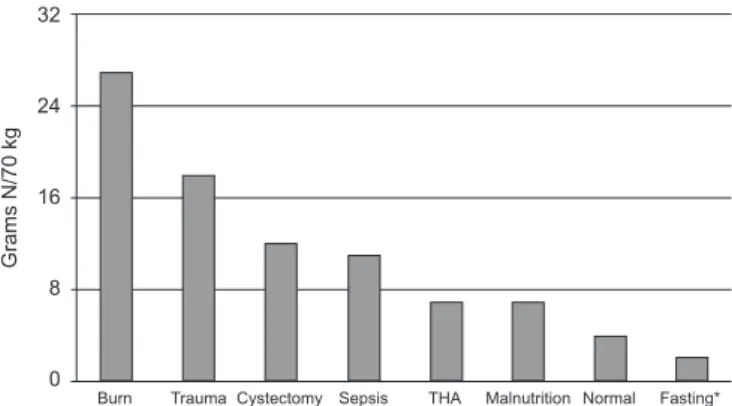
he metabolic consumption of this compartment is constant and inevitable in response to acute injury, and its intensity depends on the severity of the clinical situation (Figure 1). he consumed lean mass is not only destined for oxidation but also is used in the synthesis of acute phase proteins, i.e., proteins related to immunity and tissue repair and cellular proliferation. Clarke et al.(9) have demonstrated
the compulsory aspect of non-oxidative protein fates in their study of septic (n=14) and multiple trauma (n=10) patients by analyzing the behaviors of serum levels of visceral protein markers (insulin-like growth factor 1 (IGF-1), transferrin, and prealbumin) and acute phase markers (C-reactive protein and alpha 1-antitrypsin) relative to the amount of total body protein (TBPr) measured using an in vivo neutron activation analysis (IVNAA). hese patients received an energy intake of between 80% and 91% of their resting EE (REE), as measured using indirect calorimetry (IC) during the initial and inal phases of the study, respectively, and 1.5 g ptn.kg-1.d-1, in the form of enteral NT (ENT) or PNT, as
tolerated. he authors observed an increase in acute phase
protein serum levels and a reduction in constituent proteins, which returned to normal levels after clinical-metabolic stabilization. he hepatic synthesis of constituent proteins was maintained even during massive proteolysis and was responsible for the consumption of up to 12.6% (1.31 kg) of the TBPr during the observation period (25 days).
In a study by Zhang et al.(10) using an electrical burn
experimental model, the authors demonstrated that local tissue repair processes are also involved in the utilization of circulating amino acids and their commitment to non-oxidative pathways. he rates of deoxyribonucleic acid and protein synthesis were measured using tissue doses of radiolabeled leucine (synthesis) and amino acid metabolites (protein deposition) at three time points after injury. Compared to the control group, they observed that, on the 7th day after the trauma (coinciding
with Cuthbertson’s low phase) the rate of local protein synthesis increased by approximately 20% (20.5±8.4% per day, p<0.01) compared to the baseline measurements taken immediately following the trauma. hese data suggest that there is an increase in protein synthesis but no signiicant increase in cell proliferation in the days following an acute injury.
THE RELATIONSHIPS AMONG BODY COMPOSITION, ENERGY DEMAND, AND PROTEIN REQUIREMENTS
To preserve lean mass, nutritional protein (exogenous) should be diverted from the oxidative metabolic pathways, a goal that can be achieved with suicient energy intake. he metabolic principle, according to which the provided protein should be accompanied by a proportional amount of calories, is consistent with the current understanding of the pathways involved in energy metabolism and is supported by experimental and observational studies in
Figure 1 - Urinary excretion of nitrogen in subjects receiving intravenous infusion of glucose in different clinical contexts. Adapted from Elwyn DH. Protein metabolism and requirements in the critically ill patient. Crit Care Clin. 1987;3(1):57-69. *Fasting alone, without concomitant disease. THA - total hip arthroplasty.
Burn Trauma Cystectomy Sepsis THA Malnutrition Normal Fasting*
G
ra
ms
N
/7
0
kg
32
24
16
8
healthy volunteers. his is the paradigm guiding NT today. However, it should be remembered that these postulates have not yet been tested in patients with serious diseases, and using techniques that include radioisotopes. For example, in studies of the metabolic kinetics of macronutrients labeled with radioisotopes (continuous intravenous infusion of [L-13C] (leucine) with 1.4 to 2.2 g ptn.kg-1.d-1), Wolfe et al.(11) and Shaw et al.(12) have
demonstrated that, in severe trauma patients receiving an adequate number of calories, regardless of the type of nutritional support (enteral or parenteral), approximately one-third (33.3%) of the protein mass was directed towards protein synthesis (anabolism), and one-third was directed towards consumption (catabolism). By exclusion, the remaining one-third must become part of the plasma reserves. hus, between the fraction destined for catabolism and the reserve fraction, approximately 66.7% of the TBPr is available for immediate consumption, if necessary, in this metabolic environment, regardless of the amount of protein that is provided by NT. his inding serves as the basis for the argument against the hypothesis that the provision of excess protein is able to preserve lean mass. To date, the optimal amount of protein required to minimize the loss of lean mass remains unknown.
Furthermore, this issue does not appear to be restricted to the amount of protein provided because the intrinsic characteristics of a disease may contribute to better or worse macronutrient utilization. he hypothesis of anabolic resistance was irst postulated in the 1930s by Cuthbertson(13) and has been supported by more recent
data. Anabolic resistance, which occurs during old age and in chronic diseases including liver cirrhosis and chronic obstructive pulmonary disease,(14) is also manifested during
severe disease. he primary enzymatic mechanism involved in the process of anabolic resistance is the ubiquitin-proteasome system (UPS), which is responsible for increased protein consumption in cases of severe trauma, sepsis, and cancer. Other pathways, including the calcium-dependent and lysosomal pathways, induce only modest changes in lean mass. UPS is an enzyme complex that is regulated at diferent points by proteolytic pathways and promotes the degradation of myoibrillar proteins (actin and myosin in skeletal muscle) in the phase of organic stress. his proteolytic system is related to sarcopenia and has been extensively reviewed in the literature.(15)
ENERGY EXPENDITURES
EE is an important variable that interferes with protein balance. he irst and most well known observation
of this phenomenon was made in what is known as the “Minnesota experiment”, which was conducted during World War II. his experiment demonstrated a substantial loss of lean mass during prolonged caloric deprivation (approximately 22 kcal.kg-1.d-1),
even when healthy volunteers were given adequate protein (0.75 g.kg-1.d-1).(16) Calloway,(17,18) who was
a pioneer of nitrogen balance studies in the 1950s, later demonstrated the lean mass-sparing efect that increased amounts of protein can have on the state of negative caloric balance in normal volunteers and in patients with sepsis or trauma.(19,20)
To minimize nitrogen losses in fasting subjects receiving dextrose infusion, a large supply of carbohydrates is needed, up to 3,000 kcal.d-1. his sparing
efect can be intensiied by simply adding nitrogen to the intravenous formula. According to Bursztein et al.(2),
the incorporation of nitrogen in the setting of a simple supply of carbohydrates, promotes the formation of adipose, vessel and stroma tissue but not muscle tissue. When nitrogen is introduced, fewer calories are needed to achieve a positive nitrogen balance, at the expense of muscle protein incorporation. hese data provide the rationale for the use of the kcal non-protein:g N ratio in NT decision making.
PERCENT LEAN MASS IN THE BODY MASS INDEX
The EE per unit weight in subjects with a low body mass index (BMI) (e.g., <17 kg/m2) may be different
when measured using IC compared to when estimated using a formula. In theory, patients with a low BMI should have a greater fraction of metabolically active tissue, which would give this group a higher EE per unit weight, a peculiarity that is not normally expected in the formulas used to calculate EE. A 30-year-old who is 1.70 m tall and has a body weight of 70 kg (BMI=24) would have, according to the Harris-Benedict equation, a stress factor of 1.2 and an EE of 2012 kcal.d-1, or 28.7 kcal.kg-1. The same individual
with BMI=17 (current weight of 49 kg) would have a metabolic rate of 1666 kcal.kg-1 and 34 kcal.kg-1.d-1.
This approximately 20% increase in the energy expenditure per kg under reduced BMI conditions justifies, in the opinion of some authors, a 20% increase in the protein provision from 1.5 to 1.8 or 1.9 g.kg-1.d-1.(21-25)
CALORIC INTAKE AND ANABOLIC EFFICIENCY
In addition to the variables mentioned, it is important to remember that the eiciency of nitrogen incorporation depends on an optimal range of protein and calorie provision. In studies using immobilized healthy volunteers, Biolo et al.(27,28) observed that both hyperalimentation and
protein-calorie restriction were correlated with a loss of anabolic eiciency and skeletal muscle atrophy. Especially in the case of overprovision, increased fat deposition was observed, in addition to increased inlammatory activity and oxidative stress, linking skeletal muscle metabolism to systemic inlammation. Another interesting inding that highlights both the complexity of this issue and the prospects for intervention in critically ill patients is that even in situations of low calorie-protein provision, muscle work seemed to play an important role in protecting against atrophy and a reduction in localized inlammatory processes.
PROTEIN REQUIREMENTS
In a meta-analysis of 91 cohorts and 1107 patients in whom nitrogen balance was measured, Kreyman et al.(29) observed that proteolysis (measured using urea
nitrogen) is exponentially related to clinical severity and that EE and is greatly increased in critically ill patients (1.2 to 3.1 g.kg-1.d-1), moderately increased
in intermediate injuries (0.8 to 1.2 g.kg-1.d-1) and
minimally elevated in healthy subjects (<0.8 g.kg-1.d-1).
he intensity of protein loss tends to exceed the EE to the extent of the hypercatabolism of the patient. Interestingly, the nonlinear regression curves, which were very similar for both patients without supplied protein and those with NT, indicate that the urea nitrogen levels could not be explained simply by the excessive nitrogen provision. In the total sample, up to 35% of patients enrolled in these studies had protein deicits on the order of 1.5 to 2.0 g ptn.kg-1.d-1.
To meet the increased demand for nitrogen and preserve lean mass, a strategic response would be to increase amino acid and protein provision. In healthy adults, the amount of protein is considered adequate when it is suicient to maintain protein balance, a zero-sum position (neutral balance) in which the provision is equal to loss. his model does not apply in situations of inevitable catabolism, such as in cases of severe disease when then the supply should be aimed towards maintaining a positive or minimally negative protein (and nitrogen) balance.(30)
In a classic study, Ishibashi et al.(31) sought to
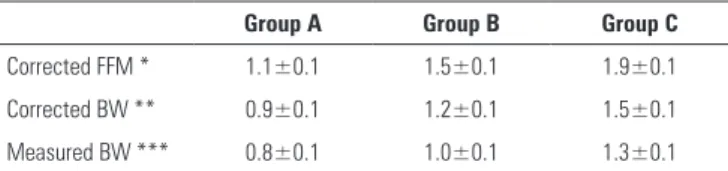
determine the optimal amount of protein to be provided. Serial body composition measurements made using the IVNAA and IC methods were taken in 25 polytrauma or septic patients after resuscitation and within the next 10 days. Three groups were established according to the amount of protein provided (0.9 to 1.2, 1.3 to 1.6 and 1.7 to 2.0 g.kg-1.d-1).
The patient’s pre-admission weight was used to calculate the protein provided, thus excluding the weight gains related to fluid retention during resuscitation. Provisions of between 1.3 and 1.6 g ptn.kg-1.d-1
were the best correlated with higher nitrogen incorporation. The authors proposed, for calculation purposes, targets of 1.2 g ptn.kg-1.d-1 (pre-admission
weight) or 1.0 g.kg-1.d-1 (post-resuscitation weight,
to compensate for the weight gain secondary to fluid retention) (Table 1). Protein provisions >1.7 g ptn.kg-1.d-1
did not have any additional benefit in preserving lean mass, and levels above 2 g.kg-1.d-1 in patients with
BMI <30 can contribute to hyperalimentation and nitrogen retention, especially in patients with impaired renal function and elderly patients.(32) However,
one cannot rule out the hypothesis that individual variation in selected clinical scenarios could benefit from provisions above the normally recommended range. For example, in traumatic brain injury (TBI), a situation in which protein oxidation can reach up to 34% of the estimated REE,(33) nitrogen balance
measurement studies have shown that provisions >2 g.kg-1.d-1 were associated with a positive nitrogen
balance compared with provisions of 1.5 g.kg-1.d-1.(34.35)
Greater protein supplementation may also be useful in patients with excessive losses, such as those suffering from burns, fistula or peritoneostomy.(36)
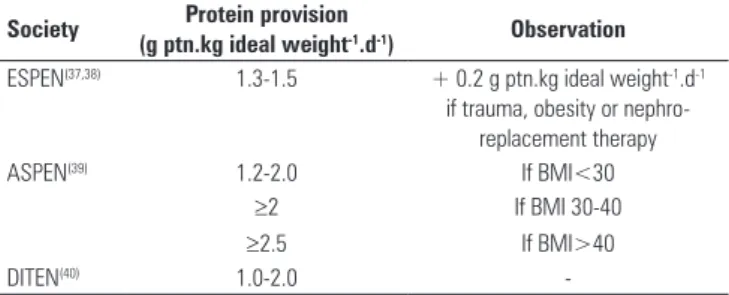
Specialist societies, primarily European societies, have very similar protein provision recommendations based on the fundamental work published by Ishibashi(31) (Table 2). A protein supply within the
range of 1 to 2 g.kg-1.d-1 is considered normal for
critically ill patients.
Table 1 - Protein intake, corrected for fat-free mass and body weight in kg
Group A Group B Group C
Corrected FFM * 1.1±0.1 1.5±0.1 1.9±0.1
Corrected BW ** 0.9±0.1 1.2±0.1 1.5±0.1
Measured BW *** 0.8±0.1 1.0±0.1 1.3±0.1
RESULTS OF RECENT CLINICAL TRIALS
he most recent evidence seems to suggest that there is an association between protein intake >1.2 g.kg-1.d-1,
which is near the upper limit, or at least within the target range, and a reduction in morbidity and mortality. In 2009, Alberda et al.(41) conducted the irst study of the
association between protein and calorie provisions and patient outcomes in a multicenter study that included 2772 patients in 167 intensive care units in 37 countries. In addition to the beneicial efects of higher caloric intake, these authors observed that the provision of an additional 30 g.day-1 was associated with a relative risk (RR) of 0.84
(95% CI=0.74-0.96, p=0.008). his observation was not explored in more detail in the original article, but it paved the way for additional research on this topic.
Strack van Schijndel et al.(42) have reported a
retrospective study that included 243 patients on mechanical ventilation. hese authors evaluated the clinical impact of caloric intake determined by IC and protein provision at a target of 1.2 g.kg-1.d-1 (pre-admission
weight). hey found a reduction in the 28-day mortality rate in the ICU and hospital for female but not male patients and suggested that this phenomenon was due to the lower lean body mass of female patients, which would imply a proportionally greater protein provision per kg of body weight, thus allowing the authors to more clearly observe the clinical impact of the increased provision. In a clinical trial with 886 critically ill patients on mechanical ventilation,(43) these same authors compared the clinical
outcomes of patients with varying levels of success in meeting protein and calorie targets. Patients were divided into three groups: (1) no control of the protein-calorie target, (2) control of the caloric target exclusively and (3) control of both the calorie and protein targets. he average protein provisions were 0.83 g.kg-1.d-1, 1.06 g.kg-1.d-1,
and 1.31 g.kg-1.d-1 in groups 1, 2, and 3, respectively.
he diferences in protein provision between groups 1
and 2 and between groups 1 and 3 for a patient of 70 kg were +17.5 g and +33.6 g, respectively. he study noted signiicant reductions in the 28-day mortality rate and hospital mortality rate in group 3 and showed that the impact of nutritional intervention extends beyond a patient’s stay in the intensive care unit. Coincidentally, the increase in the protein provided that was best associated with reduced mortality was approximately 30 g, similar to what was observed by Alberda et al.(41) Similar results were
also reported in a population of patients with less severe disease who were admitted to clinical nursing units.(44)
Nevertheless, the efects of increased protein provision are not well characterized and are, in part, dependent on the design of the study.
Research by Tsai et al.(45) and Franzosi et al.(46) on the
clinical outcomes of patients with diferent protein-caloric intake after 6 days provides examples of studies that arrive at diferent conclusions based on the quality of the matching between groups. he control of protein targets already appears to have important implications in study design for diferent clinical conditions, even those that are not speciically assessing the impact of NT. his is well stated by Wischmeyer in a recent non-systematic review.(47)
One example in this review was the exceptionally low mortality rate (the lowest reported to date, 16%) reported for patients who received the control nutritional formulation in the study. he study compared the efect of a nutritional formula containing eicosapentaenoic acid (EPA)/gamma-linolenic acid/antioxidants compared with a control enteral nutritional formula in patients with acute respiratory distress syndrome (ARDS). he quantity of protein in the control formula was ive times higher than that in the experimental formula.(48)
Another point that should be investigated further is the mechanisms of action by which higher protein provision may be related to a better prognosis. In an observational study involving 113 patients, Allingstroup et al.(49) reported that a progressive increase in protein
provision (0.79, 1.06 and 1.46 g.kg-1.d-1) did not linearly
correlate with increased survival over 10 days (50%, 78% and 87%, respectively) but did correlate with gradually reduced beneits > 1.5 g.kg-1.d-1. he authors
noted that this reduction in mortality was not mediated by positive protein or energy balances because they did not vary between groups. he authors suggested that the increased protein provisions could have inluenced both the synthesis of skeletal muscle protein and the availability of amino acids as substrates in the synthesis of metabolic and immunological mediators and structural components.(35,50)
Table 2 - Recommended protein provision level guidelines for critically ill patients, as reported by different societies
Society Protein provision
(g ptn.kg ideal weight-1.d-1) Observation ESPEN(37,38) 1.3-1.5 + 0.2 g ptn.kg ideal weight-1.d-1
if trauma, obesity or nephro-replacement therapy
ASPEN(39) 1.2-2.0 If BMI<30
≥2 If BMI 30-40
≥2.5 If BMI>40
DITEN(40) 1.0-2.0
FINAL CONSIDERATIONS
Protein provisions guided by targets appear to be related to reduced morbidity and mortality in critically ill patients. Currently, there is strong evidence in the literature that the use of higher protein concentrations (>1.2 g ptn.kg-1.d-1) is associated with reduced morbidity
and mortality in this population.
Further studies are needed to determine the mechanisms of action and optimal protein concentrations for nutritional formulations. Until more direct, precise, and simple methods for the measurement of body nitrogen levels and metabolic kinetics are available, the guideline recommendations from specialist societies will continue to serve as the basis for decision making. Nevertheless, a new principle seems to have been established: In addition to caloric requirements, the ideal protein provision target must be investigated, and the achievement of ideal protein levels may have clinical and prognostic impacts that are as important as or even more important than achieving caloric targets alone.
RESUMO
Evidências recentes sugerem que o balanço proteico negativo secundário à doença grave se associa ao aumento de morbidade. A perda da proteína corporal total é inevitável nesse cenário, mesmo com uma abordagem nutricional agressiva, e resulta, principalmente, do catabolismo da ibra muscular esquelética. O principal mecanis-mo bioquímico e metabólico envolvido nesse processo é o sistema ubiquitina-proteassoma, que, paradoxalmente, consome a adenosina trifosfatocomo fonte energética e motriz. É possível que a neutralida-de do balanço proteico nessas instâncias clínicas, seja tão importante na melhora dos desfechos quanto atingir a meta calórica estimada ou medida pela calorimetria indireta. Estudos recentes apontam a utilização de concentrações mais elevadas de proteínas na terapia nutricional do paciente grave como importante para um impacto positivo na mortalidade. A proposta deste trabalho foi revisar alguns princípios da terapia nutricional relativos ao metabolismo proteico, sinalizar para as principais assertivas das diretrizes das sociedades es-pecializadas e comentar estudos recentes, que abordam a questão em tela, sob a visão crítica da experiência clínica dos autores.
Descritores: Terapia nutricional; Terapia intensiva; Nutrição enteral; Nutrição parenteral; Proteínas na dieta; Nitrogênio; Morbidade; Mortalidade
REFERENCES
1. Cuthbertson DP. Post-shock metabolic response. Lancet.1942;239(6189):433-7. 2. Bursztein S,Elwyn DH, Askanazi J, Kinney JM. Energy metabolism, indirect
calorimetry, and nutrition. Baltimore: Williams & Wilkins; 1989.
3. Biolo G, Fleming RY, Maggi SP, Nguyen TT, Herndon DN, Wolfe RR. Inverse regulation of protein turnover and amino acid transport in skeletal muscle of hypercatabolic patients. J Clin Endocrinol Metab. 2002;87(7):3378-84. 4. Tashiro T, Mashima Y, Yamamori H, Horibe K, Nishizawa M, Okui K.
Alteration of whole-body protein kinetics according to severity of surgical trauma in patients receiving total parenteral nutrition. JPEN J Parenter Enteral Nutr. 1991;15(2):169-72.
5. Moore FD, Olesen KH, McMurrey JD, Parker HV, Ball MR, Boyden CM. The body cell mass and its supporting environment: body composition in health and disease. Philadelphia: W.B. Saunders; 1963.
6. Moore FD, Brennan MF. Surgical injury: body composition, protein metabolism, and neuroendocrinology. In: Ballinger WF, Collins JA, Drucker WR, Dudrick SJ, Zeppa R,editors. Manual of surgical nutrition. Philadelphia: W.B. Saunders; 1975. p. 169-222.
7. Monk DN, Plank LD, Franch-Arcas G, Finn PJ, Streat SJ, Hill GL. Sequential changes in the metabolic response in critically injured patients during the first 25 days after blunt trauma. Ann Surg. 1996;223(4):395-405. 8. Plank LD, Connolly, Hill GL. Sequential changes in the metabolic response
in severely septic patients during the first 23 days after the onset of peritonitis. Ann Surg. 1998;228(2):146-58.
9. Clarke MA, Hentzen BT, Plank LD, Hill GL. Sequential changes in insulin-like growth factor 1, plasma proteins, and total body protein in severe sepsis and multiple injury. JPEN J Parenter Enteral Nutr. 1996;20(5):363-70. 10. Zhang XJ, Chinkes DL, Wolfe RR, Wolfe RR. The flow phase of wound
metabolism is characterized by stimulated protein synthesis rather than cell proliferation. J Surg Res. 2006;135(1):61-7.
11. Wolfe RR, Goodenough RD, Burke JF, Wolfe MH. Response of protein and urea kinetics in burn patients to different levels of protein intake. Ann Surg. 1983;197(2):163-71.
12. Shaw JH, Wildbore M, Wolfe RR. Whole body protein kinetics in severely septic patients.The response to glucose infusion and total parenteral nutrition. Ann Surg. 1987;205(3):288-94.
13. Cuthbertson DP. The disturbance of metabolism produced by bony and non-bonyinjury, with notes on certain abnormal conditions of the bone. Biochem J. 1930;24(4):1244-63.
14. Biolo G. Protein metabolism and requirements. In: Singer P, editor. Nutrition in intensive care medicine: beyond physiology. Basel: Karger; 2012. vol. 105.p. 12- 20.
15. Mitch WE, Goldberg AL. Mechanisms of muscle wasting. The role of ubiquitin-proteassome pathway. N Engl J Med. 1996;335(25):1897-905. 16. Keys A, Brozek J, Henschel A, Mickelsen O, Taylor HL. The biology of
human starvation. Minneapolis: The University of Minnesota Press; 1950.
17. Calloway DH, Spector H. Nitrogen utilization during caloric restriction. I. The effect of dietary fat content. J Nutr. 1955;56(4):533-44.
18. Calloway DH, Spector H. Nitrogen balance as related to caloric and protein intake in active young men. Am J Clin Nutr. 1954;2(6):405-12.
19. Blackburn GL, Flatt JP, Clowes GH Jr, O’Donnell TF, Hensle TE. Protein sparing therapy during periods of starvation with sepsis or trauma. Ann Surg. 1973;177(5):588-94.
20. Frankenfield D. Energy expenditure and protein requirements after traumatic injury. Nutr Clin Pract. 2006;21(5):430-7.
21. Hoffer LJ. Protein and energy provision in critical illness. Am J Clin Nutr. 2003;78(5):906-11.
22. Ahmad E, Duerksen DR, Munroe S, Bistrian BR. An evaluation of resting energy expenditure in hospitalized, severely underweight patients. Nutrition. 1999;15(5):384-8.
23. Greenberg GR, Jeejeebhoy KN. Intravenous protein-sparing therapy in patients with gastrointestinal disease. JPEN J Parenter Enteral Nutr. 1979;3(6):427-32.
25. Dickerson RN, Rosato EF, Mullen JL. Net protein anabolism with hypocaloric parenteral nutrition in obese stressed patients. Am J Clin Nutr. 1986;44(6):747-55.
26. Weijs PJ, Sauerwein HP, Kondrup J. Protein recommendations in the ICU: g protein/kg body weight - which body weight for underweight and obese patients? Clin Nutr. 2012;31(5):774-5.
27. Biolo G, Agostini F, Simunic B, Sturma M, Torelli L, Preiser JC, et al. Positive energy balance is associated with accelerated muscle atrophy and increased erythrocyte glutathione turnover during 5 wk of bed rest. Am J Clin Nutr. 2008;88(4):950-8.
28. Biolo G, Ciocchi B, Stulle M,Bosutti A, Barazzoni R, Zanetti M, et al. Calorie restriction accelerates the catabolism of lean body mass during 2 wk of bed rest. Am J Clin Nutr. 2007;86(2):366-72.
29. Kreymann G, DeLegge MH, Luft G, Hise ME, Zaloga GP. The ratio of energy expenditure to nitrogen loss in diverse patient groups--a systematic review. Clin Nutr. 2012;31(2):168-75.
30. Guadagni M, Biolo G. Effects of inflammation and/or inactivity on the need for dietary protein. Curr Opin Clin Nutr Metab Care. 2009;12(6):617-22. Review.
31. Ishibashi N, Plank LD, Sando K, Hill GL. Optimal protein requirements during the first 2 weeks after the onset of critical illness. Crit. Care Med. 1998;26(9):1529-35.
32. Dickerson RN, Medling TL, Smith AC, Maish GO 3rd, Croce MA, Minard G, et al. Hypocaloric, high-protein nutrition therapy in older vs younger critically ill patients with obesity. JPEN J Parenter Enteral Nutr. 2012 Nov 20. [Epub ahead of print].
33. Dickerson RN, Guenter PA, Gennarelli TA, Dempsey DT, Mullen JL. Increased contribution of protein oxidation to energy expenditure in head-injured patients. J Am Coll Nutr. 1990;9(1):86-8.
34. Twyman D, Young AB, Ott L, Norton JA, Bivins BA. High protein enteral feedings: a means of achieving positive nitrogen balance in head injured patients. JPEN J Parenter Enteral Nutr. 1985;9(6):679-84.
35. Scheinkestel CD, Kar L, Marshall K, Bailey M, Davies A, Nyulasi I, et al. Prospective randomized trial to assess caloric and protein needs of critically ill, anuric, ventilated patients requiring continuous renal replacement therapy. Nutrition. 2003;19(11-12):909-16.
36. Cheatham ML, Safcsak K, Brzezinski SJ, Lube MW. Nitrogen balance, protein loss, and the open abdomen. Crit Care Med. 2007;35(1):127-31. 37. Singer P, Berger MM, Van den Berghe G, Biolo G, Calder P, Forbes
A, Griffiths R, Kreyman G, Leverve X, Pichard C; ESPEN. ESPEN Guidelines on Parenteral Nutrition: intensive care. Clin Nutr. 2009;28(4):387-400. 38. Cano NJ, Aparicio M, Brunori G, Carrero JJ, Cianciaruso B, Fiaccadori
E, Lindholm B, Teplan V, Fouque D, Guarnieri G; ESPEN. ESPEN Guidelines on Parenteral Nutrition: adult renal failure. Clin Nutr. 2009;28(4):401-14. 39. Martindale RG, McClave SA, Vanek VW, McCarthy M, Roberts
P, Taylor B, Ochoa JB, Napolitano L, Cresci G; American College of Critical Care Medicine; A.S.P.E.N. Board of Directors. Guidelines for
the provision and assessment of nutrition support therapy in the adult critically ill patient: Society of Critical Care Medicine and American Society for Parenteral and Enteral Nutrition: Executive Summary. Crit Care Med. 2009;37(5):1757-61.
40. Sociedade Brasileira de Nutrição Parenteral e Enteral, Associação Brasileira de Nutrologia. Terapia nutricional no paciente grave. In: Associação Médica Brasileira, Conselho Federal de Medicina. Projeto Diretrizes. São Paulo: AMB; 2011.v. 9.
41. Alberda C, Gramlich L, Jones N, Jeejeebhoy K, Day AG, Dhaliwal R, et al. The relationship between nutritional intake and clinical outcomes in critically ill patients: results of an international multicenter observational study. Intensive Care Med. 2009;35(10):1728-37. Erratum in Intensive Care Med. 2009;35(10):1821.
42. Strack van Schijndel RJ, Weijs PJ, Koopmans RH, Sauerwein HP, Beishuizen A, Girbes AR. Optimal nutrition during the period of mechanical ventilation decreases mortality in critically ill, long-term acute female patients: a prospective observational cohort study. Critical Care.2009;13(4):R132. 43. Weijs PJ, Stapel SN, de Groot SD, Driessen RH, de Jong E, Girbes AR, et al.
Optimal protein and energy nutrition decreases mortality in mechanically ventilated, critically ill patients: a prospective observational cohort study. JPEN J Parenter Enteral Nutr. 2012;36(1):60-8.
44. Weijs PJ, Leistra E, Schipper M, Oostenbrink J, Kruizenga HM. Achieving protein and energy targets in malnourished hospitalized patients on day 4 of admission improves length of hospital stay. Clin Nutr Suppl. 2011;6(1):21.
45. Tsai JR, Chang WT, Sheu CC, Wu YJ, Sheu YH, Liu PL, et al. Inadequate energy delivery during early critical illness correlates with increased risk of mortality in patients who survive at least seven days: a retrospective study. Clin Nutr. 2011;30(2):209-14.
46. Franzosi OS, Abrahão CL, Loss SH. Aporte nutricional e desfechos em pacientes críticos no final da primeira semana na unidade de terapia intensiva. Rev Bras Ter Intensiva. 2012;24(3):263-9.
47. Wischmeyer P. Parenteral nutrition and calorie delivery in the ICU: controversy, clarity, or call to action? Curr Opin Crit Care. 2012;18(2):164-73.
48. Rice TW, Wheeler AP, Thompson BT, de Boisblanc BP, Steingrub J, Rock P; NIH NHLBI Acute Respiratory Distress Syndrome Network of Investigators. Enteral omega-3 fatty acid, gamma-linolenic acid, and antioxidant supplementation in acute lung injury. JAMA. 2011;306(14):1574-81. Erratum in JAMA. 2012;307(6):563.
49. Allingstroup MJ, Esmailzadeh N, Wilkens Knudsen A, Espersen K, Hartvig Jensen T, Wiis J, et al. Provision of protein and energy in relation to measured requirements in intensive care patients. Clin Nutr. 2012;31(4):462-8.