
ISSN 0104-6632 Printed in Brazil
www.abeq.org.br/bjche
Vol. 30, No. 01, pp. 63 - 73, January - March, 2013
Brazilian Journal
of Chemical
Engineering
MODELING VAPOR LIQUID EQUILIBRIUM OF
IONIC LIQUIDS + GAS BINARY SYSTEMS
AT HIGH PRESSURE WITH CUBIC
EQUATIONS OF STATE
A. C. D. Freitas, L. P. Cunico, M. Aznar and R. Guirardello
*School of Chemical Engineering, State University of Campinas, (UNICAMP), Phone: + (55) (19) 3521 3955, Fax: + (55) (19) 3521 3910,
Av. Albert Einstein 500, 13083-852, Campinas - SP, Brazil. E-mail: [email protected]; [email protected];
[email protected]; *[email protected]
(Submitted: February 1, 2012 ; Revised: July 7, 2012 ; Accepted: July 11, 2012)
Abstract - Ionic liquids (IL) have been described as novel environmentally benign solvents because of their remarkable characteristics. Numerous applications of these solvents continue to grow at an exponential rate. In this work, high pressure vapor liquid equilibria for 17 different IL + gas binary systems were modeled at different temperatures with Peng-Robinson (PR) and Soave-Redlich-Kwong (SRK) equations of state, combined with the van der Waals mixing rule with two binary interaction parameters (vdW-2). The experimental data were taken from the literature. The optimum binary interaction parameters were estimated by minimization of an objective function based on the average absolute relative deviation of liquid and vapor phases, using the modified Simplex algorithm. The solubilities of all gases studied in this work decrease as the temperature increases and increase with increasing pressure. The correlated results were highly satisfactory, with average absolute relative deviations of 2.10% and 2.25% for PR-vdW-2 and SRK-vdW-2, respectively.
Keywords: Ionic liquids; Vapor-liquid equilibria; PR and SRK Eos.
INTRODUCTION
Ionic liquids are organic salts that are liquid at room temperature and consist of a small organic or inorganic anion and a large asymmetric organic cation. Ionic liquids have negligible vapor pressure and a stable and wide liquid range of over 300 K. These fluids have been proposed as attractive alternatives to volatile organic compounds for green processes (Blanchard and Brennecke, 2001).
Ionic liquids have been described as novel environmentally benign solvents because of their remarkable characteristics, such as non-volatility, high thermal stability, non-flammability and high
polarity (Anthony et al., 2001; Fadeev et al., 2001). Numerous applications of these solvents continue to grow at an exponential rate; the most common applications found in the literature are in gas and liquid separation processes (Blanchard and Brennecke, 2001; Anthony et al., 2001; Fadeev
et al., 2001;Visser et al., 2000); as solvents in various reactions systems, such as hydrogenation, hydroformylations, isomerizations, dimerizations, alkylations, among others (Welton, 1999; Hermann
various gases such as CO2, H2S and SO2 (Anderson
et al., 2007); and as lubricants in different systems (Bermudez et al., 2009).
The use of carbon dioxide (CO2) as a green reaction media has gained more and more research interest due to its environmental and nontoxic properties. Carbon dioxide is nonflammable, nontoxic and inexpensive. The most important aspect of CO2 is its tunable properties, which can change significantly with temperature and pressure. CO2 has a relatively low critical temperature (31.1 °C) and moderate critical pressure (73.8 bar) (Jessop and Leitner, 1999). Wu and coworkers (Wu et al., 2005) and Zhou and coworkers (Zhou et al., 2006) investi-gated the use of compressed and supercritical CO2 as an environmentally benign alternative in ionic liquid synthesis.
The phase behavior of ionic liquids with CO2 is unique. CO2 is very soluble in ionic liquids, but, in contrast, ionic liquids are insoluble in the pure CO2 phase. Therefore, the ionic liquid + CO2 mixture does not become miscible (critical) even at elevated pressures, which makes them advantageous as biphasic reaction media. Moreover, compressed CO2 can increase the solubility of reactive gases (H2 and O2) in ionic liquids (Solinas et al., 2004; Hert et al., 2005), and dramatically decreases the melting point of many ionic solids, even inducing melting over 100 °C below the normal melting points of some ionic solids (Scurto and Leitner, 2006; Scurto et al., 2008).
Phase equilibria in systems composed of ionic liquids + CO2 were studied by several authors (Blanchard et al., 2001; Ren et al., 2010; Nwosu
et al., 2009; Carvalho et al., 2009a, 2009b; Kroon
et al., 2005; Liu et al., 2003; Blanchard et al., 1999), but few of them have assessed the solubility in ionic liquids of other gases. The phase equilibria of different imidazolium ionic liquids with 1,1,1,2-tetrafluoroethane (R-134a) were studied by Ren and Scurto (2009a, 2009b); the authors emphasize the importance of understanding these systems for the separation of hydrofluorocarbon refrigerant gases and in other engineering applications.
In this work, isothermal vapor-liquid equilibrium data for 17 binary mixtures composed of ionic liquids and different gases (CO2, C2H6, CHF3 and R-134a) were analyzed, totalizing 390 experimental data points distributed in 50 isotherms. Pressure and temperature ranges vary between 1-620 bar and 298.15-363.15 K, respectively. The systems were modeled with the Peng-Robinson (Peng and Robinson, 1976) and Soave-Redlich-Kwong (Soave, 1972) equations of state using the van der Waals
mixing rule with two adjustable parameters (k and ij l ). ij These thermodynamic models were implemented in the PE 2000 software (Pfohl et al., 2000).
THERMODYNAMIC MODELING
The Soave–Redlich–Kwong equation of state is (Soave, 1972):
RT (T)
P
V b V(V b)
α
= −
− + (1)
Here, P is the pressure, V the molar volume, T the temperature, α(T) the temperature-dependent attractive parameter, b the co-volume and R the ideal gas constant. The co-volume is temperature independent and is calculated using the critical properties as follows:
C C RT b 0.08664
P
= (2)
The attractive parameter, α(T), is calculated by a Soave-type expression:
0.5 2
C C r
a(T , P ).[1 m.(1 T )]
α = + − (3)
where:
2 C C C
C (RT ) a(T , P ) 0.42748
P
= (4)
Here, Tr is the reduced temperature. The parameter m is correlated to the acentric factor ω for light non-polar compounds, through the following expression:
2
m=0.480 1.574+ ω −0.176ω (5)
The expression for the Peng-Robinson equation of state is (Peng and Robinson, 1976):
RT (T)
P
V b V(V b) b(V b)
α
= −
− + + − (6)
C C RT b 0.0778
P
= (7)
The attractive parameter, α(T), is calculated by:
0.5 2
C C r
a(T , P ).[1 m.(1 T )]
α = + − (8)
where:
2 C C C
C (RT ) a(T , P ) 0.45724
P
= (9)
Here, the parameter m is also correlated to the acentric factor, ω, for light non-polar compounds through:
2
m=0.37464 1.54226+ ω−0.26992ω (10)
The Peng–Robinson equation is widely used in modeling the solubility of substances in supercritical fluids. For mixtures, cubic EoS like PR and SRK are widely applied utilizing the van der Waals-2-parameter (vdW-2) mixing rules:
mix i jx xi j ij
α =
∑ ∑
α and(11)
mix i j i j ij
b =
∑ ∑
x x bwhere the cross energy, αij, and cross co-volume bij are calculated by combining rules:
0.5
ij i j ij
ij i j i
ij
j ji ij ji
( ) (1 k ) and
1
b (b b
with k k and l ).(1 ) 2
l l
= α = α α
=
= −
+ − (12)
Here, kij and lij are adjustable parameters, determined by fitting binary phase equilibrium data. The combination of van der Waals mixing rules with the PR-EoS and SRK-EoS provides a good compromise between simplicity and accuracy of the modeling algorithm for representing a large variety of systems (Florusse et al., 2008). Modeling high pressure phase equilibria with this combination showed good correspondence with experimental data in previous work (Gamse and Marr, 2000, 2001).
The software Phase Equilibrium 2000 (PE2000), chosen here to calculate the phase equilibria, was
developed by Brunner and coworkers (Pfohl et al, 2000). The software was used by several other researchers (Petkov et al., 2000; Schwarz and Nieuwoudt, 2003a, 2003b; Teodorescu et al., 2003) with excellent results to correlate and predict phase equilibria. PE2000 uses the modified Simplex algorithm (Nelder and Mead, 1965) for parameter regression of the binary interaction parameters, kij and lij, minimizing the objective function of the average absolute relative deviation ( %AARD ) for liquid and vapor phase mole fractions:
N exp pred i i
exp i i 1
N exp pred i i
exp i i 1
x x
x 100
%AARD NP
y y
y =
=
⎛ − ⎞
+
⎜ ⎟
⎜ ⎟
⎜ ⎟
=
⎜ − ⎟
⎜ ⎟
⎜ ⎟
⎝ ⎠
∑
∑
(13)
Here,xiexpis the experimental liquid mole fraction data; xpredi is the predicted value; yexpi is the experimental vapor mole fraction data; ypredi is the predicted value and NP is the number of experimental data points. This objective function was used in similar works in the literature with good results (Nwosu et al., 2009; Ren and Scurto, 2009; Ren et al., 2010). Several initial guesses were utilized to avoid the local minima in the regression in order to obtain final values for kij and lij.
RESULTS AND DISCUSSION
The critical properties of ionic liquids were taken from Valderrama et al. (2007, 2008a, 2009), Ren
et al. (2010) and Nwosu et al. (2009). For CO2, C2H6 and CHF3, the properties were taken from the DIPPR data base (DIADEM, 2000). For R-134a, the critical properties are given by Ren and Scurto (2009a). All critical properties used in this work are given in Table 1.
Table 1: Critical properties of pure components.
Compound Formula MW
(g/mol)
TC
(K)
PC
(bar) ω
Carbon dioxide CO2 44.0 304.2 73.8 0.228
Trifluoromethane CHF3 70.0 299.3 48.2 0.264
1,1,1,2-tetrafluoroethane R-134a 102.0 374.3 40.6 0.327
Ethane C2H6 30.1 305.4 48.8 0.099
1-ethyl-3-methyl-imidazolium bis(trifluoromethylsulfonyl)amide [emim][Tf2N] 391.3 1244.9 32.6 0.182 1-n-hexyl-3-methyl-imidazolium bis(trifluoromethylsulfonyl)amide [C6mim][Tf2N] 447.4 1287.3 23.9 0.354 1-n-decyl-3-methyl-imidazolium bis(trifluoromethylsulfonyl)amide [dmim][Tf2N] 504.0 1345.1 18.7 0.574 1-n-exyl-3-methyl-imidazolium bromide [C6mim][Br] 247.2 841.1 26.7 0.607 1-methylimidazole 1-methylimidazole 82.1 742.4 55.6 0.279 1-n-butyl-3-methyl-imidazolium bis(trifluoromethylsulfonyl)imide [bmim][Tf2N] 419.4 826.3 27.6 0.300 1-n-pentyl-3-methyl-imidazolium bis(trifluoromethylsulfonyl)imide [pmim][Tf2N] 433.0 1249.43 26.3 0.412 1-n-octyl-3-methylimidazolium tetrafluoroborate [omin][BF4] 282.1 737.0 16.0 1.029 1-n-butyl-3-methylimidazolium tetrafluoroborate [bmin][BF4] 226.0 643.2 20.4 0.888 1-ethyl-3-methylimidazolium hexafluorophosphate [emin][PF6] 256.2 663.5 19.5 0.671 1-n-butyl-3-methylimidazolium hexafluorophosphate [bmim][PF6] 284.2 708.9 17.3 0.755 1-n-butyl-3-methylimidazolium nitrate [bmim][NO3] 201.1 946.3 27.3 0.604 1-n-hexyl-3-methylimidazolium tetrafluoroborate [C6mim][BF4] 254.1 679.1 17.9 0.926 1-n-hexyl-3-methylimidazolium hexafluorophosphate [C6mim][PF6] 312.2 754.3 15.5 0.835
Table 2: Physical characteristics of the binary systems studied in this work.
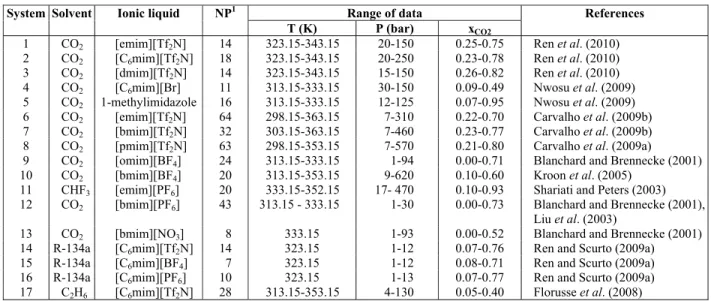
System Solvent Ionic liquid NP1 Range of data References
T (K) P (bar) xCO2
1 CO2 [emim][Tf2N] 14 323.15-343.15 20-150 0.25-0.75 Ren et al. (2010) 2 CO2 [C6mim][Tf2N] 18 323.15-343.15 20-250 0.23-0.78 Ren et al. (2010) 3 CO2 [dmim][Tf2N] 14 323.15-343.15 15-150 0.26-0.82 Ren et al. (2010) 4 CO2 [C6mim][Br] 11 313.15-333.15 30-150 0.09-0.49 Nwosu et al. (2009) 5 CO2 1-methylimidazole 16 313.15-333.15 12-125 0.07-0.95 Nwosu et al. (2009) 6 CO2 [emim][Tf2N] 64 298.15-363.15 7-310 0.22-0.70 Carvalho et al. (2009b) 7 CO2 [bmim][Tf2N] 32 303.15-363.15 7-460 0.23-0.77 Carvalho et al. (2009b) 8 CO2 [pmim][Tf2N] 63 298.15-353.15 7-570 0.21-0.80 Carvalho et al. (2009a) 9 CO2 [omim][BF4] 24 313.15-333.15 1-94 0.00-0.71 Blanchard and Brennecke (2001) 10 CO2 [bmim][BF4] 20 313.15-353.15 9-620 0.10-0.60 Kroon et al. (2005)
11 CHF3 [emim][PF6] 20 333.15-352.15 17- 470 0.10-0.93 Shariati and Peters (2003) 12 CO2 [bmim][PF6] 43 313.15 - 333.15 1-30 0.00-0.73 Blanchard and Brennecke (2001),
Liu et al. (2003)
13 CO2 [bmim][NO3] 8 333.15 1-93 0.00-0.52 Blanchard and Brennecke (2001) 14 R-134a [C6mim][Tf2N] 14 323.15 1-12 0.07-0.76 Ren and Scurto (2009a) 15 R-134a [C6mim][BF4] 7 323.15 1-12 0.08-0.71 Ren and Scurto (2009a) 16 R-134a [C6mim][PF6] 10 323.15 1-13 0.07-0.77 Ren and Scurto (2009a) 17 C2H6 [C6mim][Tf2N] 28 313.15-353.15 4-130 0.05-0.40 Florusse et al. (2008)
1
NP Number of experimental points utilized in this work.
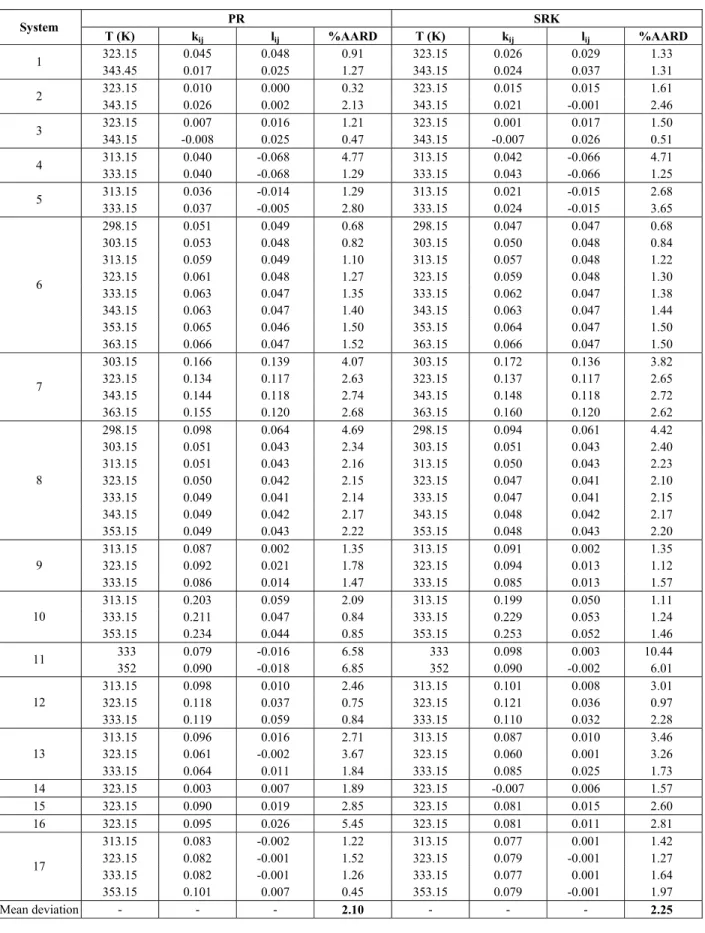
The adjustable parameters, kij and lij, the %AARD and the range of experimental data utilized (expressed in pressure and liquid phase molar composition) are shown in Table 3 for all 17 binary systems analyzed here.
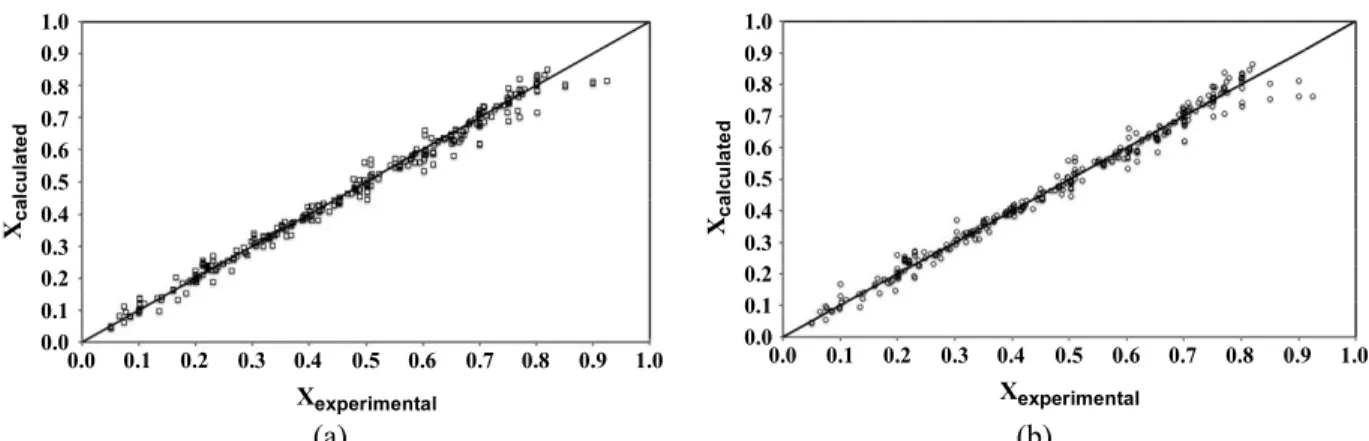
Figure 1 shows the comparison between calculated and experimental data for the mole fraction of liquid phase for all 17 systems at all temperatures, for both EoS analyzed. Analyzing Figure 1 and Table 3, it can be verified that a good correlation between experimental and calculated data was obtained for most of the systems analyzed, with low computing time for all cases. Larger deviations were observed
for the SRK equation, as shown in Table 3.
Table 3: Binary interaction parameters and deviation at different temperatures.
PR SRK System
T (K) kij lij %AARD T (K) kij lij %AARD
323.15 0.045 0.048 0.91 323.15 0.026 0.029 1.33 1
343.45 0.017 0.025 1.27 343.15 0.024 0.037 1.31 323.15 0.010 0.000 0.32 323.15 0.015 0.015 1.61 2
343.15 0.026 0.002 2.13 343.15 0.021 -0.001 2.46 323.15 0.007 0.016 1.21 323.15 0.001 0.017 1.50 3
343.15 -0.008 0.025 0.47 343.15 -0.007 0.026 0.51 313.15 0.040 -0.068 4.77 313.15 0.042 -0.066 4.71 4
333.15 0.040 -0.068 1.29 333.15 0.043 -0.066 1.25 313.15 0.036 -0.014 1.29 313.15 0.021 -0.015 2.68 5
333.15 0.037 -0.005 2.80 333.15 0.024 -0.015 3.65 298.15 0.051 0.049 0.68 298.15 0.047 0.047 0.68 303.15 0.053 0.048 0.82 303.15 0.050 0.048 0.84 313.15 0.059 0.049 1.10 313.15 0.057 0.048 1.22 323.15 0.061 0.048 1.27 323.15 0.059 0.048 1.30 333.15 0.063 0.047 1.35 333.15 0.062 0.047 1.38 343.15 0.063 0.047 1.40 343.15 0.063 0.047 1.44 353.15 0.065 0.046 1.50 353.15 0.064 0.047 1.50 6
363.15 0.066 0.047 1.52 363.15 0.066 0.047 1.50 303.15 0.166 0.139 4.07 303.15 0.172 0.136 3.82 323.15 0.134 0.117 2.63 323.15 0.137 0.117 2.65 343.15 0.144 0.118 2.74 343.15 0.148 0.118 2.72 7
363.15 0.155 0.120 2.68 363.15 0.160 0.120 2.62 298.15 0.098 0.064 4.69 298.15 0.094 0.061 4.42 303.15 0.051 0.043 2.34 303.15 0.051 0.043 2.40 313.15 0.051 0.043 2.16 313.15 0.050 0.043 2.23 323.15 0.050 0.042 2.15 323.15 0.047 0.041 2.10 333.15 0.049 0.041 2.14 333.15 0.047 0.041 2.15 343.15 0.049 0.042 2.17 343.15 0.048 0.042 2.17 8
353.15 0.049 0.043 2.22 353.15 0.048 0.043 2.20 313.15 0.087 0.002 1.35 313.15 0.091 0.002 1.35 323.15 0.092 0.021 1.78 323.15 0.094 0.013 1.12 9
333.15 0.086 0.014 1.47 333.15 0.085 0.013 1.57 313.15 0.203 0.059 2.09 313.15 0.199 0.050 1.11 333.15 0.211 0.047 0.84 333.15 0.229 0.053 1.24 10
353.15 0.234 0.044 0.85 353.15 0.253 0.052 1.46
333 0.079 -0.016 6.58 333 0.098 0.003 10.44
11
352 0.090 -0.018 6.85 352 0.090 -0.002 6.01
313.15 0.098 0.010 2.46 313.15 0.101 0.008 3.01 323.15 0.118 0.037 0.75 323.15 0.121 0.036 0.97 12
333.15 0.119 0.059 0.84 333.15 0.110 0.032 2.28 313.15 0.096 0.016 2.71 313.15 0.087 0.010 3.46 323.15 0.061 -0.002 3.67 323.15 0.060 0.001 3.26 13
333.15 0.064 0.011 1.84 333.15 0.085 0.025 1.73
14 323.15 0.003 0.007 1.89 323.15 -0.007 0.006 1.57
15 323.15 0.090 0.019 2.85 323.15 0.081 0.015 2.60 16 323.15 0.095 0.026 5.45 323.15 0.081 0.011 2.81 313.15 0.083 -0.002 1.22 313.15 0.077 0.001 1.42 323.15 0.082 -0.001 1.52 323.15 0.079 -0.001 1.27 333.15 0.082 -0.001 1.26 333.15 0.077 0.001 1.64 17
353.15 0.101 0.007 0.45 353.15 0.079 -0.001 1.97
0.0 0.1 0.2 0.3 0.4 0.5 0.6 0.7 0.8 0.9 1.0 1.0
0.9 0.8 0.7 0.6 0.5 0.4 0.3 0.2 0.1 0.0
Xexperimental
Xca
lc
ul
at
ed
0.0 0.1 0.2 0.3 0.4 0.5 0.6 0.7 0.8 0.9 1.0 1.0
0.9 0.8 0.7 0.6 0.5 0.4 0.3 0.2 0.1 0.0
Xexperimental
Xca
lc
ul
at
ed
0.0 0.1 0.2 0.3 0.4 0.5 0.6 0.7 0.8 0.9 1.0
Xexperimental
1.0 0.9 0.8 0.7 0.6 0.5 0.4 0.3 0.2 0.1 0.0
Xca
lc
ul
at
ed
0.0 0.1 0.2 0.3 0.4 0.5 0.6 0.7 0.8 0.9 1.0
Xexperimental
1.0 0.9 0.8 0.7 0.6 0.5 0.4 0.3 0.2 0.1 0.0
Xca
lc
ul
at
ed
(a) (b) Figure 1: Comparison of calculated and experimental data for the mole fraction of liquid phase using
PR-vdW-2 (a) and SRK-vdW-2 (b).
This behavior was observed in others works in the literature (Shariati and Peters, 2003, 2004; Arce
et al., 2010). The solubility of CO2 in ionic liquids follows a linear relationship with the length of alkyl chain. This relationship directly influences the prediction of data across equations of state, since the greater the solubility, the lower the error displayed, as seen for the systems studied (Shariati et al., 2005).
Overall, both EoS tested provided a good correlation for the bubble point data in the pressure range of the experimental data utilized, but the correlation was poor in the high pressure region for most systems. This behavior can be seen in Figure 1 in the high gas concentration (xexperimental) region of the graph. The high concentration of the gas coincides with the high pressure conditions for all systems.
Larger deviations in the regions of high pressure were described in other works in the literature (Carvalho et al., 2009a; Nwosu et al., 2009; Ren
et al., 2010) and, because of this behavior, the extrapolation of the model much beyond the data pressure region in which the interaction parameters were fit is not recommended.
For some systems, the combination of the vdW-2 mixing rule with the PR and SRK Eos did not
provide a good correlation between experimental and calculated data, mainly to represent the liquid phase. This behavior was expected due to the high complexity of the systems reviewed here. A possible solution to this problem would be to use more elaborate mixing rules, such as the Wong-Sandler (WS) type mixing rules (Wong and Sandler, 1992).
Some papers present the modeling of systems composed of ionic liquid and gas, principally CO2, using the combination of PR and WS mixing rules with good representation of the thermodynamic behavior, such as Alvarez et al. (2008) (PR+WS combined with NRTL model); Valderrama et al. (2008b) (PR+WS combined with the Van Laar model); Arce et al. (2010) (PRSV-Peng Robinson+ Stryjek-Vera EoS combined with the WS mixing rule and the Van Laar model) and Chilla et al. (2011) (PR+WS combined with the Van Laar model).
In Table 4, the deviations presented in different papers and the deviations observed in this paper for the liquid phase (%AARDL, given by Equation (14)) are compared. The deviations were presented only for the liquid phase because in these papers the calculations were performed only for the mole fraction of the liquid phase.
Table 4: Average absolute deviation in the liquid molar fraction and for the pressure in the present work and in some works in the literature.
Reference Thermodynamic model Parameters Observed deviation (%) Mixtures studied
Alvarez et al. (2008) PR/WS/NRTL 3 3.31 1
Valderrama et al. (2008) PR/WS/VL 3 3.01 8
PR/WS/VL 3 5.31 6
Valderrama et al. (2012)
PR/WS/NRTL 3 7.31 6
PRSV/WS/VL 6 3.61 17
Arce et al. (2010)
PRSV-vdW1 2 2.61 17
Chilla et al. (2011) PR/WS/VL 3 1.52 5
Ren and Scurto (2009) PR-vdW-2 2 4.02 4
Ren et al. (2010) PR-vdW-2 2 2.92 3
Jang et al. (2010) PR-vdW-2 2 6.42 1
PR-vdW-2 2 4.02 17
This work
SRK-vdW-2 2 4.42 17
1
pressure deviations (ΔP%); 2
N exp pred i i exp i i 1 x x 100 %AARDL
NP = x
⎛ − ⎞
= ⎜⎜ ⎟⎟
⎝
∑
⎠(14)
Most of the papers that used the combination of PR EoS combined with the WS mixing rule showed minor deviations when compared with those that used the PR EoS combined with the vdW-2 mixing rule (see Table 4). In papers that used the same combination used in this paper (PR-vdW2), similar deviations were observed. Works that used the SRK Eos for this type of system were not found in the literature and the comparison was not possible.
Effect of Gas on [C6mim][Tf2N] Phase Behavior
at 323.15 K
The solubility of three different gases (R-134a, CO2 and C2H6) was analyzed in [C6mim][Tf2N] ionic liquid. The solubility of R-134a is greater than that
of the other gases at 323.15 K (lower pressure results in higher solubility when compared with the other gases). The results can be seen in Figure 2. This behavior can be explained by the similarity between the molecules of [C6mim][Tf2N] and R-134a in terms of polarity.
Effect of Anion Modification on CO2 and R-134a
Solubility
The anion effect on CO2 and R-134a solubility can be seen in Figures 3 (a) and (b), respectively. For CO2 solubility, the anion effect is analyzed at 333.15 K for the cation 1-butyl-3-methylimidazolium ([bmim]) with the following anions: hexafluorophosphate ([PF6]), tetrafluoroborate ([BF4]) and nitrate ([NO3]).
As can be seen in Figure 3 (a), CO2 is more soluble in [PF6] than in [BF4] and [NO3], but the solubility in [NO3] is approximately equal to the solubility in [BF4] at pressures up to 80 bar.
0.0 0.5 1.0
x [R134A] 4 2 0 10 0.8 0.6 12 Press u re (bar ) 14
0.0 0.5 1.0
x [R134A] 4 2 0 10 0.8 0.6 12 Press u re (bar ) 14
0.0 0.5 1.0
x [R134A] 4 2 0 10 0.8 0.6 12 Press u re (bar ) 14 0.40 0.20 0.00 100 0.80 0.60 140 120
0.0 0.5 1.0
x [CO2]
0.40 0.20 0.00 100 0.80 0.60 140 120 0.40 0.20 0.00 100 0.80 0.60 140 120
0.0 0.5 1.0
x [CO2]
0.40 0.20 0.00 100 0.80 0.60 120 0.0 0.5
x [C2H6] 0.40 0.20 0.00 100 0.80 0.60 120 0.0 0.5
x [C2H6]
Figure 2: VLE correlation results for systems [C6mim][Tf2N] + R-134a, CO2 and C2H6 at 323.15 K. Symbols: (∆) R-134a, (◊) CO2, (□) C2H6. Experimental data were taken from Ren et al. (2010); Ren and Scurto (2009a); and Florusse et al. (2008),(---) PR-EoS + vdW2, (···) SRK-EoS + vdW-2.
0.0 0.2 0.4 0.6
0.40 0.8 0.20 0.00 100 0.80 0.60 120
x [CO2]
Press u re (b ar )
0.0 0.2 0.4 0.6
0.40 0.8 0.20 0.00 100 0.80 0.60 120
x [CO2]
Press u re (b ar )
0.0 0.2 0.4 0.6 0.8 4 2 0 10 0.8 0.6 12 Pres su re (bar ) 1.0 14 x [R134A]
0.0 0.2 0.4 0.6 0.8 4 2 0 10 0.8 0.6 12 Pres su re (bar ) 1.0 14 x [R134A] (a) (b) Figure 3: (a) VLE correlation results for the systems CO2 + [bmim][PF6], [bmim][BF4] and [bmim][NO3].
For R-134a solubility, the anion effect is analyzed at 323.15 K for the cation 1-hexyl-3-methyl-imidazolium with the following anions: bis(trifluoromethylsulfonyl) imide ([Tf2N]), [BF4] and [PF6].
As can be seen in Figure 3 (b), R-134a is more soluble in [Tf2N] than in [BF4] and [PF6]. The anions [BF4] and [PF6] have a very similar solubility for this gas for the whole range of pressure studied here.
The solubility parameter depends on the energy of vaporization and molar volume. Generally, the energy of vaporization is high for all IL, so because the [Tf2N] anion is larger than other anions, such as ([PF6] or [BF4]) its molar volume is significantly larger and therefore [Tf2N] dissolves CO2 to a greater degree.
Effect of Cation Modification on CO2 Solubility
Figure 4 shows the effect of the cation modification on the CO2 solubility for the following1-alkyl-3-methylimidazolium bis(trifluoromethylsulfonyl)imide ionic liquids: [dmim][Tf2N], [C6mim][Tf2N], [C2mim] [Tf2N], [pmim][Tf2N] and [bmim][Tf2N].
500
450 400
350 300
250 200 150
100
050
000
0.2 0.4 0.6 0.8 1.0
P
res
sure
(bar
)
x [CO2]
500
450 400
350 300
250 200 150
100
050
000
500
450 400
350 300
250 200 150
100
050
000
0.2 0.4 0.6 0.8 1.0
0.2 0.4 0.6 0.8 1.0
P
res
sure
(bar
)
x [CO2]
Figure 4: VLE correlation results for the systems CO2 + [dmim][Tf2N], CO2 + [C6mim][Tf2N], CO2 + [C2mim][Tf2N], CO2 + [pmim][Tf2N] and CO2 + [bmim][Tf2N]. Symbols: (◊) [dmim][Tf2N], (▲) [C6mim][Tf2N], (○) [C2mim][Tf2N], (■) [pmim][Tf2N] and (x) [bmim][Tf2N] at 323.15 K. (--) PR-EoS + vdW2, (···)SRK-EoS + vdW-2.
Furthermore, the solubility of CO2 is also strongly dependent on the alkyl chain length of the ionic liquid; similar results were observed in the works of Shariati and Peters (2005) and Shin et al. (2008). In general, the solubility in IL increases with the increase of the length of the alkyl chain of the IL.
Additionally, the dramatic difference in size between CO2 and an IL emphasizes the influence of the entropic effect on the solubility. The large
entropic effect led to a negative deviation from the ideal solubility that might explain why CO2 is more soluble in the larger 1-decyl- than in the smaller 1-ethyl-3-methylimidazolium IL`s (Cadena et al., 2004; Anthony et al., 2005).
CONCLUSION
Pressure–composition diagrams for 17 different binary systems of ionic liquids + CHF3, C2H6, CO2 and R-134a at high pressure were modeled at different temperatures with the PR and SRK equations of state and the vdW-2 mixing rule. Solubilities of all gases studied in this work decrease with an increase in the temperature of the system, and increase with increasing pressure. Predicted results were highly satisfactory for both EoS analyzed, with AARD% between experimental and calculated data of 2.10% and 2.25% for PR-vdW-2 and SRK-vdW-2, respectively.
NOMENCLATURE
List of Symbols
a EoS attractive parameter %AARD average absolute relative
deviation
%AARDL average absolute relative deviation for the liquid phase b EoS co-volume parameter EoS equation of state
IL ionic liquid
ij
k binary interaction parameter for the attractive parameter
ij
l binary interaction parameter for the co-volume parameter m parameter defined in the
function α MW molecular weight
NP number of experimental data points
NRTL Non Random Two Liquid model
C
P critical pressure PR Peng-Robinson EoS
PRSV Peng-Robinson Stryjek-Vera EoS
R universal gas constant
SRK Soave-Redlich-Kwong EoS
C
R
T reduced temperature
vdW - 1 classic van der Waals mixing rule with 1 adjustable parameter
vdW−2 classic van der Waals mixing rule with 2 adjustable parameters
VL Van Laar model
VLE vapor liquid equilibria
WS Wong Sandler
x mole fraction in liquid phase y mole fraction in vapor phase
Superscripts
exp experimental
pred predicted
Subscripts
i, j component
mix mixture
C critical
Greek Letters
α auxiliary parameter
ω acentric factor
ACKNOWLEDGEMENTS
The authors gratefully acknowledge the financial support from CAPES. M. Aznar and R. Guirardello are recipients of fellowships from CNPq.
REFERENCES
Alvarez, V. H., Larico, R., Ianos, Y., Aznar, M., Parameter estimation for VLE calculation by global minimization: the genetic algorithm. Braz. J. Chem. Eng., 25, 409 (2008).
Anderson, J. L., Dixon, J. K., Brennecke, J. F., Solubility of CO2, CH4, C2H6, C2H4, O2 and N2 in 1-hexyl-3-methylpyridinium bis (trifluoromethylsulfonyl) imide: comparison to other ionic liquids. Acc. Chem. Res., 40, 1208 (2007).
Anthony, J. L., Anderson, J. L., Maginn, E. J., Brennecke, J. F., Anion effects on gas solubility in ionic liquids. J. Phys. Chem., B, 109, 6366 (2005). Anthony, J. L., Maginn, E. J., Brennecke, J. F.,
Solubilities and thermodynamics properties
of gases in the ionic liquid 1-n-butyl-3-methylimidazolium hexafluorophosphate. J. Phys. Chem., B, 106, 7315 (2002).
Anthony, J. L., Maginn, E. J., Brennecke, J. F., Solution thermodynamics of imidazolium based ionic liquids and water. J. Phys. Chem., B, 105, 10942 (2001).
Arce, P. F., Robles, P. A., Graber, T. A., Aznar, M., Modeling of high-pressure vapor–liquid equilibrium in ionic liquids + gas systems using the PRSV equation of state. Fluid Phase Equilib., 295, 9 (2010).
Bermudez, M. D., Jiménez, A. E., Sanes, J., Carrion. J. F., Ionic liquid as advanced lubricant fluids. Molecules, 14, 2888 (2009).
Blanchard, L. A., Brennecke, J. F., Recovery of organic products from ionic liquids using supercritical carbon dioxide. Ind. Eng. Chem. Res., 40, 287 (2001).
Blanchard, L. A., Gu, Z., Brennecke, J. F., High pressure phase behavior of ionic liquids/CO2 systems. J. Phys. Chem., B, 105, 2437 (2001). Blanchard, L. A., Hancu, D., Beckman, E. J.,
Brennecke, J. F., Green processing using ionic liquids and CO2. Nature, 399, 28 (1999).
Cadena, C., Anthony, J. L., Shah, J. K., Morrow, T. I., Brennecke, J. F., Maginn, E. J., Why is CO2 so soluble in imidazolium based ionic liquids? J. Am. Chem. Soc., 126, 5300 (2004).
Carvalho, P. J., Álvarez, V. H., Machado, J. J. B., Pauly, J., Daridon, J. L., Marrucho, I. M., Aznar, M., Coutinho, J. A. P. High pressure phase behavior of carbon dioxide in 1-alkyl-3-methylimidazolium bis (trifluoromethylsulfonyl) imide ionic liquids. J. Supercrit. Fluids, 48, 99 (2009b).
Carvalho, P. J., Álvarez, V. H., Marrucho, I. M., Aznar, M., Coutinho, J. A. P., High pressure phase behavior of carbon dioxide in 1-butyl-3-methylimidazolium bis (trifluormethylsulfonyl) imide and 1-butyl-3methylimidazolium dicyanamide ionic liquids. J. Supercrit. Fluids, 50, 105 (2009a). Chilla, L. O. P., Lazzús, J. A., Pérez-Ponce, A. A.,
Particle swarm modeling of vapor liquid equilibrium data of binary system containing CO2 + imidazolium ionic liquids based on bis [(trifluoromethyl)sulfonyl] imide anion. J. Eng. Thermophys., 20, 487 (2011).
DIADEM Public v. 1.2 - DIPPR® - Design Institute for Physical Property Data. Information and Data Evaluation Manager (2000).
Florusse, L. J., Raeissi, S., Peters, C. J., High-pressure phase behavior of ethane with 1-hexyl-3-methylimidazolium bis(trifluoromethylsulfonyl)imide. J. Chem. Eng. Data, 53, 1283 (2008).
Gamse, T., Marr, R., High-pressure phase equilibria of the binary systems carvone–carbon dioxide and limonene–carbon dioxide at 30, 40 and 50 °C. Fluid Phase Equilib., 171, 165 (2000).
Gamse, T., Marr, R., Phase equilibrium properties of the 1-phenylethanol–carbon dioxide and 2-octanol–carbon dioxide binary system at 303.15, 313.15 and 323.15 K. J. Chem. Eng. Data, 46, 117 (2001).
Hermann, W. A., Bohn, V. P. W., Heck reaction catalized by phospha-palladacycles in non-aqueous ionic liquids. J. Organomet. Chem., 572, 141 (1999).
Hert, D. G., Anderson, J. L., Aki, S. N. V. K., Brennecke, J. F., Enhancement of oxygen and methane solubility in 1-hexyl-3-methylimidaxolium bis(trifluoromethylsulfonyl)imide using carbon dioxide. Chem. Comm., 20, 2603 (2005).
Jang, S., Cho, D. W., Im, T., Kim, H., High pressure phase behavior of CO2+1-butyl-3-methylimidazolium chloride system. Fluid Phase Equilib., 299, 216 (2010).
Jessop, P. G., Leitner, W., Chemical Synthesis Using Supercritical Fluids. Wiley-VCH: Weinheim (1999). Kroon, M. C., Shariati, A., Costantini, M., van
Spronsen, J., Witkamp, G. J., Sheldon, R. A., Peters, C. J., High-pressure phase behavior of systems with ionic liquids: Part V. The binary system carbon dioxide + 1-butyl-3-methylimidazolium tetrafluoroborate. J. Chem. Eng. Data, 50, 173 (2005).
Liu, Z., Wu, W., Han, B., Dong, Z., Zhao, G., Wang, J., Jiang, T., Yang, G., Study on the phase behaviors, viscosities, and thermodynamic properties of CO2/[C4mim][PF6]/methanol system at elevated pressure. Chem. Eur. J., 9, 3897 (2003).
Nelder, J. A., Mead, R., A Simplex method for function minimization. Comput. J., 7, 308 (1965). Nwosu, S. O., Schleicher, J. C., Scurto, A. M., High-pressure phase equilibria for the synthesis of ionic liquids in compressed CO2 for 1-hexyl-3methylimidazolium bromide with 1-bromohexane and 1 methylimidazolium. J. Supercrit. Fluids, 51, 1 (2009).
Peng, D. Y., Robinson, D. B., A new two-constant equation of state. Ind. Eng. Chem. Res., 15, 59 (1976).
Petkov, S., Pfohl, O., Brunner, G., PE 2000 allows for implementation of EOS by users. 18th European Seminar on Applied Thermodynamics;
KutnáHora, Czech Republic, June 8-11, 2000. Abstract 2 (2000).
PFohl, O., Petkov, S., Brunner, G., PE2000: A Powerful Tool to Correlate Phase Equilibrium. Herbert UtzVerlag, München (2000).
Ren, W., Scurto, A. M., Global phase behavior of imidazolium ionic liquids in compressed 1,1,1,2-tetrafluoroethane (R-134a). AIChE J., 55, 486 (2009b).
Ren, W., Scurto, A. M., Phase equilibria of imidazolium ionic liquids and the refrigerant gas 1,1,1,2 – tetrafluoroethane (R-134a). Fluid Phase Equilib., 286, 1 (2009a).
Ren, W., Sensenich, B., Scurto, A. M., High-pressure phase equilibria of {carbon dioxide (CO2) +n-alkyl-imidazolium bis(trifluoromethylsulfonyl) amide} ionic liquids. J. Chem. Thermodyn., 42, 305 (2010).
Schwarz, C. E., Nieuwoudt, L., Phase equilibrium of propane and alkanes. Part II: Hexatriacontane through hexacontane. J. Supercrit. Fluid, 27, 145 (2003a).
Schwarz, C. E., Nieuwoudt, L., Phase equilibrium of propane and alkanes. Part I. Experimental procedures, dotriacontane equilibrium and EOS modeling. J. Supercrit. Fluid, 27, 133 (2003b). Scurto, A. M., Leitner, W., Expanding the useful
range of ionic liquids: melting point depression of organic salts with carbon dioxide for biphasic catalytic reactions. Chem. Comm., 35, 3681 (2006). Scurto, A. M., Newton, E., Weikel, R. R., Draucker,
L., Hallett, J., Liotta, C. L., Leitner, W., Eckert, C. A., Melting point depression of ionic liquids with CO2: Phase equilibria. Ind. Eng. Chem. Res., 47, 493 (2008).
Seddon, K. R., Room temperature ionic liquids: Neoteric solvents for clean catalysis. Kinet. Catal., 37, 693 (1995).
Shariati, A., Peters, C. J., High pressure phase behavior of systems with ionic liquids: Measure-ments and modeling of the binary systems fluoroform + 1-ethyl-3-methylimidazolium hexafluorophosphate. J. Supercrit. Fluids, 25, 109 (2003).
Shariati, A., Gutkowski, K., Peters, C. J., Comparison of the phase behavior of some selected binary systems with ionic liquids. Phys. Chem. Mol. Thermodyn., 51, 1532 (2005).
Shariati, A., Peters, C. J., High pressure phase equilibria of systems with ionic liquids. J. Supercrit. Fluids, 34, 171 (2005).
Supercrit. Fluids, 30, 139 (2004).
Shin, E. K., Lee, B. C., Lim, J. S., High pressure solubilities of carbon dioxide in ionic liquids: 1-alkil-3-methylimidazolium bis(trifluoromethylsulfonyl) imide. J. Supercrit. Fluids, 45, 282 (2008).
Soave, G., Equilibrium constants from a modified Redlich-Kwong equation of state. Chem. Eng. Sci., 27, 1197 (1972).
Solinas, M., Pfaltz, A., Cozzi, P. G., Leitner, W., Enantio-selective hydrogenation of imines in ionic liquid / carbon dioxide media. J. Am. Chem. Soc., 126, 16142 (2004).
Souza, R. F., Padilha, J. C., Gonçalves, R. S., Dupont, J., Room temperature dialkylimidazolium ionic liquids-based fuel cells. Electrochem. Comm., 5, 728 (2003).
Teodorescu, M., Lugo, L., Fernandez, J., Modeling of gas solubility data for HFCs–lubricant oil binary systems by means of the SRK equation of state. Int. J. Thermophys., 24, 1043 (2003). Valderrama, J. O., Urbina, F., Faúndez, C. A., Gas
Liquid equilibrium modeling of mixtures containing supercritical carbon dioxide and an ionic liquid. J. Supercrit. Fluids, 64, 32 (2012). Valderrama, J. O., Reategui, A., Sanga, W. W.,
Thermodynamic consistency test of vapor–liquid equilibrium data for mixtures containing ionic liquids. Ind. Eng. Chem. Res., 47, 1318 (2008b). Valderrama, J. O., Robles, P. A., Critical properties,
normal boiling temperatures, and acentric factors
of fifty ionic liquids. Ind. Eng. Chem. Res., 46, 1338 (2007).
Valderrama, J. O., Rojas, R. E., Critical properties of ionic liquids revisited. Ind. Eng. Chem. Res., 48, 6890 (2009).
Valderrama, J. O., Sanga, W. W., Lazzús, J. A., Critical properties, normal boiling temperature, and acentric factor of another 200 ionic liquids. Ind. Eng. Chem. Res., 47, 1318 (2008a).
Visser, A. E., Swatloskim, W. M., Reichert, W. M., Griffin, S. T., Rogers, R. D., Traditional extractants in nontraditional solvents: groups 1 and 2 extraction by crown ethers in room temperature ionic liquids. Ind. Eng. Chem. Res., 39, 3596 (2000).
Welton, T., Room temperature ionic liquids. Solvents for synthesis and catalysis. Chem. Rev., 99, 2071 (1999).
Wong, D. S. H., Sandler, S. I., A theoretically correct mixing rule for cubic equations of state. AIChE J., 38, 671 (1992).
Wu, W., Li, W., Han, B., Zhang, Z., Jiang, T., Liu. Z., A green and effective method to synthesize ionic liquids: Supercritical CO2 Route. Green Chem., 7, 701 (2005).
Zhang, S., Chen, Y., Li, F., Lu, X., Dai, W., Mori, R., Fixation and conversion of CO2 using ionic liquids. Catal. Today, 115, 61 (2006).
![Figure 2: VLE correlation results for systems [C 6 mim][Tf 2 N] + R-134a, CO 2 and C 2 H 6 at 323.15 K](https://thumb-eu.123doks.com/thumbv2/123dok_br/18896067.426393/7.918.223.659.468.685/figure-vle-correlation-results-systems-c-mim-tf.webp)
![Figure 4: VLE correlation results for the systems CO 2 + [dmim][Tf 2 N], CO 2 + [C 6 mim][Tf 2 N], CO 2](https://thumb-eu.123doks.com/thumbv2/123dok_br/18896067.426393/8.918.111.435.559.765/figure-vle-correlation-results-systems-dmim-tf-mim.webp)
