Current Developments of Mixed Conducting Membranes on Porous Substrates
Priscila Lemes-Rachadela, Giulliani Sachinelli Garciaa, Ricardo Antonio Francisco Machadoa, Dachamir Hotzaa*, João Carlos Diniz da Costab
aDepartment of Chemical Engineering – EQA, Federal University of Santa Catarina – UFSC, CEP 88040-900, Florianópolis, SC, Brazil
bFilms and Inorganic Membrane Laboratory – FIMLab, School of Chemical Engineering, The University of Queensland – UQ, Brisbane, Australia
Received: March 11, 2013; Revised: September 7, 2013
The fabrication of mixed ionic-electronic conducting (MIEC) ceramic-based membranes for oxygen separation has extensively increased in the last three decades as a promising alternative of clean energy delivery. In recent years, the interest on supported MIEC membranes has increased due
to their attractive properties such as higher mechanical strength and oxygen lux compared to
self-supported membranes. This work presents a literature review on the development of self-supported MIEC membranes of perovskite structure. The concepts and transport mechanism of those membranes are explained and recent works on supported MIEC membranes are presented. Finally, manufacturing
methods of self-supported membranes and their inluence on oxygen permeation are discussed.
Keywords: perovskite, MIEC, porous substrates, self-supported membranes
1. Introduction
The reduction of CO2 emissions due to electric power generation is one of the global challenges currently. Carbon capture and storage (CCS) is an approach to relieve global warming by capturing CO2 and storing it instead of releasing it into the atmosphere1-4. Different fossil fuel power plant
concepts for CCS are currently being developed, such as oxyfuel power plants. In this process, the fossil fuel is combusted using pure oxygen and the result is a gas stream with almost pure CO2 (90-95%) in the dried lue gas. The
CO2 can then be captured more easily than when air is used in the combustion process and stored in a safe geological site5.
Mixed ionic-electronic conducting (MIEC) membranes are promising alternatives for oxyfuel power plants due to their high selectivity for oxygen separation and their significantly lowest efficiency losses compared with currently existing cryogenic distillation technology for oxygen separation6. The MIEC family is rich in structures
and the perovskite structure is within them. The perovskite structure exhibits good ionic and electronic conductivity leading to attractive oxygen flux7. In the last decade,
intensive research has been dedicated to the preparation and characterization of MIEC membranes1-18. However, a
few reports can be found regarding to the preparation of crack-free membranes (with thicknesses less than 25 µm) for planar or tubular geometries.
Based on the Wagner equation7, the oxygen lux through
a mixed-conducting dense membrane can be increased by reducing the thickness of the membrane until its thickness becomes less than a characteristic value at which the oxygen
lux is simultaneously determined by the bulk diffusion
and surface exchange kinetics. The surface exchange kinetics involves different elementary steps such as: adsorption, dissociation and reduction of O2[19]. Therefore,
the improvement of O2 permeation lux in the controlled surface system involves increasing the available surface area for the exchange process as well as the increase of catalytic properties of the membrane top layer. In this case, when the membrane thickness becomes very low, a porous support is needed for mechanical stability, particularly in the case of planar membranes. Thin porous catalytic layers can be also deposited on the other side of surface membrane to assist the increase of the available surface area for the exchange process.
Hence, in recent years the interest in the supported MIEC membranes has increased. The membranes that have been investigated vary widely in terms of thickness (10-500 µm) and chemical composition20. Catalytic layers
are also employed in some cases. A major challenge in processing supported MIEC membranes is the selection of a suitable fabrication method and material for the porous substrate, taking into account requirements as chemical compatibility, similar thermal expansion coefficient (TEC), good mechanical strength and porosity for adequate diffusion of gas.
This review paper aims to assess the concepts of perovskite MIEC membranes and relate them to the manufacturing process of MIEC membranes on porous substrates. Recent works on supported MIEC membranes as well as main fabrication methods are reported and discussed.
ions with different valences. At high temperatures, oxygen is incorporated into perovskite crystal structure resulting in the annihilation of an oxygen vacancy and the formation of two electron holes, as expressed as in Equation 2.
2 1
2 2
O
X O
V⋅⋅+ O ↔O + h⋅ (2)
where Vo¨ is the oxygen vacancy, O O
X is the lattice oxygen
and h. is the electron hole25.
2.3.
Transport mechanism
According to the literature28-31, the oxygen transport
through a MIEC membrane can occur by ive stages, as
follows (Figure 3):
• Mass transfer of gaseous O2 from the gas stream to
the membrane surface (high-pressure side. ↑p’O
2
);
• Adsorption of O2 molecules followed by dissociation
into ions (surface reaction of interface I);
• Transport of oxygen ions trough the membrane (bulk
diffusion in MIEC);
• Association of oxygen ions followed by desorption of
oxygen molecules (surface reaction of interface II);
• Mass transfer of O2 from the membrane surface to
the gas stream (low-pressure side. ↓p’O
2
).
The stages b, c, and d are the most important in this process. Stages b and d are governed by the kinetics surface exchange reactions (interfaces I and II) and stage c by the properties of bulk transport (bulk diffusion). For a MIEC membrane, the factor that limits the rate of O2 permeation
2. MIEC membranes
2.1.
Concept
The two main types of oxygen separation systems based on ceramic membranes are mixed ionic–electronic conducting membranes (MIEC membranes) and pure oxygen conducting membranes for example, solid electrolytes for solid oxide fuel cells (SOFC electrolytes). An advantage of the MIEC membranes is that those membranes require no electrodes to operate as in SOFC electrolytes7,21. The MIEC
membranes also stand out due to its potential application of high purity oxygen production.
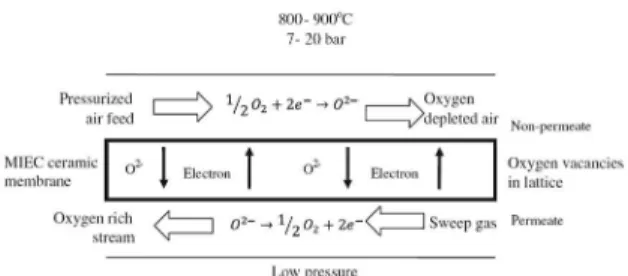
The oxygen separation is performed at high temperatures, typically 800-900 °C and high O2 lux are observed in dense membranes and with a perovskite structure22. As shown in
Figure 1, the electronic conductivity is presented as a small internal circuit involving oxygen partial pressure gradient. The O2 permeates from the high oxygen partial pressure side to the low oxygen partial pressure side, while the overall charge neutrality is maintained by opposite movement of
electron low23.
2.2.
Structure
The general crystal structure of an ideal perovskite, ABO3, is cubic and is shown in Figure 2. The A-site ion may be a rare earth, alkali or alkaline earth ion, such as La, Na, Ca, Sr or Ba. The B-site ion is a transition metal, such as Fe, Co, Ni or Cu22.
The relative sizes of the A and B ions dictate the shape of the crystal structure. The perovskite structure is maintained if the value of tolerance factor (t) is between 0.75 e 1 (Equation 1) as proposed by Goldschmidt in 1927[24]:
(
)
2
A O
B O
R R t
R R + =
+ (1)
where RA, RB e RO are the ratios of A-site, B-site and oxygen ions, respectively.
In crystals several types of defects can be present including zero dimensional or point defects. Those defects are generally separated into vacancies (particles missing in the lattice), interstitial particles (particles on lattice sites which are not normally occupied) and substitutional particles (lattice site that are occupied by foreign particles). The diffusion of oxygen ions is provided by vacancy defects present in the perovskite structure, because the ideal structure is unable of conducting those ions22,25. The presence
of vacancies is due to the high tolerance of perovskite materials to non-stoichiometric structures, which allows obtaining a high ionic conduction of oxygen26.
When the A-site of the perovskite is doped with a metal ion with lower valence state, oxygen vacancies are created as well as a change in valence state of ions B occurs, in order to maintain electronic neutrality. The stability of perovskite structure oxides is also improved by doping B-site with a more stable ion to produce AxA´1-xByB´1-yO3-δ. It is important to note that the term δ is regarded as the number of vacancies or defects; therefore, the higher number of vacancies, higher
will be oxygen permeation lux27. A large number of oxygen
vacancies can be formed in perovskite crystals by doping of
Figure 1. Schematic representation of O2 transport in dense ceramic MIEC membranes7.
3. Supported MIEC Membranes
To increase the mechanical strength of thinner ceramic membranes in operational conditions as elevated temperatures and high O2 partial pressure gradients, an alternative proposed by Bouwmeester et al.35 is the
membrane deposition via different techniques on porous substrates specially prepared. As previously mentioned, the
porous substrate strongly inluences the properties of the
thin MIEC membrane layer, regardless of which deposition technique is used and must satisfy the following requisites:
• Chemical stability at fabrication temperature and in
the fabrication atmosphere;
• Similar TEC to membrane layer materials;
• Chemical stability at membrane application
temperature (800-900 °C) under operation atmosphere;
• Permeability that does not dominate the rate of
permeation for gas diffusion;
• High mechanical strength at membrane application
temperature.
Thin perovskites MIEC membrane have been deposited on porous substrates using different techniques, e.g. dry pressing36-44, dip coating45-48, screen printing49,50, spray
pyrolisis51, slip casting52, tape casting20,53-56 and others57-63.
Table 1 lists some of these studies including membrane and support fabrication method, material used for both components, as well as their thickness, pore-forming agent
and pore size of the support and oxygen permeation luxes
in different operating conditions.
Chang et al.37 produced crack-free dense MIEC
membranes on porous supports via dry pressing by embedding 40% SCFZ (SrCo0.4Fe0.5Zr0.1O3-δ) onto MgO-based support and 40% MgO onto SCFZ membrane to avoid TEC problems between both materials. It was observed that the O2 lux is ten times higher in the supported MIEC membrane than in the self-supported membrane due to reducing of thickness. In another work36 this group veriied
that O2 flux is also dependent on the direction of the
permeation, i.e., the oxygen lux is higher when permeates
in the support-membrane direction, due to increasing surface exchange rate on the dense layer in the high partial pressure side. In other groups an improvement of the oxygen
permeation lux in supported MIEC membranes produced
by dry pressing was also observed by modifying the microstructure of porous support to straight pores in order to favor gas diffusion41, by adding a thin porous activity layer
in the permeate membrane side to increase surface area for accelerating surface exchange reaction in the low pressure side39. Kawahara et al.48 employed dip coating to produce
thin and dense perovskite membranes on porous substrates produced by dry pressing. It was noticed that higher O2
luxes were achieved by reducing membrane thickness and
controlling porosity in the porous substrate.
Baumann et al.20 produced thin (70 µm) perovskite
membranes on porous supports via tape casting and co-iring.
In this case, the porous substrate offered a certain resistance
to O2 lux and the deposition of a thin porous activity layer
improved drastically the O2 permeation lux by varying operational conditions as temperature, O2 partial pressure
and gas low rates. Figure 4a-d shows SEM images of the
cross-sections of those membranes after oxygen permeation is the region at which the highest resistance occurs. The
level of resistance in the interfaces I and II is affected by the nature of the material, such as the composition of perovskite or the exposed surface area. The resistance across the bulk diffusion is proportional to the thickness. For a relative thick membrane, the region of highest resistance is the region of
the bulk diffusion. The oxygen permeation lux based on
bulk diffusion can be expressed by Wagner equation7:
(
)
2
2
2
2 2
2 ln
16
O
O
p
O amb
p
RT
J pO d pO
F L
′
′′
=
∫
σ (3)where JO
2
is the oxygen permeation lux in mol m−2 s−1;
R is the gas constant; F is the Faraday constant; L is the membrane thickness; σamb is the ambipolar conductivity; and p’O
2
and p”O
2
are the oxygen partial pressures at the high pressure side and low pressure side, respectively.
Consequently, reducing membrane thickness will lead an increasing of O2 permeation rate. However, for thinner membranes, the resistance to oxygen ion conduction will be decreased until a certain limit, known as the characteristic thickness of the membrane (Lc), which also depends on the operating conditions such as temperature and O2 partial pressure. The Lc of most MIEC membranes typically range from 20 to 3000 µm32. For a thickness under L
c, the region of higher resistance becomes the interfaces I and II that are the surfaces with exchange reactions. The Wagner equation is
not applicable when the oxygen lux becomes determined
by the surface reaction.
Other mechanisms and relations have been proposed
to explain the oxygen lux within this regime33,34. Surface
exchange reactions are expected to be composed of sequential steps which might limit the overall rate. They may consist of adsorption from the gas phase, charge transfer reaction between the adsorbed species and bulk, including the reversed reactions19. For this point, a big challenge is
inding a mathematical model to explain explicitly both the
limiting cases such as bulk diffusion and surface exchange reactions, especially in the case of dense and thin planar MIEC membranes deposited on porous supports and/or
modiied surfaces.
sacriicial template technique to create porosity in support
material. This concept is based on incorporating an organic agent in the material composition to be removed in a slow thermal treatment after shaping and before sintering. In this context, it is interesting to select available routes
for processing macroporous ceramics in order to ind an
inexpensive, environmentally friendly and suitable method for the manufacture of porous supports. An extensive review on processing techniques of macroporous ceramics and its relationship to control the porosity was made by Studart et al.64 Further information can be found
elsewhere65-70.
A more recent and innovative method to fabricate ultra thin MIEC membranes, different of those proposed
for planar conigurations, is the formation of asymmetric hollow ibers via an immersion induced phase inversion and sintering techniques. These hollow ibers might be processed
with very thin and dense skin layer integrated on the porous support of the same perovskite material. In addition to its ability to support very thin walled membranes, the hollow
iber geometry also maximizes the surface area per unit
volume. Recent developments show large improvements in
oxygen permeation rates in hollow ibers1,12,13,15,17,18 compared
with lat, self-supported membranes. Similar results might
be compared with some of the best results in the literature
on lat supported membranes. Hollow iber membranes can
be fabricated using simple processing steps, without the use
of porous substrate. Perovskite capillaries with an outer
diameter from 0.5 to 3 mm and wall thicknesses from 50 to 500 µm have been manufactured12,13. However, material
measurements. A suitable adhesion of the dense membrane on porous support may be observed, Figure 4a, b, as well as the thin (17 µm) porous active layer deposited by screen printing, Figure 4c, d. The highest O2 luxes values achieved in the case of porous activity layer deposition are due to increased available surface area in the membrane, since the limiting factor becomes the surface exchange reaction when the membrane thickness is too thin, depending on the characteristic value (Lc) of each material. Watanabe et al.59
have used slurry dropping deposition technique to produce thinner (10-30 µm) perovskite membranes on porous support. Higher O2 luxes were measured in supported MIEC membranes with porous active layer deposited on the low partial pressure side when compared with supported membranes without active layer and even lower values for self-supported membranes.
In almost all revised works, such as in those with
highest oxygen permeation luxes showed in Table 1, the
authors used the same material for membrane and substrate. The same approach was applied to active layers to avoid
differences of thermal expansion coeficient (TEC), thereby
preventing delamination and cracks during sintering and operating conditions. Table 1 also shows that the average pore size in the support materials varies from < 1 µm to around 50 µm. Within this range it can be observed that
the average pore size had no signiicant inluence on the O2
lux results. High oxygen lux results were found either for
smaller (1-2 µm)61 or larger pores (5-25 µm)20.
An important aspect is to ensure an open and interconnected porosity, providing the adequate permeability for gas diffusion. The most of studies employed the Table 1. MIEC membranes on porous substrates: materials and properties.
Membrane/ Support Material*
Membrane/ Support Process
Pore former Pore size (µm)
Membrane/Support thickness (µm)
JO2 (mol·s
–1·cm–2) Ref.
SCFZ-0.4MgO/ MgO-0.4SCFZ
Dry pressing Active carbon 0.8 200/1000 2.02×10⁻⁷ (900 °C) [37]
BSCF Dry pressing Inorganic 1.18 200/1300 6.17×10⁻⁷ (850 °C) [39]
SCFZ Dry pressing Graphite, starch 5-30 500/1400 1.78×10⁻⁷ (930 °C) [43]
BSCF Dry pressing Graphite 3-20 170/1050 1.2×10⁻⁶ (900 °C) [44]
LSTF Dry pressing Organic 10 50-70/400 8.41×10⁻⁶ (1000 °C) [48]
LSCF Screen printing/ Warm pressing
Organic 1.4 10-20/1200 0.5×10⁻⁷ (900 °C) [49]
LSCF Slip casting/
Dry pressing
Methyl cellulose 0.5 200/1500 1.41×10⁻⁷ (800 °C) [51]
BSCF Tape casting Starch 2-25 70/830 5.04×10⁻⁵ (900 °C) [20]
LSFG/ LSF Tape casting Starch 8-20 80/1000 1.19×10⁻⁸ (900 °C) [55]
LSFG Tape casting Starch 8-20 120/820 1.12×10⁻⁷ (920 °C) [56]
CSTF Spin coating/
Dry pressing
Carbon black 10-50 35/500 1.56×10⁻⁶ (950 °C) [57]
LCC Slurry dropping/
Dry pressing
Oxalate 1-3 10/1200 3.54×10⁻⁶ (930 °C) [59]
LCC-BFZ/ LCC Slurry dropping/ Dry pressing
Oxalate 1-3 30/1200 1.19×10⁻⁶ (780 °C) [60]
BLF Slurry dropping/
Dry pressing
Oxalate 1-2 46/500-1000 1.78×10⁻⁵ (930 °C) [61]
*BFZ = BaFe
0.975Zr0.025O3-δ; BLF = Ba0.95La0.05FeO3-δ; BSCF = Ba0.5Sr0.5Co0.8Fe0.2O3-δ; CSTF = Ca0.8Sr0.2Ti0.7Fe0.3O3-δ; LCC = La0.6Ca0.4CoO3-δ; LSCF = La0.58
chemical compatibility and mechanical strength at operating conditions, the porous substrate must be engineered in order not to limit diffusion of gas by controlling its porosity and microstructure. The key point for further improvements in
the planar supported MIEC membranes is the deinition of an
explicit model for explaining the surface exchange reactions of these supported membranes and controlling the porosity and microstructure of the porous substrate.
Acknowledgements
Capes, CNPq and Petrobras are gratefully acknowledged for inancial support.
strength limitation prevents wall thickness of hollow iber
membranes to be reduced further below 200 µm.
4. Conclusions
Dense perovskite membranes are promising alternatives to O2 separation and CO2 capture in oxy-combustion plants. Improvements in the design of these membranes are being
intensively studied and lat conigurations of supported
MIEC membranes produced with the same material adding a thin porous activity layer has achieved good improvements
regarding oxygen lux. The deposition of the membrane
may be accomplished by simple methods as dip coating, tape casting and slurry dropping. Besides the need for
gastight. macrovoid-free Ba0.5Sr0.5Co0.8Fe0.2O3−δ capillaries
for high temperature gas separation. Journal of Membrane Science. 2010; 359:86-92. http://dx.doi.org/10.1016/j. memsci.2009.10.030
15. Leo A, Smart S, Liu S and Diniz da Costa JC. High performance
perovskite hollow ibres for oxygen separation. Journal of Membrane Science. 2011; 368(1-2):64-68. http://dx.doi. org/10.1016/j.memsci.2010.11.002
16. Serra JM, Vert VB, Büchler O, Meulenberg WA and
Buchkremer HP. IT-SOFC supported on mixed oxygen
ionic-electronic conducting composites. Chemistry of Materials. 2008; 20(12): 3867-3875. http://dx.doi.org/10.1021/ cm702508f
17. Liu S and Gavalas GR. Oxygen selective ceramic hollow iber
membranes. Journal of Membrane Science. 2005; 246:103-108. http://dx.doi.org/10.1016/j.memsci.2004.09.028 18. Li K, Tan X and Liu Y. Single-step fabrication of ceramic
hollow ibers for oxygen permeation. Journal of Membrane Science. 2006; 272: 1-5. http://dx.doi.org/10.1016/j. memsci.2005.11.053
19. Chen CS, Boukamp BA, Bouwmeester HJM, Cao GZ, Kruidhof H, Winnubst AJA et al. Microstructural development. electrical-properties and oxygen permeation of zirconia-palladium composites. Solid State Ionics. 1995; 76(1-2):23-28. http:// dx.doi.org/10.1016/0167-2738(94)00253-O
20. Baumann S, Serra JM, Lobera MP, Escolástico S,
Schulze-Küppers F and Meulenberg WA. Ultrahigh oxygen permeation
lux through supported Ba0.5Sr0.5Co0.8Fe0.2O3−δ membranes.
Journal of Membrane Science. 2011; 377(1-2):198-205. http:// dx.doi.org/10.1016/j.memsci.2011.04.050
21. Smart S, Lin CXC, Ding L, Thambimuthu K and Diniz da Costa
JC. Ceramic membranes for gas processing in coal gasiication.
Energy and Environmental Science. 2010; 3:268-278. http:// dx.doi.org/10.1039/b924327e
22. Burggraaf AJ and Cot L. Fundamentals of Inorganic Membrane Science and Technology. New York: Elsevier; 1996.
23. Badwal SPS and Ciacchi FT. Ceramic membrane technologies for oxygen separation. Advanced Materials. 2001; 13(121 3 ) : 9 9 3 9 9 6 . h t t p : / / d x . d o i . o r g / 13(121 0 . 13(121 0 0 2 / 13(121 5 2 13(121 -4095(200107)13:12/13<993::AID-ADMA993>3.0.CO;2-#
24. Goldschmidt VM. Geochemische Verteilungsgesetze der Elemente. Oslo: Norske Videnska; 1927. PMid:17771601. 25. Adler SB, Chen XY and Wilson JR. Mechanisms and rate laws
for oxygen exchange on mixed-conducting oxide surfaces. Journal of Catalysis. 2007; 245(1):91-109. http://dx.doi. org/10.1016/j.jcat.2006.09.019
26. Bhatia S, Hashim SM and Mohamed AR. Current status of ceramic-based membranes for oxygen separation from air. Advances in Colloid and Interface Science. 2010;
160(1-2):88-100. PMid:20813344. http://dx.doi.org/10.1016/j. cis.2010.07.007
27. Yang WS, Wang HH and Cong Y. Oxygen permeation study in a tubular Ba0.5Sr0.5Co0.8Fe0.2O3−δ oxygen permeable membrane.
Journal of Membrane Science. 2002; 210(2): 259-271. http:// dx.doi.org/10.1016/S0376-7388(02)00361-7
28. Ishihara T, Kilner JA, Honda M, Sakai N, Yokokawa H and Takita Y. Oxygen surface exchange and diffusion in LaGaO(3) based perovskite type oxides. Solid State Ionics. 1998. 113:593-600. http://dx.doi.org/10.1016/S0167-2738(98)00390-7
29. Manning PS, Sirman JD and Kilner JA. Oxygen self-diffusion and surface exchange studies of oxide electrolytes having the
luorite structure. Solid State Ionics. 1996; 93(1-2):125-132. http://dx.doi.org/10.1016/S0167-2738(96)00514-0
References
1. Leo A, Liu S and Diniz da Costa JC. Development of mixed conducting membranes for clean coal energy delivery. International Journal of Greenhouse Gas Control. 2009; 3(4):357-367. http://dx.doi.org/10.1016/j. ijggc.2008.11.003
2. Chen Z, Ran R, Shao Z, Yu H, Diniz da Costa JC and Liu S. Further performance improvement of Ba0.5Sr0.5Co0.8Fe0.2O3-δ perovskite membranes for air separation. Ceramics International. 2009; 35(6):2455-2461. http://dx.doi. org/10.1016/j.ceramint.2009.02.015
3. Baumann S, Schulze-Kuppers F, Roitsch S, Betz M, Zwick
M, Pfaff EM et al. Influence of sintering conditions on
microstructure and oxygen permeation of Ba0.5Sr0.5Co0.8Fe0.2O3−δ
(BSCF) oxygen transport membranes. Journal of Membrane Science. 2010; 359(1-2):102-109. http://dx.doi.org/10.1016/j. memsci.2010.02.002
4. Haworth P, Smart S, Glasscock J and Diniz da Costa JC.
Yttrium doped BSCF membranes for oxygen separation. Separation and Purification Technology. 2011; 81(1):88-93. http://dx.doi.org/10.1016/j.seppur.2011.07.007
5. Stadler HB, Habermehl F, Persigehl M, Kneer B, Modigell R and Jeschke M. Oxyfuel coal combustion by efficient integration of oxygen transport membranes. International Journal of Greenhouse Gas Control. 2011;5: 7-14. http:// dx.doi.org/10.1016/j.ijggc.2010.03.004
6. Czyperek MZ, Bouwmeester HJM, Modigell M, Ebert K, Voigt I, Meulenberg WA et al. Gas separation membranes for zero emission fossil power plants: MEM-BRAIN. Journal of Membrane Science. 2010;359:149-159. http://dx.doi. org/10.1016/j.memsci.2010.04.012
7. Sunarso J, Baumann S, Serra JM, Meulenberg WA, Lius S, Lin YS et al. Mixed ionic–electronic conducting (MIEC) ceramic-based membranes for oxygen separation. Journal of Membrane Science. 2008; 320(1-2):13-41. http://dx.doi.org/10.1016/j. memsci.2008.03.074
8. Bouwmeester HJM, Kruidhof H, Burggraaf AJ and Gellings
PJ. Oxygen semipermeability of erbia-stabilized bismuth
oxide. Solid State Ionics. 1992; 53-56:460-468. http://dx.doi. org/10.1016/0167-2738(92)90416-M
9. Skinner SJ and Kilner JA. Oxygen diffusion and surface exchange in La2−xSrxNiO4+δ. Solid State Ionics. 2000; 135:709-712. http://dx.doi.org/10.1016/S0167-2738(00)00388-X
10. Ji Y, Kilner JA and Carolan MF. Electrical properties and oxygen diffusion in yttria-stabilised zirconia (YSZ)–La0.8Sr0.2MnO3±δ (LSM) composites. Solid State Ionics. 2005; 176:937-943. http://dx.doi.org/10.1016/j.ssi.2004.11.019
11. Kharton VV, Kovalevsky AV, Visku AP, Shaula AL,
Figueiredo FM, Naumovich EM et al. Oxygen transport in Ce0.8Gd0.2O2−δ based composite membranes. Solid State Ionics. 2003;160:247-258. http://dx.doi.org/10.1016/S0167-2738(03)00183-8
12. Schiestel T, Kilgus M, Peter S, Caspary KJ, Wang H and Caro J. Hollow ibre perovskite membranes for oxygen separation.
Journal of Membrane Science. 2005; 258:1-4. http://dx.doi. org/10.1016/j.memsci.2005.03.035
13. Wang H, Werth S, Schiestel T and Caro J. Perovskite
hollow-ibre membranes for the production of oxygen-enriched air.
Angewandte Chemie International Edition. 2005;
44(42):6906-6909. PMid:16206306. h t t p : / / d x . d o i . o r g / 1 0 . 1 0 0 2 / anie.200501914
of Chemical Engineering. 2009; 17(4):562-570. http://dx.doi. org/10.1016/S1004-9541(08)60245-1
44. Kovalevsky AV, Kharton VV, Snijkers FMM, Cooymans JFC,
Luyten JJ and Frade JR. Processing and oxygen permeability
of asymmetric ferrite-based ceramic membranes. Solid State Ionics. 2008; 179(1-6):61-65.
45. Hong L, Chen XF and Cao ZD. Preparation of a perovskite
La0.2Sr0.8CoO3-x membrane on a porous MgO substrate. Journal of the European Ceramic Society. 2001; 21(12):2207-2215. http://dx.doi.org/10.1016/S0955-2219(00)00320-4
46. Lee S, Yu JH, Seo DW and Woo SK. Thick-ilm type oxygen transport membrane: Preparation, oxygen permeation and
characterization. Journal of Electroceramics. 2006; 17(2-4):719-722. http://dx.doi.org/10.1007/s10832-006-0388-x
47. Ito W, Nagai T and Sakon T. Oxygen separation from compressed air using a mixed conducting perovskite-type oxide membrane. Solid State Ionics. 2007; 178(11-12):809-816. http://dx.doi.org/10.1016/j.ssi.2007.02.031
48. Kawahara A, Takahashi Y, Hirano Y, Hirano M and Ishihara T. Importance of pore structure control in porous substrate for high oxygen penetration in La0.6Sr0.4Ti0.3Fe0.7O3 thin ilm for
CH4 partial oxidation. Solid State Ionics. 2011; 190(1):53-59. http://dx.doi.org/10.1016/j.ssi.2010.12.015
49. Xing Y, Bauman S, Sebold D, Ruttinger M, Venskutonis A, Meulenberg WA et al. Chemical compatibility investigation of
thin-ilm oxygen transport membranes on metallic substrates.
Journal of the American Ceramic Society. 2011; 94(3):861-866. http://dx.doi.org/10.1111/j.1551-2916.2010.04171.x
50. Buchler O, Serra JM, Meulenberg WA, Sebold D and
Buchkremer HP. Preparation and properties of thin
La1-xSrxCo1-yFeyO3−δ perovskitic membranes supported on
tailored ceramic substrates. Solid State Ionics. 2007. 178(1-2):91-99. http://dx.doi.org/10.1016/j.ssi.2006.11.015
51. Abrutis A. Preparation of dense. ultra-thin MIEC ceramic membranes by atmospheric spray-pyrolysis technique. Journal of Membrane Science. 2004; 240(1-2):113-122. http://dx.doi. org/10.1016/j.memsci.2004.03.043
52. Jin WQ, Li S, Huang P, Xu N and Shi J. Preparation of an asymmetric perovskite-type membrane and its oxygen permeability. Journal of Membrane Science. 2001; 185(2): 237-243. http://dx.doi.org/10.1016/S0376-7388(00)00650-5
53. Middleton H, Diethelm S, Ihringer R, Larrain D, Sfeir J and Herle JV. Co-casting and co-sintering of porous MgO support plates with thin dense perovskite layers of LaSrFeCoO3.
Journal of the European Ceramic Society. 2004; 24(6):1083-1086. http://dx.doi.org/10.1016/S0955-2219(03)00554-5
54. Fontaine ML, Smith JB, Larring Y and Bredesen R. On the preparation of asymmetric CaTi0.9Fe0.1O3-δ membranes by
tape-casting and co-sintering process. Journal of Membrane Science. 2009; 326(2):310-315. http://dx.doi.org/10.1016/j. memsci.2008.10.009
55. Julian A, Juste E, Geffroy PM, Coudert V, Degot S, Del Gallo
P et al. Elaboration of La0.8Sr0.2Fe0.7Ga0.3O3-δ/La0.8M0.2FeO3-δ
(M = Ca. Sr and Ba) asymmetric membranes by tape-casting
and co-iring. Journal of Membrane Science. 2009; 333(1-2):132-140. http://dx.doi.org/10.1016/j.memsci.2009.02.002
56. Etchegoyen G, Chartier T and Del-Gallo P. An architectural
approach to the oxygen permeability of a La0.6Sr0.4Fe0.9Ga0.1O3-δ
perovskite membrane. Journal of the European Ceramic Society. 2006; 26(13):2807-2815. http://dx.doi.org/10.1016/j. jeurceramsoc.2005.06.025
57. Araki S, Hoshi Y, Hamakawa S and Mizukami F. Synthesis and characterization of mixed ionic-electronic conducting 30. Ruiz-Trejo E, Siman JD, Baikov YM and Kilner JA. Oxygen
ion diffusivity. surface exchange and ionic conductivity in single crystal Gadolinia doped Ceria. Solid State Ionics. 1998; 113:565-569. http://dx.doi.org/10.1016/S0167-2738(98)00323-3
31. Lane JA and Kilner JA. Oxygen surface exchange on gadolinia doped ceria. Solid State Ionics. 2000; 136:927-932. http:// dx.doi.org/10.1016/S0167-2738(00)00530-0
32. Aasland S, Tangen IL, Wiik K and Odegard R. Oxygen permeation of SrFe0.67 Co0.33O3-δ. Solid State Ionics. 2000.
135(1-4):713-717. http://dx.doi.org/10.1016/S0167-2738(00)00389-1
33. Lin YS, Wang WJ and Han JH. Oxygen permeation through thin mixed-conducting solid oxide membranes. AICHE Journal. 1994; 40(5):786-798. http://dx.doi.org/10.1002/ aic.690400506
34. Tan XY, Liu SM and Hughes R. Theoretical analysis of ion permeation through mixed conducting membranes and its application to dehydrogenation reactions. Solid State Ionics. 2000; 138(1-2):149-159. http://dx.doi.org/10.1016/ S0167-2738(00)00782-7
35. Bouwmeester HJ, Kruidhof MH and Burggraaf AJ. Importance of the surface exchange kinetics as rate-limiting step in oxygen permeation through mixed-conducting oxides. Solid State Ionics. 1994; 72:185-194. http://dx.doi.org/10.1016/0167-2738(94)90145-7
36. Chang XF, Zhang C, Dong X, Yang C, Wanqin J and Xu N. Experimental and modeling study of oxygen permeation modes for asymmetric mixed-conducting membranes. Journal of Membrane Science. 2008; 322(2):429-435. http://dx.doi. org/10.1016/j.memsci.2008.05.061
37. Chang XF, Zhang C, Jin W and Xu N. Match of thermal performances between the membrane and the support for supported dense mixed-conducting membranes. Journal of Membrane Science. 2006; 285(1-2):232-238. http://dx.doi. org/10.1016/j.memsci.2006.08.025
38. Chen ZH, Shao ZP, Ran R, Zhou W, Zeng PY and Liu SM. A dense oxygen separation membrane with a layered morphologic structure. Journal of Membrane Science. 2007; 300(1-2):182-190. http://dx.doi.org/10.1016/j.memsci.2007.05.023
39. Kovalevsky AV, Yaremchenko AA, Kolotygin VA, Shaula
AL, Kharton VV, Snijkers FMM et al. Processing and
oxygen permeation studies of asymmetric multilayer Ba0.5Sr0.5Co0.8Fe0.2O3−δ membranes. Journal of Membrane
Science. 2011; 380(1-2):68-80. http://dx.doi.org/10.1016/j. memsci.2011.06.034
40. Kovalevsky AV, Yaremchenko AA, Kolotygin VA, Snijkers FMM, Kharton VV, Buekenhoudt A et al. Oxygen permeability and stability of asymmetric multilayer Ba0.5Sr0.5Co0.8Fe0.2O3−δ
ceramic membranes. Solid State Ionics. 2011; 192(1):677-681. http://dx.doi.org/10.1016/j.ssi.2010.05.030
41. Ikeguchi M, Ishii K, Sekine Y, Kikuchi E and Matsukata M. Improving oxygen permeability in SrFeCo0.5Ox asymmetric
membranes by modifying support-layer porous structure. Materials Letters. 2005; 59(11):1356-1360. http://dx.doi. org/10.1016/j.matlet.2004.12.042
42. Jiang QY, Nordheden KJ and Stagg-Williams SM. Oxygen permeation study and improvement of Ba0.5Sr0.5Co0.8Fe0.2Ox
perovskite ceramic membranes. Journal of Membrane Science. 2011; 369(1-2):174-181. http://dx.doi.org/10.1016/j. memsci.2010.11.073
64. Studart AR, Gonzenbach UT, Tervoort E and Gauckler LJ.
Processing routes to macroporous ceramics: A review. Journal of the American Ceramic Society. 2006; 89(6):1771-1789. http://dx.doi.org/10.1111/j.1551-2916.2006.01044.x
65. Sepulveda P and Binner JG. Processing of cellular ceramics by foaming and in situ polymerisation of organic monomers. Journal of the European Ceramic Society. 1999; 19(12):2059-2066. http://dx.doi.org/10.1016/S0955-2219(99)00024-2
66. Innocentini MDM, Salvini VR, Macedo A and Pandolfelli
VC. Prediction of ceramic foams permeability using Ergun’s
equation. Materials Research. 1999; 2(4):283-289. http:// dx.doi.org/10.1590/S1516-14391999000400008
67. Ortega FS, Innocentini MDM, Valenzuela FAO and
Pandolfelli VC. Effect of aeration technique on the
macrostructure and permeability of gelcast ceramic foams. Cerâmica. 2002; 48(306):79-85. http://dx.doi.org/10.1590/ S0366-69132002000200006
68. Prabhakaran K, Melkeri A, Gokhale NM and Sharma SC. Preparation of macroporous alumina ceramics using wheat
particles as gelling and pore forming agent. Ceramics International. 2007; 33(1):77-81. http://dx.doi.org/10.1016/j. ceramint.2005.07.020
69. Silveira CB, Escobar JA, Quintero MW, Sousa E, Moraes EG,
Oliveira APN et al. Thermal decomposition of polyurethane
foams for manufacturing LZSA cellular glass ceramics. Química Nova. 2007; 30(5):1104-1107. http://dx.doi. org/10.1590/S0100-40422007000500010
70. Barg S, Soltmann C, Andrade M, Koch D and Grathwohl G.
Cellular ceramics by direct foaming of emulsiied ceramic
powder suspensions. Journal of the American Ceramic Society. 2008; 91(9):2823-2829. http://dx.doi.org/10.1111/ j.1551-2916.2008.02553.x
Ca0.8Sr0.2Ti0.7Fe0.3O3-α thin ilm. Solid State Ionics. 2008.
178(33-34):1740-1745. http://dx.doi.org/10.1016/j.ssi.2007.11.011
58. Araki S, Yamamoto H and Hoshi Y. Synthesis of Ca0.8Sr0.2Ti0.7Fe0.3O3-δ thin ilm membranes and its application
to the partial oxidation of methane. Solid State Ionics. 2012. 221:43-49. http://dx.doi.org/10.1016/j.ssi.2012.06.001
59. Watanabe K, Yuasa M, Kida T, Shimanoe K, Teraoka Y
and Yamazoe N. Preparation of oxygen evolution layer/
La0.6Ca0.4CoO3 dense membrane/porous support asymmetric
structure for high-performance oxygen permeation. Solid State Ionics. 2008; 179(27-32): 1377-1381.
60. Watanabe K, Yuasa M, Kida T, Shimanoe K, Teraoka Y and
Yamazoe N. Oxygen Permeation of a dense/porous asymmetric
membrane using La0.6Ca0.4CoO3-δ-BaFe0.975Zr0.025O3-δ system. Chemistry Letters. 2009; 38(1):94-95. http://dx.doi. org/10.1246/cl.2009.94
61. Watanabe K, Yuasa M, Kida T, Teraoka Y, Yamazoe N and
Shimanoe K. High-Performance oxygen-permeable membranes
with an asymmetric structure using Ba0.95La0.05FeO3-δ perovskite-type oxide. Advanced Materials. 2010; 22(21):2367-2370.
PMid:20354973. http://dx.doi.org/10.1002/adma.200903953 62. Matsuka M, Agranovski IE and Braddock RD. Preparation
of asymmetric perovskite-type membranes by a settlement method. Ceramics International. 2010; 36(2):643-651. http:// dx.doi.org/10.1016/j.ceramint.2009.10.007