337
Abstract
Drilling and blasting are fundamental operations in the mining cycle and consti-tute an important component of the mining costs. Rock fragmentation can in principle be managed by means of two options: by increasing or reducing the speciic consumption of explosives, or by modifying the drilling pattern. The choice of one or other type of control depends on the relationship between the unit costs of drilling and explosives, and on techni-cal restrictions or regulations imposed by different reasons. It is then necessary to identify the link between the blast design and some factors affecting the downstream processing of the product. This paper analyzes the theoretical basis aimed at evaluating the main pa-rameters involved when organizing a production blast in open pit quarries. In particular, a method developed through the analysis of the results in a large number of limestone open pit quarries in Italy is described and commented. The irst experimental results in Brazil have been obtained by applying this method at the Experimental Mine of the Research Center of Responsible Mining of the University of São Paulo. Experimental methods and results will be analyzed and discussed in the second part of this paper.
keywords: Drill & blast, bench blasting, rock fragmentation, downstream pro-cessing, KPIs.
Marilena Cardu
Professor at Politecnico di Torino – DIATI Visiting Researcher at NAP Mineração - Universidade de São Paulo
Torino – Italy
Jacopo Seccatore
Post-Doctoral Researcher
Instituto de Goeciências; Coordinator of the Experimental Mine of NAP Mineração Universidade de São Paulo
São Paulo – São Paulo – Brazil [email protected]
Alberto Vaudagna
Researcher at Politecnico di Torino – DIATI Torino – Italy
Alvaro Rezende
Engineer of Sociedade Extrativa Dolomia Ltda. Taubaté – São Paulo – Brazil
Fabio Galvão
Engineer of Sociedade Extrativa Dolomia Ltda. Taubaté – São Paulo – Brazil
Jorge Bettencourt
Professor Emeritus of Instituto de Goeciências; Counselor of NAP Mineração
Universidade de São Paulo São Paulo – São Paulo – Brazil [email protected]
Giorgio de Tomi
Professor of Mining and Petroleum Engimeering Department; Director of NAP Mineração. Universidade de São Paulo
São Paulo – São Paulo - Brazil [email protected]
Evidences of the influence
of the detonation sequence
in rock fragmentation
by blasting – Part I
Mining
Mineração
1 Introduction
In most mining operations, the rock is subjected to several processes to become a commercial product (Kanchibotla, 2003). In designing a blast, the geometry is a very important factor (shape and size of the charges and the volume assigned to them, position and extent of the free sur-faces, position of the charges with respect to that volume), but also the amount and type of explosive and the timing sequence play an important role. Everything should be established in view of the desired effect, and containing, as much as possible, the side effects (Mancini & Cardu, 2001).
Drilling and blasting is an important step in this process and the results, such as fragmentation, muck-pile shape and looseness, dilution, damage and rock softening affect the eficiency of down-stream processes (Richard et al., 1982,
Roy & Singh, 1998; Konya & Walter, 1990; Oriard, 2005). The importance of blasting for downstream processes has been studied and discussed by many researchers. Nielsen and Kristiansen (1996) investigated the effect of blasting on crushing and grinding operations and discussed how to evaluate the application of the comminution system. From indus-trial tests and laboratory experiments, they found some relationships between blast-hole diameter, amount of explosives, detonation velocity, and percentage of ines generated after blasting and crush-ing. They pointed out that the gap between mining and mineral processing should be harmonized, and suggested that blasting could be considered as the irst step of the integrated comminution process for the optimization of the mine operations.
Eloranta (1995, 1997) compared energy requirements for blasting, crush-ing and grindcrush-ing; Nielsen (1998, 1999) studied the effect of blasting on grind-ing usgrind-ing the micro-crack concept. He suggested that the P-wave may generate two sets of micro-cracks in the rock: upon detonation, a longitudinal wave propagates outwards from the borehole; the wave has a compressive component in the radial direction and a tensile component in the tangential direction. Due to the deformations from the tensile component, new cracks may be formed when the stress level exceeds the dynamic tensile strength of the rock. Blast-induced micro-cracks generated by the shock-waves emitted throughout the rock mass by the explosive affect the reduction of
the crushing resistance.
Kanchibotla (2003), Kojovic et al.
(1995) and McCarter (1996) presented typical problems of the traditional ap-proach to blast optimization, introduc-ing an approach where the inluence of blast results on processing costs (crush-ing and separation), throughput (rev-enue and operating costs), and proit. All of them showed that the optimum blasting effect should consider all of the above components.
An important parameter, often linked to the distribution of explosive en-ergy in the blast, is the drill-hole diameter: it controls the distribution of energy in the blast and thus it affects fragmentation (Clark, 1987; Hustrulid, 1999; Eloranta, 1995). Large diameters are often associ-ated with the expansion of drilling pat-terns; however large holes intersect fewer in-situ blocks of rock, resulting in more oversize, especially in the case of jointed rock (Rajpot, 2009). Typically, the drill-hole diameter is changed depending upon the rock or drill machine type. Similarly, changes in the bench height when a new loading machine is introduced or for any other reason, affect changes on all depen-dent parameters or on the blast muck-pile size mix. Modiications in a drill-hole diameter or a bench height or a product size tend to change all other relevant blast design parameters. Changes in the bench height or drill-hole diameter, when the product size is required to be kept constant due to market demand or crusher/grinder requirements, result in changes in all other parameters and ultimately changes in the capital and operational cost of drilling, and the cost of blasting (Jimeno et al.,
1995). Comparative calculations in every case allow the designer to determine the optimum cost parameters.
Size reduction represents one of the most energy-intensive and costly processes in the excavation of rocks. Drilling and blasting, being the irst operation in the size reduction chain, may have a signii-cant downstream effect (Kim, 2010). Since the effects of blasting on size reduction, crushing and throughput have been well established (Nielsen and Kristiansen, 1996;McCarter, 1996, Eloranta, 1995, 1997), the main focus of this research is to examine the effect of different timing sequences on fragmentation, although the subject has been extensively treated in many aspects: Katsabanis et al. (2006)
conducted a series of multi-hole blasting experiments to examine the effect of delays on fragmentation using igneous rock samples. The tests showed the inlu-ence of the interaction of stress waves on fragmentation. Kim S.J. (2010) performed four different blasts with different charg-ing methods adoptcharg-ing the same powder factors to compare how energy distribu-tion affected changes in fragmentadistribu-tion. Experimental evidence under small scale conditions (Katsabanis et al., 2008) has
suggested that fragmentation is very coarse when zero delay is used but the average fragment size does not change much once small delays are used.
The blasting size reduction effect due to timing was also investigated(Cho & Kaneko, 2004) through a number of models they used to consider the effect of speciic charge and geometry in bench blasting. To investigate the inluence of blast condition on fragmentation in bench blast simulations, the fragmentation ob-tained using the numerical approach was compared and analyzed. After having simulated widely spaced blast patterns, they compared the fracture process and fragmentation with that in wide-ranging bench blasting, also discussing controlled fragmentation with respect to delay tim-ing. They concluded that the optimal fragmentation with respect to delay time depends strongly on the gas low through the fractures caused by the stress wave.
Stagg (1987) refers to some reduced-scale tests in dolomite benches, using 0 to 45 ms delay intervals, equivalent to 0 to 118ms/m of burden. All fragmented rock was screened. The inest fragmentation occurred at blast-hole delay intervals of 3 to 56ms/m of burden; coarse fragmenta-tion resulted from short delays (<3ms/m), where breakage approached presplit conditions with a major fracture between blast-holes and large blocks in the burden region. Coarse fragmentation also resulted from long delays (>17 ms/m), with explo-sive charges acting independently. The ac-ceptable range provides blast design tools useful for a variety of purposes, including optimum muck-pile displacement and vibration control.
339 blasting cost. However, when no
frag-mentation speciications are provided, this is an unclear target. In the same way, it is quite common for quarry operators to be concerned with fragmentation
when dificulties in drilling and loading are encountered, or when a large amount of oversize is produced, resulting in a general loss of productivity in secondary blasting: this was the problem
encoun-tered at the quarry site under study and, on this basis, a number of experimental blasts were performed and the blasting size reduction effect was recognized, as shown below.
2. Blast design method
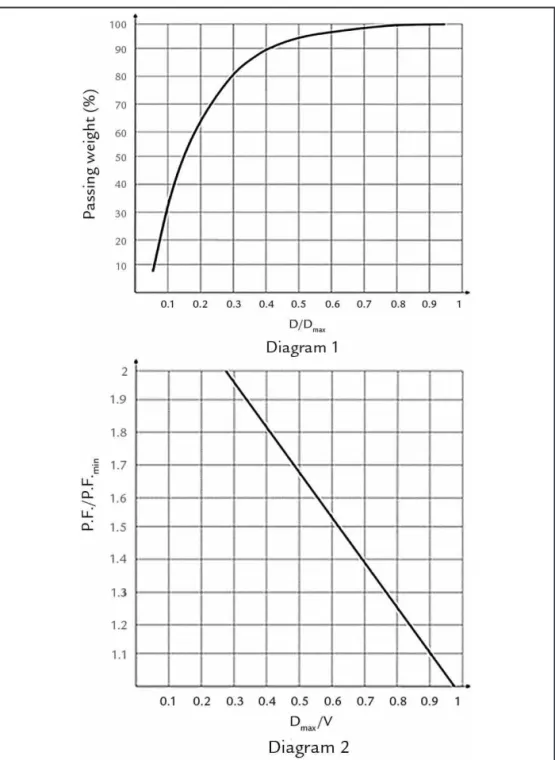
A speciic method was determined to establish the Powder Factor to achieve a fragmentation with the desired top-size. The method was developed by Clerici et al. (1974), based on the analysis
of the results of over 250 blasts in Italian limestone quarries for different applica-tions (Figure 1). Diagram I represents the particle size of the blasted material (cu-mulative distribution), in dimensionless form, as the abscissa shows the ratio be-tween the "desired size" of the fragments
D and that of the maximum block size in the blasted material Dmax. Diagram II shows the correlation between two dimensionless ratios: on the vertical axis, the relationship between the speciic con-sumption PF to be adopted and the mini-mum PFmin, that is the speciic charge that allows detaching blocks as large as the burden V; on the horizontal axis is the ratio between the maximum desired size of fragments and the burden. This method was originally designed either
to: predict the size obtainable by a blast where drilling mesh and PF are known, or estimate the speciic consumption of explosive that is necessary (once estab-lished the drilling mesh), to obtain a certain particle size, or estimate what burden is required to obtain the desired particle size, once having established the speciic consumption. For Italian lime-stone such as the one encountered in the Alps, the value of PFmin ranges between 150 and 200g/m3.
Figure 1 Graphs employed to project blasts of a given particle size distribution in limestone quarries. D[m]: Dimension of the desired size of blasted material, expressed as a percentage of the whole blast (ie, 90%<0.8m, means that only 10% of oversize is accepted, with D=0.8m); %: cumulative percentage of the blasted rock; Dmax[m]: maximum block size obtained; PFmin[kg/m3]: the
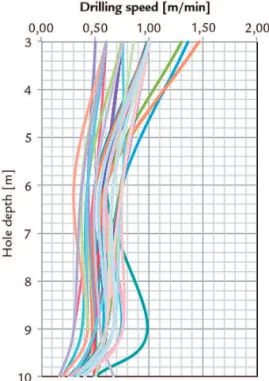
Figure2
Trend of the drilling speed
in a number of blast-holes pertaining to a 10m high bench and a surface area of 300 m2. To be noticed is the
great speed variability (0.5-1.5 m/min)
3. Concepts for the choice of the initiation sequence
During this research, the initiation sequences adopted have always obeyed the following principles:
• Decomposition of the blast; • Taking advantage of the free
surfaces to favor the movement of the blasted material;
• Simultaneous holes as far away as
possible, to avoid undesired cooperation of charges that may induce the explosive energy to work with shear effect instead of producing fragmentation.
The main limitation for the choice of the initiation sequence was the only avail-ability of detonating cord and relays of the 17 ms and 42 ms series. The initiation sequences had to be adjusted varying the geometry of the web of inter-hole connec-tions and the position of the relays along these connections.
The drilling density (holes/m2) is
an indicator of how inely the explosive is distributed in the rock and, indirectly, of how large the monolith can be, which includes the volume to be excavated that
is not affected by explosive (Langefors & Kihlström, 1967; Ash, 1968; Saharan et al., 2006); this is then correlated to the maximum size of the fragments obtained from the blast. The distinction based on the number of free surfaces available be-fore the blast is important, but refers only to the early situation: the blast must be analyzed in its evolution (decomposition), according to the sequence of explosions, which must be established with the aim of having the maximum number of blast-holes that can operate under favorable conditions. The decomposition is intended in a temporal sense, and should consist of showing the geometry of the bench after each explosion, erasing the already frag-mented rock. It is actually impossible to reach this goal on a regular blast (also an ultra-fast camera takes only the external aspect of the blast under its evolution) but a theoretical reconstruction is possible, by assigning to each blast-hole a reasonable volume, and reshaping the face for every explosion, erasing what would have to
be removed. It is therefore an idealized reconstruction of what should happen, i.e. a means to control whether a project is reasonable or not.
The objective of a production blast is to transform into fragments of a prede-termined size a predeprede-termined volume of rock (Lownds, 1997). The least one can expect is that the blast reduces to a trans-portable size, with a tolerable percentage of oversize, a given volume of rock; the maximum to be expected (the "perfec-tion") is that the blast detaches only the desired volume of rock and reduces it into fragments of a speciied particle size distribution, leaving regular and undam-aged walls corresponding to the geometry of the project (Mancini &Cardu, 2001). This perfection is almost never reached, but it can be used as an instrument to judge the quality of the result: the closer it gets to perfection, the better it is. It will be necessary, of course, to use quantita-tive indicators that take into account the performance of the result. Also, criteria Normally, the choice of some of the
aforementioned parameters, as PFmin and V, depends on the rock strength; however, being the distribution of this parameter unknown in the experimental quarry under study, it was assumed to resort to the calculation of the drilling speed to get information about the rock characteristics; in particular, drill rigs employed at the quarry have 3m length MF-rods: the operator was asked to re-cord the time elapsed between junctions,
corresponding to the time necessary to drill a 3 m length hole. Being both the operators and the machines always the same, it is legitimate to think that there are no changes in the performance of drilling. Having available a signiicant number of drilling speed data, it is possible to infer an empiric correlation between the rock strength and drilling speed. Being the drilling speed known in different areas of the quarry, resulting in higher or lower rock drillability, it can
be decided whether, for a given bench, it is necessary to increase or decrease the P.F., either by means of reducing the charge per hole or by increasing the drill mesh size. This allows also chang-ing the values of PFmin hypothesized in the initial stage, and then calculating a new PF.
341 The primary aim of this research is
to depict a way to improve the rational utilization of the explosive energy for the beneits of the quarrying process. An extensive literature review shows how good fragmentation by blasting favor-ably inluences the proitability of the whole mining process. Many methods allowing the prediction and estimation of fragmentation are available today. If these methods are carefully and
reason-ably used, they can be very helpful to obtain an optimal fragment distribution which will lower the total cost of the whole production process and not only that of the drilling and blasting. The blast design process must represent an effort to reduce oversize fragments and to minimize the amount of ines in the rock pile. In this irst part is described a method to design cost-effective and reliable solutions that can ensure
compli-ance with the productivity target without drastically modifying the geometry of drilling or the speciic consumption of explosive. This method has been applied in ield tests at the Experimental Mine of the Research Center for Responsible Mining of the University of São Paulo. The experimental methods, examples of application and the results obtained will be presented and discussed in the second part of this article.
5. References
ASH, L. R. The design of blasting round. Surface Mining. In: PFLEIDER, E. P. New York: AIME, 1968.p.387.
CHO S.H., KANEKO K. Rock fragmentation control in blasting materials. The
Mi-ning and Materials Processing Institute of Japan. v. 45, n. 5, p. 1722 -1730, 2004. CLARK, G. B. Principles of rock fragmentation. New York: John Wiley & Sons,
1987. p.2, 432-442.
CLERICI C., COLOSI G., MANCINI, R., PELIZZA S., VERGA G. Le operazioni di abbattimento in cava: mutua inluenza tra abbattimento e frantumazione, e criteri di progettazione integrata Cava – Impianto di frantumazione. In: CONV. INTER-NAZIONALE SULLE COLTIVAZIONI DI PIETRE E MINERALI LITOIDI, Atti I. Torino: 1974.
ELORANTA, J. Selection of Powder factor in large diameter blastholes. In: GENE-RAL PROCEEDING & ANNUAL CONFERENCE, 21. International Society of Explosives Engineers, 1995. p. 68-77.
ELORANTA, J. The eficiency of blasting versus crushing and grinding. In: GENE-RAL PROCEEDING & ANNUAL CONFERENCE, 23. International Society of Explosives Engineers, 1997. p. 157-163.
HUSTRULID, W. Blasting principles for open pit mining. In: BALKEMA, A. A.
(Ed.) 1999. v.1, p.27-31, 38-39, 42-44, 73, 77, 854-855.
JIMENO, C. L., JIMENO, E. L., FRANCISCO J. A. C. 1995. Drilling and blasting
of Rock. In: Balkema, A. A. (Ed.) Rotterdam: 1995. p. 30, 56-61, 179-183, 190. ( Translated to English by De Ramiro, Y. V.).
KANCHIBOTLA S.S. Optimum blasting: is it minimum cost per broken rock or ma-ximum value per broken rock? Fragblast – International Journal for Blasting and Fragmentation. vol.7, n.1, p.35-48, 2003. (DOI: 10.1076/frag.7.1.35.14059). KATSABANIS, P.D., KIM, S., TAWADROUS, A., SIGLER, J. Effect of powder factor
and timing on the impact breakage of rocks. In: ANNUAL CONFERENCE ON EXPLOSIVES AND BLASTING TECHNIQUE, 34. International Society of Ex-plosives Engineers, 2008. p.179-190.
KATSABANIS, P.D., TAWADROUS, A., BRAUN, C., KENNEDY, C. Timing effects on fragmentation. In: ANNUAL CONFERENCE ON EXPLOSIVES AND BLASTING TECHNIQUE, 32. International Society of Explosives Engineers, 2006. v.2, p.243-253.
KIM S.J. Experimental investigation of the effect of blasting on the impact breakage of rocks. Kingston, Ontario, Canada: The Robert M. Buchan Department of Mi-ning, Queen’s University, 2010. (Master Thesis).
KOJOVIC, T., MICHAUX, S., MACKENZIE, C. The impact of blast fragmentation on crushing and screening operations in quarrying. Explo 1995. n. 44, p. 427-436, 1995.
KONYA C.J., WALTER E.J. Surface blast design. Englewood Cliffs, NJ: Prentice
Hall Inc., 1990. p.20-34, p.118.
LANGEFORS U., KIHLSTRÖM, B. The modern technique of rock blasting (2.ed.) .
Stockolm: Almqvist & Wiksell, 1967. must be established to distinguish which
part of the imperfection is due to the rock
characteristics from that which is due to defects in the design or execution of the
blast, and therefore can be improved by the operator.
LOWNDS, C.M. The effect of powder factor on fragmentation. In: RESEARCH PROCEEDING E ANNUAL CONFERENCE, 23. International Society of Ex-plosives Engineers, 1997. p. 101-109.
MANCINI R., CARDU M. Scavi in roccia - gli esplosivi. In: Hevelius (Ed.) Beneven-to, Italy: 2001.
MCCARTER, M. K. Effect preconditioning on comminution for selected rock types. In: CONFERENCE OF EXPLOSIVES AND BLASTING TECHNIQUE, 22. Proceedings. Orlando, Florida, February 4-8. Cleveland, Ohio: International So-ciety of Explosives Engineers, 1996. p. 119-129.
NIELSEN, K., KRISTIANSEN, J. Blasting – crushing - grinding: Optimization of on
integrated comminution system. Rock Fragmentation by Blasting. In: Mohanty
(Ed.), Balkema, Rotterdam: 1996, p. 269-277.
NIELSEN, K. Economic optimization of the blasting-crushing-grinding comminution process. In: ANNUAL CONFERENCE ON EXPLOSIVES AND BLASTING RESEARCH. Proceeding of the International Society of Explosives Engineers, 1998. p. 147-156.
NIELSEN, K. Economic effects of blasting on the crushing and grinding of ores. Frag-blast 1999. Johannesburg: South Africa Institute of Mining and Metallurgy, 1999. p. 251-256.
ORIARD L.L. Explosives engineering, construction vibrations and geotechnology.
Cleveland, OH: International Society of explosives Engineering, 2005.
RAJPOT M.A. The effect of fragmentation speciication on blasting cost. Kingston, Ontario, Canada: Queen's University, 2009. (Master of Science Engineering - de-gree Thesis).
RICHARD D.A., FLETCHER L.R., D’ANDREA D.V. Explosives and blasting
pro-cedure manual, IC 8925. Minneapolis, MN: Twin Cities Research Center, Bureau of Mines, 1992.
ROY P.P., SINGH S.R.B. New burden and spacing formulae for optimum blasting. In: ANNUAL CONF. ON EXPLOSIVES AND BLASTING TECHNIQUE, ISEE 24. ISEE Res. Proc. Feb. 2-5, 1998. New Orleans, LA, ISEE Cleveland, OH, 11th. SAHARAN M.R., MITRIH.S., JETHWAJ.L. Rock fracturing by explosive energy:
review of state-of-the-art. Fragblast: International Journal for Blasting and Frag-mentation. vol. 10, Issue 1-2, p. 61-81, 2006. DOI: 10.1080/13855140600858792. STAGG M.S. Inluence of blast delay time on rock fragmentation: one-tenth scale
tests. International Journal of Surface Mining, Reclamation and Environment.
vol. 1, Issue 4, p. 215-222. DOI: 10.1080/09208118708944122.