doi: 10.1590/S1984-46702010000600015
Issues involving fish life, migrations, and habitats play a key role in decisions concerning existing and new projects in rivers such as hydroelectric plants, water supply, river restora-tion, and dam removal (KATOPODIS 2005). The health of fish populations depends on habitat connectivity, the availability of suitable habitats (habitat needs differ between species and life stages), and river flow regimes. The latter provide sediments, ground water, and nutrient circulation, all of which sustain ecological integrity (KATOPODIS 2005). In this context, studies
on fish swimming performance are fundamental because they provide guidance and criteria for the maintenance of connec-tivity in aquatic systems.
There are approximately 4,500 fish species catalogued for South America (REIS et al. 2003). Despite this great biodiversity, very little is known about the swimming capaci-ties of Neotropical fish (CLAY 1995). The few available studies
have focused on large migratory species (SANTOS et al. 2007,
2008) providing criteria for fishway design.
Fish swimming performance can be classified into one of three general categories: sustained, prolonged, or burst swim-ming. In sustained swimming red muscle fiber activity predomi-nates. This low-speed movement is fueled by energy derived from aerobic metabolism and can be sustained for long peri-ods (at least 200 minutes) without fatigue (BEAMISH 1978). By
contrast, burst swimming involves primarily white muscle fi-bers that utilize energy from an anaerobic process, permitting
fish to attain relatively high speeds for <15-20 seconds (BEAMISH
1978). Prolonged swimming covers a spectrum of velocities between sustained and burst swimming, and both red (aero-bic) and white (anaero(aero-bic) muscle fibers (BRETT 1964) are used. Prolonged speed is most commonly measured in labora-tory studies. Its main subcategory is the critical speed, which was first defined and employed by BRETT (1964). Critical speed
corresponds to the maximum speed that a fish can maintain against an increasing flow of changing speed during a pde-termined time interval. Critical speed has been intensely re-searched since it was initially proposed (HAMMER 1995),
allow-ing powerful comparisons among the swimmallow-ing capacity of all sorts of species.
In Latin America, fish communities in large rivers are com-prised mainly of Siluriformes and Characiformes (QUIRÓS 1989). Tetras (Tetragonopterinae) are among the main representatives of the order Characiformes. They are widely distributed across the continent, inhabiting all large river basins (main channels, tributaries, and floodplains). The pequira, Bryconamericus stramineus Eigenmann, 1908, is an abundant Tetragonopterinae with a geographic distribution that includes the Paraguai, Paraná, and São Francisco river basins (PLANQUETTEet al. 1996). It is
con-sidered a mid-water swimmer, adapted to currents that range from weak to moderate (FERREIRA 2007). The pequira is small fish
(maximum standard length of about 8 cm) and lacks commer-cial value (RINGUELETet al. 1967). However, it is one of the most
Swimming performance of the small characin Bryconamericus stramineus
(Characiformes: Characidae)
Miriam A. de Castro
1; Hersília de A.
Santos
2; Francisco A. C.
Sampaio
1& Paulo S.
Pompeu
1, 31 Programa de Pós-graduação em Ecologia Aplicada, Departamento de Biologia, Universidade Federal de Lavras. Campus
Universitário, Caixa Postal 3037, 37200-000 Lavras, MG, Brazil.
2 Departamento de Engenharia Civil, Centro Federal de Educação Tecnológica de Minas Gerais. Campus II,
Avenida Amazonas 7675, Nova Gameleira, 30510-000 Belo Horizonte, MG, Brazil.
3 Corresponding author. E-mail: [email protected]
abundant species in the fish passages of the Paraná River basin, such as the Igarapava Power Plant fish ladder passage (BIZZOTO
2009) and the Funil Power Plant fish lift passage (GODINHOet al. 2007). For this reason, a better knowledge of the swimming per-formance of this species is fundamental when trying to design fishways, not only when upstream migration is to be facilitated (when population maintenance depends on migration upriver), but also when it is to be controlled/avoided (when population densities decrease as a result of excessive upstream migration). The present study used fixed and increasing velocity tests to determine prolonged and sustained speeds for the pequira, B. stramineus.
MATERIAL AND METHODS
An experimental apparatus was constructed for tests based on Brett’s respirometer. It is basically a water tunnel where fish are forced to swim against a water current generated by a cen-trifugal pump.
The main tube is composed of three parts: a central part, where fish are confined, made of acrylic (A); and two other parts made of PVC. Tubes located anteriorly and posteriorly to the central part reduce the interference of pumps and of the exit apparatus. In the central part of the tube, fish are intro-duced into a T-junction with an intake positioned upward (B), and removed from the T-junction with an outtake positioned downward. Fish are confined within the central part by two screens (C).
The tunnel apparatus has an electromagnetic flow meter with the same diameter of the test section, to determine water flow (D), which is generated by the pumps (E), and can be changed with a frequency converter (F) (Fig. 1).
All specimens tested were collected in the Grande River during October 2008, downstream from the Funil Power Plant in the state of Minas Gerais. Until testing began, specimens were observed for at least 24 hours within a maintenance sys-tem containing water at 21ºC.
In order to avoid loss in swimming capacity, each fish was maintained in the laboratory for no longer than seven days before being tested. Differences due to captivity period, time of test and time of last feeding were avoided by testing all speci-mens during the day, throughout two days, and under the same feeding conditions. The critical speed tests, or the increasing velocity tests, were performed based on the experimental pro-cedures described by BRETT (1964). A total of 27 specimens were tested, and the fish sample range represented different size classes (Fig. 2).
Fish were habituated to the apparatus water temperature in a small aquarium, where the apparatus water was progres-sively added. After habituation, each fish was placed into the test section. The test began with the water pumps in low rota-tion. After five minutes water speed was increased in incre-ments of 5 cm/s, each increment lasting five minutes. These
increment values were based on the possibilities of speed con-trol permitted by the apparatus and total testing time. The same increments were used in former studies dealing with species from Brazil (SANTOS et al. 2007, 2008), allowing comparisons
with our results. After repeated increases in speed, the fish would stop resisting the flow of water due to fatigue. The length of time each fish swam up to the point of fatigue was recorded.
The values of critical speed were calculated according BRETT (1964): Ucrit5min = U1 + (T1/T2 x U2), where: U1 is the fastest velocity maintained for the prescribed time period; T1 is the amount of time to reach the fatigue velocity; T2 is the prescribed period of swimming (i.e., 5 min); and U2 is the ve-locity increment (approximately 5 cm/s).
Figure 1. General view of the apparatus with indications of its com-ponents.
3.0 3.5 4.0 4.5 5.0 5.5 Total length (cm)
6.0 6.5 7.0 0
2 4 6 8 10
Number
of
fish
The prolonged speed tests, or fixed velocity tests, were based on the methodology utilized by BRETT (1967) and JONESet
al. (1974). Four different velocities were tested (0.60, 0.65, 0.70, and 0.75 m/s), relative to the percentage values (85.7%, 92.8%, 100%, and 107%) of estimated critical speed (0.7 m/s) for a specimen with a total length of 5.9 cm. This size was selected for two reasons. First, it occurs frequently in fish captured in shoals of the Grande River. Second, it roughly corresponds to the size when individuals of B. stramineus mature, estimated at 4.5 cm for standard lengths (personal observation).
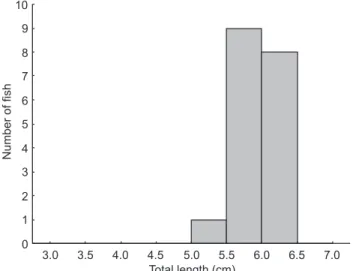
A total of 19 specimens between 5.3 and 6.4 cm (four or five per velocity) were tested between April-May 2009 (Fig. 3).
divided by the length of the fish (length/s). During each test performed, parameters concerning water quality, such as dis-solved oxygen, temperature, and pH, were monitored. After the tests, each fish was weighed (in grams) and measured (length, height, and width, in centimeters), and the condition factor (K) was calculated.
The solid blocking effect that occurs due to water flow obstruction by the fish’s body during the section test was ac-counted for and corrected for each test according to the equa-tion proposed by POPE & HAE (1966).
Relationships between critical speed and fish length, weight, condition factors, and water temperature were tested through linear regressions, with variables transformed into their natural logarithms. The same procedure was adopted for rela-tionship between prolonged speed and fatigue time, as well as the relationship between fatigue time and percentage of fa-tigued fish. Statistical significance was indicated by P-values of 0.05 or less. The determination coefficient was examined, and our accepted models have the highest coefficient. All analyses were performed using Statistica software.
RESULTS
The quality of the water in the experimental apparatus, with dissolved oxygen concentrations greater than 5 mg/l, tem-peratures between 24-28 ºC, and pH levels between 6-9, was considered satisfactory for fish in all tests performed.
The results of increasing velocity tests showed a signifi-cant relationship between critical speeds, total and standard lengths, and body weight (Figs 4-6). When associated with the total length, temperature also influenced critical speeds reached by the species (R² = 0.68, p = 0,027, y = -1.80 + 0.22X), despite slight variations during the tests. However, the condition fac-tor did not explain the critical velocity (R2 = 0.023, p = 0.45).
When compared with other Neotropical species whose critical speed data were obtained under the same experimental conditions, the pequira in our experiment showed superior speeds for specimens with an equivalent total length (Tab. I).
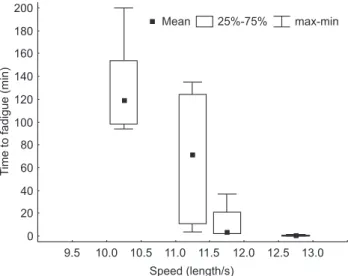
Fatigue times per prolonged speed (fixed velocity tests) class were estimated (Fig. 7) and the point of change from sus-tained to prolonged swimming (the minimum speed that can be held by a fish for more than 200 minutes) was found to occur at a speed of approximately 8.7 lengths per second. For specimens which have just reached sexual maturity (5.9 cm), this speed is approximately 0.51 m/s.
Figure 3. Number of fish per total length class tested for prolonged speed determination.
Each fish was initially subjected to a flow of 0.05 m/s for five minutes. Following this, a gradual increase was implemented until the desired speed was reached, for a maximum of five min-utes. At this point, no more alterations in water velocity were made and a stop watch was started, in order to measure the fa-tigue time. Tests had a maximum duration of 200 minutes. This swimming time was adopted because it is considered the limit between prolonged speed and sustained speed (BEAMISH 1978).
In order to eliminate the influence of fish size on the fatigue time, the test speed for each specimen evaluated was
Table I. Statistical aspects of known critical speed curves for neotropical species, and velocity (lengths per second) for the first maturation total length (ml).
Species N Equation R2 P value mL(cm) Velocity Author
L. reinhardti 25 V = 3.5 + 0.5 L 0.40 <0.001 16 8.25 L/s SANTOSet al. 2007
P. maculatus 24 V = 2.8 + 0.7 L 0.45 <0.001 23 6.09 L/s SANTOSet al. 2008
B. stramineus 27 V = 1.2 + 1.7 L 0,60 <0,001 6 11.86 L/s Present study
3.0 3.5 4.0 4.5 5.0 5.5 6.0 6.5 7.0
Total length (cm)
Number
of
fish
DISCUSSION
The results obtained in the present study for the pequira, B. stramineus, were the first for this genus involving speed mea-surements in a laboratory. Additionally, our experiments have provided the first available swimming performance data for a Neotropical small fish species.
The strong relationship between critical speed and total length reflects the importance of the caudal peduncle and the caudal fin, an important propulsion element in fish with a subcarangiform pattern of locomotion (WEBB 1994), as in the
case of the Tetragonopterinae. The relationships between criti-cal speed and standard length and weight were similar, indi-cating that weight and length measurements are strongly cor-related. These relationships are also reflected in a non-signifi-cant relationship between critical speed and the condition fac-tor, because fish in our experiment were subjected to the same conditions.
Compared to other critical speed studies on other types of fish (JONESet al. 1974, SANTOSet al. 2007, 2008), the curves obtained for the pequira showed greater R2 values, despite the equivalent number of specimens tested in all studies. However, it is important to point out that 5 min is a shorter duration time than that used in most fish swimming studies, and as a consequence of that, our values for the critical speed may be a little over-estimated.
The drag force on a body is strongly correlated with hy-drodynamic aspects of the body (MATTHEWS 1998) and is influ-enced by the velocity of flowing currents. Body shape is a ma-jor limiting factor to habitat occupancy; the shape of the body influences its locomotive abilities, especially where foraging and escape from predators are concerned (NEVES & MONTEIRO
2003). Faster environments, such as those occupied by B. stramineus (FERREIRA 2007), are assumed to be more restrictive
1.0 1.1 1.2 1.3 1.4 1.5 1.6 1.7 1.8 1.9 2.0
Ln (Total length - cm)
Ln
(Critical
velocity
-m/s)
2.0 2.4 2.8 3.2 3.6 4.0 4.4 4.8
y = 1.16 + 1.69x; R =0.60; p<0.0012
0.9 1.0 1.1 1.2 1.3 1.4 1.5 1.6 1.7 1.8
Ln (Standard length - cm)
Ln
(Critical
speed
-m/s)
2.0 2.4 2.8 3.2 3.6 4.0 4.4 4.8
y = 1.39 + 1.73x; R =0.61; p<0.0012
3.0 3.2 3.4 3.6 3.8 4.0 4.2 4.4 4.6 4.8 5.0 5.2 5.4 5.6
Ln (Weight - g)
Ln
(Critical
speed
-m/s)
2.0 2.4 2.8 3.2 3.6 4.0 4.4 4.8
y = 1.34 + 0.54x; R =0.59; p=0.0012
9.5 10.0 10.5 11.0 11.5 12.0 12.5 13.0
Speed (length/s)
T
ime
to
fadigue
(min)
0 20 40 60 80 100 120 140 160 180 200
Mean 25%-75% max-min
Figures 4-6. Relationship between critical speed and total length, standard length and weight for B. stramineus.
Figure 7. Time to fatigue per speed class (length/s) for B. stramineus.
5 4
to the fish species, because mobility and maintenance of body positions in these habitats require more energy input (LAMOUROUXet al. 2002, CASATTI & CASTRO 2006). For this reason, lower intra-specific variation is expected in these environments and explains the strong relationships that we have found.
A comparison between available data also indicates that larger species have a slower relative speed, in lengths per sec-ond. If we consider that these species could eventually be sym-patric, this relationship should be expected because smaller species must deal with water velocities that are proportionally higher.
Critical speed is a powerful tool for comparing swimming capacities among species (HAMMER 1995), but its use is limited because critical speeds are lower than speeds achieved in open channels (PEAKE 2004); additionally, critical speed has little
bio-logical significance. Endurance tests provide a more accurate measure of the swimming ability of fish species for certain time spans and at a given speed (KOLOK 1992). Thus, it is common to use prolonged speeds in fish passage mechanisms design (KATOPODIS 2005), allowing researchers to gather specific
infor-mation on how long (endurance times) and how far (swim-ming distances) a particular fish can swim against given water velocities (KATOPODIS 1992), since it is possible to create a model for the relationship between maximum traversable water ve-locity (cm/s) and length of fishway (m) (ADAMSet al. 2000).
Fish ladders already implemented in Brazil do not seem to impose an obstacle for the “pequira”, which is one of the country’s most abundant species, prevailing over migratory species populations such as the “dourado” (Salminus spp.), “curimatã” (Prochilodus spp.), and “mandi” (Pimelodus maculatus Lacepède, 1803) (GODINHOet al. 2007, BIZZOTO 2009). For this
reason, it is likely that fish ladders are providing water velocity regions with speeds of at least 0.5 m/s, the pequira’s estimated prolonged swimming speed.
Although other habitat factors (such as substrate, water quality, and depth) have an influence in the presence of a given fish (BOVEE 1986), velocity is the primary factor that can ex-plain the low selectivity of the pequira in Brazilian fishways.
However, because B. stramineus is a non-migratory spe-cies inhabiting fast flowing waters, most fish passages may be functioning as an ecological trap for them, as defined by PELICICE
& AGOSTINHO (2008). This is possible because the upstream pas-sage is not required for the species’ reproduction, the down-stream passage is generally limited (POMPEUet al. 2004), and the reservoir represents a less profitable habitat than the river downstream. Therefore, information on percentages of fatigued fish during a given swimming time and water velocity might be the most relevant to ascertain the factors affecting the swim-ming performance and management of the species.
From the data obtained, it is possible to estimate that velocities of 11.9 and 12.7 lengths per second can completely limit the passage of a specimen, in obstacles where the fish last at least seven and three minutes, respectively.
Due to the lack of basic information on the biology of Neotropical fish species, important biological factors were not considered in South American fishway projects. However, the high swimming capacity of the pequira canexplain the suc-cess of this species in ascending fishways constructed in Brazil. The data obtained for B. stramineus represent an impor-tant contribution to the knowledge about the species. This data provides guidance and criteria for designing and proper main-tenance of several structures, such as fishways, fish screens, and other systems, in order to facilitate or avoid upstream pas-sages according to management strategies.
ACKNOWLEDGEMENTS
We are grateful to FAPEMIG for financial support. Spe-cial thanks to Rafael Couto, student who helped us with the experimental tests.
LITERATURE CITED
ADAMS, S.R.; J.J. HOOVER & K.J. KILGORE. 2000: Swimming performance of Topeka shiner (Notropis Topeka) an endangered Midwestern minnow. The American Midland Naturalist144: 178-186.
BEAMISH, F.W.H. 1978. Swimming capacity, p. 101-187. In: W.S.
HOAR & D.J. RANDALL (Eds). Fish Physiology. New York, Academic Press.
BIZZOTTO, P.M. 2009. Influence of seasonal, diel, lunar, and other
environmental factors on upstream fish passage in the Igarapava Fish Ladder, Brazil. Ecology of Freshwater Fish 18: 461-472.
BOVEE, K.D. 1986. Development and evaluation of habitat
suitability criteria for use in the instream flow incremental methodology. U.S. Fish and Wildlife Service Biological Report 86: 1-235.
BRETT, J. R. 1964. The respiratory metabolism and swimming performance of young Sockeye Salmon. Journal of the Fisheries Research Board of Canada 21: 1183-1226. BRETT, J.R. 1967. Swimming performance of Sockeye Salmon
(Oncorhynchus nerka) in relation to fatigue time and temperature. Journal of the Fisheries Research Board of Canada 21: 1731-1741.
CASATTI, L. & R.M.C. CASTRO. 2006. Testing the ecomorphological
hypothesis in a headwater riffles fish assemblage of the rio São Francisco, southeastern Brazil. Neotropical Ichthyology 4: 203-214.
CLAY, C.H. 1995. Design of fishways and other fish facilities.
Boca Raton, CRC Press.
FERREIRA, K.M. 2007. Biology and ecomorphology of stream fishes
from the Mogi-Guaçu basin, Southeastern Brazil. Neotropical Ichthyology 5:311-326.
H.A. SANTOS & C.B.M. ALVES (Eds). Proceeding of the International Symposium on Fish Passages in South America. Lavras, Universidade Federal de Lavras.
HAMMER, C. 1995. Fatigue and exercise tests with fish.
Comparative Biochemistry and Physiology 112: 1-20.
JONES, D.R.; J.W. KICENIUK & O.S. BAMFORD. 1974. Evaluation of
the swimming performance of several fish species from the Mackenzie River. Journal of the Fisheries Research Board of Canada 31: 1641-1647.
KATOPODIS, C. 1992. Introduction to Fishway Design. Winnpeg,
Freshwater Institute.
KATOPODIS, C. 2005. Developing a toolkit for fish passage, ecological flow management and fish habitat works. Journal of Hydraulic Research 43: 451-467.
KOLOK, A.S. 1992. The swimming performance of individual
largemouth bass (Micropterus salmoides) are repeatable.
Journal of Experimental Biology 170: 265-270.
LAMOUROUX, N.; N.L. POFF & P. L. ANGERMEIER. 2002. Interconti-nental convergence of stream fish community traits along geomorphic and hydraulic gradient. Ecology 83:1792-1807. MATTHEWS, W.J. 1998. Patterns in Freshwater Fish Ecology. New
York, Chapman & Hall.
NEVES, F.M. & L.R. MONTEIRO. 2003. Body shape and size divergence among populations of Poecilia vivipara in coastal lagoons of souht-eastern Brazil. Journal of Fish Biology 63: 928-941.
PEAKE, S. 2004. An evaluation of the use of critical swimming speed for determination of culvert water velocity criteria for smallmouth bass. Transaction of the American Fisheries Society 133: 1472-1479.
PELICICE, F.M. & A.A. AGOSTINHO. 2008. Fish-passage facilities as
ecological traps in large neotropical rivers. Conservation Biology 22: 180-188.
PLANQUETTE, P.; P. KEITH & P.Y. LE BAYL. 1996. Atlas des poissons d’eau douce de Guyane. Paris, Museum National D’Histoire Naturelle. Service du Patrimoine Naturel, Institut D’Ecologie et de Gestion de la Biodiversité, Collection du Patrimoine Natural 22. POMPEU, P. DOS S.; V.P. FERREIRA; H.F. SILVA & C.B. MARTINEZ. 2004.
Evaluation of downstream fish passage through Santa Cla-ra Power Plant Dam, Minas GeCla-rais, BCla-razil. In: Proceedings of Fifth International Symposium on Ecohydraulics, Aquatic Habitats: Analysis & Restoration. Madrid, International Association of Hydraulic Engeneering and Research,vol 2, p. 999-1003.
POPE, A. & W.H.J. HAE. 1966. Low-Speed Wind Tunnel Testing.
New York, John Wiley and Sons.
QUIRÓS, R. 1989. Structures assisting the migrations of non-salmonid fish: Latin America. Rome, FAO.
REIS, R.E.; S.O. KULLANDER & C.J. FERRARIS JR. 2003. Check list f the freshwater fishes of South and Central America. Por-to Alegre, EDIPUCRS.
RINGUELET, R.; R. ARAMBURU & A.A. DE ARAMBURU. 1967. Los peces argentinos de água dulce. La Plata, Comission de Inves-tigacion Científica.
SANTOS, H. DE A.; P. DOS S. POMPEU & C. B. MARTINEZ. 2007. Swimming performance of the migratory Neotropical fish Leporinus reinhardti (Characiformes: Anostomidae).
Neotropical Ichthyology 5: 139-146.
SANTOS, H. DE A.; P. DOS S. POMPEU; G.S. VICENTINI & C.B. MARTINEZ.
2008. Swimming performance of the freshwater neotropical fish: Pimelodus maculatus Lacepède, 1803. Brazilian Journal of Biology 68: 433-439.
WEBB, P.W. 1994. The biology of fish swimming, p. 45-62. In: L.
MADDOCK; Q. BONE & J.M.V. RAYNER. (Eds). Mechanics and
physiology of animal swimming. Cambridge, Harvard
University Press.