ONTOFORINFOSCIENCE: A DETAILED
METHODOLOGY FOR CONSTRUCTION OF
ONTOLOGIES AND ITS APPLICATION IN THE
BLOOD DOMAIN
Fabrício M. Mendonça (1), Mauricio B. Almeida (2)
(1) Universidade Federal de Minas Gerais, Av. Antônio Carlos, 6627 – Campus Pampulha – Belo Horizonte – Minas Gerais – Brasil, [email protected], (2) [email protected]
Abstract
Ontologies are instruments of knowledge organization that have been developed by using several methodologies. These methodologies are well-known and established, but their steps often are not well explained. Thus, only knowledge engineers, in general with a major in computer science, are able to perform all steps required in ontologies development. In the present paper, we describe a methodology that details each step of the ontology development cycle. The goal of this methodology, which is called OntoForInfoScience, is to overcome issues that arise from the use of technical jargon and from the application of logical-philosophical principles in the ontology development. In order to identify the
afore-mentioned issues, our methodology was produced by infor-mation scientists during the development of ontologies in the domain of human blood. Such domain ontology, called Hem-onto, is part of an on-going scientific biomedical project. In this paper, we present a brief description of OntoForInfoSci-ence, as well as some results of its application in the devel-opment of the blood ontology. Finally, we conclude that the new methodology is useful for information scientists creating formal ontological representations. In addition to the meth-odology per se, we also provide partial results of Hemonto development.
Keywords: knowlegde representaion; ontologies; ontologies development; biomedical ontologies.
1 Introduction
Ontologies have been widely employed in knowledge representation and knowledge organization within sev-eral scientific fields. In Biomedicine, ontologies are used to improve medical vocabularies, insofar as they make use of logical formalisms able to provide more expressivity representing knowledge. In addition, on-tologies enable the creation of accurate models of reali-ty, which is a desirable characteristic in biomedicine (Freitas and Schulz 2009).
The growing use of biomedical ontologies can be no-ticed, for example, by the emergence of specialized repositories and by the use of ontologies to improve vocabularies in relevant medical domains. The former is illustrated by initiatives as the Open Biomedical On-tologies (OBO) (Smith et al. 2007), a public online repository of biomedical ontologies, which aims to foster integration and standardization of medical termi-nology. The latter is illustrated by efforts in formaliz-ing fundamental medical vocabularies such Gene On-tology (GO) (Smith, Williams and Schulze-Kremer
2003) and Foundational Model of Anatomy (FMA) (Rosse and Mejino 2003).
The present paper describes a new methodology to ontology construction, called OntoForInfoScience, which provides a higher level of detail concerning the steps of the ontological development cycle (Mendonça 2015). The goal of OntoForInfoScience is to enable experts in Knowledge Organization – often from the Information Science field – to overcome the use of both technical jargon, and logical and philosophical principles involved in the ontology development. In order to identify the difficulties, the methodology was created by researchers of Information Science during the development of an ontology for human blood com-ponents. This domain ontology, called Hemonto, is part of a scientific project called the Blood Project (1) that aims to create a formal language about blood compo-nents in hematology and blood transfusion sub-domains.
of blood. While creating the new methodology, we manage to provide more details about several steps and issue, for example: the use top-level ontologies, the characterization of different ontological relations, the creation of formal definitions, and so forth. The de-tailed steps proved to be useful to guide the ontology developers in creating domain ontologies.
The remainder of this paper is organized as follows. The second section presents biomedical domain ontol-ogies that represent and describe concepts of the blood domain. The third section presents well-known meth-odologies for ontology construction currently in use, in addition to a brief description of the OntoForInfoSci-ence methodology. The fourth section describes the construction of Hemonto using the new methodology. The fifth section presents partial results of the domain ontology. Finally, the sixth section offers final remarks and expectations for future works.
2 Biomedical ontologies and the blood domain
Surveying repositories of vocabularies for knowledge representation in the domain of human blood, one can notice that the level of coverage of current instruments, like terminologies and even ontologies, is still insuffi-cient. Indeed, one can observe that entities and proper-ties of human blood are still underrepresented in the aforementioned instruments. So, the development of ontologies about blood components is a defensible en-terprise. Even though current initiatives are not so suit-able, the existing ontologies and terminologies about blood were useful in the construction of Hemonto, since the reutilization of terms is a well-recommended principle in ontological engineering.
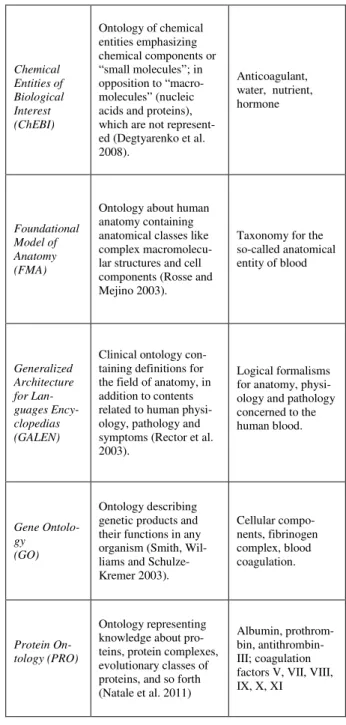
In this section, we present a literature review about biomedical ontologies that deal with aspects of the hu-man blood. These ontologies were used as sources for reutilization of terms during the Hemonto construction. It is noteworthy that the literature review is not exhaus-tive and lists only the main and best-known biomedical ontologies rather than the large amount of them availa-ble on the web. Taavaila-ble 1 describes these ontologies us-ing the labels: name and acronym, reference to authors, covered domain, descriptions and examples of the con-tent.
Ontology Description Related Examples
Cell Ontology (CL)
Ontology representing biomedical knowledge about kinds of cells, including prokaryotes cells, animal and vegetal cells, and so forth (Bard, Rhee and Ashburner 2005).
Hematopoietic cell (blood cell), plasma cell; neutrophil, eosinophil and ba-sophil; monocyte, T lymphocyte.
Chemical Entities of Biological Interest (ChEBI)
Ontology of chemical entities emphasizing chemical components or “small molecules”; in opposition to “macro-molecules” (nucleic acids and proteins), which are not represent-ed (Degtyarenko et al. 2008).
Anticoagulant, water, nutrient, hormone
Foundational Model of Anatomy (FMA)
Ontology about human anatomy containing anatomical classes like complex macromolecu-lar structures and cell components (Rosse and Mejino 2003).
Taxonomy for the so-called anatomical entity of blood
Generalized Architecture for Lan-guages Ency-clopedias (GALEN)
Clinical ontology con-taining definitions for the field of anatomy, in addition to contents related to human physi-ology, pathology and symptoms (Rector et al. 2003).
Logical formalisms for anatomy, physi-ology and pathphysi-ology concerned to the human blood.
Gene Ontolo-gy (GO)
Ontology describing genetic products and their functions in any organism (Smith, Wil-liams and Schulze-Kremer 2003).
Cellular compo-nents, fibrinogen complex, blood coagulation.
Protein On-tology (PRO)
Ontology representing knowledge about pro-teins, protein complexes, evolutionary classes of proteins, and so forth (Natale et al. 2011)
Albumin, prothrom-bin, antithrombin-III; coagulation factors V, VII, VIII, IX, X, XI
Table 1.Ontologies and terms in the blood domain.
3 OntoForInfoScience stages
for non-experts in Logic, Computer Science and Phi-losophy (Mendonça 2015).
Ontologies have been extensively applied in knowledge representation since the 1990s. So, several methodologies for construction of ontologies have been presented in literature. Indeed, one can notice a prolif-eration of methodologies and methods from the mid-90s until to the mid-2000s. Some of the most cited methodologies that emerged in this period include: Uschold and King’s Methodology – Enterprise Ontolo-gy (Uschold and King 1995); Gruninger and Fox’s Methodology– Toronto Virtual Enterprise (TOVE) (Gruninger and Fox 1995); Methontology (Gómez-Perez, Fernández and Vicente 1996); 101 Method (Noy and McGuinness 2011); CYC Method (Reed and Lenat 2002); On-To-Knowledge Methodology (OTKM) (Sure, Staab and Stuber 2003). Since the mid-2000s, other methodologies were created, for example: NeOn Methodology (Suárez-Figueroa 2008) and Up for ON-tology (UPON) (De Nicola, Missikoff and Navigli 2009).
Even though there are a significant number of method-ologies available for ontology developers, many diffi-culties are still found. An ordinary difficulty is that methodologies do not explain in details the steps to be followed during the activity. In general, methodologies suppose that developers are experienced knowledge engineers and that they already know how to perform all tasks (Mendonça 2015). For example, some meth-odologies suggest that one needs to create formal defi-nitions, but they do not explain how to accomplish this task. In general, when building ontologies some back-ground in logic, philosophy and computer science is required. The presence of technical terms without the suitable elucidation of their meanings has posed barri-ers to professionals that deal with knowledge organiza-tion in Informaorganiza-tion Science. Examples of such terms are: multiple inheritance, data types, abstract class, and disjoint class, to mention a few.
OntoForInfoScience is a methodology that explains in details all the steps required for the ontology develop-ment in a simple language suitable for a variety of pro-fessionals. In order to do this, the methodology reuses and refines phases of existing methodologies (for ex-ample, Methontology, 101 Method and Neon) with the aim of overcoming some limitations. OntoForInfoSci-ence consists of nine phases depicted in Figure 1. By limitations of space, each phase cannot be fully de-scribed here. A complete description of each phase can be obtained in Mendonça (2015).
In phase 0, the developer performs a previous evalua-tion regarding the need of constructing an ontology. On the one hand, if the goal is indexing and information retrieval from documents, one would rather to develop a thesaurus. On the other hand, if the goal is the
repre-sentation of real world entities by using a richer set of relations, the construction of an ontology should be considered.
Figure 1. Phases OntoForInfoScience Methodology
Phase 2 involves knowledge acquisition. It encom-passes the selection of materials to be studied (about the domain) and the selection of methods to extract knowledge. Within OntoForInfoScience, these activi-ties mixed different methods, like: books and papers textual analysis, automatic terms extraction, and semi-automatic methods for concepts identification, to men-tion a few. The intermediary artifacts obtained in phase 2 are glossaries of concepts, of verbs and relations. All of them are employed in phase 3.
Phase 3 concerns conceptualization. This involves identification and analysis of concepts candidates to be classes. In addition, developers perform knowledge organization to obtain relations, properties and con-straints. In OntoForInfoScience, these processes occur with the transformation of glossaries (built in phase 2) into conceptual artifacts, for example: i) a concepts and properties table containing identified concepts, defini-tions, synonyms, allowed values and properties; ii) a verbs dictionary containing identified verbs candidates to be relationships, as well as their textual definitions; iii) a graphical conceptual model that represents con-ceptual relations between concepts using graphs and similar structures.
Phase 4 favors reuse and integration through the activi-ty of ontological grounding. Developers analyze top-level ontologies that can be used as a starting point. Then, they choose the more suitable top-level ontology considering the underlying philosophical approach for modeling decisions. From the operational point of view, the top-level ontology is imported into an ontol-ogy editor tool for implementation.
In phase 5, the ontology formal representation is creat-ed using a logical language. Departing from the con-ceptualization (phase 2), developers produce formal descriptions. The domain knowledge is then organized considering ontological-formal principles, which im-plies in refining prior conceptual structures in order to meet ontological and logical constraints. Some main activities in phase 5 are: i) to construct a general tax-onomy based on the selected top-level ontology; ii) to define descriptive properties of classes, which involves to describe textual attributes as names, synonyms, defi-nitions and annotations; iii) to create formal defidefi-nitions of classes, which are derived from the textual defini-tions; iv) to define classes properties, which involves to describe attributes as data types, cardinalities, existen-tial and universal quantifiers; v) to create instances of ontological classes; vi) to specify ontological relations in applying a set of rules and principles to transform conceptual relations into formal relations. Among these rules, one can mention as an example the constraints of including only relations connecting entities in reality. Another example is the characterization of relationship
types is_a and part_of. vii) to define properties of onto-logical relationships, which includes the relation name, its semi-formal definition, its logical properties, its domain and range, to mention a few.
Phase 6 involves ontology evaluation. OntoForInfoSci-ence considers the application of a set of criteria to perform both ontological validation (correspondence between ontology and real world) and ontological veri-fication (analysis with respect of the building correct-ness). Examples of validation criteria are: non-recursivity in definitions, specification of different types of part_of relations, definition of inverse rela-tions, and creation of cardinalities.
In phase 7, all activities of the life cycle are document-ed and organizdocument-ed. Documentation is producdocument-ed along with the ontology construction. Documentation en-compasses the specification document (phase 1), refer-ence documents related to the domain (phase 2), set of conceptual models (phase 3), reused ontologies (phases 4 and 5), ontological and formal content (phase 5), and other useful notes.
Finally, in phase 8 the developer makes the ontological artifact available to be downloaded and visualized by a community of users. The steps of this phase are: i) to export the ontology content from the editor to web re-pository; ii) the ontology presentation in a graphical format, which can facilitate the understanding of the structure by users.
4 OntoForInfoScience in Hemonto construction
With the aim of both obtaining the formal representa-tion of human blood components and simultaneously testing OntoForInfoScience, we developed Hemonto following the phases established to OntoForInfoSci-ence. In this section, we describe the Hemonto con-struction as a test bed application to the new methodol-ogy.
In OntoForInfoScience, phase 0 consists in evaluating the real need of an ontology to represent a domain. Three main aspects justified the construction of Hem-onto: i) the lack of formal representations in the blood domain; ii) the need of a unique, free of ambiguities, specialized vocabulary; and iii) the need that this vo-cabulary reflects the reality.
In addition to this general purpose, in phase 1 we also delimited the scope of Hemonto: it begins with both BFO and FMA top-level classes. Then we defined blood components and derivatives by employing a middle-out strategy. The limit of the ontology coverage was defined by terms related to proteins and enzymes, which are part of other biomedical ontologies. Finally, we referenced these other biomedical ontologies, which do not belong to the blood domain like: Gene Ontolo-gy, Cell OntoloOntolo-gy, Chemical Entities of Biological Interest, and so forth. Limits in finding both the suita-ble scope and granularity of the ontology are issues that always pose difficulties in the ontology construction.
In phase 2, knowledge acquisition, we consulted tech-nical documents related to the blood domain in order to extract knowledge. Examples of these documents are: i) the guidelines of hemocomponents from the Brazili-an Ministry of Health; ii) the terminological stBrazili-andard ISBT 28 (ICCBBA 2010); and, iii) a well-known text-book about clinical hematology called Wintrobe’s Clinical Hematology (Greer et al. 2009). These docu-ments were pointed as relevant references according to hematology and blood transfusion experts. With re-spect to the activity of knowledge extraction, we em-ployed both automatic and manual methods: i) Sketch Engine (2), a software of linguistic analysis used to identify and extract most frequent terms found in doc-uments; ii) a collaborative framework called Conceptu-alization Modeling Environment (ConceptME) (Sousa, Pereira and Soares 2013), which semi-automatically extracts concepts and relations; iii) human texts analy-sis to identify candidate terms and relationships.
In phase 3, conceptualization, the glossary of concepts created in phase 2 was first turned into a dictionary of concepts, and then assume the form of a table of con-cepts and properties. This table comprises elements at the conceptual level, namely: identified concepts, their definitions, synonyms, allowed values and restrictions. Also in this phase, the glossary of verbs was turned into a dictionary of verbs, which contains the identified verbs and their textual definitions; the glossary of rela-tionships was turned into a set of conceptual relations. All of these tasks were carried out along with experts in hematology and blood transfusion. Finally, the out-come of phase 3 was applied to create graphical con-ceptual models. In such a task, we employed tools like: ConceptMe (3), DiagramEditor (4) e OmniGraffle (5).
In phase 4, ontological grounding, we followed tenets of two top-level ontologies: i) Basic Formal Ontology (BFO) (Grenon and Smith 2004), which acted as the starting point to Hemonto in providing the most of general classes; ii) Relation Ontology (RO) (Smith et al. 2005), which provides the meaning of ontological relationships between classes. Both ontologies are de-signed based on principles of what has been called “scientific ontological realism” (Smith and Ceusters
2010). To model Hemonto we applied top-level ontol-ogies importing their code to the ontology editor and maintaining their formal principles.
The formalization of ontological content of Hemonto, activity planned to phase 5, was performed following these steps: i) construction of the ontology general tax-onomy from BFO entities by classifying blood-related entities under more general entities; ii) definition of descriptive properties of classes and the equivalent textual attributes like ID, label, imported_from, has_Synonym, definition, comments, etc.; iii) creation of formal definitions of classes in logical language (for example, the class “portion of plasma” in Figure 2); iv) definition of class properties to represent the blood component characteristics, for example: proper vol-ume, percentage of hematocrits, temperature of storage, to mention a few; v) creation of classes instances from a set of rules that involves the instances identification through competence questions; vi) specification of on-tological relationships from a set of rules and ontologi-cal principles with the aim of turning conceptual rela-tions into ontological-formal relarela-tionships, for exam-ple: kinds of is_a and kinds of part_of relations; vii) definitions of descriptive and logical properties from equivalent attributes in Protégé (label, definition, char-acteristics, inverse_of, domains, ranges, etc).
Portion of Plasma: textual definition
From FMA – Portion of Plasma: portion of body substance corresponding to the liquid component of blood in which blood cells are immerserd
Annotation of the textual definition
From FMA – Portion of Plasma: portion of body substance [FMA/Hemonto: portion of body substance] corresponding to [BFO: has quality] the liquid [FMA/Hemonto: liquid] component of [RO: part_of] blood [FMA/Hemonto: portion of blood] in which blood cells [FMA/Hemonto: blood cell] are immersed [RO: contain].
Portion of Plasma: formal definition
Portion of Plasma is_a portion of body substance and (has_quality liquid) and (part_of portion of blood) and (contains blood cell)
Figure 2. Example of class definition in the ontology
In phase 6, we performed the ontological content eval-uation of Hemonto according to a set of criteria defined to validation and verification. Such criteria cover as-pects related to ontological commitments, ontology specification, expansibility, correctness, integrity, con-sistency, accurateness, validation by experts and doc-umentation. The Hemonto documentation was created during the process of ontology development and fin-ished in phase 7 with a final document.
reposi-tory and made it available. Regarding the availability on the web, we used a Protégé´s plug-in called OWLDoc, which allows creating a general view of the ontology.
5 Hemonto content
From the application of OntoForInfoScience in the construction of Hemonto, it was generated a formal and expressive representation of the human blood compo-nents to be used in healthcare and medical attendance. In this section, we describe the part of Hemonto that was developed with the aim of creating and testing OntoForInfoScience.
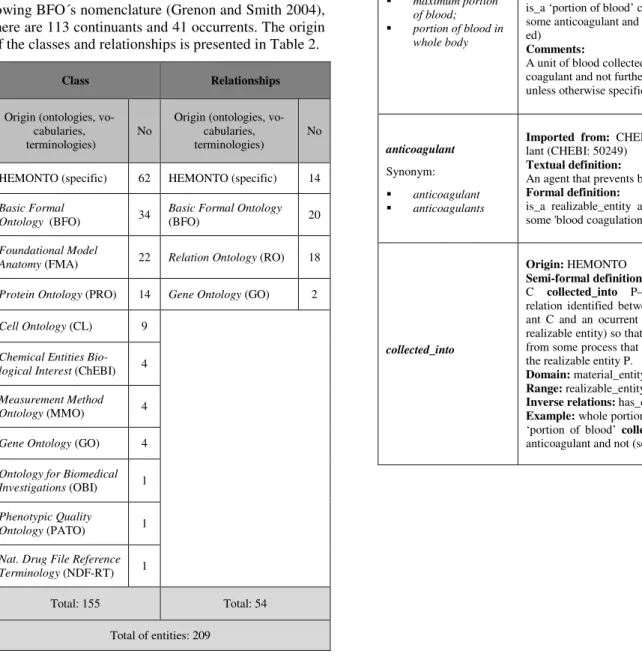
Hemonto is a biomedical domain ontology, which in the current version has 113 terms and 54 relations. Fol-lowing BFO´s nomenclature (Grenon and Smith 2004), there are 113 continuants and 41 occurrents. The origin of the classes and relationships is presented in Table 2.
Class Relationships
Origin (ontologies, vo-cabularies, terminologies)
No
Origin (ontologies, vo-cabularies, terminologies)
No
HEMONTO (specific) 62 HEMONTO (specific) 14 Basic Formal
Ontology (BFO) 34
Basic Formal Ontology
(BFO) 20
Foundational Model
Anatomy (FMA) 22 Relation Ontology (RO) 18 Protein Ontology (PRO) 14 Gene Ontology (GO) 2
Cell Ontology (CL) 9 Chemical Entities Bio-logical Interest (ChEBI) 4 Measurement Method Ontology (MMO) 4 Gene Ontology (GO) 4 Ontology for Biomedical Investigations (OBI) 1 Phenotypic Quality
Ontology (PATO) 1 Nat. Drug File Reference Terminology (NDF-RT) 1
Total: 155 Total: 54
Total of entities: 209
Table 2.Origin of the Hemonto classes.
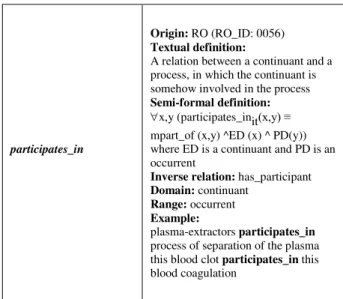
The classes and relationships of Hemonto, presented in Table 2, are described in the class dictionary and rela-tion dicrela-tionary, which were produced along with the Hemonto development. Both instruments included formalisms and logical axioms for entities defined in the ontology. Table 3 shows examples of those entities extracted from the Hemonto´s dictionaries.
Entity
(class or relation) Properties
whole portion of blood Synonym:
entire portion of blood;
maximum portion of blood; portion of blood in
whole body
Imported from: FMA: whole portion of blood (FMAID: 263001)
Textual definition:
Portion of blood collected into an anticoagulant and not further pro-cessed
Formal definition:
is_a ‘portion of blood’ collected_in some anticoagulant and not (separat-ed)
Comments:
A unit of blood collected into an anti-coagulant and not further processed unless otherwise specified
anticoagulant
Synonym: anticoagulant anticoagulants
Imported from: CHEBI: anticoagu-lant (CHEBI: 50249)
Textual definition:
An agent that prevents blood clotting Formal definition:
is_a realizable_entity and prevent_of some 'blood coagulation'
collected_into
Origin: HEMONTO Semi-formal definition:
C collected_into P– Ontological relation identified between a continu-ant C and an ocurrent P (which is a realizable entity) so that C is extracted from some process that corresponds to the realizable entity P.
participates_in
Origin: RO (RO_ID: 0056) Textual definition:
A relation between a continuant and a process, in which the continuant is somehow involved in the process Semi-formal definition:
∀x,y (participates_init(x,y) ≡ mpart_of (x,y) ^ED (x) ^ PD(y)) where ED is a continuant and PD is an occurrent
Inverse relation: has_participant Domain: continuant
Range: occurrent Example:
plasma-extractors participates_in process of separation of the plasma this blood clot participates_in this blood coagulation
Table 3. Formalisms and axioms of Hemonto entities
In addition to these dictionaries, the content of Hemon-to encompasses structures for graphical representation depicting the relation between entities. Those structures are represented through taxonomies, partonomies or a hybrid structure, which involves more than one rela-tion. Taxonomies, partonomies and other structures were developed in the conceptualization and formaliza-tion phases.
The structures defined in the conceptualization phase include: i) a blood partonomy; ii) a leukocytes taxono-my; iii) a partonomy of products derived from blood; iv) a partonomy of basic processes to obtain blood samples; v) a taxonomy of pathological blood cells; to mention a few. These structures defined in the formali-zation phase comprise: i) a continuants taxonomy; ii) a ocurrents taxonomy; iii) an anticoagulants taxonomy; iv) a taxonomy of basic parameters of blood compo-nents; v) a representation of the venous punction pro-cess; vi) a representation of processes of obtaining red blood and platelets components; vii) a representation of the processes of obtaining plasmatic components; vii) a representation of the process of obtaining the concen-trated granulocytes components; to mention a few.
6 Final Remarks
One of the most striking difficulties that professionals and researchers of Information Science face in devel-oping ontologies is the presence of technical terms from Computer Science, Logic and Philosophy. This paper presented OntoForInfoScience, a methodology that aims to provide more details about phases of on-tology development. We intended to contribute to the expansion of ontology development beyond the exper-tise of knowledge engineers. In order to create and test OntoForInfoScience, we developed part of an ontology in the hematology and blood transfusion domain.
The use of OntoForInfoScience in the construction of ontologies proved to be useful with respect to the pur-pose of obtaining a proper formal representation. In-deed, the methodology uses an ordinary and simple language, which facilitates the understanding of activi-ties performed in the construction of ontologies while maintaining the high expressivity of logical languages. Some features of OntoForInfoScience that are useful to ontology development are: i) the meaning of logical and descriptive properties of classes and relations; ii) the use of top-level ontologies as a starting point to ontology development; iii) the furnishment of details about the process of formal and textual definitions cre-ation; iv) explanation about the meaning of ontological relations and about how is possible to characterize the kinds of ontological relations; v) the promotion of col-laboration as a key aspect in the conceptualization phase; vi) explanations about how to find terms related to the domain and how to import them into the ontolo-gy. Considering features and practical applicability, OntoForInfoScience proved to be useful to the purpose of building Hemonto. For obvious limitations of space, the most important characteristics of OntoForInfoSci-ence, namely, the furnishment of activities details, could not be properly described here. For a complete coverage of the new methodology, see Mendonça (2015).
Considering the lack of formal representations in the domain of blood and its components, we believe that our research in Hemonto is fully justified. The ontolo-gy contributes to the blood components description and to better understanding of how these components are extracted, manipulated and stored for purposes of healthcare. Hemonto was developed using OntoFor-InfoScience in order to generate a formal representa-tion of blood domain. Accordingly, one of the goals of this paper was to show how the process of ontological development occurred in Hemonto.
Regarding the Hemonto content, it is noteworthy that the developed ontology is characterized by presenting a formal representation more comprehensive than other currently available ontologies, like: FMA, GALEN, UMLS, GO, to mention a few. Even so, Hemonto is an ongoing project since the blood domain is large and complex. We are aware that the ontology development is an interactive process, and that Hemonto needs addi-tional validation in different communities comprised by specialists, physicians, and other healthcare profes-sionals.
Notes
(1) Available at: http://mba.eci.ufmg.br/blo/. Accessed 05 April 2015.
(3) Available at: http://www.conceptme.pt/. Access 10 Nov. 2014.
(4) Available at: http://dia-installer.de/. Access 22 Jun 2014. (5) Available at: https://www.omnigroup.com/omnigraffle.
Access 05 Jan. 2015.
References
Bard, J.; Rhee, S. Y.; Ashburner, M. (2005). An ontology for cell types. // Genome Biology 6 (2005) R21.
De Nicola, A.; Missikoff, M.; Navigli, R. 2009. A software engineer-ing approach to ontology buildengineer-ing. // Information Systems 34 (2009) 258-275.
Degtyarenko, K.; Matos, P.; Ennis, M.; Hastings, J.; Zbinden, M.; McNaugth, A.; Alcantara, R.; Darsow, M.; Guedj, M.; Ashburn-er, M. (2008). ChEBI: A database and ontology for chemical en-tities of biological interest. // Nucleic Acids Research 36 (2008) D344-D350.
Freitas, F.; Schulz, S. (2009). Pesquisa de terminologias e ontologias atuais em biologia e medicina. // RECIIS – Revista Eletrônica de Comunicação, Informação & Inovação em Saúde 3:1 (2009 mar.): 8-20.
Gómez-Pérez, A.; Fernández, M.; Vicente, A. (1996). Towards a method to conceptualize domain ontologies. // ECAI Workshop on Ontological Engineering, Budapest. http://citeseer.ist.psu.edu/483876.html. (13-03-15).
Grenon, P.; Smith, B. (2004). SNAP and SPAN: Towards Dynamic Spatial. // Spatial Cognition & Computation 4:1 (2004): 69-104. http://ontology.buffalo.edu/smith/articles/SNAP_SPAN.pdf (02-03-15).
Greer, J. P.; Foerster J.; Rodgers G. M.; Paraskevas, F.; Glader, B.; Arber; D. A.; Means, R.T. (2009). Wintrobe's Clinical Hematol-ogy 12th Edition. Philadelphia: Lippincott Williams & Wilkins, 2009.
Gruninger, M.; Fox, M. S. (1995). Methodology for the Design and Evaluation of Ontologies. // Workshop On Basic Ontological Is-sues In Knowledge Sharing (IJCAI).
ICCBBA – ISBT 128 Standard. (2010). Standard Terminology for Blood, Cellular Therapy and Tissue Product Descriptions, v 3.33. http://www.iccbba.org (08-01-14).
Mendonça, F.M. (2015). OntoForInfoScience: metodologia para construção de ontologias pelos cientistas da informação – uma aplicação prática no desenvolvimento da ontologia sobre componentes do sangue humano (HEMONTO). 2015. Doctoral Thesis. Universidade Federal de Minas Gerais (UFMG), Belo Horizonte, Brasil, 2015.
Natale, D.A.; Arighi, C.N.; Barker, W.C.; Blake, J.A.; Bult, C.J.; Caudy, M.; Drabkin, H.J.; D’Eustachio, P.; Evsikov, A.V.; Huang, H.; Nchoutmboube, J.; Roberts, N.V.; Smith, B.; Zhang, J; Wu, C.H. (2011). The Protein Ontology: a structured represen-tation of protein forms and complexes. // Nucleic Acids Re-search 39 (2011 Database issue) D539-D545.
Noy, N.F.; McGuinness, D.L. (2001).Ontology Development 101: A Guide to Creating Your First Ontology. Stanford Knowledge Systems Laboratory Technical Report KSL-01-05; Stanford Medical Informatics Technical Report SMI-2001-0880, 2001. Rector, A.; Rogers, J.E.; Zanstra, P.E.; Haring, E. (2003).
Open-GALEN: Open Source Medical Terminology and Tools. // AMIA Annual Symposium Proceedings 2003, 982.
Reed, S.L.; Lenat, D.B. (2002). Mapping Ontologies into Cyc. http://www.cyc.com/doc/white_papers/mapping-ontologies-into-cyc_v31.pdf (25-04-14).
Rosse, C.; Mejino, J.L.V. (2003). A reference ontology for biomedi-cal informatics: The Foundational Model of Anatomy. // Journal of Biomedical Informatics 36 (2003) 478-500.
Smith, B.; Williams, J.; Schulze-Kremer, S. (2003). The ontology of the Gene Ontology. // Proc. of the AMIA Symposium 2003, 609-13.
Smith, B.; Ceusters, W.; Klagges, B.; Kohler, J.; Kumar, A.; Lomax, J.; Mungall, C.; Neuhaus, F.; Rector, A.L.; Rosse, C. (2005). Re-lations in biomedical ontologies. // Genome Biology 6 (2005) R46.
Smith, Barry; Ashburner, Michael; Rosse, Cornelius; Bard, Jonathan, Bug, William; Ceusters, Werner; Goldberg, Louis J; Eilbeck, Karen; Ireland, Amelia; Mungall, Christopher J.; The OBI Con-sortium; Leontis, Neocles; Rocca-Serra, Philippe; Ruttenberg, Alan; Sansone, Susanna-Assunta; Scheuermann, Richard H; Shah, Nigam; Whetzel1, Patricia L; Lewi, Suzanna (2007). The OBO foundry: Coordinated evolution of ontologies to support biomedical data integration. // Nature Biotechnology 25:11 (2007) 1251–1255.
Smith, B.; Ceusters, W. (2010). Ontological realism: A methodology for coordinated evolution of scientific ontologies. // Applied On-tology 5:3-4 (2010 Nov 15) 139–188.
Sousa, C.; Pereira, C.; Soares, A. (2013). Collaborative Elicitation of Conceptual Representations: A Corpus-Based Approach. // Ro-cha, A.; Correia, A.M.; Wilson, T., Stroetmann, K.A. (eds.) Ad-vances in Information Systems and Technologies, vol. 206. Ber-lin; Heidelberg: Springer Berlin Heidelberg, 111–124.
Suárez-Figueroa, M.C. (2008). NeOn D 5.4.1. NeOn Methodology for Building Contextualized Ontology Networks. NeOn project. http://www.neon-project.org (15-05-14).
Sure, Y.; Staab, S.; Stuber, R. (2003). On-To-Knowledge
Methodol-ogy (OTKM). http://www.sfu.ca/~mhatala/iat881/papers/2003_ontohandbook_
otkmethodology.pdf (17-05-14).
Uschold, M.; King, M. (1995). Towards a methodology for building ontologies. http://citeseer.ist.psu.edu/uschold95toward.html. // Workshop on Basic Ontological Issues in Knowledge Sharing, held in conjunction with IJCAI-95 (15-05-14).