disease, pulmonary vasculitis, collagenoses, or pulmonary thromboembolism.
In cases of idiopathic PAH (IPAH), one-, three-, and five-year survival rates after symptom onset are 68%, 48%, and 34%, respectively.(3) Calcium antagonist drugs have a known pulmonary vasodilator effect, decreasing pulmo-nary pressure and increasing the survival and quality of life of patients with IPAH.(4) However, less than 20% of these patients, corresponding to those that present pulmonary vasoreactivity, should use this medication.(5) For patients not presenting pulmonary vasoreactivity, the use of calcium
Introduction
Pulmonary arterial hypertension (PAH) is defined as mean pulmonary artery pressure (MPAP) > 25 mmHg at rest and > 30 mmHg during exercise.(1) Observations suggest that vasoconstriction plays an important role in the pathogenesis of PAH. This disease is characterized by medial hypertrophy of pulmonary arterioles, decreased endothelial produc-tion of vasoconstrictors (prostacyclin and nitric oxide), and increased production of the vasoconstrictor endothelin.(2)
Pulmonary arterial hypertension (PAH) is classified as idiopathic, when the cause is unknown, or secondary, when it is associated with pulmonary parenchymal diseases, heart
Edmundo Clarindo Oliveira1, Carlos Faria Santos Amaral2, Marco Antonio Moura3,
Frederico Thadeu Assis Figueiredo Campos4, Helder Machado Pauperio5
Abstract
Pulmonary arterial hypertension is classified as idiopathic or secondary (associated with collagenoses, heart disease, portal hypertension, pulmonary thromboembolism, and pulmonary vascular diseases). Pulmonary vasoreactivity should be tested in order to define the best treatment option. Of the many drugs that have been used to test pulmonary vasoreactivity, inhaled nitric oxide is the best choice, due to its specific pulmonary effect and very short half-life (5-10 s). The results of this test identify candidates for heart surgery among patients with congenital heart disease and candidates for the use of calcium antagonists among patients with other forms of pulmonary arterial hypertension. Performing and interpreting the results of such tests are a great responsibility, since mistakes can lead to incorrect treatment decisions, resulting in the death of patients.
Keywords: Hypertension, pulmonary/diagnosis; Nitric oxide/diagnostic use; Administration, inhalation.
Resumo
A hipertensão arterial pulmonar é classificada como idiopática ou secundária (associada a colagenoses, cardiopatias, hipertensão portal, trom-boembolismo pulmonar e doenças da vasculatura pulmonar). O teste de vasorreatividade pulmonar é indicado para definir a melhor opção terapêutica. Muitas drogas têm sido utilizadas para a realização desse teste, sendo o óxido nítrico inalado a melhor opção, por apresentar ação específica pulmonar e meia vida muita curta (5-10 s). O resultado desse teste identifica candidatos à cirurgia cardíaca nas cardiopatias congênitas e candidatos ao uso de antagonista de cálcio nas outras formas de hipertensão pulmonar. A realização e interpretação do teste de vasorreatividade pulmonar exigem grande responsabilidade, e erros podem levar a decisões erradas e à ocorrência de óbitos.
Descritores: Hipertensão pulmonar/diagnóstico; Óxido nítrico/uso diagnóstico; Administração por inalação.
* Study carried out at the Hospital das Clínicas da Universidade Federal de Minas Gerais – HC-UFMG, Federal University of Minas Gerais Hospital das Clínicas – Belo Horizonte, Brazil.
1. Head of the Department of Hemodynamics of the Hospital das Clínicas da Universidade Federal de Minas Gerais – HC-UFMG, Federal University of Minas Gerais Hospital das Clínicas – Belo Horizonte, Brazil.
2. Coordinator of the Graduate Course in Clinical Medicine of the Universidade Federal de Minas Gerais – UFMG, Federal University of Minas Gerais – School of Medicine, Belo Horizonte, Brazil.
3. Coordinator of the Pediatric Intensive Care Unit of the Hospital da Baleia, Belo Horizonte, Brazil. 4. Coordinator of the Teaching and Research Center of the Hospital Júlia Kubitschek, Belo Horizonte, Brazil. 5. Head of the Department of Pediatric Cardiology of the Hospital Vila da Serra, Nova Lima, Brazil.
Correspondence to: Edmundo Clarindo Oliveira. Rua Teodomiro Cruz, 65/102, Novo São Lucas, CEP 30240-530, Belo Horizonte, MG, Brasil. Tel 55 31 3337-9988. E-mail: [email protected]
Financial support: None.
• cases of IPAH with level of evidence A or cases
of PAH associated with systemic diseases with level of evidence E/C,(6) in order to evaluate treatment options
• cases of candidates for heart transplantation,
in order to evaluate the need for concomitant lung transplantation
Drugs used to test pulmonary
vasoreactivity
Various substances with pulmonary vasodilator properties have been used to test pulmonary vaso-reactivity, as described below.
Nifedipine
Sublingually or orally administered, nifed-ipine involves risk of severe complications, such as systemic hypotension and death, as well as having a half-life of 2-5 h. The availability of safer drugs makes the use of nifedipine inadvisable.(7,8)
Prostacyclin
Prostacyclin has a recognized pulmonary vasodi-lator effect, as well as an onset of action and a half-life of a few minutes. However, prostacyclin is costly, is not available in Brazil, and has no proven superiority over other drugs that are more accessible.(9)
Sildenafil
Sildenafil is a potent and selective inhibitor of cyclic guanosine monophosphate-specific phos-phodiesterase type 5, abundant in the lungs. Phosphodiesterase type 5 inhibition prevents the degradation of cyclic guanosine monophosphate, which is an intracellular messenger of nitric oxide, with consequent pulmonary vasodilation. Sildenafil has been used to treat PAH of various causes,(10-13) including crisis of PAH.(14)
Although continuous venous administration of this drug could be a good option for testing pulmo-nary vasoreactivity, this presentation is not available on the market, and there are few published studies on the use of sildenafil in humans.(15,16)
Adenosine
Adenosine has a known pulmonary vasodilator effect, as well as an onset of action and a half-life of antagonists is inadvisable, due to the very lack of
response to the medication and due to the risk of severe complications, including death.
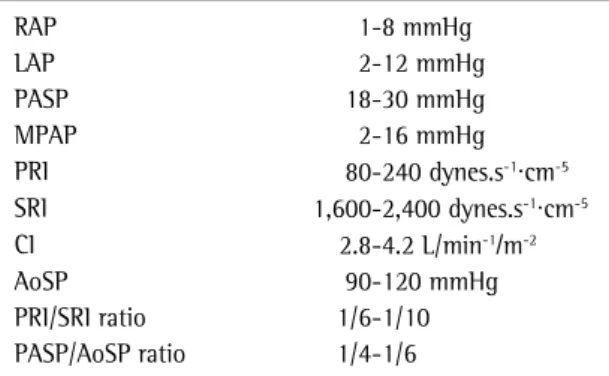
In order to gain a better understanding of what is discussed here, normal values were listed (Chart 1).
Hemodynamic classification of
pulmonary arterial pressure
The various categories of PAH are defined according to pressure and pulmonary resistance (Table 1).
Indications for testing pulmonary
vasoreactivity
The following are among the various clinical indications for testing pulmonary vasoreactivity:
• cases of complicated congenital heart disease
and severe PAH in which clinical and nonin-vasive tests are inconclusive as to the best approach
• cases of candidates for Fontan surgery, or
variants, presenting pulmonary pressure above the ideal level
Chart 1 - Normal values.
RAP 1-8 mmHg
LAP 2-12 mmHg
PASP 18-30 mmHg
MPAP 2-16 mmHg
PRI 80-240 dynes.s-1·cm-5
SRI 1,600-2,400 dynes.s-1·cm-5
CI 2.8-4.2 L/min-1/m-2
AoSP 90-120 mmHg
PRI/SRI ratio 1/6-1/10
PASP/AoSP ratio 1/4-1/6
RAP: right atrial pressure; LAP: left atrial pressure; PASP: pulmonary artery systolic pressure; MPAP: mean pulmonary artery pressure; PRI: pulmonary resistance index; SRI: systemic resistance index; CI: cardiac index; and AoSP: aortic systolic pressure.
Table 1 - Hemodynamic classification of pulmonary hypertension.
Mean pulmonary pressure (mmHg)
Resistance index (dynes.s-1·cm-5/m2)
Classification
< 25 < 320 Normal
25-45 320-400 Slight increase 46-65 400-640 Moderate increase
• Using the simplified formula: Qp/Qs = (SpO2 in the Ao − SpO2 in the VC) ÷ (SpO2 in the PV − SpO2 in the PA) = 2
an intervention should be considered.
• Using the complete formula, including the
dissolved oxygen:
Qp/Qs = [(13.6 × hemoglobin × SpO2 in the Ao) + (0.031 × PaO2 in the Ao)] − [(13.6 × hemo -globin × SpO2 in the VC) + (0.031 × PaO2 in the VC)] ÷ [(13.6 × hemoglobin × SpO2 in the PV) +
(0.031 × PaO2 in the VC)] − [(13.6 × hemoglo -bin × SpO2 in the PA) + (0.031 × PaO2 in the PA)] = 1.2
surgical correction of heart disease would be contraindicated.
Inhaled nitric oxide
Due to its selective pulmonary vasodilator effect and rapid onset of action (< 10 s), iNO is currently considered the drug of choice for testing pulmonary vasoreactivity. Doses range from 5 to 80 ppm, and there are rarely any side effects, since it is used for a short time during the procedure.(23-25)
In order to test pulmonary vasoreactivity, iNO is administered via an endotracheal tube, a laryn-geal tube, or a face mask, the last being the most common method of administration in adults. The iNO is introduced into the airway using a “T” or “Y” connector, at approximately 35 cm from the entrance of the airway connections (Figure 1). The a few seconds. Various studies have described its use
in the treatment of PAH of various causes(17-19) and in testing pulmonary vasoreactivity,(20,21) with doses ranging from 50 to 500 μg/kg-1/min-1. Adenosine would have the advantage of greater availability, especially in developing countries, over inhaled nitric oxide (iNO), if the efficacy of the former were comparable to that of the latter. However, this is a question that remains unanswered.
Continuous infusion of adenosine should be given into the pulmonary artery (PA) using an addi-tional catheter or into the opening of the right ventricle using a Swan-Ganz catheter in the absence of interventricular communication or in cases of patent ductus arteriosus. These measures prevent adenosine from reaching the systemic circulation without passing through the pulmonary circulation, which could cause systemic hypotension. The most common side effects include bronchospasm, chest pain, and bradycardia, which usually make it impos-sible to continue the test.
Pure oxygen
For several years, pure oxygen has been used to test pulmonary vasoreactivity, especially in cases of congenital hear disease.(22)
It has the advantage of being available in all facilities, being easily administered, and having almost no side effects. Since its effect on other forms of PAH is not well defined, pure oxygen should not be the drug of choice in these situations. When pure oxygen is used to test pulmonary vaso-reactivity in cases of congenital heart disease, the dissolved oxygen should be included in the calcula-tions of pulmonary blood flow (Qp) and systemic blood flow (Qs). Calculations performed using the simplified formula, without including the dissolved oxygen, can lead to severe interpretation errors, with false-positive results.
Example: a patient with interventricular communication and severe PAH, with no evidence of pulmonary hyperflow in the baseline state, presented the following results after using pure oxygen: arterial oxygen tension (PaO2) and aortic peripheral oxygen saturation (SpO2) in the aorta (Ao) = 100 (100%); PaO2 and SpO2 in the PA = 90 (90%); PaO2 and SpO2 in the vena cava (VC) = 50 (80%); and PaO2 and SpO2 in the pulmonary vein
(PV) = 400 (100%). Figure 1 - Model for the use of nitric oxide via a mask.
Monitor connection
Nitric oxide
calibrated, with the baseline (zero) calibrated for the midaxillary line.
Arterial pressure can be measured through cannulation of the femoral or radial artery, as well as through noninvasive methods.
Right atrial pressure (RAP) is easily measured using a catheter or through the proximal opening of the Swan-Ganz catheter, and pulmonary capil-lary pressure (PCP) can be measured using a wedged Swan-Ganz catheter. In patients with right-to-left shunt, even if only through a patent foramen ovale, the catheter balloon should be insufflated with carbon dioxide, due to the risk of rupture and para-doxical embolism when it is insufflated with air.
When it is difficult to obtain a reliable PCP curve, as sometimes occurs in the presence of greatly dilated pulmonary vessels, left atrial pressure (LAP), measured through the foramen ovale, when it is patent, or retrogradely, when it is closed, can be used. Another alternative is to use left ventricular end-diastolic pressure (LVEDP), which is usually equal to LAP in the absence of mitral stenosis. When LVEDP is used, its curve should leave no room for doubt as to the pressure thresholds.
When the Swan-Ganz catheter is used, there can be difficulties in positioning it in the PA, due to dilated right heart chambers and tricuspid or pulmonary insufficiency. In this situation, the use of a guide wire is generally recommended. It is not always possible to position the catheter without creating a large loop in the right ventricle, which can cause arrhythmias. In such cases, by insufflating the balloon in a distal branch and pulling the cath-eter gently, it is usually possible to undo the loop closest port is reserved for the monitor connection.
Of the two distal ports, one (the most distal) is used for the oxygen/air connection, and the other is used for the nitric oxide connection.
The face mask should be comfortably adjusted, and the expiratory valve should be working prop-erly, in order to prevent carbon dioxide retention. Since it preferably acts on well-ventilated airways, decreasing pulmonary shunt, iNO has advantages over other vasodilators. It is stored in 300-, 800-, and 2,000-ppm cylinders. The concentration to be used is determined by increasing the iNO flow until the desired value is identified on the monitor. In the absence of a monitor, the estimation of the iNO flow needed to reach the desired concentration can be calculated using the following formula:
iNO flow offered = (oxygen/air flow used × de-sired iNO dose × 1,000) ÷ concentration of the cylinder used
Examples:
• In the case of a 300-ppm cylinder, an
oxygen/ air flow of 10 L/min, and a desired iNO dose of 10 ppm, the iNO flow needed will be 333 mL/ min—(10 × 10 × 1,000) ÷ 300.
• Using an 800-ppm cylinder, the iNO flow will
be 125 mL/min—(10 × 10 × 1,000) ÷ 800. The cost of using iNO to test pulmonary vaso-reactivity is low (less than R$100.00, or US$50.00), since it is used for a short time during the proce-dure. However, a cylinder and a monitor need to be available, and this makes the procedure more costly in facilities where it is rarely used. Unfortunately, there are few facilities in Brazil where iNO is avail-able for testing pulmonary vasoreactivity.
Technique
The ratio between pulmonary circulation and systemic circulation should be determined based on readings obtained simultaneously in order to avoid momentary pressure changes that can cause inter-pretation errors.
In the absence of intracardiac shunt, cardiac and pulmonary outputs can be calculated by the ther-modilution technique or using the Fick method. In the presence of shunt, the thermodilution technique should not be used, since it yields false results.
The pressures should be carefully monitored after confirming that the equipment is correctly
Table 2 - Patient with idiopathic pulmonary arterial hypertension presenting pulmonary vasoreactivity.
Criterion Baseline After 20 ppm of iNO for 5 min
Right atrial pressure 10 10
Pulmonary capillary pressure 10 10
Cardiac index 3.2 3.6
Pulmonary output/systemic output
1 1
Mean pulmonary artery pressure
40 28
Mean aortic pressure 95 95
Pulmonary resistance index 750 400 Pulmonary resistance/
systemic resistance
0.48 0.29
endotracheal tube at graded doses (increased every 5 min in the absence of response) of 10, 20, 30, 40, 50, 60, and 80 ppm
• in the absence of response, combine pure
oxygen and iNO
• measure the pressures, the Qp/Qs ratio, pulmo -nary resistance (PR), and systemic resistance (SR), as well as the ratio between them
• calibrate the manometer, maintaining the value
of zero at the level of the midaxillary line
Interpreting the results of tests used to
determine pulmonary vasoreactivity
The interpretation of the results of tests used to determine pulmonary vasoreactivity in cases of IPAH or in cases of PAH associated with systemic diseases should focus on changes in pulmonary and systemic pressures. However, in cases of congenital heart disease, the focus should be on alterations in resistances and in pulmonary and systemic outputs. In cases of heart disease, there can be significant output changes, with resistance alterations, but without significant pressure changes.
Example: a patient with interventricular commu-nication and pulmonary and systemic pressures of 100 mmHg who, after being tested for pulmonary vasoreactivity, presents no pressure changes, but in whom the Qp/Qs ratio increases from 1.2 to 2.4, indicating a significant decrease in PR, that is, the presence of pulmonary vasoreactivity.
Criteria indicating the presence of
pulmonary vasoreactivity
Heart disease with shunt
An increase in the Qp/Qs ratio greater than 1.8 and accompanied by a decrease in the PR index/SR index ratio greater than 30% should be interpreted together with other information, such as ausculta-tion findings during the test, alteraausculta-tions in systemic oxygen saturation during exercise, and clinical examination findings, as well as the results of elec-trocardiography, chest X-ray, echocardiography, and angiography (pulmonary flow).
A patient with interventricular communication who presents decreased systemic oxygen satura-tion during exercise, even if the Qp/Qs ratio remains without moving the catheter out of the desired
position.
Factors that can have a transient effect
on the results
Transient alterations in pulmonary pressure and systemic pressure can cause errors in the interpreta-tion of the results.(26) Simultaneous measurements and the comparison between them are more impor-tant than the analysis of the result in isolation. In order to avoid errors, arterial carbon dioxide tension, body temperature, catheter permeability and position, as well as the level of anxiety and sedation, should be controlled, and the first meas-urements should not be taken until at least 5 min after parameter stabilization.
Summary
Regardless of the medication selected to test pulmonary vasoreactivity, factors that can have a transient effect on pressure values should be eliminated. Such factors include acidosis, systemic arterial hypotension or hypertension, changes in temperature, arrhythmias, pulmonary ventilation asymmetry (when blood is collected from the PVs), and variations in the level of sedation during the measurements. After these factors have been elimi-nated, the following steps should be taken:
• monitor RAP, LAP (or PCP or LVEDP), PA pres -sure, and systemic pressure
• collect blood samples for oximetry at the
shortest intervals possible
• if, during the measurements, there are
alterations in the clinical profile (level of consciousness, changes in temperature, pulmonary abnormalities, or delayed sample collection from different sites), allow 10 min for stabilization and repeat the process
• collect blood from PVs through the interatrial
communication, when present, or retrogradely through the left ventricle when pure oxygen is used in the presence of intracardiac shunt
• wait for the results of the tests before removing
the catheters, and, in cases of inconclusive results, repeat the steps
• take the baseline measurements with the
• Interpreting the results of tests used to
determine pulmonary vasoreactivity without correlating them with other clinical param-eters can lead to errors in the final treatment strategy adopted.
• Accepting an inconclusive PCP value in cases
of an intact interatrial septum preventing the measurement of the left atrium by this route; in cases in which a good PCP measurement cannot be obtained and there is no commu-nication between the atria, LAP should be measured retrogradely, or a good LVEDP curve should be obtained, after excluding mitral valve stenosis.
• Not waiting for the results of blood gas anal -ysis before finishing a test used to determine pulmonary vasoreactivity, which makes it difficult to repeat the test when the results are inconclusive.
Final considerations
Testing pulmonary vasoreactivity in severe patients is an invasive procedure whose result can indicate the best treatment option to be adopted. Recently, the European Society of Cardiology estab-lished a criterion to define the presence of pulmonary vasoreactivity in cases of IPAH: a decrease in MPAP of at least 10 mmHg accompanied by a decrease in absolute PAP values to less than 40 mmHg.(14) This same criterion has been used for other forms of PAH, except for congenital heart disease with pulmonary hyperflow. However, it is important to emphasize that the precise definition of pulmonary vasoreac-tivity is still controversial.
Various substances with pulmonary vasodilator properties can be used to test pulmonary vasore-activity. However, since many of these substances can have severe side effects and a long half-life, these risks should be considered when they are used. Due to its specific pulmonary vasodilator effect, minimal systemic effect, and short half-life (only a few seconds), iNO has been the drug of choice. Due to the fact that it is available at all facilities and is inexpensive, pure oxygen is a good option in the absence of iNO or can be combined with iNO in the absence of response to one or the other. Interest in using adenosine for this purpose has increased, although its role in this process has yet to be well defined.
between 1.5 and 1.8 at rest, is hardly likely to benefit from surgical treatment.(8,27)
Idiopathic pulmonary arterial hypertension
or pulmonary arterial hypertension
associated with noncardiac causes
A recent criterion defines the presence of pulmo-nary vasoreactivity as a decrease in MPAP of at least 10 mmHg, its final value being ≤40 mmHg, without changes or with improvement in cardiac output. Table 2 shows data on the presence of pulmonary vasoreactivity.
Common errors in interpreting the
results of tests used to determine
pulmonary vasoreactivity
As previously mentioned, the results of tests used to determine pulmonary vasoreactivity can be influ-enced by various transient factors, which should be recognized and eliminated. In addition, there can also be errors in the interpretation of the results of tests used to determine pulmonary vasoreactivity.(8) The following are the most common such errors:
• Designating as unresponsive a patient with
heart disease and shunt who, after being tested for pulmonary vasoreactivity, does not present decreased pulmonary pressure, without taking resistance values and the Qp/Qs ratio into account.
• Using the simplified method of calculating the
Qp/Qs ratio in a patient on pure oxygen, in which the elimination of the dissolved oxygen can falsely increase pulmonary flow, with a consequent decrease in PR, even in inoperable cases.
• Analyzing the results without considering the
alterations in the systemic circulation, absence of response being indicated by a significant decrease in PR in congenital heart disease— with an equal or greater decrease in SR and without a significant change in the PR/SR ratio—or a significant decrease in the PA pres-sure/arterial pressure ratio in other causes of PAH.
• Collecting blood samples for oximetry at
14. Oliveira EC, Oliveira AM, Amaral CF, Oliveira JS, Miranda ME, Pontes AK. Uso de Sildenafil® para facilitar a retirada de óxido
nítrico inalado em pós-operatório de hérnia diafragmática. Revista Brasileira de Terapia Intensiva. 2005;17(1):60-2. 15. Shekerdemian LS, Ravn HB, Penny DJ. Intravenous sildenafil
lowers pulmonary vascular resistance in a model of neonatal pulmonary hypertension. Am J Respir Crit Care Med. 2002;165(8):1098-102.
16. Stocker C, Penny DJ, Brizard CP, Cochrane AD, Soto R, Shekerdemian LS. Intravenous sildenafil and inhaled nitric oxide: a randomised trial in infants after cardiac surgery. Intensive Care Med. 2003;29(11):1996-2003.
17. Konduri GG, Garcia DC, Kazzi NJ, Shankaran S. Adenosine infusion improves oxygenation in term infants with respiratory failure. Pediatrics. 1996;97(3):295-300. 18. Reeves JT, Groves BM, Weir EK. Adenosine and selective
reduction of pulmonary vascular resistance in primary pulmonary hypertension. Circulation. 1991;84(3):1437-9. 19. Fullerton DA, Jaggers J, Jones SD, Brown JM, McIntyre RC
Jr. Adenosine for refractory pulmonary hypertension. Ann Thorac Surg. 1996;62(3):874-7.
20. Souza R, Amato MB, Demarzo SE, Deheinzelin D, Barbas CS, Caruso P, et al. Effect of adenosine on pulmonary circulation in patients with primary pulmonary hypertension. J Bras Pneumol. 2005;31(1):20-4.
21. Schrader BJ, Inbar S, Kaufmann L, Vestal RE, Rich S. Comparison of the effects of adenosine and nifedipine in pulmonary hypertension. J Am Coll Cardiol. 1992;19(5):1060-4.
22. Rudolf AM. Functional assessment. In: Rudolph A M. Congenital diseases of the heart: clinical-physiological considerations. Armonk, NY: Futura Pub.; 2001. p. 45-84. 23. Ichinose F, Roberts JD Jr, Zapol WM. Inhaled nitric oxide: a
selective pulmonary vasodilator: current uses and therapeutic potential. Circulation. 2004;109(25):3106-11.
24. Azeka E, Costa Auler JO Jr, Kajita L, Alliman AC, Franchini Ramires JA, Ebaid M. Effects of low doses of inhaled nitric oxide combined with oxygen for the evaluation of pulmonary vascular reactivity in patients with pulmonary hypertension. Pediatr Cardiol. 2002;23(1):20-6.
25. Jiang BH, Maruyama J, Yokochi A, Amano H, Mitani Y, Maruyama K. Correlation of inhaled nitric-oxide induced reduction of pulmonary artery pressure and vascular changes. Eur Respir J. 2002;20(1):52-8.
26. Clabby ML, Canter CE, Moller JH, Bridges ND. Hemodynamic data and survival in children with pulmonary hypertension. J Am Coll Cardiol. 1997;30(2):554-60.
27. Kirklin JW, Barratt-Boyes BG. Ventricular septal defect. In: Kouchoukos NT, Kirklin JW. Kirklin/Barratt-Boyes cardiac surgery: morphology, diagnostic criteria, natural history, techniques, results, and indications. Philadelphia: Churchill Livingstone; 2003. p. 850-909.
The results of tests used to determine pulmo-nary vasoreactivity can be influenced by various transient changes, which should be recognized and corrected.
References
1. Farber HW, Loscalzo J. Pulmonary arterial hypertension. N Engl J Med. 2004;351(16):1655-65.
2. Runo JR, Loyd JE. Primary pulmonary hypertension. Lancet. 2003;361(9368):1533-44.
3. D’Alonzo GE, Barst RJ, Ayres SM, Bergofsky EH, Brundage BH, Detre KM, et al. Survival in patients with primary pulmonary hypertension. Results from a national prospective registry. Ann Intern Med. 1991;115(5):343-9.
4. Rich S, Kaufmann E, Levy PS. The effect of high doses of calcium-channel blockers on survival in primary pulmonary hypertension. N Engl J Med. 1992;327(2):76-81.
5. Sitbon O, Humbert M, Jagot JL, Taravella O, Fartoukh M, Parent F, et al. Inhaled nitric oxide as a screening agent for safely identifying responders to oral calcium-channel blockers in primary pulmonary hypertension. Eur Respir J. 1998;12(2):265-70.
6. Badesch DB, Abman SH, Simonneau G, Rubin LJ, McLaughlin VV. Medical therapy for pulmonary arterial hypertension: updated ACCP evidence-based clinical practice guidelines. Chest. 2007;131(6):1917-28.
7. Kreiner G, Siostrzonek P, Heinz G, Pabinger I, Roden M, Gössinger H. Drug-testing in patients with pulmonary hypertension of unknown cause. Eur Heart J. 1992;13(6):776-80.
8. Sociedade Brasileira de Pneumologia e Tisiologia. Diretrizes Brasileiras para Manejo da Hipertensão Pulmonar - 2005. J Bras Pneumol. 2005;31(Supl 2):S1-S31.
9. Jolliet P, Bulpa P, Thorens JB, Ritz M, Chevrolet JC. Nitric oxide and prostacyclin as test agents of vasoreactivity in severe precapillary pulmonary hypertension: predictive ability and consequences on haemodynamics and gas exchange. Thorax. 1997;52(4):369-72.
10. Ghofrani HA, Schermuly RT, Rose F, Wiedemann R, Kohstall MG, Kreckel A, et al. Sildenafil for long-term treatment of nonoperable chronic thromboembolic pulmonary hypertension. Am J Respir Crit Care Med. 2003; 167(8):1139-41.
11. Michelakis ED, Tymchak W, Noga M, Webster L, Wu XC, Lien D, et al. Long-term treatment with oral sildenafil is safe and improves functional capacity and hemodynamics in patients with pulmonary arterial hypertension. Circulation. 2003;108(17):2066-9.
12. Molina J, Lucero E, Luluaga S, Bellomio V, Spindler A, Berman A. Systemic lupus erythematosus-associated pulmonary hypertension: good outcome following sildenafil therapy. Lupus. 2003;12(4):321-3.