Original article (short paper)
Moderate physical training counterbalances harmful effects of low-protein diet
on heart: metabolic, oxidative and morphological parameters
Déborah S. Carthagenes Michelly D. P. Barreto
Cristiane M. Freitas Anderson da Silva Pedroza
Mariana P. Fernandes Diorginis S. Ferreira
Claudia J. Lagranha
Universidade Federal de Pernambuco, UFPE, Centro Acadêmico de Vitória, Vitória de Santo Antão, PE, Brazil
Luciana C. Nascimento
Universidade Federal de Pernambuco, UFPE, Recife, PE, Brazil
Liriane Baratella Evencio
Universidade Federal de Pernambuco, Departamento de Patologia, Recife, PE, Brazil.
Abstract — Aims: Maternal low-protein diet induces several impairments on cardiac system. Conversely, moderate exercise has been widely recommended to health improvement due to its effects on heart function. Thus, we investigated whether the moderate physical training is capable to offset the lasting injuries of a maternal protein restriction on the hearts of male adult rats. Methods: Pregnant rats were divided into two groups: Control (C=17% casein) and undernutrition (U=8% casein). Offspring from the undernutrition group, at 60 days of life, were subdivided into undernutrition (U) and undernutrition+exercise (UT) groups. Treadmill exercise was performed: (8 weeks, 5 days/week, 60 min/day at 70% of VO2máx). 48 hours after last exercise session, tissues were collected for morphological and biochemical analysis.
Results: Despite the deleterious effect induced by low-protein diet, physical training was able to restore morphological parameters to similar levels to the control group. Additionally, oxidative stress index was also improved in UT group, due to the increase in antioxidant enzymatic defense. In metabolic enzymes, maternal low-protein diet induced a change in metabolism, and moderate physical training improved oxidative metabolism. Conclusion: We demonstrated that moderate physical training can offset the cardiac metabolism in adult rats that were exposed to a maternal low-protein diet.
Keywords: maternal low-protein diet, moderate exercise, cardiac morphology, oxidative stress; cardiac metabolism.
Introduction
It is well known that the energy requirements vary among the tissues. In the heart, the low amounts of adenosine triphosphate (ATP) and the high energy demands impose to this organ a fast and continuous ATP turnover1. In normal conditions, adult heart
obtains ATP mainly through fatty acid oxidation2, however, in
some pathological conditions, the ATP supplied to this organ can mostly be from glucose and lactate3.
Studies have demonstrated that the onset of cardiac im-pairments can be related to the intrauterine life4,5, wherein
external factors, such as malnutrition, can induce long-lasting biochemistry and structural changes to the organism6. In this
context, Hales, et al.7 and Barker, Winter, Osmond, Margetts,
Simmonds8 analyzing people with an average of 64 years, who
were born in Hertforshire between 1920 and 1930, concluded that death from cardiac ischemia was more frequent in people born with low weight those with than normal weight. Further studies show that malnutrition during the critical period of de-velopment can induce metabolic syndrome indicating a strong correlation between perinatal undernutrition and the develop-ment of metabolic and cardiovascular diseases later in life9,10.
Previous work has shown that protein restriction during the
critical period of development changes cardiac metabolism11.
In addition, studies from our laboratory also have shown that protein undernutrition during the developmental period induces oxidative stress in hearts and brainstems of adult offspring12,13.
Exercise training, on the other hand, is well recognized as a reducer in the propensity to cardiovascular disease by the reduc-tion of risk factors such as obesity, hypertension and oxidative stress14,15. It is proposed that the exercise upregulates the antioxidant
defenses which leads to an improvement in the cellular resistance to oxidative stress15. In addition, moderate physical training has
also been related with an improvement in cardiac function, likely
via modiication in ventricular structure, including left ventricular,
wall thickness, end-diastolic diameter, among others16.
Previous reports demonstrated that protein restriction during the critical period of development modulates morphological heart parameters17 as well as induces deleterious effects on the
oxida-tive status in rat hearts12. Since the moderate physical exercise is
METHODS
Experimental Approach to the Problem
In the present study we examined whether the moderate physical training can counterbalance the injuries on the hearts from adult offspring that suffered nutritional insult during the critical period of development, on the cardiac morphology, oxidative stress parameters and metabolic enzymes. In order to investigate the effects of moderate physical training on the cardiac parameters of undernourished rats, we used male adult rats that had their mothers fed either with normoprotein (17% casein) or low-protein (8% casein) diet throughout gestation and lactation period. A moderate physical training based on the 70% of VO2 max capacity was used daily (5 days week-1)
during 8 weeks. 48 hours after the last session of training, rats were killed by decapitation and had their hearts collected to morphological and to biochemical analysis.
Animals
All experiments were carried out with offspring from an out-bred colony strain of Wistar rats obtained from the Nutrition Department of the Federal University of Pernambuco. The experimental design was performed in accordance with the guidelines of the Institutional Ethics Committee for Animal Research (approval protocol no. 23076.016335/2012-11), complying with the “Principles of Laboratory Animal Care” (National Institutes of Health, Bethesda, USA).
Procedures
Females with age between 80-90 days were mated in a ratio of 1 male to 2 females. They were daily checked and the day when spermatozoa were found in vaginal smear was considered as the day of conception and the pregnant rats were divided into two groups. The pregnant rats were fed with different diets, normoprotein (17% casein, n=4) or low-protein (8% casein, n=8), throughout the perinatal period (i.e gestation and lactation). Both diets had the same energetic value and were prepared at the Laboratory of Dietetic Technic at Academic Center of Vitoria – Federal University of Pernambuco-UFPE according to research previously published12.
Twenty-four hours after delivery, the litters were standardized
to 8 pups each and the female pups maintained only to ill the lit
-ters, no adoption was used in this study. To avoid litter inluence,
at weaning, three male animals from each mother were randomly chosen to continue in the study and started to receive laboratory chow (LABINA, Purina Brasil®) until ending the experiment.
Treadmill exercise
At 60 days of age, the animals from mothers that received low-protein diet were blind and randomly divided into trained
and untrained groups. After this new division three groups were formed: control (C) n=12, undernutrition (U) n=12 and undernutrition trained (UT) n=12. The moderate physical train-ing was performed in accordance to the parameters previously standardized in animals at 60 days of life18. Briely, a treadmill
adapted for rats (EP-131, Insight Equipments, SP, Brazil) and the protocol was conducted during 8 weeks (5 days week−1, 60 min day−1), each day-session was divided into four stages: (1) warm-up (5 min); (2) intermediary (20 min); (3) day target speed (30 min); and (4) cool down (5 min). The percentage of VO2max during the training sessions was kept around 65–70%. Rats from the sedentary groups were placed on the treadmill just as the exercised animals, but the treadmill remained off. After 48 hours of the last exercise session, the rats had their hearts collected to morphological and to biochemical analysis. All animals completed the whole experiment protocol.
Morphological analysis
The following parameters were measured: left ventricle (LV) cross-section, left ventricle thickness and left ventricle cavity.
1. Processing of the material for histological study
Heart processing was conducted as recommended by Toscano, et al.17. Briely, after anesthesia, the atrium were removed and
ventricles were ixed in 10% formalin followed by a cross-cut
at the midpoint between the atrioventricular groove and the apex of the heart at the ventricular level, dividing the heart
in two. After ixation, the fragments were conventionally
processed for light microscopy being dehydrated in increas-ing ethanol concentrations (80 to 100%), cleared in xylene
baths (20-minute), and immersed in parafin. After inclusion,
histological cross sections of the heart were made serially. The ventricular cavities were sectioned into thicknesses of 4 mm each, using a microtome Leica (RM 2125RT). Then they were stained with hematoxylin-eosin (HE), mounted on slides using entellan, photographed and observed under a light microscope.
2. Measurement of LV thickness, cross-sectional area and LV cavity area
The images of histological cross-sections of the heart were captured on graph paper using a scanner (HP brand, model C4700) coupled to a computer. To measure the LV thickness, LV cross-sectional area and LV cavity, Image J software (ver-sion 1.47t for Windows) was used.
Heart preparation for biochemical analysis
Rat hearts were collect as previous described12. The atriums
cold buffer containing 50 mM-TRIS and 1mM-EDTA (pH 7.4), with the addition of 1 mM-sodium orthovanadate and 1.1 mM
phenylmethanesulfonyl luoride (PMSF) using a sampling homog -enizer (Tecnal, Sao Paulo, Brazil). Ventricular homogenates were centrifuged at 4000 RPM for 10 min at 4ºC. Protein concentration was determined in the supernatant using the Bradford protocol and this supernatant was used for the following biochemical analyses.
Evaluation of Malondialdehyde production
A total of 0.2 mg/ml heart homogenate was used to measure malondialdehyde production (MDA) following reaction with thiobarbituric acid (TBA) at 100 °C according to the method of Draper, Squires, Mahmoodi, Wu, Agarwal, Hadley19. In the TBA
test reaction, malondialdehyde (MDA) or MDA-like substances react to produce a pink pigment with a maximum absorption at 535 nm. The reaction was developed by the sequential addition to the sample of 30% trichloroacetic acid and Tris-HCl (3mM) followed by thorough mixing and centrifugation at 2 500 g for 10 min. This supernatant was transferred to another tube and 0.8% TBA (v/v) was added before mixing and boiling for 30 min. After cooling, the absorbance of the organic phase was read at 535 nm in a spectrophotometer. Results were expressed as nmol per mg of protein12.
Superoxide dismutase (SOD) assay
The determination of total superoxide dismutase enzyme activity (t-SOD) was performed according to the method of Misra, Fridovich20. Supernatants (0.1 mg/ml) collected from
homogenized hearts following centrifugation were incubated with 80 µl sodium carbonate (0.05%, pH 10.2, 0.1 mM EDTA) at 37°C before development of the reaction by the addition of 30 mM epinephrine (in 0.05% acetic acid) and determined by measuring the kinetic of the inhibition of adrenaline auto-oxidation at 480 nm expressed as U/mg protein.
Catalase (CAT) assay
CAT activity was measured according to the method described by Aebi21. The principle of the assay is based on the determination
of the rate constant (k) of H2O2 decomposition, which under our
conditions of temperature and pH, was deined as 4.6 x10⁷. The
assay mix was compounded by 50 mM-phosphate buffer (pH 7.0), 300 mM H2O2 and sample (0.3 mg/ml). The rate constant of the enzyme was determined by measuring change in absorbance (at 240 nm) per minute over a 4-minute period at 30 °C and the CAT activity was expressed as U/mg protein.
Phosphofructokinase (PFK) assay
PFK was determined on the homogenate by a modiication method
developed by Opie, Newsholme22. The enzymatic reaction system
consisted of 50 mM Imidazole (pH 7.4), 6 mM MgCl2, 0.4 mM NADH, 5 mM ATP, 5mM glucose-phosphate-dehydrogenase, 5 mM triose phosphate isomerase, 5 mM glycerolphosphate, 5 mM aldolase and 0.3 mg/ml of sample. The reaction started with 20 mM fructose-6-phosphate at 37°C and the oxidation of NADH was followed at 340 nm to measure PFK activity.
ß-hydroxyacyl-CoA dehydrogenase (β-HAD) assay
ß-HAD was determined as previously published by Ito, et al.23.
The enzymatic reaction system consisted of 50 mM Tris-HCL (pH 7.4), 50 mM Imidazole, 12 mM EDTA, 0.018 mM NADH and 0.3 mg/ml of sample. The reaction started with 0.1 mM acetoacetil-CoA at 37°C and absorbance of 340 nm. ß-HAD was measured from oxidation of NADH.
Citrate synthase (CS) assay
CS activity was determined as described previously24. For
citrate synthase activity, 0.3 mg/ml of sample was incubated in a reaction mixture containing (in mM) 100 Tris·HCl (pH 8.1), 1 MgCl2, 1 EDTA, 0.2 5,5-dithio-bis(2-nitrobenzoic
acid) (DTNB) (ε=13.6 µmol·ml-1 ·cm-1), 0.1 acetyl-CoA, and
0.5 oxaloacetate at 25 °C. The citrate synthase activity was measured by assessing the rate of change in absorbance at 412 nm over 3 min (30-s intervals).
Obs: All drugs and reagents were purchased from Sigma-Aldrich (St. Louis, MO, USA) and Sovereign (Sao Paulo, Brazil).
Statistical analyses
Analyses were performed using GraphPad Prism (version 6.0). The analysis of the enzyme activity was performed according
to the speciic reference for each enzyme. For nonparametric
data, the Kruskal-Wallis test followed by Dunn´s post-test was used; for parametric data, the ANOVA One-Way test and followed by Tukey post-test were used. The values were ex-pressed as mean ± standard error of mean (SEM). Data were
considered as statistically signiicant for p≤0.05.
Results
In the present study we aimed to investigate the effect of moderate physical training on adult rats that had suffered nutritional insult during the critical period of development. Evaluating cardiac morphology, our data demonstrates that
perinatal protein restriction signiicantly interferes in cardiac
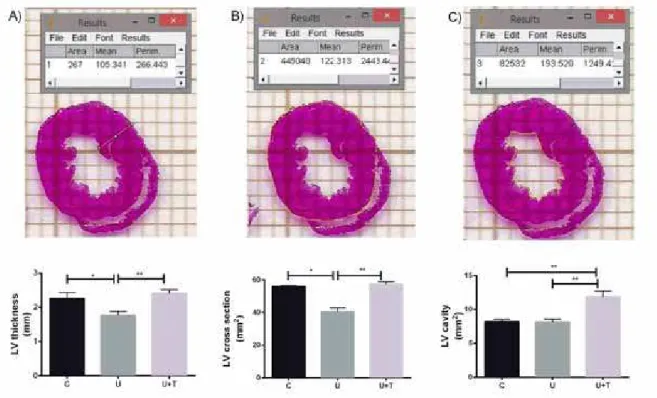
morphology decreasing left ventricle thickness and cross-section. On the other hand, moderate physical training restored left ventricle thickness and the cross-section to control values
(igure 1A-B). Related to the left ventricle cavity, we observed
that undernourished trained rats showed an increase compared
Figure 1: Effect of maternal low-protein diet and moderate physical training on cardiac morphology. Left ventricle thickness (A), cross-section (B) and cavity area (C) in male offspring at 120 days of life. C= Control group; U= undernourished group; U+T= undernourished plus 8 weeks
of moderate physical training group. Data are shown as mean + SEM for 4-6 animals per group. *p<0.05; ** p<0.01
Figure 2: Effect of maternal low-protein diet and moderate physical training on cardiac oxidative stress. Lipid peroxidation evaluated by MDA levels (A) Antioxidant enzymatic defense, Superoxide dismutase activity (B) and catalase activity (C) in male offspring at 120 days of life. C= Control group; U= undernourished group; U+T= undernourished plus 8 weeks of moderate physical training group. Data are shown as mean +
After the observation of cardiac morphology alteration in-duced by perinatal protein restriction, we next evaluated oxida-tive status and metabolic enzymes. One important biomarker for oxidative stress is the MDA levels. As demonstrated in Figure
2A, protein restriction increases signiicantly MDA levels in the
cardiac tissue, although moderate physical training restored MDA product to control levels (Control: 3.85 + 0.51 nmol/mg protein; U: 7.81 + 0.49 nmol/mg protein; U+T: 3.47 + 0.08 nmol/mg protein). Associated to the levels of pro-oxidant agents, there are the antioxidant enzymes that combat and decrease the action
of the oxidant agents. Therefore in the evaluation of the irst
antioxidant enzyme, superoxide dismutase-SOD, we observed
that in undernourished group this enzyme was signiicantly re -duced, otherwise moderate physical training raised SOD activity to control values (Control: 3.23 + 0.17 U/mg protein; U: 1.39 + 0.21 U/mg protein; U+T: 3.26 + 0.21 U/mg protein, igure 2B). The function of SOD is convert anion superoxide to hydrogen peroxide, and additional enzyme, catalase-CAT, is capable to convert hydrogen peroxide in oxygen and water. Our observation of CAT activity showed that undernutrition during the critical period also decreased the activity of this enzyme, but physical
training signiicantly improved the catalase activity (Control:
0.89 + 0.09 U/mg protein; U: 0.53 + 0.08 U/mg protein; U+T: 1.30 + 0.05 U/mg protein, igure 2C).
Either glucose or fatty acids can feed the Krebs cycle. After the glucose is internalized, a series of reactions occur to transform the glucose into pyruvate, wherein Phosphofructokinase-PFK catalyzes the critical step in the glycolytic pathway, convert-ing fructose-6-phosphate to fructose-1,6-bisphosphate. This enzyme was not modulated in any experimental condition
used (igure 3A). Regarding the Krebs cycle maintaining from β-oxidation, we further quantiied the activity of ß- hydroxyacyl-CoA dehydrogenase-β-HAD, one key enzyme responsible for
β-oxidation of fatty acid. Our data demonstrate that undernour
-ished rats had a signiicant decrease in β-HAD activity; on the other hand, moderate physical training overcompensated the enzymatic activity impairment (Control: 3.90 + 0.39 U/mg protein; U: 1.18 + 0.25 U/mg protein; U+T: 5.79 + 0.15 U/mg
protein, igure 3B).
Then, we analyzed the citrate synthase-CS activity, this
enzyme being responsible for catalysis of the irst reaction in
the Krebs cycle, condensing acetyl-CoA and oxaloacetate to citrate, and used as a marker for mitochondrial oxidative capac-ity25. Our data demonstrates that perinatal protein restriction
signiicantly decreases the activity of this enzyme, but physical
training restored the CS activity (Control: 3.29 + 0.54 U/mg protein; U: 1.20 + 0.15 U/mg protein; U+T: 2.61 + 0.16 U/mg
protein, igure 3C).
Figure 3: Effect of maternal low-protein diet and moderate physical training on cardiac metabolism. Enzymatic activities of Phosphofructoki-nase-PFK (A); 3-hydroxybytyryl-CoA dehydrogenase-β-HAD (B) and Citrate synthase (C) in male offspring at 120 days of life. C= Control group; U= undernourished group; U+T= undernourished plus 8 weeks of moderate physical training group. Data are shown as mean + SEM for
Discussion
In the present study we examined the effects of moderate physical training, on adult offspring that suffered nutritional insult during the critical period of development, on the car-diac morphology, oxidative stress parameters and metabolic
enzymes. Our data, for the irst time in the literature, brings the combination of a detrimental situation induced by deicient
diet with a non-expensive treatment, as the physical exercise to combat cardiac damage induced by a situation still present in our society, which is the undernutrition. There are epidemiological and clinical data supporting the hypothesis that poor quality of diet during developmental period increases the risk for several diseases including cardiovascular diseases26,27. In the opposite
direction, hefty evidences have demonstrated that physical exercise counteracts the deleterious effect of several metabolic and cardiovascular diseases14,28.
The Developmental Origins of Health and Disease hypoth-esis considers that nutritional insult between development and early ages induces fetus or newborn adaptation in response to the signals in the intrauterine environment, resulting in adjust-ments to support immediate survival and improve success in an adverse postnatal environment29. However, inappropriate
interpretations of prenatal signals and alterations in the post-natal environment may result in a mismatch between prepost-natal projections and postnatal reality30.
It is suggested that these adaptive responses may eventu-ally be detrimental in postnatal life, leading to an increase in the risk of chronic diseases in adulthood31, wherein the early
undernutrition causes loss of cardiac muscle32 as well as
altera-tions in cardiac morphology17. Recent studies demonstrated that
physical training acts as a treatment by ameliorate cell function in different tissues33,34. Our data demonstrate that moderate
physi-cal training also attenuates the deleterious effect of nutritional insult in heart tissue, corroborating with previous studies that demonstrate which physical exercise improves cardiac function both in humans and experimental models35,36.
Our data suggest that protein restriction may induce altera-tion in cardiac morphology due to the increase in oxidative stress associated with decrease in antioxidant defense, which
corroborates with previous indings37. Tarry-Adkins, et al.38,
demonstrated that maternal poor nutrition diet induces oxidative stress in the heart and suggest that this effect may contribute to the development of disease in adulthood. Corroborating with these previous observations, the study from our labora-tory recently demonstrated that adult offsprings that suffered nutritional deprivation during the critical period of develop-ment have an impairdevelop-ment in the mitochondrial function (i.e decrease in mitochondrial oxygen consumption and increase in ROS-production) associated with a marked oxidative stress in hearts12. Additionally our data demonstrates that moderate
physical training can act as a positive stimulus against the del-eterious effect induced by undernutrition, increasing antioxidant defense and diminishing oxidative stress, corroborating with previous studies that demonstrate that exercise is a positive health modulator, wherein the antioxidant improvement seem
to be upregulated via NF-κB signaling pathway39,40.
The adult heart prefers fatty acid oxidation as the main substrate to obtain energy supply2. During the development of
heart failure, the main energy substrate often switches from fatty acid oxidation to carbohydrate metabolism, with a declin-ing regulation of enzymes involved in fatty acid oxidation41.
Studies suggest that initially the substrate switch improves the
eficiency of the pathological heart, since the amount of ATP
produced per oxygen consumed is higher in glucose oxidation than fatty acid oxidation. In agreement with this reasoning, Tappia, Guzman, Dunn, Aroutiounova,11 demonstrated that a
maternal low-protein diet can increases the gene expression and protein levels of key components of glucose metabolism in the neonatal rat heart, which may be related to accelerated energy supply, demand and utilization for ventricular remodeling due to compromised contractile performance during early life, however, at the current study, no statistic changes were observed
in cardiac PFK activity. The decrease in the β-HAD activity,
nevertheless, suggests that protein undernutrition decreases the lipid oxidation capacity in the heart, being the moderate physical training a feasible strategy to offset it. Taken together, our data and literature data suggest that undernutrition during the developmental period induces an adaptive response that modulates cardiac metabolism that can lead to cardiac diseases in adulthood, similar to alterations observed in other cardiac diseases such as hypertrophy and heart failure42.
In relation to citrate synthase activity, a marker for mi-tochondrial oxidative capacity43, our data show that
under-nourished rats had a signiicant decrease in citrate synthase
activity, suggesting that nutritional insult during the critical
period of development signiicantly decreases oxidative ca -pacity in cardiac tissue. Moderate physical training, however, attenuated the enzymatic impairment observed in the under-nourished group. Corroborating our data, Laker, Wlodek, Wadley, Gallo, Meikle, McConell44, using an experimental
model of intrauterine growth restriction (IUGR), showed that
treadmill exercise training increases skeletal muscle β-HAD
and citrate synthase enzymatic activities in male offspring. In addition, Horowitz, Leone, Feng, Kelly, Klein45 demonstrated
that endurance training increases the skeletal muscle expres-sion of TCA cycle enzyme, citrate synthase, with concomitant increase in the mitochondrial oxidative capacity. These data suggest that moderate physical training induces an energy
metabolic recovery in the heart relecting an increased capac -ity for mitochondrial fatty acid oxidation and improvement in oxidative metabolism, minimizing the pathological effect of an early nutritional insult to the heart.
Here, we demonstrated that maternal low protein diet in-duces deleterious effects on cardiac morphology, antioxidant enzymatic capacity and oxidative metabolism. Notwithstanding, moderate physical training is capable to offset both morphologic as well as metabolic parameters. Taken together, our results
demonstrated the beneits of moderate physical training, which
References
1. Stanley WC, Recchia FA, Lopaschuk GD. Myocardial substrate metabolism in the normal and failing heart. Physiol Rev, 2005. 85(3): p. 1093-129.
2. Taegtmeyer H. Energy metabolism of the heart: from basic con-cepts to clinical applications. Curr Probl Cardiol, 1994. 19(2): p. 59-113.
3. Gavete ML, Agote M, Martin MA, Alvarez C, Escriva F. Effects of chronic undernutrition on glucose uptake and glucose transporter proteins in rat heart. Endocrinology, 2002. 143(11): p. 4295-303. 4. Blackmore HL,Ozanne SE. Programming of cardiovascular
disease across the life-course. J Mol Cell Cardiol, 2015. 83: p. 122-30.
5. Zohdi V, Lim K, Pearson JT, Black MJ. Developmental program-ming of cardiovascular disease following intrauterine growth restriction: indings utilising a rat model of maternal protein restriction. Nutrients, 2015. 7(1): p. 119-52.
6. Lucas A. Role of nutritional programming in determining adult morbidity. Arch Dis Child, 1994. 71(4): p. 288-90.
7. Hales CN, Barker DJ, Clark PM, Cox LJ, Fall C, Osmond C, et al. Fetal and infant growth and impaired glucose tolerance at age 64. BMJ, 1991. 303(6809): p. 1019-22.
8. Barker DJ, Winter PD, Osmond C, Margetts B, Simmonds SJ. Weight in infancy and death from ischaemic heart disease. Lancet, 1989. 2(8663): p. 577-80.
9. Remacle C, Bieswal F, Reusens B. Programming of obesity and cardiovascular disease. Int J Obes Relat Metab Disord, 2004. 28 Suppl 3: p. S46-53.
10. Blumield ML, Nowson C, Hure AJ, Smith R, Simpson SJ,
Raubenheimer D, et al. Lower Protein-to-Carbohydrate Ratio in Maternal Diet is Associated with Higher Childhood Systolic Blood Pressure up to Age Four Years. Nutrients, 2015. 7(5): p. 3078-93. 11. Tappia PS, Guzman C, Dunn L, Aroutiounova N. Adverse cardiac
remodeling due to maternal low protein diet is associated with alterations in expression of genes regulating glucose metabolism. Nutr Metab Cardiovasc Dis, 2013. 23(2): p. 130-5.
12. Nascimento L, Freitas CM, Silva-Filho R, Leite AC, Silva AB, da Silva AI, et al. The effect of maternal low-protein diet on the heart of adult offspring: role of mitochondria and oxidative stress. Appl Physiol Nutr Metab, 2014. 39(8): p. 880-7.
13. Ferreira DJ, Liu Y, Fernandes MP, Lagranha CJ. Perinatal low-protein diet alters brainstem antioxidant metabolism in adult offspring. Nutr Neurosci, 2015.
14. Smith JK. Exercise and cardiovascular disease. Cardiovasc Hematol Disord Drug Targets, 2010. 10(4): p. 269-72.
15. Radak Z, Chung HY, Goto S. Systemic adaptation to oxidative challenge induced by regular exercise. Free Radic Biol Med, 2008. 44(2): p. 153-9.
16. Lee BA,Oh DJ. The effects of long-term aerobic exercise on cardiac structure, stroke volume of the left ventricle, and cardiac output. J Exerc Rehabil, 2016. 12(1): p. 37-41.
17. Toscano AE, Amorim MA, de Carvalho Filho EV, Aragao Rda S,
Cabral-Filho JE, de Moraes SR, et al. Do malnutrition and luox
-etine neonatal treatment program alterations in heart morphology? Life Sci, 2008. 82(21-22): p. 1131-6.
18. Leandro CG, Levada AC, Hirabara SM, Manhaes-de-Castro R, De-Castro CB, Curi R, et al. A program of moderate physical training for Wistar rats based on maximal oxygen consumption. J Strength Cond Res, 2007. 21(3): p. 751-6.
19. Draper HH, Squires EJ, Mahmoodi H, Wu J, Agarwal S, Hadley M. A comparative evaluation of thiobarbituric acid methods for the determination of malondialdehyde in biological materials. Free Radic Biol Med, 1993. 15(4): p. 353-63.
20. Misra HP,Fridovich I. The role of superoxide anion in the autoxi-dation of epinephrine and a simple assay for superoxide dismutase. J Biol Chem, 1972. 247(10): p. 3170-5.
21. Aebi H. Catalase in vitro. Methods Enzymol, 1984. 105: p. 121-6. 22. Opie LH,Newsholme EA. The activities of fructose 1,6-di-phosphatase, phosphofructokinase and phosphoenolpyruvate carboxykinase in white muscle and red muscle. Biochem J, 1967. 103(2): p. 391-9.
23. Ito M, Jaswal JS, Lam VH, Oka T, Zhang L, Beker DL, et al. High levels of fatty acids increase contractile function of neonatal rabbit hearts during reperfusion following ischemia. Am J Physiol Heart Circ Physiol, 2010. 298(5): p. H1426-37.
24. Smitherman TC, Mukherjee A, Robinson JB, Jr., Butsch RW, Richards EG, Srere PA. Human heart citrate synthase: puriication, properties, kinetic and immunologic studies. J Mol Cell Cardiol, 1979. 11(2): p. 149-60.
25. Wiegand G,Remington SJ. Citrate synthase: structure, control, and mechanism. Annu Rev Biophys Biophys Chem, 1986. 15: p. 97-117.
26. Fattal-Valevski A, Bernheim J, Leitner Y, Redianu B, Bassan H, Harel S. Blood pressure values in children with intrauterine growth retardation. Isr Med Assoc J, 2001. 3(11): p. 805-8.
27. Gluckman PD, Lillycrop KA, Vickers MH, Pleasants AB, Phillips ES, Beedle AS, et al. Metabolic plasticity during mammalian de-velopment is directionally dependent on early nutritional status. Proc Natl Acad Sci U S A, 2007. 104(31): p. 12796-800. 28. Le Page C, Noirez P, Courty J, Riou B, Swynghedauw B, Besse
S. Exercise training improves functional post-ischemic recovery in senescent heart. Exp Gerontol, 2009. 44(3): p. 177-82. 29. Barker DJ,Osmond C. Diet and coronary heart disease in England
and Wales during and after the second world war. J Epidemiol Community Health, 1986. 40(1): p. 37-44.
30. Gluckman PD, Hanson MA, Spencer HG. Predictive adaptive responses and human evolution. Trends Ecol Evol, 2005. 20(10): p. 527-33.
31. Nettle D, Frankenhuis WE, Rickard IJ. The evolution of predic-tive adappredic-tive responses in human life history. Proc Biol Sci, 2013. 280(1766): p. 20131343.
32. Bergman JW, Human DG, De Moor MM, Schulz JM. Effect of kwashiorkor on the cardiovascular system. Arch Dis Child, 1988. 63(11): p. 1359-62.
33. Gatford KL, Kaur G, Falcao-Tebas F, Wadley GD, Wlodek ME, Laker RC, et al. Exercise as an intervention to improve metabolic outcomes after intrauterine growth restriction. Am J Physiol Endocrinol Metab, 2014. 306(9): p. E999-1012.
35. Libonati JR, Sabri A, Xiao C, Macdonnell SM, Renna BF. Exercise training improves systolic function in hypertensive myocardium. J Appl Physiol (1985), 2011. 111(6): p. 1637-43.
36. Chung E,Diffee GM. Moderate intensity, but not high intensity, treadmill exercise training alters power output properties in myo-cardium from aged rats. J Gerontol A Biol Sci Med Sci, 2012. 67(11): p. 1178-87.
37. Chuang CY, Degendorfer G, Hammer A, Whitelock JM, Malle E, Davies MJ. Oxidation modiies the structure and function of the extracellular matrix generated by human coronary artery endothelial cells. Biochem J, 2014. 459(2): p. 313-22.
38. Tarry-Adkins JL, Martin-Gronert MS, Fernandez-Twinn DS, Hargreaves I, Alfaradhi MZ, Land JM, et al. Poor maternal nutri-tion followed by accelerated postnatal growth leads to alteranutri-tions in DNA damage and repair, oxidative and nitrosative stress, and oxidative defense capacity in rat heart. FASEB J, 2013. 27(1): p. 379-90.
39. Ji LL, Gomez-Cabrera MC, Vina J. Exercise and hormesis: acti-vation of cellular antioxidant signaling pathway. Ann N Y Acad Sci, 2006. 1067: p. 425-35.
40. Sanchis-Gomar F, Garcia-Gimenez JL, Perez-Quilis C, Gomez-Cabrera MC, Pallardo FV, Lippi G. Physical exercise as an epi-genetic modulator: Eustress, the "positive stress" as an effector of gene expression. J Strength Cond Res, 2012. 26(12): p. 3469-72. 41. Sack MN, Rader TA, Park S, Bastin J, McCune SA, Kelly DP.
Fatty acid oxidation enzyme gene expression is downregulated in the failing heart. Circulation, 1996. 94(11): p. 2837-42.
42. Bishop SP,Altschuld RA. Increased glycolytic metabolism in cardiac hypertrophy and congestive failure. Am J Physiol, 1970. 218(1): p. 153-9.
43. Wu JY,Yang JT. Physicochemical characterization of citrate synthase and its subunits. J Biol Chem, 1970. 245(1): p. 212-8. 44. Laker RC, Wlodek ME, Wadley GD, Gallo LA, Meikle PJ,
McConell GK. Exercise early in life in rats born small does not normalize reductions in skeletal muscle PGC-1alpha in adulthood. Am J Physiol Endocrinol Metab, 2012. 302(10): p. E1221-30. 45. Horowitz JF, Leone TC, Feng W, Kelly DP, Klein S. Effect of
endurance training on lipid metabolism in women: a potential role for PPARalpha in the metabolic response to training. Am J Physiol Endocrinol Metab, 2000. 279(2): p. E348-55.
Corresponding author
Claudia J. Lagranha
Rua Alto do Reservatório, s/n. CEP: 55608-680, Núcleo de Educação Física e Ciên-cias do Esporte, Bela Vista, Vitória de Santo Antão, PE, Brasil.
Email: [email protected]
Manuscript received on March 7, 2017 Manuscript accepted on July 12, 2017