discussions on work and training
Andréia Patrícia Gomes 1, Lucas Lacerda Gonçalves 2, Camila Ribeiro Souza 3, Rodrigo Siqueira-Baista 4
Abstract
The work of the Family Health Strategy has introduced a number of new bioethical challenges for health professionals. Addiional efort has been required in terms of research – mapping the problems faced by staf – and training, focusing on ethical preparaion for the creaion of care aciviies. The aim of the present study was to understand this context by idenifying, using the focus group technique, the percepion of staf from the municipality Viçosa/MG, Brazil, of the concepts of ethics and bioethics, the approach to bioethical problems in the day to day funcioning of the health units, and the training process relaing to such issues. The results indicate recogniion of the centrality of bioethics to the work of the Family Health Strategy and the need to create training areas which prioriize dialogue and lifelong learning.
Keywords: Bioethics. Educaion. Work.
Resumo
Estratégia Saúde da Família e bioéica: grupos focais sobre trabalho e formação
A atuação laboral na Estratégia Saúde da Família tem trazido uma série de novos desaios bioéicos para os pro -issionais de saúde. Demandam-se esforços, tanto em termos de invesigação (mapeamento dos problemas enfrentados pela equipe) quanto de formação, tendo em vista a preparação éica para o desenvolvimento das ações de cuidado. O reconhecimento desse contexto foi o mote desta invesigação, que procurou ideniicar, pela técnica de grupos focais, a percepção de trabalhadores no município de Viçosa (MG) sobre os conceitos de éica e de bioéica, a abordagem de problemas bioéicos no coidiano das unidades de saúde e o processo de formação para a condução destes. Os resultados apontam para o reconhecimento da centralidade da bio-éica no trabalho da Estratégia Saúde da Família e a necessidade de criar espaços de formação que priorizem o diálogo e a educação permanente.
Palavras-chave: Bioéica. Educação. Trabalho.
Resumen
Estrategia salud de la familia y bioéica: grupos focales sobre trabajo y formación
El trabajo en la Estrategia Salud de la Familia possibilitó una serie de nuevos desaíos bioéicos a los profesiona -les del área de la salud. Se han exigido esfuerzos tanto en términos de invesigación – mapeo de los problemas que enfrenta el equipo – como en la formación, considerando la preparación éica para el desarrollo de las acciones de cuidado. El reconocimiento de este contexto fue el lema de esta invesigación, la cual trató de ideniicar, mediante la técnica de grupos focales, la percepción de los trabajadores de la municipalidad de Viçosa/MG, Brasil, sobre los conceptos de éica y bioéica, el enfoque bioéico de los problemas coidianos de las unidades de salud y el proceso de capacitación para la conducción de los mismos. Los resultados apuntan al reconocimiento de la centralidad de la bioéica para trabajar en la Estrategia Salud de la Familia y la necesi -dad de crear espacios de educación que le den prioridad al diálogo y al aprendizaje permanente.
Palabras clave: Bioéica. Educación. Trabajo
Aprovação CEP-UFV 68/2010
1. Doutora [email protected] – Universidade Federal de Viçosa (UFV) 2. Graduado [email protected] – UFV
3. Graduanda[email protected] – UFV 4. Doutor[email protected] – UFV, Viçosa/MG, Brasil.
Correspondência
Andréia Patrícia Gomes – Universidade Federal de Viçosa, Campus de Viçosa. Av. Peter Henry Rolfs, s/nº, Campus Universitário CEP
36570-900. Viçosa/MG, Brasil.
Declaram não haver conlito de interesse.
R
e
se
a
rc
h
a
rt
ic
le
The beginnings of the Sistema Único de Saúde (the Uniied Health System) (SUS) are closely linked to the Health Reform Movement and the struggle for democraizaion in Brazil 1. Its legiimacy was established by the Federal Consituion of 1988 2. The chapter on health of this document called for universal access – that health is a right for everyo -ne – and its guarantee through social and economic policies. The Estratégia Saúde da Família (Family Health Strategy) (ESF) has emerged as the model of deployment for the (radical) transformaion of pri -mary health care (PHC) in Brazil 3, the irst phase in the structuring of health care networks. It funcions as a gateway and the linking element of the system – through referral and counter-referral – to ensure that the SUS provides comprehensive care 4.
However, the consolidaion of PHC and the ESF, which lie at the heart of SUS, faces several obs -tacles, including poliical and economic factors and the inadequacy of vocaional training 5, as well as the rotaion of professionals who work as private doctors 6. In addiion, the relaionship of proximity and coninuity of the ESF with the local populaion has brought new challenges, raising quesions not previously taken into account or considered in other contexts, due to the pariculariies that arise from the introducion of a new care model.
In this context, bioethical problems arise, as the pracice of healthcare is built on the daily reality of teamwork and the act of work itself, sup-ported by the relaionships between the members of a mulidisciplinary team, users, managers and the community 7-9. Muliple quesions and even dilem -mas, which can be addressed in bioethical terms, develop in such a scenario. Some of these, however, are not perceived by healthcare workers, who are deeply involved with the pracical aspects of their work 10,11.
From this perspecive, therefore, the deli -neaion of bioethical issues and the process of appropriate and guided training in bioethics for PHC professionals are essenial, as they allow the construcion of tools for the ideniicaion, proble -maizaion and, if possible, resoluion of the ethical dilemmas that emerge on a daily basis, contribuing to the success of PHC, the ESF and the SUS 12,13. It is also necessary to evaluate the enire construc -ion process performed by professionals along this route 1,3.
Based on these consideraions, the aim of this paper is to present the results of focus groups con-ducted in the I° Oicina de Formação em Bioéica e
Atenção Primária à Saúde (theI st Training Workshop
in Bioethics and Primary Health Care) (OFB-APS) for
professionals from the ESF of Viçosa in the state of Minas Gerais, emphasizing the bioethical relecions developed throughout the educaional process. The theme of the importance of ethical and bioethical aspects in training aciviies was prioriized.
Method
Where did the focus group come from?
The focus group originated from a prior in-vesigaion 14, which focused on the delineaion of the bioethical problems ideniied by ESF teams in Viçosa, Minas Gerais. The municipality is part of the Viçosa microregion and the Zona da Mata (Fo -rest Region) macroregion of Minas Gerais, which is composed of 142 municipaliies and has a total of around three million inhabitants. The populaion of Viçosa, in 2012, was 73,333 inhabitants, 93.20% of whom resided in the urban area and 6.80% of whom lived in the rural zone. The esimated populaion in 2013 was 76,147, with a demographic density of 241.2 inhabitants per km² 15.
The city has a PHC network of thirteen units, twelve of which form part of the ESF, and has iteen family health teams. A total of 11,286 families are registered with the ESF. Despite being situated in the countryside of Minas Gerais, Viçosa has unique characterisics, as it is home to the Universidade Federal de Viçosa (the Federal University of Viço -sa), one of the oldest higher educaion insituions in Brazil. In 2009 and 2010 the university began undergraduate courses in nursing and medicine, respecively, which has allowed new thinking about educaion-work-community integraion, based on successful projects 16.
The research project was carried out in three stages. The irst step consisted of a study with a quanitaive and qualitaive approach, with the paricipaion of 73 professionals from 15 ESF tea -ms. This phase revealed interesing results such as the low awareness and ideniicaion of bioethical issues by team members 14. The perceived proble -ms were categorized into ive groups, related to: (1) unequal access to health services; (2) the edu -caion-work-community relaionship; (3) secrecy and conideniality; (4) conlicts between teams and users; and (5) conlicts between team members 14.
In the second phase, the Ist Training Workshop
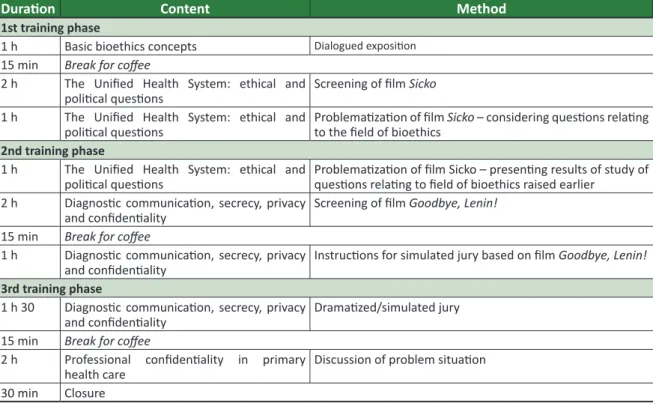
in Bioethics and Primary Health Care was held, with 128 professionals from 15 ESF teams, in accor -dance with the proposal of Vidal et al. (Table 1) 13.
R
e
se
a
rc
h
a
rt
ic
le
Table 1. ESFbioethics workshop
Duraion Content Method
1st training phase
1 h Basic bioethics concepts Dialogued exposiion
15 min Break for cofee
2 h The Uniied Health System: ethical and
poliical quesions Screening of ilm Sicko
1 h The Uniied Health System: ethical and
poliical quesions Problemaizaion of ilm to the ield of bioethics Sicko – considering quesions relaing 2nd training phase
1 h The Uniied Health System: ethical and
poliical quesions Problemaizaion of ilm Sicko – presening results of study of quesions relaing to ield of bioethics raised earlier
2 h Diagnosic communicaion, secrecy, privacy
and conideniality Screening of ilm Goodbye, Lenin!
15 min Break for cofee
1 h Diagnosic communicaion, secrecy, privacy
and conideniality Instrucions for simulated jury based on ilm Goodbye, Lenin! 3rd training phase
1 h 30 Diagnosic communicaion, secrecy, privacy
and conideniality Dramaized/simulated jury
15 min Break for cofee
2 h Professional conideniality in primary
health care Discussion of problem situaion
30 min Closure
Fonte: Vidal SV e colaboradores 13
This phase used the following references for the construcion of competencies in bioethics: (i) the methodology of pluralism 17, (ii) working in small groups 18, (iii) meaningful learning 19 and (iv) the use of art 20. The results obtained through assessment of
completed quesionnaires and the discourses of the groups involved, were opimisic about the efeci -veness of the project, both from the viewpoint of ESF professionals and other paricipants (facilitators and the teachers involved).
The third (and last) stage was based on focus groups, the theme of this aricle, in order to highli -ght the importance of this stage of the study. The project was approved by the Ethics Commitee for Research involving Humans of Viçosa Federal Uni -versity, in accordance with the resoluions of the Conselho Nacional de Saúde (the Naional Health Council), in paricular Resoluion 466/12 21.
Focus group: who were the paricipants?
The paricipants of the focus groups were se -lected by drawing lots and by direct appointment from the Training Workshop group (n = 128). Three convenience groups were selected by the authors, based on an interest in expanding the percepion of the role of the 1st Training Workshop in the dai-ly work of the teams: (1) composed exclusively of community health workers (twelve individuals); (2) professionals from diferent teams (two nurses and
ten community health workers); and (3) a full team (one doctor, one nurse, one denist, one dental hygiene technician, a nursing technician, six com-munity health agents, one administraive assistant and a general service assistant).
Ater the composiion of the groups, a leter of invitaion was sent to the Viçosa Municipal He -alth Service, requesing that the guarantee and authorizaion of the paricipaion of all professionals selected by the municipal administraion. The leter was also sent to the units to invite those chosen to paricipate.
Focus group: how did it work?
The groups, once consituted, were mediated by the same researchers who had paricipated in the project from its iniial concepion to the inal eva -luaion acivity. The professionals were once again
R
e
se
a
rc
h
a
rt
ic
le
consulted about the possibility of recording their discourse, as oral consent had already been provi -ded and a free and informed consent form signed by the paricipants.
To avoid bias, the same guiding script was used with all groups. This consisted of the following quesions: (1) What do you understand by ethics? (2) What do you understand by bioethics? (3) How should the bioethical problems that occur in the ESF be solved? (4) What did you think of the training workshop on ethics and bioethics? (5) Do you think that the discussions held in the training workshop will be useful for addressing the bioethical problems that occur in the ESF?
The paricipants verbally answered each quesion, and the dialogues were recorded and transcribed by two members of the project team. The results, which include the three focus groups, are described below.
Results
Speaking for themselves
The percepion of the mediators is that despi -te the contact with bioethical concepts during the training workshop, they experienced (and sill expe -rience) many diiculies regarding the concepts of ethics and bioethics. Analyzing the discourse of the paricipants, it was noted that clarity regarding the concepts is quickly lost when, for example, they are requested to present a descripion of the problems of their daily lives and suggest possible soluions. An associaion was observed between the two con -cepts, for example, in the following point: “Bioethics is ethics applied to health professionals”.
It was found that although the workshop ai-med to incorporate essenial concepts from the bioethics toolbox in the daily work of the professio-nal, it did not achieve total success. Nevertheless, the paricipants considered the subject to be impor -tant, as described in the sentences:
“This quesion of ethics, we’re always worried about it, aren’t we?”;
“You experience and hear things, so yes, you have to worry!”.
There was some consensus among the group about the resoluion of bioethical issues that arise in the ESF, as it was considered that discussion – in a group, including all members of the team – was the best strategy, represening a wider approach
to seeking the best soluion. The paricipants are aware of their responsibiliies, as shown in their discourses:
“We need to be divided into teams... To socialize and try and maintain ethics, yes. I think it has to be like that”;
“Discussing things deinitely helps”;
“Communicaion among the team makes things easier”.
As regards the organizaion of the workshop itself, there were some suggesions for the beter use of content: 1) choosing a locaion closer to the workplace of the paricipants; 2) using shorter ilms, preferably dubbed versions; and 3) planning aimed at providing more ime for discussion, as highlighted below:
“When it was ime for the pracical discussions, the -re wasn’t enough ime in my group”;
“The problem-situaion about secrecy and coniden -iality with HIV was very interesing”;
“The key moment in my group (during the discus-sion) was when the doctor should tell the team or not (the case)”;
“Have more ime for discussion”.
The characterisics of the paricipants consi -derably inluenced the course of the acivity. One of these was shyness in terms of the diiculty of expressing one’s thoughts. When consulted, the ESF professionals expressed a desire to paricipate in other workshops, due to the importance of the subject and the desire to coninue their professio -nal development. It is clear that work processes, in a mulidisciplinary team, have not efecively en -sured access to producive in-service training for various professionals, and they commented on the importance of informaion and insuicient prior pro -fessional training. This situaion leads to relecion on the importance of not considering team meein -gs as solely for the discussion of operaional issues, but as a tool for generaing dialogue and a space for relecion, indispensable for the realizaion of ex -panded health care. It is also clear the diiculty that professionals, such as those working in PHC, have in building a close relaionship with the scieniic kno -wledge that is essenial to their daily pracice, which was evident in the following statements:
R
e
se
a
rc
h
a
rt
ic
le
“As they say, we’re human and we make mistakes, but I think we’re always remembering informaion, I think that makes a diference”;
“It’s important to always remember”;
“I didn’t do a PHC course... just one module...”. This inding is signiicant when considering the current recogniion of the relevance of bioethics in health work, as clearly expressed in the Naional Curriculum Guidelines for graduate courses in me -dicine and nursing:
Art. 5º In Health Care, the undergraduate will be trained to always consider the dimensions of bio -logical, subjecive, ethnic and racial, gender, sexual orientaion, socio-economic, poliical, environmen -tal, cultural and ethical diversity and other aspects that make up the spectrum of human diversity that individualize each person or each social group, in or-der to achieve: (...)
VI - professional ethics based on the principles of Ethics and Bioethics, taking into account that the responsibility for health care does not end with the technical act 22.
Art. 5º. The training of a nurse aims to provide the professional knowledge required for the exercise of the following speciic skills and competencies: (...) XXIII – manage the process of nursing work with the principles of Ethics and Bioethics, with resolvability both individually and collecively in all professional areas of acivity 23.
The inclusion of bioethics is also prescribed in the Referencial Curricular do Curso Técnico de ACS (Referenial Curriculum of the PHC Technical Course):
(...) The concept of training seeks to characterize the need to improve educaional levels and profes -sional performance proiles, enabling the increased intellectual autonomy of workers – command of technical and scieniic knowledge, the capacity to self-plan to manage ime and space at work, to exer -cise creaivity, to work as a team, to interact with service users, to have awareness of the quality and ethical implicaions of their work 24.
In the same way, the quesions that the ESF professionals elaborated about their own pracical
performance emerged, as the workshop provided relecion on the limits of professional pracice and the need to create spaces for conversaion about everyday problems 25-28, issues that are oten
overlooked because of issues such as ime and orga -nizing the processes of work. Also clearly raised was the “objeciicaion” of health care, which for many came to mean paperwork, prescripions and exams. It was felt that this situaion belitles and reduces the workforce, as well as lowers the self-esteem of professionals:
“Today they [the community] come to us; they sche -dule tests, and bring prescripions”;
“The whole unit revolves around one doctor”; “We’re losing out... They just want appointments”; “It isn’t common to have ime to discuss things in the team”.
The diiculies are many. The reality is com -plex. The needs are far from being addressed. There is much to be done...
Bioethics and family health: speaking for themselves or (in)conclusions
In the logic of coninued work and dialo -gic training, there is no more rewarding success than that perceived in conversaions during a fo -cus group, when we idenify the birth of a concern about work in the ield, the detecion of its impor -tance and the percepion that there is much to do and to learn. Certainly, the need for spaces for training and the discussion of bioethical issues was clear to all paricipants. The ability to bond with the team was noiceable to all who paricipated, even though the major undertaking that is training is only the beginning. There are needs to be addressed so that dialogue and coninuing educaion are used as tools for more efecive, resolute and pleasurable teamwork.
Despite the success we may achieve in the fu -ture, if strategies are deployed for the educaion of health professionals in the ield of bioethics, we are only at the beginning of the journey. The process is long, and thinking and puing into acion the bioe -thical toolbox is essenial for this work to be carried out in a successful way, because imely intervenions
R
e
se
a
rc
h
a
rt
ic
le
will certainly not be as eicient as longitudinal and coninued strategies. The assimilaion of funda -mental concepts, principles and currents are sill incomplete in relaion to professionals. More work and ime are needed for this approach and for the aggregaion of knowledge into the repertoire of in -dividuals and teams.
The need for training is therefore evident. New research is necessary to improve the chances of success. But this team, of which the researchers consider themselves part, will not be judged on suc -cess. This team thrives on the will and need to care for people. The story, then, is just beginning. There will be many, many new chapters.
The authors would like to thank Conselho Nacional de Desenvolvimento Cieníico e Tecnológico (the Naional Council for Scieniic and Technological Development) (CNPq) and Fundação de Amparo à Pesquisa do estado de Minas Gerais (the Research Support Foundaion of the state of Minas Gerais) (Fapemig) for supporing this study.
Referências
1. Cohn A. Caminhos da reforma sanitária. Lua Nova. 1989;(19):123-40.
2. Brasil. Consituição da República Federaiva do Brasil. São Paulo: Revista dos Tribunais; 2000.
p. 762.
3. Brasil. Lei nº 8.080, de 19 de setembro de 1990. Dispõe sobre as condições para a promoção, proteção e recuperação da saúde, organização e o funcionamento dos serviços correspondentes e dá outras providências. [Internet]. Diário Oicial da União. Brasília; 19 set 1990 [acesso 29 set 2016]. Disponível: htp://bit.ly/1UVpr2U
4. Borges CF, Bapista TWF. A políica de atenção básica do Ministério da Saúde: releindo sobre a deinição de prioridades. Trab educ saúde. 2010;8(1):27-53.
5. Ronzani TM, van Stralen CJ. Diiculdades de implantação do Programa de Saúde da Família como estratégia de reforma do sistema de saúde brasileiro. Rev APS. 2003;6(2):99-107.
6. Costa JRB, Romano VF, Costa RR, Vitorino RR, Alves LA, Gomes AP et al. Formação médica na
estratégia de saúde da família: percepções discentes. Rev Bras Educ Méd. 2012;36(3):387-400. 7. Mota LCS, Vidal SV, Siqueira-Baista R. Bioéica: ainal, o que é isto? Rev Soc Bras Clin Méd.
2012;10(5):431-9.
8. Neves CAB. Saúde: a cartograia do trabalho vivo. Cad Saúde Pública. 2008;24(8):1953-5. 9. Mota LCS. O cuidado no espaço-tempo do oikos: sobre a bioéica e a estratégia saúde da família
[dissertação]. Rio de Janeiro: Universidade Federal do Rio de Janeiro; 2012.
10. Gomes KO, Cota RMM, Cherchiglia ML, Mitre SM, Siqueira-Baista R. A práxis do agente comunitário de saúde no contexto do programa saúde da família: relexões estratégicas. Saúde Soc. 2009;18(4):744-55.
11. Zoboli ELCP, Fortes PAC. Bioéica e atenção básica: um peril dos problemas éicos vividos por enfermeiros e médicos do Programa Saúde da Família, São Paulo, Brasil. Cad Saúde Pública. 2004;20(6):1690-9.
12. Rego S, Palácios M, Siqueira-Baista R. Bioéica para proissionais da saúde. Rio de Janeiro: Editora Fiocruz; 2009. p. 160.
13. Vidal SV, Gomes AP, Maia PM, Gonçalves LL, Rennó L, Mota LCS et al. A bioéica e o trabalho na
Estratégia Saúde da Família: uma proposta de educação. Rev Bras Educ Méd. 2014;38(3):372-80. 14. Siqueira-Baista R, Gomes AP, Mota LCS, Rennó L, Lopes TC, Miyadahira R et al. (Bio)ethics and
Family Health Strategy: mapping problems. Saúde Soc. 2015;24(1):113-28.
15. Brasil. Insituto Brasileiro de Geograia e Estaísica. Cidades. [Internet]. [s. d.] [acesso 2 jun 2014]. Disponível: htp://bit.ly/2cOX5ru
16. Albuquerque VS, Gomes AP, Rezende CHA, Sampaio MX, Dias OV, Lugarinho RM. A integração ensino-serviço no contexto dos processos de mudança na formação superior dos proissionais da saúde. Rev Bras Educ Méd. 2008;32(3):356-62.
17. Gomes AP, Siqueira-Baista R, Rego S. Epistemological anarchism of Paul Karl Feyerabend and medical educaion. Rev Bras Educ Méd. 2013;37(1):39-45.
18. Rego S, Gomes AP, Siqueira-Baista R. Bioéica e humanização como temas transversais na formação médica. Rev Bras Educ Méd. 2008;32(4):482-91.
19. Gomes AP, Dias-Coelho UC, Cavalheiro PO, Gonçalvez CAN, Rôças G, Siqueira-Baista R. A educação médica entre mapas e âncoras: a aprendizagem signiicaiva de David Ausubel, em busca da Arca Perdida. Rev Bras Educ Méd. 2008;32(1):105-11.
20. Cezar PHN, Gomes AP, Siqueira-Baista R. O cinema e a educação bioéica no curso de graduação em Medicina. Rev Bras Educ Méd. 2011;35(1):93-101.
21. Brasil. Conselho Nacional de Saúde. Resolução CNS nº 466, de 12 de dezembro de 2012. Diretrizes e normas regulamentadoras de pesquisas envolvendo seres humanos. [acesso 21 fev 2014]. Disponível: htp://bit.ly/1mTMIS3
R
e
se
a
rc
h
a
rt
ic
le
Recebido: 9.5.2016 Revisado: 19.9.2016 Aprovado: 26.9.2016 22. Brasil. Ministério da Educação. Resolução CNE/CES nº 3, de 20 de junho de 2014, Insitui diretrizes
curriculares nacionais do curso de graduação em medicina e dá outras providências. [Internet]. Diário Oicial da União. Brasília; 20 jun 2014 [acesso 21 fev 2014]. Disponível: htp://bit.ly/2dqejcd
23. Brasil. Ministério da Educação. Resolução CNE/CES nº 3, de 7 de novembro de 2001. Insitui diretrizes curriculares nacionais do curso de graduação em enfermagem. [Internet]. Diário Oicial da União. Brasília; 7 nov 2001 [acesso 17 fev 2014]. Disponível: htp://bit.ly/240Zoez
24. Brasil. Ministério da Saúde, Ministério da Educação. Referencial curricular para curso técnico de agente comunitário de saúde: área proissional saúde. Brasília: MS/MEC; 2004.
25. Gomes KO, Cota RMM, Mitre SM, Siqueira-Baista R, Cherchiglia ML. O agente comunitário de saúde e a consolidação do Sistema Único de Saúde: relexões contemporâneas. Physis. 2010;20(4):1143-64.
26. Silva JAM, Peduzzi M. Educação no trabalho na atenção primária à saúde: interfaces entre a educação permanente em saúde e o agir comunicaivo. Saúde Soc. 2011;20(4):1018-32. 27. Silva JA, Dalmaso ASW. O agente comunitário de saúde e suas atribuições: os desaios para
os processos de formação de recursos humanos em saúde. Interface Comun Saúde Educ. 2002;6(10):75-83.
28. Morosini MV. Agente comunitário de saúde: o ser, o saber, o fazer. Trab Educ Saúde. 2003;1(2):366-8.
Paricipaion of Authors
Andréia Patrícia Gomes and Rodrigo Siqueira-Baista designed the study and carried out the inal review of the text. Andréia Patrícia Gomes organized the focus group and guided Lucas Lacerda Gonçalves and Camila Ribeiro Souza in the creaion of the irst version of this aricle.