UNIVERSITY OF LJUBLJANA FACULTY OF ECONOMICS
MASTER’S THESIS
DETERMINANTS OF ACCEPTANCE OF E-MATERIALS: AN
EMPIRICAL INVESTIGATION IN THE CONTEXT OF SLOVENIAN
ELEMENTARY EDUCATION
AUTHORSHIP STATEMENT
The undersigned Rok Sešel, a student at the University of Ljubljana, Faculty of Economics, (hereafter: FELU), declare that I am the author of the bachelor thesis / master’s thesis / doctoral dissertation entitled DETERMINANTS OF ACCEPTANCE OF E-MATERIALS: AN EMPIRICAL INVESTIGATION IN THE CONTEXT OF SLOVENIAN ELEMENTARY EDUCATION, written under supervision of Aleš
Popovič.
In accordance with the Copyright and Related Rights Act (Official Gazette of the Republic of Slovenia, Nr. 21/1995 with changes and amendments) I allow the text of my bachelor thesis / master’s thesis / doctoral dissertation to be published on the FELU website.
I further declare
the text of my bachelor thesis / master’s thesis / doctoral dissertation to be based on the results of my own research;
the text of my bachelor thesis / master’s thesis / doctoral dissertation to be language-edited and technically in adherence with the FELU’s Technical Guidelines for Written Works which means that I
o cited and / or quoted works and opinions of other authors in my bachelor thesis / master’s thesis / doctoral dissertation in accordance with the FELU’s Technical Guidelines for Written Works and
o obtained (and referred to in my bachelor thesis / master’s thesis / doctoral dissertation) all the
necessary permits to use the works of other authors which are entirely (in written or graphical form) used in my text;
to be aware of the fact that plagiarism (in written or graphical form) is a criminal offence and can be prosecuted in accordance with the Criminal Code (Official Gazette of the Republic of Slovenia, Nr. 55/2008 with changes and amendments);
to be aware of the consequences a proven plagiarism charge based on the submitted bachelor thesis / master’s thesis / doctoral dissertation could have for my status at the FELU in accordance with the relevant FELU Rules on Bachelor Thesis / Master’s Thesis / Doctoral Dissertation.
TABLE OF CONTENTS
INTRODUCTION ... 1
1 THEORETICAL BACKGROUND ... 2
1.1 E-MATERIALS ... 2
1.1.1 Types of e-materials ... 4
1.1.2 The role of e-materials in teaching ... 5
1.1.3 E-materials versus traditional printed materials ... 6
1.2 TEACHERS’ ACCEPTANCE OF TECHNOLOGY ... 9
1.2.1 Evolution of IT use for educational manners ... 9
1.2.2 Technology trends in the educational context ... 10
1.2.3 IT support in teaching ... 11
1.2.4 Obstacles to overcome ... 12
1.2.5 IT adoption process in education ... 14
1.3 REVIEW OF TECHNOLOGY ACCEPTANCE THEORIES ... 16
1.3.1 Technology Acceptance Model (TAM) ... 17
1.3.2 Extended technology acceptance model (TAM2) ... 18
1.3.3 Unified Theory of Acceptance and Use of Technology (UTAUT) ... 20
2 PROPOSED MODEL DEVELOPMENT... 22
2.1 PERSONAL INNOVATIVENESS IN IT ... 25
2.2 PERCEIVED CREDIBILITY OF PROVIDER ... 26
2.2.1 Corporate reputation ... 28
2.2.2 Communication ... 29
3 HYPOTHESES AND RESEARCH MODEL ... 30
3.1 HYPOTHESES DEVELOPMENT ... 30
3.1.1 The influence of perceived performance expectancy and effort expectancy on commitment to use ... 30
3.1.2 The influence of subjective norms on commitment to use ... 31
3.1.3 The influence of personal innovativeness in IT on commitment to use ... 32
3.1.4 The influence of provider credibility on commitment to use ... 33
3.2 RESEARCH MODEL ... 35
4 RESEARCH METHODOLOGY ... 37
4.1 MEASUREMENT ... 38
4.1.1 Performance Expectancy ... 38
4.1.2 Effort Expectancy ... 39
4.1.3 Subjective Norms ... 39
4.1.4 Personal innovativeness in IT ... 40
4.1.5 Commitment to use ... 40
4.1.6 Provider credibility ... 41
4.1.8 Communication ... 42
4.2 DATA COLLECTION ... 42
4.3 DATA ANALYSIS METHODS ... 44
5 RESULTS ... 44
5.1 MEASUREMENT MODEL ... 45
5.2 STRUCTURAL MODEL ... 47
6 DISCUSSION ... 50
6.1 IMPLICATIONS FOR THEORY ... 51
6.2 PRACTICAL IMPLICATIONS ... 51
6.3 LIMITATIONS AND FUTURE RESEARCH ... 53
CONCLUSION ... 53
REFERENCE LIST ... 55
LIST OF FIGURES
Figure 1. Cognitive Theory of Multimedia Learning ... 6Figure 2. Uptake of e-teaching in education sector ... 7
Figure 3. Hype Cycle of technology maturity used in Education, 2013 ... 11
Figure 4. A model of technology adoption in education ... 15
Figure 5. Connection between learning philosophies and level of technology use ... 16
Figure 6. Technology Acceptance Model (TAM) ... 17
Figure 7. Proposed TAM2 - Extension of the Technology Acceptance Model ... 19
Figure 8. The Unified Theory of Acceptance and Use of Technology (UTAUT) model ... 21
Figure 9. Proposed conceptual model of e-materials acceptance ... 36
Figure 10. The structural model - PLS results ... 49
LIST OF TABLES
Table 1. Three e-learning architectures ... 4Table 2. Research review from the field of technology acceptance in education manner .. 22
Table 3. Prior findings of research relations ... 37
Table 4. Performance Expectancy construct variables ... 39
Table 5. Effort Expectancy construct variables ... 39
Table 6. Subjective Norms construct variables ... 40
Table 7. Personal innovativeness in IT construct variables ... 40
Table 8. Commitment to use construct variables ... 41
Table 9. Provider credibility construct variables ... 41
Table 10. Corporate reputation construct variables ... 42
Table 11. Communication construct variables ... 42
Table 12. E-mailing report ... 43
Table 14. Reliability indicators ... 46
Table 15. Correlations and AVEs ... 46
Table 16. PLS loadings ... 47
INTRODUCTION
For the past few years we have been commonly hearing that the only thing which is constant is change. One of the main reasons for that is development and use of new information technologies (hereinafter: IT). In many industries, implementation of IT solutions has improved and changed process flows.
Impacts of IT can also be found in educational processes. Nowadays, marks of chalk in classrooms can only be found within an Art class. Majority of classrooms are equipped with at least one of the IT innovations; computer, projector, interactive white board, internet connection, etc.
Since today’s pupils are raised with presence of modern IT at every step and consequently
with the modern lifestyle, they are losing the initial contact with the traditional way of learning. That is why it makes sense to think about alternatives to traditional learning, to raise the motivation among students and prepare them to accept more information, as well as to link new information with the already obtained knowledge and store it in long-term memory (Clark & Mayer, 2011, p. 36).
Integrating technologies in educational process offers alternative channels to deliver knowledge in pursuit of promoting learning and motivating pupils. In the last few years, we have been witnesses to a large promotion of e-materials use in classrooms. However, use of e-materials does not only require technologically equipped classrooms, but mostly a change in the way of teaching. Since the educational system has been moving quite slowly towards changes, there has not been a massive adoption of e-materials in classrooms, especially by teachers (Demetriadis et al., 2003, pp. 19-20).
Technology by itself does not increase motivation among students, and after all, the teacher is still the one who needs to guide the lesson. Therefore, it is important to increase the perceived value of technology in the eyes of the teachers.
The purpose of this master’s thesis is to examine how perceptions of different factors influence acceptance behaviour of the teachers in terms of e-materials within Slovenian elementary schools.
Within the research, my goal is also to find out whether age, years of proficiency and prior experience with e-materials impact the teacher’s acceptance of e-materials. Under my own findings and previous insights of other authors, I would like to contribute to a better use of e-materials in classrooms, especially when it comes to the elementary school system.
I start my master’s thesis with a literature review on the topic of e-materials; here, I explain some key terms from the field of e-teaching materials, the reasons for their use, and the differences with conventional types of teaching materials. In addition, I discuss the
importance of teacher’s acceptance of the technology as such, where I also illustrate some
trends in the evolution of technology within education. The last part of the theoretical background chapter represents the demonstration of three most widely used technology acceptance theories.
I continue my master’s thesis with research model development, where I comprehensively
describe both already used as well as some additional e-materials acceptance constructs, one by one. Further, I place hypotheses according to the proposed research model, and present data collection and analysis.
The last part of my master’s thesis represents results of the research, interpretation and their application discussion, where I give theoretical, practical, and further research
implications. Finally, I close my master’s thesis with a conclusion.
1
THEORETICAL BACKGROUND
1.1
E-materials
Learning materials are one of the most important components in the educational process. The content of a learning material is in accordance with the educational program, thus a learning material first and foremost plays an important role as it serves as a useful utility for the teacher to prepare for his or her lectures. Furthermore, learning materials are especially designed for delivering information to learners. In this part of the educational process, learning materials serve as a source of information, where a student can refresh the already obtained knowledge or acquire new one. Moreover, learning materials may also be used as a motivational tool for the teacher to attract more attention of his or her listeners.
Learning materials do not serve only as a storage of learning content but also, according to Kitao and Kitao (1997), “materials have a hidden curriculum that includes attitudes toward knowledge, attitudes toward teaching and learning, attitudes toward the role and relationship of the teacher and student, and values and attitudes related to gender, society,
There are various forms of learning materials; however, it is a teacher’s decision which of them he or she will use. The most common learning material that teachers rely on is a textbook. The structures of textbooks base on the teaching program and thus determine the components of teaching content, which facilitates the teaching effort to prepare for the lecture. By using textbooks it is easier for teacher to control content lessons, methods and procedures of teaching (Kitao & Kitao, 1997).
There are other learning materials as well that are involved in educational processes. In addition to textbooks, multimedia such as sound, video, interactivity content, etc. are stepping increasingly to the forefront. Use of supplementary materials depends on limitations of subject and mainly on classroom equipment.
With the development of information technology (IT), mostly the access to World Wide Web, education got new dimensions and possibilities, and so did teaching materials. At first, technological advancements have enabled distance educators to provide opportunities to interactive dialogue. Furthermore, the influence of IT developments changed educational environment and learning processes with growth of e-teaching.
In practice, we can find several interpretations of e-teaching, or in other words, e-learning. Holsapple and Lee-Post (2006, pp. 67-68) defined it as the process of spreading teaching or publishing didactic materials to distant sites via the Internet, private networks, audio, video and portable drives like CD, etc. Moreover, they added that e-teaching is still often used correspondently with education over distance or distance teaching. Ruiz, Mintzer and Leipzig (2006, p. 207) define the concept of e-teaching as a computer-assisted aid in the delivery of stand-alone multimedia packages. In my thesis, I use Anderson’s (2008, p. 17) definition of e-teaching, which describes it as the use of the World Wide Web to access teaching-learning materials; to interact with the content, instructor, and other members-students; and to obtain support during the educational process, in order to acquire knowledge, to construct personal meaning, and to grow from the teaching experience.
1.1.1 Types of e-materials
There is a great difference in teaching pupils at elementary level or giving lectures at a university due to diverse complexity of the audience. E-materials need to enable different levels of learner involvement according to the educational program. Therefore, the teacher is the one that has to be able to decide which material is an appropriate for considered difficulty level.
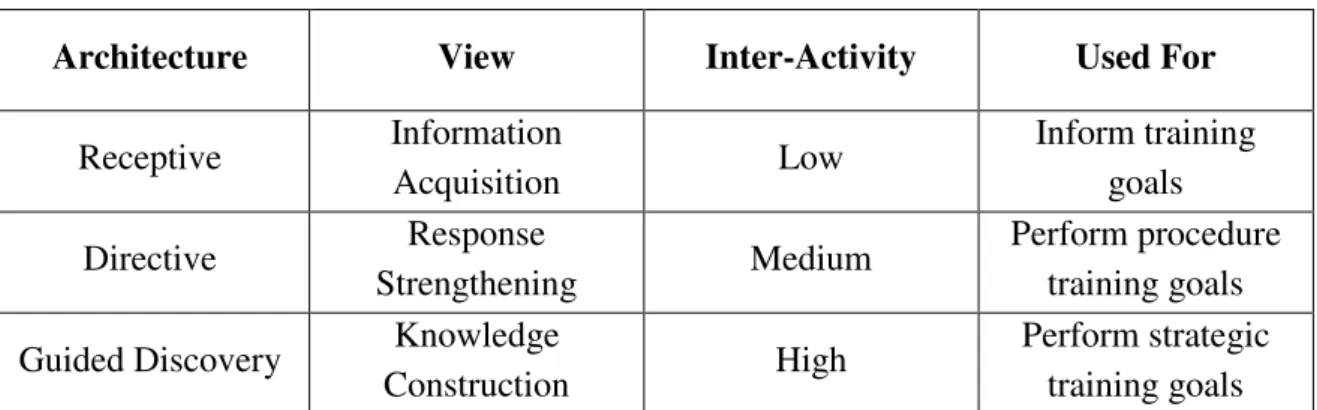
In the last century, three views of learning have evolved and based on them we can find three e-learning architectures, summarized in Table 1. We can see that receptive architecture is based on the information acquisition view, directive is based on a response strengthening view and guided discovery is based on a knowledge construction view (Clark & Mayer, 2011, p. 22).
Table 1. Three e-learning architectures
Architecture View Inter-Activity Used For
Receptive Information
Acquisition Low
Inform training goals
Directive Response
Strengthening Medium
Perform procedure training goals
Guided Discovery Knowledge
Construction High
Perform strategic training goals
Source: R. C. Clark & R. E. Mayer, e-Learning and the Science of Instruction, 2011, p. 22.
According to the above described learning architectures, interactivity of the lessons in e-materials ranges from low to high. For receptive lessons, e-e-materials contain a low level of interactivity and do not offer opportunities for student responses and feedback. At this level we can classify traditional learning materials converted in digital media. Examples of this type of e-material are digital textbooks and workbooks, and the like (Clark & Mayer, 2011, p. 22).
Medium level of interactivity presents materials designed for directive architecture e-learning. The e-materials for directive lessons accompany the sequence of “explanation -example-question-feedback”. E-materials in this segment incorporate highly structured practice opportunities composed to attend teaching in a step-by-step aspect. An example of an e-material for directive lessons is the e-textbook, with integrated multimedia building blocks and linkage of terms across the lessons (Clark & Mayer, 2011, pp. 22-23).
With guided discovery forms of e-learning, e-materials include simulations and games. This type of e-materials presents the highest level of interactivity. A student can engage both behaviourally and psychologically. This kind of lesson in e-material requires from students to solve a problem and learn from its situation (Clark & Mayer, 2011, p. 23).
1.1.2 The role of e-materials in teaching
Many teachers decide to utilize e-materials in their classrooms, since all interactive and multimedia elements help them get attention of all the students and their senses. Namely, when information is detected by several channels simultaneously, quality of understanding and memory significantly increases, because of enhanced activity in all parts of brains (Mayer, 2005, pp. 118-121).
Teaching with e-materials helps the student to transform the words and pictures in the lecture through the working memory so that they are integrated into the already obtained knowledge in long-term memory (Mayer, 2005 pp. 31-33). Structure of e-materials is from this perspective in accordance with the cognitive learning theory.
The knowledge construction view is to Mayer’s theory of cognitive multimedia learning (2005, pp. 31-38) based on three central foundations:
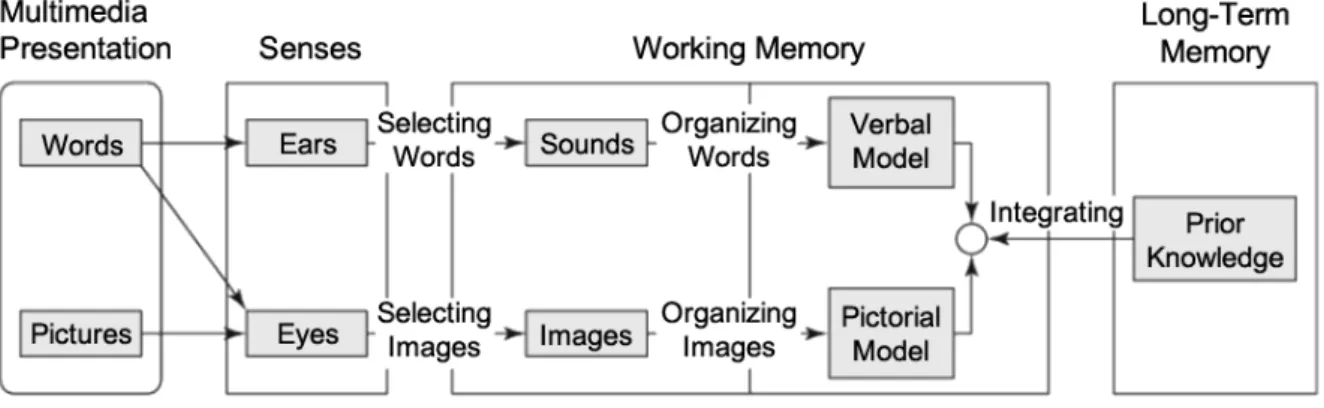
Dual channels; this foundation declares that two independent approaches are used to deal with processing data. The first channel processes sounds in working memory and the second channel is used to process images. The former model results in verbal models and the latter in pictorial models. The construction of both can be affected by background knowledge saved in long term memory (Clark & Mayer, 2011, p. 35-36). Limited capacity, as our next foundation, suggests that students are restricted in the
volume of information that they can actively detect and integrate simultaneously along both sensing paths (Clark & Mayer, 2011, p. 35).
Active processing; as the last foundation of multimedia learning, which take a place when pupils become involved in appropriate cognitive processing during learning. The result of active cognitive processing is the development of an understandable subjective illustration, so active learning can be considered as a process of model assembling. A psychological model symbolizes the essential elements of the given materials and their connections to the already obtained knowledge (Clark & Mayer, 2011, p. 35).
below we can also see the active processing foundation that is interpreted by five pointers. Active processing consists of choosing words, picking images, arranging words and images, and integrating, which are the essential processes of cognitive meaningful learning (Mayer, 2005, pp. 33- 37; Clark & Mayer, 2011, pp. 35-36).
Figure 1. Cognitive Theory of Multimedia Learning
Source: R. C. Clark & R. E. Mayer,e-Learning and the Science of Instruction, 2011, p. 36.
In Figure 1 we can also see three important cognitive processes indicated by the arrows (Clark & Mayer, 2011, pp. 36-37):
Selecting words and images; firstly students pay attention to important words and graphics sensed by ears and eyes in the present material – lesson.
Organizing words and images; at this step pupils in their minds organize selected words and images in reasoned verbal and pictorial likeness.
Integrating; as a last step that combines inbound verbal and pictorial perceptions with each other and with already obtained – background knowledge.
Active learning occurs when the student appropriately engages in all of these processes (Mayer, 2005, p. 36).
1.1.3 E-materials versus traditional printed materials
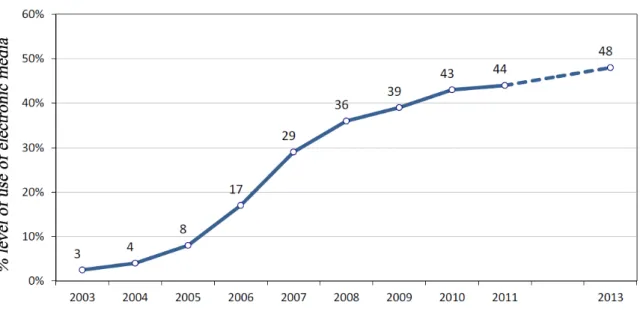
Figure 2. Uptake of e-teaching in education sector
Source: Flexible Learning Advisory Group, 2013 E-Learning Benchmarking Survey, 2013, p. 4.
We often say and hear that paper can handle everything, but can it truly? It can when we have in mind words, pictures, diagrams, etc. But when speaking about interactive multimedia content, such as digital media, paper just cannot come into play. When compared to e-materials, traditional printed learning materials are losing the pace. In the paragraphs below, I expose some major benefits of e-materials according to traditional printed learning materials.
In comparison to traditional printed learning materials, the main benefit of e-materials is a set of interactive and multimedia learning elements. E-materials are with all interactivity and multimedia more dedicated to user perception of multiple senses and that is why they are more design-sophisticated and user attractive. According to that, e-materials are much better for presenting complex or ambiguous real-world events, for providing actual examples whose benefits are also reflected in higher education quality, innovativeness in learning process and motivation to learn.
E-learning materials with proper learning objects enable greater interaction between student and learning content. By that, e-learning materials encourage higher mental participation of student in the educational process than classic printed learning materials. Thereby students’ learning is more efficient and even promotes independent self-discovery of new knowledge. Aitken and Tabakov (2005, p. 638) in their research reveal that students who use e-materials improve in their knowledge from 25 to 35 percent, which indicates that e-material has been more effective in comparison with traditional materials.
they also reveal that today’s students do not find traditional learning materials the best
materials to learn from. Authors suggest that unlike traditional learning material, involving e-materials in the educational process increases motivation and deep learning of students (Aitken & Tabakov, 2005, p. 638).
According to traditional materials, e-materials enable higher education quality with simulations and instructive games. Since this type of learning is focused on case solving, students adopt information and knowledge faster, as well as they integrate more knowledge into long-term memory after past simulations. In addition, students develop thinking skills through problem based learning (Clark & Mayer, 2011, pp. 346-349).
Another functional advantage of e-materials over printed learning materials is accessibility. E-materials are available everywhere and anytime. That is one of the crucial benefits of learning, because students spend less time to get the keen material. With e-materials, there is no waiting in the line to get desired material like with traditional materials; every e-material is just one click away (Aitken & Tabakov, 2005, p. 638).
A further advantage of e-materials is related to their reusability. Providers can easily change or complement lessons. Also, teachers can evaluate the materials and help make them even better. The real benefit of this is that the content is constantly up to date. In comparison with e-materials, classic materials in a few years fall out of use since content, methods, etc. become out-of-date (Bates, 2005, p. 164).
When considering pros and cons from financial perspective e-materials once again show precedence over traditional printed learning materials. The major costs of e-materials can be considered as costs of developing, costs of delivery and the costs of e-material administration. In comparison with traditional learning material the major cost is eliminated – the cost of printing. Therefore, e-materials are cheaper over printed materials, in many cases even free to use (Rumble, 2001, pp. 79-81; Bates, 2005, p. 84).
There are also some limitations of use of e-materials. A major limitation in comparison to traditional learning materials is necessity of use of IT that enables presentation of e-materials. In spite of the fact that we are in the 21st century, not every classroom has a computer, a projector or access to the internet. However, we can solve this problem by equipping students with laptops and tablet computers, but there is another problem that occurs – battery autonomy of portable devices (Ekanayake & Wishart, 2013, p. 20).
or more (Gosper & Malfroy & McKenzie & Rankine, 2011, p. 506), it appears to be a serious concern that they are going to use social networks in time of lectures.
1.2
T
eachers’ acceptance of technology
IT by itself enables the use of e-materials in classrooms, however, it does not grant their actual use. Namely, teacher’s acceptance of e-materials is greatly dependent on their attitude and perception of the IT as such. For that reason, I investigate how IT and education have gone hand in hand over time. Also, I take a look on the approaching trends of technology in education; furthermore I expose what are the justifications of teacher’s use of technology. Finally, I expose the steps to be considers when adopting technology. All of this is further described in the following sub-chapters.
1.2.1 Evolution of IT use for educational manners
The first contacts between technology and education were made for military purposes. After that, institutes were impressed about the new technology and spent more and more attention to involve technology in educational processes. Firstly, a massive emerging technology was television with corresponding videos, which, however, did not fulfil the expectations. The first problem was shown as lack of knowledge about the placement of used IT into the instructional program, and the second problem, educators did not know how to incorporate technology into the teaching process. Television in education was recognized as an unfortunate adoption also because students found it as uninteresting due to its non-interactivity (Stigzelius, 2011, p. 12).
Following the emerged technology was the computer. The technology was at that time still in its infancy, so it provided only basic functions of nowadays possibilities. Also, at that time the above mentioned technology was very expensive, so mass use of it was not available. In time, prices have decreased, performance of hardware improved, so did user friendly software. Thus, educational institutions adopted computer-based teaching, which was the beginning of e-teaching (Stigzelius, 2011, p. 12).
Technology trends are also present in education; therefore, we can find the next generation of e-learning, which is mobile learning, also known as m-learning. Here, teaching and learning is conducted through portable devices. From the point of view of e-materials this is very important technology as its main purpose is to deliver e-materials to every individual user. With e-teaching it is mostly the teacher who is operating with the technology, but when using mobile devices in the classroom, every student has its own device, which enables them to include into the lesson all students at the same time and promote collaborative learning. Currently used and supported technologies for m-learning are handheld computers, laptop PCs or tablet PCs. Mobile phones or smart phones are not yet supported portable device in educational manner (Uzunboylu & Ozdamli, 2011, pp. 544-545; Jairak & Praneetpolgrang & Makhabunchakij, 2009, p. 363).
In the study acceptance of tablet PCs in classroom instruction, authors Ifenthaler and
Schweinbenz (2013, p. 532) explore determinants of teacher’s acceptance of tablet computers. Findings show that most teachers do not know how tablet PCs can be used as an innovative improvement to facilitate teaching processes. Therefore, they rather base on more secure techniques of delivering knowledge and their prior experience.
1.2.2 Technology trends in the educational context
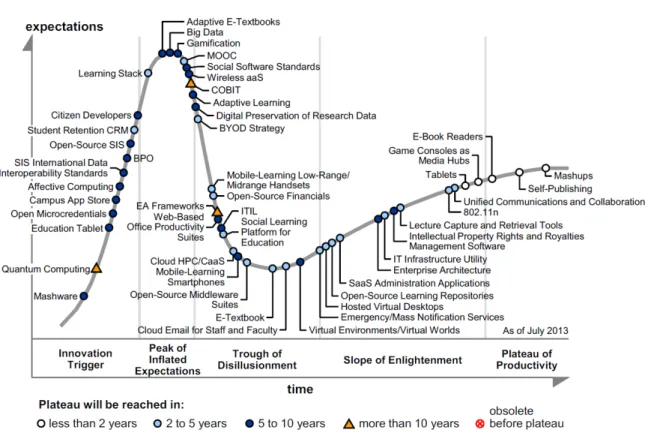
For emerging technology to penetrate into educational systems is inevitable. Gartner, a leading global corporation in IT research and consulting, forecasts evolving technologies and trends in the upcoming future. New trends and evolving technologies in the field of education are presented in Figure 3, where it can be seen that technology innovations are highly present in education. Tablet PCs as such are according to Gartner (2013, p. 7) going to reach the plateau in 2 to 5 years.
According to Stigzelius (2011, p. 14), when technologies rapidly evolve, educational systems need to be agile to new demands. Authors, including Vander Ark and Hess (2014) argue that schools focused in acquiring state-of-the-art technology are making huge
mistakes, as technology by itself won’t improve education. Technology needs to be
properly addressed to educational problems and needs to serve as a tool for teachers, students and parents to complete their tasks sophisticatedly. Thus, adapting to change, new innovative and effective methods have to be developed, which are necessary for teacher support at student learning.
In the field of education we can see, in Figure 3, many technologies that are represented under materials. We can also see several innovation trends which are reflections on e-materials and which justify subject relevance of my master’s thesis.
p. 7). Gamifaction is the use of games in nongame contexts to design behaviours, develop skills or to engage people in innovation. By 2020, Gartner (2012, p. 5) predicts that gamification will be generally used to develop more engaging course materials.
Figure 3. Hype Cycle of technology maturity used in Education, 2013
Source: Gartner Inc., Hype Cycle for Education, 2013, p. 7.
1.2.3 IT support in teaching
Implementation of IT in education institutions has for a long time been perceived as a matter of provision of hardware and software only. In the last few years, attention has been oriented to implications of use of IT for curriculum content, learner activities, teacher role, assessment practices, etc. (Voogt & Knezek, 2008, pp. 38-39).
New technology present in the classroom can contribute to teaching and learning. John and Sutherland (2004, p. 102) provide the following four contributions with respect to student learning:
State-of-the-art technologies can trigger growth of intellectual skills.
Modern technologies motivate and stimulus voluntary interest more than conventional approaches.
Students that use advanced technologies accumulate more than students on the usual approach.
Incorporating IT into classroom situations can and does alter the traditional balance between teacher and student (John & Sutherland, 2004, p. 102). Notwithstanding the high level of IT in education, teacher presence is vital. The main task of the teacher has for long decades been delivering information to students and strengthening their knowledge. With the presence of IT, the teacher is not losing this role, but his or her role is changing. Nowadays teacher has to consider and accept changes and move to new roles. The teacher role has evolved from deliverer to active participant, monitor, consultant and student guide (Yang, 1998, pp. 128-129).
Authors (John & Southerland, 2004, p. 102) emphasize that positive images of IT contribution to classroom are, however, balanced by two further observations of genuine significance:
The advantage of practicing modern technologies to students largely depends on the teacher’s ability to use technology and the teacher’s attitude to the presence of the technology during the lectures.
The training that educational staff receive, greatly impacts on their skills and attitude towards the technology.
1.2.4 Obstacles to overcome
Use of IT in educational processes has been an examination focus for decades. Results have reviled that in spite of teacher training programs, an increase in IT resources and the requirements of the curriculum, there has been very reluctant uptake of IT communication in educational institutions by the most of teachers. Authors expose the following reasons for a lack of a more extensive uptake of IT (Cox & Preston & Cox, 2000):
Understanding the need for change; one of the major issues in education reform is
that employees do not have a clear and rational sense of the reasons for educational change, what it is and how to proceed. It is not that teachers are by default reluctant against changes, but they just get insufficient information to make sense of the change.
practice, and it is very probable that they may not accept the use of IT at their lectures or other instructional processes.
Pedagogical practice versus technical skills; much research has shown that until lately teacher training has covered mainly the technical aspects of use of IT with less focus on the pedagogical practice required and how to incorporate IT in the curriculum. In short, teachers knew only how to run certain software, but did not know how to use it for teaching students.
Support from the whole school; like in many cases of adopting an innovation, one of the major factors of effective and successful adoption is the support from the top. The same goes for the school system, where without a committed head of school, changes are more or less doomed. Another key part to successful adoption is involving individual teachers who are going to be part of change and are willing to learn and pass the knowledge to colleagues. Only one or few enthusiastic teachers will probably not impress others to change their rooted practice.
Losing control of the learning; most teachers like to have order in the classroom and to maintain controlled learning environment. Teachers in most cases see adoption of IT as a threat to current mold and therefore changes are not preferable. There is fear present amongst many teachers about IT and reluctance of its value to their pupils. Inadequate resources; even if all above issues are overcome, it is still often difficult
to use IT in the learning process. Teachers simply cannot be able to use IT if there are insufficient resources of technology in the school. Problems of adoption occur as well if teachers do not have enough time to plan lessons incorporating the use of IT.
Sang, Valcke, Van Braak and Tondeur (2009, p. 808) categorize two levels of adoption barriers for hindering teachers’ IT integration efforts. They differ between external and internal barriers. Factors exposed in the previous paragraphs mostly present the external barriers. Among external barriers, authors include those which are frequently recognized as the main obstacles for adoption; issues of insufficient access to the technologies, inadequate training and lack of support. They also add that with disregarding those factors, it is almost hopeless to talk about technology integration.
Resolving external barriers is a necessary but not sufficient condition to count integration of technology as successful. Even with prosperous overcome of external barriers, Sang, Valcke, Van Braak and Tondeur (2009, p. 808) add that, “teachers would not automatically use technology to achieve the kind of meaningful outcomes advocated”. Therefore we need to consider internal barriers stalling IT integration by teachers.
are better than old ones. Likewise there are some other factors that also influence information communication integration, such as computer motivation, computer attitudes and perceptions on IT policy (Sang & Valcke & Van Braak & Tondeur, 2009, p. 808).
Crossing the line between described barriers and factors affecting the decision about adoption of IT it is not surprising as the learning process has not significantly changed for decades. Hooper and Rieber (1995, p. 155) twenty years ago gave an example that if we compared teachers and doctors from fifty years ago, only few of doctors would be capable and skilled enough to barely handle with the nowadays technology. On the other side, teachers from fifty years ago would probably continue with their practice without any significant issues in most of today’s classrooms.
1.2.5 IT adoption process in education
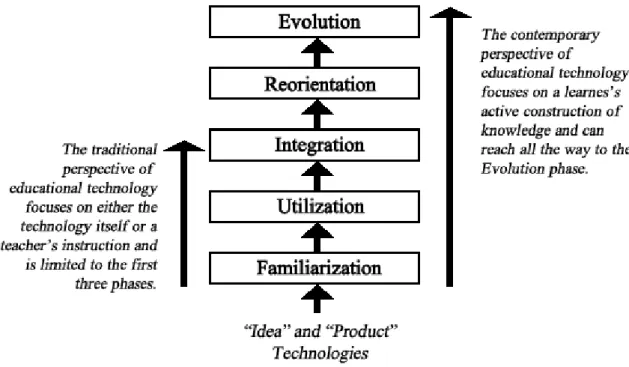
To easier understand adoption patterns of technology in education, Hooper and Rieber (1995, pp. 154-158) present a model in simplified form. The model is illustrated in Figure 4; it consists of five steps or phases of IT adoption:
Familiarization; initial contact and experience with technology. The most usual example of familiarization is a teacher who participates in a workshop where usage of technology is presented. The main result of this phase is memory of the experience in
teachers’ minds, which triggers discussions among teachers and sharing ideas about the features seen. In this phase no further action takes place.
Utilization; this phase starts when the teacher tries out the technology in the classroom. In this phase occurs a chance of giving up on the technology, because teachers are testing limited editions and they cannot use all features presented and learned in the workshops. That is why teachers who proceed only to this stage are likely to refuse the use of technology at the first sign of trouble, since they have not made any commitment to use it.
Integration; represents the breakthrough phase. This stage takes place when the educator is dependent on technology in the educational process. So in case that IT fails or is suddenly unavailable, the teacher cannot continue with his or her lessons as planned. For many, integration presents the last stage of the adoption model, but this phase truly illustrates the beginning of comprehending education technology.
Reorientation; this phase is more advance and it requires teachers’ readiness for changes in the learning process. It requires the teacher to re-examine and reconceptualize the aim and role of the classroom. The main characteristic of this phase is change of classroom focus. Instead of the teacher’s instructions, focus is in
single student to gain their own knowledge. In this stage of the adoption model, teachers are open to new technologies that enable and support this knowledge development process and are not scared by being replaced by technology. Teachers will in this phase likely adopt technology even if they are not experts in usage.
Evolution; presents the final stage of IT adoption process in education, which is intended as a reminder to teachers to be aware that educational system need to continue to develop to remain effective. To meet the challenge and potential provided by new understandings of how students learn, educational environment should constantly subject to change.
Figure 4. A model of technology adoption in education
Source: S. Hooper & L. P. Rieber, Teaching with Technology, 1995, p. 156.
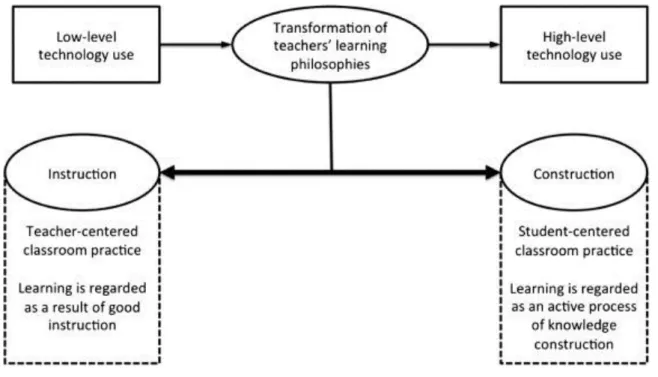
Authors Hooper and Rieber (1995, p. 155) affirm that the entire potential of any education IT can be accomplished only when the teacher progresses through all five phases. Contrarily, the technology will likely be misused or discarded. The key phase of successful IT is reorientation, where teachers change the philosophy of learning and teaching and develop expertise to apply a high level technology use and in term of transformation lead to a change towards a student-oriented teaching practice (Ifenthaler & Schweinbenz 2013, pp. 532-533).
transformation indicates the crossing from low level of technology use to high level of technology use at teaching process in classroom (Hooper & Rieber, 1995, pp.159-160).
Figure 5. Connection between learning philosophies and level of technology use
Source: D. Ifenthaler & V. Schweinbenz, The acceptance of Tablet-PCs in classroom instruction: The teachers’ perspectives, 2013, p. 533.
1.3
Review of technology acceptance theories
Hereinafter I review relevant models for acceptance of e-materials in the teaching processes from a teacher’s point of view. Many theories and their models are not
appropriate for examination of teacher’s acceptance of e-materials. Some of them are designed for other purposes, which is why I review some of the earlier studies in the related field.
1.3.1 Technology Acceptance Model (TAM)
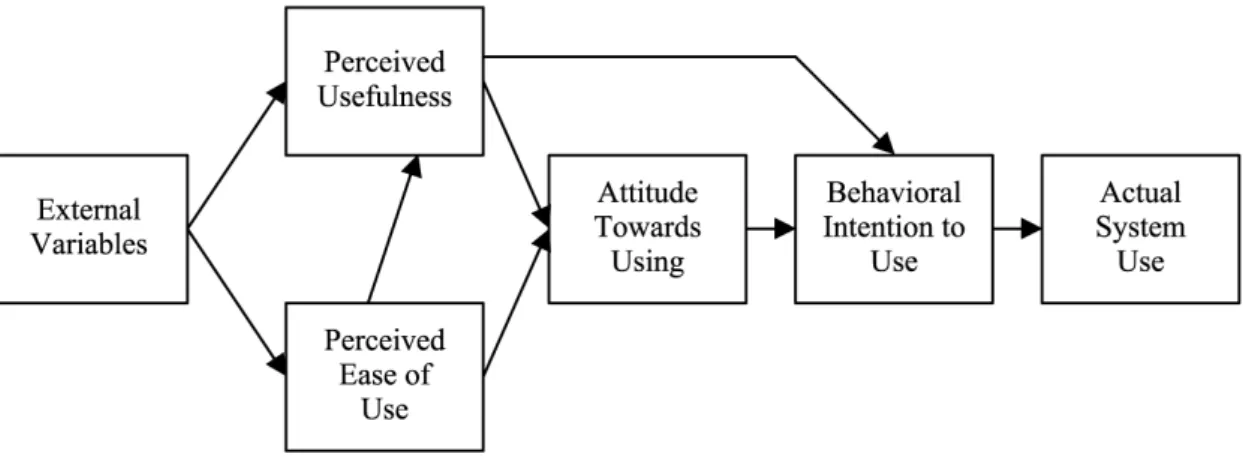
Successfulness of the integrated information system into processes is closely related to user acceptance and actual use of technology, which has been identified by numerous researches. Davis (1989, p. 319) adapts the theory of reasoned action (TRA) in the view of computer acceptance behaviour and presents his Technology Acceptance Model (TAM). The model identifies two main user beliefs: perceived usefulness and perceived ease of use, which influence on individual’s behavioural intention to use the information system (Bourgonjon & Valcke & Soetaert & Schellens, 2010, p. 1146).
Researchers have applied TAM to various technologies and tests in different contexts. In research of Bourgonjon, Valcke, Soetaert and Schellens (2010, p. 1146) we can come across a statement that TAM has developed into one of the most widely used and empirically approved models within information systems research in the last 25 years. Additionally Hong, Thong and Tam (2006, p. 1822) state that TAM is among researchers a preferred choice over alternative models as the Theory of Reasoned Action (TRA) and the Theory of Planned Behavior (TPB). Authors (Bourgonjon & Valcke & Soetaert & Schellens 2010, p. 1146) expose that comparative studies affirm the dominance of the TAM over other intentional behaviour theories as TAM justify about 40% of the deviation in usage intentions and behaviour.
The bellow paragraph in Figure 6 visually presents the TAM model with vital constructs and causal relations between them. As mentioned above, main constructs of the model are user-perceived usefulness and perceived ease of use. Those user beliefs are constituted by external variables which directly influence from design features. According to the model, a major determinant of user actual use is the overall attitude toward using a given system (Davis Jr., 1986, p. 24).
Figure 6. Technology Acceptance Model (TAM)
Davis (1989, p. 320) defines perceived usefulness in his research as “the degree to which a person believes that using a particular system would enhance his or her job performance”. Persons will have higher expectations and intentions to use technology if they are familiar with the benefits of technology implementations to their performance on the job.
Technology as such does not attribute to persons’ attitude toward use as the importance of
the performance increase (Amoako-Gyampah, 2007, p. 1235).
Davis (1989, p. 320) defined users’ perceived ease of use as “the degree to which a person
believes that using a particular system would be free of effort”. Among the beliefs,
perceived ease of use is hypothesized to be a predictor of perceived usefulness. Past researches provide evidence of the significant effect of perceived ease of use on usage intention, either directly or indirectly through its impact on perceived usefulness (Wang & Wang & Lin & Tang, 2003, p. 507).
Amoako-Gyampah (2007, p. 1235) states that if technology is easy to use, users expectations about technology regarding to performance enhancement are higher. Usually users find the system which is easier to use more useful, when selecting between two systems which perform equal operations (Davis, 1993, p. 477). To prevent the “under
-used” useful system issue, the information system should be as easy to learn as easy to use (Wang & Wang & Lin & Tang, 2003, p. 507).
In the research by Davis Jr. (1986, pp. 109-110), we can find the TAM analysis, where he tests the TAM motivational variables and their causal relations. Results of the analysis show significant impact of perceived ease of use and perceived usefulness on user behaviour. Results also show that perceived usefulness has a significant direct impact on actual use in addition to its indirect effect via user attitude toward using. Results also show that perceived usefulness has a greater impact on the attitude toward using and consequently on the actual use than perceived ease of use.
The key finding of Davis’ (1986, pp. 109-110) research is that the attitude toward using has, due to direct influence of perceived usefulness, indirect influence between users’ beliefs and the actual use. That is why the question to consider the attitude in the model is justified. In addition, researchers also expose that TAM findings are not always consistent because of comprehensiveness of use (Bourgonjon & Valcke & Soetaert & Schellens 2010, p. 1146).
1.3.2 Extended technology acceptance model (TAM2)
of usefulness and ease of use; as well as improves clarification of larger proportions of variance (Bourgonjon & Valcke & Soetaert & Schellens 2010, p. 1146).
Figure 7. Proposed TAM2 - Extension of the Technology Acceptance Model
Source: V. Venkatesh & F. D. Davis, A Theoretical Extension of the Technology Acceptance Model: Four Longitudinal Field Studies, 2000, p. 188.
TAM2 consists of five additional direct factors – Subjective Norm, Image, Job Relevance, Output Quality, and Result Demonstrability – and two indirect factors – Experience and Voluntariness.
Subjective norm and Image evaluate if the technology is socially accepted or rejected. Social influences also have an impact on individuals, i.e. thinking and beliefs of people who are important to individuals. Perception of expected behaviour from people who influence individuals is concerned as a subjective norm. Other authors define also other concepts of that perception, such as normative beliefs, social influence and social norms (Van Raaij & Schepers, 2008, p. 842; Venkatech & Davis, 2000, pp. 187-189).
The reason why we should consider the subjective norm in research when analyzing user behaviour about intention to use is more than justified, since individuals may behave and react as others expect from them to perform. Venkatesh and Davis (2000, p. 187) expose that an individual can perform contrary to their own beliefs against the attitude or its consequences when people who are important in the individual’s environment think he or she should adopt the system or technology. Since opinion of important persons in the environment has an influence on an individual’s behavior, individuals are sufficiently motivated to comply with others’ beliefs (Van Raaij & Schepers, 2008, p. 842; Venkatesh & Davis, 2000, p. 187).
Voluntariness indicates how a user perceives the use of technology. It can be perceived either mandatory or voluntary. When use of technology is perceived as voluntary, then Subjective norms usually do not have a significant impact on the user’s behaviour. There are similar experiences where users without experience are more reliant on beliefs of others. On the contrary, persons with prior experiences with the use gain their own opinions and beliefs so they trust their own beliefs and beliefs of others are no more significant (Venkatech & Davis, 200, pp. 188-189; Stigzelius, 2011, p. 27).
Job relevance reflects the perception of how technology supports their assignments and what the contribution is to the objectives set. The benefits of the performed assignments are indicated as output quality. When users have demonstrable results and they understand them, they lose doubts about the usefulness of technology (Venkatech & Davis, 200, pp. 191-192; Stigzelius, 2011, p. 27).
1.3.3 Unified Theory of Acceptance and Use of Technology (UTAUT)
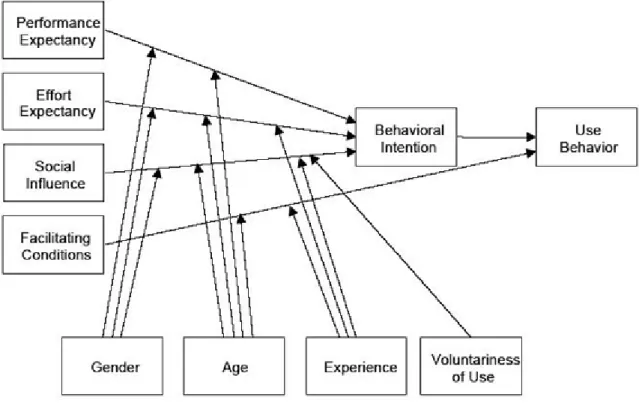
Furthermore, other models have been suggested. One of them needs to be especially mentioned. This model integrates eight different models of technology acceptance in one – the Unified Theory of Acceptance and Use of Technology (UTAUT), proposed by Venkatesh, Morris, Davis and Davis (2003, p. 447).
As already mentioned, the proposed model combines eight adoption theories; the Theory of Reasoned Action (TRA), Technology Acceptance model (TAM), Motivational model (MM), Theory of Planned Behaviour (TPB), Combined TAM and TPB (C-TAM-TBP), Model of PC Utilization (MPCU), Innovation Diffusion Theory (IDT), and Social Cognitive Theory (SCT).
constructs explain up to 70% of the variance in usage intention (Van Raaij & Schepers, 2008, p. 841).
Figure 8. The Unified Theory of Acceptance and Use of Technology (UTAUT) model
Source: V. Venkatesh & M. G. Morris & G. B. Davis & F. D. Davis,User acceptance of information technology: Toward a unified view, 2003, p. 447.
Venkatesh et al. (2003, p. 447) define performance expectancy as “the degree to which an individual believes that using the system will help him or her to attain gains in job
performance”. The construct performance expectancy is equivalent to perceived usefulness from TAM and TAM2 models. Authors also argue that construct, performance expectancy, is the strongest predictor and it has the most influential impact on behavioural intention. Studies confirm the significance in both mandatory and voluntary technology acceptance environments.
Effort expectancy is according to Venkatesh et al. (2003, p. 450) defined as “the degree of ease associated with the use of the system”. When comparing with the TAM model,
authors in prior research note that construct effort expectancy is equivalent to perceived ease of use. The significance of effort expectancy in relation to behavioural intention has been proofed in both, mandatory and voluntary usage. However, prior studies expose that this construct is becoming non-significant over periods of extended use.
acceptance models, we can find similarities. There are three constructs related to social influence; subjective norm, social factors and image. Despite different labels, each of the
above mentioned constructs determine the individual’s behaviour influenced by the other
person’s opinion and expectations to behave about the use of technology (Venkatesh et al., 2003, p. 451).
Venkatesh et al. (2003, p. 453) define facilitation conditions as an individual belief if existing technical infrastructure can support the use of the system. In other words, this construct considers if companies remove barriers that affect the use and if the technology is compatible with the current environment. Authors expose that when both performance expectancy and effort expectancy are present, facilitating conditions becomes non-significant in predicting intention.
As Van Raaj and Schepers (2008, pp. 841-842) state in their research work, UTAUT’s high R2 is only attained when moderating the key relationships with up to four variables – gender, age, experience and voluntariness, in order to yield more significant coefficients.
2
PROPOSED MODEL DEVELOPMENT
Acceptance models have been deployed in a number of studies attempting to clarify the acceptance of a range of different technologies. To explain technology adoption behaviour, authors in various studies in educational context mostly use for the base model the TAM or UTAUT as most effective and powerful models used in this millennium (Ling & Downe & Ahmad & Lai, 2011, p. 2). Many of them modify the original model and extend it with additional constructs from other theories. For the purpose of my study model I first review some of the prior studies in educational context and gather them in Table 2, where we can see which acceptance model authors use for the base of study, what the technology examined in the study is, what modifications of the original model they make and which constructs they consider in research model.
Table 2. Research review from the field of technology acceptance in education manner
Base
model Study reference Type of technology Research model Research variables
TAM Ma, Andersson & Streith (2005)
computer
technology Modified TAM
Perceived usefulness Perceived ease of use Subjective norm Intention to use
Continued
Base
model Study reference Type of technology Research model Research variables
TAM
Callum & Jeffrey
(2013) Mobile learning
Combined TAM and ICT Self-Efficacy
Perceived ease of use Perceived usefulness Behavioural intention Advanced mobile skills Basic ICT skills Advanced ICT skills
Bourgonjon, Valcke, Soetaert & Schellens (2010)
video games in the classroom Modified and extended with gender, experience and learning opportunities
Perceived ease of use Perceived usefulness Gender
Experience
Learning opportunities Preferences for video games
Cox, Preston & Cox (2000)
use of IT in
classroom TAM
Perceived ease of use Perceived usefulness Attitude towards use Behavioural intention to use Actual system use
Sang, Valcke, Van Braak & Tondeur (2009)
integration of ICT
into classroom Extended TAM
Teacher beliefs ICT-related policies ICT motivation ICT attitudes Assisted ICT use ICT use in class
Liu, Liao & Pratt (2009)
Media richness
learning materials Extended TAM
Perceived usefulness Perceived ease of use Concentration Attitude towards use Intention to use
Van Raaij & Schepers (2008)
Virtual learning
environment Extended TAM
Personal innovativeness in IT Computer anxiety
Social norms Perceived usefulness Perceived ease of use System usage
De Smet, Bourgonjon, De Wever, Schellens & Valcke (2012)
Learning
management system Extended TAM
Perceived usefulness Perceived ease of use Experience
Personal innovativeness in IT Subjective norm
Internal ICT support Communicational use Informational use
Continued
According to the revised theories of adoption and reviewed prior studies, I find that regardless of the acceptance model, the two main constructs in all cases are perceived usefulness or performance expectancy and ease of use or effort expectancy. However, I also examine the comparison between the mentioned acceptance models in educational contexts. Ling et al. (2011, p. 2) expose that TAM is more suitable for business and commercial settings, but for the educational context authors propose UTAUT. The latter also explains 70 percent of variance while TAM about 40 percent.
Thus as my base model I consider UTAUT; however I modify it according to my research needs and study purpose. In my model I integrate performance expectancy and effort expectancy as key determinants. Also, according to prior studies in educational context and acknowledge influence on technology acceptance I integrate subjective norms into my model.
However, according to the environment of my study I exclude facilitating conditions from the research model, as I run the study among current users of e-materials, where the
Base
model Study reference Type of technology Research model Research variables
TAM Teo, Lee & Chai (2009)
Computers in
classroom Extended TAM
Perceived usefulness
Perceived ease of use Facilitating conditions Computer attitude
UTAUT
Anderson,
Schwager & Kerns (2006)
Tablet PCs 4 constructs UTAUT model Performance expectancy Effort expectancy Social influence Facilitating conditions Use behaviour Jairak, Praneetpolgrang & Mekhabuchakij (2009) Mobile learning Replaced social factors for social influence, included attitude towards behaviour and excluded the mediator variables Performance expectancy Effort expectancy Social Factors Facilitating conditions Behavioural intention
Attitude towards behaviour
Ifenthaler & Schweinbenz (2013)
Tablet PCs in
classroom UTAUT
Performance expectancy Effort expectancy Social influence Behaviour intention Use behaviour
Stigzelius (2011) Online learning
environment UTAUT
teaching environment already fulfils all the necessary technology infrastructure conditions for implementation and further use of e-materials into lectures. Oshlyansky, Cairns and Thimbleby (2007, p. 83) expose that when required technology is available and accessible to all participants, it makes responses to this construct redundant. Therefore, facilitating conditions should be excluded.
Results from prior studies have proposed that personality traits have influential part in terms of technology adoption (Van Raaij & Schepers, 2008, p. 841). That is why I consider extending my model with personality traits into research, namely I include into model a personal innovativeness in the domain of IT, as I feel this is a particularly relevant in an e-materials context. As well, it is a well proven and used construct in many of studies in educational context. In a chapter below, I briefly described the term of personal innovativeness in domain of IT.
In previous studies related to technology acceptance, researchers have not devoted much attention to the role of the innovation’s provider. However, authors Lee, Kim and Ahn (2011, p. 223) expose that potential adopters may not regard new technology innovation only as a new tool for gaining benefits, but may also consider the relationship with the technology provider. Authors also note that the adopter’s past experience with the technology provider often shapes his or her beliefs and perception about the provider’s
credibility. Thus, I consider provider’s credibility in my study model, as I believe that it has a great impact on the teacher’s acceptance of e-materials.
2.1
Personal innovativeness in IT
On acceptance of certain technology, researchers found an impact of personality traits. Since individuals have their own opinions and beliefs, they form different dispositions toward using technology (Walczuch & Lemmink & Streukens, 2007, p. 207). Agarwal and Prasad (1998) argue why some of the persons effortlessly adopt new technology while others reject it. Therefore, they consider personal innovativeness an important and significant construct of IT innovation acceptance.
In behavioural science there are only few concepts with such immediate impact to consumer behaviour as innovativeness. Innovativeness plays one of the most crucial roles in theories of brand loyalty, decision making, preferences, and communications. Without innovativeness consumer behaviour would consist of a series of routine buying responses to a static set of products. Innovativeness is on the one hand a main actor for rapid changes in markets, and on the other hand, it makes consumer behaviour hard to predict (Hirschman, 1980, pp. 283-284).
say, these persons are able to cope with high levels of uncertainty, they are more perceptive to new manners and they develop stronger intentions concerning acceptance.
Our willingness to innovate affects personality and perceptions of the environment. Constraints, negative outcomes and high risks are perceptions to individuals which may reduce the interest in exploratory or creative behaviour (Bennett Thatcher & Srite & Stepina & Liu, 2003, p. 74).
In the concern of IT, Agarwal and Prasad (1998, pp. 16-18) consider personal innovativeness in the domain of IT as the willingness of an individual to try out new IT. To Agarwal and Prasad definition of personal innovativeness in IT, Van Raaij and Schepers (2008, p. 841) add that a person’s tendency to experiment with and adopt new IT is individual and autonomous of opinions from others.
Persons who are not afraid of changes are willing to take risks and will go for new challenges, and they are more likely to express willingness to innovate with IT. On the other hand, persons with restraints to usage of IT will more likely need external incentive to try IT innovation (Bennett Thatcher et al., 2003, p. 74).
Where persons are not self aware of the importance of innovations, authors (Bennett Tatcher et al., 2003, pp. 74-75) agree that managers need to encourage them. Managerial actions and support regarding innovativeness with IT have significant effects on IT acceptance of other employees. According to Lee, Qu and Kim (2007, pp. 887-888), highly innovative users with managerial support are likely to use a certain technology, in contrary, low innovative users with no managerial support are reluctant to use the proposed technology.
2.2
Perceived credibility of provider
Many authors, including Newell and Goldsmith (1997, p. 235) and also Lee, Kim and Ahn (2011, p. 223) in their studies expose that corporate credibility of company which design and produce products – innovation’s provider – has received a slight attention in business research and even less attention in educational context. To better understand the credibility of corporate, hereinafter I expose its meaning relevance to the study.
Newell and Goldsmith (1997, p. 235) define corporate credibility as “the extent to which consumers feel that the firm has the knowledge or ability to fulfil its claims and whether
responses and attitude towards company’s brands or products and consequently it has a relative impact on purchase intention (Goldsmith & Lafferty & Newell, 2000, p. 304).
Corporate credibility is also associated with persons trust in corporate, where credibility as such presents the first, main and essential dimension of trust. It is based upon a main
actor’s intention and ability to keep promises and agreements at task competences, reliability in the delivery of goods and services and predictability in work conditions behaviour (Ganesan & Hess, 1997, p.440).
Trust is in general and most commonly defined as a relationship between the buyer and seller. In this relationship there are usually four participants; vendor organization, the seller
– sales representative who represents the vendor organization, buying organization and buyer. Among all four participants there is a variety of connections and consequently variety possibilities of trusts (Ganesan & Hess, 1997, pp. 440 – 441).
According to the relationship among these, entities Ganesan and Hess (1997, pp. 440 – 441) define four types of trust:
interpersonal trust; occurs between an individual buyer and a sales representative, organizational trust; the buyer or sales representative trusts the selling or buying
organization,
intraorganizational trust; exists on the one side between the buyer and buyers organization and on the other side between the sales representative and vendor, and interorganizational trust; which exists between buying and selling organization.
Within my study, organizational trust is adequate, as I am researching how individual teacher’s perception of provider’s credibility as organization affects the acceptance of e-materials.
When considering trust and behaviour to use, we simply cannot avoid Morgan and Hunt (1994, p. 22) Commitment-Trust theory, where authors find that trust is positively related to commitment in buyer-seller relationships (Ganesan & Hess, 1997, p. 439). Moreover, Lee, Kim and Ahn (2011, p. 223) support the relational characteristic – trust in the
that the effect of trust on commitment relies on the level on which trust is developed (Ganesan & Hess, 1997, p. 441).
Authors Lee, Kim and Ahn (2011, p. 223) expose the importance of corporate communication and its positive impact on individual’s perceived credibility, however, authors Newell and Goldsmith (1997, pp. 235-236) and Nguyen and Leblanc (2001, pp. 228-229) additionally emphasize the importance of corporate reputation that affects the perceived credibility of corporate.
Thus, I include two more constructs into my research model, i.e. corporate reputation and
communication, which will additionally explain the impact of perceived provider’s
credibility on acceptance of e-materials among teachers.
The eligibility of considered constructs in educational context justifies findings of prior studies, where Law (1997, p. 21) exposes the importance of provider’s reputation which increases the value of teaching materials and also teachers percept them as more credible.
2.2.1 Corporate reputation
Corporate reputation has been variously defined (Dolphin, 2004, p. 79). Researchers, in the fields of economics, organizational theory and marketing, who had studied the concept of corporate reputation, have divergent interpretations of corporate reputation. Economists examine reputation in relation with product quality and price. Organizational researchers consider it a social identity and exemplify it as an intangible resource which may
significantly contribute to an organization’s performance. And analysts in marketing define reputation as brand equity and associate it with the credibility of the company (Nguyen & Leblanc, 2001, p. 228).
Common to all is the fact that corporate reputation is a result of past actions of the corporation. Nguyen and Leblanc (2001, p. 228) define corporate reputation as a reflection of company interactions to its target groups regarding the quality of its products and services in comparison with the competition. He also adds that corporate can have numerous reputations, for each attribute, such as price, product or service quality, innovativeness, etc., or a global reputation.
Stakeholders have their own expectations and depend on that, they design opinions about a product, service, employer, business partner, etc., and appropriately to that, they react and response. Aggregation of stakeholder’s perceptions, of how well organization meets their demands and expectations, their created opinions, previous experiences and responses, generates corporate reputation (Dolphin, 2004, pp. 79-80).
Keh and Xie (2009, p. 733) state that corporate reputation has a positive effect on financial performance. They expose the following advantages that a company with favourable corporate reputation can benefit from; charging price premium, delaying rival mobility, attracting larger amounts of investments, highly motivated employees, partnership relation with suppliers, and supporting new product and recovery strategies in time of crisis.
Nguyen and Leblanc (2001, pp. 228-229) also believe that in order to build a strong corporate reputation, a company needs many credential actions over time. However, the downsides of good reputation are shown especially when corporate makes a mistakes or comes into trouble. According to Nguyen and Leblanc (2001, p. 229) the impacts of bad actions on stakeholders are much stronger than good actions, so corporate reputation can be easily destructed. Keh and Xie (2009, p. 733) also expose findings from earlier researches where corporate with good reputation suffer more than those with poor reputation when they make a mistake. The reason for that is the contrast effect from non-fulfilment of high expectation.
2.2.2 Communication
Communication is a very large concept, composite of interactions between persons. In general, the purpose of communication is to share, to inform, to give notice, to announce, etc, relevant information to the receiver. The value of communication between customers and company has been and still is significant. Ball, Simoes and Machas (2004, p. 1277) consider communication as a forerunner of trust, along with shared values and lack of opportunistic behaviour.
There are two common ways of communicating – written and verbal. Considering communication between company and customer, written communication refers to personalized letters, direct mail, and since the development of IT also interactions on web sites and e-mail. On the other side, communication in-person refers to interactions with service personnel before, during and after service transactions (Ball & Simoes & Machas, 2004, p. 1277).