Ann. Geophys., 26, 893–903, 2008 www.ann-geophys.net/26/893/2008/ © European Geosciences Union 2008
Annales
Geophysicae
Case study on total electron content enhancements at low latitudes
during low geomagnetic activities before the storms
Libo Liu, Weixing Wan, Man-Lian Zhang, and Biqiang Zhao
Institute of Geology and Geophysics, Chinese Academy of Sciences, Beijing 100029, China
Received: 11 December 2007 – Revised: 28 February 2008 – Accepted: 7 March 2008 – Published: 13 May 2008
Abstract. Sometimes the ionospheric total electron con-tent (TEC) is significantly enhanced during low geomag-netic activities before storms. In this article, we investi-gate the characteristics of those interesting TEC enhance-ments using regional and global TEC data. We analyzed the low-latitude TEC enhancement events that occurred around longitude 120◦E on 10 February 2004, 21 January 2004, and 4 March 2001, respectively. The TEC data are derived from regional Global Positioning System (GPS) observations in the Asia/Australia sector as well as global ionospheric maps (GIMs) produced by Jet Propulsion Laboratory (JPL). Strong enhancements under low geomagnetic activity before the storms are simultaneously presented at low latitudes in the Asia/Australia sector in regional TEC and JPL GIMs. These TEC enhancements are shown to be regional events with longitudinal and latitudinal extent. The regions of TEC enhancements during these events are confined at narrow lon-gitude ranges around lonlon-gitude 120◦E. The latitudinal belts of maxima of enhancements locate around the northern and southern equatorial ionization anomaly (EIA) crests, which are consistent with those low-latitude events presented by Liu et al. (2008). During the 4 March 2001 event, the to-tal plasma densityNi observed by the Defense Meteorolog-ical Satellite Program (DMSP) spacecraft F13 at 840 km al-titude are of considerably higher values on 4 March than on the previous day in the TEC enhanced regions. Some TEC enhancement events are possibly due to contributions from auroral/magnetospheric origins; while there are also quasi-periodic enhancement events not related to geomagnetic ac-tivity and associated probably with planetary wave type os-cillations (e.g. the 6 January 1998 event). Further investi-gation is warrented to identify/separate contributions from possible sources.
Keywords. Ionosphere (Equatorial ionosphere; Ionosphere-atmosphere interactions; Ionospheric disturbances)
Correspondence to: Libo Liu
1 Introduction
It is well known that, during geomagnetic storms, large and global dramatic disturbances occur in the geospace due to enhanced dissipation of energy of solar winds and/or inter-planetary magnetic fields, driving the magnetosphere, ther-mosphere and ionosphere system deviated considerably from their normal levels. In particular, the considerably perturbed behavior of the ionosphere is commonly known as an iono-spheric storm, manifesting as huge increases and/or deple-tions in total electron content (TEC), electron concentradeple-tions and peak height (hmF2) of the F2 layer. Since its discov-ery, the ionospheric storm has received extensive studies (e.g. Araujo-Pradere et al., 2004; Buonsanto, 1999; Kane, 1973; Kutiev and Muhtarov, 2001; Lin et al., 2005; Liu et al., 2004). As a result, many excellent reviews on this topic have been published (e.g. Buonsanto, 1999; Danilov, 2001; Fejer, 2002; Mendillo, 2006; Pr¨olss, 1995), although many open questions are still unresolved.
prolonged low geomagnetic activity periods can be linked di-rectly to penetrating interplanetary electric field in the equa-torial ionosphere.
There is an intriguing feature among the day-to-day vari-abilities in the ionosphere; that is, compared to the corre-sponding background level, in some cases electron density is greatly enhanced with an amplitude comparable to the F2-layer storm effects for some hours, even up to a day, prior to the onset of geomagnetic storm disturbances. This peculiar feature is termed as the prestorm enhancement by Bureˇsov´a and Laˇstoviˇcka (2007) or a positive phase before the begin-ning of a geomagnetic storm by Danilov (2001) and Kane (1973). Danilov (2001) listed it as one of the unsolved prob-lems. Typical examples of these unusual enhancements in the maximum electron density (NmF2) or the critical frequency (foF2) of the F2 layer can be found in Kane (1973, 2005), Blagoveshchensky et al. (2006), Bureˇsov´a and Laˇstoviˇcka (2007), Danilov (2001) and Liu et al. (2008). Early works also reported such anomalies, but unfortunately it attracted little attention and has been studied much less than the storm-time behaviors of the F2 region. As a result, we are still lack-ing information on the characteristics of this phenomenon; the sources and mechanisms responsible for its happening are also unknown.
Bureˇsov´a and Laˇstoviˇcka (2007) proposed that these en-hancements might be a sub-group of such Q-disturbances. Therefore, studying these unusual enhancements in the iono-sphere will improve our understanding on the physical pro-cesses during ionospheric storms and the day-to-day variabil-ity of the ionosphere. It also has potential applications in the ionospheric weather.
Recently, Bureˇsov´a and Laˇstoviˇcka (2007) reported the oc-currence of NmF2 prestorm enhancements at European mid-dle latitudes. They found that about 20–25% of strong storms are accompanied by strong prestorm enhancements. Later, Liu et al. (2008) investigated the 21 April 2001, 29 May 2003, 22 September 2001, 9 August 2000, and 10 May 2002 events at low latitudes in the Asia/Australia sector. All five events they reported illustrate that NmF2 and TEC were si-multaneously enhanced significantly at equatorial ionization (EIA) crest latitudes. Both Bureˇsov´a and Laˇstoviˇcka (2007) and Liu et al. (2008) demonstrated that the solar flare effects are generally not the main drivers for these enhancements, because the main features of these enhancements do not co-incide with the solar flare effects. Moreover, Bureˇsov´a and Laˇstoviˇcka (2008) found that the E-region appears to be in-sensitive to prestorm enhancements. Liu et al. (2008) sug-gested that the plasma vertical drift or zonal electric field is a likely cause for the low-latitude prestorm enhancements, supported by the existence of stronger EIA and the latitudi-nal coverage of the enhancements during these low-latitude events.
Up to now, we do not know whether or not the signa-ture of the enhancement can be detected in one region when it appears in another region. In other words, it is still not
clear whether this kind of unusual enhancements is a re-gional or global phenomenon. Both Liu et al. (2008) and Bureˇsov´a and Laˇstoviˇcka (2007) did not provide us with a detailed picture of the spatial coverage of the enhancement events. These enhancements may have a longitudinal depen-dence. Evidence can be found from a typical example on 28 October 2003. On that day, a large enhancement in foF2 was presented at middle latitudes over Europe (Bureˇsov´a and Laˇstoviˇcka, 2007), but it was not detected at low latitudes in the Asia/Australia sector. Moreover, it is necessary to deter-mine whether the sources are associated with geomagnetic activity or have their origins in the atmosphere or from be-low. A detailed comparison of the evolutions of the iono-sphere and solar wind and interplanetary parameters is help-ful for identifying possible sources. This question has been answered in part by Kutiev et al. (2006, 2007). They re-ported that, although these events are observed during peri-ods of low geomagnetic activity, some cases are attributed to the post-storm effects of preceding storms; while in other cases enhancements appear during prolonged periods of low geomagnetic activity, not connected with the recovery phase of a storm.
The present work collects the regional and global TEC data from global positioning system (GPS) measurements to further investigate this enhancement phenomenon at low latitudes in the Asia/Australia sector. The global GPS TEC data are provided from the global ionospheric maps (GIMs) produced by Jet Propulsion Laboratory (JPL), which make it possible to determine the longitudinal and latitudinal extent of the enhancement events. A regional GPS (the network of International GNSS Service (IGS), formerly the Interna-tional GPS Service, augmented with GPS receivers from a network located in China) will provide accurately the evolu-tion of TEC at around longitude 120◦E. We will focus on de-termining the latitudinal and longitudinal coverage of these TEC enhancements in selected cases; and to explore whether or not it can be found in the topside ionosphere using ob-servations of the Defense Meteorological Satellite Program (DMSP) spacecraft. Moreover, on the basis of our observa-tions we will also discuss the possible sources of enhance-ments.
2 Data source
Libo Liu et al.: Prestorm low-latitude TEC enhancements 895
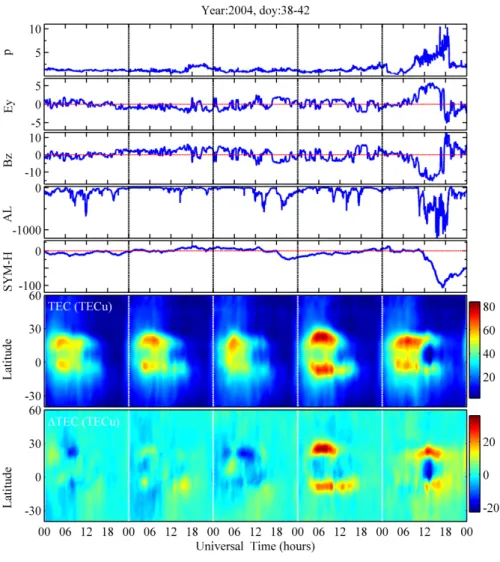
Fig. 1. Solar wind pressure (p), IEFEy, and IMFBzmeasured by the ACE satellite, AL and SYM-H indices, and total electron content
(TEC) measured along 120◦E longitude and the deviations (1TEC) from the median TEC values on 7–11 February (days 38–42) 2004.
The median values are evaluated from the 31-day observations centered on 10 February, 2004. The ionospheric TEC were enhanced at low latitudes in both hemispheres on 10 February 2004.
At the same time, GIMs for ionospheric TEC have been routinely produced at JPL since 1998 using GPS data col-lected from the IGS worldwide GPS network (e.g. Mannucci et al., 1998; Iijima et al., 1999). A GIM provides a snap-shot of TEC for a universal time interval, and such maps are produced continuously through a day. A version of GIMs with temporal resolution of 2 h is archived at the website ftp://cddisa.gsfc.nasa.gov/gps/products/ionex/. In terms of the snapshots of TEC as a function of longitude (in degrees), latitude (in degrees) and universal time (UT in hours), we can determine the longitudinal and latitudinal structure of the ionospheric signature during these events.
3 Results
3.1 The 10 February (day 41) 2004 event
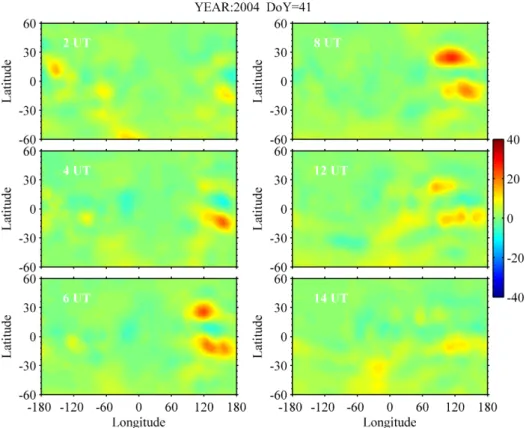
Fig. 2. The deviations (1TEC) from the median values of JPL GIM total electron content (TEC) as a function of longitude and latitude at six universal times on 10 February (day 41), 2004. The median values are evaluated from the 31-day observations centered on 10 February 2004.
following figures no time-shift correction was made inp, IEF
Ey, and IMFBzto account for the propagation time. SYM-H (Iyemori and Rao, 1996) has a time resolution of 1 min, essentially a higher-resolution version ofDst. A remarkable feature in Fig. 1 is the onset of a storm on 7–11 February 2004. The preceding days (7–9 February) were geomagneti-cally quiet, except for a weak depression in the SYM-H index on 9 February with minimum values not exceeding−27 nT. This disturbance is too small to be regarded as a storm, ac-cording to the magnetic storm classification. However, as indicated by the AL index, weak to moderate bursts, which are possibly related to substorms, are documented at high lat-itudes due to the IMFBzsouthward turnings.
The bottom two panels in Fig. 1 show the regional TEC values and the corresponding deviations1TEC along 120◦E during 7–11 February 2004. Here 1TEC=(TEC−TECm) are the absolute deviations of TEC from the median values TECm, which are evaluated from the 31-day observations centered on 10 February 2004. The TEC enhancements are described in terms of the deviations of TEC (1TEC) from the reference level. As seen from the TEC contour, the equa-torial ionization anomaly (EIA) is well developed and inten-sified at local noon on 10 February 2004. Two humps appear in the TEC maps. The1TEC is augmented at latitudes of the north and south EIA crests, with maximum positive
val-ues larger than 30 TECu (TEC unit, in 1016electrons/m2). The main feature of this enhancement event is quite similar to those reported in Liu et al. (2008). After the shock wave and southward IMFBzapproaching the Earth, the 11 Febru-ary 2004 storm started, accompanied by huge disturbances in the ionosphere.
In order to determine the latitudinal and longitudinal cov-erage of the TEC enhancement, deviations (1TEC) from the median values are calculated from global JPL GIMs. Fig-ure 2 plots the global1TEC as a function of longitude and latitude at selected six universal times (02:00, 04:00, 06:00, 08:00, 12:00 and 14:00 UT) on 10 February (day 41) 2004. The corresponding median values are evaluated from the 31-day global GIMs centered on 10 February 2004.
Libo Liu et al.: Prestorm low-latitude TEC enhancements 897
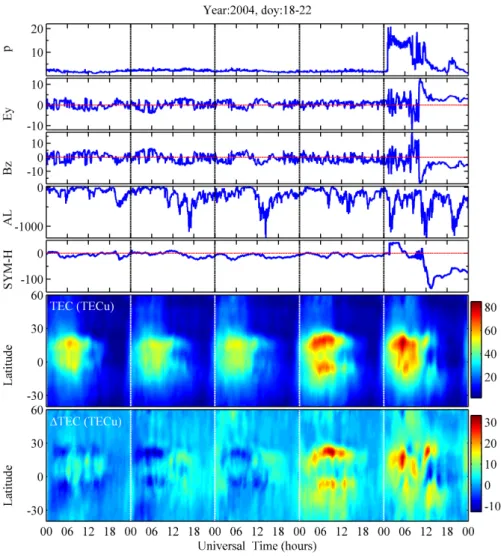
Fig. 3. Same as Fig. 1, but for 18–22 January (days 18–22) 2004. TEC were enhanced at low latitudes in both hemispheres on 21 January
2004.
and latitudinal coverage of the enhanced1TEC derived from JPL GIM is generally consistent with that of the regional TEC, as shown in the bottom panel of Fig. 1.
3.2 The 21 January 2004 event
The second enhancement event occurred on 21 January 2004, followed by a storm on 22 January 2004. Similar to Fig. 1, Fig. 3 plots the ACE satellite measured solar wind dynamic pressurep, IEFEyand IMFBz, as well as AL and SYM-H indices on 18–22 January 2004. As demonstrated in Fig. 3, a storm started on 22 January 2004. The preceding four days (18–21 January) were geomagnetically quiet, according to SYM-H index. In contrast, it is interesting that the situa-tion at high latitudes is dynamic; geomagnetic bursts are in progress on 19 and 20 January, as indicated by AL index. So-lar winds and huge IMF disturbances were approaching the Earth at the beginning hours of 22 January, which caused a geomagnetic storm with a SSC at 1.58 UT.
The bottom two panels in Fig. 3 show values of the re-gional TEC and1TEC along 120◦E during 18–22 January 2004. As seen from the bottom two contours in Fig. 3, the EIA is evidently more developed on 21 January 2004 with a stronger northern/winter EIA crest. Previous observations re-veal that the plasma density in the F-layer is higher in winter than in summer, a feature known as a winter anomaly. Dur-ing the enhancement the northern EIA crest moves to higher latitudes, compared to the preceding quiet days. The most marked enhancement of TEC appears in the local afternoon. 3.3 The 4 March 2001 event
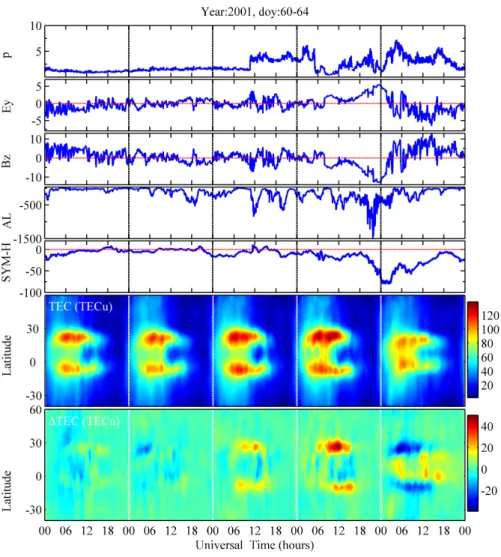
Fig. 4. Same as Fig. 1, but for 1–5 March (days 60–64) 2001. TEC were enhanced at low latitudes in both hemispheres on 4 March 2001.
enhancement event was over. A difference in this event from the above two events is that a shock wave was approaching the Earth around 12:00 UT on 3 March, as indicated by solar wind dynamic pressurep(top panel of Fig. 4). As a result, it is interesting that the prestorm AL index is quite dynamic, although its values are not very high, while the SYM-H index is low. This is a case of the so-called HILDCAA (High In-tensity, Long Duration, Continuous Auroral Activity), which appears when the Earth passes through the so-called Corotat-ing Interaction Regions (CIR); more about this kind of phe-nomena can be found in Tsurutani and Gonzalez (1997).
The bottom two panels in Fig. 4 show the regional TEC and1TEC along 120◦E during 1–5 March 2001. As is evi-dent, the EIA becomes stronger on 3 March and more signifi-cant on 4 March. The latitudes of the regional TEC enhance-ment are again located at the south and north EIA crests. The most marked enhancements of TEC also appear at intervals from local afternoon to evening.
Figure 5 plots the global 1TEC constructed from JPL GIMs as a function of longitude and latitude at selected
six universal times (05:00, 07:00, 09:00, 13:00, 15:00 and 19:00 UT) on 4 March 2001. The global1TEC maps illus-trate that the unusual enhancement can be detected from JPL GIMs at intervals from 09:00 UT to 15:00 UT. The 4 March 2001 TEC enhancement is also a regional event. However, the situation of global TEC is quite different from the re-gional result (the bottom panel of Fig. 4). The enhancement in JPL global TEC is clustered around the northern EIA crest latitudes in a narrow longitudinal band centered at a longi-tude around 120◦E. An enhancement signature cannot be easily found in the Southern Hemisphere. In contrast, the en-hancement in the regional TEC appears at both hemispheres, although the southern one is relatively weaker. The differ-ences are possibly due to many more GPS receivers in the Asia/Australia sector being included in constructing the re-gional TEC data than the JPL GIM TEC.
Libo Liu et al.: Prestorm low-latitude TEC enhancements 899
Fig. 5. Same as Fig. 2, but for the event on 4 March 2001. The median values are evaluated from the 31-day observations centered on 4
March 2001.
in the topside ionosphere, we check the DMSP F13 total ion concentrations (Ni) observations. Fortunately, during the 4 March 2001 event DMSP F13 passed over the TEC en-hancement regions which were illustrated in Figs. 4 and 5. The left panel of Fig. 6 demonstrates the trajectories of se-lected DMSP F13 passes on 3 March 2001 (solid curve) and 4 March 2001 (dotted curve), and the right panel forNi dur-ing the F13 passes shown in the left panel. Leavdur-ing aside the plasma irregularity structures (Ni spikes in the right panel), an obvious feature of Fig. 6 is that the values ofNiat 840 km altitude in the TEC enhanced regions are considerably higher on 4 March (doy=63) than those on 3 March (doy=62). Thus, enhancement in plasma density also occurred in the topside ionosphere during this event. It also provides evidence of the existence of enhanced electric fields (Zhao et al., 2005). Another interesting feature is that the magnitude of theNi el-evation tends to be more pronounced in the Northern Hemi-sphere, compared to that in the Southern HemiHemi-sphere, which is consistent with the result of our regional TEC data (Fig. 4). However, the overall levelNi is elevated over the whole lat-itude range, and not just limited in the EIA crest latlat-itudes as is the regional TEC.
4 Discussion
Both Bureˇsov´a and Laˇstoviˇcka (2007) and Liu et al. (2008) demonstrated that the solar flare effects are generally not the
Fig. 6. (Left) Trajectories of DMSP F13 spacecraft during the 3
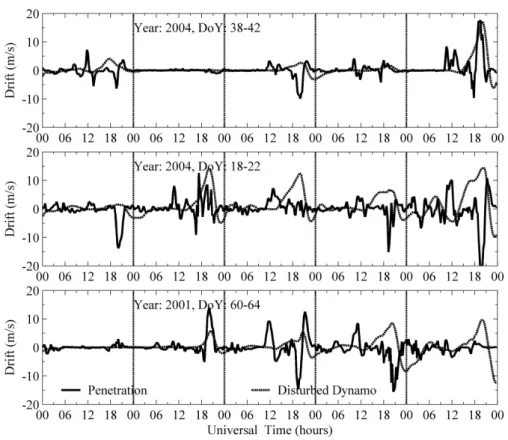
Fig. 7. The prompt penetration vertical drifts and perturbed vertical drift components due to disturbed wind circulation dynamo effects
during the periods of those three events. These vertical drifts were predicted by the storm-time drift model of Fejer and Scherliess (1997).
main driver for these unusual enhancements; thus, we will no longer discuss the solar flare effects. Based on the fact that there were better developed EIA presented in those events, Liu et al. (2008) suggested that the enhanced zonal electric field or vertical plasma drift is a likely cause for low-latitude unusual enhancements.
It is well known that the equatorial electric field plays an important role in the variations of the equatorial and low lat-itude F2 layer ionosphere under both geomagnetically quiet and active conditions (Abdu, 1997; Fejer, 2002; Huang et al., 2006; Huba et al., 2005; Maruyama et al., 2007). Enhanced equatorial electric fields during storms have been reported (e.g. Huang et al., 2005; Lin et al., 2005; Tsurutani et al., 2004; Zhao et al., 2005), which may induce the so-called super-fountain effect in the equatorial ionosphere. Many in-vestigations revealed that, the perturbations in the equatorial plasma drift are due to the combined effects of direct penetra-tion and longer lasting ionospheric disturbed dynamo electric fields (Fejer, 2002; Fejer and Scherliess, 1997; Tsurutani et al., 2004). Prompt penetration electric fields occur during periods of rapid and large IMF driven changes. Thus, so-lar wind and magnetospheric driving mechanisms often di-rectly affect the ionosphere at low latitude, even at middle latitudes (Huang et al., 2002, 2006). Southward turnings of IMFBzmark enhanced magnetospheric convection and
pro-duce a dawn-dusk electric field in the equatorial ionosphere. The y-component of the solar wind electric field can be di-rectly mapped to the equatorial ionosphere, giving rise to a penetration electric field and a vertical drift (Kelley et al., 2003). The penetration drifts have typical lifetimes of about an hour.
Another kind of disturbed electric field is associated with storm-time thermospheric circulation, driven by enhanced energy deposition into the high-latitude ionosphere (e.g. Abdu, 1997). According to the results of empirical and the-oretical models, the ionospheric disturbance dynamo electric fields at low latitude are westward by daytime and eastward at night, with longer time delays of about 20–30 h (Scherliess and Fejer, 1997).
Libo Liu et al.: Prestorm low-latitude TEC enhancements 901 Strong electron density enhancements are frequently
ob-served during geomagnetic storms (Kelley et al., 2003; tiev et al., 2006, 2007; Lin et al., 2005; Liu et al., 2004). Ku-tiev et al. (2006, 2007) observed strong TEC enhancements at the end of the recovery phase of geomagnetic storms. Since the ionospheric disturbances caused by geomagnetic activ-ities usually last 1–3 days, Kutiev et al. (2006, 2007) at-tributed the enhancements of TEC during some events to the “post storm effects”. Although SYM-H indices are low dur-ing these events (see Figs. 1, 3, and 5), continuous heatdur-ing of the auroral thermosphere by electrojet current and particle precipitations are possible when geomagnetic activity in the high latitude ionosphere is active. Both AL indices and the predicted vertical drifts (Fig. 7) show that the atmosphere is disturbed 6 to 8 h ahead of TEC enhancing on 10 February 2004. For the 21 January 2004 and 4 March 2001 events, the predicted vertical drifts (Fig. 7) are disturbed in the preced-ing two days as well as durpreced-ing the enhancement periods.
Global maps of TEC deviations during the selected events (Figs. 2 and 5) clearly show that enhanced TEC structures are confined around 120◦E longitude. It is interesting to note that some events of enhanced TEC during storms were reported to be confined in regions in the literature (for ex-ample, Kelley et al., 2004). This kind of enhancement was called a storm-enhanced density (SED), which is regularly observed in the pre-midnight sub-auroral ionosphere (Kelley et al., 2004). Probably, the TEC enhancement in the equato-rial anomaly crests is strongly local-time dependent, which deserves further investigation.
In contrast, there are also events (e.g. the 6 January 1998 event) with quasi-periodic TEC enhancements not related to geomagnetic activity and associated probably with planetary wave type oscillations. Planetary wave effects in the F2-layer have been reported previously (e.g. Altadill and Apostolov, 2003; Xiong et al., 2006). Although planetary waves can-not propagate directly upwards to the altitude of the F-layer, due to the viscosity effects, they can affect the F-region pro-cesses via modulating ionospheric E-layer dynamo electric fields and mapping to higher altitudes along geomagnetic field lines. This extremely large day-to-day variability under such a long period of low geomagnetic activity suggests that this kind of enhancement event should not be caused by the effects of auroral activities/ magnetospheric origins, rather possibly by the atmospheric origin.
However, at present, we have difficulties in separating sources associated with auroral/magnetospheric activities from those in the atmosphere itself or from below. The his-torical state of geomagnetic activity makes the question more complicated. To say the least, if the low-latitude enhance-ments can be attributed to enhanced zonal electric fields or vertical plasma drifts, the latitudinal extent of positive1TEC can be explained. However, we still have difficulty to an-swer why these unusual TEC enhancements only appear in the narrow longitudinal band.
5 Summary
To reveal the behaviors of unusual ionospheric enhance-ments at low latitudes during low magnetic activity before the storms, we analyzed selected low-latitude enhancement events by using TEC measurements from regional and global GPS receivers. The main results of this investigation may be listed as follows:
Strong low-latitude enhancements under a long period of low geomagnetic activity before the storms are simultane-ously presented in regional TEC and JPL GIMs. These en-hancements are regional events, having longitudinal and lat-itudinal extent. The regions of TEC enhancements are con-fined at narrow longitude ranges with centers at around lon-gitude 120◦E. The latitudinal belts of the maxima of en-hancements located around the northern and southern EIA crests, are consistent with those events presented by Liu et al. (2008). Besides, both data sources show general similar features during these events; differences are also presented, possibly due to many more GPS receivers being included in constructing the regional TEC maps in the Asia/Australia sector.
The 10 February 2004, 21 January 2004, and 4 March 2001 events are possibly the effects associated with auro-ral/magnetospheric activities, according to the conditions of solar wind, interplanetary electric and magnetic fields ob-served by ACE satellite, as well as AL and SYM-H indices. There are also quasi-periodic enhancement events (e.g. the 6 January 1998 event, figure not shown here), not related to geomagnetic activity and associated probably with planetary wave type oscillations. However, we still have difficulties in separating the possible sources. More coordinate observa-tions are requested to identify the contribuobserva-tions from differ-ent sources.
Acknowledgements. The authors thank two referees for valuable
suggestions. The SYM-H and AL indices are downloaded from http://swdcwww.kugi.kyoto-u.ac.jp/. Ionospheric data are provided from http://cddisa.gsfc.nasa.gov/. The ACE solar wind data are provided by CEDAR Data System from the Principal Investigator D. J. McComas of Southwest Research Institute. The DMSP data are provided by the Center for Space Sciences at University of Texas at Dallas and the US Air Force. The code for the empirical model for storm time equatorial zonal electric fields was kindly provided by L. Scherliess. This research was supported by National Natu-ral Science Foundation of China (40725014, 40674090, 40134020) and National Important Basic Research Project (2006CB806306).
References
Abdu, M. A.: Major phenomena of the equatorial ionosphere under disturbed conditions, J. Atmos. Sol.-Terr. Phy., 59, 1505–1519, 1997.
Altadill, D. and Apostolov, E. M.: Time and scale size of plane-tary wave signatures in the ionospheric F region: Role of the ge-omagnetic activity and mesosphere/lower thermosphere winds, J. Geophys. Res., 108(A11), 1403, doi:10.1029/2003JA010015, 2003.
Araujo-Pradere, E. A., Fuller-Rowell, T. J., and Bilitza, D.: Time Empirical Ionospheric Correction Model (STORM) response in IRI2000 and challenges for empirical modeling in the future, Ra-dio Sci., 39(1), RS1S24, doi:10.1029/2002RS002805, 2004. Blagoveshchensky, D. V., MacDougall, J. W., and Piatkova, A.
V.: Ionospheric effects preceding the October 2003 Halloween storm, J. Atmos. Sol.-Terr. Phy., 68, 821–831, 2006.
Buonsanto, M. J.: Ionospheric storms – a review, Space Sci. Rev., 88, 563–601, 1999.
Bureˇsov´a, D. and Laˇstoviˇcka, J.: Pre-storm enhancements of foF2 above Europe, Adv. Space Res., 39(8), 1298–1303, 2007. Bureˇsov´a, D. and Laˇstoviˇcka, J.: Pre-storm electron density
en-hancements at middle latitudes, J. Atmos. Sol.-Terr. Phy., 70, doi:10.1016/j.jastp.2008.01.014, in press, 2008.
Danilov, A. D.: F2-region response to geomagnetic disturbances, J. Atmos.-Sol. Terr. Phy., 63, 441–449, 2001.
Fejer, B. G.: Low latitude ionospheric electrodynamics, J. Atmos.-Sol. Terr. Phy., 64, 1401–1408, 2002.
Fejer, B. G. and Scherliess, L.: Empirical models of storm time equatorial zonal electric fields, J. Geophys.Res., 102(A11), 24 047–24 056, 1997.
Forbes, J. M., Palo, S. E., and Zhang, X. L.: Variability of the iono-sphere, J. Atmos.-Sol. Terr. Phy., 62(8), 685–693, 2000. Huang, C.-S., Foster, J. C., and Erickson, P. J.: Effects of solar
wind variations on the midlatitude ionosphere, J. Geophy. Res., 107(A8), 1192, doi:10.1029/2001JA009025, 2002.
Huang, C.-S., Foster, J. C., and Kelley, M. C.: Long-duration pene-tration of the interplanetary electric field to the low-latitude iono-sphere during the main phase of magnetic storms, J. Geophys. Res., 110, A11309, doi:10.1029/2005JA011202, 2005.
Huang, C., Sazykin, S., Spiro, R., Goldstein, J., Crowley, G., and Ruohoniemi, J. M.: Storm-Time Penetration Elec-tric Fields and Their Effects, Eos Trans. AGU, 87(13), 131, doi:10.1029/2006EO130005, 2006.
Huba, J. D., Joyce, G., Sazykin, S., Wolf, R., and Spiro, R.: Sim-ulation study of penetration electric field effects on the low-to mid-latitude ionosphere, Geophys. Res. Lett., 32, L23101, doi:10.1029/2005GL024162, 2005.
Iijima, B. A., Harris, I. L., Ho, C. M., Lindqwister, U. J., Mannucci, A. J., Pi, X., Reyes, M. J., Sparks, L. C., and Wilson, B. D.: Au-tomated daily process for global ionospheric total electron con-tent maps and satellite ocean altimeter ionospheric calibration based on Global Positioning System data, J. Atmos. Sol.-Terr. Phy., 61, 1205–1218, 1999.
Iyemori, T. and Rao, D. R.: Decay of theDst field of geomagnetic
disturbance after substorm onset and its implication to storm-substorm relation, Ann. Geophys., 14, 608–618, 1996,
http://www.ann-geophys.net/14/608/1996/.
Kane, R. P.: Global evolution of F2-region storms, J. Atmos. Terr. Phys., 35, 1953–1966, 1973.
Kane, R. P.: Ionospheric foF2 anomalies during some intense geo-magnetic storms, Ann. Geophs., 23, 2487–2499, 2005.
Kelley, M. C., Makela, J. J., Chau, J. L., and Nicolls, M. J.: Penetration of the solar wind electric field into the magneto-sphere/ionosphere system, Geophys. Res. Lett., 30(4), 1158, doi:10.1029/2002GL016321, 2003.
Kelley, M. C., Vlasov, M. N., Foster J. C., and Coster, A. J.: A quantitative explanation for the phenomenon known as storm-enhanced density, Geophys. Res. Lett., 31, L19809, doi:10.1029/2004GL020875, 2004.
Kutiev, I. and Muhtarov, P.: Modeling of midlatitude F region response to geomagnetic activity, J. Geophys. Res., 106(A8), 15 501–15 509, 2001.
Kutiev, I., Otsuka, Y., Saito, A., and Watanabe, S.: GPS observa-tions of post-storm TEC enhancements at low latitudes, Earth Planets Space, 58, 1479–1486, 2006.
Kutiev, I., Otsuka, Y., Saito, A., and Watanabe, S.: Low-latitude total electron content enhancement at low geomagnetic ac-tivity observed over Japan, J. Geophys. Res., 112, A07306, doi:10.1029/2007JA012385, 2007.
Laˇstoviˇcka, J.: Forcing of the ionosphere by waves from below, J. Atmos. Sol.-Terr. Phy., 68, 479–497, 2006.
Laˇstoviˇcka, J. and ˇSauli, P.: Are planetary wave type oscillations in the F2 region caused by planetary wave modulation of upward propagating tides?, Adv. Space Res., 24(11), 1473–1476, 1999. Lin, C. H., Richmond, A. D., Liu, J. Y., Yeh, H. C., Paxton, L. J.,
Lu, G., Tsai, H. F., and Su, S.-Y.: Large-scale variations of the low-latitude ionosphere during the October–November 2003 su-perstorm: Observational results, J. Geophys. Res., 110, A09S28 doi:10.1029/2004JA010900, 2005.
Liu, L., Wan, W., Ning, B., Yuan, H., and Liu, J.: Low latitude ionospheric effects near longitude 120oE during the great geo-magnetic storm of July 2000, Science in China (A), 45 (Supp.), 148–155, 2002.
Liu, L., Wan, W., Lee, C. C., Ning, B., and Liu, J. Y.: The low lat-itude ionospheric effects of the April 2000 magnetic storm near 120◦E, Earth Planet Space, 56, 607–612, 2004.
Liu, L., Wan, W., Zhang, M.-L., Zhao, B., and Ning, B.: Prestorm enhancements in NmF2 and TEC at low latitudes, J. Geophys. Res., 113, A02311, doi:10.1029/2007JA012832, 2008.
Mannucci, A. J., Wilson, B. D., Yuan, D. N., Ho, C. M., Lindqwis-ter, U. J., and Runge, T. F.: A global mapping technique for GPS-derived ionospheric total electron content measurements, Radio Sci., 33, 565–582, 1998.
Maruyama, N., Sazykin, S. Spiro, R. W., Anderson, D., et al.: Modeling storm-time electrodynamics of the low-latitude ionosphere–thermosphere system: Can long lasting disturbance electric fields be accounted for?, J. Atmos. Sol.-Terr. Phy., 69(10–11), 1182–1199, 2007.
Mendillo, M.: Storms in the ionosphere: Patterns and pro-cesses for total electron content, Rev. Geophys., 44, RG4001, doi:10.1029/2005RG000193, 2006.
Mikhailov, A. V., Depueva, A. Kh., and Yu. Leschinskaya, T.: Morphology of quiet time F2-layer disturbances: High and lower latitudes, Int. J. Geomagn. Aero., 5, GI006, doi:10.1029/2003GI000058, 2004.
Libo Liu et al.: Prestorm low-latitude TEC enhancements 903
1541, 2007a.
Mikhailov, A. V., Depuev, V. H., and Depueva, A. H.: Synchronous
NmF2 and NmE daytime variations as a key to the mechanism
of quiet-time F2-layer disturbances, Ann. Geophs., 25, 483–493, 2007b.
Pr¨olss, G. W.: Ionospheric F-region storms, in: Handbook of at-mospheric electrodynamics, edited by: Volland, H., CRC Press, 195–247, 1995.
Scherliess, L. and Fejer, B. G.: Storm time dependence of equato-rial disturbance dynamo zonal electric fields, J. Geophys. Res., 102(A11), 24 037–24 046, 1997.
Tsurutani, B., Mannucci, A., Iijima, B., et al.: Global day-side ionospheric uplift and enhancement associated with in-terplanetary electric fields, J. Geophys. Res., 109, A08302, doi:10.1029/2003JA010342, 2004.
Tsurutani, B. T. and Gonzalez, W. D.: The interplanetary causes of magnetic storms: A review, in: Magnetic Storms, Geophys. Monogr. Ser., vol. 98, edited by: Tsurutani, B. T., Gonzalez, W. D., Kamide, Y., and Arballo, J. K., pp. 77–89, AGU, Washington, D.C., 1997.
Xiong, J., Wan, W., Ning, B., Liu, L., and Gao, Y.: Planetary wave-type oscillations in the ionosphere and their relationship to mesospheric/lower thermospheric and geomagnetic disturbances at Wuhan (30.61 N, 114.51 E), J. Atmos. Sol.-Terr. Phy., 68, 498– 508, 2006.
Zhao, B., Wan, W., and Liu, L.: Responses of equatorial anomaly to the October–November 2003 superstorms, Ann. Geophys., 23, 693–706, 2005,