..
EPGE
FUNDAÇÃO
GETULIO VARGAS
Escola de Pós-Graduação em
Economia
·"ENTRY MISTAKES
HAPPEN!"
Luís M. B.
CABRAL
(LONDON BUSINESS SCHOOL E
CEPR)
LOCAL
Fundação Getulio Vargas
Praia de Botafogo, 190 - 10° andar - Auditório
DATA
21/08/97
(sa
feira)
HORÁRIO
16:00h
. (00
セ@
,6
lセOQQMNセ@
r
..
,
•
Entry Mistakes Happen!
Luís M. B. Cabral*
London Business School and CEP R
First draft: January 1997; This draft: June 1997
Abstract
Frequently, aspiring entrants have only limited infonnation about their potential rivaIs' entry decisions. As a result, the outcome of the entry game may be that more firms enter than the market can sustain; or, at least, that unnecessary entry investments are made: entry mistakes may happen. We consider two models of non-coordinated entry. In these models, entry mistakes occur because of lags in observing rivaIs' entry decisions (grab-the-dollar entry) or because entry investments take time (war-of-attrition entry). The widebody aircraft industry in the late sixties is presented as supporting evidence for the models' assumptions. We also discuss the welfare implications of non-coordinated free entry. Both models predict that entry incentives are excessive (resp. insufficient) when duopoly profits are high (resp. low). However, if entry costs are high, entry incentives are excessive under war-of-attrition entry but insufficient under grab-the-dollar entry.
..
,
•
1
Introduction
Much of the Industrial Organization literature on entry assumes that firms' de-cisions are sequential, i.e., firm i decides whether to enter after observing firm
i - I 's decision. Examples include mo deIs of firm location (Prescott and Viss-cher (1977)), capacity choice (Eaton and Ware (1987)), and technology choice
(McLean and Riordan (1989)). But arbitrating an order of entry, as sequential-entry mo deIs implicitly do, amounts to assuming a "considerable feat of coordi-nation" between potential entrants (Farrell (1987)). In most real-world examples, firms h ave , at most, limited information about their potential rivaIs' entry deci-sions. As a result, the outcome of the entry game may be that more firms enter
than the market can sustain: entry mistakes may happen.1
An alternative framework that accounts for the possibility of entry mistakes is the assumption that firms make their entry decisions simultaneously and that en-try is an instantaneous decision. It can be shown that the symmetric equilibrium of this alternative game involves firms playing mixed-strategies, entering with
probability p, O
<
p<
1. Since firms randomize independently, entry mistakes (excessive or insufficient entry) occur with positive probability.Still another alternative is to assume that entry investments are made
grad-ually: entry only occurs when all of the entry cost is paid; and firms can stop investing at any time during the processo It can be shown that the symmetric equilibrium of this alterna tive game implies that with positive probability two firms will enter; and that, with probability one, total entry investment is greater than necessary for one firm to enter. Again, entry mistakes occur, now with probability one.
If entry costs are low or if they are not sunk, then entry mistakes are not of great importance. In particular, Dixit and Shapiro (1986) show that there exists a
..
I
•
dynamic equilibrium of the simultaneous, instantaneous entry game in which, by means of successive entry and exit, the number of active firms converges to n, the equilibrium number of active firms in the sequential-entry game. If entry costs are significant and sunk, however, then entry mistakes are equally significant, both from the perspective of firm profitability and from the perspective of social welfare.2
This paper addresses several of these issues.
In
Section 2, we discuss an exam-pIe which suggests that the paradigm of simultaneous entry is more reasonablethan that of sequential entry.3 Moreover, we argue that the example fits the
assumptions of the theoretical mo deIs to be presented later, namely the assump-tions that: (i) the market grows rapidly,
(ii)
observation lags are long, (iii) entrycosts are large and sunk, and (iv) entry investments take time. Section 3 intro-duces the first paradigm of simultaneous (or non-coordinated) entry, based on
the "grab-the-dollar" game. We argue that discrete time is a good reduced form of continuous time with observation lags. Moreover, the probability of an entry mistake is greter the longer observation lags are or the faster the market grows.
Section 4 presents an alternative model of simultaneous entry, based on the war-of-attrition game. This game assumes that entry investments take time to complete. Under the symmetric equilibrium of this model, the probability of a duopoly is lower than under grab-the-dollar entry. However, the expected value
of entry mistakes is greater. The reason for this reversal is that, under war-of-attrition entry, one has to include the costs of firms that drop out before completing their entry investment.
Section 5 discusses the welfare implications of free entry when firms cannot coordinate their decisions. It shows that, depending on various parameters, free
2Cabral (1993) generalizes Dixit and Shapiro's (1986) analysis, showing that, when sunk costs are significant, the number of active firms may converge to different values of n. More generally, if payoff functions have persistent effects ("experience advantages," of which sunk costs are a particular case) then entry mistakes have a permanent effect on market structure.
I
•
entry may induce either excessive or insufficient entry. Specifically, both models of simultaneous entry predict that entry incentives are excessive (resp. insufficient)
when duopoly profits are high (resp. low). However, if entry costs are high, entry incentives are excessive under war-of-attrition entry but insufficient under grab-the-dollar entry.
Section 6 concludes the paper.
2
Wide-bodyaircraft: The Lockheed-McDonnell
Douglas story
One of the most fascinating events in the business history of aircraft manufac-turing occurred during the second half of the sixties, the time when wide-body jet-liners first appeared.4
In
1965-66, Boeing and PanAm set up an agreement whereby PanAm wouldsecure the first order of a new large aircraft to be developed by Boeing, the B-747. A few days after the companies signed a formal contract, F. Kolk from American Airlines sent Boeing and the other manufacturers a proposal for a new aircraft of larger size than the existing ones but smaller than the proposed 747. With Boeing busy with the development of the 747, this left McDonnell Douglas and Lockheed as the potential contendors to enter the market "created" by AAs
proposal.5
Not long after Kolk's proposal, the V.S. government announced it was drop-ping its plans to support the development of the supersonic transport (SST) project.6 Lockheed, which had invested heavily into the SST project, decided to
transfer that effort, and the staff involved in it, to working on Kolk's proposal. The credibility of Lockheed's decision was strengthened by hiring one of Boeing's senior engineers (Lockheed experience in civil aeronautics was limited). Despite Lockheed's move and the perception that the market would likely not hold two
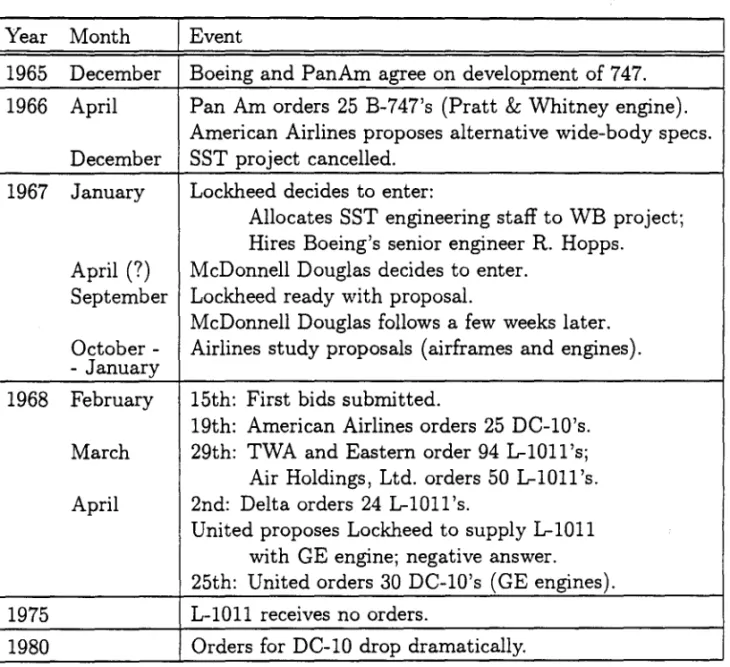
4Table 1 presents a summary of the main chronological events surrounding this process.
5 Although the initiative carne from American Airlines, several other airlines agreed that the
747 was too big for their needs.
I
•
Table 1: Wide-body aircraft. Chronology of main events surrounding the Mc-Donnell Douglas and Lockheed entry process in the late sixties.
I
Year MonthI
Event1965 December Boeing and PanAm agree on development of 747. 1966 April Pan Am orders 25 B-747's (Pratt
&
Whitney engine).American Airlines proposes altemative wide-body specs. December SST project cancelled.
1967 January Lockheed decides to enter:
Allocates SST engineering staff to WB project; Hires Boeing's senior engineer R. Hopps. April
(?)
McDonnell Douglas decides to enter.September Lockheed ready with proposal.
McDonnell Douglas follows a few weeks later. October - Airlines study proposals (airframes and engines). - January
1968 February 15th: First bids submitted.
19th: American Airlines orders 25 DC-10's.
March 29th: TWA and Eastem order 94 1-1011'5;
Air Holdings, Ltd. orders 50 1-1011'5. April 2nd: Delta orders 24 1-1011 's.
United proposes Lockheed to supply 1-1011 with GE engine; negative answer. 25th: United orders 30 DC-10's (GE engines).
1975 L-1011 receives no orders.
1980 Orders for DC-10 drop dramatically.
firms, McDonnell Douglas decided, three months later, to enter the race with its
own designo
The first seriously credible signal that the companies were committed to the market was received in September 1967, when specific design proposals were sent to the main airlines. The proposals appeared within a few weeks difference: McDonnell Douglas had closed the initial gap by developing the first draft of blueprints in six months (as opposed to Lockheed's nine months). From then on, the game was a war of attrition as much as it had been a preemption game up
I
•
Between October 1967 and January 1968, the main airlines studied the pro-posaIs. The aircraft designs were (unsurprisingly) similar in their main character-istics (lenghth, width, wing span, capacity, range speed, engine thrust, seat-mile
costs). From an engineering point of view, Lockheed was generalIy preferred; but most airline executives had greater trust in McDonnell Douglas as a com-pany: there was no clear winner. The process was further complicated by the
general disagreement regarding the choice of engine manufacturers: some airlines preferred a GE engine, whereas others favored Rolls-Royce.
The first bids were submitted in mid-February 1968. The bids were reportedly within two hundred thousand dollars of each other. On February 19, American Airlines announced the first order-to McDonnell Douglas. Despite this first
setback, Lockheed did dot give up; and, by means of some aggressive marketing, it managed to secure the next three large orders. The pressure was now on McDonnell Douglas to leave the market while it was time to do it. In fact, their contract with American Airlines gave McDonnell Douglas the option of cancelling the order if within ninety days two other airlines hadn't ordered the De-lO.
Attention was now centered around United Airlines, the next airline expected to place an order. Although alI previous orders had specified RolIs-Royce engines, United preferred the GE engine. A proposal was made to Lockheed for supplying the combination L-lOll/GE. Lockheed's response was negative, perhaps because it sensed it had won the race and gained sufficient bargaining power, as no airline would want to place an order on McDonnell Douglas' nearly orphaned designo
As it turned out, on 25 April1968 United placed an order with McDonnell Dou-glas, thus cementing the market into a duopoly that would eventualIy lead both Lockheed and McDonnelI Douglas to huge losses.7
7 After a good start in terms of orders, the L-1011 suffered from production delays caused by
the bankrupcy of Rolls Royce, its engine supplier. As a result, many potential buyers switched to the B-747 and DC-lO. Lockheed received no orders for the L-1011 in 1975 and very few in the ensuing years. It finally discontinued production in 1981 (7).
•
•
• Discussion. WhiIe the Lockheed-McDonnell Douglas duopoly was
cer-tainIy the resuIt of an entry mistake, one may wonder whether its source was Iack of entry coordination or simpIy an incorrect forecast of market profitabiIity
(demand growth, intensity of competition). In fact, Newhouse (1988) claims that by the mid-sixties "nearly everyone was unreservedIy optimistic, or professed to be" (p. 11). However, he Iater adds that "none of the suppliers felt that the market was Iarge enough to sustain both airpIanes" (p. 149).8 An aIternative
ex-pIanation to a coordination mistake or a calculation mistake is that the firms held opposite priors with respect to their relative probability of success in the market. However, by January 1968, it was common knowledge to both airlines and man-ufacturers that the formers' preferences were spIit between the two designs, i.e., that there was no clear winner.
Whether or not there was a coordination mistake, the example seems to fit
some of the assumptions of our theoretical mo deIs presented in the next two sections. First, there was a very rapid increase in the value of entering the market.
In particular, a discontinuous increase occurred in April 1966, when American Airlines announced its proposal. Second, information lags seem relevant. By the time Lockheed presented the result of its initial efforts -the first credible signal of its commitment to entry-, McDonnell Douglas had already been working on the project for several months. Even if we assume that information lags are not very important, the example clearly shows that it takes time for firms to enter. Lockheed spent 9 months, and McDonnell Douglas 6 months, before it produced a first proposal to show the airlines. As we will see in the following two sections, these assumptions impIy that entry mistakes occur with positive probability.
Finally, aircraft manufacturing is an industry where entry costs are indeed significant in size and sunk in nature. It is difRcult to find good estimates for the cost of developing a new aircraft, but the order of magnitude is billions of dollars (compare with the price of an individual aircraft, something in the order of 15
million dollars). Sunkness of the development costs results from the specificity of most of the design work.9 ,1O
3
Entry as a grab-the-dollar game
The grab-the-dollar game was first proposed by Gilbert and Stiglitz (1979) as a stylized model of non-coordinated entry into a new market. Suppose there are two potential entrants into a natural monopoly.l1 The value of the new market, in case of monopoly, is 2. If two firms enter, then profits are zero.12 Assuming a
sunk entry cost of 1, then an entrant gets a net payoff of 1, if it is the only one
to "grab the dollar," or -1, if two firm simultaneously enter. Entry can occur in any period t = 1,2, ....
It can be shown that the uni que symmetric equilibrium of this game consists of firms entering with probability 1/2 in each period if no firm has entered in the past (and entering with probability zero if the rival firm entered in the past). In this equilibrium, the probability that each firm becomes a monopolist is 1/3.
The probability that the a duopoly emerges (an entry mistake) is also 1/3. While this model is consistent with the possibility of two rational firms enter-ing into a merket with enough room for just one, several objections can be made to its assumptions and outcomes. First, the equilibrium features mixed-strategies. The idea of firms randomizing their decisions, especially important decisions as entering the market, seems very unplausible. Second, the model seems very ar-tificial in assuming that time is discrete and the payoff from entering the market is constant in time.
9 As it happened, Lockheed applied some of the technology developed in the SST project to
the design of the L-lOll: not all design costs are completely sunk.
lOOne objection that could be made to the claim the model applies to the example is that, in the model, potential entrants are symmetric, whereas in reality there were important differences between the Lockheed and McDonnell Douglas. In fact, the qualitative nature of the results does not depend on the assumption of symmetry, even though the simplicity of its solution does.
11 By natural monopoly we mean a market where discounted duopoly profits, net of entry
costs, are negative.
12 Assume that duopoly variable profits do not cover fixed costs. Then, if both firms enter, a
The second of these objections is dealt with in the next subsection. The first one has been addressed by Harsanyi (1974), in a general result of which the grab-the-dollar game is a particular case. Consider the following simple
incomplete-information extension of the grab-the-dollar game: the cost of entering the market
can be 1
+
E or 1-E, each with probability 1/2; each firm knows its own cost butnot the other firm's cost; the prior distribution is common knowledge.
A natural Bayesian equilibrium of this incomplete information game is for each firm to enter if and only if its cost is low, i.e., l-E. In the play of this equilibrium,
firm j's strategy, as seen from firm i's perspective, is undistinguishable from the play of the 50-50 mixed-strategy of the complete information game. Effectively, firm j enters with probability 1/2, even though firm j is playing apure strategy.
The complete-information grab the dollar game is, therefore, an approximation of a more complicated model with asymmetric information about payoffs.13
3.1
Discrete-time as a reduced form
Discrete-time models like the grab-the-dollar game are often thought of as reduced
forms of continuous-time mo deis with an observation lag (e.g., Fudenberg et aI.
1983, Section 4). That is, the possibility that two firms enter "simultaneously" (as in the discrete-time model) should not be taken literally: the idea is that, if it takes À time for player 2 to learn player 1'5 decision, then, if player 1 enters at
time t and player 2 enters at time t
+
ç
<
t+
À, it is, for all practical purposes, as if players had entered simultaneously. The question to ask is, then, how gooda reduced form is a discrete-time mo dei?
In this subsection, we consider a slightly more general version of the grab-the-dollar game. First, we assume that the entry cost is u and that the value of becoming a monopolist is a continuous, strictly increasing function of time,
7r(t),
lower than u up to some t; without further 1055 of generality, we assume that 7r(0) = u. Second, we model the discrete nature of the game by assuming that
13In fact, it can be shown that, as f - O, the pure-strategy equilibrium of the incomplete
•
players can only move at times k€, where k E 7l and €
>
o.
Assume that the "true" model is one in continuous time, and that there is an
information lag of À. That is, all actions up to time t - À are public information; actions in
(t
-
À,t]
are each firm's private information. As before, assume that if one firm enters alone at time t it gets a payoff of 7r(t). If a second firm enterswithin a period of time
ç
<
À, then payoff is zero. 14 We maintain the previous assumptions regardiI:1g7r(.).
Let
Fi(t),
i=
C,D,
be the cumulative probability of entry up to timet
inthe equilibrium of the continuous- and discrete-time games, respectively.15 The following result suggests that the discrete-time model is indeed a good reduced form of the continuous-time model.
Theorem 1 For €
=
2À, FD(k€+
À)=
FC(2kÀ), for all integer k.quilibriumF
Figure ?? depicts the cumulative distributions in the continuous-time and discrete-time games for the particular profit function
7r(t)
= 1 - exp(_t
2 /8), andfor €
=
2, À=
1. The figure illustrates Theorem 1: beginning at t =À, theequilibrium cumulative distributions of the continuous- and discrete-time mo deis
coincide every €.
The intuition for the result is the following. Assume that FD(O)
=
FC(À), as is the case in the figure. Consider firm i's decision of entering at time t = € =2À = 2. First, notice that the payoff from entering the market is the same in both models (because the profit function is the same). Second, the probability
that firm j will enter simulataneously is given by F D(€)/(l - FD(O)) in the discrete-time mo deI. In the continuous-time model, this probability is given by the probability that firm j will have entered between
t
-
À andt
(an event that14This is a simplifying assumption. Normally, we would like to consider the possibility of a firm being a monopolist for a while before the second firm has entered. However, in some circumstances, this may indeed be a reasonable assumption. For example: If a new, natural-monopoly market for wide-body aircraft emerges, customers (airlines) may prefer to wait for À
firm i cannot observe at time
t)
plus the probability that firm j will enter betweent and t
+
À (not having observed firm i's decision). In total, this probability isgi ven by
FC (t
+
À) /(1 -
FC (t
-
À) ) .But then
FD(t
-
c)=
FC(t
-
À) implies thatFD(t)
=
FC(t
+
À), and the complete result follows inductively. In other words, if firm j enters within À time of firm i it is as if it had entered simulataneously. In equilibrium, this probabilitymust be the same as the probability of firm j's entry at time t in the discrete-time game.
In summary, the discrete-time game is a good approximation of the continuous
time game when the length of the discrete grid equals twice the observation lago This corresponds to the possibility of firm j entering without firm i observing it, or, alternatively, of firm i entering without firm j observing it.
3.2
Observation lags and entry mistakes
In the first part of this section, we have established that (a) the grab-the-dollar model implies that entry mistakes occur with positive probability and (b) the
grab the dollar model is a reasonable approximation of a continuous time model with observation lags.
The question we are now interested in addressing is, how do entry mistakes depend on the extent of observation lags and on other parametres of interest. Denote by
pGD
the probability of an entry mistake in the play of the symmetric mixed-strategy equilibrium of the game presented in the previous section (the generalized grab-the-dollar game). The following result shows that entry mistakesare more likely when observation lags are longer. Define p
=
i,
where 7r=
lim
7r(t).
t-+oo
Theorem 2
robMistake
(a)
pGD(c)
<
PGD(2c)
(b) lim
pGD
(c) = Oe-+O
(c) lim
pGD(c)
= 1 - p.Figure ?? illustrates the main ideas of Theorem 2 for the specific case
7r(t)
=2 - exp( -t2). The probabiIity of an entry mistake is increasing in the vaIue of é,
ranging from zero
(é
= O) to セセセ@(é
=00).
For the particular vaIues considered in this exampIe, the maximum vaIue of pGD(é) is 1/3. However, other functionsmight generate different limit vaIues. In fact, if
7r(t)
= a - exp( -t2 ), then the maximum vaIue of pGD(é) ranges from zero (a=
1) to one (a - t00).
In words,the probability of an entry mistake can, in principIe, take any vaIue between zero and one.
The same is not true, however, of the expected value of entry mistakes. Denote by
V
GD the expected vaIue of entry mistakes as a fraction of maximum monopolyprofits, i.e.,
V
GD is equal to pGD, the probability that a second firm will enter,times a, the cost of that second entry, divided by ft; or:
V
GD=
p . pGD. FromTheorem 2, we conclude that VGD is, at most, ーセセーN@ This is maximum when
p = y'2-1, yieIding expected costs that are approximateIy 17% of gross monopoly profits (ft), or 29% of net monopoly profits (ft -
o)
Theorem 2 has a different interpretation in terms of the comparative statics of market growth. Assume that
7r(t;
13)
=
<jJ(f3t).
13
is, therefore, an index of market growth.16 What would happen if the vaIue of13
were to increase two-fold,for exampIe? The probability of duopoly is basically a function of a series of
entry probabilities at each time ké. With the increase in
13,
the first vaIue (afterp(O)
= O) in the new sequence of probabilities would be equal to the secondvaIue in the initial sequence; and the second vaIue in the new sequence would be
equal to the fourth vaIue in the inital sequence; and so forth. But this is exactly what would happen if we were to increase é two-fold. More generally, Theorem 2
applies to changes in
13
equally well as to changes in é.16The idea of market growth should be understood fairly comprehensively: any factor that increases the expected discounted payoff from entering the market as a monopolist increases the value of 7r. American Airlines announcement of the desired specs for a new aircraft would
4
Entry as a war af attritian
The grab-the-dollar game assumes that entry decisions are instantaneous. How-ever, as the example of aircraft manufacturing suggests, entry investments may
take time. In this section, we consider an alternative framework of simultaneous entry which takes this feature into account.
Assume, as in the previous section, that the payoff from being a monopolist is given by
7r(t) , t
being the time of entry, whereas the entry cost is a. We now assume, for simplicity, that there are no observation lags. The main difference between grab-the-dollar entry and war-of-attrition entry is that, in the former,entry investments are instantaneous, whereas in the latter it takes time for the entry investment a to take place. Specifically, assume that entry investments are made at a constant rate of 1 per unit of time, so that it takes a time to complete the necessary initial investment. Assume that firms start investing at time
to,
and, with no further loss of generality, make to=
o.
Denote by 7r=
7r(t'), t'
=
amonopoly profits at the time of completion of the entry investment. We assume that a
<
7rY
There are two important assumptions in this modelo First, the investment rate is assumed constant. A more reasonable alternative is to make total cost a convex function of the investment rate. However, considering industries like
aircraft, it seems reasonable to assume a fixed maximum rate of investment. For example, it is likely that, in the short run, the number of engineers working on the development of a new aricraft cannot be increased.
A potentially more problematic assumption is that both firms start investment at a given date
to.
One possible defense of this assumption is that the cost of the entry investment drops discountinuously at time to from a prohibitively high17 A similar application of the war of attrition to Economics is Fudenberg and Tirole's (1986)
theory of exit. In fact, our model can be interpreted as one in which firms exit from an entry race. Our assumption that a < 7r is similar to Fundenberg-Tirole's assumption that eventually
value to a reasonable one.18 If we make the equilibrium assumption that a firm does not start investing at all if it is starting late with respect to his rival, then the uni que symmetric equilibrium calls for firms to start investing at date to.
If the payoff functions are continuous in time, then the above argument would imply that firms start investing at time time to such that 7r( to
+
0") = 0". However, this is by no means the only possible equilibrium. An alternative equilibriumhypothesis is that, if firm i starts investment at time to, firm j follows immediately after.19 Then there exists a continuum of symmetric equilibria with firms starting
investment at any time t. Moreover, if we introduce a small probability that each firm will never start investing at all, then firms would actually prefer to wait. We thus conclude that there exists no obvious starting date for the symmetric equilibrium. In the remainder of this section, the value to is taken as given.
We begin by deriving the symmetric equilibrium strategies. Let
F(t)
be the probability that a given finn will have dropped out of the entry race by time tgiven the rival has not dropped out. Make the equilibirum hypothesis that firms
are indifferent between any exit time.20 Since dropping out at time zero yields a
payoff of zero, the indifference condition becomes:
F(t)(7r
-
0")+
(1 -
F(t)) (-t)
=
O.
The left-hand side is the expected value for a firm that decides to invest until time
t
even if its rival does not drop out of the market. With probabilityF(t),
the rival will indeed drop out before time t, in which case the firm receives the net payoff 7r - 0". With probability (1 -
F(t)),
the rival will not drop out before18 American Airlines annoucement of the desired specifications for a new aircraft may be an instance of this.
19Suppose firm j enters at time to
+
é. In the ensuing subgame, firm i exits by time t withProbability F.(t)
=
(t)-tO-E (t > to +é), whereas firm j exits by time t with probability• 7r o-+E o-+t- to-E
-FJ· (t)
= ()
t- to t . This solution has the apparent problem that firm j is supposed to exit7r o- -o-+t- o
by time é with positive probability. However, this can be easily solved by modeling continuous
time as the limit of a discrete grid. The same modeling strategy solves the problem of defining the time "imediately after."
20 Just like in the case of mixed-strategies, this indifference can be "purified" by introducing
time t, in which case the firm does drop out, receiving a payoff of -t, the entry cost already sunk by then.
Solving for
F(t),
we getF(t)
_
__
t _
7r-O"+t
Notice that F(O") = ;
<
1, that is, in equilibrium each firm will invest all the way up to O" even if its rival does not drop out of the entry race. Just like in grab-the-dollar entry, entry mistakes (too many entrants) occur with positive probability.Moreover, even if only one firm eventually survives the entry race, the "losing" firm will have incurred, with probability one, strictly positive entry costs. In other words, the expected value of entry mistakes includes the probability of two firms entering (as in the grab-the-dollar entry) plus the expected value of entry investments by the firm that drops out.
Specifically, define the relative expected value of entry mistakes, VWA as the
expected value of entry costs in excess of O" (the minimum entry cost for the entry of one firm), divided by 7r. In the case of grab-the-dollar entry, as we saw in the
previous section, this is simply O" times the probability that a duopoly emerges divided by 7r. In the case of war-of-attrition entry, as we have just argued, one
must also include the costs incurred by firms that drop out of the entry race before they complete the necessary investment for entry. As before, we denote by p the ratio between entry cost O" and monopoly profit 7r.
Theorem 3 Under war-of-attrition entry,
(a) The expected value of entry mistakes as a percentage of monopoly profits is given by
VWA = p(l - p).
In words, the probability of a duopoly is decreasing in the ratio between entry costs and monopoly profits. The expected value of entry mistakes, in
turn, is increasing in that ratio for low values and decreasing for high values. The maximum value of entry mistakes (25% of monopoly profits, or 50% of net monopoly profits) is obtained for p ]セL@ i.e., (J
=
7r/2.This result has an alterantive interpretation in terms of entry times. We
as-sumed entry starting at time
to.
How would the expected value of entry mistakes change if entry were to start at a slightly later date, say, エセ@>
to.
Since7r(t)
is increasing, the value of 7r (monopoly profits at the time firms finish entry invest-ments) is now greater, and p lower. Therefore, delaying the start of the entry race increases the expected value of entry mistakes if and only if p>
1/2; and increases the probability of a duopoly for any value of p .• A comparison of the two models. Having presented two alternative models of simultaneous entry, each based on a different set of assumptions, it is natural to inquire what their relative implications are in terms of the likelihood of entry mistakes. In order to make the two models comparable, we assume that
7r(t)
= 7r in the grab-the-dollar mo deI. (By continuity, the results follow in themore general case with the qualification "if observation lags are long enough.") Then, by comparison of Theorems 2 and 3, it follows that: (a) the probability that a duopoly emerges under grab-the-dollar entry is greater than under
war-of-attrition entry. In fact, one can easily show that (1 -
p)/(l
+
p)
is greater than (1-p)2. However, (b) the expected value of entry mistakes is greater under war-of-attrition entry than under grab-the-dollar entry. In fact, it is immediately apparent thatp(l
-
p)
is greater thanp(l
-
p)/(l
+
p).
Figure ?? illustrates the two parts of the above statement. An alternative
proof of part (a) is instructive: The probability of duopoly under war-of-attrition entry is the square of the probability that a firm will invest all the way up to
(J. In equilibrium, each firm is indifferent between dropping out of the race and
grab-the-dollar entry, a similar reasoning applies in each period. But this implies that the probability of duopoly under war-of-attrition is equal to the probability that a duopoly emerges in the first period of grab-the-dollar entry.
How does the ordering between the two models get reversed when we consider the total expected value of entry mistakes? Clearly the answer is that, while under
grab-the-dollar entry the value of entry mistakes results solely from the possibility of a second firm entering the market, under war-of-attrition entry one must aIs o
consider the interim entry investment made by firms that decide to drop out of
the race before time (J, i.e., before the entry investment is completed.
ompanson
5
Free entry and welfare
What are the social welfare implications of free entry when there can be entry mistakes? Suppose there are two potential entrants, monopoly profits are 7r,
duopoly profits are I (O ::; I ::; 7r /2), and the cost of entry is (J (O ::; (J ::; 7r).
Moreover, let gross social surplus (gross of entry costs) be J.L7r under monopoly
and 1/7r under duopoly. We require J.L = 1/ when I = 7r /2 (perfect collusion with
homogeneous product) and 1/
>
J.L>
1 when I<
7r /2 .• Sequential entry. For comparison, we begin this section by presenting a
result for the sequential-entry, or coordinated-entry, mode!.
Theorem 4 In the coordinated entry model,
(a) For (J
<
7r/2,
there is excess entry if I is large enough.(b) For a given small (J, there is insufficient entry if I is small enough.
enter are excessive. The intuition for that result is that much of the benefits a firm receives from entering an industry correspond to a transfer of profit from the
incumbent firms. This private benefit does not correspond to a social benefit, thus leading to an externality in the direction of excessive entry incentives. Mankiw and Whinston (1986) refer to this as the business stealing effect. Their result corresponds to part (a) of Theorem 4. Part (b) states that the business stealing
effect is not the end of the story. If the entry of a second firm makes competition much more intense, then an opposite externality occurs: even though a second firm would increase social welfare, competition is so intense that the private
benefit from entry does not cover the entry cost. oordEntry Fig
Figure ?? depicts the regions of excessive and insufficient entry in the
(0",
,)
space in the case of a linear oligopoly (linear demand and linear cost functions). Parts (a) and (b) of Theorem 4 can be readily checked. It is also interesting to see that, for extreme values of the entry cost, the equilibrium solution yields the
social welfare second best.
• Grab-the-dollar entry. Let us now consider the case of the simultaneous
entry, beginning with grab-the-dollar entry. The model we are considering is slightly different from the general model presented in Section 3. It is less general in that we assume E --+ 00. On the other hand, it allows for the possibility of
duopoly profits being positive.
Theorem 5 In the non-coordinated entry model,
(a) For a given small
0",
there is excess entry if, is large enough. (b) For a given small0",
there is insufficient entry if, is small enough. (c) There is insufficient entry if O" is large enough.( d) For a given large
0",
there is excess entry if ó is large enough.(resp. part (b)) states that, if duopoly profits are very high (resp. very low) , then there are excessive (resp. insuficient) incentives to enter.
However, there are also important differences. Parts (c) and (d) introduce a set of considerations that are absent from the sequencial-entry model. Part ( c) states that if entry costs are large, then entry incentives are too small. The
intuition for this result is that, from society's viewpoint, the probability of an entry mistake, p2, is very small: entry mistakes are a second-order effect. In fact, since (j is dose to 7r, p is dose to zero. However, for a given firm, conditional on
entering, the probability of an entry mistake is p, a first-order effect. For this reason, the risk of an entry mistake is disproportionally large from a private per-spective, implying a delay effect, in the terminology of Bolton and Farrell (1986): firms are too cautious (too slow) in their entry decision, from the perspective of social welfare.
If the discount factor is very dose to one, however, then time is not a very important factor from a social welfare point of view. As a result, the delay effect is of little importance. The ma in relevant effect, from a social welfare perspective, is the possibility of an entry mistake - the duplication effect, in the terminology of Bolton and Farrell (1986). Firms are too eager to enter, from a social welfare perspecti ve. 21
Figure ?? depicts the regions of excessive and insufficient entry in the ((j, ,)
space in the case of a linear oligopoly (linear demand and linear cost functions). Parts (a) to (c) of Theorem 5 can be readily checked.
ncoordEntry99Fig
Figure ?? also shows that the comparative statics with respect to the value
of (J are "non-monotonic." Specifically, there exist values of I such that, by
increasing (J, we move from a region of insufficient entry to one of excessive entry
and then back to one of insufficient entry. In fact, for high values of 6, this is
true for any low value of I' The idea is that, as the entry cost increases, both the private and the social incentives for entry decrease. However, these marginal benefits do not vary in the same proportion. In fact, they do not vary linearly: as the value of (J reaches very high values and the probability of entry becomes
very small, the social marginal benefit of additional entry becomes very large, thus reversing the effect of excessive entry for intermediate values of (J •
• War of attrition entry. Consider now the case of war-of-attrition entry.
The model we consider here is slightly more general than the one presented in Section 4 in that we allow for positive duopoly profits.
Theorem 6 Under war-of-attrition entry,
(a) There is excess entry if I is large enough.
(b) For a given small (J, there is insufficient entry if I is small enough.
(c) There is excess entry if (J is large enough.
(d) lf I is small and (J is such that equilibrium entry is second best, then a
small increase in I leads to insufficient entry.
arofAttrition
Parts (a) and (b) are similar to those in Theorems 4 and 5. In fact, the intuition implicit in Mankiw and Whinston's (1986) "business stealing" effect seems to be quite robusto Parts (c) and (d) highlight the main differences between war-of-attrition entry and grab-the-dollar entry. First, if entry costs are very high, then entry incentives are excessive. In fact, since one firm is certain to enter, there is no great social benefit in encouraging entry when the potential cost of an entry mistake is so high. This contrasts with the case of grab-the-dollar entry, where
Second, the relation between private and social incentives may be non-monotonic
with respect to , (whereas, under grab-the-dollar entry, non-monotonicity oc-curred with respect to a). Specifically, there exist values of a such that entry incentives are excessive for ,low, excessive for intermediate " and again
exces-sive for high f. The intuition for this result is the following. At,
=
O, the derivative of social surplus with respective to , is zero: a little profits does notreduce social surplus very much. However, even though an increase in , has a second-order effect on social surplus, it has a first order effect on the firms'
incen-tives to enter. In particular, many instances of firms droping out of the race just before completing the investment a are now changed to complete completion. This in turn has a first-order effect on social welfare, for the difference in terms of social surplus between monopoly and duopoly is strictly positive.
6
Concluding remarks
The main point of this paper is that coordination entry mistakes may happen. In many industries, the model of sequential entry is not an appropriate description of reality, as it implicitly assumes too much coordination between potential entrants.
Having said that, one must also admit that the models of simultaneous entry we have considered assume too little coordination, in fact, no coordination at alI. Most likely, reality is somewhere between the extremes of sequential entry and the mo deIs of simultaneous entry considered in this paper.
Specifically, the mo deIs of sequential entry and grab-the-dollar entry can be
thought of as extremes of a more general model in which there is some, but not total, coordination between potential entrants. Consider the following three-stage incomplete information model. In the first stage, Nature generates each firm's payoff from being a monopolist, 7ri
=
2+
Q:'f/i, i=
1,2. In the second stage,Nature decides whether 'f/i is firm i's private information (probability 1 -
B)
or•
Information leaks between the two potential entrants may serve as a
coordi-nation device. In fact, a natural equilibrium of this game is the following: If both
"li are common knowledge, then the player with a higher "li enters.22 If "li only is
common knowledge, then player i enters if and only if "li ;::: O, and player j enters if and only if "li
<
O. Finally, if both "li are private information, then let each player i enter if and only if "li ;::: O. One can easily show that these strategies constitute a Bayesian equilibrium of the in complete information game. Moreover, the limit of this equilibrium as a: - t O, that is, as the game approaches one ofcomplete information, corresponds to a correlated equilibrium of the complete information model
(cf MiIgrom and Weber (1985)).
This is a very simpIistic and in some ways unrealistic model. For example, the
probability of an information leak is exogenously given, whereas we would expect firms to invest more heaviIy in information gathering when the vaIue of the market and/or the cost of entry are greater. However, it serves to show that the mo deIs of sequentiaI and simuItaneous entry can be thought of as two extreme cases: sequentiaI entry corresponds to the case when () = 1, whereas simuItaneous entry
corresponds to () = O (in which case the incomplete information game corresponds to Harsanyi's (1973) purification argument). Which mo deI is more reaIistic is a
matter for empiricaI investigation. Most Iikely, reaIity is somewhere in between the extremes of the two abovementioned models, i.e., O
< () <
l.Likewise, the mo deIs of grab-the-dollar entry and war-of-attrition entry are somewhat exterme in the way they treat entry investments. Examples Iike that of wide-body aircraft suggest that reaIity is a combination of both instantaneous
decisions and time-Iasting ones .
•
Appendix
Proof of Theorem 1: Consider the continuous-time mode!. Make the equilibrium
hypothesis that the equilibrium is symmetric and that the cumulative distribution char-acterizing each firm's strategy, pc (t), is continuous. Make the additional equilibrium hypothesis that each firm is indifferent between entering and not entering, at ali times
t 2:: O. Clearly, for t
<
O, it is a dominant strategy not to enter with probability one. We then haveor
pC( >') = 7r(t) - O'
+
pC(t - >')t
+
7r(t) , (1)for t 2:: O. This equation yields a unique solution for pC(t). In fact, pC(t) = O for t < O generates the values of pC(t) for t E [>.,2>.J. In particular, pC(>') = 1 - O'j7r(O) = O. Hence, pC(t) = O for t E [O, >.J. Given this, ali values of pC(t) can be obtained.
An alternative equilibrium hypothesis would be that each firm is indifferent between entering and not entering only after to, O
<
to セ@ >., and strictly prefers not to enter before to. (to>
>. cannot be an equilibrium, since expected payoff from entering after t = O and before to - >. would be positive.) By the same reasoning as ab ove , the inifference condition for to セ@ t セ@ >.+
to implies equilibrium values of pC(t) for >.+
to<
t<
2>'+
to, and recursively, the values of pC(t) for (2k+
1)>'+
to<
t
<
2(k+
1)>'+
to can be derived. However, the equilibrium conditions have little implications regarding the value of pC(t) for to<
t<
>.+to. In particular, the solution derived for to = O is consistent with the equilibrium hypothesis. Other solutions would also be consistent with each particular values to, but these would not be consistent with the equilibrium hypothesis to = O. More specifically, the solution for to = O is the only that is consistent with all equilibrium hypotheses to E [O, 1J. The same reasoning would apply for discontinuous functions pc (t).Consider now the discrete-time model: players can only move (simultaneously) at times {kehE71' At each point, conditional on entry not having occurred before, the probability of entry in a symmetric equilibrium, p(t), solves the indifference condition
O' = (1 - p(t))7r(t)
or O'
p(t) = 1 - 7r(t)
The cumulative probability of entry is recursively given by
...
•
or
D _7r(ke)-u+FD ((k-1)e)
F (ke) - 7r ( ) ke .
Comparing to (1), the result folIows .•
Proof of Theorem 2: (a) Consider two games with the same 7rC), but different
e: e2 = 2el' The equilibrium of the first game is characterized by a series of entry
probabilities Pl, P2, P3, •••. The equilibrium of the second game, in turn, is characterized by the series of entry probabilities P2, P4, P6, ....
Let us compare the probability that each game ends in an entry mistake by time
e2 conditional on the game ending by that time. In the case of the second game, this is given by
(The denominator equals the probability that the game ends during the first entry round.)
Likewise, for the first game we have
Straightforward calculation indicates that m2
>
ml if and only if P2>
Pl, which in turn follows from the assumption that 7r(') is strictly increasing.FinalIy, the the proof of part (a) follows from an induction argument: Conditional on the game not having ended by time ke2, the probability of it ending in an entry mistake by time (k
+
1)e2 is greater for the second game than it is for the first one.(b) For a smalI J.Ll, define tI by 7r(t') = J.Ll' The game ends by t' with probability greater than 1 - J.L2, where J.L2 can be made arbitrarily smalI by an appropriate choice of a small e. (Notice that there exists a til < t' such that 7r(t") is strictly positive and so is the probability of entry in alI entry moments between til and t'.) Since the payoff from being a monopolist is very smalI and the expected value of the game is zero, it must be the case that the probability of an entry mistake is also very small, specifically, a value J.L3 that tends to zero when J.Ll and J.L2 tend to zero. Since J.Ll and J.L2 can be made arbitrarily small by choosing e arbitrarily small, the result follows.
(c) As the value of e becomes arbitrarily large, the relevant values of 7r(t) for the purpose of computing Pl, ... all converge to 1i'
=
lim 7r(t). Therefore, the probabilityt-too of entry at each ke converges to p, which solves
or
(1 - p)1i' = u,
u
p=l-::-.
•
In the lirnit, the probability of an entry rnistake is thus given by
Substituting, expression (c) results .•
Proof of Theorem 3: The probability of duopoly is given by
(1 _
F( a) ) 2 =(1 _ ;)
2 which is equal to the expression in the textoThe expected value of entry rnistakes consists of two components. Entry mistakes occur either because there is a duopoly or because one of the firms incurred entry costs before dropping out of the entry race. The fust term is given by a· (1 - p)2 NセN@ The second one, in turn, is
;: .
!ou
21(s)(1-
F(s)) sds.Substituting F(s)
=
s/(7r - a+
s), 1(s) = (7r - a)/(7r - a+
s)2, we get(7r-a)2[s 1
]U
2 --(7r - a
+
s)-2 - -(7r - a+
s)-l7r 2 2 o
- -7r-7r2
_ (1- p)p2.
Finally, the expeted value of entry rnistakes under war-of-attrition entry is given by
which is equal to the expression in the texto •
Proof of Theorem 4: In equilibrium, two fums will enter if and only if'Y
>
a.From a social welfare perspective, a duopoly is better than a monopoly if and only if 1/7r - 2a
>
1.L7r - a. Suppose that 'Y=
7r/2. Then, if a<
7r/2, two fums will enter. However, 'Y = 7r/2 implies j.L = 1/. Therefore, a monopoly is better than a duopoly for any a>
O. This proves part (a) by continuity. Suppose now that 'Y = O and a is small but positive. In equilibrium, only one firm enters the market. However, since a is small and 1/ is strictly greater than j.L, a duopoly is better than a monopoly. This proves part (b) by continuity .•Proof of Theorem 5: Social welfare is given by the equation
..
,--•
or
w
= p2(1/7r - 20")+
2p(1 - p)(p:;r - 0")1 - (1 - p)28
The derivative with respect to pis given by
8W 8p
(2p(1I7r - 20")
+
2p(1 - 2p)(p:;r - 0")) (1 - (1 - p)28)(1 - (1 _ p)28)2
(2(1 - p)8) (p2(1I7r - 20")
+
2p(1 - p )(p:;r - 0")) (1_(1_P)28)2A necessary and suflicient condition for 。。セ@
>
O is thereforeç ==
(2p(1I7r-20")+2p(1-2p)(J.L7r-0"))(1-(1-P)28)-- (2(1 (1-(1-P)28)-- p)8) (p2(V7r - 20")
+
2p(1 - p)(J.L7r - 0"))>
O.The equilibrium probability of entry is given by the minimum between 1 and the value from the indifference condition
n+(l-p)7r=O",
or
( 7r - 0")
p=min 1 , - - .
7r-,
Suppose that , = 7r /2 and O" < 7r /2. From (2), p = 1. It follows that
ç -
2(v7r - 20") - 2(J.L7r - 0") - -20"<
O,(2)
which, by continuity, proves part (a). Suppose that , = O" = O. Again, (2) implies
p = 1. It follows that
ç
=
2v7r - 2J.L7r=
2(v - J.L)7r > O,which, by continuity, proves part (b).
Suppose that O" = 7r. From (2), p = O, and which, by continuity, proves part (c).
Finally, suppose that 8 = 1. Substituting in the expression for
ç
and simplifying, we getç
= 2p2 ((V7r - 20") - (J.L7r - 0")) ...
"
•
•
Proof of Theorem 6: Social welfare is given by
W = (71" - ru)2 (1/71" _ u)
+
(1 _
(71" - ru)2) /-L7I" _ u _ (71" - ru)(ru _/)271"-/ 71"-/ (7I"-/)2r
The derivative with respect to r, at r
=
1, isセセ@
Ir=l
= (71" _/)-2 (u2(7I" -I)+
71"/2 - u2/ _ 2u7l"(7I" - u)(1/ - /-L)) (3)Suppose that /
=
71"/2. This implies that 1/=
/-L. If u> /,
so that the solution is interior, we getaWI
= 71" > O.ar
r=lIf u < /, then we have a comer solution. The minimum tax that would yield an interior solution is r = ;;. At that leveI, we have
aw
I
u2- =4->0.
ar
r=:L
u 71" In either case, part (a) follows by contiuity.Substituting / = O in (3), we get
a
WI
= 1+
2(1/ - /-L) u2 _ 2(1/ - /-L)u.ar
r=l 71"For small values of u, the second term dominates. Since 1/ > /-L for / = O, part (b) follows by continuity.
Substituting u = 71" in (3), we get
aWI
=
71">
O,ar
r=land part (c) follows by contiuity.
Finally, straightforward computation establishes that
a
2w
I
-u(7I"-u)(I/-/-L) O
a a
r /-
-4 71" 2 < ,r=l,'Y=O which proves part (d) .•
Lemma 1 For aU t
>
O, there exists a symmetric equilibrium such that firms startinvesting at time t.
Proof: For any given t, suppose the firms play the symmetric equilibrium described
in the texto This equilibrium yields each firm a payoff of zero. Suppose now that a firm devi ates by starting investing after time t. Then, let the subgame following this de-viation determine that the firm not deviating enters with probability one (conditional on not having stopped investing by time t
+
À, the time when it observes its rival hasf
!
i
...
•
..
References
BLUESTONE, BARRY, PETER JORDAN AND MARK SULLIVAN (1981), Aircraft Industry
Dynamics, Boston: Auburn House.
BOLTON, PATRICK, AND JOSEPH FARRELL (1988), "Decentralization, Duplication and
Delay," Journal of Political Economy 98, 803-826.
BULOW, JEREMY, AND PAUL KLEMPERER (1997), "The Generalized War of Attrition,"
CEPR Discussion Paper No. 1564, January .
CABRAL, Luís (1993), "Experience Advantages and Entry Dynamics," Journal of
Eco-nomic Theory 59, 403-416.
DIXIT, AVINASH, AND CARL SHAPIRO (1986), "Entry Dynamics with Mixed
Strate-gies," in Lacy Thomas (ed.), The Economics of Stmtegic Planning, Lexington
Books, 63-79 ..
EATON, B. CURTIS, AND ROGER WARE (1987), "A Theory of Market Structure With
Sequential Entry," Rand Journal of Economics 8,1-16.
FUDENBERG, DREW, AND JEAN TIROLE (1986), "A Theory of Exit," Econometrica
54, 943-960.
FUDENBERG, DREW, RICHARD GILBERT, JOSEPH STIGLITZ, AND JEAN TIROLE
(1983), "Preemption, Leapfrogging and Competition in Patent Races," Euro-pean Economic Review 22, 3-31.
GHEMAWAT, PANKAJ, AND BARRY NALEBUFF (1985), "Exit," Rand Journal of
Eco-nomics 16, 184-194.
GILBERT, RICHARD AND JOSEPH STIGLITZ (1979), "Entry, Equilibrium and Welfare,"
IIllmeo.
HARSANYI, JOHN C. (1973), "Games with Randomly Disturbed Payoffs: A New
Ra-tionale for Mixed-Strategy Equilibrium Payoffs," International Journal of Came
Theory 2, 1-23.
HOLDEN, STEINAR, AND CHRISTIAN Rns (1994), "Entry lnto a New Market: A Game
of Timing," International Journal of Industrial Organization 12, 549-568.
KRISHNA, VIJAY, AND JOHN MORGAN (1997), "An Analysis of the War of Attrition
and the All-Pay Auction," Journal of Economic Theory 72, 343-362 .
MANKIW, N. GREGORY, AND MICHAEL D. WHINSTON (1986), "Free Entry and Social
Inefficiency," Rand Journal of Economics 17,48-58.
McLEAN, RICHARD P., AND MICHAEL H. RrORDAN (1989), "Equilibrium lndustry
Structure with Sequential Technology Choice," Journal of Economic Theory 47,
r
.
,
•
,
•
MILGROM, PAUL R., ANO ROBERT J. WEBER (1985), "Distributional Strategies for Games with Incomplete Information," Mathematics of Operations Research 10, 619-632.
NEWHOUSE, JOHN (1988), The Sporty Came, New York: Alfred Knopf.
PRESCOTT, E. C., ANO M. VISSCHER (1977), "Sequential Location among Firms with Perfect Foresight," Bell Journal of Economics 8, 378-393 .
SUTTON, JOHN (1997), Technology and Market Structure: Theory and History, MIT Press, forthcoming.
FUNDAÇÃO GETULIO VARGAS
BIBLIOTECA
ESTE VOLUME DEVE SER DEVOLVIDO A BIBLIOTECA NA ULTIMA DATA MARCADA
N.Cham. P/EPGE SPE C117e
Autor: Cabral, Luis M. B. Título: Entry mistakes happen!.
1111111111111111111111 ""111"111111111
087394
50763
FGV -IBMHS N° Pat.:ABF171198