Original Article
EFFECTIVENESS OF THORACIC CORE CONDITIONING USING
STRETCH POLE FOR COM M UNITY ELDERLY W ITH M ODERATE
COPD- A SINGLE BLIND STUDY
Kritica Boruah
1, Vinod Babu. K *
2, Sai Kumar. N
3, V.R. Ayyappan
4.
1 M PT 2012-2014, *2 Assistant Professor in Physiot herapy,3 Principal & Professor in Physiot herapy,
4 AssociateProfessor.
K.T.G. College of Physiot herapy and K.T.G Hospital. Bangalore. India.
Back ground and introduction: Thoracic Core condit ioning exercises are found t o be effect ive in increasing chest expansion in healt hy m idd le aged individuals. The pur pose is t o find t he short t erm ef fect of t horacic core condit ioning using st retch pole on im proving t horacic expansion, int ensity of perceived exert ion of breat hlessness and funct ional perform ance for com m unit y elder ly w it h m oderat e COPD.
M ethod: A Single blinded exper im ent al st udy design, 40 subject s w it h m oderat e COPD random ized 20 subject s int o each St udy and Cont rol group. St udy group received t horacic core condit ioning exercises w it h st retch pole w hi le Cont rol group received t horacic core condit ioning exercises w it hout st retch pole for one w eek. Subject s w ere follow ed up aft er one w eek post int er vent ion w here no int ervent ion w as given during follow up w eek.
Results: Analysis using RM ANOVA found t hat t here w as a stat ist ically significant (p<0.05) great er percentage of im provem ent in Chest expansion, int ensit y of perceived exer t ion and funct ional per form ance follow ing one w eek of int ervent ion in St udy group w hen com pared w it h Cont rol Group. Dur ing follow -up t here is stat ist ically significant great er percent age of m aint enance of im provem ent s w ere found in st udy group t han cont rol group.
Conclusion: It is concluded t hat t horacic core condit ioning exercises w it h st retch pole found t o be m ore effect ive t han w ithout st retch pole in short t erm im proving chest expansion, int ensit y of perceived exert ion and funct ional per form ance in com m unit y elderly w it h m oderat e COPD.
KEYW ORDS:COPD; Thoracic core condit ioning exercises; St retch pole; Com m unit y elderly; Chest expansion; Breat hlessness; Dyspnea; Funct ional perform ance; Thoracic m obilit y; Perceived exert ion.
Quick Response code
Access this Article online
International Journal of Physiotherapy and Research ISSN 2321- 1822
w w w.ijmhr.org/ ijpr.html
Received: 21-01-2014 Accepted: 07-02-2014
Published: 11-02-2014
ABSTRACT
INTRODUCTION
Address for correspondence: Vinod Babu.K, Assistant Professor, K.T.G. College of Physiot herapy and K.T.G. Hospital, Bangalore-560 091, India. Email: vinodbabupublicat [email protected]
Peer Review : 21-01-2014
Global Init iat ive for chronic Obst ruct ive Lung Disease defined chronic Obst ruct ive pulmonary Disease COPD a com m on prevent able and t reatable disease charact erized by persist ent airflow limitat ion t hat is usually progressive and asso ci at ed w i t h an en h anced ch r on i c inflammatory response in t he airway.1 M oderate COPD is defined as FEV1/ FVC < 0.7 and FEV1 < 80% predicted.2 The prevalence of moderate COPD is 7.2% in 45-54 years age group, 14% bet w een 55 and 64 years, 20.7% at 65-74 years and 22.9% at 75 years and older.2
M ATERIALS AND M ETHODS
COPD- A SINGLE BLIND STUDY.
Thoracic Core Condit ioning t raining or Core inst abilit y st rengt h t raining involves exercises t hat are given for bot h t r unk m uscles and post ural cont rol and may t hus have t he potent ial t o induce benefit s in t runk m uscle st rengt h, spinal m obi lit y and balance per form ance.5 Thorax is easily extended or elevated in supine posit ion on st retch pole, cylinder shaped t ube made of materials similar t o a special St yrofoam ( Bolster) w it h a lengt h of 98 cm and diameter of 15cm, and is t herefore expected t o improve t horacic mobilit y by core condit ioning.6 Thoracic Core Condit ioning t raining w it h st ret ch pole exercises are found ef fect ive in increasing t horacic expansion in healt hy, non-sm oking middle aged and elderly females. 6 It proved t o be a feasible exercise program for aged seniors and t heir related deficit s in measures of t runk m u scle st ren gt h, sp inal m ob i l it y, dyn am ic balance and funct ional mobilit y5 but it s effect on pat hological condit ion has not been st udied and limited.
Communit y Geriat rics w it h COPD present s w it h greater exercise limitat ions due to significant age relat ed chan ges in lun g f u nct ion , reduced t horacic m obi lit y, chest expansion, cardiac funct ion, decreased peripheral muscle st rengt h and endurance, dyspnea, sensory impairment , an d l oss o f coor din at ion .7 The st ud y w i t h r esear ch q u est io n d o es t he t h o raci c cor e condit ioning using st retch pole have an effect in com m u nit y elder ly w it h m oderat e ch ronic obst r uct ive pulm onar y disease. Hence, t he purpose of the study to find t he effect of thoracic core condit ioning using st retch pole on t horacic exp ansi on, sever it y o f br eat h lessn ess and funct ional performance for communit y elderly w it h moderate COPD. St udy hypot hesis stated t here w ill be a significant difference in t horacic core condit ioning w it h or w it hout st retch pole on im proving t horacic expansion, intensit y of perceived exert ion and funct ional performance in com munit y elderly w it h m oderat e chronic obst ruct ive pulmonary disease.
Repeat ed m easures single blind t w o group experimental st udy design. The et hical clearance was obtained from et hical committee of K.T.G. College of Physiot herapy and K.T.G. Hospital, Bangalore and st udy was registered w it h
Univer-sit y Reg. No. 09_T031_39081. Subject s w ere recruited and st udy conducted at comm unit y day care cent ers and Com m unit y Geriat rics centers across Bangalore. Subject included w ere elderly w it h age group 65-75 years bot h males and fem ales8, m oderat e airflow obst r uct ion graded as GOLD 2: 50% FEV1 < 80% predicted2, hist ory of exacerbation during stair climbing t hat reduces w ith rest or short-act ing drugs, score d” 7 in Body mass index (B), Airway obst ruct ion (O), Dyspnea (D) and Exercise capacit y (E) i. e BODE index9-11, subject s wit h chest expansion <1.5cm12 of average of t hree t rial at xiphist ernal level. Sub j ect s w er e exclu d ed w i t h com o r bi d condit ions- cardiovascular disease, diabet es m ellit us. Cor pulm onale w hich present w it h ankle sw elling, diagnosis of heart fai lure 13, hist ory of severe exert ion, angina or ot her pain in six minute walk test , pat hology of spine such as d i sc p r ot r u si o n , sp on d y lo l i st h esi s, Osteoporosis, most ly seen w it h a risk of fract ure provided by bone marrow densit y test .
Procedure of randomization and single blind:
The fort y (n=40) subject s w ere selected based on inclusion criteria. Once t he subject agrees t o part icipate in t he st udy, an informed w rit ten consent w as t aken f rom t he subj ect s. The subject s w ere randomly allocated using simple random sam pling m et hod 20 each int o t w o groups using fort y pieces of marked paper w ere t ight ly folded and placed in a box. After shaking t he box, each subject was asked t o w it hdraw a paper and allotted t o groups based on group code. Com plet e explanat ions w ere given t o subject s in bot h t he groups separately. Subject s w ere blinded on eit her t ype of intervent ion and t o w hich group they w ere belonged. Throughout t he t reat ment sessions, subject s from bot h t he groups w ere not allow ed t o have any interact ion t o each ot her and t he subject s w ere not aware of w hat kind of t reat ment t hey received and it s effect s.
Intervention: St udy group subject s received
Intervention for study group: The exercise int-ervent ion w ere performed supine on st retch pole t hat was placed longit udinally dow n t he lengt h of t he spine.6 The intervent ion included a t otal of ten exercises consist ing of t hree pre-liminary mot ions:
A. Prelim inary M otions6: 1.M aint enance of
shoulder adduct ion: Subject s supine on st retch pole w ere asked t o take bot h t heir arms away from t he body w it h t heir elbow extended t ill a co m f o r t ab l e ext en t an d r el ax f or abo u t 60 seconds. The knees had t o be in f lexed posit ion; 2. M aintenance of external rotat ion of hip joint : Subject s supine on st retch pole w ere asked t o take bot h t heir legs away from midline w it h t he knees slight ly flexed t ill a comfortable extent and relaxing for about 60 seconds. Arms w ere placed beside t he body; 3. Uni lat eral sho u l der ab d u ct i o n an d co nt r alat eral hi p external rotat ion: Subject s supine on st retch pole w ere asked t o take one arm away from t he body w it h elbow extended and t he opposite leg away from t he midline w it h knee in slight flexion and relaxing for about 60 seconds. The same proce-dure w ere follow ed by the opposite arm and leg. The uninvolved arm was placed beside t he body and t he uninvolved leg was kept in knee flexed posit ion. B. M ain Exercises: 4.Floor polishing: Subject s supine on st retch w ere asked t o round hands t o draw circles on t he floor. The knees w ere maintained in flexed posit ion; 5. Scapular adduct ion and abduct ion: Subject s supine on st retch pole w it h t heir knee in flexed posit ion w ere asked t o repeatedly extend both arms wit h hands reaching t he ceiling w it h scapular abduc-t ion and abduc-t hen relaxing abduc-t he scapulae w hile main-taining t he arm in extension; 6. Shoulder abduc-t ion and adducabduc-t ion: Subjecabduc-t s supine on sabduc-t reabduc-tch pole w it h t heir knees flexed w ere asked t o re-peatedly abduct and adduct both shoulders w it h bot h forearms sliding on t he floor; 7. Internal and ext ernal rot at ion of hips: Subject s supine on st retch pole w ere asked t o repeat hip external and internal rotation w it h both hips in extension and knees in slight flexion; 8. Slight knee exten-sion: Subject s supine on st retch pole w ere asked t o repeat hip abduct ion in extension and exter-nal rotat ion w it h knees in slight flexion; 9. Sway-ing: Subject s supine on st retch pole w ere asked t o repeat sliding t he t runk laterally on t he st retch pole; 10. Abdominal breat hing: Subject s supine
on st ret ch pole w ere asked t o puf f out t he abdomen during inspirat ion and draw ing it in during expiration. The exercises w ere performed for 30-45 minutes w here each main exercise had t o be repeated 8-10 times per session.14 Subject s w ere advised t o perform the exercises w it h deep breat hings. The intervent ion was carried out t w ice a day for 7 days w it h t otal of 14 sessions.
Intervent ion for Control Group: The sam e
exercise intervent ion w as follow ed w it hout a st retch pole and t he exercises w ere performed in supine flat on floor.
Follo w u p in t er ve nt io n: Sub j ect s w er e
inst ructed t o carry t heir rout ine daily act ivit ies, but no intervent ion was given during t his one w eek period.
Outcome M easurements:
Pre, Po st -In t er v ent i o n an d Fo ll o w u p measurement s w ere taken in bot h t he groups. Ou t com e m easur em ent s su ch as Th or acic expansion using inch tape, Intensit y of perceived breat hlessness using M odified Borg Scale of Dyspnea and Funct ional perform ance using Clinical COPD Quest ionnaire w ere measured.
Thoracic Expansion: It was assessed using inch tape at t w o levels of t horax, t he axillary and t he xiphisternal level. The subject was inst ructed t o stand w it h t he arms relaxed by t he sides. The tape was placed around t he circumference of the chest . To measure t he upper t horacic excursion, t ape w as placed at t he level of 5t h t horacic spinous process and 3rd intercostal space at mid clavicular line. To measure t he low er t horacic excursion, t ape w as placed at 10t h t horacic spinous process and t ip of xiphoid process. The measurement s w ere taken at peak inhalat ion and an average of 3 trials was documented.15 The reliabilit y of t his technique show s an interclass correlat ion coefficient of 0.81 t o 0.91 proving it reliable in clinical sett ing.15
COPD- A SINGLE BLIND STUDY.
Functional performance: It was measured by
u sin g Cl i n ical COPD Qu est i o nn ai re w hi ch contained 10 quest ions and w ere divided int o 3 d o m ai n s n am el y sy m pt o m , m ent al an d funct ional state. The subject s w ere inst ructed t o circle t he response t hat best descri be t heir feeling since t he previous w eek of assessment .20 CCQ is t he best pat ient-reported outcome t ools t o measure funct ional performance.20
Statistical M ethods:
Descript ive st at ist ical analysis present ed as mean ± SD. Significance is assessed at 5 % level of significance w it h p value was set at 0.05 (1 tailed Hypot hesis). Repeated M easures Analysis of Variance (RM ANOVA) w it h Bonferroni’s as post-hoc test was used t o find t he significance in pair-w ise comparison pre t o post t reat ment , post t o follow-up t reat ment and pre-t reat ment t o follow -up. Fr iedm an’s ANOVA w as used analysis w it hin t he group t o perform pair-w ise cont rast comparison. Independent ‘t ’ test as a paramet ric and M ann Whit ney U test as a non-paramet ric test have been used t o compare t he means bet w een t he groups w it h calculat ion of percentage of difference bet w een t he means.
RESULTS AND TABLES
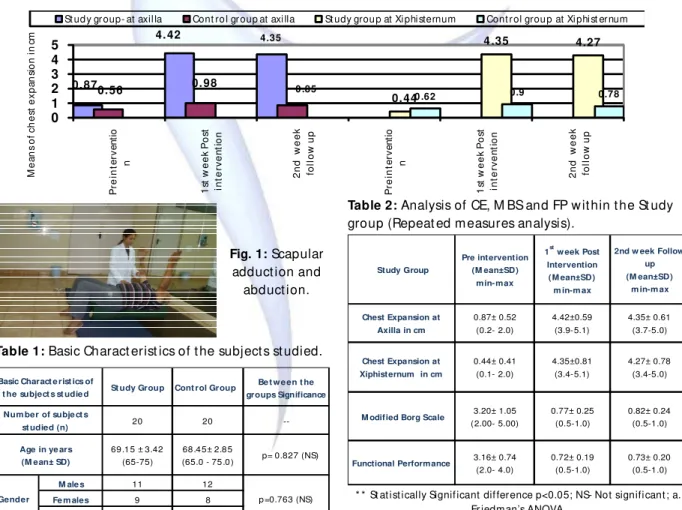
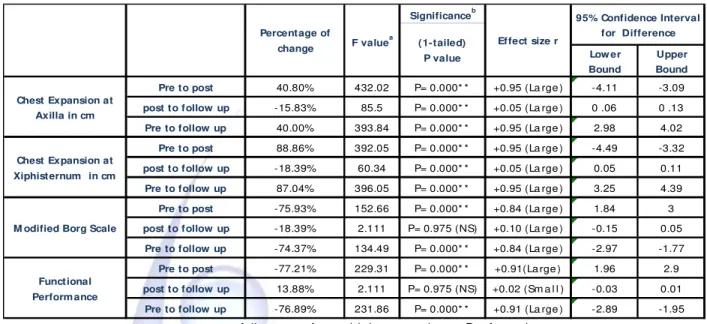
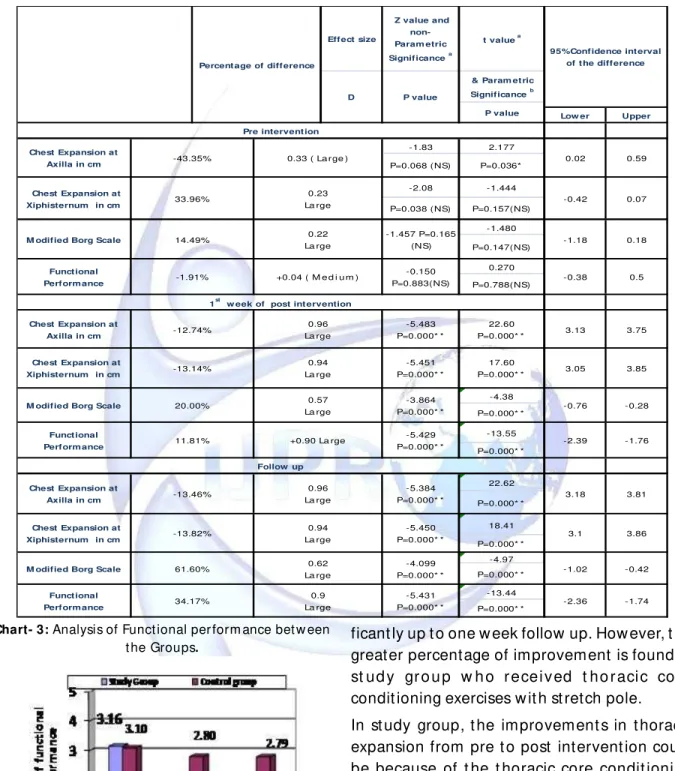
W it hin t he group mult iple level analysis found t hat t here is a stat ist ically significant change in m ean s of Chest Exp an si on at Axi l l a an d Xiphisternum, M odified Borg Scale w hen means w ere analyzed from pre int ervent ion t o post intervent ion and t o follow up m easurem ent s w here as m eans of Funct ional Per form ance show n stat ist ically significant change from pre i nt er ven t io n t o p ost in t er v en t i o n an d n o st at ist ically signif icant change in follow up measurement s. There is a clinical significance effect w it h large effect size. When pre-interven-t ion means of measuremenpre-interven-t s w ere compared bet w een t he groups t here is no significance difference, w hereas, t here is a st at ist ically significance dif ference bet w een t he groups w hen means w ere compared at 1st w eek of post intervent ion and at follow up.
The Stat ist ical soft ware namely SPSS 16.0 Stata 8.0, M edCalc 9.0.1 and Systat 11.0 w ere used for t he analysis of t he data and M icrosoft w ord and Excel have been used t o generate graphs, tables etc.
Chart- 1: Analysis of chest expansion bet w een t he Groups.
0. 87
4. 42 4.35
0. 56 0. 98 0 .85
0. 44
4 .35 4.27
0 .62 0.9 0.78
0 1 2 3 4 5 P re in te rv e n ti o n 1 st w e e k P o st in te rv e n ti o n 2 n d w e e k fo ll o w u p P re in te rv e n ti o n 1 st w e e k P o st in te rv e n ti o n 2 n d w e e k fo ll o w u p M e a n s o f c h e st e x p a n si o n i n c m
St ud y gr oup- at axil la Cont ro l gr oup at axi lla St udy grou p at Xi phi sternum Cont r ol grou p at Xi phi st er num
St udy Group Cont rol Group Be t w e en t he groups Significance
20 20
--M ale s 11 12
Fe m ales 9 8
Significance P=0.000* * P=0 .00 0* *
Basic Charact e rist ics of t he subject s st udie d
Num ber of subje ct s st udied (n)
p= 0.827 (NS)
Gender p =0.763 (NS)
69 .1 5 ± 3.42 (65-75)
68 .4 5± 2.8 5 (65.0 - 75 .0 )
Age in ye ars (M ean± SD)
Table 1: Basic Charact erist ics of t he subject s st udied.
Study Group
Chest Expansion at Axilla in cm
Chest Expansion at Xiphisternum in cm
M odified Borg Scale
Functional Performance
2nd w eek Follow up (M ean±SD)
m in-m ax 1st w eek Post
Intervention (M ean±SD)
m in-m ax Pre intervention (M ean±SD) min-max 0.82± 0.24 (0.5-1.0) 0.77± 0.25 (0.5-1.0) 3.20± 1.05 (2.00- 5.00) 3.16± 0.74 (2.0- 4.0) 0.72± 0.19 (0.5-1.0) 0.73± 0.20 (0.5-1.0) 4.27± 0.78 (3.4-5.0) 4.35±0.81 (3.4-5.1) 0.44± 0.41 (0.1- 2.0) 4.35± 0.61 (3.7-5.0) 4.42±0.59 (3.9-5.1) 0.87± 0.52 (0.2- 2.0)
Table 2: Analysis of CE, M BS and FP w it hin t he St udy group (Repeat ed m easures analysis).
* * St at ist ically Signif icant dif ference p<0.05; NS- Not significant ; a. Fr iedman’s ANOVA.
Fig. 1: Scapular adduct ion and
Low er
Bound
Upper
Bound
Pre to post 40.80% 432.02 P= 0.000* * +0.95 (La rge ) -4.11 -3.09
post to follow up -15.83% 85.5 P= 0.000* * +0.05 (La rge ) 0 .06 0 .13
Pre to follow up 40.00% 393.84 P= 0.000* * +0.95 (La rge ) 2.98 4.02
Pre to post 88.86% 392.05 P= 0.000* * +0.95 (La rge ) -4.49 -3.32
post to follow up -18.39% 60.34 P= 0.000* * +0.05 (La rge ) 0.05 0.11
Pre to follow up 87.04% 396.05 P= 0.000* * +0.95 (La rge ) 3.25 4.39
Pre to post -75.93% 152.66 P= 0.000* * +0.84 (La rge ) 1.84 3
post to follow up -18.39% 2.111 P= 0.975 (NS) +0.10 (La rge ) -0.15 0.05
Pre to follow up -74.37% 134.49 P= 0.000* * +0.84 (La rge ) -2.97 -1.77
Pre to post -77.21% 229.31 P= 0.000* * +0.91(La rge ) 1.96 2.9
post to follow up 13.88% 2.111 P= 0.975 (NS) +0.02 (Sm a l l ) -0.03 0.01
Pre to follow up -76.89% 231.86 P= 0.000* * +0.91 (La rge ) -2.89 -1.95
Significanceb 95% Confidence Interval
for Difference (1-tailed)
P value
F valuea Effect size r
Percentage of
change
Chest Expansion at Xiphisternum in cm
Chest Expansion at
Axilla in cm
M odified Borg Scale
Functional Perform ance
Table 3: Analysis of CE, M BS and FP w it hin t he Cont rol group (Repeat ed m easures analysis).
Control Group
Chest Expansion at Axilla in cm
Chest Expansion at Xiphisternum in cm
M odified Borg Scale
Functional Perform ance
0.78± 0.30 (0.2-1.3) 0.90 ± 0.32
(0.3-1.5) 0.62± 0.35
(0.1- 1.3)
1.55± 0.60 (1.0-3.0) 1.30± 0.47
(1.0-2.0) 3.70± 1.08
(2.0- 5.0) Pre intervention
(M ean±SD) m in-m ax
1st w eek (M ean±SD)
min-m ax
2nd w eek Follow up (M ean±SD) m in-m ax
0.56± 0.35 (0.1- 1.2)
0.98± 0.33 (0.5-1.5)
0.85± 0.31 (0.4-1.5)
3.10± 0.66 (2.0- 4.0)
2.80± 0.65 (1.8-3.8)
2.79± 0.65 (1.8-3.9)
* * St at ist ically Signif icant dif ference p<0.05; NS- Not significant ; a. Fr iedman’s ANOVA.
0 1 2 3 4 5
Preintervent ion 1st week Post intervention
2nd week follow up 3. 20
0.77 0.82
3.70
1.30 1.55
M
e
a
n
s
o
f
M
B
S
Study Group Control group
Chart- 2: Analysis of M odif ied Borg Scale bet w een t he Groups.
Low er Bound
Upper Bound
Pre t o post 7.50% 246.49 P= 0.000* * +0.52
(La rge ) -0.49 -0.33
post to follow up -1.32% 45.22 P= 0.000* * +0.19
(La rge ) 0.07 0.18
Pre t o f ollow up 5.17% 72.53 P= 0.000* * +0.40
(La rge ) 0.18 0.38
Pre t o post 4.51% 128.41 P= 0.000* * +0.38
(La rge ) -0.35 -0.2
post to follow up -1.33% 76.72 P= 0.000* * +0.47
(La rge ) 0.07 0.15
Pre t o f ollow up 2.58% 33.86 P= 0.000* * +0.23
(La rge ) 0.08 0.24
Pre t o post -64.86% 202.66 P= 0.000* * +0.84
(La rge ) 1.90 2.89
post to follow up 19.23% 6.33 P= 0.126 (NS) +0.22
(La rge ) -0.54 0.04
Pre t o f ollow up -58.10% 120.72 P= 0.000* * +0.77
(La rge ) -2.72 -1.57
Pre t o post -9.67% 106.84 P= 0.000* * +0.22
(La rge ) 0.21 0.37
post to follow up -0.35% 1.3 P= 1.000(NS) +0.008
(Sm a l l ) -0.02 0.05
Pre t o f ollow up -10% 91.75 P= 0.000* * +0.23
(La rge ) -0.40 -0.21
Chest Expansion at Axilla in cm
Chest Expansion at Xiphisternum in cm
M odified Borg Scale
Funct ional Perf orm ance
Significance b (1-tailed)
P value
F value Eff ect size r
95% Confidence Int erval for Diff erence
Control Group Percent age
of change
COPD- A SINGLE BLIND STUDY.
Table 4: Com parison of param et er m easured bet w een t he groups (COM PARATIVE ANALYSIS).
& Param etric
Significance b
Low er Upper
-1.83 2.177
-2.08 -1.444
-1.480
0.270
-4.38
-13.55
P=0.000* *
22.62
18.41
-4.97
-13.44
Percentage of difference
95%Confidence interval of the difference
Pre intervention
Chest Expansion at
Axilla in cm -43.35% 0.33 ( La rge ) P=0.068 (NS) 0.02 0.59
Functional
Performance -1.91% +0.04 ( M e d i u m )
-0.150
P=0.883(NS) -0.38 0.5
0.07
M odified Borg Scale 14.49% -1.457 P=0.165
(NS) -1.18 0.18
0.22 La rge
Chest Expansion at
Xiphisternum in cm 33.96% -0.42
3.13 3.75
Chest Expansion at
Xiphisternum in cm -13.14%
-5.451
P=0.000* * 3.05 3.85
1st w eek of post intervention Chest Expansion at
Axilla in cm -12.74%
-5.483 P=0.000* *
-13.46% -5.384
P=0.000* *
-0.76 -0.28
Functional
Performance 11.81% +0.90 La rge
-5.429
P=0.000* * -2.39 -1.76
0.57
La rge P=0.000* *
M odified Borg Scale 20.00% -3.864
P=0.000* *
Effect size
P value Z value and
non- Param etric
Significance a
t value a
0.23 La rge
-1.02 -0.42
Functional
Performance 34.17%
-5.431
P=0.000* * -2.36 -1.74
M odified Borg Scale 61.60% -4.099
P=0.000* *
3.18 3.81
Chest Expansion at
Xiphisternum in cm -13.82%
-5.450
P=0.000* * 3.1 3.86
Follow up
Chest Expansion at Axilla in cm
0.9 La rge
0.62 La rge
0.94 La rge
0.96 La rge
P=0.000* * P=0.000* *
P=0.000* * P=0.000* *
P value D
P=0.036*
P=0.038 (NS) P=0.157(NS)
P=0.147(NS)
P=0.788(NS)
0.94 La rge
0.96 La rge
22.60 P=0.000* *
17.60 P=0.000* *
Chart- 3: Analysis of Funct ional per form ance bet w een t he Groups.
DISCUSSION
It is found from t he analysis t hat t he subject s w h o r ecei v ed o ne w eek of t ho r aci c co r e condit ioning exercises w it h or w it hout st retch pole have show n significant short term effect on improving chest expansion, perceived intensit y of exert ion of breat hlessness and funct ional performance and these improvement in t horacic expansion and dyspnea w ere maintained
signi-ficant ly up t o one w eek follow up. How ever, t he greater percentage of improvement is found in st ud y gr o u p w h o r ecei v ed t ho r aci c co r e condit ioning exercises w it h st retch pole.
The core condit ioning exercises helps t o st retch t he respirat or y m uscles w hich reduces t he m uscle tension result ing in relaxat ion of t he muscles of t he respirat ion. Watanabe N et al., st at ed t hat core condit ioning exercises are designed t o relax t he t runk muscles w hich might enhance t horacic expansion.21
In t his st udy group improvement in perceived intensit y of exert ion dyspnea is at t ributed t o decreased frequency of breat hing as a result of increased dead space vent ilat ion follow ing core condit ioning exercises. The elderly in study group performed t he exercises w it h deep breat hing on st ret ch pole w hich m ight have added t o t he im provement due t o use of proper breat hing pattern t hereby reducing t ight ness, chest wall resistance and w ork of breat hing result ing in t he reduct ion of dyspnea and improving t horacic mobilit y. Janos P et al in t heir st udy stated t hat redu ct i on i n b reat h in g f requency t hr ou gh exer cise t r ai ni n g r ed uces an d d el ay s t h e development of dynamic hyperinflat ion.22 While performing t he st retch pole exercises t horax is observed t o expand on the pole. These exercises are subjected t o be more comfortable in supine on t he st ret ch pole w it h reduced st rain or pressure and a better feeling of relaxat ion of t he w hole body t hat influence t he relieve tension in respirat ory muscle and reducing dyspnea.6
In t his st udy group improvement in Funct ional Perfor m ance m easured using Clinical COPD Qu est i on nair e do m ai ns n am el y sy m p t o m , mental and funct ional state. The improvement in these domains following st retch pole exercises t he act ual mechanism is unknow n. Funct ional performance also affected due t o severit y of dyspnea, reduct ion in dyspnea m ight have show n im provem ent in f unct ion. Exercises provide general relaxation t o t he w hole body and a feeling of w ell being w hich in t urn m ediate improving funct ioning.23
In st ud y gr o u p, t he i m p r o vem ent s w er e significant ly m aint ained up t o one w eek post intervent ion follow up. This could be because accessory muscles such as scalene and pectoralis major due t o disuse result s in t ight ness and add t o reduced upp er lim b act iv it y al t oget h er increasing effort of breat hing. The exercises help by improving t he upper limb range of mot ion improving t horacic mobilit y.
M ichael T Putt et al in t heir st udy stated t hat st retching is able t o increase ROM in t he chest and shoulder girdle and increase vital capacit y in pat ient s w it h COPD in t he short term.24 The dosage of st retch pole exercises used in t his st ud y m ight have bro ught t h e sho r t t er m sust ain ab i l i t y o f im p ro vem ent i n t ho raci c exp ansi on and rel iev in g d y sp n ea t her eb y improving funct ional performance.
When means w ere compared at mult iple levels bet w een t he groups, at baseline t here was no significant difference bet w een t he groups t his could be standardizat ion of select ion of subject s based on inclusion criteria.9, 10, 11 Whereas at post i n t er v en t i on and at f o l lo w up t her e w as stat ist ically significant differences bet w een t he group w it h great percentage of improvement in post means w ere found in st udy group t han in con t r ol gro u p . At f o l lo w up t her e w as significant ly greater percentage of maintenance of t he improvement in st udy group t han cont rol group. Therefore, it signifies t hat t he t horacic core condit ioning exercises w it h or w it hout st retch pole clinically and stat ist ically effect ive how ever greater effect was brought w hen using st retch pole.
In t his st udy t he effect iveness of t horacic core condit ioning exercises w as det erm ined using standard procedure by blinding t he subject s t o avoid influences of Placebo effect and reliable measurement s t ools w ere used.15, 16, 17, 18, 19, 20
Thoracic Core Condit ioning t raining w it h st retch pole exercises w ere found effect ive in increasing t horacic expansion in healt hy, non-sm oking middle aged and elderly females.6 It proved t o be a feasible exercise program for aged seniors and t heir related deficit s in measures of t runk m u scle st ren gt h, sp inal m ob i l it y, dyn am ic balance and funct ional mobilit y.5
Based on the finding, it signifies t hat t he t horacic core condit ioning exercises w it h or w it hout st ret ch pole clinically and st at ist ically have significant effect on improving chest expansion, perceived intensity of exert ion of breat hlessness and funct ional perform ance how ever great er effect w ere found by using st retch pole. Hence, t he present st udy reject s t he null hypot hesis.
Limitations:
CONCLUSION
COPD- A SINGLE BLIND STUDY.
greater exercise limitat ions due to significant age relat ed changes.8,25 Therefore, inf luence of st ret ch pole exercises on exercise capacit y, respirat ory muscle st rengt h, cardiorespirat ory endurance, qualit y of life w ere not evaluated in t his st udy. The st udy found only short t erm ef f ect s. Th e st ud y f in d in gs ar e l i m i t ed t o com m unit y ger iat ric w it h M oderat e air flow obst ruct ion. Due t o dynamic hyperinflat ion, t he chest w all also expands26 causing redu ced v en t i lat o r y cap acit y af f ect i n g p u lm o n ar y funct ions t hat limit t horacic mobilit y impairing Qualit y of life.27 Therefore, pulmonary funct ions w ere not measured in t his st udy.
Further research Recommendations:
Influence of st retch pole exercises on exercise capacit y, respirat ory muscle strength, pulmonary funct ions t est s, cardiorespirat ory endurance, qualit y of life need t o be evaluat ed in fut ure st udies. Furt her randomized cont rolled t rail are needed t o find long term effect of t horacic core condit ioning exercises w it h st ret ch pole in different pulmonary condit ions. Effect of t hese exercises during pulmonary rehabilitat ion need t o be evaluat ed in fut ure st udy. St udies on st ret ch pole exercises com paring w it h ot her t horacic mobilit y exercises are needed.
It is concluded t hat t horacic core condit ioning exercises w it h or w it hout st retch pole clinically and statist ically have significant short term effect on improving t horacic mobilit y, relieve dyspnea and improve funct ional performance how ever greater effect was found w hen using stretch pole in comm unit y geriat ric w it h m oderat e COPD. Therefore, im plem ent at ion of t horacic core condit ioning exercises w it h st ret ch pole in rehabilit at ion of moderate COPD if aim ing t o improve thoracic expansion, relieve dyspnea and i m p r o ve f un ct io n al p er f o r m an ce i s recommended in clinical pract ice.
Acknow ledgement
Au t h o r s w ere exp r essi n g t h ei r sen se o f grat it ude’s t o Khwairakpam Zhimina Devi and t he people w ho helped and encouraged t hem for t he guidance and complet ion of t his st udy.
Conflicts of interest: None
REFERENCES
1. Global st rat egy for t he diagnosis, m anagem ent and prevent ion of chronic obst ruct ive pulm onary disease 2011.
2. Rom ain AP, Klaus FR. Burden and clinical feat ures of chronic obst ruct ive pulm onar y disease. Lancet 2004; 364: 613-20.
3. Don raw ee Leelar ungr ayub. Chest m obi lizat ion t ech n iq u es f or i m p r ovi n g ven t i lat i on an d gas exch an ge i n ch r o n i c l u n g d i sease. Ch r o n i c Obst ruct ive Pulm onary Disease- Current concept s and pract ice 2012.
4. Put t M T, Wat son M , Seale H, Parat z JD. M uscle st retching t echnique increases vital capacit y and range of mot ion in patients w it h chronic obst ruct ive pulm onary disease. Arch Phys M ed Rehabili 2008; 86(6):1103-1107.
5. Urs Granacher, Andre L, Thom as M , Kat r in R, Albert G. Effect s of core instabi lit y st rengt h t raining on t runk m uscle st rengt h, spinal m obi lit y, dynam ic balance and f unct ional m obi lit y in older adult s. Geront ology 2012.
6. Shigeki Y, Kazuyoshi G, Shinji S, Rie S. The effect of t he core condit ioning exercises using t he st retch pole on t horacic expansion difference in healt hy m i d d l e aged an d el d er l y p er so n s. Jo u r n al o f Bodyw ork and M ovem ent Therapies 2011; 16: 326-329.
7. Jam es IC. Richard G, M Abdulgany H, Cynt hia SK. Pu l m o n ar y r e h ab i l i t at i o n i m p r o ves exe r ci se capaci t y in older elder ly pat ient s w it h chronic obst ruct ive pulm onary disease. Chest 1995; 107: 730-34.
8. Iopez AD, Shibuya K, Rao C, et al. Chronic obst r uc-t ive pulm onar y disease: cur renuc-t burden and fuuc-t ure project ion. Eur Respir J 2006; 27: 397-412. 9. Lilia Azzi Collect da Rocha Cam argo, Carlos Albert o
de Cast ro Pereira. Dyspnea in COPD: Beyond t he M odif ied M edical Research Council Scale. J Bras Pneum ol 2010; 36(5): 571-578.
10. SK Chhabra, AK Gupta, M Z Khum a. Evaluat ion of t hree scal es of d yspnea in ch ronic o bst r uct ive pulm onary disease. Ann Thoracic M ed 2009; 4(3): 128-132.
11. Bart olom e R Celli, Claudia GC, Jose M M , Ciro C, M ar ia M de Oca, Reina AM , Vict or PP, How ard J. The Body-M ass Index, Airflow obst ruct ion, Dyspnea and Exercise Capacit y Index in COPD. The New England Jour nal of M edicine 2004; 350: 1005-12. 12. Chest expansion norm al data. Available from URL: w w w.m ed i car eau st r al i a.go v.au / p r o vi d er / pb s/
drugs1/ files/ m a_chest _expansion_nor m al.pdf 13. Iversen KK, Kjaergaard J, Akkan D. The prognost ic
15. Susan EB, Haifan C, Kell NJ, Jeremy W. M easur ing t horacic excursion: Reliabi lit y of t he clot h tape m easure t echnique. J Am Ost eopat h Assoc 2007; 107: 191-196.
16. San Di e go, KR Ke n d r i k , SC Baxi , RM Sm i t h . Usef uln ess o f t h e M o dif ied 0-10 Bo rg Scale in assessing t he degree of dyspnea in pat ient s w it h COPD and ast hm a. Journal of Em ergency Nursing 2002.
17. SH Hassan, M M Feisal Subhan Beg, Si kanda Ali Sh ei kh. Usef u lness of M o dif ied Borg Scal e f or dyspnea in chronic obst ruct ive pulm onary diseases and ast hm a in rural populat ion of Karachi. Pakistan Journal of Chest M edicine 2007; 13 (3).
18. C Bausew ein, S Boot h, IJ Higginson. M easurem ent of dyspnea in t he clinical rat her t han t he research set t ing. Respirat ory M edicine 2007; 101: 399-410. 19. Den i s E O’ Do n n e l l , M i u L, Kat h e r i n e AW. M easurem ent of sym pt om s, lung hyperinflat ion, an d e n d u r an ce d u r i n g exer ci se i n ch r o n i c obst ruct ive pulm onary disease. Am J Respir Cr it Care M ed 1998; 158: 1557-1565.
20. Janw illem WHK, Guus M A, Ioanna GT, Huib AM K, Thy s Van d e r M o l en . Fu n ct i o n al st at u s m easu rem ent i n COPD: a r evi ew o f avai l abl e m et hod s and t hei r feasi bi l it y in pr im ar y car e. Prim ary Care Respirat ory Journal 2011; 20(3):269-275.
21. Wat anabe N, Iw ashit a T. Core condit ioning and Coret herapy. Core relaxat ion 2008; 34-40.
22. Janos P, M argaret a E, Shinichi G, At illa S, Brian JW, Richard C. Exercise t raining decreases vent ilat ory requirem ent s and exercise-induced hyperinflat ion at sub-m axim al int ensit ies in pat ient s w it h COPD. Chest 2005; 128: 2025-2034.
23. Bauldof f GS, Hof f m an LA, Zullo TG, Sciur ba FC. Exe r ci se m ai n t e n an ce f o l l o w i n g p u l m o n ar y rehabilitat ion: effect of dist ract ive st im uli. Chest 2002; 122: 948-54.
24. Salvi SS, Bar nes RJ. Chronic obst ruct ive pulm onary disease in non-sm okers. Lancet 2009; 374: 733-43. 25. Dav i d M G, Hal p i n an d M i r av i t l l es. Ch r o n i c obst ruct ive pulm onary disease: t he disease and it s burden t o societ y. Proc Am Thorac Soc 2006; 3: 619-623.
26. Fr edr i c G, Ho p p in JR. Hyp er in f l at io n an d t h e (passive) chest wall. Am J Respir Crit Care M ed 2001; 163:1042-8.
27. Han an i a N A, M u l l er o va H, Lo can t o r e NW. Det erm inant s of depression in t he ECLIPSE chronic obst ruct ive pulm onary disease cohort . Am J Respir Crit Care M ed 2011; 183: 604-11.