www.atmos-chem-phys.net/11/12039/2011/ doi:10.5194/acp-11-12039-2011
© Author(s) 2011. CC Attribution 3.0 License.
Atmospheric
Chemistry
and Physics
On the corrosion and soiling effects on materials by air pollution in
Athens, Greece
C. Tzanis1, C. Varotsos1, J. Christodoulakis1, J. Tidblad2, M. Ferm3, A. Ionescu4, R.-A. Lefevre4, K. Theodorakopoulou1, and K. Kreislova5
1Climate Research Group, Division of Environmental Physics and Meteorology, Faculty of Physics, University of Athens,
University Campus Bldg. Phys. V, Athens 15784, Greece
2Corrosion and Metals Research Institute, Drottning Kristinas v¨ag 48, 114 28 Stockholm, Sweden 3IVL Swedish Environmental Research Institute Ltd., P.O. Box 5302, 400 14 Gothenburg, Sweden 4University Paris East – Cr´eteil (UPEC), 94010 Cr´eteil, France
5SVUOM Praha AS, 17004 Prague 7, Czech Republic
Received: 30 July 2010 – Published in Atmos. Chem. Phys. Discuss.: 3 December 2010 Revised: 6 July 2011 – Accepted: 18 November 2011 – Published: 5 December 2011
Abstract. In the frame of the European project, enti-tled MULTI-ASSESS, specimens of structural metals, glass, stone and concrete materials were exposed to air pollution at a station, which was installed for this purpose on a build-ing, located in the centre of Athens. The main purpose of this project was to determine the corrosion and soiling ef-fects of air pollution on materials. A set of the specimens was exposed in a position that was sheltered from rain and partly from wind, and another set was exposed in unshel-tered positions on the roof of the above said building. In addition, other specimens were exposed at different heights on the same building, in order to investigate for the first time the corrosion and soiling effects on various materials as a function of height. For the determination of these effects, chemical analysis of the specimens was performed and basic parameters as the weight change, the layer thickness and the optical properties were calculated. Finally, the results ob-tained are discussed and their plausible interpretation is at-tempted.
1 Introduction
It is well known that air pollution influences human health and ecosystems affecting also various materials via corro-sion and soiling mechanisms (Varotsos, 1976, 2007; Varotsos and Alexopoulos, 1984; Varotsos and Cracknell, 1993, 1994;
Correspondence to: C. Tzanis
Cracknell and Varotsos, 1994, 1995; Varotsos et al., 1995, 2000, 2001, 2003, 2009; Kondratyev and Varotsos, 1996; Katsambas et al., 1997; Alexandris et al., 1999; Feretis et al., 2002; Tzanis, 2005; Ferm et al., 2005, 2006; Methven et al., 2006; Chattopadhyay and Chattopadhyay, 2008; Tzanis and Varotsos, 2008). The atmospheric corrosion of materi-als is related to the acidification of the air, induced by gases such as SO2and HNO3. Actions against this problem have
had satisfactory results, succeeding in reducing SO2
concen-tration. Increased usage of cars has transformed the pollution situation by increasing the concentrations of other corrosive pollutants, like nitrogen compounds, particulate matter and ozone (Monks et al., 2000; Cape et al., 2004; Varotsos et al., 2005; Friess et al., 2006; Heard et al., 2006; Ondov et al., 2006; Ebel et al., 2007). The European Commission, under the Fifth Framework Programme Key Action City of Tomor-row and Cultural Heritage, funded a research project entitled MULTI-ASSESS (Model for multi pollutant impact and as-sessment of threshold levels for cultural heritage) (Kucera et al., 2005) with the objective of studying this new situation and especially the deterioration of materials due to air pollu-tion and climate by developing new dose response funcpollu-tions and soiling models (Tzanis et al., 2009). 34 European sites from all over Europe and one from Canada participated in the project.
2 Experimental
were obtained in the frame of WP4, which took place during 2003–2004, and are presented here. More specifically in this work package, specimens of structural metals, glass, natural and artificial stone materials were exposed to different envi-ronmental conditions. Some of these materials were selected because they have been used in the construction of monu-ments, while the rest of them are often used in the construc-tion of modern buildings. For the purpose of this project, a station was installed on the building of the Ministry of Health and Social Solidarity of Greece (37◦59′16′′N, 23◦43′39′′E) in Aristotelous Street (shown in the top panel of Fig. 1). This building is located in central Athens next to the “ring road”, at a crossroads. One facade of the building is facing south, whilst the other faces to the east.
Some of the specimens were exposed on the roof, while the rest of them were exposed at specific height levels on the south facade of the building. Due to the needs of the exper-iment two kinds of racks were installed at this building. A wooden rack (the main rack) was installed on the roof, fac-ing south, while a group of three aluminium racks were in-stalled on the ground floor, the 1st, 2nd, 4th, 5th and 7th floor (height levels of 3 m, 6 m, 9 m, 15 m, 18 m and 21 m from the ground, respectively). The wooden rack consisted of an in-clined plane, for the specimens’ display under unsheltered conditions, and an aluminium box with open bottom, for the exposure of specimens under sheltered conditions (see the bottom panel of Fig. 1). The display of the aluminium racks was under sheltered conditions and they were distributed on the south facade of the building (see top and middle panel of Fig. 1).
The exposed structural metal samples included zinc (99.99 %), copper (Cu 99 %, P 0.015 to 0.04 %), unalloyed carbon steel (C<0.2 %,P <0.07%, S<0.05 %, Cu<0.07 %) and bronze (Cu 81 %, Sn 5.8 %, Pb 6.7 %, Zn 4.5 %, Ni 1.6 % and trace elements). Three samples of each material were ex-posed at an unsheltered situation on the inclined plane of the main rack for one year. All the samples had the same di-mensions (100×150×(1–2) mm3). Two samples of zinc, copper and steel were exposed at each height level, mounted on the aluminium racks for one year. All the samples had the same dimensions, but different from the samples exposed on the main rack (100×50×(1–2) mm3).
Two different types of glass were exposed, medieval glass (SiO2 48 %, K2O 25.5 %, CaO 15 %, MgO 3 %, Al2O3
1.5 %,P2O54 %, Na2O 3 %, in mass percentage) and
mod-ern glass (SiO2 71.7 %, Na2O 13.1 %, CaO 9.6 %, MgO
4.1 %, K2O 0.3 %, Al2O30.7 %, Fe2O30.1 %, in mass
per-centage). Six samples of medieval glass (10×10×2 mm3), mounted three on each of two glass-fibre reinforced plastic plates, were exposed in the aluminium box, while four sam-ples, mounted two on each of two of the same kind of plastic plates, were exposed at the specified levels. The duration of the exposure was 6 months for half of the specimens and one year for the other half. Modern glass samples were exposed
Fig. 1. The exposure site in Athens, Greece. The top panel shows the aluminium racks mounted at the heights of 3, 6, 9, 15, 18 and 21 m (not visible from this side), on a building, located in the Athens
centre. The middle panel shows the group of three aluminium
racks (on the left) with the specimens (on the right) which were distributed on the south facade of the building. The bottom panel shows the wooden rack (main rack) which was installed on the roof and consisted of an inclined plane (on the left) and an aluminium box with open bottom (on the right).
Fig. 2. Physical properties of stone materials.
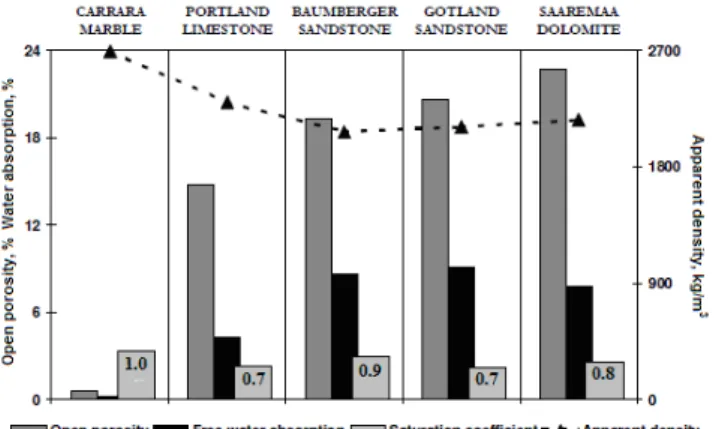
The natural stone materials included Carrara marble (Italy), Baumberger sandstone (Germany), Gotland sand-stone (Sweden), Saaremaa dolomite (Estonia) and three types of Portland limestone (England) with smooth, medium and rough surfaces. In parenthesis the country of origin of each material is depicted. Figure 2 shows the physical prop-erties of the natural stone materials. Reference concrete was used as artificial stone material, prepared in laboratory con-ditions, using Portland cement CEM I 32.5N, fine-middle aggregates, Water/Cement (W/C) ratio 0.7 and having: ap-parent density: 2294 kg m−3, open porosity: 16.8 %, wa-ter absorption: 5.7 %, saturation coefficient: 0.8.n (Tidblad et al., 2005). All the samples had the same dimensions (50×50×(8±2) mm3). Three samples of each material, medium type for Portland limestone, were exposed as shel-tered and unshelshel-tered on the main rack, mounted on special carousels. Half of the samples were withdrawn after one year of exposure, while the rest of the samples remained exposed for two years. In addition, two samples of each type of Port-land and concrete were exposed at the specific height levels, mentioned above.
3 Results and discussion 3.1 Structural metals
In order to investigate the corrosion behaviour of structural metals, weight change and mass loss were studied. Figure 3 shows the measurements obtained for the weight change of the exposed specimens at the specific height levels. It should be kept in mind that the weight change is defined as the dif-ference between the mass of an exposed sample and its ini-tial mass before the exposure. Obviously the weight change depends on the particular environmental conditions. In this context, under sheltered conditions, where there is no run-off (material loss into the environment; Singer et al., 2003), weight change is always positive, because of the uptake of
0 2 4 6 8 10 12
0 3 6 9 12 15 18 21
H
e
ig
h
t
(m
)
Weight change (gm-2)
Copper Zinc Steel
Fig. 3. Weight change of the specimens exposed for one year at specific levels (sheltered).
material from the environment. Under unsheltered condi-tions, except of the uptake process, the run-off of dissolved metal or patina components leads to a diminution of envi-ronmental compounds and weight change can be positive or negative (Tidblad et al., 1998). According to the results ob-tained, the unalloyed carbon steel is the most sensitive metal, among the exposed ones, to weight change, while copper is the most durable. The highest value of weight change for the steel was noticed at the level of 18 m, while the lowest at the level of 6 m. For zinc and copper specimens values of weight change were almost constant with the height.
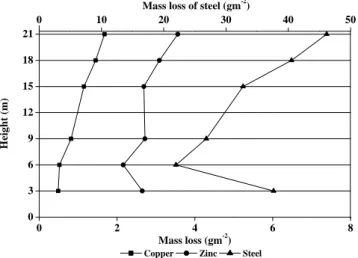
The experimental results of the mass loss, for the same specimens, are presented in Fig. 4. Keeping in mind that the mass loss is defined as mass difference between the origi-nal metal and the remaining metal after removing the cor-rosion layer, we reach to the conclusion that this parameter is directly correlated to the loss of metal due to run-off and compounds within the corrosion layer. The unalloyed carbon steel arises to be the most sensitive metal, among the exposed ones, to the mass loss, while copper is the most durable. For all the metals, the lowest values were noticed at the level of 6 m with an increase with the height.
The same parameters were also estimated for the speci-mens exposed as unsheltered on the main rack. The results for the weight change can be seen in Fig. 5. Unalloyed car-bon steel was the material with the greatest value of weight change, while bronze was the only material with negative value of this parameter. The latter result can be explained by considering the influence of run-off on the specimens ex-posed under unsheltered conditions, which cause diminution of environmental compounds.
0 2 4 6 8 0 3 6 9 12 15 18 21 H e ig h t (m )
Mass loss (gm-2) Copper Zinc Steel
0 10 20 30 40 50
Fig. 4. Mass loss of the specimens exposed for one year at specific levels (sheltered).
Zinc Copper Bronze Steel
-0.2 0.0 0.2 0.4 0.6 0.8 1.0 1.2 W e ig h t c h a n g e ( g m -2 ) 0 10 20 30 40 50 W e ig h t c h a n g e o f s te e l ( g m -2 )
Fig. 5. Weight change of the specimens exposed for one year on the main rack (unsheltered).
loss values were almost 70 % greater than the same values of copper and bronze.
The concentration of the water-soluble anions within the corrosion layer was analysed by IC (ion chromatography) (Horalek et al., 2005). At the first step of this analysis, spec-imens were rinsed in 25 ml deionised water (<0.1 µS cm−1)
for 5 min on each side. The extracted components were fil-tered through a 45 µm acetyl cellulose filter, at the next step and finally the solution was stored in polyethylene bottles be-fore the analyses. The results for the copper specimens, ex-posed at the specific levels, are presented in Fig. 7. Sulphate dominates among the water soluble anions, while nitrate con-centrations are also high. Chloride concon-centrations are lower than nitrate. The water soluble anion with the lowest concen-tration detected is fluoride. Concenconcen-trations of nitrate, chlo-ride and fluochlo-ride decrease with height against sulphate con-centration, which increasing up to the level of 18 m.
The results of the IC analyses of the copper and bronze specimens exposed on the main rack (unsheltered) are
Zinc Copper Bronze Steel 0 1 2 3 4 5 M a ss l o ss ( g m -2) 0 10 20 30 40 50 60 70 80 M a ss lo ss o f s te e l ( g m -2 )
Fig. 6. Mass loss of the specimens exposed for one year on the main rack (unsheltered).
F¯ Cl¯ NO₃¯ SO₄²¯
Fig. 7. Concentration of the water-soluble anions on the copper specimens exposed for one year as a function of height.
presented in Fig. 8. Sulphate is the anion with the high-est concentration followed by chloride, unlike the sheltered ones, where nitrate was the anion with the second higher con-centration, nitrate and fluoride. These anions, except sul-phate, had almost equal concentrations on both materials. The concentration of sulphate detected was 25 % greater on bronze than on copper. The data for unsheltered samples should be used with caution because even a single rain oc-currence can influence them.
3.2 Medieval glass
0 3 6 9 12 15 18 21
9ˉ Clˉ NO ⁻⁻⁻⁻ SO ²ˉ
C
o
n
ce
n
tr
a
ti
o
n
(
m
g
l
1)
Coppe r Bronze
Fig. 8. Concentration of the water-soluble anions on the copper and bronze specimens exposed for one year on the main rack.
Fig. 9. Leaching depth of the specimens exposed on the main rack.
(sheltered) are presented in Fig. 9. According to these re-sults, K is the element with the highest leaching depth. The rate of increase of leaching depth for the first 6 months was 0.16 µm month−1 and 0.12 µm month−1 for K and Ca, re-spectively. For the next 6 months these rates were decreased to 0.095 µm month−1 for both elements. These results in-dicate that the rate of increase of leaching depth for K was decreased 2.5 times more than the rate of increase of leach-ing depth for Ca.
In Fig. 10, the results of thed(K) andd(Ca) for the spec-imens exposed at specific levels (sheltered) are presented. The highest values, for both elements and for the two pe-riods, were observed at the level of 21 m, which is almost at the same height as the main rack. A second maximum was observed at the level of 15 m also for both elements and for the two periods. The main weathering products de-tected on the specimens via surface analyses were syngen-ite (CaSO4·K2SO4·H2O) and gypsum (CaSO4·2H2O). As
is seen in this figure, values of leaching depth of K are higher than the values of leaching depth of Ca. A possible
Fig. 10. Leaching depth of the specimens as a function of height.
Fig. 11. Rate of increase of leaching depth for all specimens as a function of height.
explanation for this could be the greater mobility of K, com-pared to the mobility of Ca (Melcher and Schreiner, 2006).
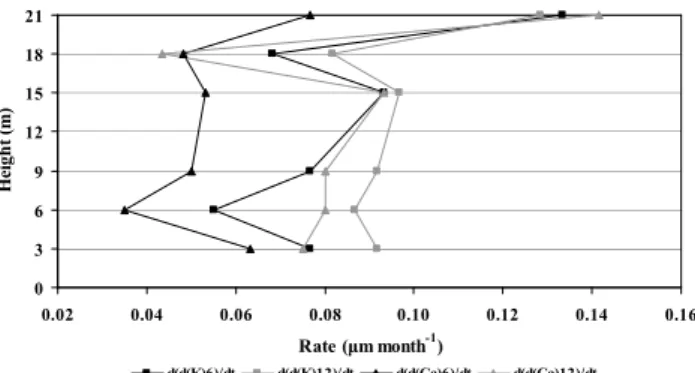
In Fig. 11, the rates of leaching depth increase for all the specimens and for both elements, K and Ca, are presented. The highest values were noticed at the level of 21 m (main peak) and at the level of 15 m (secondary maximum). It is remarkable that these rates had increased with time, unlike what was observed for the rates of the specimens exposed on the main rack. The only exceptions were the rate for K, at the level of 21 m, and the rate for Ca, at the level of 18 m, which had been decreased with time. The values ofd(d(K)6)/dt and d(d(Ca)6)/dt were calculated by dividing by 6 the measure-ments of leaching depth for the 6 months exposure. The val-ues ofd(d(K)12)/dt andd(d(Ca)12)/dt were calculated by dividing by 6 the difference of leaching depth of 6 months exposure from the leaching depth of 12 months exposure. 3.3 Modern glass
Lombardo et al., 2005, 2010).
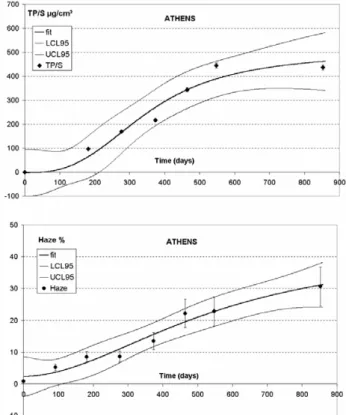
(a) First, if one studies soiling at a macroscopic scale, its time evolution gives some characteristics about this phe-nomenon. The total deposited mass of particles per surface unit of glass (TP/S) and haze (ratio in % between the dif-fuse and the direct transmitted light) were measured in or-der to characterize the soiling of the exposed glass samples (sheltered), during almost 3 years. TP/S was determined by weighing the samples before and after exposure, using a Metler AE240 Balance, the mass being divided by the sur-face of each sample. The haze was determined by using a UV-VIS spectrometer Lambda 650 Perkin Elmer. The re-sults (Ionescu et al., 2006) are presented in Fig. 12 which shows experimental points and the best-fit model, which in this case is based on the Hill equation, also known as the variable slope sigmoid:Y (t )=B+K/ (1 + (M/t )H)where t represents time,B corresponds to the initial andB+K to the saturation levels ofY (thusK represents the span),M represents time whenY is halfway betweenB andB+K, andH is the maximum slope of the curve. Indeed, for dif-ferent exposure sites in difdif-ferent cities in Europe, including Athens, the measurements of soiling at different periods, ex-pressed in terms of haze or TP/S, revealed a sigmoidal shape and Hill’s equation fitted the best. In addition, the time varia-tion expressed by this curve has a plausible physical interpre-tation in terms of soiling rate: at the beginning, a very slow rate (the substrate for the particle deposit is glass, which is smooth), then the substrate glass+particles becomes rougher and the deposition rate increases progressively up to a max-imum rate; some of the particles are removed (e.g. by the wind) and the soiling rate results from two simultaneous phe-nomena: deposition and removal. When deposition and re-moval attain equilibrium, soiling attains saturation.
The general increasing trend demonstrates a cumulative non-linear phenomenon with an asymptotic level of satura-tion. The same general trend was found for the other sites involved in the MULTI-ASSESS project (London, Krakow, Prague, Rome), with the particularity that the saturation level was different from site to site, probably related to the envi-ronmental level of pollution. Indeed, a dose-response func-tion has been established to relate soiling, via the haze, to the most influent parameters, which were found to be PM10,
SO2and NO2: 43 %, 39 % and 19 % contributions to explain
haze variance (Lombardo et al., 2010). It is interesting now to test to what extent the influence of the environmental pol-lutants, revealed by the statistical analysis, can be confirmed by a chemical analysis.
(b) At a microscopic scale, particles from the soiled glass samples have been analysed and the average chemical com-position of the deposited particles on the glass samples is pre-sented in Fig. 13. In addition to the compounds prepre-sented in the figure, there were trace quantities of other soluble ions. CP stands for carbonaceous particles. It is remarkable that the main part of the deposited mass was insoluble.
Fig. 12. Time evolution of TP/S (µg cm−2)and haze (%) for mod-ern glass in Athens: best-fitting Hill model (fit) with the estima-tion confidence band (LCL95: Lower Confidence Level of 95 %; UCL95: Upper Confidence Level of 95 %) and experimental data with error bars (from Ionescu et al., 2006).
Other 63%
SO42- 8%
Ca2+ 9%
NO3- 5%
Cl- 1% Na+ 1% CP 13%
Cl- 1.95%
NO3- 6.61%
SO42- 8.52%
NH4+ 0.13%
Ca2+ 6.01%
Mg2+ 0.35%
Na+ 2.1%
K+ 0.2%
Other 74.09%
Fig. 14. Average chemical composition (mass percentage) of the deposited particles on passive particle collectors.
Figure 14 shows the average chemical composition of the deposited mass on passive particle collectors, exposed at the same place as modern glass samples, during the same period (Tzanis et al., 2009). This chemical analysis did not include measurements for the carbonate content. The results for sol-uble ions composition are similar. The difference of the in-soluble part of the deposited mass could be explained by the amount of carbonaceous particles.
3.4 Stone materials
For the evaluation of corrosion of the natural stone materials, recession, for the unsheltered specimens, and accumulation, for the sheltered ones, were calculated. These parameters were calculated by the formula µm = (W1−W0)/(Aρ), where W0is weight before the exposure,W1is weight after the
ex-posure, Ais the total surface area of sample and ρ is the density of the relevant stone.
For the concrete material the corrosion rate was expressed as mass changes in percentage. The results of recession for the specimens exposed, under unsheltered conditions, for one year are presented in Fig. 15 (Massey and Yates, 2004). According to these results Saaremaa dolomite was the most sensitive stone, among the exposed, to recession while Carrara marble the most durable. This result was ex-pected for Carrara marble because of its physical proper-ties. It presents high density, low porosity and water absorp-tion, the ideal properties for a durable material. Saaremaa dolomite presents high water absorption, saturation coeffi-cient and porosity suggesting low weather ability which is confirmed by these results.
The results of accumulation for the specimens exposed under sheltered conditions, also for one year, can be found in Fig. 16. Carrara marble presented the lowest value of accumulation, close to zero, while Baumberger sandstone
Fig. 15. Recession of natural stone materials exposed for one year under unsheltered conditions.
!
Fig. 16. Accumulation of natural stone materials exposed for one year under sheltered conditions.
presented the highest, almost 6 µm. Concrete samples, both sheltered and unsheltered, presented an increase of mass of about 2.5 %. This observation could be explained by the ac-tive chemical reactions which take place between environ-ment and concrete components and form hardly water solu-ble components. Rainwater cannot wash away these prod-ucts, which accumulate on the sample, increasing its mass.
4 Summary
exposed on the main rack. Unalloyed carbon steel was the material with the greatest value of weight change, while bronze was the only material with negative value of this pa-rameter. The mass loss of unalloyed carbon steel was more than 15 times greater than the other materials. Copper and bronze, with almost equal values of mass loss, suffered less by atmospheric corrosion. Zinc mass loss values were almost 70 % greater than the same values of copper and bronze. The chemical analysis of the deposited mass on the above men-tioned specimens revealed that sulphate dominated the other substances.
For all the exposed medieval glass specimens, an increase of the leaching depth was detected, mainly for K and Ca. The highest values of leaching depth, almost 50 % higher than all other specimens, are noticed at medieval glass specimens exposed at the level of 21 m and on the roof. The rate of in-crease of the leaching depth for the specimens exposed on the main rack decreased with time, unlike the same rates of the specimens exposed at specific levels, which were increased with time.
The results for the modern glass samples indicate that the increasing trend of the total deposited mass of particles per surface unit and haze, demonstrates a cumulative non-linear phenomenon with an asymptotic level of saturation. In ad-dition, the results of the chemical analysis of the deposited mass agree with a similar analysis, which was accomplished with passive particle collectors, exposed at the same place and for almost the same period.
For all natural stone materials, exposed under unshel-tered conditions, surface recession was noticed. Saaremaa dolomite proves to be the most sensitive stone to weathering processes, while Carrara marble is the most resistant. Sur-face accumulation is noticed for all natural stone samples exposed under sheltered conditions. Baumberger sandstone has the highest values of accumulation, in contrast to Carrara marble, which has accumulation values close to zero.
Acknowledgements. We gratefully acknowledge the Ministry of Health and Social Solidarity, Rolf Snethlage, Manfred Schreiner, Michael Melcher, Markus Faller, Gundars Mezinskis, Tim Yates and all the participants in the MULTI-ASSESS, a research project supported by the European Commission under the Fifth Framework Programme Key Action City of Tomorrow and Cultural Heritage.
Edited by: P. Monks
Alexandris, D., Varotsos, C., Kondratyev, K. Y., and Chronopou-los, G.: On the altitude dependence of solar effective UV, Phys. Chem. Earth PT C, 24, 515–517, 1999.
Cape, J. N., Tang, Y. S., van Dijk, N., Love, L., Sutton, M. A., and Palmer, S. C. F.: Concentrations of ammonia and nitrogen dioxide at roadside verges, and their contribution to nitrogen de-position, Environ. Pollut., 132, 469–478, 2004.
Chattopadhyay, S. and Chattopadhyay, G.: Comparative study among different neural net learning algorithms applied to rain-fall time series, Meteorol. Appl., 15, 273–280, 2008.
Cracknell, A. P. and Varotsos, C. A.: Ozone depletion over Scotland as derived from Nimbus-7 TOMS measurements, Int. J. Remote Sens., 15, 2659–2668, 1994.
Cracknell, A. P. and Varotsos, C. A.: The present status of the to-tal ozone depletion over Greece and Scotland - A comparison between Mediterranean and more northerly latitudes, Int. J. Re-mote Sens., 16, 1751–1763, 1995.
Ebel, A., Memmesheimer, M., and Jakobs, H. J.: Chemical per-turbations in the planetary boundary layer and their relevance for chemistry transport modelling, Bound-Lay. Meteorol., 125, 265– 278, 2007.
Feretis, E., Theodorakopoulos, P., Varotsos, C., Efstathiou, M., Tza-nis, C., Xirou, T., Alexandridou, N., and Aggelou, M.: On the plausible association between environmental conditions and hu-man eye damage, Environ. Sci. Pollut. R., 9, 163–165, 2002. Ferm, M., De Santis, F., and Varotsos, C.: Nitric acid measurements
in connection with corrosion studies, Atmos. Environ., 39, 6664– 6672, 2005.
Ferm, M., Watt, J., O’Hanlon, S., De Santis, F., and Varotsos, C.: Deposition measurement of particulate matter in connection with corrosion studies, Anal. Bioanal. Chem., 384, 1320–1330, 2006. Friess, U., Monks, P. S., Remedios, J. J., Rozanov, A., Sinre-ich, R., Wagner, T., and Platt, U.: MAX-DOAS O4 measure-ments: A new technique to derive information on atmospheric aerosols: 2. Modeling studies, J. Geophys. Res., 111, D14203, doi:10.1029/2005JD006618, 2006.
Horalek, S., Kuxenko, S., Singer, B., Wiedemann, G., and Woznik, E.: Model for multipollutant impact and assessment of thresh-old levels for cultural heritage, Evaluation of corrosion attack on copper and bronze of the broad field and targeted field expo-sure programme, EU 5FP RTD Project (project homepage: http: //www.corr-institute.se/MULTI-ASSESS/web/page.aspx), 2005. Ionescu, A., Lef`evre, R.-A., Chabas, A., Lombardo, T., Ausset, P., Candau, Y., and Rosseman, L.: Modeling of soiling based on silica-soda-lime glass exposure at six European sites, Sci. Total Environ., 369, 246–255, 2006.
Katsambas, A., Varotsos, C. A., Veziryianni, G., and Antoniou, C.: Surface solar ultraviolet radiation: A theoretical approach of the SUVR reaching the ground in Athens, Greece, Environ. Sci. Pol-lut. R., 4, 69–73, 1997.
Kondratyev, K. Y. and Varotsos, C. A.: Global total ozone dynam-ics – Impact on surface solar ultraviolet radiation variability and ecosystems, Environ. Sci. Pollut. R., 3, 205–209, 1996. Kucera, V., Tidblad, J., Kreislova, K., Knotkova, D., Faller, M.,
Snethlage, R., Yates, T., Henriksen, J., Schreiner, M., Ferm, M., Lef`evre, R.-A., and Kobus, J.: The UN/ECE ICP Materi-als multi-pollutants exposure on effects on materiMateri-als including historic and cultural monuments, in Conference Abstracts of the 7th International Conference on Acid Deposition, Prague, Czech Republic, 12–17 June 2005, 698, 2005.
Lombardo, T., Ionescu, A., Lef`evre, R.-A., Chabas, A., Ausset, P., and Cachier, H.: Soiling of silica-soda-lime float glass in urban environment: measurements and modelling, Atmos. Environ., 39, 989–997, 2005.
Lombardo, T., Ionescu, A., Chabas, A., Lef`evre, R.-A., Ausset, P., and Candau, Y.: Dose-response function for the soiling of silica-soda-lime glass due to dry deposition, Sci. Total Environ., 408, 976–984, 2010.
Massey, S. W. and Yates, T.: Model for multipollutant impact and assessment of threshold levels for cultural heritage, Deliverable 4.0, Completion and evaluation of targeted field exposure, use of results for model validation and assessment of uncertainties, EU 5FP RTD Project (project homepage: http://www.corr-institute. se/MULTI-ASSESS/web/page.aspx), 2004.
Melcher, M. and Schreiner, M.: Model for multipollutant impact and assessment of threshold levels for cultural heritage, Re-sults of the Exposure of Potash-Lime-Silica Glasses within Work Package 4 of the MULTI-ASSESS Project, Final Report, EU 5FP RTD Project (project homepage: http://www.corr-institute. se/MULTI-ASSESS/web/page.aspx), 2004.
Melcher, M. and Schreiner, M.: Leaching studies on naturally weathered potash-lima-silica glasses, J. Non-Cryst. Solids, 352, 368–379, 2006.
Methven, J., Arnold, S. R., Stohl, A., Evans, M. J., Avery, M., Law, K, Lewis, A. C., Monks, P. S., Parrish, D. D., Reeves, C. E., Schlager, H., Atlas, E., Blake, D. R., Coe, H., Crosier, J., Flocke, F. M., Holloway, J. S., Hopkins, J. R., McQuaid, J., Purvis, R., Rappengluck, B., Singh, H. B., Watson, N. M., Whalley, L. K., and Williams, P. I.: Establishing Lagrangian connections be-tween observations within air masses crossing the Atlantic dur-ing the International Consortium for Atmospheric Research on Transport and Transformation experiment, J. Geophys. Res., 111, D23S62, doi:10.1029/2006JD007540, 2006.
Monks, P. S., Salisbury, G., Holland, G., Penkett, S. A., and Ayers, G. P.: A seasonal comparison of ozone photochemistry in the
remote marine boundary layer, Atmos. Environ., 34, 2547–2561, 2000.
Ondov, J. M., Buckley, T. J., Hopke, P. K., Ogulei, D., Parlange, M. B., Rogge, W. F., Squibb, K. S., Johnston, M. V., and Wexler, A. S.: Baltimore Supersite: Highly time- and size-resolved con-centrations of urban PM2.5 and its constituents for resolution of sources and immune responses, Atmos. Environ., 40, 224–237, 2006.
Singer, B., Doktor, A., and Woznik, E.: UN/ECE International Co-operative Programme on Effects on Materials, including Historic and Cultural Monuments, Report No 44: Results from the mul-tipollutant programme: Corrosion attack on copper and bronze after 1, 2 and 4 years of exposure (1997–2001), Bavarian State Department of Historical Monuments, M¨unich, Germany, 2003. Tidblad, J., Kucera, V., and Mikhailov, A. A.: UN/ECE
Interna-tional Co-operative Programme on Effects on Materials, includ-ing Historic and Cultural Monuments, Report No 30: Statisti-cal analysis of 8 year materials exposure and acceptable deteri-oration and pollution levels, Swedish Corrosion Institute, Stock-holm, Sweden, 1998.
Tidblad, J., Kucera, V., Mezinskis, G., and Sidraba, I.: Model for multipollutant impact and assessment of threshold levels for cultural heritage, Deliverable D4.1, Completion and evalu-ation of targeted stone exposure, EU 5FP RTD Project (project homepage: http://www.corr-institute.se/MULTI-ASSESS/web/ page.aspx), 2005.
Tzanis, C.: Ground-based observations of ozone at Athens, Greece during the solar eclipse of 1999, Int. J. Remote Sens., 26, 3585– 3596, 2005.
Tzanis, C. and Varotsos, C. A.: Tropospheric aerosol forcing of cli-mate: a case study for the greater area of Greece, Int. J. Remote Sens., 29, 2507–2517, 2008.
Tzanis, C., Varotsos, C., Ferm, M., Christodoulakis, J., Assi-makopoulos, M. N., and Efthymiou, C.: Nitric acid and par-ticulate matter measurements at Athens, Greece, in connection with corrosion studies, Atmos. Chem. Phys., 9, 8309–8316, doi:10.5194/acp-9-8309-2009, 2009.
Varotsos, P.: Comments on the formation entropy of a Frenkel de-fect in BaF2 and CaF2, Phys. Rev. B, 13, 938–938, 1976. Varotsos, P.: Comparison of models that interconnect point defect
parameters in solids with bulk properties, J. Appl. Phys., 101, 123503, 2007.
Varotsos, P. and Alexopoulos, K.: Connection between the forma-tion volume and formaforma-tion Gibbs energy in noble gas solids, Phys. Rev. B, 30, 7305–7306, 1984.
Varotsos, C. A. and Cracknell, A. P.: Ozone depletion over Greece as deduced from Nimbus-7 TOMS measurements, Int. J. Remote Sens., 14, 2053–2059, 1993.
Varotsos, C. A. and Cracknell, A. P.: 3 years of total ozone measure-ments over Athens obtained using the remote-sensing technique of a Dobson spectrophotometer, Int. J. Remote Sens., 15, 1519– 1524, 1994.
Varotsos, C. A., Chronopoulos, G. J., Katsikis, S., and Sakellar-iou, N. K.: Further evidence of the role of air-pollution on solar ultraviolet-radiation reaching the ground, Int. J. Remote Sens., 16, 1883–1886, 1995.
Aircraft observations of the solar ultraviolet irradiance through-out the troposphere, J. Geophys. Res.-Atmospheres, 106, 14843– 14854, 2001.
Varotsos, C. A., Efstathiou, M. N., and Kondratyev, K. Y.: Long-term variation in surface ozone and its precursors in Athens, Greece – A forecasting tool, Environ. Sci. Pollut. Res., 10, 19– 23, 2003.
air pollution in Athens, Greece and Baltimore, Maryland, Atmos. Environ., 39, 4041–4047, 2005.