Revistă
cotată
CNCSIS,
categoria B+
THE ANNALS OF THE
"ŞTEFAN CEL MARE"
UNIVERSITY OF SUCEAVA.
FASCICLE OF THE FACULTY OF
ECONOMICS AND
PUBLIC ADMINISTRATION
VOLUME 10, SPECIAL NUMBER, 2010
Editor-in-chief: Carmen NĂSTASE
General editorial secretary: Adrian Liviu SCUTARIU
Editors:Elena HLACIUC, Carmen CHAŞOVSCHI, Mariana LUPAN, Ovidiu Florin HURJUI
SCIENTIFIC COMMITTEE:
Angela ALBU, „Ştefan cel Mare” University of Suceava, Romania George P. BABU, University of Southern Mississippi, USA
Christian BAUMGARTNER, International Friends of Nature, Austria Grigore BELOSTECINIC, ASEM, Chi şinău, Republic of Moldova Ionel BOSTAN, „Alexandru Ioan Cuza” University of Iaşi, Romania Aurel BURCIU, „Ştefan cel Mare” University of Suceava, Romania
Gheorghe CÂRSTEA, Academ y of Economic Studies, Bucharest , Romania Slobodan CEROVIC, Singidunum University, Belgrade, Serbia
Simion CERTAN, State University of Chişinău, Republic of Moldova
Carmen CHAŞOVSCHI, „Ştefan cel Mare” University of Suceava, Romania Liliana ELMAZI, Tirana University, Albania
Cristian Valentin HAPENCIUC, „Ştefan cel Mare” University of Suceava, Romania Elena HLACIUC, „Ştefan cel Mare” University of Suceava, Romania
Elena IFTIME, „Ştefan cel Mare” University of Suceava, Romania Marian JALENCU, State University of Chişinău, Republic of Moldova Miika KAJANUS, Savonia University of Applied Sciences, Iisalmi, Finland Stefanos KARAGIANNIS, Institute of Tourism Research, Athens, Greece Maria MUREŞAN, Academy of Economic Studies, Bucuresti, Romania Carmen NĂSTASE, „Ştefan cel Mare” University of Suceava, Roman ia Alexandru NEDELEA, „Ştefan cel Mare” University of Suceava, Romania Ion PÂRŢACHI, ASEM, Chişinău, Republic of Moldova
Rusalim PETRIŞ, „Ştefan cel Mare” University of Suceava, Romania Abraham PIZAM, University of Central Florida, Orlando, Florida Ion POHOAŢĂ, „Alexandru Ioan Cuza” University of Iaşi, Romania
Gabriela PRELIPCEAN, „Ştefan cel Mare” University of Suceava, Romania Gheorghe SANDU, „Ştefan cel Mare” University of Suceava, Romania Petru SANDU, Elizabethtown College, Pennsylvania, USA
Pavlo SHYLEPNYTSYI, Bucovina State Academy of Finance, Chernivtsi, Ukraine Doru TILIUŢE, „Ştefan cel Mare” University of Suceava, Romania
Ion TORONCIUC, National University Yuri Fedcovici, Chernivtsi, Ukraine Viorel ŢURCANU, ASEM, Chişinău, Republic of Moldova
Diego VARELA PEDREIRA, University of A Coruna, Spain
Răzvan VIORESCU, „Ştefan cel Mare” University of Suceava, Romania
Valeriy YEVDOKYMENKO, National University Yuri Fedcovici, Chernivtsi, Ukraine
Text review:Alina HODOROABĂ, Adrian Liviu SCUTARIU.Cover design:Adrian Liviu SCUTARIU Contact:
Faculty of Economics and Public Administration „Ştefan cel Mare” University of Suceava
Str. Universităţ ii nr. 13, Corp H, Camera H108 720229 SUCEAVA, ROMANIA
Phone: (+40) 230 216147 int. 294 E-mail:[email protected]
Journal web site:www.seap.usv.ro/annals Faculty web site:www.seap.usv.ro University web site:www.usv.ro
Responsabilitatea pentru conţ inutul articolelor revine în întregime autorilor.
CONTENT
SECTION 1 - ECONOMY, TRADE, SERVICES ... 7 THE STRATEGIC EFFECTS OF THE RECESSION... 9
PhD Mr. Gheorghe VĂDUVA
The Christian University “Dimitrie Cantemir”, Bucuresti, Romania...9 CS I dr. Gheorghe VĂDUVA
The Christian University „Dimitrie Cantemir”, Institute for Security Studies, Bucuresti, Romania
MAKING THE DECISION ON BUYING SECOND-HAND CAR MARKET USING DATA MINING
TECHNIQUES... 17
Assistant PhD. Student Cristina OPREA Petroleum-Gas University, Ploiesti, Romania
ASPECTS REGARDING THE EVOLUTION OF THE TOURIST ACTIVITY AT A REGIONAL LEVEL IN ROMANIA, POLAND AND SLOVAKIA... 27
Professor PhD. Cristian Valentin HAPENCIUC Assistant PhD. Student Adrian Liviu SCUTARIU
Ştefan cel Mare University of Suceava, Romania
DRINKING WATER, A PROBLEM OF SUSTAINABLE DEVELOPMENT OF THE CITY WE LIVE
IN. CASE STUDY... 36
Professor Eng. PhD. Romeo IONESCU
Stefan cel Mare University of Suceava, Romania
THE DISINFLATION PROCESS IN ROMANIA WITHIN THE CONTEXT OF THE EUROPEAN
INTEGRATION ... 45
Ph.D. Student Monica DAMIAN
“Alexandru Ioan Cuza” University, Faculty of Economics and Business Administration of Iasi, Romania
THE IMPACT OF BUSINESS LOCALIZATION ON THE INTERNATONAL TRADE ... 55
Lecturer PhD. Liviu-George MAHA Professor PhD. Ion IGNAT
PhD. Student Sorin-Ştefan MAHA ”Al. I. Cuza” University of Iaşi, Romania
CULTURAL-CREATIVE INDUSTRIES (CCI)– ECONOMIC AND SOCIALPERFORMANCES…………63 Prof. PhD.Gheorghe ZAMAN
Corresponding member of Romanian Academy, Romania Prof. PhD. Valentina VASILE
Institute of National Economy-Romanian Academy, Romania
THE ENVIRONMENTAL DIMENSION OF COMMON AGRUCULTURAL POLICY ... 78
PhD. Student Cristian TEODOR
Academy of Economic Studies of Bucharest, Romania
THE MIGRATION OF HEALTH CARE SKILLS IN THE CONTEXT OF THE ENLARGEMENT OF THE ECONOMIC EUROPEAN AREA - THE CASE OF THE ROMANIAN DOCTORS - ... 83
Lecturer PhD. Despina VASILCU
Stefan cel Mare University of Suceava, Romania
ECONOMETRIC ANALYSIS OF THE FLOW OF TOURISTS IN ACCOMMODATION STRUCTURES IN ROMANIA ... 92
Professor PhD. Marian ZAHARIA
Petroleum-Gas University of Ploiesti, Romania Associate Professor PhD. Rodica Manuela GOGONEA Academy of Economic Studies of Bucharest, Romania Univeristy Assistant PhD. Student Cristina OPREA
INTEGRATED QUALITY MANAGEMENT OF TOURIST DESTINATIONS IN PROTECTED AREAS, THE CASE OF PIATRA CRAIULUI NATIONAL PARK ... 101
Post-doctoral researcher PhD. Adina Nicoleta CANDREA
Professor PhD. Gabriel BRĂTUCU
University of Transilvania, Braşov, Romania
IMPACT OF ECONOMIC CRISIS ON THE TOURISM INDUSTRY IN ROMANIA. AN ECONOMETRIC ANALYSIS OF OVERNIGHTS STAYS... 110
Ec. PhD. Candidate Alina BALAN
Associate Professor PhD. Mihaela BÎRSAN
THEORETICAL CONSIDERATIONS FOR SECURITIES ISSUED BY JOINT STOCK COMPANY ... 117
Assistant PhD.Laurentiu NOVAC-DIACONU Assistant Adrian LUPASCU
George Bacovia University from Bacau, Romania
SECTION 2-MANAGEMENT AND BUSINESS ADMINISTRATION ... 128 EMPLOYEE MOTIVATION IN THE COMPANY. STUDY CASE ... 129
Professor PhD. Cristian Valentin HAPENCIUC Master student Andrei-Alexandru MOROŞAN “Ştefan cel Mare” University of Suceava, Romania
METHODS OF MEASURING THE PERFORMANCE OF INTERNAL AUDIT... 137 PhD Assistant Cristina BOŢA-AVRAM
PhD Professor Ioan POPA
PhD Lecturer Cristina ŞTEFĂNESCU
Babeş-Bolyai University, Faculty of Economic Sciences and Business Administration, Cluj-Napoca, Romania
METHODS FOR ECONOMIC AND FINANCIAL ANALYSIS OF INTANGIBLE ASSETS ... 147
Associate ProfessorGabriel I. NĂSTASE Director Department of University Studies Masters–Christian University “Dimitrie Cantemir”
THE IMPORTANCE OF INNOVATION IN INTERNATIONAL BUSINESS ... 157
Associate professor, PhD Valeriu POTECEA
Teaching assistant, PhD candidate Georgiana CEBUC Romanian-American University, Bucharest, Romania
THE IMPLICATIONS OF CULTURAL DIMENSIONS ON BUSINESS PRACTICES AND MANAGERIAL BEHAVIOUR WITHIN THE ORGANIZATIONS OF BIHOR COUNTY ... 162
PhD Maria-Madela ABRUDAN
University of Oradea, Faculty of Economics Mirabela Constanţa MATEI
University of Oradea, Faculty of Economics
Adriana Şchiopoiu BURLEA
University or Craiova, Faculty of Economics and Business Administration
Doina DĂNĂIAŢĂ
West University of Timişoara, Faculty of Economics and Business Administration
Mirela SÎRBU
University or Craiova, Faculty of Economics and Business Administration– Dr. Tr. Severin
Doina ROŞCA
University or Craiova, Faculty of Horticulture
THE EVOLUTION OF THE GLOBALIZATION AND ITS IMPACT ON THE INVESTMENT PROCESS .. 180
Lecurer PhD. Mariana LUPAN
Stefan cel Mare University of Suceava, Romania
ETHICAL ISSUES IN INTERNATIONAL BUSINESS... 189
Assistant Professor, PhD. Andreea-Daniela GANGONE Constantin Brâncoveanu University of Pitesti, Romania
FDI FLOWS IN THE ERA INTERDEPENDENCIES ... 200
Assistant PhD. Student Angela-Nicoleta COZORICI Assistant PhD. Student Simona BUTA
Stefan cel Mare University of Suceava, Romania
ECONOMICS OF LONG TAIL, A CHALLENGE FOR BRANDING ... 210
Ph.D. student Andreia Gabriela ANDREI Ph.D. student Andrei DUMEA
F.E.A.A., University “Al. I. Cuza” of Iasi, Romania
KNOWLEDGE DYNAMICS AND THE CONCEPT OF– ‘BA’... 217
Junior Assistant, PhD Student Ruxandra BEJINARU
“Ştefan cel Mare” University of Suceava, Romania
THE GROUP AND THE TEAM IN MILITARY ORGANIZATION ... 224
PhD. Student Sofronia Petrică PUIU
THE ROLES PLAYED BY THE TEAM MEMBERS IN THE HUMAN RESOURCES PERFORMING
MANAGEMENT ... 231
Master Student Paul IVAN
„Stefan cel Mare” University of Suceava, Romania
SECTION 3-ACCOUNTING - FINANCES... 241 REFLECTIONS ON THE NATURE OF ACCOUNTING ... 242
Professor. Dr. Elena HLACIUC Professor. Dr. Rusalim PETRIS
“Stefan cel Mare” University of Suceava, Romania
THE IMPLICATION OF THE ACCOUNTING PROFESSION IN THE ACCOUNTING REGULATION FOR
“MICRO-ENTITIES” IN THE ACTUAL ECONOMIC CONTEXT: DEBATES AND OPINIONS... 260
Professor PhD. Ramona NEAG
Assistant PhD.Student Irina Doina PĂŞCAN Lecturer PhD. Student Ema MAŞCA
Assistant PhD.Beatrice Anemari ŞTEFAN “Petru Maior” University, Târgu Mures, Romania
THE RECONCILIATION BETWEEN NET INCOME AND EQUITY OF THE PARENT COMPANY AND CORRESPONDING VALUES IN CONSOLIDATED FINANCIAL STATEMENTS * ... 268
Professor PhD. Stefano AZZALI Professor PhD. Luca FORNACIARI Università degli Studi di Parma, Italy
FINANCIAL MANAGEMENT WHEN INTERESTS ON DEBT ARE NOT FULLY DEDUCTABLE. THE ITALIAN CASE STUDY ... 283
Assistant Professor Ph.D. MSc. Alberto LANZAVECCHIA
Assistant Professor Ph.D. Lucia POLETTI
Assistant Professor Ph.D. Beatrice RONCHINI
Full Professor Giulio TAGLIAVINI
Faculty of Economics, University of Parma, Italy
ANALYSIS ON THE IMPACT OF NON-COMPLIANCE WITH ACCOUNTING PRINCIPLES BY
COMPANIES, IN TERMS OF EXTERNAL FINANCIAL AUDIT “FILTERS”... 301
PhD. Associate Professor Ovidiu-Constantin BUNGET Lecturer PhD. Student Alin-Constantin DUMITRESCU
West University of Timisoara, Faculty of Economics and Business Administration, Timisoara
A PREDICTION MODEL FOR THE ROMANIAN FIRMS IN THE CURRENT FINANCIAL CRISIS... 309
Dan LUPU
Andra NICHITEAN
Alexandru Ioan Cuza University of Iaşi,Romania
ACCOUNTING KNOWLEDGE IN FORESTRY'S DECISION SUPPORT SYSTEMS. LITERATURE
REVIEW... 316
Ph.D Student Ec. Daniela I. POSTOLACHE (MALEŞ) “Alexandru I. Cuza” University of Iasi, Romania
ACCOUNTING INFORMATION IN THE CONTEXT OF GLOBALIZATION ... 326
PhD. Student Alexandra-Daniela SOCEA
“Alexandru Ioan Cuza” University of Iaşi, Romania
THE STUDY ABOUT USING FINANCIAL AND ECONOMICAL ANALYSIS ... 334
Ec. PhD. Student Cristina Antonela SOFRONIA Alexandru Ioan Cuza University of Iasi, Romania
CONSIDERATIONS REGARDING THE CONTENTS AND APPLICABILITY OF FISCAL MECHANISMS INFLUENCING THE ECONOMY IN THE MODERN SOCIETY... 340
PhD. Candidate Marius FRUNZĂ
Faculty of Economics and Business Administration, “Alexandru Ioan Cuza” University of Iaşi, Romania THE GLOBAL FINANCIAL CRISIS IMPACT OVER THE REFORMATION OF THE FINANCIAL
SURVEILLANCE ARCHITECTURE IN EU: PROSPECTS AND IMPLICATIONS ... 350
Elena CIOBANU (SIRETEANU)
„Alexandru Ioan Cuza” University of Iaşi, Faculty of Economics and Business Administration Doctoral School of
SECTION 4-STATISTICS, DATA PROCESSING (INFORMATICS) AND MATHEMATICS... 356
MACROECONOMIC DEVELOPMENTS BASED ON THE MAIN COMPONENTS’ METHOD... 357
PhD. MarianaBĂLAN
Institute for Economic Forecasting– NIER, Romanian Academy, Romania Prof. univ. PhD. Valentina VASILE
Institute for National Economy– NIER, Romanian Academy, Romania
CAR ACCESS USING MULTIMODAL BIOMETRICS... 368
Catalin LUPU
“Stefan cel Mare” University of Suceava, Romania
SECTION 5-LAW AND PUBLIC ADMINISTRATION... 378 COMPETITION AND CONTRACT... 379
Professor PhD. Luca DI NELLA University of Parma, Italy
DOCTRINARY OPINIONS REGARDING THE AUTONOMY OF COMMUNITIES IN THE LOCAL PUBLIC ADMINISTRATION MANAGEMENT ... 390
University Assistant PhD. candidate Petronela ZAHARIA Lecturer PhD. Candidate Irina BILOUSEAC
“Stefan cel Mare” University of Suceava, Romania
THE STAMP DUTY REGULATION IN DIFFERENT EUROPEAN COUNTRIES ... 396
Assistant Bogdan-Dumitru DÎMBU
,,Ştefan cel Mare” University of Suceava, Romania
SOME ASPECTS OF THE CONSTITUTIONALITY OF LAWS CONF CONTROL... 403
PhD Luminita DRAGNE
Christian University “Dimitrie Cantemir” of Bucharest
THE DISTINCTION OF THE ADMINISTRATIVE CONTRACT... 408 FROM OTHER TYPES OF CONTRACTS ... 408
Assistant professor Ph.D. Liana-Teodora PASCARIU
University „Stefan cel Mare” Suceava, Romania
THE EU CHARTER OF FUNDAMENTAL RIGHTS ACCORDING TO TREATY OF LISBON ... 414 Lecturer Ph.D. Răzvan VIORESCU
“Stefan cel Mare” University of Suceava, Romania
Judge Iulius-Cezar DUMITRESCU Suceava Appeal Law Court, Romania
COMBATING ECONOMIC AND FINANCIAL CRIMINALITY AT THE EUROPEAN LEVEL ... 421
Research Assistant Ana PIRLAC
University “Stefan cel Mare” Suceava, Romania
A STUDY ON THE ROLE OF LOCAL BUDGET PROCESS IN THE SOCIAL-CULTURAL DEVELOPMENT OF THE NORTH-EASTERN REGION ... 428
Lecturer PhD. Student Cristinel ICHIM
“Ştefan cel Mare” University of Suceava, Romania
SECTION 1
THE STRATEGIC EFFECTS OF THE RECESSION
PhD Mr.Gheorghe VĂDUVA
The Christian University “Dimitrie Cantemir”,Bucuresti, Romania [email protected]
CS I dr. Gheorghe VĂDUVA
The Christian University „Dimitrie Cantemir”, Institute for Security Studies, Bucuresti, Romania [email protected]
Abstract:
The financial crises are big crisis, crisis of system, with chaotic and unpredictable developments. They are an effect of creation and tendencies to autonomy of a system which goes to became dominant and sovereign, but extremely
vulnerable to the condition’s variation. The analysis which we have made on some segments of these crisis’s effects led
to the conclusion that their impact is and will be peculiarly strong especially on those major components of the security1s risk management. The effects generated by the crisis are rolling on in complicated chains which trend to multiple in uncontrollable developments, to became radical and to explode starting economic, social and military collapses which multiplies the challenges, the defiance, the dangers and threats, amplify the vulnerabilities to these and increase, in a significant way, the risk level, crossing a lot over the strategic security level. It is unlikely that such crisis to evolve to a maximum of conflict called war, as it happened with 1929-1933 crisis which generated, mostly, the World War II, but we can not exclude that these effects could still generated another king of war, more complicated and more subtle. The effects of present crisis are still looming and it is hard to predict how they will develop in the future. NATO is on its way to elaborate the strategic concept while EU already applies the Lisbon Treaty. Both documents, with essential political and strategic value, are elaborated and finalized during a profound crisis which has effects on all levels, especially in the economic, social and military fields and also regarding the geopolitical and geostrategic reconfigurations, which are in a new dynamic of the interdependent sovereign, within a new power unbalance and against a new possible intensification of the battle for resources and markets.
Key-words: crisis, impact, strategic, effect, regions, cash/coin
JEL Classification:H12
INTRODUCTION
The mankind is passing through a new crisis of which effects felt and felt again on all levels, mainly on the strategic level. The crisis affects the power,not only doesn’treduce neither the gaps nor the differences, but, furthermore, emphasis and submit them to some unpredictable evolutions. Following the Wall Street effects, the American Government, as many other governments, intervened through huge salvation plans, granting to the insolvent banks and assurance societies big aids. The vertiginous decrease of the consumption expenses and the moratoria over the loans put on the block even the strongest companies what impose, on the part of the states, again, new interventions, new plans and other huge expenses tranches. Bt just the consumption credits with high risk level – imposed, generally, by the encouragement measures of the consumption credits, most of them in the guise of under-bonuses (1), with high risk level, taken, maintained and even secured by states in favor of poor stratum–result in the impossibility of their reimbursement and to the bankruptcy of some of the largest banks and assurance societies from the world. John B. Taylor –showed that, in fact,“theactionsand the Government’s interventions, and also some weakness of the private environment caused, extended and aggravated in a radical manner the crisis” (2). Many people request the establishment of inquiry committee regarding this crisis similar to the committee established to analyze the causes of 9/11 events.
There are, of course, other opinions regarding this recession’s philosophy andphysiognomy with its causes and effects. Some opinions, for example, endorses that not only the non-overwrought and even hasted intervention of the state in favor of poor stratum and support of disadvantageous credits, but also the bank’s greedy, the granting without limit of some consumption credits with high risk level and the inadequacy of present financial system to the real economy demands, of the market and life represent the true cause of this disaster. The state, in their opinion, didn’t make anything else than interfere for the protection of a system which he, obviously, also created.
It seems like, in the train of this recession, the American economy gives up to the Milton Friedman Model (3) and starts to flirts with the Intervention Theory (4). The ideas of Intervention of James Tobin, laureate of Nobel Premium, start to fall into place and get support. In other words, John Maynard Keynes come back to present. The American President Barak Obama signed a plan for economic stimulations costing 787 billions dollars.
This recession proves one more time that, in troublous time, the rigid doctrines are not the most suitable ones. It is requested flexibility. In the moment when the reference interest comes close to zero are requested, according to some experts, the options of USA Federal Reserve or of American Central Bank (Fed) for economy’s stimulation. The optimal employment rate, affirms James Tobin, is zero. As John Maynard Keynes, he claims that it is necessary that the Government to interfere in economy in order to maintain the employment rate to the free and must be made a very strict control of the money pumped over in economy. Those who follow the Tobin’s line believe that the Government must interfere in economy, inclusive through the stimulation packages of expenses. Of course, the influence of Tobin’s ideas is very large at Washington, but not as large as its follower wishes. Richard Levin, president of Yale University, affirms that, within the fiscal stimulation program of Obama Administration, it is desired to be as less possible taxes reduction and a stronger implication in creation of new jobs. That means the opposite of what John. B. Taylor claims.
Still, in our opinion, the recession proves one again that the financial ventures, the implementation of rigid theories, the chaotic liberalization of market, the excessive increase of consumption, the lack of balanced economic and social policies can go to dramatic developments, to spectacular crashes of economic and financial power and disequilibrium hard to be managed, with multiple, complex and hard to remove effects, inclusive over to the national and international security. The recession’s effects are numerous, but the most dramatic are those at strategic level. These creates power’s unbalance and impose, on one side, new policies, unbearable, of relocation and rebalance of the ratios between the great strategic policy makers, with effects within the globalization and fragmentation process and, on the other side, an excessive and confliction fragmentation of the geopolitical congruence areas and a proliferation of the power’s asymmetry.
THE POWER AND THE POWER CRISIS
The strategic balance reshaped after the end of Cold War is a restless, asymmetric and even chaotic one. The American Superpower– which remain still dominant in strategic level– doesn’t necessary need an effective support, but just only by pivots, and a fitting strategic concept. The security projected and wished by the Americans is one with variable geometry within the 3 components of Power – political, economic-financial and military– interact dynamic, meaning that the effects of one of the components can be found in the other’s effects, in an interactive manner. USA represents, still, a geopolitical nucleus of stability and management of conflicts, despite the fact that the principle is of the force - through the economic and financial power, but also through the military power. USA represents the vital centre of world military power. The Americans invest in defense over 4 % from a huge GDP, meaning twice more than the rest of the world.
vital center of this power – Airpower – the most dynamic and most important component in force projection which, in fact, means the power projection.
Airpower is made from a forces and devices system which ensures the domination of entire American strategic interested space of the planet. The American Airpower is made, generally, from the USA Air Forces (USAF), Naval Forces (US Navy), the air component Naval Infantry, the air component of Land Forces (US Army), the American Intelligence Systems, Intelligences, Surveillance, Reconnaissance (I2SR), meaning the satellites, networks, reconnaissance devices, sensor system and other elements which assure the rapid action and the force projection. USA, where she is placed today, is mostly, due to its airpower. Airpower consists of USAF (3542 fighters, 180 bombardiers (5) and a lot of transport, air-refueling aircrafts, battle and transport helicopters), 13 carriers which dominate the world oceans, and Naval Infantry realized as an expeditionary corp. At this huge and dynamic power should be added the strategic nuclear forces. How the recession affects this huge American power?
The Swiss Military Magazine (6) realize an interesting analysis in this direction, after a very laborious study elaborated on November 21st 2008 by Karim Lakjaa (7). Airpower is not only the vital center of the greatest world military power but also the harder, flexible and most responsible core for the strategic stability of the planet. The air park of Airpower is twice larger than the air parks of all other countries together.
The recession limits (even stops for long time) the modernization programs of USA Airpower, and its effects consist of ageing the aircrafts park and considerable increasing of maintenance costs.
USA injected in their bank establishments, although, on the first stage, the Congress opposes, almost 700 billions dollars (8). This amount come close to the costs of global war against terrorism, initiated after 9/11, of 824 billions dollars (653 for Iraq war and 171 those in Afghanistan) (9), meaning 1584 billions dollars! And the American budgetary deficit is 2000 billions dollars.
The recession affects the USA Airpower through at least 3 complementary effects: the impossibility to maintain an air capacity always to a constant level; the significant depreciation of existent air capacity; the creation of a too big gap between the scientific and technologic research through which were already realized a new generation aircrafts and the effective reality of Airpower.
The first effect is materialized through the ageing of aircraft, the significant increasing of maintenance costs and decreasing of operational potential. The cost of a flight hour with F-15 and other 14 aircraft categories– noticesThe Swiss Military Magazine– doubled in the last ten years. They grew and still grow the production costs. The cost of a bombardier B-2B grew with 300%, while, for an aircraft F-22 Raptor, conceived to assure the domination of the air space, U.S.A.F. must pay 200 millions dollars. This aircraft was expensive even before the recession (near 120 millions dollars). A few years ago, in USA, started a competition among main aircraft manufacturers in order to realize a cheap aircraft, with vertical take-off, especially for U.S.A.F. and U.S. Navy. Remain in competition 2 large manufacturers– Lockheed Martin and Boeing and won Lockheed Martin, which produces the F-35. But this aircraft costs already 90 millions dollars. These 2 super-aircrafts– F-22 Raptor and F-35– should replace almost entire fighters park but the recession doesn’t allow the discharge of these huge costs, which tantamount to the amount which the Americans expended to stop the recession’s effects. U.S.A.F. must purchase 750 fighters F-22. The too large costs of this aircraft imposed the decreasing of the amount to 183. Furthermore, USAF will purchase only 20 pieces on year. From here result that U.S.A.F. will have a full capacity (diminished from 750 to 183) in 9 years and if it this aircraft must replace all 441 F-15 from USAF it would be necessary 26 years. From this results that 177 F-15 aircrafts must be maintained on duty till 2025. F-35, an aircraft with vertical take-off, comes to accouter both U.S.A.F. and the 10 U.S. Navy carriers and 3 Naval Infantry carriers. But there are not enough money to purchase him and its production goes pretty slowly. From this reason, the aircraft F-18 resource will be prolonged with another 6,000 hours (to cover the period necessary to implement the F-35 aircraft).
fight and also for other usage aircrafts. The firmly domination of air space by USA is one of the characteristics of both operation fields. Without this air and informational domination it wouldn’t be possible the mission’s fulfillment in these operation fields. These missions will continue till 2017 and even till 2020, although, partially, the army will be redraw due to the fact that these areas are considered dangerous.
Preserving proportions the same thing is happening with the Romanian Air Forces (FAR). Despite the fact it was realized an hole air space surveillance integrated system and a part of the existent aircrafts were upgraded, the delay, due to the recession, of implementation of the procurement programs (for entire Armed Forces and not only for FAR) generates the most alarmgly effects. MiG 21 Lancer– a solution for 2 decades– comes to the resource’sexhaustion and the new aircraft, although it was chosen, it wasn’t yet purchased. Of course, it would be wonderful if the Romanian Aeronautic Industry could contribute, at least partially, to the new aircraft realization which FAR needed but such option was long time ago abandoned. Probably the political and strategically decision makers from our country will analyze and the possibility of resurging, in a way or another – of course in Romania Armed Forces benefit – of the Aeronautic Industry, as it used to be long time ago or how it could be sometime in future… Therecessions passes but the projects, the realizations and realities remain for long time.
THE DEPRESION, THE NUCLEARE POWERS AND THE EMERGENTE POWERS
The general manager of the China Popular Bank considers that the faults of the international monetary system can be repaired, in a certain measure, through the creation of a new coin of world reserve. This is a controversial idea which generated many debates.
In the next years China will endow, probably, with its first carrier. It is for the first time after Ming dynasty (10) when China will send warships to protect its commercial lines. So, recently, were sent 2 destroyers and a supplying navy in a sector located off the Somalia coast.
The BRIC countries (Brazil, Russia, India, and China) run, no long time ago, their first summit. China is a kind of pillar of this organization which constitutes a good discussions platform with USA and European Union about the main issues of the world, as peace, stability, durable development, climate changes and global warming. This is another strategic mutation through which can be created structures and potentials for conflict status improvement, for dialog and international balance. The China’s priority is not the battle for global supremacy but finding and applying the best solutions for its durable development and for regional stability.
The China’s relations with USA are becoming closer.Nolens volens, China will continue to “buy” the American debt meaning that she must “help” USA in order to help herself. Even if China is looking other quotes, presently, neither Yen nor Euro is capable to replace the dollar.
The exports are the China’s development engine and the main markets for the Chinese products are in USA, Japan and European Union. The weakness of these markets, due to recession, could have a serious impact over the Chinese trade. This impact already exists. As a result of recession, the China’s foreign trade knew already, in May 2009, a diminution with 25.9 % comparing with same period in 2008. From this reason, over 20 millions people lost their jobs.
The 3 fundamental questions which China asked herself during this period contain 3 important fields: stimulation of internal consumption; creation of new jobs for the unemployed people; maintenance of durable development around the limit of 8 % from GDP. Shortly, the problems seem to be solved. Not on long term meaning at strategic level because today the strategic level is determined not the domination levels but the interdependences level.
strategic investors will not avoid Russia, but, contrary, will look after her. The recent negotiation with European Union and main European countries proves this think.
The intervention in Georgia and also the firmly attitude during the gas crisis period from January 2009, the provenience of similar situation in 2010, the same firmly reaction toward the implementation in Europe of some elements of American anti-missile system, the trenchant conception and offensive and active position regarding the exploitation of Arctic energetic resources, the contraposition expressed pretty directly regarding the NATO and EU enlargement, the competition and, simultaneously, the complementary solutions regarding the new European architecture of the energetic resources – we are talking about the projects North Stream and South Stream, but also about the other European projects through is trying to be reduced the dependence by Russia and at which, obviously, Russia reacts pretty consistent– are elements of a certain type of firmly implication in geopolitical reshape of Euro-Asia space on power and partnership support. The NATO-Russia Council, the strategic partnerships between Russia and USA, Russia and China, Russia and India so, and also the one which is still negotiating between Russia and EU, are part of a new construction through which it is expected to dilute as much as possible the conflict within the relations and to stress the collaboration and cooperation.
The NATO General Secretary, Anders Fogh Rasmussen, made 3 concrete proposals in order to consolidate the NATO-Russia partnership, serious affected after the Georgia’s war from August 2008. Those 3 proposals are: the examination of the possibilities to consolidate the cooperation in all common interest fields (fight against terrorism, the Mass Destruction Weapons proliferation and Afghanistan’s stabilization); rehabilitation of the damaged trust due to the serious divergences regarding the NATO enlargement and resuscitation of “NATO-Russia Council”, advisory body between the Nord-Atlantic Alliance and Russia, with main purpose to approach all subjects without prejudices; reviewing the entirety new security challenges of XXI century. Also, the NATO General Secretary considers that is comes the moment that Moscow, Washington and other European leaders must reunite their anti-missile systems. The old American project of defense system against long-range missile predicted the installation of strong radars and interceptive missile systems in California, Alaska, Poland and Czech Republic, forcing the security strategic environment– already to storm-beaten by numerously crisis and armed conflicts – and looking to realize an accomplished fact.
In February 2009, President Obama announced President Medvedev that he intends to give up to this program in exchange of Russia collaboration on stopping the nuclear Iranian program, similar with the 1962 “missile crisis” from Caribbean Sea. During that time, the Russians turned around the missiles which had to be deployed in Cuba with the condition that the Americans will give up to deploy similar missile in Turkey.
But, after these new tide turns within the relations between Washington and Moscow, it seems that the exit from the Cold War’s effects and reshape ofa strategic environment in which the World Powers to become Power of World for World’s protection and security represents the only escape from a conflict status and a complete change of security and defense philosophy and physiognomy.
NEW SUPPORTS FOR A REVOLUTION OF STRATEGIC THINKING
Luhan published the paper «War and Peace in the global Village», which proposes a new concept:
glocal (13). This mean a world turn upside down by the new technologies. The strategic mutation is obvious. The town shake itself free more and more by its productive function, exchange function and Intelligence refinement function (which sends in cyberspace) and concentrates on new organization’s forms on local level, giving the impression that he didn’t need other structures that are managing, guarding and exploiting him; nor even the state. In other words, we are coming back to the ancient cities-states.
The information has an essential role and a great responsibility in starting and developing the present recession because contribute to the dangerous acceleration of the financial cash flow at the entire planet level. The adverse reaction was to put this information under control, looking to solve the crisis inclusive through the consolidation of FMI role. But FMI is not pleased by anyone due to the fact that imposes conditions and restrictions. The network activate this flux, the savings coming out from rigid national system frameworks and become a sort of systems of systems, accelerating and metamorphosing the substance, energy and information exchange within an oversaturated strategic environment, intoxicated and extremely fragile and vulnerable, in which is liberated a new, cultivated and courted dimension today in Europe– the regional one.
Bernard Lietaer and Margrit Kennedy published a book called “Regional Coins. New ways to a
durable prosperity” (14) through which analyses such delicate and controversial subject. From the beginning, the authors underline that: “The recession started in 2008 has amplitude and a complexity without precedent. The announced recession promises to be long, hard and most difficult since 1930. During that time, we managed ineffectual the economic situation and the social and political degradations. That situation drove to a fascism wave which climaxed with the Second World War”.
The present recession points up a regional dimension and a sort of end of absolute sovereignty of national states. For the time being the states are sovereign and nobody makes an attempt to their sovereignty. The agreements, understandings and international institutions are not targeting the diminution of sovereignty, but just its right exercise within the new conditions generated by the interdependences increasing.
There is a kind of European consensus regarding the regions importance in the development politics. This thing is underlined in Eduard Balladur’s rapport called “It comes the time to decide”, advanced within the Committee for the local collectivities reform from France, whereby are made 20 proposals, mostly of them being adopted unanimously. It is the same thing with the establishment and function of the 8 regions from Romania. The Balladur’s rapport shows: “The regional echelon is considerate by the Committee being the best adapted to the new competitive conditions, turning out that there is an European consensus regarding the importance of regional level within the development politics”. The articles 2 and 3 fromThe European Charta of the local autonomy underlines that “the local autonomy must be recognized in internal legislation”, this autonomy being defined as “the right and effective capacity of the local collectivities to adjust and generate, within the law framework, under its own responsibility and for their people’s profit, an effective part of public problems”. Unfortunately, some local communities understands by this regional policy a support for ethnic separatism, when, in fact, the European Charta of local autonomy targets a new architecture through which must be assured, both, even out the left behind regions to European level and creation of a greater flexibility which allows a better resilience to crisis and conflicts. That’s mean exactly vice versa of what promoting the ethnic separatists.
with jetton shape which the citizens earns cleaning the town’s misery. In this way, Curitiba became one of the most cleanest and prosperous city in Brazil and the citizens are enjoying by the advantages of such coin. There is also the example of collaborative activities such those used for the elaboration, on Internet, of a popular encyclopedia.
Starting from this example and from many others, Lietaer proposes the creation of B-B systems
(Business-to-Business) at the enterprises level. A Russian business man – German Sterligov –invested millions dollars (in London, Paris, Bruxelles and Hong Kong) to realize some anti-crisis center which allows to enterprises to organize barter payments. He specified that is not just a barter but a new payment system, a new compatibility, within the money, credits, interestdisappear …
Some specialists advocate that the mutations produced during these possible reshapes could genera armed conflicts and even wars. Generally, it is asserting the territories reorganization and region’s number contraction, simultaneously with their emphatic autonomisation. First proposal from Balladur’s rapport, assimilated unanimously by the members of the Committee for the local collectivities reform from France refers to the “bias region’s voluntaryreshuffle and modification of their territorial limits in order to reduce their number to 15”.
Today, France is a unitary state composed from 26 administrative regions which have no kind of legislative or other type of autonomy. These proposals as those 20 contained in Balladur’s rapport can be found everywhere in Europe.
The Region’s European Policyto gain momentum and seems to become benefic for the rising of some left behind regions but, as it can be deduced from all above mentioned, at strategic level, it could have more complex effects, even contradictory to the initial purpose.
CONCLUSIONS
The crisis is interconnected. The recessions are strong connected with financial, social, ecological, energetic one, with the raw material crisis, food crisis and even by the political and military crisis. You can not be analyses one without the other because one’s effects are or could be causes for the others and even for its evolution. That’s why, Gilles Bonafi, same as other authors, considers that the crisis issues must be analyzed, both global and on levels, among these most important being the followings: financial level; monetary system which has as pillar the dollar (considered to be, during the recession, but also after that, failing); adaptation of economic system to the new information technologies which destroy millions jobs; energy (it considers that the traditional energy sources are going to end and no viable alternative sources weren’t found yet; actually, except the fact that, according to a theory which is confirming more and more every day– the a biotic theory of oil–, the oil is forming from primary elements, deep in the Earth, at very high temperatures and pressures, and comes out in the guise of cold eruptions, is developing, thenceforth, nuclear technologies which bring the people’s world in theinexhaustible universe of atomic energy, the Universe energy); the dangers which lurks the democracies and freedom, due to the fact that the real power is detained by a hand of people through capital accumulation (it proves the John Kenneth Galbraith warnings who underlined, in an interview published by Nouvel Observateur in 04.11.2005, that it are necessary only a “few enough strong and convincing salesmen in order to determine what people must buy, eat and drink”; the eco-genocide (the act of destruction of an ecosystem, especially through its excessive exploitation) caused by the present economic system.
These levels are interacting, interpenetrating and tries to settle little within the vulnerabilities identification and risk management, especially of the extreme risk. The reality shows that the extreme risk is not consisting in the danger represented by the nuclear weapon which, out of control, can destroy the world, or in unpredictable, bloody and villainous actions of terrorists, but mainly in the calamitous effects generated by the recession which itself is, in fact, an effect of effects.
REFERENCES/ENDNOTES
1Under-bonusesare risk credits with high interest (in order to cover the risk rate).
2http://www.contrepoints.org/Comment-le-gouvernement-a-cree-la.html (opened on 12.09.2009)
3 Milton Friedman elaborated a theory of permanent income, through which he advocates that the temporary incomes increase, as opposed to permanent accretions, are not starting a significant increase of consumption.
4 http://www.zf.ro/business-international/sfarsitul-pietei-libere-economia-americana-renunta-la-milton-friedman-cochetand-cu-interventionismul-4051488/, opened on 10.09.2009
5In 1992, USAF had 5783 fighters, in 2000 - 3985 and in 2008 - 3542, while the bombers number dropped from 276 in 1992, at 208 in 2000 and at 180 in 2008.
6http://www.revuemilitairesuisse.ch/node/503 (opened on 19.09.2010).
7 Karim Lakjaa, L’airpower américaine, entre crise financière et opérationnelle, www.robin-woodard.eu/spip.php?article474(opened at 20.09.2010).
8This amount was injected to the bank institutions till November 2008. Barak Obama signed an economic stimulation plan in which is forecasted the amount of 787 billions dollars, subsequent injected.
9 Amy Belasco,The Cost of Iraq, Afghanistan and Other Global War on Terror Operations Since 9/11, Congressional Research Service, RL33110, 14 juillet 2008 pages 16 et 19 (quoted after http://www.robin-woodard.eu/spip.php?article474&lang=fr, opened on 16.09.2010)
10 Dynasty Ming (1368-1644) removed the Mongolian dynasty Yuan (1279-1368), established by Gingis Han grandson, realized the Great Chinese Wall and brought to China prosperity and stability.
11 Gilles Bonafi,Crise systemique– Les solutions (nr.4 : regions et monaies complementaires), Mondialisation, 30 avril 2009,
12www.strategicstudiesinstitute.army.mil/pdffiles/ PUB890.pdf (opened on 17.09.2010)
13Glocal– sort of mixture betweenglobal and local, which defines an architecture of new global order, on one side being located continents and, on the other side being located regions and great urban agglomerates. After that the continents will not count anymore.
14 Lietaer and Margrit Kennedy,Regional coins. New ways to a durable prosperity, Charles Leopold Mayer Publishing House, Paris, 2008 (translated from German language) ISBN: 978-2-84377-144-6.
MAKING THE DECISION ON BUYING SECOND-HAND CAR MARKET USING DATA MINING TECHNIQUES
Assistant PhD. Student Cristina OPREA Petroleum-Gas University, Ploiesti, Romania
Abstract:
According to a recent study by GfK Romania, the institute number one of market research in Romania, 55% of Romanians that plan to buy a car and would buy a second hand car.
Given the high demand for such cars, this study is to facilitate the acquisition of second hand cars. This will be achieved through analysis of existing data on the auto market using data mining techniques.
The paper has determined the price of a car using linear regression and the of score each type of car, which, on a scale from 1 to 5, will show whether or not a car worths to be bought. Also there have been identified the most important criteria considered when choosing a car using the algorithm "InfoGainAttributeEval" Ranker search method. The results obtained indicate a strong correlation between price and features set cars: class, fabrication_year, no_km, combustible, engine capacity, registration_statementand and emissions_class.
Keywords: data mining, linear regresion, decision tree, J 48 algoritm, ID3 algoritm.
JEL Classification: C38, C13
INTRODUCTION
Data mining consists of an evolving set of techniques that can be used to extract valuable information and knowledge from massive volumes of data. [Ioniţ ă, 2005].
Data mining process includes the following activities [Tudor, Carbureanu, 2007]: data selection aimed retrieval of massive data only for relevant data for analysis;
data cleaning dealing with data cleaning and preparation of the activities that are necessary to ensure accurate results,
data transformation, converts the data into a bidimensional table and eliminates unwanted fields so that the results to be valid;
extracting patterns from data (data mining) is to analyze the data by a suitable set of algorithms to discover patterns and significant rules and to produce predictive models
data validation which requires proper interpretation of the results of data mining and aims to select those models that are valid and useful in future decisions in different areas.
Data mining techniques to discover segments, clusters, subgroups to classify and better understanding of the phenomenon analyzed and implement details of its forecasts evolution.
1. DATA PRESENTATION
The data is supplied by ads in newspapers Raid and Automar for selling second hand cars in Ploieşti and in the country published in May 2010. It was created an Excel database with the criteria considered when choosing a second hand car. Thus, we identified nine attributes, namely:
Table1. The Attributes of the model
Nr. Attribute Description Possible values
1. combustible Type of combustible used 0, 1
2. cylinder_capacity Engine capacity 1, 2, 3
3. emissions_class Class of emissions pollutants 1, 2, 3
4. endowments Endowments car: the trunk, air
conditioning, airbags, etc.
0, 1
6. class Car class 1, 2, 3, 4, 5
7. fabrication_year Fabrication year of the car 1, 2, 3
8. no_km Number of kilometers 1, 2, 3
9. price Price of the car 1, 2, 3
The data quality in terms of attributes used for completing the degree is 99%. Combustible attribute
values is the type of combustible used by car and can take two possible values, namely 0 for gasoline and 1 for diesel.
Cylinder_capacityattribute is the engine capacity and may take the following values:
Table 2. The value of cylinder_capacity attribute
The values of cylinder_capacity
attribute
Cylinder_capacity
1 =1400 cmc
2 1400 cmc and <=1800 cmc
3 1800 cmc
Emissions_class attribute is the class of vehicle classification by pollutant emissions and has a value of 1 if it is Euro 2, 2 if it is Euro 3 and the value 3 if it is Euro 4.
Features attribute refers to the facilities available on the vehicle, e.g. trunk, right passenger airbag, air conditioning etc. If your vehicle has such features, attribute receives a value and 0 if no such facilities.
Registration_statement attribute value is 0 if the vehicle is not registered in Romania and one if it is registered.
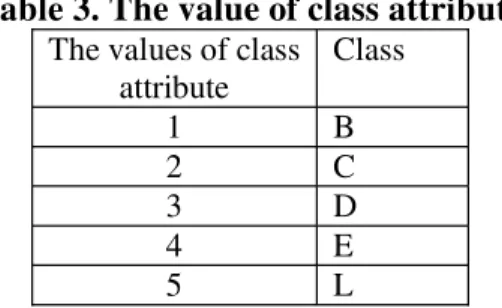
Cars are divided into classes. Cars are divided into classes by certain criteria: destination, car body type, weight, length etc. Each class is denoted by a letter in Latin alphabet. Attribute class has the following values:
Table 3. The value of class attribute
The values of class
attribute Class
1 B
2 C
3 D
4 E
5 L
Fabrication_yearattribute refers to the year the car was manufactured and may take the following values:
Table 4. The value of fabrication_year attribute
The values of fabrication_year
attribute
Fabrication_year
1 <=2000
2 2000 and=2005
3 2005
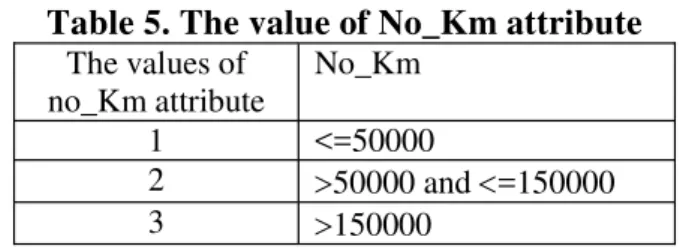
Table 5. The value of No_Km attribute
The values of no_Km attribute
No_Km
1 <=50000
2 50000 and=150000
3 150000
Priceattribute refers to the price offered by the seller and has the following values:
Table 6. The value of price attribute
The values of price attribute
Price (Euro)
1 <=5000
2 5001 and=10000
3 10000
Before starting the tests, given that the algorithms selected for analysis established a relationship between input attributes and output attribute (the cause-effect) it was required a modification. Therefore, all instances of the database must contain at least two attributes not null, one for input and one for output, since it is impossible to establish a relationship with a single attribute. As a result, in the database there were deleted all instances that had a single attribute.
2.THE PROPOSED MODEL
As environmental data mining it was used WEKA platform. Weka stands for Waikato Environment for Knowledge analysis (Waikato Environment Knowledge Analysis) software and is a University of Waikato, New Zealand.
Figure 1. Source file containing the input dataset
Weka strengths of this package are:
is available under GNU (General Public License)
is very portable as it is implemented in Java programming language, language that runs on any platform;
contains a collection of techniques for preprocessing and data modeling; is easy to use even by a beginner because it uses graphical user interfaces.
Dataset used in WEKA programming environment must be in CSV or ARFF to be processed. The data come mostly from an Excel table or a database and must be converted to CSV or ARFF format, the most widely distributed database in text files. Using this format in parallel with direct support for databases is another advantage of WEKA. In addition to these favorable factors characterizing WEKA system, there are some disadvantages, namely that use interface requires learning, understanding algorithms and the interpretation of numerical and graphical results.
In addition, WEKA uses statistical terms instead of using appropriate terms of input (e.g., in economic applications) like other specialized software business and more intuitive for a manager or economist
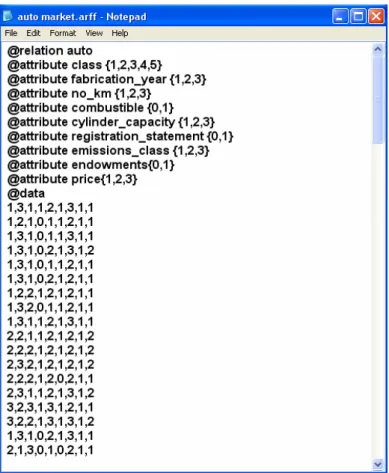
Dataset used was converted into ARFF format to be processed and it was added a header containing the description of attributes, types and their values. In figure 1 are the attributes that were used for modeling application.
The final form of the database contains 9 attributes which describe the existing information about cars and 329 instances. Analyzing the distribution of car prices according to the 9 attributes we observe the following (Figure 2):
Only 49 of the 329 machines have higher selling price of 10,000 euros; Nearly half of all machines are considered Class B
Only 75 of all cars are unregistered.
Figure 2. Attribute Distribution
After applying the algorithm "InfoGainAttributeEval" with Ranker search method we notice that the most important attribute to consider for the price of a car is the class attributes, followed by year of manufacture and the number of kilometers traveled.
Figure 3. Attribute evaluation results
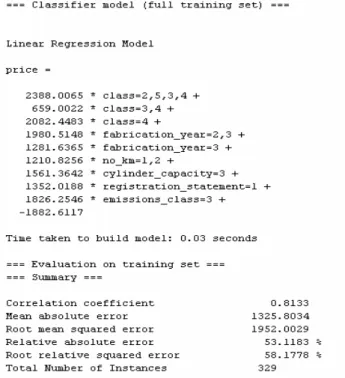
Between the analyzed characteristics and the cars price is a direct relationship, this being represented by a linear connexion. The corresponding algorithm for a linear connexion between the input attributes and the output attribute is the model of linear regression, model that is found in the set of functional algorithms in Weka package.
Linear regression algorithm implemented in Weka is not limited to numeric attributes, being an excellent method to analyze the training database were 7 attributes determine directly the 8th attribute (price). The most important parameter to the algorithm of linear regression is the attribute selection method with 3 possible options.
At the extreme there are “without selection” method that leads to rapid obtain of some results, but it is less selective, respectively, the “Greedy” method that is considerably slower but with precise results. Between them, there is “M5” method that makes a compromise between speed and accuracy. Though, we must consider a restriction: The “Greedy” method determines the most precise formula, but it needs that the relationship between the input and the output attributes is as close to a linear order to determine the correct local maximum values. If the relationship is not linear, it will lead to an incorrect formula.
By applying linear regression classification algorithm based on complete data (329 records), so method "Greedy" and method "M5" found exactly the same car pricing formula based on its characteristics.
Correlation coefficient was 0,8133, which means that the relation between car characteristics and price can be well approximated with a linear relation. A correlation coefficient of value 1 indicates a perfect linear relation and 0 means that there is no relation between the input and output. The rate of linear regression considered relevant only 6 input attributes of 7.
1826,2546-1882,6117=6008,34 Euro
Using the found formula we can easily calculate the price of a car by its characteristics. For example, a car class D, made in the last 5 years, with less then 50000 km, engine capacity greater than 1800 cc, registered, has an estimated price by simple adding the corresponding values for each attribute.
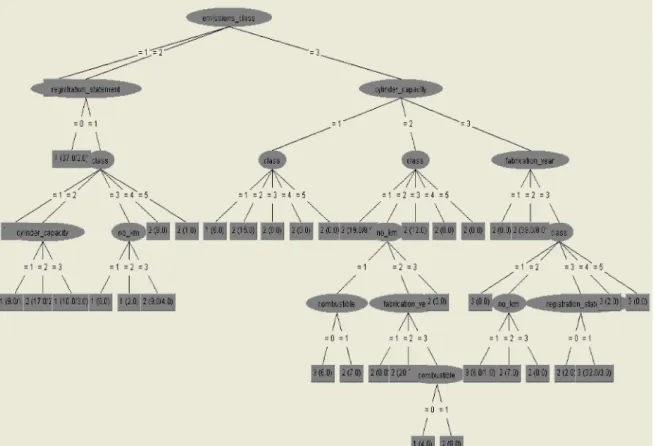
Figure 4. Decision tree algorithm resulting from applying J 48
J.48 algorithm is C4.5 algorithm implementation in Java. and uses top-down inductive method of building decision trees. They are built on testing each node of the tree from the root node for each record. Each node represents an attribute name. it tries placing the instance in an existing class based on common characteristics, evaluating the corresponding attribute for the reached node. Depending on the value, the instance will follow a branch. When there are no more nodes to evaluate, the instances is classified. If a particular class no more obviously differs from a different class by the introduction of more and more records, the two unite, using a process called "pruning." After applying the J48 classification algorithm we achieved an accuracy of 88.75% which means that 292 of 329 instances were classified correctly in the model created.
The value of kappa statistic is 0,8152 and indicates a strong correlation between the attributes analyzed.
Weka generated the following confusion matrix in which the columns indicate the previewed classes (classified), and the rows are the actual classes (real).
Diagonal matrix indicates correct predictions (110 +140 +42 = 292), and the other elements of the matrix shows incorrect predictions (20 +6 +7 +4 = 37).
TP rate (true positive rates) is the fraction of positive instances predicted as positive and equals to recall parameter.
Rate parameter FP (False Positive Rate) is the fraction of negative instances predicted as positive. The confusion matrix, PF Rate is calculated using the formula:
linii celelalte pe
elem suma diag pe de elem coloana pe
elem suma Rate
FP_ ( _ _ _ _ _ _ )/ _ _ _ _
Parameter F-Measure is calculated using the formula:
) Pr
_ /( ) Pr
* _ * 2 (
_Measure TP Rate ecision TP Rate ecision
F
ROC curves (Receiver Operating Characteristic) are widely used in evaluating the results of predictions (forecasts) The Area Under the ROC Curve (AUC) is a measure of performance that encapsulates many of the advantages of ROC curve.
The generated decision tree has as root node the class of pollutant emissions, this attribute being the main mean to differentiate the cars. In the model there were also found as relevant for car differentiation the attributes: class (present in every main brach of the tree), the registration state and the manufacturing year.
For E class cars, the model cannot be successfully applied in the dataset because there are only six cars registered for the class E. The lack of a greater number of records made it impossible to create a viable model for this class.
emissions_class = 3(Euro 4)
| cylinder_capacity = 3(1800 cmc) | | class=2(C)
| | | no_km=2 (50000-150000 Km)
| | | | fabrication_year = 1(2000-2005): 2 (5000-10000 Euro)
To make a comparative study it was applied ID3 algorithm. This verifies the number of instances classified correctly, respectively incorrectly.
Figure 5. Results obtained from applying the ID3 algorithm
The results obtained can be viewed in Figure 5. In the example shown, the case of ID3, achieved an accuracy of 91.48% which means that 301 of 329 instances were classified correctly and 28 incorrectly in the created model.
The value of kappa statistic is 0.8599 and indicates a strong correlation between the attributes analyzed.
Weka generated following confusion matrix.
Confusion matrix columns indicate the predicted class (classified), and the raws, the existing classes (real). Class 1 contains 130 instances, class 2, 149 instances, class 3, 49 instances.
the total number of predicted values is stated in the Precision parameter that indicates that the proposed model has predictive power and is conclusive.
CONCLUSIONS
This study shows that data mining is an instrument of analyze very strong that allows extracting new information regarding second hand cars prices by their characteristics and using these information in buying decision.
Based on a set of learning it was built a model that can be applied to estimate second car price as to identify defining characteristics client car buying decision.
The obtained results indicate a string relation between the car price and the characteristics presented: Class, year of fabrication, number of km, engine capacity, registration, and emissions. The most important attributes for cr price analyze are class, manufacturing year and number of km. The study can be extended be including others factors, such as interest rate.
REFERENCES
1. Gorunesu, F., „Data Mining. Concepte, modele şi tehnici”, Editura Albastră, Cluj-Napoca, 2006.
2. Ioniţ ă, A., „Asupra termenului de data mining”, Revista Română de Informatică şi Automatică, vol. 15, nr. 2, 2005.
3. Leontin, T. L., Moldovan, D., Rusu, M., Secară, D., Trifu, C., „Data mining on the real estate market”, Revista Informatica Economică, nr. 4 (36)/2005
4. Oprea Cristina, Zaharia, M., Gogonea, M., “ Analysis of student performance to license exam using data mining techniques”, The 14th IBIMA Conference on Global Business Transformation through Innovation and Knowledge Management, Istanbul, 2010
5. Oprea Cristina, Zaharia, M., Enăchescu, D., „Knowledge discovery using data mining techniques: A case study”, „Annual Session Of Scientific Papers IMT”, Oradea, 2010”
6. Oprea, M., „Sisteme bazate pe cunoştinţ e Ghid teoretic şi practic”, Matrix ROM, Bucureşti, 2002
7. Oprea, M., Tudor, I., Cărbureanu, M., „Prediction of Student Professional Evolution with
Data Mining Techniques”, The eight international conference on informatics in economy, Bucharest, Romania, May 17-18, 2007
8. Tudor, I., Cărbureanu, M., Tehnici de data mining în managementul cunoaşterii într-o universitate, în Managementul cunoaşterii în universitatea modernă, coord.: Bodea C.N. şi Andone I., Editura ASE Bucureşti, 2007, p.293.
9. Zaharia M., Gogonea R. M., Econometrie. Elemente fundamentale, Editura Universitară, Bucureşti, 2009.
ASPECTS REGARDING THE EVOLUTION OF THE TOURIST ACTIVITY AT A REGIONAL LEVEL IN ROMANIA, POLAND AND SLOVAKIA
Professor PhD. Cristian Valentin HAPENCIUC Assistant PhD. Student Adrian Liviu SCUTARIU
Ştefan cel Mare University of Suceava, Romania
[email protected] [email protected]
Abstract:
This article aims at highlighting the general tendencies that manifest in the field of tourism, at regional level in Romania, in comparison with Slovakia and Poland during the period after 2002. The first part presents several general landmarks at E.U. level, and then the analysis will focus on the three countries mentioned. Thus, one will follow through some indicators, among which: the number of accommodation places, the number of overnight stays, and the intensity of tourism. The available data permit one to observe the evolution of tourism in the three countries at a regional level for the last years. The study reveals several conclusion among which the fact that Romania is situated third after Poland and Slovakia as tourist activity, the latter having a larger intensity of this activity, as well as the fact that there are large discrepancies between regions from the point of view of tourist activity.
Key words: tourist activity, tourism intensity, overnight stays, regional, Romania, Poland, Slovakia
JEL Classification: L 83
1. INTRODUCTION
This research focuses on making a comparison, at regional level, between the evolution of tourism in Romania, a country which adhered to the E.U. in 2007 and two of the countries which adhered in 2004, Poland and Slovakia; in this manner one analyzes the manifested tendencies and the registered experiences, and if these are similar in Romania in the post-adhesion years.
The reason why one has chosen Poland and Slovakia, is the fact that this two countries, like Romania, had a rather similar past (former communist countries located in the influence zone of the U.S.S.R.), and for that matter, having a similar route if not identical after 1990, also having at least the same objectives, although for Romania, the road to creating and consolidating a market economy was even longer.
One will engage in a short general analysis of tourism in these three countries, in the E.U. context, underlying the general tendencies of tourism in the E.U. member states in the recent period, emphasizing the tendencies which manifest themselves at regional level in Romania, Poland and Slovakia.
2. CONSIDERATIONS REGARDING THE TOURISM OF ROMANIA, POLAND AND SLOVAKIA IN THE E.U. CONTEXT
Tourism is an important element of the third sector, and has a more and more important role in the economy of a country, constituting as a factor on which the economic growth is based. The last half of century has registered a growth in the third sector, which has diversified the activities, becoming preponderant in the developed countries.
The services which constitute tourism are varied and are derived from the primordial ones: of information, placement of tourist travels, accommodation, selling of food products, treatments, leisure and entertainment. The development of tourist activity has as an effect the boosting of those economy branches, suppliers for tourism and of other fields necessary to consolidating the tourist product (constructions, food, transportation etc.) as well as those connected, like commerce.
Europe remains one of the world’s major tourist destinations, and 6 of the U.E. member states are among the top 10 destination of tourist operators (1). Thus, it is absolutely normal that the tourist industry has an important role from an economic and labor market point of view, and also from a social and an environmental perspective.
Along with its economical and employment potential, tourism can have a significant role in the development of regions. The infrastructure can contribute to the local development, and the jobs in tourism can counteract the effects of the industrial or rural decline. Durable tourism presupposes the conservation of the natural and cultural heritage, as well as keeping the biodiversity.
The general tendency of tourism was of rapid development in the last part of the past century, and between 2001 and 2003 as a consequence of the economic regression, terrorist risks, epidemics and natural disasters, the demand has decreased. After this period low-cost companies have flourished and tourism has known a revival.
The largest number of overnight stays, according to the data available in 2009, is registered in Italy, followed by Spain, Germany and France. Poland registers a number of overnight stays significantly larger in comparison to Romania, and Slovakia ranks after Romania (figure 1).
0 100000000 200000000 300000000 400000000 500000000 600000000 700000000 It a ly S p a in G e rm a n y F ra n c e A u s tr ia N e th e rl a n d s P o rt u g a l P o la n d S w e d e n C z e c h C ro a ti a B e lg iu m D e n m a rk R o m a n ia F in la n d H u n g a ry B u lg a ri a C y p ru s S lo v a k ia M a lt a S lo v e n ia E s to n ia Ic e la n d L a tv ia L it h u a n ia L u x e m b o u rg L ie c h te n s te in Nights
Figure 1. Total nights spent in collective tourist accommodation establishments, hotels and
similar establishments, 2009 Source: Eurostat
It can be said that the first four countries constitute tourist destinations par excellence; having superior worth values in comparison to the other E.U. member countries.
Because of the different surfaces of the countries, one can say that is relevant to underline the values of the tourism intensity indicator. Figure.2 stresses the intensity of tourism which means the number of overnight stays of tourists related to the population of a country. Thus, one can notice the relative intensity of tourist activities in the E.U. countries. This is preponderant in Malta, Cyprus, and Austria which occupy the first places in the E.U. countries ranking. Regarding Slovakia, Poland and Romania, they are situated on lower places, the latter occupying the last place in the ranking.
Figure. 2. Tourism intensity, 2008
(ratio of nights spent by residents and non-residents in hotels and similar establishments and other collective accommodation establishments per inhabitant)
For completing the analysis, it is also interesting to follow the evolution of income and international expenditures occasioned by tourism.
In its dynamic, the point value of income and international expenditure of tourism reveals a growth, at the E.U. 27 level, and as well as in the case of most member states. Romania lies behind Poland and even Slovakia, regarding the receipts, registering decreases concerning the income. This is probably due to a diminishing in the foreign tourists’ interest for Romania, because of a low promotion and of disequilibrium in the quality/price value. As opposed to Romania, Slovakia and Poland register substantial increases in income from international tourism. As value for tourist expenditure, Poland has the biggest tourist expenses made by citizens outside the country, in comparison with the other two countries.
Table 1. Tourism receipts and expenditure from personal travel


![Table no.1. The evolution of the volume of drinking water distributed to consumers,[1].](https://thumb-eu.123doks.com/thumbv2/123dok_br/16423985.195471/40.892.125.745.738.1200/table-evolution-volume-drinking-water-distributed-consumers.webp)