NHESSD
2, 3863–3886, 2014Extreme temperature days and potential impacts in Southern
Europe
A. Cardil et al.
Title Page
Abstract Introduction
Conclusions References
Tables Figures
◭ ◮
◭ ◮
Back Close
Full Screen / Esc
Printer-friendly Version
Interactive Discussion
Discussion
P
a
per
|
Discus
sion
P
a
per
|
Discussion
P
a
per
|
Discussion
P
a
per
|
Nat. Hazards Earth Syst. Sci. Discuss., 2, 3863–3886, 2014 www.nat-hazards-earth-syst-sci-discuss.net/2/3863/2014/ doi:10.5194/nhessd-2-3863-2014
© Author(s) 2014. CC Attribution 3.0 License.
This discussion paper is/has been under review for the journal Natural Hazards and Earth System Sciences (NHESS). Please refer to the corresponding final paper in NHESS if available.
Extreme temperature days and potential
impacts in Southern Europe
A. Cardil1, D. M. Molina1, and L. N. Kobziar2
1
School of Agrifood and Forestry Science and Engineering, University of Lleida, Avenida Rovira Roure 191, 25198 Lleida, Spain
2
School of Forest Resources and Conservation, University of Florida, P.O. Box 110410, Gainesville, 32611-0410, USA
Received: 28 April 2014 – Accepted: 20 May 2014 – Published: 2 June 2014
Correspondence to: A. Cardil ([email protected])
NHESSD
2, 3863–3886, 2014Extreme temperature days and potential impacts in Southern
Europe
A. Cardil et al.
Title Page
Abstract Introduction
Conclusions References
Tables Figures
◭ ◮
◭ ◮
Back Close
Full Screen / Esc
Printer-friendly Version
Interactive Discussion
Discussion
P
a
per
|
Discus
sion
P
a
per
|
Discussion
P
a
per
|
Discussion
P
a
per
|
Abstract
Extreme temperature events have consequences for human health and mortality, forest disturbance patterns, agricultural productivity, and the economic repercussions of these consequences combined. To gain insight into whether extreme temperature events are changing in light of global climate dynamics, the annual numbers of high temperature
5
days (those with temperatures higher than 20, 22.5 and 25◦C at 850 hPa) were
an-alyzed across Southern Europe from years 1978–2012. A significant increase in the frequency of these days was found in many areas over the time period analyzed, and patterns in the spatial distribution of these changes were identified. We discuss the potential consequences of the increases in high temperature days with regards to
for-10
est fire risk, human health, agriculture, energy demands, and some potential economic repercussions.
1 Introduction
Heat wave events play a role in determining human health and episodic mortality patterns, and are also recognized as having marked impacts on agriculture, forestry,
15
wildland fire and socio-economic activities (Poumadère et al., 2005; Mills, 2005; Trigo et al., 2006; Kuglitsch et al., 2010; Cardil et al., 2013). Multiple heat waves have been recorded in Southern Europe in recent years, including 2003 where summer tempera-tures across Europe were the highest of the last 500 years (Luterbacher et al., 2004). Extreme temperature days and heat waves were linked to above-average human
mor-20
tality in the cities of Madrid and Lisbon (García-Herrera et al., 2005), and in France in 2003 (Poumadere et al., 2005). In addition, large wildland fires are more likely dur-ing heat wave events, burndur-ing thousands of hectares across multiple ecosystems in the Mediterranean region (e.g. 1994 in Spain, 2003 in Portugal, 2007 in Greece). In Russia
in 2010, unusual temperatures around 40◦C were recorded and the resulting drought
25
NHESSD
2, 3863–3886, 2014Extreme temperature days and potential impacts in Southern
Europe
A. Cardil et al.
Title Page
Abstract Introduction
Conclusions References
Tables Figures
◭ ◮
◭ ◮
Back Close
Full Screen / Esc
Printer-friendly Version
Interactive Discussion
Discussion
P
a
per
|
Discus
sion
P
a
per
|
Discussion
P
a
per
|
Discussion
P
a
per
|
much of the region with toxic smog (Gobin et al., 2013). An unprecedented spring heat wave in the US and Canada peaked in intensity during March of 2012 (Gobin et al., 2013), followed by a summer of destructive and even fatal wildfires in North American forests.
Extreme temperature events can also exacerbate other effects of global climate
5
change. For example, climate change-related increases in average temperatures have been linked to widespread insect outbreaks in North American forests (Safranyik, 2004), which coupled with wildfires propagated by extreme temperature events, can
have an multiplied effect on forest persistence. The synergistic effects of extreme
tem-peratures and their repercussions have been identified as possible mechanisms for
10
the development of a positive feedback cycle of global warming and continued loss of greenhouse gases to the atmosphere.
Climate change projections for the Mediterranean Basin show a higher variability in weather conditions and an increase in extreme weather events, with longer, more
frequent, and even more intense heat waves (Moriondo et al., 2006; Diffenbaugh
15
et al., 2007; Giorgi and Lionello, 2008; Regato, 2008; Giannakopoulos et al., 2009; Barriopedro et al., 2011). The Mediterranean is widely considered a climate change “hot spot” (Giorgi, 2006), meaning that the region is a sensitive indicator of changes which have already occurred, and is expected to be a sensitive responder to predicted changes due to its location at the intersection of tropical and mid-latitude atmospheric
20
and oceanographic processes. Although numerous authors have explored the relation-ships between predicted climate change and expected increases in temperatures (e.g. Giorgi and Lionello, 2008; Giannakopoulos et al., 2009), few have identified spatial
patterns and differences in magnitude of recent change in extreme temperature day
frequencies. In order to explore trends in extreme temperature events over time across
25
NHESSD
2, 3863–3886, 2014Extreme temperature days and potential impacts in Southern
Europe
A. Cardil et al.
Title Page
Abstract Introduction
Conclusions References
Tables Figures
◭ ◮
◭ ◮
Back Close
Full Screen / Esc
Printer-friendly Version
Interactive Discussion
Discussion
P
a
per
|
Discus
sion
P
a
per
|
Discussion
P
a
per
|
Discussion
P
a
per
|
Although extreme events can be interpreted using a variety of metrics, we focused on air temperature at 850 hPa as a reference (the air temperature at approximately 1500 m a.s.l. where pressure is 850 hPa) because it is used by many forecast agen-cies and is an indicator of heat waves or the evolution of temperatures in successive days (AEMET – Spanish Meteorological Agency; Trigo et al., 2006). In addition, some
5
problems that affect near surface reanalysis do not occur when using temperatures at
this altitude (Ogi et al., 2005). We assessed trends in the number of high
tempera-ture days (HTD) with three different temperature thresholds: 20, 22.5, and 25◦
C. Be-cause the 95th percentile weather, or the “hot tail” has been identified as an important metric for predicting future heat stress and amplification by soil moisture loss in the
10
Mediterranean Basin (Diffenbaugh et al., 2007), we also analyzed this variable using
the summer period from June–September from 1978–2012.
2 Methods 2.1 Study area
This work focused on Southern Europe because it is expected to be the most
sus-15
ceptible European area to a significant increase in extreme temperature events, and to sustain some of the most significant impacts (Giorgi, 2006; Giannakopoulos et al., 2009). Thirty-four points were used for the analysis, distributed systematically across the region (Fig. 1). This region comprises Portugal, Spain (Mediterranean Coast, points 2, 3, 4, 8, 9 and 14; Interior Spain, points 6, 7 and 13; North Spain; 10, 11 and 12) South
20
NHESSD
2, 3863–3886, 2014Extreme temperature days and potential impacts in Southern
Europe
A. Cardil et al.
Title Page
Abstract Introduction
Conclusions References
Tables Figures
◭ ◮
◭ ◮
Back Close
Full Screen / Esc
Printer-friendly Version
Interactive Discussion
Discussion
P
a
per
|
Discus
sion
P
a
per
|
Discussion
P
a
per
|
Discussion
P
a
per
|
2.2 High temperature days (HTD)
We used NCEP reanalysis data from the National Centers for Environmental Prediction and the National Center for Atmospheric Research (Kalnay et al., 1996) to character-ize the high temperature days on a synoptic scale. NCEP output data has a
horizon-tal resolution of 2.5◦
latitude-longitude. We analyzed the 34 points distributed in the
5
study area as shown in Fig. 1. Daily air temperature data at 850 hPa pressure level at 00:00 UTC were analyzed from 1978 to 2012. We chose the air temperature at 850 hPa as reference because it is used by Meteorological Services to forecast and display heat-waves or the trend of temperatures in successive days (AEMET, Spanish
Meteorological Agency). It is also used by different agencies across Southern Europe
10
(i.e. Aragón Forest Service, Castilla-La-Mancha Forest Service, Catalonia Fire-Fighting Service, Valencia Fire-Fighting Service, CFVA in Sardinia – Italy) to analyze past fire weather events and to forecast daily potential fire occurrence and behavior (Trigo et al., 2006; Garcia-Ortega et al., 2011). In this manner, it provides adequate regional
cover-age and it is representative of the surface, avoiding some of the problems that affect
15
near surface reanalysis (Ogi et al., 2005; Trigo et al., 2005, 2006).
We used several HTD categories considering different temperature thresholds:
(1) HTD20, those days with an air temperature higher than 20◦C at 850 hPa,
(2) HTD22.5, those days with an air temperature higher than 22.5◦C at 850 hPa and,
(3) HTD25, those days with an air temperature higher than 25◦C at 850 hPa, (4) HTDp95,
20
95th percentile of air temperature at 850 hPa in the June–September period from 1978
to 2012. The use of the 95 % percentile helps capture the different implications for
hu-man health, energy systems, and natural vegetation and disturbances for temperature
extremes in different locations. For example, in the northern section of the study area,
where mean temperatures are generally lower, a temperature above 20◦C would
ex-25
NHESSD
2, 3863–3886, 2014Extreme temperature days and potential impacts in Southern
Europe
A. Cardil et al.
Title Page
Abstract Introduction
Conclusions References
Tables Figures
◭ ◮
◭ ◮
Back Close
Full Screen / Esc
Printer-friendly Version
Interactive Discussion
Discussion
P
a
per
|
Discus
sion
P
a
per
|
Discussion
P
a
per
|
Discussion
P
a
per
|
The limit of 20◦C of air temperature at 850 hPa was chosen because it provides high
temperatures in surface and typically low relative humidity in the territory, and is as-sociated with heat waves in many zones in the study area (Montserrat, 1998; Cardil et al., 2013). We analyzed temporal trends in relation to the annual number of HTD in all four categories using least squares fitted linear regression models and tested
5
whether slopes differed significantly from zero (p <0.05). For those locations where
significant temporal changes were found to exist, we further investigated spatial
pat-terns of change. To determine whether significant differences in number and changes
in high temperature days across latitudes and longitudes, we used one-way ANOVA followed by Tukey’s HSD test.
10
3 Results
The annual number of HTD differed in relation to the different areas and countries.
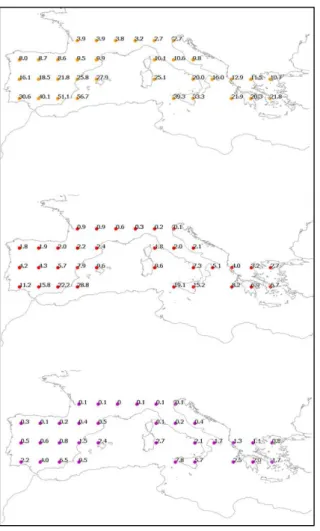
Generally, points with higher latitude had fewer HTD in all categories (Fig. 2). The
points with a higher annual number of HTD20, HTD22.5, HTD25 are located in
Mediter-ranean Spanish Coast (points 2, 3 and 4) and in the South of Portugal (point 1; Fig. 2).
15
However, points located in Greece at the same latitude had a significantly lower num-ber of these days. The island of Sardinia (point 21) and Balearic Islands (point 9) had higher numbers of extreme temperature days in relation to other locations at the same latitude. The same results were obtained in relation to the 95th percentile in terms of temperature during the June–September period from 1978 to 2012.
20
Temporal trends in terms of annual number of HTDp95, HTD20, HTD22.5, and the
95th percentile for all analyzed points are shown in Table 1 and Fig. 3. Note that the
HTD25 category is not in Table 1 because no significant trends were found at any
point, mainly due to the low number of these days. A significant increase in the annual
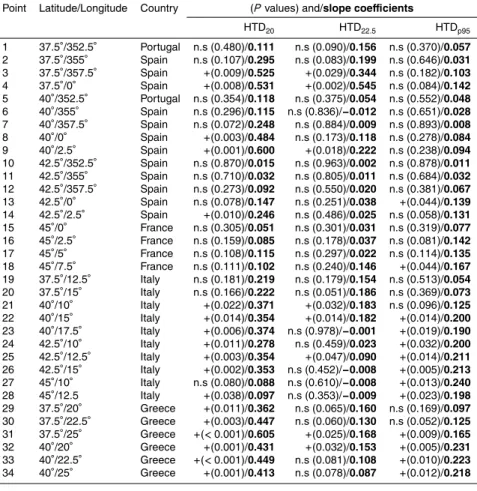
number of HTD20 was found in locations around the Mediterranean Spanish Coast
25
NHESSD
2, 3863–3886, 2014Extreme temperature days and potential impacts in Southern
Europe
A. Cardil et al.
Title Page
Abstract Introduction
Conclusions References
Tables Figures
◭ ◮
◭ ◮
Back Close
Full Screen / Esc
Printer-friendly Version
Interactive Discussion
Discussion
P
a
per
|
Discus
sion
P
a
per
|
Discussion
P
a
per
|
Discussion
P
a
per
|
no significant changes over the study time period analyzed were detected. However,
significant increases of the annual number of HTD20 and/or the 95th percentile were
found in the majority of sites in Italy and Greece (except in Sicily). Extreme weather days are becoming more frequent in these areas. Additionally, the highest increases in
terms of annual number of HTD20 were found in Greece and along the Mediterranean
5
Spanish Coast (0.60 HTD20 more per year over the entire period). In Italy, significant
increases were found but lower than in Greece or along the Mediterranean Spanish
Coast (0.35 HTD20 more per year).
When all sites were considered HTD20 was higher overall in coastal vs. inland
loca-tions (8.8 vs. 5.1 days increase in days over time,p=0.005), Percent change in HTD25
10
differed between locations, being negative along the coast (−4.4 %) and positive inland
(+41.6 %,p <0.05). Other differences associated with proximity to the Mediterranean
coast were not detected. Although significant primarily for political planning, some
over-all differences among countries were detected. Italy had a higher change in HTD95than
Spain (4.1 vs. 2.3 days,p <0.05), and Spain had a greater relative change in HTD25
15
than Italy (43.3 % vs.−25.9 %, p <0.05). Greece had more than three times the
in-crease in HTD20 than France (9.6 vs. 2.3 days,p <0.05). Regarding HTD22.5, there is
a difference among Northern locations (points 14 and 28) vs. Southern locations (3, 4,
22 and 23) in Spain and Italy. The Southern locations displayed a significant increase
(0.3 HTD22.5more per year) in the number of HTD22.5.
20
In higher latitudes, the increase in number of days with an air temperature at 850 hPa
higher than 20 and 22.5◦C was less than in lower latitudes (Fig. 4). However, the
rela-tive increase in HTD20 was significantly higher in higher latitudes (Fig. 5), considering
only sites where significant temporal changes were evidenced. However, considering
22.5 and 25◦C thresholds, the relative increase in HTD did not change consistently
25
with latitude. In relation to those days that exceeded the 95th percentile, in higher lat-itudes there was an increase in both number of days and relative increase in number of days (Figs. 4 and 5). In most points included within the study scope, there was an
NHESSD
2, 3863–3886, 2014Extreme temperature days and potential impacts in Southern
Europe
A. Cardil et al.
Title Page
Abstract Introduction
Conclusions References
Tables Figures
◭ ◮
◭ ◮
Back Close
Full Screen / Esc
Printer-friendly Version
Interactive Discussion
Discussion
P
a
per
|
Discus
sion
P
a
per
|
Discussion
P
a
per
|
Discussion
P
a
per
|
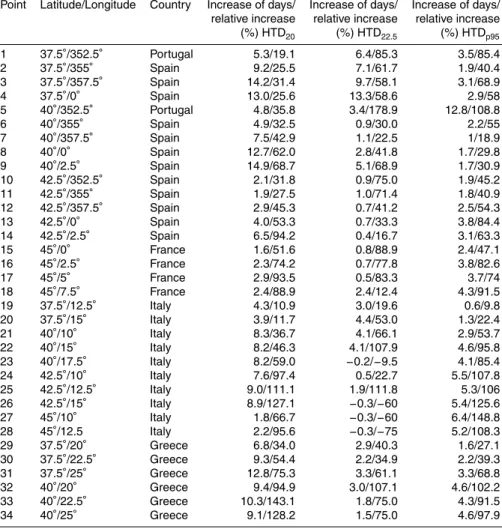
relative increase in these categories from 1978–1987 to 2002–2012. The highest rela-tive increases were found in Italy and Greece with values higher than 100 %; in other words, more than a doubling in the number of days (Table 2).
4 Discussion
Mean, maximum and minimum temperatures have increased and will likely continue to
5
increase in Southern Europe in the future (Moriondo et al., 2006; IPCC, 2007; Giorgi and Lionello, 2008; Giannakopoulos et al., 2009). Our study showed that there was also a trend towards more frequent HTD in summer (June to September) in Mediter-ranean coastal areas and in more southerly latitudes across the study area. This is in agreement with other studies on temperature trends, which have been shown to be
10
correlated to wildfire size and occurrence (Cardil et al., 2013, 2014). Overall, in South-ern Europe, most high temperature days are related to the weather system that brings hot dry air masses from North Africa (Rodriguez-Puebla et al., 2010; Pereira et al., 2011). However, we did not find the same HTD trends in NW Iberia, where other re-ports have documented increased warming of surface temperatures from 1974–2006
15
(Gómez-Gesteira et al., 2011), or in interior Spain. It is plausible that air fluxes from North Africa do not reach this area as frequently as in other regions, or that their in-fluence is mitigated by other weather systems associated with Atlantic currents. Some HTD might simply be caused by summer heating in Central Spain (Spanish plateau, 800 m a.s.l.).
20
Areas with the highest increases in terms of annual number of HTD20 (June–
September period) were found both in Greece and along the Mediterranean Spanish Coast. These areas are likely to be especially susceptible to the variety of impacts as-sociated with heat-wave episodes, including ecological, social, and economic impacts. While higher latitudes (more northern) sites exhibited a smaller increase in the number
25
of days with HTD22.5 and HTD20 than lower latitudes, the number of days exceeding
NHESSD
2, 3863–3886, 2014Extreme temperature days and potential impacts in Southern
Europe
A. Cardil et al.
Title Page
Abstract Introduction
Conclusions References
Tables Figures
◭ ◮
◭ ◮
Back Close
Full Screen / Esc
Printer-friendly Version
Interactive Discussion
Discussion
P
a
per
|
Discus
sion
P
a
per
|
Discussion
P
a
per
|
Discussion
P
a
per
|
the higherrelative increase in HTD 95 and HTD20 with latitude. It may be that the
af-fected vegetative, social, and economic systems in the lower latitude sites have already experienced some of the pressures of adapting to, or mitigating, the repercussions of, extreme temperatures. It is important to consider the relative increase in extreme tem-perature days in these higher latitudes, as a greater degree of change usually equates
5
to a higher severity of challenge. Some authors suggest that the consequences of heat waves is closely tied to a culture’s prior conditioning and adaptation to climate, includ-ing behavior (e.g. siesta on hot afternoons), characteristics of buildinclud-ings (e.g. exterior sun shades) and communities (orientation of windows away from afternoon sun), and even social attitudes about health risks (Poumadere et al., 2005; deCastro et al., 2011).
10
This suggests that although the absolute increase in extreme temperature days is less
severe at the higher latitudes, the relevance of the effects of the change may be greater
in more northern populations lacking prior conditioning and adaptation.
In all cases, where HTD 95 increased, additional synergistic repercussions are likely
to already be occurring. For example, Diffenbaugh et al. (2007) use downscaled climate
15
model predictions of heat stress in the Mediterranean region to show that increases in 95th percentile maximum temperatures are amplified by a reduction in soil moisture and 2 m relative humidity levels. These changes are relevant to human health, wildfire risk, energy demand, and perpetuity of existing ecological systems as detailed below.
4.1 Human health
20
Human health and mortality is affected by extreme temperature days. Many examples
have been reported in recent years. During the summer of 2010 in Russia,
tempera-tures of 40◦C were reached and the resulting drought caused extensive wildland fires.
These fires were responsible for hundreds of human deaths, and toxic smog covered Moscow for weeks (Gobin et al., 2013). Other works show that human mortality
in-25
NHESSD
2, 3863–3886, 2014Extreme temperature days and potential impacts in Southern
Europe
A. Cardil et al.
Title Page
Abstract Introduction
Conclusions References
Tables Figures
◭ ◮
◭ ◮
Back Close
Full Screen / Esc
Printer-friendly Version
Interactive Discussion
Discussion
P
a
per
|
Discus
sion
P
a
per
|
Discussion
P
a
per
|
Discussion
P
a
per
|
extreme temperature days continues to increase, mortality rates could respond simi-larly in the future. It may be necessary to take preventive measures to reduce these impacts on populations, preventing heat strokes and other heat-related illness. Such measures typically include increased cooling during these periods, which can also re-sult in peak demands for energy consumption.
5
4.2 Energy demands
Energy demand is closely linked to climatic conditions (Giannakopoulos and Psiloglou, 2006) and energy demand and temperature have a non-linear, somewhat complex relationship. The unevenness of ambient air temperature is associated with energy consumption, whose maximum values correlate with the extreme values of air
temper-10
ature (maximum or minimum). In January, in the Mediterranean region, highest values of energy consumption are correlated to the onset of minimum temperatures. During the transitory season of March–April, energy intake levels remain nearly constant until about May when air temperatures are consistently rising. From mid-May onwards and during the summer period, an increase in air temperature aligns with a rise in energy
15
consumption, mainly due to the wide use of air conditioning elements. It is during these early summer months that our data suggest increased number of HTD will have the greatest impact on energy demands. By August, when many people take their summer vacation, the demand for air conditioning is lower, especially in large Mediterranean metropolises. An additional transitory period is from September through October when
20
energy demand is stable. From this time onward there is a continually increasing en-ergy demand with a peak before the Christmas season. As a result, it is expected that warmer climate circumstances will lead to reduced demand in winter, while increased demand should have an impact during the early summer months (Giannakopoulos and Psiloglou, 2006).
25
Furthermore, higher temperatures in summer are likely to cause a larger peak energy demand and not only an increase on net demand. This may require the development
NHESSD
2, 3863–3886, 2014Extreme temperature days and potential impacts in Southern
Europe
A. Cardil et al.
Title Page
Abstract Introduction
Conclusions References
Tables Figures
◭ ◮
◭ ◮
Back Close
Full Screen / Esc
Printer-friendly Version
Interactive Discussion
Discussion
P
a
per
|
Discus
sion
P
a
per
|
Discussion
P
a
per
|
Discussion
P
a
per
|
4.3 Forest fire risk
Frequent heat waves in last decade or so (2000–2012) triggered the occurrence of large wildland fires (Mills, 2005; Trigo et al., 2006; Barriopedro et al., 2011; Cardil et al., 2013) in the Euro-Mediterranean region (Italy and Greece, 2007; Portugal, 2003 and 2005; Spain, 2006 and 2009) and overall the world (Australia, 1983 and 2009; Canada,
5
2004; Russia, 2010; USA, 2000, 2006 and 2007). On hot days, usually related to very dry fine dead fuel, ignition probability is higher and wildland fire behavior could be extreme (i.e. increasing flame length, rate of spread, crown fire activity, and spotting activity). As a result, fires may burn quickly and intensely and make large wildland fires
difficult to contain as they exceed the firefighting capabilities (Riaño et al., 2007; Salis
10
et al., 2012; Cardil and Molina, 2013). Such fires are more costly to local communi-ties, and in some cases may accrue bills that exceed a country’s planned resource allocations.
Recent analysis has shown that high temperatures days account for the majority of area burned in recent years in some regions in Spain and Italy, where the average daily
15
number of large fires and daily area burned was higher in HTD than in non-HTD (Cardil et al., 2013, 2014). Therefore, if extreme conditions (HTD) are more frequent in the future, the forest fire risk will most likely increase considerably. The resilience of forests to disturbance may also be influenced by extreme temperatures. Touchan et al. (2014) analyzed long-term tree chronologies in the eastern Mediterranean to find that growth
20
rates were sensitive to, and negatively related to, summer month temperatures. The trends reported here suggest that, in certain areas, forests have been increasingly stressed by extreme temperatures during the summer months over the last 34 years. Evidence of such stress has been documented in increased climate-linked mortality of forests across Europe (Allen et al., 2010). As summer temperatures continue to
25
increase (Giorgi and Lionello, 2008), and soil moisture contents decrease (Diffenbaugh,
NHESSD
2, 3863–3886, 2014Extreme temperature days and potential impacts in Southern
Europe
A. Cardil et al.
Title Page
Abstract Introduction
Conclusions References
Tables Figures
◭ ◮
◭ ◮
Back Close
Full Screen / Esc
Printer-friendly Version
Interactive Discussion
Discussion
P
a
per
|
Discus
sion
P
a
per
|
Discussion
P
a
per
|
Discussion
P
a
per
|
4.4 Agricultural losses
Investigation reports suggest that the consequences of climate change on farming and forestry is likely to be more severe in the Mediterranean areas than in northern tem-perate areas (Gobin et al., 2013). Some weather related dangers such as drought and
floods have a systemic component, i.e. they affect most growers within a whole region.
5
Others are more location specific, i.e. storms. Undoubtedly, agriculture as a profitable
segment is exposed to and sensitive to weather events, affecting multiple related
eco-nomic systems.
Harvest unevenness is likely to increase due to more recurrent extreme weather ex-cesses (at least at the individual farm level) (IPCC, 2012). Understanding of extreme
10
events and hardships is a pre-requisite for the implementation of adaptation strategies and risk mitigation in the context of climate change. Extreme events will have higher im-pacts on sectors with closer links to climate, such as agriculture and food security. A di-versity of research publications since 2010 present evidence that the present warming tendencies have started to have deleterious impacts on agriculture through
intensifica-15
tion in the probability of extreme temperatures during the growing period (Gobin et al., 2013). Our data provide quantification of these extreme temperatures, which can be informative for agricultural planning and decision making specifically in each location analyzed.
Risk management should be active in anticipating potential problems, and planning
20
to mitigate their consequences, rather than reacting to unfavorable events after they happen. The two main aspects of risk management are first anticipating that an unfa-vorable event may occur and acting to decrease the probability of its happening, and second, taking actions which will moderate the harmful costs should the unfavorable episode occur. Both structural and non-structural measures are vital to reducing the
25
NHESSD
2, 3863–3886, 2014Extreme temperature days and potential impacts in Southern
Europe
A. Cardil et al.
Title Page
Abstract Introduction
Conclusions References
Tables Figures
◭ ◮
◭ ◮
Back Close
Full Screen / Esc
Printer-friendly Version
Interactive Discussion
Discussion
P
a
per
|
Discus
sion
P
a
per
|
Discussion
P
a
per
|
Discussion
P
a
per
|
the medium range weather forecasting and crop insurance. We hope that the data presented here can be useful for planning for risk reduction.
5 Conclusions
Even though we did not find significant increases in South France, Interior Spain and the Northwestern Iberian Peninsula, the annual number of HTD increased significantly
5
in many areas across Southern Europe including the Spanish Mediterranean Coast, Italy, and Greece. The highest increases in terms of annual number of HTD were found in both Greece and along the Spanish Mediterranean Coast. In these areas, extreme temperature conditions are becoming more frequent now and could become more com-mon in the future. In addition, in areas where temporal increases were detected, relative
10
increases in 95th percentile temperatures were higher at higher latitudes. Where so-cial, infrastructure, and economic systems are not preconditioned to high temperature
days and heat waves, the severity of increased temperature effects may be elevated.
Heat wave days have been linked to negative impacts in terms of forest fire risk, human health, agriculture, energy demands, and economic repercussions. Adaptive measures
15
should be instituted in an attempt to diminish the negative consequences for human populations and the environment.
Acknowledgements. We are appreciative to the University of Lleida and Pau Costa Foundation
for supporting this study through a partial grant to fund Adrian Cardil Ph.D. studies. We also thank the Erasmus Mundus European Forestry program for supporting international scholarly
20
NHESSD
2, 3863–3886, 2014Extreme temperature days and potential impacts in Southern
Europe
A. Cardil et al.
Title Page
Abstract Introduction
Conclusions References
Tables Figures
◭ ◮
◭ ◮
Back Close
Full Screen / Esc
Printer-friendly Version
Interactive Discussion
Discussion
P
a
per
|
Discus
sion
P
a
per
|
Discussion
P
a
per
|
Discussion
P
a
per
|
References
Allen, C. D., Macalady, A. K., Chenchouni, H., Bachelet, D., McDowell, N., Vennetier, M., Kitzberger, T., Rigling, A., Breshears, D. D., Hogg, E. H. (T.), Gonzalez, P., Fensham, R., Zhang, Z., Castro, J., Demidova, N., Lim, J.-H., Allard, G., Running, S. W., Semerci, A., and Cobb, N.: A global overview of drought and heat-induced tree mortality reveals emerging
5
climate change risks for forests, Forest Ecol. Manage., 259, 660–684, 2010.
Barriopedro, D., Fischer, E. M., Luterbacher, J., Trigo, R. M., and García-Herrera, R.: The Hot Summer of 2010: redrawing the temperature record map of Europe, Science, 332, 220–224, 2011.
Cardil, A. and Molina-Terren, D. M.: Large wildland fires in three diverse regions in Spain from
10
1978 to 2010, Forest Systems, 22, 526–534, 2013.
Cardil, A., Molina, D. M., Ramirez, J., and Vega-García, C.: Trends in adverse weather patterns and large wildland fires in Aragón (NE Spain) from 1978 to 2010, Nat. Hazards Earth Syst. Sci., 13, 1393–1399, doi:10.5194/nhess-13-1393-2013, 2013.
Cardil, A., Salis, M., Spano, D., Delogu, G., Molina Terrén, D.: Large wildland fires and extreme
15
temperatures in Sardinia (Italy), iForest, 7, 162–169, 2014.
deCastro, M., Gómez-Gesteira, M., Ramos, A. M., Alvarez, I., and deCastro, P.: Effects of heat waves on human mortality, Galicia, Spain, Clim. Res., 48, 333–341, 2011.
Diffenbaugh, N. S., Pal, J. S., Giorgi, F., and Gao, X.: Heat stress intensification in the Mediterranean climate change hotspot, Geophys. Res. Lett., 34, L11706,
20
doi:10.1029/2007GL030000, 2007.
García-Herrera, R., Díaz, J., Trigo, R. M., and Hernández, E.: Extreme summer temperatures in Iberia: health impacts and associated synoptic conditions, Ann. Geophys., 23, 239–251, doi:10.5194/angeo-23-239-2005, 2005.
García-Ortega, E., Trobajo, M. T., López, L., and Sánchez, J. L.: Synoptic patterns associated
25
with wildfires caused by lightning in Castile and Leon, Spain, Nat. Hazards Earth Syst. Sci., 11, 851–863, doi:10.5194/nhess-11-851-2011, 2011.
Giannakopoulos, C. and Psiloglou, B. E.: Trends in energy load demand for Athens, Greece: weather and non-weather related factors, Clim. Res., 31, 97–108, 2006.
Giannakopoulos, C., Le Sager, P., Bindi, M., Moriondo, M., Kostopoulou, E., and
Good-30
NHESSD
2, 3863–3886, 2014Extreme temperature days and potential impacts in Southern
Europe
A. Cardil et al.
Title Page
Abstract Introduction
Conclusions References
Tables Figures
◭ ◮
◭ ◮
Back Close
Full Screen / Esc
Printer-friendly Version
Interactive Discussion
Discussion
P
a
per
|
Discus
sion
P
a
per
|
Discussion
P
a
per
|
Discussion
P
a
per
|
Giorgi, F.: Climate change hot-spots, Geophys. Res. Lett., 33, L08707, doi:10.1029/2006GL025734, 2006.
Giorgi, F. and Lionello, P.: Climate change projections for the Mediterranean region, Global Planet. Change, 63, 90–104, 2008
Gobin, A.: Impact of heat and drought stress on arable crop production in Belgium, Nat. Hazards
5
Earth Syst. Sci., 12, 1911–1922, doi:10.5194/nhess-12-1911-2012, 2012.
Gobin, A., Tarquis, A. M., and Dalezios, N. R.: Preface “Weather-related hazards and risks in agriculture”, Nat. Hazards Earth Syst. Sci., 13, 2599–2603, doi:10.5194/nhess-13-2599-2013, 2013.
Gómez-Gesteira, M., Gimeno, L., de Castro, M., Lorenzo, M. N., Alvarez, I., Nieto, R., Taboada,
10
J. J., Crespo, A. J. C., Ramos, A. M., Iglesias, I., Gómez-Gesteira, J. L., Santo, F. E., Bar-riopedro, D., and Trigo, I. F.: The state of climate in NW Iberia, Clim. Res., 48, 109–144, 2011.
IPCC: IPCC Fourth Assessment Report: Climatic Change 2007, available at: http://www.ipcc. ch/ipccreports/assessments-reports.htm (last access: 5 March 2014), 2007.
15
IPCC: Managing the Risks of Extreme Events and Disasters to Advance Climate Change Adap-tation, in: a Special Report of Working Groups I and II of the Intergovernmental Panel on Climate Change, edited by: Field, C. B., Barros, V., Stocker, T. F., Qin, D., Dokken, D. J., Ebi, K. L., Mastrandrea, M. D., Mach, K. J., Plattner, G. K., Allen, S. K., Tignor, M., Midg-ley, P. M., Cambridge University Press, Cambridge, New York, USA, 582 pp., 2012.
20
Kalnay, E., Kanamitsu, M., Kistler, R., Collins, W., Deaven, D., Gandin, L., Iredell, M., Saha, S., White, G., Woollen, J., Zhu, Y., Leetmaa, A., and Reynolds, R.: The NCEP/NCAR 40-year reanalysis project, B. Am. Meteorol. Soc., 77, 437–471, 1996.
Kuglitsch, F. G., Toreti, A., Xoplaki, E., Della-Marta, P. M., Zerefos, C. S., Türkeş, M., and Luter-bacher, J.: Heat wave changes in the eastern Mediterranean since 1960, Geophys. Res.
25
Lett., 37, L04802, doi:10.1029/2009GL041841, 2010.
Lobell, D. B., Schlenker, W., and Costa-Roberts, J.: Climate trends and global crop production since 1980, Science, 333, 616–620, 2011.
Luterbacher, J., Dietrich, D., Xoplaki, E., Grosjean, M., and Wanner, H.: European seasonal and annual temperature variability, trends, and extremes since 1500, Science, 303, 1499–1503,
30
2004.
NHESSD
2, 3863–3886, 2014Extreme temperature days and potential impacts in Southern
Europe
A. Cardil et al.
Title Page
Abstract Introduction
Conclusions References
Tables Figures
◭ ◮
◭ ◮
Back Close
Full Screen / Esc
Printer-friendly Version
Interactive Discussion
Discussion
P
a
per
|
Discus
sion
P
a
per
|
Discussion
P
a
per
|
Discussion
P
a
per
|
Montserrat, D.: Situaciones sinópticas relacionadas con el inicio de grandes incendios fore-stales en Cataluña, NIMBUS, 1–2, 93–112, 1998.
Moriondo, M., Good, P., Durao, R., Bindi, M., Giannakopoulos, C., and Corte-Real, J.: Potential impact of climate change on fire risk in the Mediterranean area, Clim. Res., 31, 85–95, 2006. Ogi, M., Yamazaki, K., and Tachibana, Y.: The summer northern annular mode and abnormal
5
summer weather in 2003, Geophys. Res. Lett., 32, L04706, doi:10.1029/2004GL021528, 2005.
Pereira, M. G., Malamud, B. D., Trigo, R. M., and Alves, P. I.: The history and characteristics of the 1980–2005 Portuguese rural fire database, Nat. Hazards Earth Syst. Sci., 11, 3343– 3358, doi:10.5194/nhess-11-3343-2011, 2011.
10
Poumadère, M., Mays, C., Le Mer, S., and Blong, R.: The 2003 heat wave in France: dangerous climate change here and now, Risk Anal., 25, 1483–1494, 2005.
Regato, P.: Adapting to Global Change: Mediterranean Forests, IUCN Centre for Mediterranean Cooperation, Malaga, Spain, 254 pp., 2008.
Riaño, D., Ruiz, J. A., Isidoro, D., and Ustin, S. L.: Global spatial patterns and temporal trends
15
of burned area between 1981 and 2000 using NOAA-NASA Pathfinder, Global Change Biol., 13, 40–50, 2007.
Rodriguez-Puebla, C., Encinas, A. H., García-Casado, L. A., and Nieto, S.: Trends in warm days and cold nights over the Iberian Peninsula: relationships to large-scale variables, Climatic Change, 100, 667–684, 2010.
20
Safranyik, L.: Mountain Pine Beetle Epidemiology in Lodgepole Pine, Information Report BC-X-399, Canadian Forest Service, Pacific Forestry Centre, Victoria, BC, 298 pp., 2004 Salis, M., Ager, A. A., Arca, B., Finney, M. A., Bacciu, V., Duce, P., and Spano, D.: Assessing
exposure of human and ecological values to wildfire in Sardinia, Italy, Int. J. Wildland Fire, 22, 549–565, 2012.
25
Touchan, R., Anchukaitis, K. J., Shishov, V. V., Sivrikaya, F., Attieh, J., Ketmen, M., Stephan, J., Mitsopoulos, I., Christou, A., and Meko, D. M.: Spatial patterns of eastern Mediterranean climate influence on tree growth, Holocene, 24, 381–392, 2014.
Trigo, R. M., García-Herrera, R., Díaz, J., Trigo, I. F., and Valente, M. A.: How excep-tional was the early August 2003 heatwave in France?, Geophys. Res. Lett., 32, L10701,
30
NHESSD
2, 3863–3886, 2014Extreme temperature days and potential impacts in Southern
Europe
A. Cardil et al.
Title Page
Abstract Introduction
Conclusions References
Tables Figures
◭ ◮
◭ ◮
Back Close
Full Screen / Esc
Printer-friendly Version
Interactive Discussion
Discussion
P
a
per
|
Discus
sion
P
a
per
|
Discussion
P
a
per
|
Discussion
P
a
per
|
Trigo, R. M., Pereira, J. M., Mota, B., Calado, T., Dacamara, C., and Santo, F.: Atmospheric conditions associated with the exceptional fire season of 2003 in Portugal, Int. J. Climatol., 26, 1741–1757, 2006.
van Mantgem, P. J., Nesmith, J. C. B., Keifer, M., Knapp, E. E., Flint, A., and Flint, L.: Climatic stress increases forest fire severity across the western United States, Ecol. Lett., 16, 1151–
5
NHESSD
2, 3863–3886, 2014Extreme temperature days and potential impacts in Southern
Europe
A. Cardil et al.
Title Page
Abstract Introduction
Conclusions References
Tables Figures
◭ ◮
◭ ◮
Back Close
Full Screen / Esc
Printer-friendly Version
Interactive Discussion
Discussion
P
a
per
|
Discus
sion
P
a
per
|
Discussion
P
a
per
|
Discussion
P
a
per
|
Table 1.Simple linear regression analysis of significant trends in annual number of HTDp95, HTD20, HTD22.5, over time in the study area during the June–September period from 1978 to 2012. Point locations are mapped in Fig. 1.
Point Latitude/Longitude Country (Pvalues) and/slope coefficients
HTD20 HTD22.5 HTDp95
1 37.5◦/352.5◦ Portugal n.s (0.480)/0.111 n.s (0.090)/0.156 n.s (0.370)/0.057
2 37.5◦/355◦ Spain n.s (0.107)/0.295 n.s (0.083)/0.199 n.s (0.646)/0.031
3 37.5◦/357.5◦ Spain +(0.009)/0.525 +(0.029)/0.344 n.s (0.182)/0.103
4 37.5◦/0◦ Spain +(0.008)/0.531 +(0.002)/0.545 n.s (0.084)/0.142
5 40◦/352.5◦ Portugal n.s (0.354)/0.118 n.s (0.375)/0.054 n.s (0.552)/0.048
6 40◦/355◦ Spain n.s (0.296)/0.115 n.s (0.836)/
−0.012 n.s (0.651)/0.028 7 40◦/357.5◦ Spain n.s (0.072)/0.248 n.s (0.884)/0.009 n.s (0.893)/0.008
8 40◦/0◦ Spain +(0.003)/0.484 n.s (0.173)/0.118 n.s (0.278)/0.084
9 40◦/2.5◦ Spain +(0.001)/0.600 +(0.018)/0.222 n.s (0.238)/0.094
10 42.5◦/352.5◦ Spain n.s (0.870)/0.015 n.s (0.963)/0.002 n.s (0.878)/0.011
11 42.5◦/355◦ Spain n.s (0.710)/0.032 n.s (0.805)/0.011 n.s (0.684)/0.032
12 42.5◦/357.5◦ Spain n.s (0.273)/0.092 n.s (0.550)/0.020 n.s (0.381)/0.067
13 42.5◦/0◦ Spain n.s (0.078)/0.147 n.s (0.251)/0.038 +(0.044)/0.139
14 42.5◦/2.5◦ Spain +(0.010)/0.246 n.s (0.486)/0.025 n.s (0.058)/0.131
15 45◦/0◦ France n.s (0.305)/0.051 n.s (0.301)/0.031 n.s (0.319)/0.077
16 45◦/2.5◦ France n.s (0.159)/0.085 n.s (0.178)/0.037 n.s (0.081)/0.142
17 45◦/5◦ France n.s (0.108)/0.115 n.s (0.297)/0.022 n.s (0.114)/0.135
18 45◦/7.5◦ France n.s (0.111)/0.102 n.s (0.240)/0.146 +(0.044)/0.167
19 37.5◦/12.5◦ Italy n.s (0.181)/0.219 n.s (0.179)/0.154 n.s (0.513)/0.054
20 37.5◦/15◦ Italy n.s (0.166)/0.222 n.s (0.051)/0.186 n.s (0.369)/0.073
21 40◦/10◦ Italy +(0.022)/0.371 +(0.032)/0.183 n.s (0.096)/0.125
22 40◦/15◦ Italy +(0.014)/0.354 +(0.014)/0.182 +(0.014)/0.200
23 40◦/17.5◦ Italy +(0.006)/0.374 n.s (0.978)/
−0.001 +(0.019)/0.190 24 42.5◦/10◦ Italy +(0.011)/0.278 n.s (0.459)/0.023 +(0.032)/0.200
25 42.5◦/12.5◦ Italy +(0.003)/0.354 +(0.047)/0.090 +(0.014)/0.211
26 42.5◦/15◦ Italy +(0.002)/0.353 n.s (0.452)/
−0.008 +(0.005)/0.213 27 45◦/10◦ Italy n.s (0.080)/0.088 n.s (0.610)/
−0.008 +(0.013)/0.240 28 45◦/12.5 Italy +(0.038)/0.097 n.s (0.353)/
−0.009 +(0.023)/0.198 29 37.5◦/20◦ Greece +(0.011)/0.362 n.s (0.065)/0.160 n.s (0.169)/0.097
30 37.5◦/22.5◦ Greece +(0.003)/0.447 n.s (0.060)/0.130 n.s (0.052)/0.125
31 37.5◦/25◦ Greece +(<0.001)/0.605 +(0.025)/0.168 +(0.009)/0.165
32 40◦/20◦ Greece +(0.001)/0.431 +(0.032)/0.153 +(0.005)/0.231
33 40◦/22.5◦ Greece +(<0.001)/0.449 n.s (0.081)/0.108 +(0.010)/0.223
34 40◦/25◦ Greece +(0.001)/0.413 n.s (0.078)/0.087 +(0.012)/0.218
+: Significant increase over time (pvalue<0.05), n.s: not significant trend (pvalue<0.05) and value in parenthesis means the
NHESSD
2, 3863–3886, 2014Extreme temperature days and potential impacts in Southern
Europe
A. Cardil et al.
Title Page
Abstract Introduction
Conclusions References
Tables Figures
◭ ◮
◭ ◮
Back Close
Full Screen / Esc
Printer-friendly Version
Interactive Discussion
Discussion
P
a
per
|
Discus
sion
P
a
per
|
Discussion
P
a
per
|
Discussion
P
a
per
|
Table 2.Increase from 1978–1987 to 2002–2012 decades in both number of days and relative increase in number of days of HTD20, HTD22.5, and HTDp95 (June to September period).
Point Latitude/Longitude Country Increase of days/ Increase of days/ Increase of days/
relative increase relative increase relative increase
(%) HTD20 (%) HTD22.5 (%) HTDp95
1 37.5◦/352.5◦ Portugal 5.3/19.1 6.4/85.3 3.5/85.4
2 37.5◦/355◦ Spain 9.2/25.5 7.1/61.7 1.9/40.4
3 37.5◦/357.5◦ Spain 14.2/31.4 9.7/58.1 3.1/68.9
4 37.5◦/0◦ Spain 13.0/25.6 13.3/58.6 2.9/58
5 40◦/352.5◦ Portugal 4.8/35.8 3.4/178.9 12.8/108.8
6 40◦/355◦ Spain 4.9/32.5 0.9/30.0 2.2/55
7 40◦/357.5◦ Spain 7.5/42.9 1.1/22.5 1/18.9
8 40◦/0◦ Spain 12.7/62.0 2.8/41.8 1.7/29.8
9 40◦/2.5◦ Spain 14.9/68.7 5.1/68.9 1.7/30.9
10 42.5◦/352.5◦ Spain 2.1/31.8 0.9/75.0 1.9/45.2
11 42.5◦/355◦ Spain 1.9/27.5 1.0/71.4 1.8/40.9
12 42.5◦/357.5◦ Spain 2.9/45.3 0.7/41.2 2.5/54.3
13 42.5◦/0◦ Spain 4.0/53.3 0.7/33.3 3.8/84.4
14 42.5◦/2.5◦ Spain 6.5/94.2 0.4/16.7 3.1/63.3
15 45◦/0◦ France 1.6/51.6 0.8/88.9 2.4/47.1
16 45◦/2.5◦ France 2.3/74.2 0.7/77.8 3.8/82.6
17 45◦/5◦ France 2.9/93.5 0.5/83.3 3.7/74
18 45◦/7.5◦ France 2.4/88.9 2.4/12.4 4.3/91.5
19 37.5◦/12.5◦ Italy 4.3/10.9 3.0/19.6 0.6/9.8
20 37.5◦/15◦ Italy 3.9/11.7 4.4/53.0 1.3/22.4
21 40◦/10◦ Italy 8.3/36.7 4.1/66.1 2.9/53.7
22 40◦/15◦ Italy 8.2/46.3 4.1/107.9 4.6/95.8
23 40◦/17.5◦ Italy 8.2/59.0
−0.2/−9.5 4.1/85.4
24 42.5◦/10◦ Italy 7.6/97.4 0.5/22.7 5.5/107.8
25 42.5◦/12.5◦ Italy 9.0/111.1 1.9/111.8 5.3/106
26 42.5◦/15◦ Italy 8.9/127.1 −0.3/−60 5.4/125.6
27 45◦/10◦ Italy 1.8/66.7 −0.3/−60 6.4/148.8
28 45◦/12.5 Italy 2.2/95.6 −0.3/−75 5.2/108.3
29 37.5◦/20◦ Greece 6.8/34.0 2.9/40.3 1.6/27.1
30 37.5◦/22.5◦ Greece 9.3/54.4 2.2/34.9 2.2/39.3
31 37.5◦/25◦ Greece 12.8/75.3 3.3/61.1 3.3/68.8
32 40◦/20◦ Greece 9.4/94.9 3.0/107.1 4.6/102.2
33 40◦/22.5◦ Greece 10.3/143.1 1.8/75.0 4.3/91.5
NHESSD
2, 3863–3886, 2014Extreme temperature days and potential impacts in Southern
Europe
A. Cardil et al.
Title Page
Abstract Introduction
Conclusions References
Tables Figures
◭ ◮
◭ ◮
Back Close
Full Screen / Esc
Printer-friendly Version
Interactive Discussion
Discussion
P
a
per
|
Discus
sion
P
a
per
|
Discussion
P
a
per
|
Discussion
P
a
per
|
Figure 1.Identification of the NCEP reanalysis analyzed points (National Center for Environ-mental Prediction) in the study area (Portugal, Spain, South France, Italy and Greece). Red points mean a significant increase (p value<0.05) in the annual number of days with an air temperature higher than 20◦C at 850 hPa (HTD
20) in the June–September period from 1978 to
NHESSD
2, 3863–3886, 2014Extreme temperature days and potential impacts in Southern
Europe
A. Cardil et al.
Title Page
Abstract Introduction
Conclusions References
Tables Figures
◭ ◮
◭ ◮
Back Close
Full Screen / Esc
Printer-friendly Version
Interactive Discussion
Discussion
P
a
per
|
Discus
sion
P
a
per
|
Discussion
P
a
per
|
Discussion
P
a
per
|
Figure 2.Mean annual number of days with an air temperature higher than 20◦C (orange
points), 22.5◦C (red points) and 25◦C (purple points) at 850 hPa in the June–September period
NHESSD
2, 3863–3886, 2014Extreme temperature days and potential impacts in Southern
Europe
A. Cardil et al.
Title Page
Abstract Introduction
Conclusions References
Tables Figures
◭ ◮
◭ ◮
Back Close
Full Screen / Esc
Printer-friendly Version
Interactive Discussion
Discussion
P
a
per
|
Discus
sion
P
a
per
|
Discussion
P
a
per
|
Discussion
P
a
per
|
NHESSD
2, 3863–3886, 2014Extreme temperature days and potential impacts in Southern
Europe
A. Cardil et al.
Title Page
Abstract Introduction
Conclusions References
Tables Figures
◭ ◮
◭ ◮
Back Close
Full Screen / Esc
Printer-friendly Version
Interactive Discussion
Discussion
P
a
per
|
Discus
sion
P
a
per
|
Discussion
P
a
per
|
Discussion
P
a
per
|
c) Linear fit: -7.75 + 0.30*Latitude
R2
= 0.62 (p = 0.002) a) Linear fit: 45.8 - 0.90*Latitude
R2
= 0.40 (p = 0.005)
b) Linear fit: 74.0 - 1.76 *Latitude
R2 = 0.56 (p = 0.01)
Figure 4.Linear regression showing the relationship between latitude and change in number of days with an air temperature at 850 hPa higher than(a)20◦C (HTD
20),(b)22.5◦C (HTD22.5),
NHESSD
2, 3863–3886, 2014Extreme temperature days and potential impacts in Southern
Europe
A. Cardil et al.
Title Page
Abstract Introduction
Conclusions References
Tables Figures
◭ ◮
◭ ◮
Back Close
Full Screen / Esc
Printer-friendly Version
Interactive Discussion
Discussion
P
a
per
|
Discus
sion
P
a
per
|
Discussion
P
a
per
|
Discussion
P
a
per
|
(“relative increase”) in number
a) Linear fit: -188,4+7.0 *Latitude
R2 = 0.58 (p = 0.004)
b) Linear fit: -324.1+10.0 *Latitude
R2 = 0.36 (p = 0.01)
Figure 5.Linear regression testing relationship between latitude and percent change (“relative increase”) in number of days with an air temperature at 850 hPa higher than(a)20◦C (HTD
20),