Lithostratigraphy, depositional history and sea level
changes of the Cauvery Basin, southern India
M
UTHUVAIRVASAMYR
AMKUMAR1, D
ORISS
TÜBEN2& Z
SOLTB
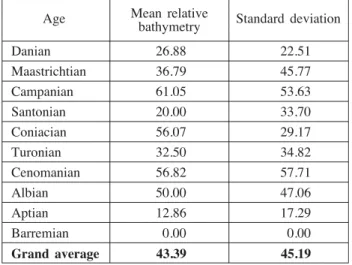
ERNER2Abstract.The sedimentary sequence exposed in the erstwhile Tiruchirapalli district hosts a more or less com-plete geological record of the Upper Cretaceous–Tertiary period. Systematic field mapping, collation of data on the micro–meso scale lithology, sedimentary structures, petrography, faunal assemblage and facies relationships of these rocks, in the light of modern stratigraphic concepts, helped to enumerate the lithostratigraphic setup and depositional history of the basin. Spatial and temporal variations of the lithologies and revised stratigraph-ic units are presented in this paper. Many high frequency sea level cycles (presumably fourth or higher order) which stack up to form third order sea level cycles (six in number), which in turn form part of second order cycles (two in number), including seven eustatic sea level peaks, have been recorded in this basin. Trend analy-sis of sea level curves indicates a gradual increase of the sea level from Barremian to Coniacian and a grad-ual decrease from Coniacian to Danian. Such lasting sea level trends had their influence on the sedimentation pattern and facies association. It is inferred that depositional bathymetry was maintained at a shallow–moder-ate level, primarily influenced by a lack of major subsidence during the depositional history of this basin. The study also revealed a prevalent simple basin filling process and dominant control by sea level changes, rather than tectonic movements over the depositional regime.
Keywords:stratigraphic revision, sedimentary environments, sea level cycles, sequence development, Cauvery Basin, southern India.
Apstrakt. Sedimentni niz otkriven u nekada{wem Tiru~irapali rejonu sadr`i mawe ili vi{e celo-vit geolo{ki zapis gorwokredno–tercijarne periode. Sistematskim geolo{kim kartirawem, upore|i-vawem podataka mikro i mezo sleda litologije, sedimentnih struktura, petrografije, skupa faune i stenskih facijalnih odnosa, u svetlu modernih stratigrafskih shvatawa, pospe{eno je stvarawe lito-stratigrafskih postavki i depozicione istorije basena. U ~lanku su prikazane prostorne i vremenske varijacije litolo{kih i revidovanih stratigrafskih jedinica. Visoka u~estalost ciklusa kolebawa niova mora (po svoj prilici ~etvrtog ili vi{eg reda) stvorila je oblike tre}eg ciklusa morskog nivoa (ukupno {est), a u obrnutom delu ciklusa (dva), ukqu~uju}i i sedam eustati~nih pikova morskog nivoa zabele`enih u ovom basenu. Trend analiza krivih nivoa mora ukazuje na postepeno pove}awe nivoa od barema do konijaka i postepeno smawewe od konijaka do danskog kata. Takvo trajawe trendova morskog nivoa je imalo uticaja na sedimentacioni model i asocijaciju facija. Zakqu~eno je da je depoziciona ba-timetrija odra`avala umeren plitkovodni nivo, prvobitno uzorkovan nedostatkom glavnog spu{tawa za vreme depozicione istorije basena. Studija je tako|e ukazala na jednostavne procese puwewa basena i na tektonske pokrete kao dominantnu kontrolu promene nivoa mora tokom depozicionog re`ima.
Kqu~ne re~i:stratigrafska revizija, sedimentne sredine, ciklusi kolebawa nivoa mora, sekventni razvoj, Kaveri basen, ju`na Indija.
1 Department of Geology, Periyar University, 636011 Salem, Tamil Nadu, India. E–mail: [email protected]
2 Institut für Mineralogie und Geochemie, Universität Karlsruhe, D–76128 Karlsruhe, Deutschland. E–mail: doris.stueben@
Introduction
The Cauvery Basin, the southernmost basin (Fig. 1) in the Indian peninsular shield of the NE–SW trending Late Jurassic–Early Cretaceous rift basins (POWELL et
al., 1988) was created during the fragmentation of the supercontinent (JAFER, 1996). A more or less complete Upper Cretaceous–Paleocene succession is exposed in the Ariyalur–Pondicherry depression of this basin (SA -STRY & RAO, 1964). This succession, in view of its lithologic and faunal diversities, has attracted the atten-tion of geologists since the early studies of KAY(1840), BLANFORD (1862) and STOLICZKA (1861–1873). Many
hundreds of papers have been published since then, among which the works on microinvertebrates (CHIP -LONKAR, 1987), foraminifers (GOVINDANet al., 1996), os-tracods (BHATIA, 1984), ammonites (AYYASAMY, 1990), nannofossils (JAFER & RAY, 1989; KALE & PHANSAL -KHAR, 1992; KALE et al., 2000), bryozoans (GUHA,
1987; GUHA & SENTHILNATHAN, 1990, 1996), lithostra-tigraphy (RAMANADHAN, 1968; BANERJI, 1972; SUNDA -RAM & RAO, 1986; RAMASAMY & BANERJI, 1991; TE -WARI et al. 1996) and tectonics, (KUMAR, 1983; PRABA -KAR& ZUTCHI, 1993) present a comprehensive account. In general, many of these publications were, to a major part, devoted to a single species or genera, group or formation/member/ lithology and, hence, a generalised depositional model for the whole of the basin has yet to be documented. The economic discoveries of hydrocar-bons in this basin demand a more organised classification of these strata which could help in designing improved exploration strategies (RAJU & MISRA, 1996). As far as the existing stratigraphic classifi-cations of the Cauvery Basin are concerned, as noted by TE -WARIet al. (1996), there is still a reluctance to the recognition of the association of facies based on stratigraphic classifi-cations. Furthermore, there has been no synergic study eluci-dating the sedimentologic me-chanisms which acted during the course of the evolution of this basin. Thus, the goals of this study were:
• to present a workable litho-stratigraphy with detailed li-thological profiles, including recognisable units so as to produce a realistic meso-micro scale lithological co-lumn. This was necessary, primarily because recognition and fixation of any biostrati-graphic or chronostratigaphic boundaries rely mostly on the correct recognition of la-teral and vertical spatial rela-tionships of the strata, and • to enumerate the
deposition-al history of the basin with a view of singling out the controls of the depositional and stratigraphic continuum and breaks in order to de-duce the differential roles of geological agents and pro-cesses.
Methods and materials
Systematic field mapping on the scale of 1:50 000 (the first ever in this part of basin) was conducted in and around the Ariyalur, Perambalur and Tiruchirapalli districts, (erstwhile Tiruchirapalli district) in which the
largest exposure (a more complete one than the other exposures located north of it – YADAGIRI & GOVINDAN, 2000) is located. Data on the lithology, sedimentary structures, tectonic structures, facies and faunal associ-ation (mega and ichno) were collected from natural exposures, as well as well and mine sections. A total of 308 locations were logged and sampled. The guide-lines and norms provided in EYESINGA (1970) and The North American Stratigraphic Code (1983) were fol-lowed for the presentation of the systematic strati-graphy. The following procedures for major revision of lithostratigraphy, as suggested by HART et al. (2000), were adopted in this study:
• primary field work in the exposed area,
• detailed analysis of the relationships of the intrafor-mational facies,
• hierarchical use of groups, formations and members in accordance with the stratigraphic codes,
• formal definitions of type sections and historical pre-cedent.
The exposed beds were traced laterally and vertical-ly. Gross lithology (meso scale), general faunal and ichnofaunal information, petrography and sedimentary structures were considered when defining the stratigra-phic units. The proposed lithostratigrastratigra-phic setup is pre-sented in Table 1. The lateral and vertical variations of the lithostratigraphic units in the study area are present-ed in Fig. 2. The geographic distribution of the mem-bers is presented in Fig. 5. The stratigraphic
informa-tion, interpretations of depositional environments, major geological events (such as faulting, sea level changes, depositional breaks, etc.) generated with ground truth data and laboratory analyses and published paleontolog-ic data enabled the elucidaton of the depositional histo-ry and prevalent geologic processes.
Systematic stratigraphy
TEWARI et al. (1996) presented a comprehensive ac-count on the lithostratigraphy of this basin. Following the current practices in stratigraphic terminology, the classi-fication was modified and updated in the present work.
Sivaganga Formation
BANERJI (1982) recorded the extensive occurrence of a conglomerate–sandstone unit in regions far south of the present study area and named it the Sivaganga Forma-tion. BANERJI & RAMASAMY (1991) and BANERJI et al. (1996) reported a similar unit in the Tiruchirapalli ex-posure. These beds mark the first Cretaceous sedimen-tation in this basin. Three discrete members constitute this formation in the study area.
Basal Conglomerate Member
Nomenclature. This member corresponds to the Ko-vandankurichchi Conglomerate Member of TEWARI et
al. (1996). As they named the overlying sandstone member also with the prefix “Kovandankurichchi”, the nomenclature is amended herein to avoid repetition of the same geographic name for two stratigraphic units. Since this member forms the bottommost sedimentary record of this basin, the prefix “Basal” has been added.
Stratotype: It is located at 78°55’48” E; 10°52’36” N in the Kovandankurichchi Mine I, NE wall, Bench IV (mine owned by Dalmia Cements Ltd.).
Lithology, contacts and environment. These beds are lithoclastic boulder conglomerates that contain abundant clasts of granitic gneiss (basement rocks). The clasts are sub-angular to sub-rounded and range in size from 10 m to 60 cm. This lithological unit is clast supported and towards the top shows a reduction in the size of the clast and an increase in the quantity of finer grains. Many such upward fining sequences have been observed to rest over the highly faulted Archaen basement. These sedi-ments are essentially brought by rivers and deposited un-der high-energy conditions as coastal conglomerates in view of the widespread erosion of the fault scarps (BA -NERJI, 1983). They may be termed as type II conglome-rates according to the classification of PETTIJOHN (1957).
Geographic extension. This member is exposed only in the mine section in this part of the basin. Mine sec-tions expose only a limited portion of this unit, as all
the limestone deposits are found only above this unit. All other sub-basins of Cauvery basin, where deep bore wells were drilled, show existence of this member in direct contact with Archaen basement rocks.
Fossils and age. Subsurface counterparts contain Bar-remian–Aptian fossils of Globigerina boteriveca (GOVIN -DAN et al., 1996; RAJANIKANTH et al., 2000).
Thickness. 18 m.
Equivalents from other areas. BANERJI (1982) report-ed extensive exposures of this member in the southern part of this basin.
Kovandankurichchi Sandstone Member
Nomenclature. It has been amended from the nomen-clature of TEWARI et al. (1996) to reflect its lithology.
Stratotype. It is located at 78°55’51” E; 10°52’34” N in the Kovandankurichchi Mine I, NW wall, Bench III (mine owned by Dalmia Cements Ltd.).
Lithology, contacts and environment. These are grain supported upward coarsening cyclic beds that show pa-rallel, even and thin to thick bedding. Individual bed set ranges in thickness from 20–100 cm. This member rests over the Basal Conglomerate Member having a dis-tinct, non-depositional and erosional unconformity. It dif-fers from the underlying member in terms of the chan-ge in lithology and lack of granitic clasts. The sands range in size from granule to coarse silt and are carbo-nate cemented. The grains are well sorted within each lamina and show rounded-well rounded shape. These re-present recurrent sheet flow deposits probably in a sub-aqueous fan deltaic environment. Towards the north, they grade to argillaceous siltstones and claystones, re-presenting deposition in a basinal setup.
Geographic extension. This member is exposed in the Kovandankurichchi mine and is observed to occur in stream sections, well cuttings and trenches up to the region south of Perali. From south to north, there seems to be a gradual reduction in the thickness and grain size
with a simultaneous increase in argillaceous matrix. In the southern regions, these are essentially grain-support-ed fabrics. Towards the north, the rocks are matrix sup-ported, loosely packed and well cemented.
Fossils and age. Early Cretaceous palynoflora were reported from subsurface sections (bore well samples) of this member (VENKATACHALA, 1974; RAJANIKANTHet
al., 2000).
Thickness. 24 m.
Equivalents from other areas. BANERJI(1982) report-ed this member and a Basal Conglomerate Member as conglomerate–sandstone succession of the Sivaganga For-mation. The availability of new exposures in the Kovan-dankurichchi mine and the tracing of them up to the south of Perali, with a distinct stratigraphic break in be-tween them, allowed us also to precisely define the stra-tigraphic relationships and position. BANERJI (1982) re-ported isolated outcrops of this member also in Virud-hachalam (north of the study area).
Terani Claystone Member
Nomenclature. Amended herein from the nomencla-ture of TEWARI et al. (1996) to reflect its lithology.
Stratotype: It is located at 78°54’01” E; 11°07’42” N in the Terani clay mine (mine owned by Nataraj Ce-ramics Ltd.).
Lithology, contacts and environment. Traditionally these have been termed as clay deposits resting over the Archaen basement (GOVINDAN et al., 1996). How-ever, transition of Kovandankurichchi siltstone and sandstone into basinal clay and argillaceous siltstone, which have contact with Archaen rocks, were observed in new mine sections. This transition might have result-ed from a rise in the sea level and the cessation of coarse clastic influx. As these are primarily clays, severe continental weathering was also indicated. The clays are white to pale brown in colour and show the frequent occurrence of alternate bands of red and red-dish brown laminae. Less frequent interlayers of thin to thick ferruginous siltstone are also present. These ob-servations indicate the influence/existence of seasonal floods that brought in a significant detrital influx to the depo-center of this member, although this member was deposited in deeper regions of the basin (regions far below the base of a storm weather wave). The preva-lence of a faulted basin topography which might have hosted a narrow shelf and a sudden steep slope could explain the bypassing of silts and sands to the basinal setting. Deposition took place principally through sus-pension settling, except for the siltstone/fine sandstone laminae.
Geographic extension. These beds are generally found to have been deposited in isolated patches in and around Karai. They occur along the westernmost bor-ders of the sedimentary basin. The extensive distribu-tion of their counterparts has been reported from all
over the subsurface part of the basin (VENKATACHALA, 1977; MAHESHWARI, 1986).
Fossils and age. The clay beds contain frequent im-pressions of Ptilophyllum sp. MAMGAIN et al. (1973) reported two Barremian ammonite species and one ino-ceramid species, as well as fossils of this plant. SASTRY
et al. (1977) and RAMASAMY& BANERJI(1991) assign-ed Aptian age to this member.
Thickness. 30 m.
Dalmiapuram Formation
Grey Shale Member
Nomenclature. The original nomenclature of RAMA -SAMY & BANERJI (1991) has been restored with an amendment herein. On account of water logging and the non-accessibility during their visit to the mine, TE -WARI et al. (1996) termed this unit as Grey Siltstone based on only one sample from this mine and another sample from Perali. They mentioned the validity of their term in their paper and reported the non-exami-nation of the more “calcareous nature of the shale” as described by earlier workers. The sampling conducted for this study occurred during a period when dry mine floor was exposed, which allowed this unit to be defined more precisely.
Stratotype. It is located at 78°55’51” E; 10°52’34” N in the Kovandankurichchi mine I, NW wall, Bench III (mine owned by Dalmia Cements Ltd.).
Lithology, contacts and environment. This is princi-pally grey shale with frequent interbeds of fossiliferous grey limestone (the thickness of which increases up-wards) and to a minor extent it is composed of a sig-nificant admixture of silt-sized siliciclastics. The ubiq-uitous grey colour is more pronounced where shale without any intercalation or admixture was encoun-tered. Deposition in a periodically restricted shallow marine setting was indicated by lithological and faunal information. The lower contact is an unconformity sur-face associated with marine flooding and the upper contact is non-depositional and erosional with an over-lying biostromal member.
Geographic extension. This member is well exposed in the Kovandankurichchi mine. Diagenetically altered counterparts are exposed in well sections located north-east of Kallagam and south of Perali. Many authors ha-ve recorded subsurface extensions of this member (e.g. SUBBARAMAN, 1968; GOVINDANet al. 2000). Deposition of this member in isolated patches restricted the avail-ability of extensive exposures.
floral assemblages indicate Barremian to Albian age for this member.
Thickness. 7 m.
Varagupadi Biostromal Limestone Member
Nomenclature. (Proposed herein). RAMASAMY & BA -NERJI (1991) and TEWARI et al. (1996) termed rocks of this member as Dalmiapuram Limestone Formation and Member respectively. As a more complete section of this member occurs in the Varagupadi mine and assign-ing two lithostratigraphic units with the same name is discouraged, this unit has been termed as Varagupadi Biostromal Limestone Member.
Stratotype. It is located at 78°54’57” E; 11°09’35” N in the Varagupadi mine, Bench I and II (mine owned by Vijay Cements Ltd.).
Lithology, contacts and environment. These are lime-stone beds containing various proportions of bioclastic and siliciclastic materials. They show wackstone to rud-stone fabric and have clasts of redeposited boundrud-stones. Thin to thick bedded, even to parallel, bioclastic lime-stone beds which have drawn their detritus from reefs predominate. Typical reef cores are absent in this mem-ber. These are typical reef flank biostromal deposits de-posited under high-energy conditions and show signifi-cant lateral variation of facies and texture. These beds are found to be directly overlying the Grey Shale Member, while their reef core counterparts might have been located further west directly over the Archaen rocks, which in turn were eroded during a major mid-Cretaceous faulting (TEWARI et al., 1996; YADAGIRI & GOVINDAN, 2000; STEINHOFF & BANDEL, 2000). The in-terpretation of BANERJI et al. (1996) based on field characteristics that “these biostromal deposits were de-rived from some older biohermal bodies which are no longer seen outcropping”, adds further support to this assertion. The information that the Ariyalur–Pondicher-ry sub-basin had experienced erosion of a ca. 1.5 km thick sediment pile (YADAGIRI & GOVINDAN, 2000) and the occurrence of Olaipadi Member (detailed latter) at 10 km directly west of the Dalmia mine confirm the prevalent but eroded reef counterpart of this biostromal member. Many authors, however wrongly recognised a much younger Dalmia Biohermal Member to be the biohermal counterpart of this member. It is to be noted that the biohermal member was subaerially exposed and underwent karstification. Had it been the counterpart of this member, then how could this member have escap-ed similar karstification? Basescap-ed on the common reef mineralogy and their easy susceptibility to subaerial ex-posure, it is assumed that as the Dalmia Biohermal Member contained highly unstable carbonates and a pre-valence of a high host to fluid bulk chemistry ratio, the diagenetic fluid (that moved downwards) attained satu-ration before reaching the lower member producing less/no recrystallisation of beds of this member. The
presence of disconnected vugs and voids in the bioher-mal member, indicates that the absence of interconnect-ed pores might have thwartinterconnect-ed access of meteoric waters to the deeper regions, because of which, the biostromal member, located there, escaped karstification. If so, the biostromal member might be older than the Dalmia Bio-hermal Member.
The depositional relationship between this member with an eroded biohermal counterpart and the Grey Shale Member could be such that deposition along fault scarps and differential growth of reef and reef derived bioclastic limestone deposits introduced a temporary to long term closure of parts of the depositional setting, whereby more anoxic, fine grained shale and grey lime-stone deposits were alternatively deposited. Through the passage of time, with the rise in the sea level, more open conditions of sea were introduced which permit-ted the deposition of bioclastic reef derived limestone only. Faulting, as evident from the Varagupadi mine, where the biostromal limestone beds rest directly over Archaen rocks, may also have influenced this change. However, the occurrence of alternating shale-bioclastic limestone beds indicates that fluctuations in the sea le-vel must have taken place which were probably accom-panied by faulting and submergence with the net result that the sea level had an overwhelming influence on the depositional pattern. The occurrence of granitic cob-bles at the bottom beds of this member suggests a reju-venated fresh erosion of basement rocks, implying the cessation of the deposition of the shale member by fault movement, followed by a rise in the sea level and the rejuvenation of bioclastic limestone deposition. From bottom to top, the increase of the thickness of the grey fossiliferous limestone within the shale beds, the con-current reduction of the thickness of the grey shale bed and the increase of silt admixture in the shale, and the complete cessation of shale deposition and the presence of only limestone at the top and, finally, the occurrence of such an observed biostromal sequence make way for the interpretation of facies variation over time under the major influence of sea level changes.
direction, which might also have resulted in a lateral shift of this member.
Fossils and age. The faunal composition of this mem-ber constitutes bioclasts of bivalves, rudists, corals, al-gae, foraminifers, ostracods, and bryozoans and echi-noid spines. GOVINDAN et al. (1996) assigned Middle Albian age to these biostromal beds.
Thickness. 23 m.
Dalmia Biohermal Limestone Member
Nomenclature. It is proposed herein.
Stratotype. It is located at 78°57’23” E; 11°59’19” N in the Kallakkudi mine II, Northern wall, Bench III and IV (mine owned by Dalmia Cements Ltd.).
Lithology, contacts and environment: These are pure algal and coral facies limestone beds that form a reef core. The occurrence of the reef core stratigraphically above the biostromal limestone deposits, the absence of a reef core counterpart of the underlying biostromal limestone beds and the younger Olaipadi Member over the biohermal member, as well as the direct overlap-ping of the much younger Kallakkudi Sandstone Mem-ber in the Kallakkudi mine are all suggestive of a pre-valent progradation of reef colonies over the former de-eper regions of the sea concomitant with a fall in the sea level (STEINHOFF & BANDEL, 2000). This 15 m thick, biohermal member contains massive pink to greyish white limestone deposits with abundant vugs and cavity fillings. The growth and movement of coral–algal colonies were suddenly truncated as a result of mid-Cretaceous faulting. The upper contact of this member is a forced regression and associated subaerial exposure surface which has even resulted in meteoric diagenesis of these limestone deposits. The bottom con-tact is conformable with biostromal limestone and rep-resents a non-depositional surface. The occurrence of lithified carbonates clearly indicates a fall in the sea le-vel (associated with faulting) after the deposition of the biohermal member as the sea level crossed the shelf edge (Type I sequence boundary). The absence of an Olaipadi Member over this member in the Kallakkudi mine and the adjoining regions, as well as the super-position of the much younger Kallakkudi Sandstone Member directly over this limestone member in this region suggests that, in view of faulting, this area became topographically raised and served as a sediment source for the Olaipadi Member. On the contrary, the occurrence of slope failure could also be interpreted as large-scale mass wasting, a phenomenon commonly associated with a fall in the sea level (SARG, 1988). The interpretation whereby slowly prograding reefs moved towards former offshore regions with a falling of the sea level adds support to this view as prograda-tion of reefs could have surpassed the angle of repose and become unstable and might have contributed towards the generation of mass wasting. However, the
presence of granitic clasts (more than 10 m diameter) in the younger Olaipadi Member (lithoclastic conglom-erate deposits – detailed latter) indicate fresh erosion of continental materials, which paves the way for the interpretation of a fall in the sea level concomitant with tectonic movement, whereby the change in the sea level had an overwhelming influence.
Geographic extension. This member is typically ex-posed in the Kallakkudi mine. Isolated and highly weathered counter parts are observed in the northwest-ern region of this basin. Their very limited occurrence, also above the Biostromal Limestone Member, is inter-preted as being the result of reef growth along the fault scarp, a large scale fault later associated with erosion, which allowed the preservation of only relatively deep-er watdeep-er biostromal and biohdeep-ermal limestone deposits.
Fossils and age. The limestone consists of red algae, corals and bryozoans, bioclasts of gastropods, bivalves, echinoid plates, ostracods, foraminifers and sponges. Based on the faunal assemblage, Middle Albian age is assigned to this member (GOVINDAN et al., 1996).
Thickness. 15 m.
Olaipadi Conglomerate Member
Nomenclature. After TEWARI et al. (1996).
Stratotype. It is located at 79°05’47” E; 11°19’12” N in the Olaipadi mine, Bench I, II, III and IV (mine owned by Ramco Cements Ltd.).
Lithology, contacts and environment. These are es-sentially basinal silty clays and clays in which chaotic blocks (Fig. 3A) are embedded. The beds contain large blocks of basement rocks (angular and sub-rounded boulders which are often >10 m in diameter), lithified coralline limestone blocks (similar to the underlying biohermal limestones), claystones (Fig. 3B; similar to that of the Terani Clay Member) and lithoclasts of ol-der conglomerates, etc. The occurrence of lithoclastic conglomeratic boulders (1–2 m diameter, extraforma-tional), limestone (intraformational) and basement boul-ders (extraformational) in an otherwise deep marine silty claystone is indicative of sudden fault movement asso-ciated with widespread erosion of coastal/nearshore se-dimentary rocks and their transportation by gravity and instability of a newly created slope, bypassing the nar-row shelf, to the new depocenters. TEWARIet al. (1996) interpreted this member as having been deposited from rapid flows of submarine debris/talus deposits at the foot of eroding fault scarps. The fault movement imme-diately after the deposition/lithification of the underlying limestone member associated with subaerial erosion is clearly exhibited in the Kovandankurichchi mine and the Kallakkudi mine, wherein offsetting of fault blocks is exposed in terms of displaced bedded limestone deposits (Varagupadi Member).
continuously from Tirupattur in the south to Govinda-rajapalaiyam in the north. The granitic gneissic boul-ders are abundant in the Tirupattur mine. Their size and frequency is reduced towards the north, to be progres-sively replaced by lithified carbonate boulders drawn from the underlying biohermal member. It should be noted that the lithified claystone conglomerate boulder clasts, which occur in association with other clasts of this member, were not present elsewhere in the exposed area as a distinct lithology/bed. This observation, in ad-dition to the complete absence of biohermal counter-parts of Varagupadi Biostromal Member and presence of >10 m large basement clasts, supports the interpre-tation of the existence of such lithologies further west before faulting and complete erosion of them in view of faulting. Towards the top, deep marine clays grade into calcareous siltstone and include granitic cobbles and mi-nor amounts of siliciclastic sands, which indicate a
grad-ual reduction of the sea level followed by the commenc-ment of the influx of fluvial sedicommenc-ment. The thickness of this member varies within short distances, which is indicative of a fault controlled depositional topography.
Fossils and age. Reworked fauna, namely: belem-nites, rudists, corals and serpulids characterize this mem-ber. The occurrence of this member at the dawn of the Cenomanian, together with a sudden change in the envi-ronment and faulting could be interpreted as beeing the result of a major basin development process.
Thickness: 65 m.
Kallakkudi Sandstone Member
Nomenclature. It is proposed herein. It corresponds to the Kallakkudi Sandstone Member and the Kallakku-di Siltstone Member of TEWARI et al. (1996) and the
Fig. 3. A. Large sized limestone chaotic block (a) embedded in deep marine silty clay (b) of the Olaipadi Member. Note the conformable relationship of silty clay bands with the boundary of lithoclast. Tirupattur quarry. B. Close up view of clasts of older sedimentaries in the Olaipadi Conglomerate Member. Note the presence of lithoclasts of every conceivable size and shape.
a- Hammer (~ 30 cm in length) is placed for scale; b - Subangular–subrounded claystone lithoclasts; c - Subangular–angular
biostromal and reefal deposits of RAMASAMY& BANERJI (1991). Although TEWARIet al. (1996) eradicated many discrepancies existing in previous studies with their re-vision, they overlooked the gradation of faces between sandstone and siltstone members, the repetitive occur-rence of alternate sandstone and siltstone beds which grade to each other (may be the result of varying ener-gy and sediment influx and also of minor sea level fluctuations) and lack any stratigraphic break.
Stratotype. It is located at 78°57’23” E; 11°59’19” N in the Kallakkudi Mine II, Bench I and II (mine owned by Dalmia Cements Ltd.).
Lithology, contacts and environment. This is a fine--coarse sandstone member with alternate medium to thick beds of silty clay, calcareous siltstones, bioclastic arenaceous limestone and gypsiferous clay. The inter-calations are recurrent and show typical Bouma sequen-ces, normal grading, load casts (Fig. 3C), channel and scour structures. The sandstones are thin to medium bedded and always start over a gypsiferous band and/or arenaceous limestone bed with an erosional surface and grade to finer clastics. Towards the northern regions, this member grades to more silty and clayey, but the gradation and gypsiferous bands are persistent with the addition of ferruginous silty clay bands.
The depositional setting of this member ranges from a shallow coastal to a basinal setting which were under the influence of a major fluvial source near coast and a turbidity current in the basinal part, respectively. The co-astal region must have been periodically closed/partially closed to produce evaporitic layers. In the basinal part, deposition took place principally from a high-density tur-bidity current in a ramp developed over the Olaipadi Member. The talus like platform created a steep sloped turbiditic apron, fed by siliciclastics derived from a flu-vial source and eroded carbonate sands, bypassing the narrow slope (newly created by mid-Cretaceous faulting) and reaching to the basinal region. The continued depo-sition of this member must have been sustained by a pro-grading apron/talus. The channel orientation, large-scale scour structures and the nature of the bedding, suggest flow from south to north (TEWARI et al., 1996).
Geographic extension. Next to the Olaipadi Member, this is a well-developed member of the Dalmiapuram Formation. Its thickness was controlled by depositional topography. In the southern region, these beds show recurrent bands of fining upward sequences of only sili-ciclastics with calcareous cements. From Varagupadi to-wards the north, they show a thickening and thinning nature and a cyclic occurrence of bioclastic arenaceous limestone, coarse sandstone–silty clay and evaporitic lay-ers with frequent minor–significant erosional surfaces.
Fossils and age. TEWARI et al. (1996) recorded fora-miniferal population of the Rotalipora appenninica in-terval Zone to Rotalipora cushmani total range Zone, the belemnite species Tetrabelus seclusus,Parahebolites blanfordi andNeohibolitessp., and mid Cretaceous phy-loceratid ammonite along with shell debris of Exogyra,
Alectryonia, echinoids and bryozoans. According to these observations, this member ranges in age from Late Al-bian to Late Cenomanian.
Thickness. 60 m.
Karai Formation
This formation has two members, namely: the Gypsi-ferous Clay Member and the Odiyam Sandy Clay Mem-ber, in stratigraphic order.
Gypsiferous Clay Member
Nomenclature. The nomenclature of RAMASAMY & BANERJI (1991) was restored with an amendment to reflect its lithology.
Stratotype. It is located between 78°54’33”–78°54’58” E; 11°07’22”–11°08’09” N in stream section exposures of a traverse from east of Karai to west of Kulakkanattam.
Lithology, contacts and environment. This member consists of unconsolidated deep marine clays and silty clays. Very thin to thick gypsiferous (synsedimentary) clay beds characterize this formation. These beds con-tain a thick population of belemnite rostrum and phos-phate nodules. The extensive occurrence of gypsum along with celestite makes this member readily recog-nizable in the field. The deposition of this member took place under increasing sea level conditions. After reach-ing its maximum, the sea level started declinreach-ing concur-rently with the deposition of relatively coarser siliciclas-tics and the development of syngenetic gypsum ceased to continue, marking the end of the deposition of this member. While a non-depositional unconformity surface separates this member from the underlying member, the upper contact is non-depositional and erosional.
Geographic extension. This member is best exposed along the Karai–Kulakkanattam road section, where an extensive sprawl of badland topography occurs. From south to north, gradual reductions of depth, number of belemnite and phosphate nodules and frequency of gyp-sum layers are observed.
Fossils and age. Gryphaea, Tubulostrum, belemnites and foraminiferal assemblages belonging to Rotalipora subticinensis interval Zone to the Praeglobotrancana helveticainterval Zone are reported and demonstrate Ce-nomanian age for this member (GOVINDAN et al., 1996).
Thickness. 275 m.
Odiyam Sandy Clay Member
Stratotype. It is located between 78°54’20”–78°55’58” E; 11°07’18”–11°07’22” N in the exposures of stream sections along the Karai–Kulakkanattam road.
Lithology, contacts and environment. These are es-sentially silty clays and sandy clays deposited in a pro-gressively shallowing basin. This member differs from the lower member in terms of the conspicuous absence of belemnites and the occurrence of ammonites. Load structures and syndepositional slump folds are also ob-served. There seem to have been a sudden change of the sedimentary source, as well as of the quantity and nature of the sediment influx between the lower member and up-per member of the Karai Formation. The upup-per portion of this member has localised pockets of fine sandstone along with ammonites. While the lower contact with the under-lying member is conformable, the upper contact is ero-sional and signifies a major regression and unconformity.
Geographic extension. This member is absent in the southern part of the study area and has maximum occur-rence in the northern regions. The beds progressively thicken from south (Karai) to north (west of Kunnam) and suddenly thin out to become absent further east and north. The beds have regionally varying proportions of a sand and silt admixture and also contain petrified wood logs, the patchy occurrence of bivalve shells and shell frag-ments. Lenses of calcareous silty clay and siltstone are also observed in the middle portion of this member.
Fossils and age. The fossil population of this mem-ber includes Thalassinoides,Pecten, Exogyra, Alectryo-nia, ammonites, foraminifers and serpulids. GOVINDAN
et al. (1996) recorded a distinct faunal assemblage of species of Rotalipora, Preaglobotruncana, Whiteinella
and Hedbergella and regard this lithological unit to have been deposited during Cenomanian–Early Turoni-an. TEWARI et al. (1996) also determined the same age for this member based on the occurrence of Whiteinella arahaeocretacea (PASSAGNO).
Thickness. 175 m.
Garudamangalam Formation
Following BLANFORD(1862), SUNDARAM& RAO(1986) recognised this formation as Trichinopoly Group. This formation, exposed in and around Garudamangalam and the town Trichinopoly located about 40 km away, rest over Archaen rocks and thus, KOSSMAT (1897) named this unit as Garudamangalam. Yet, many authors con-tinued using the old terminology, which made BANERJI (1983) and RAMASAMY& BANERJI(1991) to restore the nomenclature of KOSSMAT (1897). This formation com-prises three members.
Kulakkanattam Sandstone Member
Nomenclature. TEWARI et al. (1996) proposed this nomenclature and defined this member. In the present
re-vision, the top beds, described by them as carbonate con-cretions, have been excluded. This member corresponds to the Kottarai Member of RAMASAMY& BANERJI(1991).
Stratotype. It is located between 78°56’22”–78°57’06” E; 11°07’22”–11°22’23” N in exposures along the Ka-rai–Kulakkanattam road.
Lithology, contacts and environment. The rocks of this member are massive, yellowish brown ferruginous sand-stones and contain abundant admixtures of silt and clay. Localised concentrations of shell fragments, bivalves and gastropods (resembling a shell bank typical of subtidal to intertidal coastal lagoons) and ammonites are common. BANERJIet al. (1996) interpreted this unit as having been deposited under a high-energy wave regime. A significant feature of this member is that the sandstone contains abundant wood fragments (in which a high concentration of bivalve boring and oyster encrustation are observed), which vary in size between 5 cm length and 2 cm diam-eter to 18 m length and 3.5 m diamdiam-eter, at places found to be fit enough to term them as woody sandstone (Fig. 3D). Cross bedding, channel courses (1 m deep and sev-eral meters across), planar bedding and feeding traces are also common in this member. The depositional surface was strongly bioturbated and riddled roots (BANDEL, 2000). The rocks are well cemented. In the Karai–Kulak-kanattam traverse, an angular erosional unconformity was found to separate this member from the underlying Karai formation. BANERJI (1972) and BANERJI et al. (1996) recognised this contact as a transgressive onlap.
Geographic extension. This member is totally absent in the northern and southern ends of the study area. From the central south part, it thickens towards the north and from the central north part, it thins down to become absent in the northern extreme. The population of gas-tropod and bivalve shell fragments is very high in the middle portion. The concentration of large – small wood trunks and fragments is higher in the southern region. While the northern and southern regions show abundant argillaceous admixtures, the middle region always shows a coarse grain supported fabric and a bedded nature with frequent bioclastic arenaceous limestone lenses.
Fossils and age. Abundant wood fragments encrust-ed with oysters, Pinna, Thalassinoides, Diplocraterion, Ophiomorpha and others molluscs. Age ranges from Middle–Late Turonian.
Thickness. 123 m.
Grey Sandstone Member
Nomenclature: Proposed herein.
Stratotype. It is located between 79°00’02”–79°00’56” E; 11°00’42”–11°01’24” N in the exposures of the Kal-padi–Ariyalur traverse (Fig. 3; traverse No. IV).
highly fossiliferous (small molluscs and whole bivalve and other shells and fragments) sandy layers (Fig. 4A) the thickness of which varies regionally. The sands are well sorted and well rounded. These sediments represent sub-tidal to suprasub-tidal sand bars deposited under wave and tide dominated environments. This member rests conformably over the Kulakkanattam Member and has a distinct ero-sional and non-depositional surface. The upper contact is a non-depositional surface associated with marine flood-ing. The deposition of this member immediately over sub-tidal flat sediments may indicate an advancing deltaic plain due to increased flow and or a stable/regressing sea. The presence of normal grading, cyclic sedimentation, repetitive occurrence of fossiliferous and barren layers of different thickness and planar horizontal bedding are all indicative of a foreshore environment, wherein the sedi-ment influx was controlled by the relative intensity of a fluvial source, often reworked during periods of dry sea-sons. The difference in the cemented nature of this mem-ber compared to the overlying and underlying memmem-bers confirms the assertion that the sediments of these rocks were exposed and cemented periodically under subaerial conditions, to form beach rocks. At the base, in the north-ern and southnorth-ern regions, the deposition of this member started with calcareous cemented pebbly sandstone. TE -WARI et al. (1996) interpreted this unit as a sign of depo-sition during transgression in a tidal inlet or a delta plain, or within a barrier succession. BANDEL (2000) interpreted this pebbly sandstone as a shift of the principal depocen-ter connected with regression and a structural disturbance. In either case, the deposition of this member represents a lowstand system tract above the Karai sequence boundary.
Geographic extension. The shelly layers show regio-nal variation of fauregio-nal and bioclastic composition. In the south, the layers constitute essentially gastropods and in the north bivalves. Discrete layers of well-sorted sands with shell fragments in the form of shell lag deposits are also observed. The increase of argillaceous admix-ture towards the upper part of this member indicates a deepening of the depocenter, may be because of marine flooding. In the southern part, the beds are thin and sili-ciclastic. Towards the north, they become more calcare-ous, thick bedded and at places have a very high con-tent of bioclastic materials, which made earlier workers regard this unit as shell limestone (e.g. RAO, 1970).
Fossils and age. Teredolites burrows, feeding traces of Thalassinoides, oysters, gastropods and molluscs. YADAGIRI & GOVINDAN (2000) assigned Late Turonian as the age of these beds.
Thickness. 35 m.
Anaipadi Sandstone Member
Nomenclature. Authors: TEWARI et al. (1996).
Stratotype. It is located between 78°57’40”–78°59’35” E; 11°07’06”–11°07’21” N in the exposures north of Anaipadi–east of Kulakkanattam and west of Kulattur.
Lithology, contacts and environment. The Grey Sand-stone Member is conformably overlain by dirty yellow silty sandstone which contains abundant ammonites (many of which are more than 1 m in diameter), Nau-tilus, brachiopods (rhynchonellids), molluscs and bored wood fragments. The massive nature of the rocks, fos-sil association and lithological characteristics indicate, probably deeper marine conditions. The occurrence of lithoclastic cobbles in the middle portion of this mem-ber suggests the prevalence of periodic high-energy conditions, continental erosion and increased terrestrial sediment influx. The presence of intercalated beds with rich fauna dominated by oysters or rhynchonellids indi-cates the exchange of shallow water environment for open marine condition (BANDEL, 2000). The deposition of this member was truncated by a major regression.
Geographic extension. These are massive and thin-bedded claystones, silty claystones and clayey sandsto-nes in the south that gradually grade to silty clay in the southern center and thin down. Again, from there, the thickness of these beds and sediment grain size in-crease and contain abundant large ammonites. Further north, these were observed to be clayey siltstones with abundant shell fragments and ammonites.
Fossils and age. A rich assemblage of Coniacian am-monites represented by Kosmaticeras gr. theobaldianum, Kossmaticeras theobaldianum crassicostata, Puzosia sp., Damesitesaff. sugataand other fossils viz., Nautilus, mol-luscs, bored woods, encrusting oysters and rhynchonellids is present in this member, all typical of Coniacian age. This member corresponds to the Kossmaticeras theobaldinum am-monite Zone of AYYASAMY(1990) and the Marginotruncana planktonic foraminiferal Zone of GOVINDANet al. (1996).
Thickness. 215 m.
Ariyalur Group
The Ariyalur group is distinct from rest of the strati-graphic units of the Cauvery basin in terms of litholog-ical and faunal diversity. Although BLANFORD (1862) described this stratigraphic unit into a group, it was SASTRYet al. (1964, 1968, 1972) who assigned a system-atic stratigraphic nomenclature. Yet, different workers continued utilizing varied terminologies and classification systems that posed difficulties in recognising them in the field. Later, CHANDRASEKARAN & RAMKUMAR (1995) re-viewed all the existing classification systems of this group and supplemented additional field, petrographic, faunal and sedimentologic data. Their study confirmed the appli-cability of the classification reported by SASTRY et al. (1972) through biostratigraphic, chronostratigraphic and lithostratigraphic boundaries. These are detailed herein.
Sillakkudi Formation
Varakuppai Lithoclastic Conglomerate Member
Nomenclature. It is proposed herein. This member in-cludes the lower beds of the Upper Sandstone Member of SUNDARAM & RAO (1986) and an unnamed fluvial silty sandstone of TEWARI et al. (1996). These publications mention only a single exposure and there was not much information on the extent, lateral variations and other char-acteristics. The detailed mapping conducted in this study allowed a precise description of the rocks and enabled them to be classified into a formal stratigraphic unit.
Stratotype. It is located at 78°55’06” E; 11°01’23” N in exposures of a stream section west of Varakuppai.
Lithology, contacts and environment. Following the deposition of the Anaipadi Member, there was a major regression, possibly associated with the reactivation of basement faults resulting in the movement of the shore-line towards former offshore regions. The period of reju-venated significant sedimentation after this regression was primarily under a fluvial regime and the fluvial agent was turbulent enough to transport well-rounded basement rocks, quartzite and older sedimentary rock boulders (Fig. 4B; lithoclastic boulders) in addition to unsorted coarse sand-pebble sized siliciclastics into the new depocenter. These deposits are typically reverse
graded and show cyclic bedding, large scale cross bed-ding and lack any body fossils. They rest over older sed-imentary rocks with typical erosional surfaces. The ero-sional intensity was so high that these beds have direct contact with the Karai Formation, thus giving testimony to the prevalent large scale undercutting, recycling and transporting nature of the fluvial channels. Three such major paleochannel courses were recognised with the help of remotely sensed data and field mapping (Fig. 5). The occurrence of large scale cross bedding, mud drapes, fresh feldspar and sandstone clasts made TEWARI
et al. (1996) interpret this unit as a fluvial channel fill with some marine tidal influence during periods of sea-sonal change in discharge. The cross bedded sequence has large lithoclasts of basement boulders along with claystone boulders and this unit is underlain by large scale cross-bedded, coarse lithoclastic sandstone which contains in situ burrow filling (Thalassinoid - Fig. 4C). These obser-vations confirm marine influence over a drowning river mouth. The lower portion of this member was devoid of marine influence. The inference of a progressively increas-ing marine influence towards the top (inferred from the occurrence of sedimentary structures and Thalassinoid, typical of shallow coastal regions) of the member indi-cates the presence of a sequence boundary at its base.
Geographic extension. These beds are typically exposed in the regions south and northwest of Alundalipur, north of Melarasur and south and west of Sadurbagam in stream and road sections. Further east, north and south, they rap-idly die out. In a stream section across a bridge which connects Alundalipur–Kallakkudi, these are excellently preserved and rest directly over the Karai Formation.
Fossils and age. No in situ fossils were observed, except a few Thalassinoidesin the upper portion of the member. Subsurface sections indicate a Marginotrunca-na coroMarginotrunca-nata – Dicarinella asymmetrica zone (GOVIN -DAN et al., 1996) of Santonian age.
Thickness. 45 m.
Sadurbagam Pebbly Sandstone Member
Nomenclature. It is proposed herein.
Stratotype. It is located at 78°54’25” E; 11°03’52” N in a stream section east of Sadurbagam.
Lithology, contacts and environment: The contact be-tween the Varakuppai and the Sadurbagam Members is a marine flooding surface. The resting of the Sadur-bagam Member over Archaen rocks and the Varakuppai Member clearly affirms that, on flooding, areas that had not been previously transgressed were brought under ma-rine conditions. SUNDARAM& RAO(1986) also stated that
the regions had remained structurally and topographical-ly high since the inception of this basin were brought under marine influence during Late Santonian–Early Campanian as a result of a fault movement. At the top, a distinct non-depositional surface separates this member from the overlying member, which could be interpreted as the maximum flooding surface created at the dawn of the Campanian. Coarse siliciclastics with abundant ma-rine fauna, shell fragments, and varying proportions of a calcareous matrix were deposited concomitantly with the rising of the sea level along the western margin of the newly established coasts which forms this member. At the base of this member, an erosional surface followed
Fig. 5. Geographic distribution of the members of the Cauvery Basin. Legend:
F1 = Initial block faulting,
F2 = Faulting during Cenomanian,
F3 = Faulting during Santonian,
F4 = Faulting during post Danian,
1= Unclassified gneiss,
2= Charnockite & Gneiss,
3= Basal Conglomerate Member,
4= Kovandankurichchi Member,
5= Terani Member,
6= Grey Shale Member,
7= Varagupadi Member,
8= Dalmia Member,
9= Olaipadi Member,
10 = Kallakkudi Member,
11 = Gypsiferous clay Member,
12 = Odiyam Member,
13 = Kulakkanattam Member,
14 = Grey Sandstone Member,
15 = Anaipadi Member,
16 = Varakuppai Member,
17 = Sadurbagam Member,
18 = Varanavasi Member,
19 = Kallar Member,
20 = Kattupiringiyam Member,
21 = Tancem Member,
22 = Srinivasapuram Member,
23 = Ottakoil Formation,
24 = Kallamedu Formation,
25 = Anandavadi Member,
26 = Periyakurichchi Member,
27 = Cuddalore Sandstone,
by a distinct cobble-pebble quartzite conglomerate is observed, which marks the beginning of the sedimenta-tion of this member. The rocks show massive, thick to medium, even and parallel bedding and rest over the Varakuppai Member. At places, pockets of shell rich car-bonate lenses with an abundant siliciclastic admixture are found to occur, which made earlier workers, (SUNDARAM & RAO, 1986; TEWARI et al. 1996) interpret this mem-ber as Lower Limestone Memmem-ber and Kilpaluvur Grain-stone Member, respectively. CHANDRASEKARAN et al. (1996) recorded load casts, slump folds, pillow structures and synerasis cracks in this member. The sandstone beds frequently show normal grading and low angle cross bedding. The occasional development of algal mounds, intimately associated with fault scarps of older sedimen-tary rocks, is also found to signify this member. The sedimentary structural and lithological information sug-gest a subtidal to intertidal clastic depositional environ-ment for this member.
Geographic extension. The thickness of this member varies drastically in the south, may be reflecting the depositional topography as created by the fault scarp. The rocks are monotonously pebbly sandstones with massive bedding in the north and are continuously bor-dered by the Paleo Sea except in the region northwest of this member, where the younger Varanavasi Member rests directly over the Anaipadi Member.
Fossils and age. The fossil composition of this member includes inoceramids, rhynchonellids, terebratulids, Nau-tilus, echinoids, crinoids, fragments of corals and bivalves and algal mounds, indicative of Late Santonian age.
Thickness. 80 m.
Varanavasi Sandstone Member
Nomenclature. It is proposed herein.
Stratotype. It is located at 79°04’09” E; 11°04’58” N in a stream section southwest of Varanavasi.
Lithology, contacts and environment. These are planar sheet sands, primarily consisting of featureless, massive, thick bedded, coarse to medium grained sandstones. They rest over the pebbly sandstone member with a non-depositional surface, may be due to flooding by marine waters. AYYASAMY (1990) recognised a hiatus between Santonian (Sadurbagam Member) and this member based on the ammonite zonation. The beds contain intermittent fine pebble-coarse sand laminae and show normal grad-ing to reestablish the deposition of thick, massive, medi-um sand deposits, probably representing periods of high-er enhigh-ergy and sediment influx. The sands are loosely packed and cemented by a calcareous medium. Towards the top, serpulid colonies are frequently observed which survived in a slowly waning sea (RAMKUMAR, 1997). The upper surface of this member represents an erosion-al surface associated with regression.
Geographic extension. These are the most extensive lithologies in this part of the basin, developed mainly due
to a constant supply of sediment and stable shelf condi-tions, the duration of which was longer than before or after. They show the development of monotonous, thick to very thick beds with coarse-medium sands in all the regions, except an argillaceous admixture and less grain-to-grain contacts in the north. Periodic higher energy con-ditions, marked by the deposition of very coarse sand-stone lenses, pockets of shell hash, intraformational litho-clastic bounders in association with vertical cylindrical burrows and resedimented petrified wood logs are observ-ed in the middle portion. In the type section of this mem-ber, thin to medium, cross-bedded siliciclastics are record-ed. This member has a more or less uniform thickness.
Fossils and age. Important fauna of this member in-clude inoceramids, serpulids, Turritella, Globotruncana arca, Globigerinelloides, Marginotruncana marginata,
Whiteinella baltica and Archaeoglobigerina and indi-cate Campanian age. GOVINDAN et al. (1996) recorded typical Campanian benthonic foraminifer Bolivinoides culverensis and B. decoratus in this member. This member also belongs to the Karapadites karapadense
ammonite Zone (SASTRY et al., 1968; 1972) and the
Globotruncana elevata - G. ventricosa planktonic fora-miniferal Zone (GOVINDAN et al. 1996).
Thickness. 270 m.
Kallankurichchi Formation
Recently, RAMKUMAR (1999) reported the lithostrati-graphic setup of this formation with four members, which are detailed herein.
Kallar Arenaceous Member
Nomenclature. Amended with a prefix from the no-menclature of RAMKUMAR (1999).
Stratotype. It is located at 79°07’24” E; 11°08’32” N in a Kallar river section.
upper contact is a non-depositional surface resulting from marine flooding. The occurrence of larger foraminifera in this unit, as described by HART et al. (2000), and their counterparts in ther neritic regime of modern seas indi-cates the initiation of the deposition of this member in very shallow bathymetry with a slow increase in the sea level (as evidenced by the colonisation of gryphea over the conglomerate bed).
Geographic extension. This member rests directly over the Sillakkudi Formation and could be readily recognized in the field by distinct changes in lithology, colour, fauna, sedimentary structures, etc. Laterally, the proportion of siliciclastics varies to produce localized lenses of silici-clastic conglomerates and limy conglomerates.
Fossils and age. Orbitoids and sideralolites constitute the dominant microfaunal composition. Gryphaea and
Alectryoniaare the major fauna of this member. The fos-sil assemblage indicates Lower Maastrichtian age (RADU -LOVI] & RAMAMOORTHY, 1992). Based on the large occurrence of foraminiferal, HART et al. (2000) assigned very uppermost Campanian to very Early Maastrichtian age and equated the initiation of the deposition of this member with a global eustatic sea level rise.
Thickness. 6 m.
Equivalents from other areas. Based on the study of subsurface borehole samples, NAIR (1974, 1978) report-ed this unit 50 km south from the present study area.
Kattupiringiyam Inoceramus Limestone Member
Nomenclature. Amended with a prefix from the no-menclature of RAMKUMAR (1999).
Stratotype. It is located at 79°09’30” E; 11°07’31” N in the Kattupiringiyam mine NE Wall, Bench I (mine owned by Fixit Co. Ltd.).
Lithology, contacts and environment. This member consists of dusty brown friable carbonate sands (Fig. 6A) with parallel, even and thick to very thick bedding, which contain only inoceramids and bryozoans. This member has a pronounced diagenetic bedding and abundant geopetal structures filled with mm to cm sized dog tooth spars of low magnesian, non-ferroan calcite. Based on standard microfacies analysis, RAMKUMAR (1995) interpreted this member as having been deposit-ed in a middle to outer shelf. This member has a non-depositional surface at the bottom and a distinct ero-sional surface at the top.
Geographic extension. This member is well develop-ed in the south and dies out in northern regions. It shows monotonous, massive dusty brown limestone beds with inoceramids all over the exposed regions without any lateral or vertical variation and also with-out any break in sedimentation.
Fossils and age. This members hosts thick popula-tions of inoceramids and bryozoans and was deposited during Early Maastrichtian.
Thickness. 8 m.
Tancem Biostromal Limestone Member
Nomenclature. Amended with a prefix from the no-menclature of RAMKUMAR (1999).
Stratotype. It is located at 79°07’32” E; 11°09’26” N in the Kallankurichchi Mine I, Bench I and II (mine owned by Tancem Ltd.).
Lithology, contacts and environment. The beds have local concentrations of fragments of Inoceramus, Gry-phaea, Exogyra, Stigmatophygus, Alectryonia, terabra-tulids and bryozoans, in the order of decreasing propor-tion, and are interpreted as having received their source materials from adjacently located shell banks. Sporadic admixture of siliciclastics and intraclasts are observed. The sorting is generally poor and the roundness varies from angular to well rounded. The size differs between fine sand to cobble and shows lateral and vertical gra-dation. These are the products of periodic and long lasting high-energy conditions, related with temporal re-gression, storm events and associated erosion and rede-position. They show a thin to thick, parallel, even bed-ded nature, cross bedding, normal grading, hummocky cross stratification, feeding traces, escape structures and tidal channel structures and range in depositional envi-ronment from tidal channel to middle shelf. This mem-ber rests over the Inoceramids Limestone Memmem-ber and the gryphaean limestone beds of the Arenaceous Mem-ber with a distinct erosional surface. The upper surface is non-depositional and at places erosional.
Geographic extension. These beds occur all over the exposed area. They show lateral variation in composi-tion and concentracomposi-tion of shell fragments.
Fossils and age. Except Stigmatophygusand Planoli-tes, no whole fossils are present in this member. MI -TROVI]-PETROVI] & RAMAMOORTHY (1993) interpreted this unit as having been deposited during Early Maas-trichtian.
Thickness. 8 m.
Equivalents from other areas. These are the frag-mental limestones of NAIR (1974, 1978) who reported them 50 km south of this location and also from off-shore bore wells.
Srinivasapuram Gryphaean Limestone Member
Nomenclature. Amended with a prefix from the no-menclature of RAMKUMAR (1999).
Stratotype. It is located at 79°07’38” E; 11°09’44” N in the Kallankurichchi mine II, northern wall, Bench I and II (mine owned by Tancem Ltd.).
the shell banks is observed which may be interpreted as adjustments of shell colonies in response to a preva-lent sea level rise. The upper contact of the member shows a distinct erosional surface. Based on the occur-rence of extensive boring in the gryphaean shells, synsedimentary cementation, colonies of encrusting bry-ozoa over gryphaean shells and micritization of bio-clasts, as well as the lifestyle of gryphaeans, RAMKU -MAR (1996, 2000) interpreted this member as having been deposited within 50 meters bathymetry under open sea conditions in a distally steepened ramp setting.
Geographic extension. These are the most extensive beds of this formation and have a distinct very high population of Gryphaea. Towards the top, admixture of siliciclastics and an increased proportion of shell frag-ments were observed, which indicate a fall in the sea level and an associated increase in energy as a result of which shell banks were eroded and redeposited.
Fossils and age. Gryphaea, Alectryonia, terebratu-lids, bryozoans, ostracods, sponges and ammonites. RA -DULOVI] & RAMAMOORTHY (1992) assigned Lower Ma-astrichtian age to this member. This member belongs to the Hauriceras rembda ammonite Zone (SASTRY et
al., 1972; AYYASAMY, 1990).
Thickness. 18 m.
Equivalents from other areas. NAIR (1974, 1978) reported these beds from 50 km south of this location and also from offshore regions.
Ottakoil Formation
Nomenclature. After SASTRYet al. (1972) and CHAN -DRASEKARAN & RAMKUMAR (1995).
Stratotype. It is located at 79°07’12” E; 11°01’26” N in a stream section east of Ottakoil.
Lithology, contacts and environment. These are coar-se to medium sized, well-sorted, fossiliferous, low an-gle cross-bedded and planar to massive bedded sand-stones. They also show recurrent upward fining sequen-ces. The rocks contain abundant echinoids and a few trace fossils. The rocks are loosely cemented with a calcareous medium. These lithological and faunal char-acters indicate deposition in marginal marine settings in a shallowing basin. This formation rests over the Kal-lankurichchi Formation with disconformity and overlap-ping by the Kallamedu Formation. This formation marks the end of marine Cretaceous deposition in this part of the basin.
Geographic extension. It developed only in the cen-tral region of the exposed area and ubiquitously con-tains Stigmatophygus elatus in thick populations. The calcareous admixture varies regionally. The lower por-tion of this member shows a medium-bedded nature that grade to a massive and very thick-bedded nature towards the top.
Fossils and age. The faunal composition includes
Stigmatophygus elatus, Durania mutabilis,
Thalassino-Fig. 6. A. Carbonate sand beds (a) overlain by a fragment-ed shell limestone bfragment-ed (b) with a sharp erosional surface in between (pen placed for scale rests on this surface, indi-cated by an arrow). These are the products of short–long lived periodic high energy conditions prevalent during the deposition of the Tancem Member of the Kallankurichchi Formation. Tancem mines, west of Kallankurichchi village.
ides, Ophiomorpha, Dactyloidites, Nautilus and frag-ments of GryphaeaandAlectryonia. RADULOVI] & RA -MAMOORTHY (1992) and MITROVI]-PETROVI] & RAMA -MOORTHY, (1993) interpreted this formation to have been deposited during middle Maastrichtian. This for-mation belongs to the Pachydiscus otacodensis ammo-nite Zone (AYYASAMY, 1990) and the G. gansseri fora-miniferal Zone (GOVINDAN et al., 1996)
Thickness. 40 m.
Equivalents from other areas. NAIR (1978) reported the occurrence of this formation in offshore regions through a study of borehole samples.
Kallamedu Formation
Nomenclature. After Sastry et al. (1972) and CHAN -DRASEKARAN & RAMKUMAR (1995).
Stratotype. It is located at 79°08’39” E; 11°11’46” N in stream sections north and northeast of Kallamedu.
Lithology, contacts and environment. This formation consists of loosely packed sands drawn from older sedi-mentary rocks. The sediments are well rounded, poorly sorted and non-consolidated and are barren except for a few fragments of dinosaurian bones. The local occurrence of clays and silts with dispersed detrital quartz grains and sandy streaks, its non-bedded nature, rare lamination and mud cracks are all indicative of prevalent sedimentation as over bank deposits associated with a channel. This for-mation primarily consists of white, coarse to medium grained immature, often pebbly sands with a clay matrix and localized clay lenses. These characteristics indicate primary deposition in and around shallow channels (Fig. 6C). Towards the top, this formation shows the develop-ment of soil and a return to continental conditions. Thus, the upper surface represents a non-depositional and ero-sional surface and also forms a sequence boundary.
Geographic extension. Next to the Sillakkudi Forma-tion, this is the most extensive formation of the Ariyalur Group. It covers the whole region between the Kallankurichchi and Niniyur Formations. It shows de-velopment of monotonous, massive, loosely packed sands with localised and isolated patches of clayey soil. In the bottom portion, along the central region of the study area, higher frequencies of texturally matured resedimented peb-bles are observed along with a few dinosaurian bone frag-ments. Towards the top, these rocks grade from medium to thin bedded, relatively highly argillaceous sandstones.
Fossils and age. Relatively barren except for a few dinosaurian bone fragments belonging to Carnosaur
(YADAGIRI & AYYASAMY, 1987). MITROVI]-PETROVI]& RAMAMOORTHY (1993) and GOVINDAN et al. (1996) assigned Late Maastrichtian age to this formation. This formation represents the Abathomphalus mayoroensis
planktonic foraminiferal Zone (TRIPATHI & MAMGAIN, 1987) and is consistent with Upper Maastrichtian paly-noassemblage (VENKATACHALA & SHARMA, 1974) which includes Aquilapollenites bengalensis, Cranwellia
cau-veriensis, Araucariacites australis, Tricolpites microre-ticulatus and Triporopollenites minimus (SAHNI et al., 1996).
Thickness. 100 m.
Equivalents from other areas. MASTHAN (1978) re-ported subsurface extension of this formation in off-shore regions.
Niniyur Formation
At the beginning of Danian, sedimentation started again to be associated with a rise in the sea level in this basin. The presence of a conformable relationship between this formation and the Kallamedu Formation suggests the absence of major tectonic activity and indicates simple sea level fall and sea level rise. This formation comprises two members.
Anandavadi Arenaceous Member
Nomenclature. It is proposed herein.
Stratotype. It is located at 79°10’52” E; 11°11’22” N in stream sections south and northeast of Anandavadi.
Lithology, contacts and environment. It consists of isolated coral mounds, impure arenaceous limestone, sandstone and clay lenses. The deposition of this mem-ber might have taken place in a restricted marine regime under subtidal to intertidal regions. The occur-rence of localised concentrations of shell fragments, well-indurated coralline limestone and reef-derived ta-lus deposits are characteristics of this member. This member rests over the Kallamedu Formation with a dis-tinct disconformity and is exposed in stream sections, road cuttings and well cuttings located in the southern part of the study area. The upper contact is an erosion-al surface associated with marine flooding.
Geographic extension. While it is principally isolat-ed coral algal colonies, they are connectisolat-ed through thin veneers of bioclastic and arenaceous counterparts in the south. More arenaceous coral algal limestone deposits signify this member towards the north.
Fossils and age. SASTRY & RAO (1964) recorded a drastic decrease in fossil population from the underly-ing Cretaceous beds to this member. The fossil compo-sition consists of corals, algae, serpulids, bivalves and gastropods. This member was deposited during Danian (SAHNI et al., 1996).
Thickness. 30 m.
Equivalents from other areas. NAIR & VIJAYAM (1980) reported an extensive occurrence of this mem-ber in offshore subsurface regions.