J. Serb. Chem. Soc. 76 (11) 1505–1511 (2011) UDC 547.52/.53+66.095.252.5:54.02
JSCS–4224 Original scientific paper
A simple mathematical model for the effect of
benzo-annelation on cyclic conjugation
IVAN GUTMAN1*# and ALEXANDRU T. BALABAN2
1Faculty of Science, University of Kragujevac, P. O. Box 60, 34000 Kragujevac, Serbia and 2Texas A & M University at Galveston, 200 Seawolf Parkway, Galveston, TX 77553, USA
(Received 28 February 2011)
Abstract: In a series of earlier studies, it was established that benzo-annelation in the angular (resp. linear) position relative to a ring R of a polycyclic conjugated π -electron system, increases (resp. decreases) the intensity of the cyclic conjugation in the ring R.Herein, it is shown how this regularity can be explained by means of a simple, Kekulé-structure-based argument, itself based on an idea of Randić from the 1970s.
Keywords: cyclic conjugation; Kekulé structure; benzo-annelation; local aromaticity.
INTRODUCTION
The fact that various parts of a polycyclic conjugated molecules have diffe-rent π-electron properties (often referred to as differences in their local aroma-ticity or differences in the magnitude of cyclic conjugation in individual rings) was recognized a long time ago;1–5 see also recent works along these lines.6–16 In 2004, within a study17 of the effect of benzo-annelation on cyclic conjugation
in perylene, it was found that in the case of its central six-membered ring:
a) benzo-annelation in an angular position increases the intensity of cyclic conjugation in this ring and that
b) benzo-annelation in a linear position decreases the intensity of cyclic con-jugation in this ring.
Several years were needed to recognize that the regularities a and b are not restricted to perylene, but are generally valid, both for benzenoid18–21 and non- -benzenoid22–26 polycyclic conjugated systems. Initially,17–26 the rules a and b
were verified by calculating the energy effects (ef) of the respective rings. This quantity is known5 to provide a reliable measure of the magnitude of cyclic
con-jugation in individual rings. Details of the theory on which the ef-method is based,
as well as on its numerous applications, are outlined in two reviews.27,28
Even-tually, in order to eliminate the doubt that the results obtained are artifacts of the
ef-method, the rules a and b were corroborated by means of several other (more advanced) quantum-theoretical approaches.29–31 In addition, a general mathema-tical theory of this phenomenon was elaborated,32,33 and its applicability
de-monstrated on the case of benzo-annelated perylenes.34,35
In the present paper, it is shown that results equivalent to rules a and b can be deduced by means of a simple approach3 for quantifying the intensity of cyc-lic conjugation in a particular ring (or, as it was originally stated,3 of local
aro-maticity).
Let G be the molecular graph36 of a polycyclic conjugated π-electron sys-tem, R one of the rings of G, and G–R the subgraph obtained from G by deleting the vertices of R; for an illustrative examplesee Fig. 1.
Fig. 1. An example illustrating the notation used in this paper. In naphtho[1,2,3,4-ghi]perylene (B) the ring R has ef = 0.0261 and Λ = 0.5263. In the angularly benzo-annelated derivative
(BA), ef = 0.0323, Λ = 0.6897, and Δ = +0.1634, whereas in the linearly benzo-annelated derivative (BL), ef = 0.0223, Λ = 0.3704, and Δ = −0.1559.
According to Randić,3 the local aromaticity (Λ) pertaining to the ring R in a
conjugated system Gcan be measured by means of the expression:
2 ( )
( , )
( )
K G R G R
K G
Λ Λ
−
= = (1)
A ring is fully aromatic if Λ = 1, and devoid of any cyclic conjugation if Λ = 0.
The difference between the local aromaticity (of the ring R) after and before ben-zo-annelation is denoted by Δ = Δ(R).
APPLICATION OF EQUATION (1)
The notation used in this section is explained in Fig. 2 (and illustrated by a particular example in Fig. 1).
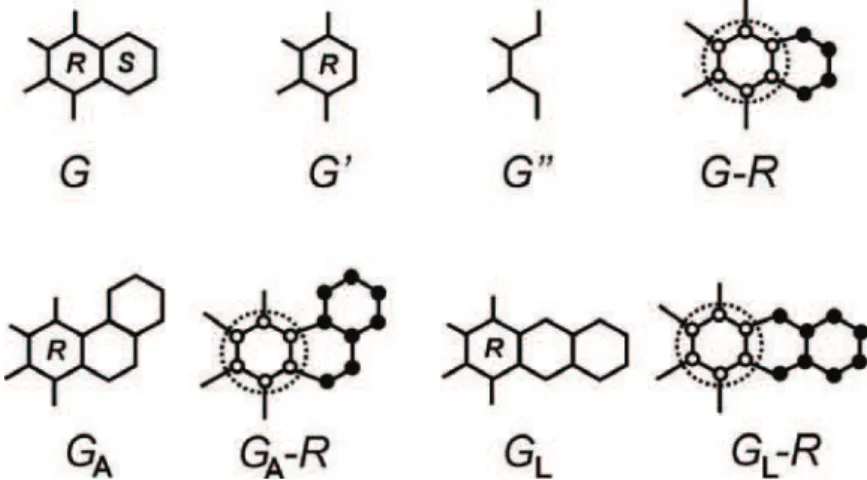
Fig. 2. The notation used. The encircled vertices are those that have been deleted.
Thus, let G be the molecular graph of a polycyclic conjugated system, R the ring whose cyclic conjugation is to be examined, and S the ring adjacent to R. It should be noted that the ring Smust be six-membered, but the ring Rneed not be. In G’ the ring Sis missing, whereas in G” both rings R and S are missing. The subgraph G–R is obtained by deleting from G all vertices belonging to the ring R.
The angularly and linearly benzo-annelated derivatives of G are denoted by GA
and GL, respectively, and their subgraphs GA–R and GA–R are constructed in full analogy with G–R.
In order to apply Eq. (1), the Kekulé structure counts of G, GA, and GL must be computed. This can be realized using standard recursive methods,37,38 namely:
( ) ( ) ( )
K G =K G−e +K G−u−v (2)
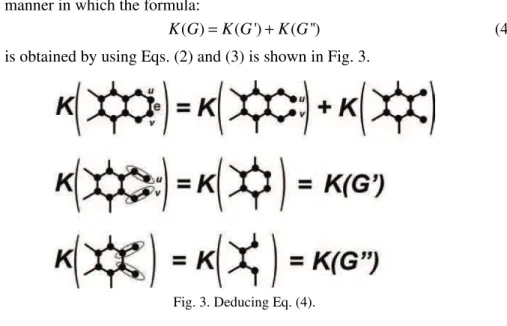
if either the vertex u or the vertex v are pendent (have a single neighbor). The manner in which the formula:
( )K G =K G( ')+K G( '') (4)
is obtained by using Eqs. (2) and (3) is shown in Fig. 3.
Fig. 3. Deducing Eq. (4).
In an analogous manner, one obtains:
A
( ) ( ) ( ')
K G =K G +K G and K G( L)=K G( )+K G( '') which combined with Eq. (4) yield:
A
( ) 2 ( ') ( '')
K G = K G +K G and
L
( ) ( ') 2 ( '')
K G =K G + K G
It should be noted that since K(G) > 0, then K(G’) and K(G”) must also be > 0. From Figs. 1 and 2, it can be seen that the subgraph GA–R differs from G–R
by having a styrene fragment instead of a butadiene fragment. Since styrene has two Kekulé structures, whereas butadiene only one, one has K(GA–R) = 2K(G–R).
On the other hand, the subgraph GL–R possesses an o-xylylene fragment, the
Kekulé structure count of which is unity. Therefore, K G( L−R)=K G( −R). Bearing these relations in mind one readily arrives at:
2 ( ) 2 ( )
( , )
( ) ( ') ( '')
K G R K G R
G R
K G K G K G
Λ
− −
= =
+ (5)
A A
2 ( ) 4 ( )
( , )
( ) 2 ( ') ( '')
K G R K G R
G R
K G K G K G
Λ
− −
= =
+ (6)
and
L L
2 ( ) ( )
( , )
( ) 2 ( ') ( '')
K G R K G R
G R
K G K G K G
Λ
− −
= =
It is now a matter of elementary calculation to verify that if K(G–R) is non- -zero, then Eqs. (5)–(7) imply:
L A
(G , )R ( , )G R (G , )R
Λ <Λ <Λ
i.e.,
L( )R (GL, )R ( , )G R 0
Δ =Λ −Λ < and
A( )R (GA, )R ( , )G R 0
Δ =Λ −Λ > , which is
in full agreement with rules a and b. In other words, our finding with regard to the effect of benzo-annelation on cyclic conjugation can be rationalized by means of the simple Kekulé-structure-based formula, Eq. (1). However, this is the case only if the subgraph G–R is also Kekuléan, i.e., if K (G–R) > 0.
THE CASE K(G–R) = 0
The case K(G–R) = 0 needs to be analyzed separately. This case is important, because it is encountered if the ring Ris odd-membered, as in the much studied acenaphthylene and fluoranthene congeners.22–26 Also, perylene belongs to this
case.17
If the subgraph G–R is non-Kekuléan, then from Eqs. (5)–(7), it follows:
A L
( , )G R (G , )R (G , )R 0
Λ =Λ =Λ =
i.e.,
L( )R A( )R 0
Δ =Δ =
a result that would be expected from a model based solely on Kekulé structures. The way to circumvent this difficulty is evident: Eq. (1) has to be modified to:
*
* *( , ) 2 ( )
( )
K G R G R
K G
Λ Λ
−
= =
where K* is the count of some pertinently chosen resonance structures (with one or more unpaired π-electrons).39,40 For the present analysis, the actual choice of
K* is immaterial, it is only necessary that K*(G–R) > 0. If so, then from the modi-fications of Eqs. (5)–(7), namely:
* *
*( , ) 2 ( ) 2 ( )
( ) ( ') ( '')
K G R K G R
G R
K G K G K G
Λ − − = = + * * * A A
2 ( ) 4 ( )
( , )
( ) 2 ( ') ( '')
K G R K G R
G R
K G K G K G
Λ − − = = + * * * L L
2 ( ) ( )
( , )
( ) 2 ( ') ( '')
K G R K G R
G R
K G K G K G
Λ
− −
= =
+
i.e.,
* * *
L( )R (GL, )R ( , )G R 0
Δ =Λ −Λ < and * * *
A( )R (GA, )R ( , )G R 0
Δ =Λ −Λ > ,
that is in harmony with the rules a and b.
Acknowledgement. I. G. thanks for the support of the Ministry of Education and Science of the Republic of Serbia (Grant No. 174033).
JEDNOSTAVNI
Ј - Ј
Ј Ј
1
ALEXANDRU T. BALABAN2 1Prirodno
–matemati~ki fakultet Univerziteta u Kragujevcu i 2Texas A & M University
at Galveston, Galveston, USA
- ( .
-) Р π
-, ( . ) R. -,
, .
( 28. 2011)
REFERENCES
1. M. J. S. Dewar, The Molecular Orbital Theory of Organic Chemistry, McGraw-Hill, New York, 1969
2. E. Clar, The Aromatic Sextet, Wiley, London, 1972 3. M. Randić, Tetrahedron 30 (1974) 2067
4. M. Randić, Tetrahedron 31 (1975) 1477
5. I. Gutman, S. Bosanac, Tetrahedron 33 (1977) 1809 6. M. Randić, Chem. Rev. 103 (2003) 3449
7. A. T. Balaban, Polyc. Arom. Comp. 24 (2004) 83 8. A. T. Balaban, M. Randić, J. Math. Chem. 37 (2005) 443 9. G. Portella, J. Poater, M. Sola, J. Phys. Org. Chem. 18 (2005) 785 10. P. Bultinck, S. Fias, R. Ponec, Chem. Eur. J. 12 (2006) 8813 11. J. Aihara, T. Ishida, H. Kanno, Bull. Chem. Soc. Jpn. 80 (2007) 1518 12. J. Ou, MATCH Commun. Math. Comput. Chem. 64 (2010) 157 13. M. Randić, MATCH Commun. Math. Comput. Chem. 64 (2010) 303 14. M. V. Putz, MATCH Commun. Math. Comput. Chem. 64 (2010) 391
15. A. Ciesielski, T. M. Krygowski, M. K. Cyranski, A. T. Balaban, Phys. Chem. Chem. Phys. 13 (2011) 3737
16. A. T. Balaban, M. Randić, in: Advances in Physics and Chemistry of Carbon Bonding and Structures, M. V. Putz, Ed., Springer-Verlag, Berlin, 2011, in press
18. S. Jeremić, S. Radenković, I. Gutman, Maced. J. Chem. Chem. Eng. 29 (2010) 63 19. A. T. Balaban, J. Đurđević, I. Gutman, S. Jeremić, S. Radenković, J. Phys. Chem., A 114
(2010) 587
20. S. Jeremić, S. Radenković, I. Gutman, J. Serb. Chem. Soc. 75 (2010) 943
21. A. T. Balaban, I. Gutman, S. Jeremić, J. Đurđević, Monatsh. Chem. 142 (2011) 53 22. I. Gutman, J. Đurđević, A. T. Balaban, Polyc. Arom. Comp. 29 (2009) 3
23. J. Đurđević, I. Gutman, J. Terzić, A. T. Balaban, Polyc. Arom. Comp. 29 (2009) 90 24. I. Gutman, J. Đurđević, J. Serb. Chem. Soc. 74 (2009) 765
25. I. Gutman, S. Jeremić, V. Petrović, Indian J. Chem., A 48 (2009) 658
26. B. Furtula, I. Gutman, S. Jeremić, S. Radenković, J. Serb. Chem. Soc. 75 (2010) 83 27. I. Gutman, Monatsh. Chem. 136 (2005) 1055
28. I. Gutman, in: Mathematical Methods and Modelling for Students of Chemistry and Biology, A. Graovac, I. Gutman, D. Vukičević, Eds., Hum, Zagreb, 2009, pp. 13–27 29. J. Đurđević, S. Radenković, I. Gutman, S. Marković, Monatsh. Chem. 140 (2009) 1305 30. J. Đurđević, I. Gutman, R. Ponec, J. Serb. Chem. Soc. 74 (2009) 549
31. A. T. Balaban, T. K. Dickens, I. Gutman, R. B. Mallion, Croat. Chem. Acta 83 (2010) 209 32. S. Radenković, J. Đurđević, I. Gutman, Chem. Phys. Lett. 475 (2009) 289
33. I. Gutman, J. Math. Chem. 47 (2010) 1309
34. S. Radenković, W. Linert, I. Gutman, S. Jeremić, Indian J. Chem., A 48 (2009) 1657 35. I. Gutman, S. Radenković, W. Linert, Monatsh. Chem. 141 (2010) 401
36. I. Gutman, O. E. Polansky, Mathematical Concepts in Organic Chemistry, Springer-Verlag, Berlin, 1986
37. W. C. Herndon, J. Chem. Educ. 51 (1974) 10
38. S. J Cyvin, I. Gutman, Kekulé Structures in Benzenoid Hydrocarbons, Springer-Verlag, Berlin, 1988
![Fig. 1. An example illustrating the notation used in this paper. In naphtho[1,2,3,4-ghi]perylene (B) the ring R has ef = 0.0261 and Λ = 0.5263](https://thumb-eu.123doks.com/thumbv2/123dok_br/17211392.243394/2.892.235.654.509.891/fig-example-illustrating-notation-used-paper-naphtho-perylene.webp)