_____________________________ *)
Corresponding author: [email protected]
doi:
10.2298/SOS0703287C
UDK 621.397.331.5:531.3
Kinetics of C
xN
yFormation on Electrode Surface Through
Electrochemical Method
A.Chekhovskii, T.Tomila
*), A.Ragulya, I.Timofeeva, A.Ivanchuk, D.Bykov,
T.Labunets
Frantsevich Institute for Problems of Materials Science of NASU,
3, Krzhyzhanovsky St., Kyiv, 03142, Ukraine.
Abstract:
Powded CxNy coatings were deposited from acetonitrile on Ni, Si, and C surfaces at
a voltage of 500-2000 V by the electrochemical method. Electrolysis products were analyzed by IR spectroscopy, X-ray phase analysis and electron microscopy. According to FTIR data,
at frequencies 1370 and 1530 cm-1, absorption bands characteristic for stretching C-N and
C=N oscillations are observed. The obtained results indicate that the deposition process occurs in different manner in each specific case, i.e., the kinetics of the electrode depends on the electrode material (Ni, Si, and C).
Keywords: Electrochemical method, Acetonitrile, Voltage, Electrode, Carbon nitride.
Introduction
The search of new superhard materials has reached a higher level after publication of [1,2], whose authors theoretically forecast the probability of the existence under normal conditions of crystalline carbon nitride (C3N4), which is similar by structure to the known
silicon nitride and by hardness to diamond. The calculations performed over further years [3] confirmed the possibility of the existence of crystalline carbon nitride with high mechanical and electrophysical properties.
Most papers report about synthesis of films containing nonstoichiometric nitrogen-carbon compounds using various methods. Generally, film microstructure represents a matrix from amorphous carbon nitride with а low content of crystalline phase grains. In order to
synthesize carbon nitride films, many efforts have been devoted to application of physical PVD and chemical CVD methods such as vacuum spraying [4], ion beam deposition [5], ion laser deposition [6], graphite-target spraying in nitrogen plasma [7], et al. All of them are deposition from a gaseous phase. They require complex equipment, high vacuum and high temperature, which adversely affect synthesis of such metastable mixtures as C3N4, alongside
with difficult control over experiment conditions.
___________________________________________________________________________
This work deals with conditions for production of carbonitride CxNy coatings by the
electrochemical method on various electrodes in acetonirile [14].
Experimental
In the investigation, an electrochemical cell was used similar to the one described in [8-10]. The source of direct current made it possible to apply voltage on the electrodes in the range 0-2400 V. The distance between the electrodes was 10 mm. As a working liquid, acetonitrile CH3-CN of the trade “pure for analysis” was used; it underwent distillation before
the experiments. The temperature of electrochemical processes was in the range 18-70 oC. Electrodes were chosen from carbon, silicon, and nickel. The effect of a polar electrode on the kinetics of electrode processes, which was shown up by the change in the current density, I (mA/cm2), over time, τ (min), was studied in the C-C, Si-Si, Ni-Ni, C-Si, and C-Ni systems.
Since the rates of the processes were small and the deposition yields were low, it became necessary to conduct experiments with large electrodes up to 90 cm2 and a volume of acetonitril of 600 cm3, thanks to which there appeared a possibility to take up powdered products of electrolysis for analyses. The products were analyzed by X-ray diffraction (XRD), IR spectroscopy with the Fourier transformation (FTIR), and X-ray photoelectron spectroscopy (XPS). IR spectroscopic investigations were carried out on a Fourier spectrometer FSM-1201 in the frequency 4000-400 cm-1.
Results and discussion
The molecule of acetonitrile as an organic substance is characterized by the following principal parameters: the bond length between atoms; valence angles, atom charge, dipole moment, polarity, and polarizability, which in strong magnetic fields change. In any electrochemical process, the nature and state of the electrode surfaces play an important part. The properties of electrodes, in their turn, depend on the chemical element, valence, crystalline structure, surface energy as well as on electrical, magnetic, thermalphysic and other properties. This is especially related to processes proceeding in electrochemical systems where as an electrolyte, organic liquid substances (solvents), which have high electrical resistivity, are used, They do not dissociate into anions and cations like aqueous solutions of electrolytes, which operate at low voltage (3-30 V). That is why investigation of the kinetics of electrode processes near the boundary organic solvent/solid electrode is of great interest, firstly, from the scientific viewpoint and, secondly, thanks to the possibility of producing needed substances and materials via electrochemical processes.
All of the previous investigations have been carried out using the same electrode pair carbon/silicon, with carbon being as an anode and silicon as a cathode. How this system behaves after changing electrode polarity vice versa was completely unclear. Therefore, the aim of our work was to study the kinetic behavior of electrodes made from systems of carbon, silicon, and nickel elements, different in their chemical nature and properties in acetonitrile. We expected the carbonitride CxNy to be the product of the electrolysis. We were interested in
the behavior of the systems in the cases of electrodes from the same material as well as from different materials.
Tab. I. Electrochemical electrode/acetonitrile systems Symbol
of System
System of electrodes
Intensity of electric field,
V
Formation of coating on:
Characteristic of coating
a C+-C- 500-2000 no coating
b C--Si+ 500-2000 Si+ Powdered coating of
gray-yellow color
c C+-Si- 500-2000 Si- Powdered coating of
brown-yellow color
d Si+-Si- 500-2000 Si+ Powdered coating of
gray-yellow color
e C+-Ni- 500-2000 no coating
f Ni--Ni+ 300-1500 Ni- powdered coating of
yellow-green color
As follows from these data, in such systems as C+ - C- and C+-Ni- in the U range 500-2000 V, the formation of coating is not observed. From the other systems, namely C--Si+, C+ -Si-, Si+-Si-, and Ni+-Ni-, powdered coatings different in color form. It is worth noticing that the polarity of electrodes in the C-Si system determines the electrode (+ or -) on which electrolysis products form. In the C-Si system they can form on both Si+ and Si- electrodes (see Tab. I, symbols b and c). In the case of the Si+-Si- system, the electrolysis products form on Si+ whereas in the Ni+-Ni- system on the negative Ni- electrode.
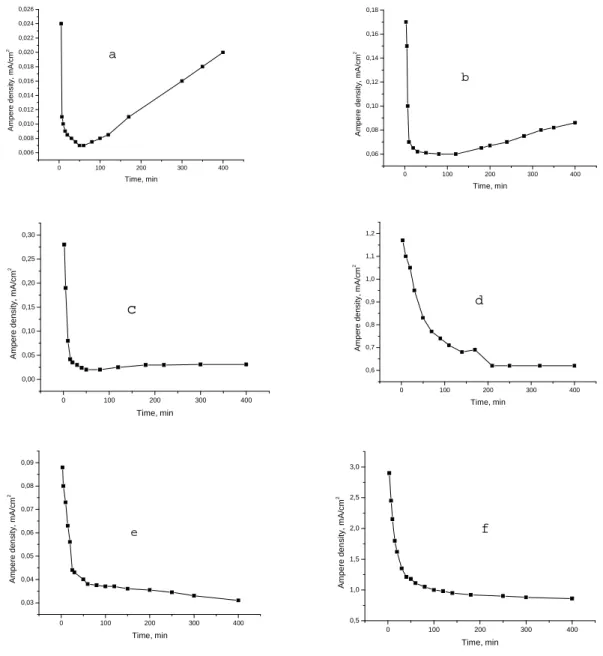
The data obtained indicate that the nature of electrodes significantly affects the kinetics of interaction in the acetonitrile/electrode system. Fig. 1 (a-f) demonstrates the dependences of changes in the current density, I (mA/cm2), on the experiment duration, τ
(min), for the systems investigated. It should be noticed that for C+-C- (a) and C+-Ni- (e) systems, electrolysis products form on the electrode surfaces in the presence of current in the circuit, which is lower than in the other systems by an order of magnitude. This evidences the fact that electric energy is spent on the decomposition of acetonitrile into individual radicals, which form new species of molecules of organic substances (the composition of the liquid phase was not analyzed) and on heating of liquid phase (from 18 to 70 oC).
In the C-C system (Fig. 1a) at the initial stage up to 50 min, the current sharply decreases, then after 100 min it increases and practically reaches the initial value within 400 min. In our opinion, this is associated with the change in the chemical composition, physical and physicochemical properties of the liquid phase. The same phenomenon, that is, an increase in the current over time, was observed in other systems such as C- -Si+ (Fig. 1b) and C+-Si- (Fig. 1c), however, to a much lesser extent. For Si+-Si- (Fig.1d), C+-Ni- (Fig. 1e), and Ni+-Ni- (Fig. 1f) systems, a decrease in the initial current density by 2-3 times occurs and over time up to 400 min this tendency remains but to a lower extent. The current density in the systems characterized by the formation of electrolysis products is 10-50 fold higher than in the other systems. Such different behaviors of electrode pairs in acetonitrile at high electric field intensities indicate complicated electrode processes and strong influence of the nature and polarity of the electrodes in an electrochemical system.
___________________________________________________________________________
metal-organic nickel compounds form, which decompose under treatment in air with the formation of nickel oxides.
0 100 200 300 400
0,006 0,008 0,010 0,012 0,014 0,016 0,018 0,020 0,022 0,024 0,026 A m p e re d e n s it y , m A /c m 2 Time, min a
0 100 200 300 400
0,06 0,08 0,10 0,12 0,14 0,16 0,18 A m p e re d e n s it y , m A /c m 2 Time, min b
0 100 200 300 400
0,00 0,05 0,10 0,15 0,20 0,25 0,30 A m p e re d e n s it y , m A /c m 2 Time, min c
0 100 200 300 400
0,6 0,7 0,8 0,9 1,0 1,1 1,2 A m p e re d e n si ty, m A /cm 2 Time, min d
0 100 200 300 400
0,03 0,04 0,05 0,06 0,07 0,08 0,09 A m p e re d e n s it y , m A /c m 2 Time, min e
0 100 200 300 400
0,5 1,0 1,5 2,0 2,5 3,0 A m p e re d e n s it y , m A /c m 2 Time, min f
Fig. 1 Change in the current density, I (mA/cm2), over time, τ (min), under electrochemical
interaction of acetonitrile in the systems: a) C+-C-, U=1900 V, no deposit ; b) C--Si+, U=1200 V, deposit on Si+; c) C+-Si-, U=2300 V, deposit on Si-; d) Si+-Si-, U=1000 V, deposit on Si+; e) C+-Ni-, U=2300 V, no deposit ; f) Ni--Ni+, U=300 V, deposit on Ni-;
evident (symbol b, Table) (electric field intensity 1370 V, temperature 20-72 oC, process duration 18 h).
0 1000 2000 3000 4000 5000 6000
8 18 28 38 48 58 68 78
2 тета
in
te
n
s
it
y
a)
0 1000 2000 3000 4000 5000 6000 7000 8000 9000
8 18 28 38 48 58 68 78
2 Theta
In
te
n
s
it
y
b)
0 2000 4000 6000 8000 10000 12000
8 18 28 38 48 58 68 78
2 тета
in
te
n
s
it
y
c)
___________________________________________________________________________
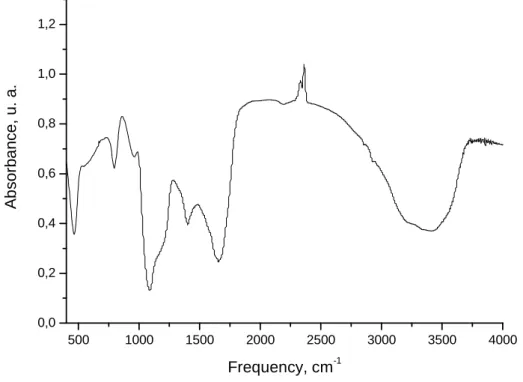
In the IR spectra from the powder formed on the silicon electrode, in addition to the characteristic C-N and C=N bands in the frequency range 1370 and 1530 cm-1, absorption bands appear, which can be related to Si-N oscillations in the frequency range 450-1150 cm-1. The presence of the absorption frequencies 2170-2200 cm-1 can be prescribed to the valence oscillations of the end C≡N bonds. The absorption bands in the ranges 2800-3000 and 1210
cm-1 are connected with the valence and deformation CH oscillations, respectively. The IR spectra from powders have absorption bands in the frequency range 3100-3600 and 1640 cm-1, which can be related to the valence and deformation NH oscillations, respectively. From the IR spectra obtained, a conclusion can be drawn that under interaction of acetonitrile with a silicon electrode, composite CxNy-Si3N4 coatings form.
500 1000 1500 2000 2500 3000 3500 4000
0,0 0,2 0,4 0,6 0,8 1,0 1,2
A
b
s
o
rb
a
n
c
e
,
u
.
a
.
Frequency, cm-1
Fig. 3 FTIR spectrum from the C--Si+-acetonitrile system; coating on Si+ at U= 1370 V, T= 20-72 oC, τ= 18 h.
For the Ni-Ni (f) system, in addition to the abovementioned bonds, the presence of the Me-C and Me-O bonds is characteristic, which manifest themselves in the bands within the frequency range 400-800 cm-1.
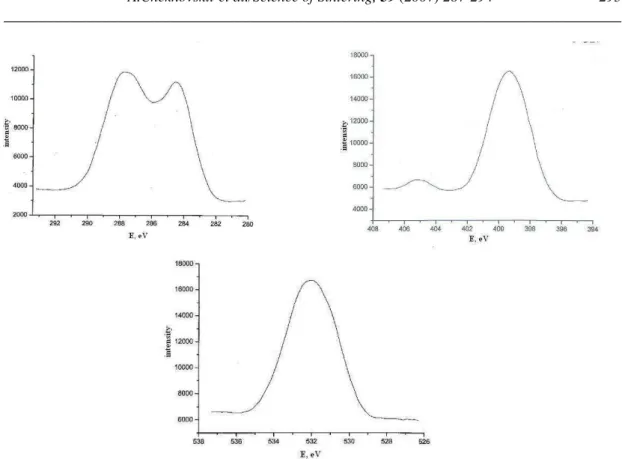
Fig. 4 XPS spectrum from the CxNy coating obtained in the Si-Si-acetonitrile system on Si +
electrode: (a) C1s, (b) N1s, (c) O1s.
The atomic composition of the electrolysis product is: C = 44.9 %, N=24.6%, O=24.4%, and Si=6.1%. The N/C ratio in the coating is equal to 0.54, which is high enough in comparison with the C-Si-acetonitrile system [8, 10].
Conclusions
For the first time, the kinetics of electrode processes proceeding at the boundary organic solvent (acetonitrile)/solid electrode has been studied at temperature 18-70 oC and direct electric field intensity of 400-2000 V. As electrodes, C, Si, and Ni were used. The cases when in the electrochemical cell electrodes were made from the same material or from combination of different materials have been considered. In the case of different materials, the electrochemical kinetics is markedly affected by the polarity of electrodes, which determines the character of forming electrolysis products. In the case of the C+-C- and C+-Ni- electrode systems, the formation of electrolysis products is not observed. In the studied systems of elements C, Si, and Ni under electrolysis in acetonitrile, oxides, carbonitrides, and composite powdered CxNy-Si3N4 materials form depending on the electric field intensity and electrode
polarity. By using X-ray phase analysis, IR spectroscopy, and X-ray photoelectron analysis, it has been established that in the coatings obtained there are single and double carbon-nitrogen bonds and the N/C ratio is equal to 0.54.
References
___________________________________________________________________________
2. A.Y. Liu, M.L. Cohen. Phys. Rev. B, 41 (1990), 10727.
3. V.L.Korsunskii and V.I.Perekin, Uspekhi khimii, 66 (1977)1003. 4. Y. Tani, Y. Aoi, E. Kamijo. J. Appl. Phys., 73 (1998) 1652.
5. S. Bhattacharyya, C. Vallee, Cardinand, O. Chaulet, G. Turban. J. Appl. Phys., 82 (1999) 2162.
6. J. Bulir, M. Jelinek, V. Vorlicek, Zemek, V. Perina. Thin Solid Films, 292 (1997) 318.
7. C. Niu, Y.Z. Lu, C.M. Lieber, Science, 261 (1993) 334.
8. Q. Fu, J.T. Jiu, K. Cai, H. Wang, C.O. Cao, H.S. Zhu. Phys. Rev. B, 59 (1999) 1693.
9. S. Kundoo, Banergee, R. Saha, K.K. Chattopadnyay. Materials Letters, 57 (2003) 2193
10. X.B. Yan, B.K. Tay, G. Chen, S.R. Yang. Electrochemistry Communications, 8 (2006) 737.
11. A.A.Chekhovskii, A.A.Ivanchuk, and V.I.Podsosonnyi. Proc. Current Problems of Physical Material Science, IPM NAS Ukraine, Kyiv, 2002, p. 153-158.
Садржај: Превлаке од праха CxNy су нанете електрохемијском методом из
ацетонитрила на површине Ni, Si, и C под напоном од 500-2000 V. Производи
електролизе су анализирани IR спектроскопијом, рентгенском анализом и
електронскоммикроскопијом. У складуса FTIR подациманафреквенцијамаод 1370 и
1530 см-1примећенисуабсорпциониопсезикојисукарактеристичнизаистезање C-N
и C=N осцилатора. Добијенирезултати су указали да се процеснаношења одвија на
различите начине за сваки специфичан случај. Кинетика електрода зависи од
материјалаодкогајеелектрода (Ni, Si, и C).
Кључне речи: Електрохемијска метода, ацетонитрил, напон, електрода, карбон