APPLICATION OF CORRESPONDENCE ANALYSIS IN THE ASSESSMENT OF GROUNDWATER CHEMISTRY
Running Head: Application of Correspondence Analysis in the Assessment of Groundwater Chemistry
Fernando António Leal Pacheco(a)
(a)
Department of Geology, Trás-os-Montes e Alto Douro University, 5000 Vila Real, Portugal Phone (59) 320186
Fax: (59) 320480
ABSTRACT
Correspondence Analysis was used to determine the sources and processes that may explain the variation observed in data sets of groundwater analyses. The following method was adopted: (1) based on the observation of “sympathies” and “antipathies” between loadings signs, correspondence factors were represented by parameters with some pertinent geochemical meaning; (2) the relation between factors and parameters was then checked by Multiple Linear Regression, where factors acted as independent variables and parameters as dependent variables. Sample scores of the selected parameters gave us the ability to separate polluted from non-polluted waters, to identify areas where pollution is dominated by agriculture and areas where contamination is controlled by domestic effluents, and to describe weathering and agricultural activities in the sampled area. The practical example presented here anticipates the impact of agriculture and urban pollution on the chemistry of 160 water samples collected in a granitoid area at central Portugal (Fundão).
Key words: Correspondence Analysis, Multiple Linear Regression, hydrogeochemistry,
INTRODUCTION
The composition of groundwaters is affected by a several processes that include wet and dry deposition of atmospheric salts, evapotranspiration, and water-soil and water-rock interactions. In inhabited areas, especially where there is intensive agriculture or industry, the water composition may be affected by fertilizers and manure, by solid waste leachates, and by domestic and industrial effluents.
The contribution of each source or process to the groundwater chemistry may be quantitatively assessed by mass balance models, as early recognized by Garrels and Mackenzie (1967) in the study of a pristine area (Sierra Nevada, USA) and lately by Pacheco and Van der Weijden (1996) in the study of an area with sizeable anthropogenic input (Fundão, Portugal).
Correspondence Analysis and other eigenvector techniques may be used as methods for assessing the controls on groundwater composition, especially in the study of large hydrochemical data sets. Frequently, the approach is strictly statistical and although the analysis can select several factors more or less objectively the interpretation of these factors in terms of actual controlling sources and processes is highly subjective.
Pacheco and Portugal Ferreira (1996) studied the groundwaters from a pristine area in Portugal and established simple linear regression models between correspondence factors and several relevant hydrochemical parameters (e.g., the molar bicarbonate to silica ratio, which is characteristic for particular water-mineral interactions, as pointed out by Garrels, 1967). Based on the meaning of these parameters, Pacheco and Portugal Ferreira (1996) concluded that the variation in the concentrations of major cations, major anions and dissolved silica could be approximately attributed to silicate weathering of metamorphic rocks-forming minerals and soil
fertilization (a minor contribution), and classified their data set as a system of double influence. Alencoão, Sousa Oliveira, and Pacheco (1996) applied a similar methodology to a small set of stream waters draining granites and schists and found that the direct discharge of domestic effluents into streams and rivers could be demarcated by Correspondence Analysis as a third independent influence. Therefore, they classified their stream water data set as a system of triple influence. The present paper (1) corroborates the results obtained by the above cited authors in the case of a large groundwater data set (160 samples), (2) provides a comprehensive review of the rationale for the selection of hydrochemical parameters, (3) argues about the option for Correspondence Analysis in detriment of more standard eigenvector techniques such as Principal Components Analysis or Factor Analysis, (4) and discusses the choice of variables to include in the model.
METHODOLOGY
Eigenvector Techniques
In general, variables in hydrochemical data sets are intercorrelated, but the correlations are hard to see and the data are difficult to interpret as they stand. For instance, the number of variables with which the investigator has to grapple is frequently large and the common scatter diagrams between pairs of variables fail to show a complete or at least comprehensive picture of the whole data variation. Eigenvector techniques such as Correspondence Analysis (CA), Principal Components Analysis (PCA) or Factor Analysis (FA) transform these original variables onto a
or factors, respectively for CA, PCA and FA) so that a major portion of data variation is concentrated on just a few of them (commonly two or three). This reduced set of vectors may then be represented on a single diagram and the groupings formed interpreted in terms of some physical or chemical process. Basically, vectors are a new set of orthogonal axes geometrically characterized by the eigenvectors and eigenvalues: (1) the elements of the eigenvectors are the cosines of the angles between the original and transformed axes; (2) the eigenvalues measure the spread of the data in the direction of the vectors. For example, the first eigenvector is the direction of maximum spread of the data in terms of a p-dimensional space (where p is the number of original variables) and this spread is measured by the first eigenvalue; the second vector has maximum spread at right angles to the first vector, and so on. Eigenvalues are used to measure the proportion of data used by each vector. The first vector will contain the most information and succeeding vectors will contain progressively less information. The methods used to decide about the number of vectors that should be retained and submitted to interpretation are frequently called stopping rules (Jackson, 1991). One of the most popular is the SCREE test (Cattell, 1966). This is a graphical technique which plots the p eigenvalues in ordinate and their ranks in abscissa. In a typical SCREE plot, the k highest eigenvalues will nearly fit to a straight line of high slope and the lowest p-k eigenvalues to a straight line of low slope. The break in slope between these two lines is sometimes called an elbow and is used as stopping rule. According to it, only the k highest eigenvectors should be considered for interpretation.
The mechanics of CA is briefly outlined below. The details of this technique are beyond the scope of this paper and can be found elsewhere, for example in the original work of Benzecri (1973, 1977), or in later studies such as the analytical discussion of Heiser and Meulman (1983), the geometric interpretation of Greenacre and Hastie (1987), or the tutorial paper of Van der
Heijden, Falguerolles and Deleeuw (1989). The initial raw data for CA consist of a matrix Xnxp,
where n is the total number of observations and p the total number of variables. Traditionally, X is a matrix of qualitative data or quantitative data treated as qualitative (categorical data), but no practical objections exist to the use of “raw” quantitative data (Davis, 1986). In the present paper, the observations are represented by water samples and the variables by the analytical concentrations of major inorganic compounds in those samples. The method of CA comprises four consecutive steps:
1) X is scaled in a manner that treats rows and columns identically. This is done by dividing the elements of X (xij) by the product of the square roots of the row and column totals:
z x x x ij ij ij i n ij j p
1 x
1 (1)Scaled values are saved in the matrix Znxp.
2) A similarity matrix, Rpxp, is obtained by multiplying Z by its transpose (ZT):
RZT Z
x (2)
3) The p eigenvalues and eigenvectors are calculated from R (some eigenvector extracting techniques are described in Press and others, 1989). By definition, eigenvectors have unit length and must be scaled in order to be converted onto correspondence factors. This is done by multiplying each eigenvector by its corresponding singular value, which is the square root of the corresponding eigenvalue. Factor elements are called loadings and measure the extent to which the original variables are associated with the factors. Besides, if two loadings have the same sign the variables are positively correlated and if they have opposite signs the variables are negatively correlated. Factor loadings are saved in the
4) The samples coordinates (the so-called correspondence factor scores) are finally computed and saved in the matrix Fnxp:
FZ x W (3)
PCA and FA are two major competitors of CA. The original works date back to the turn of the century (Pearson, 1901; Spearman, 1904; respectively for PCA and FA) and later derivations of FA (especially the method of Principal Factor Analysis - PFA - of Thompson, 1934) are widely used in hydrogeochemistry (Reeder, Hitchon and Levinson, 1972; Klovan, 1975; Jöreskog, Klovan and Reyment, 1976; Likens and others, 1977; Miller and Drever, 1977a; Drever, 1988). The mathematics of PCA is in most similar to that of CA. Basically, the methods differ in the matrix that is used to calculate the eigenvalues and eigenvectors (R). In PCA, this is a variance-covariance matrix when the p variables are all measured in the same units or a correlation matrix otherwise. FA also uses variance-covariance or correlation matrixes to calculate the eigenvalues and associated eigenvectors, but is somehow a different technique. For a better understanding of the differences between PCA and FA, a few concepts must be introduced:
System variability and system structure: System variability measures data variation and
is equal to the sum of the variances of the original variables. System structure measures the interdependencies between original variables and is equal to the sum of the covariances. The diagonal elements of a variance-covariance matrix describe system variability and the off-diagonal elements describe system structure.
Common vectors are the k vectors obtained by the stopping rule.
Common variability, common structure and communality: Common variability and
explained by the common vectors. Communality is the contribution of each original variable to the common variability. These quantities are calculated by multiplying a matrix of loadings, Wpxk, by its transpose:
R*=WxWT (4)
The diagonal elements of R* are the communalties, the sum of these elements is the common variability and the sum of the off-diagonal elements is the common structure.
Residual variability and residual structure are the part of the system variability and
system structure unexplained by the common vectors. These are calculated by:
E=R-R* (5)
where E is the matrix of residuals.
Equation 5 may be turned around and written as:
R=R*+E (6)
This equation says that the variance-covariance matrix is made up of the part explained by the common vectors (first term of the right-hand side) plus the proportion unexplained by them (second term). The main difference between PCA and FA stands on the fact that PCA continues extracting principal components until the residual variability has been reduced to some prescribed amount determined by the stopping rule, while the residual structure is left unconstrained. On the other hand, FA tries to reduce the residual structure as much as possible. The minimization of residual covariances cannot be done by any direct method and for that reason FA has to be carried out iteratively. There are a number of methods to do this, generally called estimation procedures (Jackson, 1991). PFA is one of these methods and operates as
number of initial estimates for the communalities have been proposed over the years, but the square multiple correlation coefficient of each original variable with all the others is the most widely used at this point in time.; (2) The eigenvalues and associated eigenvectors are obtained from the resultant matrix on the basis of the stopping rule; (3) From these, new estimates of the communalities are obtained (Equation 4) and placed at the diagonals of R. The process is repeated until convergence is attained between “old” and “new” communalities; (4) At this point, the common variability and structure are calculated as well as the residuals (Equations 4 and 5). If full convergence has been attained, matrix E is diagonal (all off-diagonals are equal to zero), meaning that the system structure has been completely explained. It is important to mention that once the diagonals of E are minimized (PCA) the off-diagonals are going to be reduced, and vice versa (FA). Each method does best what is supposed to do, but the results obtained by the two methods will generally be very similar. For that reason, only CA and PCA will be further considered.
The Option for CA
CA and PCA belong to that category of methods in which utility is judged by performance and not by theoretical considerations (Davis, 1986). In this study, three performance criteria were tested in order to select the most appropriate technique to use in the assessment of groundwater chemistry: (1) The interpretability of vector one. Despite the fact that interpretability of vectors may not be considered an objective matter (whatever method is used), this seems a reasonable criterion as in most cases vector one explains about half of the system variability; (2)
Reproducibility of results in identical situations; (3) Robustness regarding the units in which data are expressed.
Four hydrochemical data sets were selected for the performance analysis: Sousa Oliveira (1995), Pacheco and Portugal Ferreira (1996), Alencoão, Sousa Oliveira and Pacheco (1996), Pacheco and Van der Weijden (1996); this last data set (the Fundão data set) is given in the Appendix. In all cases the bedrocks were silicate (granites and/or metamorphic) rocks and land use affected the groundwater chemistry to a certain extent. The original variables were the major inorganic compounds Na+, K+, Mg2+, Ca2+, HCO3-, Cl-, SO42-, NO3- and dissolved silica (SiO2).
The results obtained when data are expressed in mg/l are shown in Figures 1a,b (changing the measurement scale from mg/l to mol/l had little effect on the results). As expected, the results obtained with both methods are identical for all data sets. The exception is the loading of SiO2
when PCA is applied to the data set of Alencoão, Sousa Oliveira and Pacheco (1996).
CA plots the loadings of HCO3-and SiO2 at the positive side and the loadings of Cl-, SO4
2-and NO3- at the negative side of the first factor axis (Figure 1a). This means that the
concentrations of bicarbonate and silica are positively correlated on factor one (F1) and the same
is true for the concentrations of chloride, sulphate and nitrate. Na+ has always very low factor loadings and the distribution of the other cations depends on the data set: K+ is at the negative side of the F1 axis for Sousa Oliveira (1995) and at the positive side for the other data sets, and
the distributions of Mg2+ and Ca2+ are reversed. The results of CA are consistent with the generally held assumptions about the sources of dissolved components in contaminated groundwaters from silicate rocks: (1) All dissolved HCO3- and SiO2 are assumed to be products
others). Alkalinity of groundwater may vary due to sizeable input of limestone dust, application of calcium carbonate on agricultural land, dissolution of trace amounts of calcite in joint planes, secondary precipitation of carbonate, selective uptake of nitrate or cations in exchange with bicarbonate or protons (respectively), but in the vast majority of cases these processes are assumed to produce little effect on the level of alkalinity acquired by water-rock interaction under soil PCO2. The SiO2 concentrations may change by secondary precipitation of silica but that
can be neglected for dilute shallow groundwaters; (2) The Cl-, SO42- and NO3- concentrations are
mostly attributed to atmospheric and pollution sources, especially fertilizers and domestic effluents (Zobrist and Stumm, 1981; Matthess, 1982; Appelo and Postma, 1993; Frapporti, 1994; Pacheco, 1995; Pacheco and Van der Weijden, 1996; and references therein). Contributions made by dissolution of trace amounts of Cl- and S-minerals (e.g., halite, gypsum, pyrite), frequently present in metamorphic rocks, are swamped by the anthropogenic contributions and may be ignored; (3) The cation concentrations are related to both natural and anthropogenic/atmospheric sources as the negative electric charge associated with HCO3-, Cl-, SO42- and NO3- has to be
compensated by an equivalent positive charge derived from Na+, K+, Mg2+ and Ca2+. In brief, when results are obtained by CA, F1 may be easily interpreted as a “source factor” which can be
used separate between samples with pollution-dominated chemistries and samples with weathering-dominated chemistries, respectively the ones with negative and positive F1 scores.
An equivalent interpretation for the first principal component (pc1) is hardly attained.
Figure 1b shows that 8 (of 9) original variables have positive moderate to high pc1 loadings,
meaning that they are all positively correlated. Besides, for all data sets but one (Pacheco and Portugal Ferreira, 1996), the pc1 scores were found to be highly correlated with the samples
Weijden and others (1983). Chemical weathering, use of fertilizers on farmland, pollution by sewage systems, apart or in combination, can produce waters with different Ec values. Different degrees of evapotranspiration will also give rise to differences in these values. But there is no easy way to estimate the contribution of each process to the Ec just looking to the samples pc1
scores. For that reason, the interpretation of pc1 will depend on prior knowledge about the
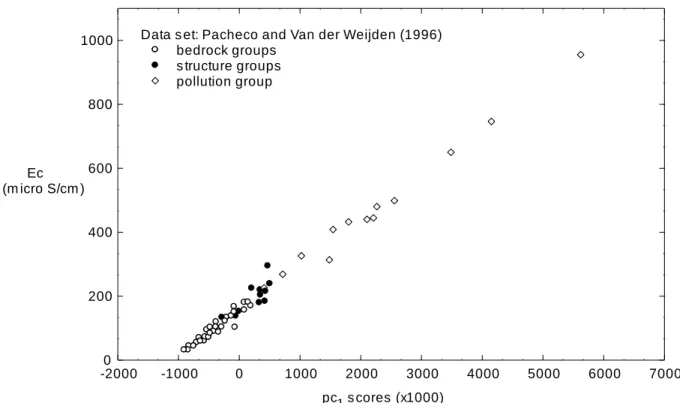
geology, land use and human occupation of the study area. For instance, Pacheco and Van der Weijden (1996) identified 13 groups of water samples using the RST algorithm, a clustering algorithm based on the mathematical concept of equivalent relations between objects. Using a mass balance algorithm (the SiB algorithm), seven of these groups were associated with petrological units (bedrock groups), two with basic dikes (structure groups), and one with pollution (pollution group); the remaining three groups could not be associated with any source or process. Figure 2 plots the Ec values of Fundão water samples against the corresponding pc1
scores. Different symbols were used to represent the bedrock, structure and pollution groups, respectively circles, bullets and diamonds. The distribution of these symbols suggests that chemical weathering is responsible for the low (bedrock groups) to moderate (structure groups) electroconductivities and pollution for the high electroconductivities. When the relation between pc1 and Ec is checked for the Alencoão, Sousa Oliveira and Pacheco (1996) data set one finds
that granite waters are responsible for the lower conductivities and schist waters for higher conductivities. For the other two data sets no simple explanation could be found for the variation in Ec. The exigency of a detailed background knowledge about the study area for the interpretation of pc1 reduces the applicability of PCA as an “exploratory” technique for the
Choice of Variables for the CA model
As previously mentioned, the concentrations of major dissolved components are constrained by the charge balance condition, which is represented by the following equality (concentrations in the equivalent scale):
[Na+]+[K+]+[Mg2+]+[Ca2+]=[HCO3-]+[Cl-]+[SO42-]+[NO3-] (7)
This “closed sum” condition demands that the sources and processes responsible for the variation in the anion concentrations match those which are responsible for the variation in the cation concentrations (and vice versa). In fact, because the negative electric charge in water is not free to vary without the corresponding variation in the positive charge, one could define the cations as the “positive face” of the inorganic groundwater chemistry and the anions as its “negative” counterpart. This means that, in principle, there should be no further gain when CA is applied to a data set using both the cations and anions, with respect to those cases where only the cations or the anions are used. In other words, the conclusions taken from the interpretation factors should be the same no matter the model in use. To test this hypothesis, three separate analyses were carried out using the Fundão data set: (1) All the 9 major inorganic compounds were included in the analysis (global model); (2) Just the four major anions and silica were used (anions model); (3) Just the four major cations and silica were used (cations model). The SCREE plots are shown in Figure 3a. The five circles representing the anions model almost coincide with the first five black bullets of the global model. Further correspondence between the anions and the global models exist regarding the loadings in the first four factors (the common factors according to the SCREE test); in Figure 3b, the trends in the anions model (white ribbons) follow the anions trends in the global model (dashed ribbons). A different set of factors is obtained with the cations
model (diamonds in Figure 3a). A single factor accounts for about 80% of the data variation and three “satellite” factors explain the remaining 20%. It was also found that the first factor is highly correlated with Ec (Pearson coefficient of 0.8 for 99.999% of probability). The cleavage between the cations model and the anions/global models is very striking. It seems like the variation in the anion concentrations swamps the variation in the cation concentrations so that when both the cations and the anions are taken together (global model) only the variation in the anions is seen.
The results obtained with the anions and the global models support the working hypothesis. They are identical and therefore the interpretation of the four common factors leads to the same conclusions. The main advantage of the anions model with respect to the global model is that the first explains 100% of the system variability and structure while the second leaves unexplained the variability and structure associated with the last five correspondence factors (cf. Figure 3a). The results of the cations model do not contradict the initial hypothesis. In this case, a major portion of the system variability is connected to a physical parameter (Ec) which, as previously seen (Figure 2), is related to a number of sources and processes, but its variation is not readily interpretable.
For the reasons presented above, the definition of hydrochemical parameters discussed below will stand on the results obtained with the anions model.
Rationale for the Selection of Hydrochemical Parameters
The application of CA to a set of n groundwater samples from crystalline rocks that were analytically measured for HCO3-, Cl-, SO42-, NO3- and SiO2 may result in four common factors
(Figure 3a). The relation between factor i (Fi) and the original variables is described by Equation
3 which can be re-written as:
F i wi,HCO 3 HCO 3 wi, ClCl wi, SO 4 SO 4 2 + w i,NO 3 NO 3 + wi, SiO 2 SiO 2 (8)As mentioned, the wi-coefficients (factor loadings) measure the extent to which each variable is
associated with Fi. It was also told that if two loadings have the same sign the variables are
positively correlated and if they have opposite signs the variables are negatively correlated. From the observation of these “sympathies” and “antipathies” between factor loadings, Equation 8 may be transformed onto other equations which have some real geochemical meaning.
A common observation for the first factor is that bicarbonate and silica are sympathetic, and antipathetic in regard to chloride, sulphate and nitrate (cf. Figure 1a). In other words, weathering is in opposition to pollution on factor one. The hydrochemical parameter selected to represent this factor was the w%-Pollution defined by:
w% Pollution Pollution Weathering Pollutionx100 (9) where,
Pollution w Cl w SO w NOWeathering w HCO w SiO
1,Cl 1,SO 4 2 1,NO 3 1,HCO 3 1,SiO 2 4 3 3 2
Samples with w%-Pollution scores less than 50% will have weathering-dominated water chemistries and samples with w%-Pollution scores greater than 50% will have pollution-dominated water chemistries. The extent to which each component contributes to the w%-Pollution is determined by the w1 values.
In general, silica and bicarbonate have different loading signs on the second factor. This antipathy between natural components suggests that factor two may describe weathering in the
study area. Garrels (1967) showed that the ratio [HCO3-]/[SiO2] (in mole values) is a good
diagnostic parameter for particular water-mineral interactions and for that reason this ratio was chosen to represent factor two.
In the third factor, chloride is frequently in opposition to sulphate and nitrate. All three components are present in common fertilizers, but chloride may in a great deal be derived from domestic effluents and atmospheric input. For this reason, factor three was interpreted as the factor that discriminates sources of pollution, and the parameter chosen to perform this separation was the w%-Agriculture defined by:
w% Agriculture Agriculture
Dom. Effluents / Atm. Input Agriculturex100
(10) where,
Agriculture w SO w NODom. Effluents / Atm. Input w Cl
2,SO 4 2 2,NO 3 2,Cl 4 3
Samples with w%-Agriculture greater than 50% are assigned to agricultural activities and samples with w%-Agriculture less than 50% are attributed to urban pollution plus atmospheric input.
Finally, in factor four, sulphate and nitrate have opposite loading signs and the sulphate to nitrate ratio ([SO42-]/[NO3-]) was proposed to represent this factor. The antipathy between
components derived from fertilizers suggests that factor four may describe land use in the study area. For example, the [SO42-]/[NO3-] ratio may be used to separate areas occupied by dry
farming from those used for irrigated crops or vine yards as these crops are normally fertilized by products with different sulphur and nitrogen compositions.
factors. This variation decreases from factor one to factor four, which means that the impact of selected parameters also declines from the w%-Pollution to the ratio [SO42-]/[NO3-]. Furthermore,
the “low variation” parameters represent particular features of the “high variation” parameters. In brief, (a) The w%-Pollution describes a general feature, the separation between polluted and non polluted waters; (b) The ratio HCO3-/SiO2 and the w%-Agriculture furnish more detailed
information about polluted and non-polluted waters (HCO3-/SiO2 characterizes weathering
and the w%-Agriculture discriminates sources of pollution); (c) Finally, the mole ratio [SO4
2-]/[NO3-] characterizes one specific source of pollution, namely agriculture. This hierarchical (or
tree) structure of hydrochemical parameters is represented in the dendogram of Figure 4.
There are several exceptions to the sympathies and antipathies commonly observed between factor loadings:
Factor absence: Sometimes, the sympathies and antipathies of a particular factor cannot be
identified. For example, Alencoão, Sousa Oliveira and Pacheco (1996) were not able to identify the sympathy between bicarbonate and silica that is commonly observed for factor one. Factor absence is related to what one may call "variance deficit", which occurs when parameter scores are all very similar. In the case of Alencoão, Sousa Oliveira and Pacheco, the w%-Pollution could not be used to represent factor one because all water samples were heavily polluted.
Factor exchange: Sometimes, factor two exchanges with factor three, which means that, in
these cases, the bicarbonate to silica ratio is attributed to factor three whereas the w%-Agriculture is assigned to factor two. Factor exchange is inherently associated to parameter variation. In general, (a) If water samples are collected from a large number of rock types that are affected by different weathering rates, the variance in the
bicarbonate to silica ratio may be high, and this ratio may then represent factor two, otherwise, it will represent factor three; (b) Similarly, if pollution is essentially the result of atmospheric input, it might be expected that w%-Agriculture is assigned to factor three (or be absent), but if domestic effluents and agriculture are also important sources of contamination, variance in the w%-Agriculture will increase and, in principle, this parameter will be attributed to factor two.
Factor summation occurs when two factors are condensed onto a single factor. Summed
factors are represented by summed parameters. For example, factor three may in some cases be the sum of (common) factors three and four. In this case, the parameter w%-Agriculture + [SO42-]/[NO3-] (or HCO3-/SiO2 + [SO42-]/[NO3-], if factor exchange
occurs) will be chosen to represent factor three. The reason for this summation may be purely statistical: (1) When all factors have a definite interpretation, there is no factor left to represent the variation associated with analytical errors or other sources of variability not related to chemical processes (the residuals); (2) In case this residual variation is high, it may swamp the variance associated with factor four; (3) Consequently, factors three and four will join, and the new factor four will gather the non-process variations.
Parameter substitution: In some cases, the antipathy between sulphate and nitrate in factor
four (or factor three, when factor summation occurs) may not be clear. This probably means that fertilization is not dominated by the pair nitrate, but by the sulphate-chloride or nitrate-sulphate-chloride pairs. In these cases, the sulphate to sulphate-chloride ([SO42-]/[Cl-])
Changes in the use of fertilizers may also affect the w%-Agriculture parameter. If the fertilizers composition is largely dominated by nitrate, the sulphate loading in factor three may change its sign, becoming equal to the chloride’s sign. In these cases, it may be more realistic to compute the w%-Agriculture with sulphate attributed to Dom. Effluents/Atm. Input instead to Agriculture (cf. Equation 10).
Significance of Hydrochemical Parameters
Despite the number of exceptions, the selected parameters are chemically sound because they are reasonably attributed to sources or chemical processes. It is important to mention, however, that this set of parameters is not unique. In general, a parameter is suited for selection (or is significant) if correlated to one (and just one) factor.
Multiple Linear Regression (MLR) may be used to test the significance of hydrochemical parameters (for details about MLR, see Jobson, 1991). The MLR model for the w%-Pollution is represented by:
w%Pollutionb0b F1 1b F2 2b F3 3b F4 4 (11) (where the b values are model coefficients and the F values are factors) and similar equations may be written for the other parameters. After solving Equation 6 in regard to the b-coefficients, each bj may be standardized in order to represent the impact that Fj has on the variance of
w%-Pollution. Then, the goodness-of-fit of the model is estimated by the Adjusted Coefficient of Multiple Determination (R2) which measures the variation in w%-Pollution explained by the factors. When all the standardized b values (the so-called B values) are close to zero except B1,
the w%-Pollution is qualified to represent factor one if R2 100%. In general, when all the B values except Bi are close to zero, a parameter Pi is suited to represented factor Fi.
Factor Representation of Systems of Double and Triple Influence
The main difference between systems of double and triple influence stands on the number of pollution sources that affect the water chemistry, two sources (atmospheric input plus soil fertilization) in the first case and three sources (plus domestic effluents) in the second case. Because the separation between waters with fertilizer-dominated chemistries and those with effluent and/or atmosphere-dominated chemistries is based on the w%-Agriculture parameter, the distinction between systems of double and triple influence are expected to become visible through the analysis of factor three (Equation 10), or factor two if exchange occurs. In general, the factor associated with the w%-Agriculture should be absent when systems are of double influence (Pacheco and Portugal Ferreira, 1996) and present when systems are of triple influence (Alencoão, Sousa Oliveira and Pacheco, 1996).
When systems are of triple influence, it should be possible to classify the water samples according to their dominant influence. A method is suggested that takes into account the scores in the w%-Pollution and w%-Agriculture parameters (Table 1): a) The class weathering includes all samples with w%-Pollution less than 50%; b) The class effluents, all the polluted samples (w%-Pollution > 50%) that have w%-Agriculture less than 50%; c) And the class fertilization, the remaining samples (w%-Pollution > 50% and w%-Agriculture > 50%).
A set of 160 groundwater samples were collected in the Fundão area (central Portugal, Figure 5a) by Van der Weijden and others (1983). The samples locations are plotted in Figure 5b and the chemical analyses are given in the Appendix. This data set was extensively studied by Pacheco and Van der Weijden (1996) who used a combination of a novel grouping algorithm (the RST-algorithm) and a novel weathering algorithm (the SiB-RST-algorithm) to assess the contributions made by chemical weathering and anthropogenic inputs to groundwater composition in this granitoid area. Using the grouping algorithm, they identified groups of waters with similar chemistries in the data set, and with the weathering algorithm they related the medians of each identified group to water-mineral interactions in the area. Background information on the mineralogy of rocks and soils of the area (Costa and others, 1971; Portugal Ferreira, 1982; Portugal Ferreira, Alves and Macedo, 1985) allowed them to chose the most realistic water-mineral interactions. Despite the high background concentrations derived from pollution, Pacheco and Van der Weijden (1996) obtained realistic results, later corroborated by Pacheco (submitted, 1996) using the classical plot - mole ratio HCO3-/SiO2 vs. HCO3- (mg/l) - of
Garrels (1967). In the present paper, the impact of individual sources of pollution is briefly evaluated on the basis of results obtained by CA.
The Fundão CA-model
CA was applied to the 160 groundwater samples collected in the Fundão area The computer program used to perform the analysis was adapted from Benzecri (1973). The variables included in the CA model were the major anions and dissolved silica (concentrations in mg/l). The results are shown in Table 2.
From the observation of sympathies and antipathies between factor loadings (Table 2), and taking into account the significance of hydrochemical parameters as tested by MLR (Table 3), the factors are represented by:
The w%-Pollution (factor one), with
Pollution=443.0Cl-+370.8SO42-+748.9NO3-
Weathering=313.4HCO3-+421.0SiO2
The w%-Agriculture (factor two), with Agriculture=63.4SO42-+591.6NO3-
Dom. Effluents/Atm. Input=377.0Cl- The HCO3-/SiO2 + SO42-/Cl- (factor three) Residuals (factor four)
Areal Distribution of Influences
The distribution of element concentrations in the Fundão area has been visualized by Van der Weijden and others (1983) using SYMAP plots (Dougenik and Sheenan, 1976). In these plots, the concentration ranges are divided into ten equal steps with the darkest shading depicting the highest concentrations. The distribution maps obtained for the pollutants chloride, sulphate and nitrate show a set of small spots of very high concentrations which coincide with the main villages in the area. Pacheco and Van der Weijden (1996) measured the percentage of pollution in the Fundão groundwater samples using the parameter %-Pollution = (Cl-+SO42-+NO3 -)/(HCO-+Cl-+SO 2-+NO -)x100. They plotted the %-Pollution scores on a map and
< 50%) from those where the composition is dominated by pollution (%-Pollution > 50%). The results confirmed that the polluted areas roughly coincide with the local villages and densely farmed areas, but it was also seen that these areas were further extended in the direction of the main tributaries of the Meimoa river (cf. the drainage pattern of the Fundão area in Figure 5b). In the present paper, a detailed version of the map obtained by Pacheco and Van der Weijden (1996) is produced by applying the methodology described in Table 1. In Figure 6, the areas with pollution-dominated water are further separated into areas where pollution is mainly produced by domestic effluents and areas where pollution is caused by agriculture. The results suggest that pollution caused by agriculture is essentially concentrated near the villages whereas pollution caused by domestic effluents basically follows the direction of streams and streamlets in the area.
Distribution of the SO42-/Cl- Ratios in the Samples with Agriculture-Dominated Chemistries
The climate in the Fundão area is very good for agriculture. Four main types of agriculture may be distinguished: dry farming (rye, barley, etc), irrigated crops (potato, bean, etc), fruit orchards (apple, cherry), and other crops (vine and olive yards, etc). Fertilizers commonly applied in the first three types of cultures have SO42-/Cl- ratios of 0.0, 1.4 and 0.9, respectively (Van der
Weijden and others, 1983). Figure 7 shows the distribution of the SO42-/Cl- ratios for the
samples with agriculture-dominated chemistries (26 samples, as determined by the methodology specified in Table 1). The significance of this distribution should be critically considered given the reduced number of samples that have been used to produce the histogram, but it may be provisionally stated that the impact of agriculture on the groundwater chemistry is determined by the fruit orchards, followed by the irrigated crops, dry farming and other cultures.
CONCLUSIONS
The chemical parameterization of groundwater data sets, as performed by relating hydrochemical parameters with correspondence factors, is very effective. It is remarkable how the variation in the chemical composition of large groups of water samples can be imputed to a small set of sources and chemical processes represented by straightforward parameters. The application of this methodology to the 160 Fundão groundwater samples produced promising and mostly convincing results, as the areas with weathering-dominated water chemistries were clearly demarcated from those where water is affected by fertilization or domestic effluents, and the relative impact of specific crops could be evaluated.
APPENDIX: Fundão data set. Chemical analyses (in mol/l) of 160 water samples from the Fundão area. The sample numbers are given in the first column and their locations are shown in Figure 5b. In the second column (T) the type of sampled water is given: 2-fresh wells; 3-springs. Reproduced from Pacheco and Van der Weijden (1996).
Nr T Na+ K+ Mg2+ Ca2+ Cl- SO4 2-NO3 -HCO3 -SiO2 28 3 613 39 245 433 447 178 371 780 656 30 3 691 38 242 468 493 229 460 844 639 31 2 613 15 129 315 430 93 387 490 506 32 3 491 31 100 260 287 65 371 390 558 35 3 639 25 183 320 353 171 221 729 614 39 2 406 17 121 128 235 65 216 620 260 41 3 332 19 74 180 192 99 55 261 463 42 3 396 8 58 8 132 63 139 370 421 45 2 1070 55 387 488 680 232 121 1280 571 51 2 817 36 275 650 508 229 189 780 100 59 2 1683 52 683 1142 2152 318 150 2260 674 60 3 433 13 126 217 252 79 63 561 524 61 3 439 11 93 158 235 42 18 580 560 63 2 704 76 300 622 803 367 998 229 399 66 3 530 7 192 325 301 162 366 480 474 67 3 591 9 129 236 247 2 »0 1052 684 71 3 470 16 192 199 186 217 5 639 626 72 3 330 6 19 13 166 28 1 239 478 74 3 424 14 80 146 152 22 32 661 609 75 2 313 7 105 88 141 31 1 480 399 76 2 374 11 150 200 158 46 5 810 503 77 3 792 20 204 405 560 119 258 851 499 78 2 1796 197 400 630 1693 236 875 918 438 79 3 407 11 113 136 184 63 121 410 634
Nr T Na+ K+ Mg2+ Ca2+ Cl- SO4 2-NO3 -HCO3 -SiO2 84 3 509 7 171 221 313 161 211 451 426 85 3 425 9 88 221 172 47 82 590 606 86 3 570 25 183 200 284 18 60 870 663 87 3 470 2 92 123 247 89 1 451 613 90 3 535 11 150 181 252 63 47 761 506 92 2 452 14 92 145 189 58 »0 580 552 96 2 591 11 75 73 341 29 32 480 652 99 2 752 21 171 248 577 183 37 600 353 202 2 856 43 419 708 1320 654 840 139 573 203 2 677 25 196 272 379 209 185 610 440 204 2 527 11 114 126 258 865 158 352 657 205 2 748 23 296 375 545 202 380 716 485 206 2 731 21 156 207 689 145 37 472 441 207 2 708 13 236 422 631 238 500 244 489 208 3 433 11 75 88 184 86 92 328 474 209 2 567 21 107 213 235 161 240 367 532 210 3 362 11 45 75 186 38 82 389 626 211 2 716 69 232 381 402 192 71 1080 587 212 3 397 27 70 130 86 86 143 357 603 213 2 830 32 337 556 703 216 855 429 405 214 3 528 11 112 229 224 219 203 215 437 215 3 457 345 125 170 123 87 18 690 564 216 3 518 14 213 356 192 113 53 1113 660 217 3 541 11 90 225 247 45 3 787 654 218 2 604 88 302 1306 493 114 181 2995 635 219 3 710 53 238 457 775 69 877 167 465 220 2 1968 155 2163 1133 2524 524 1081 3656 264 221 2 495 11 94 139 212 68 3 477 522 222 3 538 23 172 285 264 97 216 642 634
Nr T Na+ K+ Mg2+ Ca2+ Cl- SO4 2-NO3 -HCO3 -SiO2 224 3 359 57 162 386 132 69 77 1156 411 225 3 393 15 71 155 135 113 58 372 472 226 2 387 16 132 66 114 79 85 436 545 227 3 409 27 80 186 126 77 226 367 581 228 3 667 41 201 328 272 171 177 836 750 229 3 880 40 140 230 545 81 205 557 666 230 3 666 11 136 210 206 159 21 664 546 231 3 592 15 127 330 181 224 124 626 508 232 2 565 33 75 213 178 40 435 334 745 233 2 1227 82 603 1165 803 257 2903 690 687 234 3 443 11 89 215 161 139 132 433 670 235 3 473 25 43 147 158 35 65 523 668 236 2 1265 74 503 1192 1377 572 1387 602 586 237 3 427 12 74 154 120 48 248 400 207 238 3 403 11 68 109 143 68 68 438 535 239 3 633 62 219 392 330 137 500 600 558 241 3 256 12 33 41 80 12 61 231 514 242 3 215 11 9 22 66 5 71 136 445 243 2 1097 109 486 763 890 258 435 1529 776 244 3 656 18 105 254 270 168 250 323 476 245 2 536 29 153 265 316 87 131 692 608 246 3 493 11 99 170 129 76 131 564 519 247 3 593 13 125 269 287 186 167 454 532 248 2 656 24 196 347 198 192 500 526 415 249 3 418 12 83 83 109 85 52 408 560 250 3 711 31 163 124 273 139 324 187 579 251 3 316 16 15 24 95 8 35 203 467 252 3 283 11 12 23 106 3 66 128 414 253 2 356 11 24 31 92 33 61 249 619 254 3 345 16 69 45 118 37 29 296 600
Nr T Na+ K+ Mg2+ Ca2+ Cl- SO4 2-NO3 -HCO3 -SiO2 255 3 383 11 66 47 126 36 66 293 672 256 3 385 11 38 32 132 38 35 236 520 257 3 474 11 72 60 146 50 140 243 613 258 3 184 11 12 14 98 5 66 59 237 259 3 635 29 210 234 267 87 190 723 740 260 3 481 12 102 140 143 31 43 648 760 261 2 1177 93 296 517 947 183 452 675 620 262 2 2312 113 700 1254 3385 375 1516 1048 617 263 2 1846 93 1051 1827 3213 725 1241 1724 740 264 3 549 16 114 252 338 102 250 451 550 265 3 407 11 59 90 155 22 9 567 697 266 2 1123 36 586 1018 1320 892 532 1278 486 267 2 938 46 294 78 574 56 182 1278 739 268 2 740 27 231 377 537 220 282 526 581 269 2 3889 193 663 1794 6886 559 1048 877 567 270 2 1016 55 799 855 1348 338 726 1169 452 271 3 481 18 72 856 218 25 139 449 842 272 3 365 26 85 126 264 6 187 367 573 273 3 359 19 65 144 166 12 4 554 723 274 3 492 11 108 105 310 52 150 470 530 275 3 417 27 89 107 287 13 105 516 662 276 3 547 15 135 223 488 35 176 531 615 277 3 447 49 143 191 367 59 113 606 736 278 3 359 11 54 75 207 18 113 375 760 279 3 690 22 158 212 602 67 118 688 692 280 3 271 43 43 90 155 11 13 434 583 402 3 165 24 25 34 116 7 22 150 211 404 3 266 24 43 105 192 10 32 308 399 406 3 987 33 127 195 634 75 60 853 692
Nr T Na+ K+ Mg2+ Ca2+ Cl- SO4 2-NO3 -HCO3 -SiO2 408 3 430 34 181 76 273 70 112 551 711 410 3 290 27 78 47 109 12 74 272 530 411 2 177 48 122 75 202 46 30 214 209 415 3 465 6 115 42 248 17 8 470 612 420 3 313 15 53 108 213 23 14 390 340 421 3 317 31 70 97 192 22 23 353 339 423 3 241 18 93 29 89 16 29 262 352 424 3 468 26 78 119 236 39 81 365 445 425 3 375 32 115 183 92 10 11 819 812 427 3 354 38 61 101 165 5 30 433 534 430 3 645 29 89 302 245 162 34 725 464 432 3 368 39 43 57 164 9 25 338 689 433 3 327 11 59 64 108 41 24 280 524 434 3 239 31 48 52 80 8 13 292 524 435 3 293 38 39 67 65 5 5 421 581 438 2 454 47 68 57 155 30 30 430 487 439 3 448 55 68 134 130 13 »0 714 709 440 3 398 36 68 134 129 29 7 636 729 441 3 472 47 129 237 172 33 8 957 875 442 3 680 58 166 283 846 25 75 607 838 443 3 475 45 156 147 384 33 33 549 569 444 3 301 38 95 60 160 13 36 351 442 446 3 488 34 102 171 260 14 33 651 887 447 2 707 72 207 373 542 95 107 974 548 452 3 669 50 198 332 344 176 105 838 774 453 3 607 36 197 253 280 46 17 1124 752 457 3 304 36 62 146 94 1 1 566 568 458 3 330 35 66 148 196 9 22 526 670 463 2 313 37 71 82 245 33 31 231 366 514 2 371 31 96 188 164 66 27 558 497
Nr T Na+ K+ Mg2+ Ca2+ Cl- SO4 2-NO3 -HCO3 -SiO2 522 2 442 30 241 294 184 47 32 1150 600 523 2 600 39 118 282 307 149 34 650 860 524 2 576 63 145 293 252 114 21 919 679 525 2 400 47 86 142 128 69 48 503 554 530 2 669 37 168 316 462 178 62 643 742 534 2 471 36 95 150 281 81 100 310 604 535 2 548 113 245 404 737 143 105 625 568 536 2 370 41 99 254 240 55 42 529 431 539 2 566 51 100 289 697 113 150 600 375 540 2 319 84 124 186 228 23 63 520 806 573 2 177 35 28 29 199 10 19 96 280 574 3 634 80 223 241 930 95 29 652 515 575 2 596 81 223 224 433 130 30 876 514 583 2 880 166 738 452 2390 134 284 305 415 589 3 302 88 121 146 208 19 24 502 679 591 2 450 134 183 285 419 209 20 572 228
ACKNOWLEDGMENTS
I wish to thank C.H. Van der Weijden of the Utrecht University (Holland) for his geochemical advice. I also thank two anonymous referees for their constructive remarks and suggestions on an earlier version of this paper.
REFERENCES
Alencoão, A.M.P., Sousa Oliveira, A., and Pacheco, F.A.L., 1996, Seasonal variations on
systems of triple influence: In First European Conference on Geostatistics for Environmental Applications (geoENV96), Instituto Superior Técnico, Lisbon.
Appelo, C.A.J., and Postma, D., 1993, Geochemistry, groundwater and pollution: Balkema,
Rotterdam, 536p.
Barnes, I., and O´Neil, J.R., 1971, The relationship between fluids in some fresh Alpine-type
ultramafics and possible modern serpentinization, western United States: Geol. Soc. Am. Bull., v. 80, p. 1947-1960.
Benzecri, J.P., 1973, L’analyse des données, v. 2 - L’analyse des correspondences: Dunod, Paris,
578p.
Benzecri, J.P., 1977, Histoire et prehistoire de l’analyse des données, v. 5 - L’analyse des
correspondences: Cahiers de l’analyse des données, v. 2, p. 9-40.
Cattell, R.B., 1966, The scree test for the number of factors: Mult. Behav. Res., v. 1, p. 245-276.
Costa, C.V., Pereira, L.G., Portugal Ferreira, M.R., and Santos Oliveira, J.M., 1971,
Distribuição de oligoelementos nas rochas e solos da região do Fundão: Memórias e Notícias (Coimbra University), v. 71, p. 1-37.
Davis, J.C., 1986, Statistics and data analysis in geology: John Wiley & Sons, New York, 646 p.
Drever, J.I., 1988, The geochemistry of natural waters: Prentice Hall, New Jersey, 437p.
Dougenik, J.A., and Sheenan, D.E., 1976, SYMAP user´s reference manual: Technical report,
Frapporti, G., 1994, Geochemical and statistical interpretation of the dutch national ground
water quality monitoring network: Ph. D thesis, Utrecht University, 119p.
Garrels, R.M., 1967, Genesis of some ground waters from igneous rocks: In P.H. Abelson (ed),
Researches in Geochemistry, Wiley, New York, v. 2, p. 405-420.
Garrels, R.M., and MacKenzie, F.T., 1967, Origin of the chemical compositions of some
springs and lakes: In R.F. Gould (ed), Equilibrium Concepts in Natural Water Systems, Advances in Chemistry Series 67, Am. Chem. Soc., Washington, p.222-242.
Greenacre, M.J., and Hastie, T., 1987, The geometric interpretation of correspondence
analysis: J. Amer. Stat. Assoc., v. 82, p. 437-447.
Heiser, W.J., and Meulman, J., 1983, Analyzing rectangular tables by joint and constrained
multidimensional scaling: J. Econometrics, v. 22, p. 139-167.
Jackson, J. E., 1991, A user’s guide to principal components: John Wiley & Sons, New York,
569p.
Jobson, J.D., 1991, Applied multivariate data analysis, v. 1 - Regression and experimental
design: Springer-Verlag, New-York, 621p.
Jöreskog, K.G., Klovan, J.E., and Reyment, R.A., 1976, Geological factor analysis: Elsevier,
Amsterdam, 178p.
Klovan, J.E., 1975, R- and Q-mode factor analysis: In R.B. McCamon (ed), Concepts in
geostatistics, Springer-Verlag, New York, p. 21-69.
Likens, G.E., Bormann, F.H., Pierce, R.S., Eaton, J.S., and Johnson, N.M., 1977,
Biogeochemistry of a forested ecosystem: Springer-Verlag, New York, 135p.
Miller, W.R., and Drever, J.I., 1977a, Water chemistry of a stream following a storm, Absaroka
Mountains, Wyoming: Geol. Soc. Am. Bull., v. 88, p. 286-290.
Miller, W.R., and Drever, J.I., 1977b, Chemical weathering and related controls on surface
water chemistry in the Absaroka Mountains, Wyoming: Geochim. Cosmochim. Acta, v. 41, p. 1693-1702.
Pacheco, F.A.L., 1995, Interacção água rocha em unidades do Grupo Peritransmontano (Serra da
Padrela, Vila Pouca de Aguiar): M Sc thesis, Trás-os-Montes e Alto Douro University, 123p. Pacheco, F.A.L., submitted, 1996, Clustering groundwater data sets using the concept of
equivalence class: Computers & Geosciences, paper number ms#96.112.
Pacheco, F.A.L., and Portugal Ferreira, M. R., 1996,. Sistemas hidroquímicos com dupla influência, sua definição e interpretação no contexto da análise de correspondências: In 3º Congresso da Água/VII Silubesa, Associação Portuguesa de Recursos Hídricos (APRH), LNEC, Lisbon, v. 3, p. 177-185.
Pacheco, F.A.L., and Van der Weijden, C. H., 1996, Contributions of water-rock interactions
to the composition of groundwater in areas with sizeable anthropogenic input. A case study of the waters of the Fundão area, central Portugal: Water Resour. Res., v. 32, p. 3553-3570. Pearson, K., 1901, On lines and planes of closest fit to systems of points in space: Phil. Mag.,
Series B, v. 2, p. 559-572.
Portugal Ferreira, M.R., 1982, A magmatic arc in the Iberian Segment of the Hercynian Chain:
I- the northwest-southeast lineament between Oporto (Portugal) and Zarza la Major (Spain): Memórias e Notícias (Coimbra University), v. 94, p. 31-50.
Portugal Ferreira, M.R., Ivo Alves, E., and Regêncio Macedo, C.A., 1985, A zonalidade
Press, W.H., Flannery, B.P., Teukolsky, S.A. and Vetterling, W.T., 1989, Numerical Recipes in
Pascal: Cambridge University Press, Cambridge, 759 p.
Reeder, S.W., Hitchon, B., and Levinson, A.A., 1972, Hydrogeochemistry of the surface waters
of the Mackenzie river drainage basin, Canada. Factors controlling inorganic composition: Geochim. Cosmochim. Acta, v. 36, p. 825-865.
Sousa Oliveira, A., 1995, A hidrogeologia da região de Pedras Salgadas: M Sc thesis,
Trás-os-Montes e Alto Douro University, 230p.
Spearman, C., 1904, General intelligence, objectively determined and measured: Amer. J.
Psychol., v. 15, p. 201-293.
Thompson, G.H., 1934, Hotelling´s method modified to give Spearman´s g: J. Educ. Psych., v.
25, p. 366-374.
Van der Heijden, P.G.M., de Falguerolles, A., and Deleeuw, J., 1989, A combined approach
to contingency table analysis using correspondence analysis and log-linear analysis: Appl. Stat., v. 38, p. 249-292.
Van der Weijden, C.H., Oosterom, M.G., Bril, J., Walen, C.G., Vriend, S.P., and Zuurdeeg,
B.W., 1983, Geochemical controls of transport and deposition of uranium from solution.
Case study: Fundão, Portugal: Technical Report, Utrecht University, Institute of Earth Sciences, Department of Geochemistry, EC contract 007.79.3 EXU NL.
Zobrist, J., and Stumm, W., 1981, Chemical dynamics of the Rhine catchment area in
Switzerland. Estimation of the “pristine” Rhine river input to the ocean: Proceedings of the review and workshop on river inputs to ocean systems, Food and agriculture organization, Rome.
TABLE LEGENDS:
Table 1: Weathering, effluents and fertilization classes of influence as established by the
w%-Pollution and w%-Agriculture scores (Equations 9 and 10).
Table 2: Results obtained with CA (eigenvalues and factor loadings were multiplied by 1000).
FIGURE CAPTIONS
Figure 1a: Distribution of the CA F1 loadings in four different data sets. n = Number of
groundwater samples; %F1 = Percentage of data variation explained by F1
Figure 1b: Distribution of the pc1 loadings in four different data sets. N = Number of
groundwater samples; %pc1 = Percentage of data variation explained by pc1. Figure 2: Relation between the pc1 and the Ec scores of the Fundão groundwater samples. Figure 3a: SCREE plots obtained for the Fundão data set.
Figure 3b: F1-F4 loadings trends of the global and anions models.
Figure 4: Dendogram showing the tree structure of hydrochemical parameters. Adapted from
Alencoão, Sousa Oliveira and Pacheco (1996).
Figure 5a: Geographical map of central Portugal indicating the position of the Fundão area.
Reproduced from Van der Weijden and others (1983).
Figure 5b: Blow-up of the Fundão area with the major villages (dashed polygons) and
connecting roads (double lines), the rivers Zêzere and Meimoa and their tributary streams and streamlets. Distribution of 160 springs and wells water samples (labeled circles). Modified after Van der Weijden and others (1983).
Figure 6: Areas with weathering-, urban pollution- and agriculture-dominated groundwater
chemistries as established by the method outlined in Table 1.
Figure 7: Distribution of the ratios SO42-/Cl- in the samples with agriculture-dominated
Table 1
Class
w%-Pollution w%-Agriculture
Weathering
<50
Effluents
>50
<50
Table 2
Variance distribution
Correspondence factor loadings (x1000)
F
(x1000)
%F
Cum-%F
HCO
3-Cl
-SO
42-NO
3-SiO
21
190.5 55.3
55.3
313.4 -443.0 -370.8 -748.9
421.0
2
74.8 21.7
77.0
92.0 377.0
-63.4 -591.6
-160.3
3
44.9 13.0
90.0 -202.6 178.3 -346.5
35.7
210.3
4
34.6 10.0
100.0
164.6
14.6 -394.1
235.5
-114.7
Table 3
Hydrochemical parameter
B
1B
2B
3R
2(%)
w%-Pollution
51.4
1.4
0.6
99.1
w%-Agriculture
22.1
68.5
12.0
77.9
HCO
3-
/
SiO
2
+
SO
42-
/
Cl
-
0.2
0.2
3.2
81.4
Symbols: Bi - standardized regression coefficient for factor i; R2 - adjusted coefficient of multiple
determination; w%-Pollution and w%-Agriculture are calculated by Equations 9 and 10, respectively.
Figure 1a Original v ariables
-1000 -800 -600 -400 -200 0 200 400 600 800 1000 Na+ K+ Mg2 + Ca2 + HCO3 - SiO 2 Cl- SO4 2 -NO3
-Data sets (concentrations in mg/l):
Sousa Oliveira (1995); n=17; %F1=55
Pacheco and Portugal Ferreira (1996); n=19; %F1=59 Alencoão, Sousa Oliveira and Pacheco (1996); n=29; %F1=40 Pacheco and Van der Weijden (1996); n=160; %F1=52
CA F1 loadings
Figure 1b Original v ariables -1000 -800 -600 -400 -200 0 200 400 600 800 1000 Na+ K+ Mg2 + Ca2 + HCO3 - SiO 2 Cl- SO4 2 -NO3 -Sousa Oliveira (1995); n=17; %pc1=45
Pacheco and Portugal Ferreira (1996); n=19; %pc1=36
Alencoão, Sousa Oliveira and Pacheco (1996); n=29; %pc1=73 Pacheco and Van der Weijden (1996); n=160; %pc1=61 Data sets (concentrations in mg/l):
pc1 loadings
Figure 2 pc1 s cores (x1000) 0 200 400 600 800 1000 -2000 -1000 0 1000 2000 3000 4000 5000 6000 7000
Data s et: Pacheco and Van der Weijden (1996) bedrock groups
s tructure groups pollution group
Ec (m icro S/cm )
Figure 3a Factor -10 0 10 20 30 40 50 60 70 80 90 100 0 1 2 3 4 5 6 7 8 9
Global model (major cations and anions and silica) Anions model (major anions and silica)
Cations model (major cations and silica)
Variance explained by the eigenv alue (%)
Figure 6
Souto da Casa
Areas with fertilizer-dominated water chemistries
Areas with domestic effluents-dominated water chemistries Areas with weathering-dominated water chemistries
Telhado Fatela Fundão Alcaria Alcaide 2km Figure 7
[SO4 2 -]/[Cl-] O b s e rv a ti o n s 0 1 2 3 4 5 6 7 8 9 10 11 12 13 14 15 0 0.5 1 1.5 2 Dry f arming Irrigated crops Fruit orchards Other cultures (?)