Title: Nature, variations and preferences in ‘level of comfort’ among employees with different national background
Abstract
Purpose and hypothesis
Cultural ethos and preferences varies a lot not only among continents but also among countries. This brings us to the concept of „national culture‟ (Hofstede, 1980, 1983, 1984). National culture has to do with differences among national cultural background of individuals in their societal or business environment. The concept has also to do with the way those manifested differences may influence business decisions at the international level. National culture can be interpreted as “a common frame of reference or logic by which members of a society view organizations, the environment, and their relations to one another.” (Geletkanycz 1997, p. 617). According to most authors of cultural studies, these differences emerges from several factors such as ethnical differences, ethical differences, geographical differences, moral differences, historical differences, political differences, linguistic differences and religious differences. (Matondo, JPM, 2012).
In business environment, during communication between persons of different national cultural backgrounds, such differences can play an important role which may manifest into certain degree of friction, discomfort and inability to appreciate „these differences and different ways of thinking of persons of foreign cultures‟ (Shenkar and Zeira, 1992, p. 55-75), potentially affecting the performance of the project teams (Shenkar, 2001, p. 519). This phenomenon leads us to the concept of „level of comfort with foreign cultures‟. Prime purpose of this study is to investigate
the possible differences in „level of comfort‟ among people coming from different national backgrounds in multinational workplaces in terms of national cultural preferences of individual employees. In other words this paper studies the differences in „level of comfort‟ among different cultural pairs working together at multinational enterprises in India or abroad.
Therefore we suggest our hypothesis in this paper as follows:
H1: Level of comfort among MNC employees of different pairs of cultures vary.
At the same time paper also investigates possible pattern of cultural preferences by people of different national origins when it comes to dealing with colleagues with different national background at multinational workplaces.
Literature Review
Comparative international studies to record cultural differences are broadly based on certain popular cultural models, so called „onion models‟ (Schein, 2010) or „multi-layered models‟ (Homburg, et al., 2000) or „multi-dimensions models‟ (Houkamau, et al., 2010). Most popular among these are those suggested by Hofstede (1980, 1991), Fons Trompenaars (1997), Shalom Schwartz (1994, 2006), GLOBE study (House, et al., 2001), Smith (1995), Inglehart (1997) and others. More recently several authors of cultural research have also suggested the concept of „cultural competence‟ which seems to have come closer to explaining the reaction of local cultures with foreign cultures during their different set of encounters including workplace encounters. Some of these classical studies on national cultural differences are studied and discussed in this research paper as a foundation of the construct of this research study.
Hofstede (2001, p11) has also suggested the „cultural consequences‟ being the result of things like outside influence, societal norms and origins of the persons. Therefore it is prudent to investigate if the level of comfort among MNE employees varies based on different combinations of cultural backgrounds.
Design / Methodology
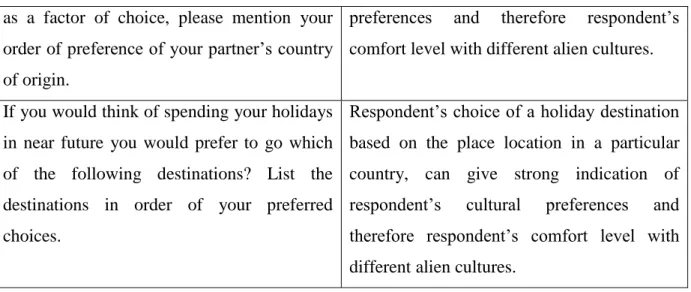
This study took into consideration a perception scaling and consultative method to devise survey questions using Delphi method with the help of a set of cross cultural experts and students of cross cultural studies. Based on several brain-storming sessions and using Delphi sessions, an online questionnaire is prepared which uses questions related to cultural preferences of MNC (Multinational Companies) employees from varying perspectives. Questions which emerged as explaining variables to the enquiry are given in table 1. These questions formed the part of the survey questionnaire. The choices of these questions were based on testing the cultural preference of the respondents in different situations and purpose. Respondent were the MNE employees from different „source‟ countries.
Table 1: Questions / items included in the survey instrument
Question Purpose of the question
If you were an employer yourself, and if you happen to choose from among a set of candidates with similar skills and requisites, if you will be thinking of their country of origin as a factor of choice, please mention your order of preference of the hires.
How the national origin of potential candidate affect respondent‟s decision to hire someone for respondent‟s own business, can give strong indication of your cultural preferences and therefore respondent‟s comfort level with different alien cultures. As a resident in your city / country, if you How the national origin of potential neighbor
happen to choose a new house having neighbor of a foreign origin, is it likely that your choice of housing unit will be influenced by the country of origin of your neighbor. If you will be thinking of their country of origin as a factor of choice, please mention you order of preference of your neighbor‟s country origins.
affect respondent‟s decision to live along side can give strong indication of respondent‟s cultural preferences and therefore respondent‟s comfort level with different alien cultures.
As an employee if you happen to choose from among a set of job offers with similar potential and remuneration, you may be thinking of the country of origin of your boss. If you will be thinking of their country of origin as a factor of choice, please mention you order of preference.
How the national origin of the potential employer affect respondent‟s decision to „work for‟ can give strong indication of respondent‟s cultural preferences and therefore respondent‟s comfort level with different alien cultures.
As an employee if you happen to choose from among a set of multinational company (MNC) with similar prospects to work abroad. If you will be thinking of their country of origin as a factor of choice, please mention you order of preference.
Respondent‟s choice of employer based on the country to work in can give strong indication of respondent‟s cultural preferences and therefore respondent‟s comfort level with different alien cultures.
As a potential migrant to a foreign country getting a new job from several choices of countries, you may be thinking of the country as a factor of choice of your new job. If you will be thinking of their country of origin as a factor of choice, please mention you order of preference.
Respondent‟s choice of country to „work in‟ can give strong indication of respondent‟s cultural preferences and therefore respondent‟s comfort level with different alien cultures.
If you were yourself a businessman and you had to choose a global business partner. If you will be thinking of their country of origin
Respondent‟s choice of a business partner based on his or her national origin, can give strong indication of respondent‟s cultural
as a factor of choice, please mention your order of preference of your partner‟s country of origin.
preferences and therefore respondent‟s comfort level with different alien cultures.
If you would think of spending your holidays in near future you would prefer to go which of the following destinations? List the destinations in order of your preferred choices.
Respondent‟s choice of a holiday destination based on the place location in a particular country, can give strong indication of respondent‟s cultural preferences and therefore respondent‟s comfort level with different alien cultures.
The above questionnaire is used to get responses from a set of countries based on convenience sampling and from MNC employees working with different organizations in these countries and tires to investigate their preferences of being comfortable with colleagues from different national backgrounds. A total of 556 responses from 14 different countries have been used to draw results (See table 2)
Table 2: Sample structure for the cross cultural study Name of the
country Sample Size No of Males No of Females
Italy 84 40 (48%) 44 (52%) Argentina 31 10 (32%) 21 (68%) Australia 32 12 (37%) 20 (63%) Canada 32 11 (34%) 21 (66%) China 40 25 (63%) 15 (37%) Germany 38 13 (34%) 25 (66%) Japan 32 15 (47%) 17 (53%) Nigeria 32 20 (63%) 12 (27%) Pakistan 35 28 (80%) 7 (20%)
Saudi Arabia 35 27 (77%) 8 (23%) U.K. 45 20 (44%) 25 (56%) USA 34 14 (41%) 20 (59%) India 54 30 (55%) 24 (45%) Portugal 32 15 (47%) 17 (53%) Total 556 280 (50%) 276 (50%)
Findings – Empirical and theoretical results
The research finds that there are differences in „level of comfort‟ among cultural pairs of national background of the MNC employees. It means there are clear preferences of being comfortable by employees of one cultural background with another employee of preferred cultural identity. This paper successfully identified MNC employees of which national backgrounds are likely to be comparatively more comfortable with colleagues with which national backgrounds. Study also found clear pattern of such preferences wherein colleagues of certain national background were universally preferred.
Research limitations
The construct of the research is based on brain storming and Delphi techniques with possible cultural biases, which are however unavoidable in such kind of research. Further study of this nature may require larger number of responses for conclusive evidence of cultural preferences.
Implications for theory and practice
Team managers at multinational workplaces will find the finding very interesting and useful to manage multicultural teams. They will be able to see through the level of comfort dynamics among their team members more clearly. The study will also help human resource personnel to manage multicultural teams better. The outcomes and findings of this study can also be used at government level in better managing international relations related aspects.
Theoretical implications of this research study are many since the study provides immense opportunities to investigate the concept of „level of comfort‟ in multicultural work environment. More specifically the study provides theoretical roadmap for studying interaction between multicultural employees from the perspective of national background pairs in order to investigate cultural affinity of different world cultures.
Originality/Value
The concept of „level of comfort‟ taken up in this research has not been extensively and exclusively researched in the arena of cross cultural management research or even in social research. More specifically the data is focused on responses from MNC employees having worked or working in multicultural teams, giving new look into the problem of discomfort among employees coming from different cultural background in organizations.
References
Geletkanycz, M. A. (1997). The salience of 'culture's consequences': The effects of cultural values on top executive commitment to the status quo. Strategic Management Journal, I8(S), p.615-634.
House, R., Javidan, M., & Dorfman, PW (2001). Project GLOBE: An introduction in Applied Psychology: An International Review, 50(4), p.489-505.
Hofstede, G. (1980). Culture’s consequences: International differences in work-related values. Beverly Hills, CA: Sage.
Hofstede, G. (1983). The Cultural Relativity of Organizational Practices and Theories, Journal of International Business Studies, 14, 1983
Hofstede, G. (1984). Culture’s consequences: International differences in work-related values. Newbury Park, CA: Sage
Hofstede, G. (1987). "The Applicability of McGregor's Theories in South East Asia," Journal of Management Development, Vol. 6, No. 3, p. 9-18.
Hoststede, G. (1991). Culture and organizations: Software of the mind. London: McGraw-Hill. Hoststede, G. (1996). "Riding the waves of commerce: a test of Trompenaars' "model" of national culture differences", in: International Journal of Intercultural Relations 20(2): p. 189-198.
Hofstede, G. (2001). Culture’s consequences: Comparing values, behaviors, institutions, and organizations across nations. Thousand Oaks, CA: Sage.
Hofstede, G. (2006). What did GLOBE really measure? Researchers‟ minds versus respondents‟ minds? Journal of International Business Studies, p. 37, 882-896.
Hofstede, G. & Bond, M.H. (1984). "Hofstede's Culture Dimensions: An Independent Validation Using Rokeach's Value Survey." Journal of Cross-Cultural Psychology, 15(4): p.417-433
Homburg, C & Pflesser, C., (2000), A Multiple-Layer Model of Market-Oriented Organizational Culture: Measurement Issues and Performance Outcomes, Journal of Marketing Research, Vol. 37, No. 4, pp. 449-462
Houkamau, CA, & Sibley, CG (2010). The Multi-Dimensional Model of Māori Identity and Cultural Engagement. New Zealand Journal of Psychology, 39, 8–28.
Inglehart, R. (1997). Modernization and Post-Modernization: Cultural, Economic, and Political Change in 43 Societies. Princeton, N.J.: Princeton University Press, 1997
MATONDO, J.P.M (2012), Cross-Cultural Values Comparison between Chinese and Sub-Saharan Africans, International Journal of Business and Social Science, Vol. 3 No. 11; p.38-45
Schwartz, SH (2006).Value orientations: Measurement, antecedents and consequences across nations. In R. Jowell, C. Roberts, R. Fitzgerald, & G. Eva (Eds.), Measuring attitudes cross-nationally - lessons from the European Social Survey. London: Sage
Schein, E. H. (2010). Organizational Culture and Leadership, 4 edition. Jossey-Bass, ISBN-10: 0470190604, ISBN-13: 978-0470190609.
Shenkar, O. & Zeira, Y. (1992). Role conflict and role ambiguity of CEO‟s in international joint ventures‟. Journal of International Business Studies, 23 (1), p.55–75.
Shenker, O. (2001). Cultural distance revisited: Towards a more rigorous conceptualization and measurement of Cultural Differences., Journal of International Business Studies; Third Quarter; 32, 3; ABI/INFORM Global, p. 519
Smith, PB and Peterson, MF (1995). "Beyond Value Comparisons: Sources Used to Give Meaning to Management Work Events in Twenty-Nine Countries." Paper presented at the annual meeting of the Academy of Management, Vancouver, Canada.
Trompenaars F., and Hampden-Turner, C. (1997). Riding the waves of culture: Understanding diversity in global business (2nd Ed.). New York: McGraw-Hill.
View publication stats View publication stats