EVALUATION OF CHILE’S NATIONAL TUBERCULOSIS PROGRAM’ Mario Grinspun S., M.D., M.P.H.,’ and Rebeca Goldenberg V., Q.F.D.3
A major need of national tuberculosis programs, especially in developing countries, is to integrate anti-tuberculosis measures into general health activities, thus permitting the resources of all health sector institutions, both public and private, to be utilized in a common program. This paper presents an account of what has been done recently in Chile with that end in mind.
Introduction
The health measures employed by Chile’s national tuberculosis program can be separated into two main categories, depending on whether they are aimed at protection or re- covery of health.
At the national level, protective activities are the exclusive preserve of the National Health Service (SNS), which is responsible for BCG vaccination of newborns and revaccina- tion of schoolchildren. While most health re- covery activities (case-finding and treatment of patients) are also carried out by the SNS (which cares for insured persons and indi- gents), about 20 per cent of the populition is covered by the Employees’ National Medical Service (SERMENA), which serves other white-collar personnel, and another 10 per cent is covered by other government institu- tions and private medical services.
Chile’s BCG vaccination program includes an initial vaccination at birth, administered in maternity hospitals and clinics by “ma- tronas,“4 and two revaccinations, one when children enter primary school at age six and the second when they graduate from it at age 14-15. These two revaccinations are admin- istered by staff members of SNS hospitals located throughout the country.
lSlightly abridged version of the article appearing in Spanish in the Boletin de la Ojicina Sanitaria Panamericana, Volume LXXVIII, 1975.
2Epidemiologist, South Area, Santiago, Chile. 3Bacteriologist, San Borja Hospital, Santiago, Chile.
4University personnel whose academic training resembles that of nurses and who attend births.
Case-finding among respiratory sympto- matics is carried out by the SNS. Urban areas with fixed X-ray equipment use this equip- ment, while urban areas without it and all rural areas use microscopic examination of sputum specimens. It is SNS policy to replace radiography with microscopy and to make the latter the sole SNS case-finding method em- ployed at the national level. Some parts of Santiago are already relying entirely on the latter method. SEFLMENA, because of its patient care system, bases case-finding on the required annual physical examination given all those receiving its services. Other participating institutions use a variety of methods.
Treatment of cases by both SNS and SERMENA is fully supervised and is based on a regimen of streptomycin, isoniazid, and thioacetazone-though in many cases the thioacetazone is replaced with para-amino- salicylic acid. The capacity to provide other drug treatments has been centralized in certain specialized services. The current trend is toward employing ambulatory treatment from the start.
5
Grinspun and Goldenberg . CHILE’S NATIONAL TUBERCULOSIS PROGRAM 319
h * ‘3
*
0
testing almost solely for epidemiologic pur- poses. This is partly due to the fact that at one time facilities were available for conduct- ing culture examinations and drug sensitivity tests almost everywhere in the country. Evaluation of 1972 Activities
Table 1 presents the country-wide targets of the tuberculosis program for 1972.
To properly evaluate the newborn BCG vaccination program, the actual number of live births in 1972 must be used as the base, rather than the expected number of newborns. Table 2 shows the number of live births in the country and the number which took place in maternity hospitals, together with the corre- sponding percentage of newborns vaccinated. It is important to note that roughly 85 per cent of all births in Chile take place in the maternities of hospitals and clinics, which is where the vaccinations are administered. Over- all, the figures obtained are highly encour- aging, because they show vaccinations were
administered to over 75 per cent of all live- born infants in the country and over 90 per cent of those born in hospitals and clinics.
While we are satisfied quantitatively, there is no proof of the quality of the vaccinations. However, numerous improvements have been made in this regard, both through training of personnel and through introduction of the Omega syringe.
Table 3 shows the numbers of school-age children vaccinated. The average percentages vaccinated were 69 per cent of those in the first year of primary school and 89 per cent of those in the final year. This first figure appears rather low in comparison with pre- vious years.
The numbers of microscopic and radiologic case-finding examinations performed are shown in Table 4. For Chile as a whole, the number of radiologic examinations totalled 96 per cent of the goal set for 1972. However, considered on a zone-by-zone basis this work was carried out very irregularly; while some areas made excessive use of the method
TABLE l-Goals of Chile’s national tuberculosis program and expected case rates, 1972.
SNS SERMENA Other
institutions Total
BCG vaccinations
Newborns . . . 214,6 1.5 - - 214,615 Children entering primary
school . . . 296,532 - - 296,532 Children graduating prima-
ry school . . . 144,662 - - 144,662
Total vaccinations . . . 655,809 - - 655,809
Diagnostic examinations
Microscopy . . . _ _ . . . 168,746 - - 168,746
Radiology . . . 240,871 - - 240,871
Anticipated cases
Population served over age
15 . . . 4,338,570 1,239,590 619,791 6,197,951 Estimated incidence per
100,000 inhabitants . . . 167.8 85.0 50.0 139.5 No. of cases expected in
320 PAHO BULLETIN - Vol. VIII, No. 4, 1974
TABLE 2-BCG vaccination of newborns, 1972.
No. of vaccinations Live births in maternities vaccinated Per cent Total births live vaccinated Per cent
193,519 212,552 90.9 253,162 76.4
TABLE 3-BCG revaccination of primary school students, 1972.
c
^t
c
First year of primary school No. of vaccinations % of goal
204,848 69.1
Eighth year’of primary school No. of vaccinations % of goal
129,134 89.2
TABLE 4-National Health Service bacteriologic and radiologic examinations, 1972.
Microscopic examinations Radiologic examinations
No. performed $6 of goal No. performed % of goal
115,627 68.5 230,606 95.7
(achieving nearly twice the target figure in one instance), others performed as little as one- fourth of the examinations programmed.
Table 5 shows the number of cases of pulmonary tuberculosis diagnosed in persons over 15 during 1972, and the percentage of the program target attained. It can be seen that the target set for the SNS was met satisfactorily, 93.8 per cent of the expected cases being found, although the degree to which local targets were reached in different areas of the country varied considerably. SERMENA found only about 23 per cent of the expected cases, and the other health insti- tutions involved have not supplied data. Even
so, these figures indicate that for the country as a whole, 82 per cent of the expected cases were actually found. On the basis of these results we have stepped up our coordination with SERMENA, in order to improve report- ing and to intensify case-finding activities. We have also initiated contacts with a number of smaller health institutions in order to obtain data on their anti-tuberculosis activities.
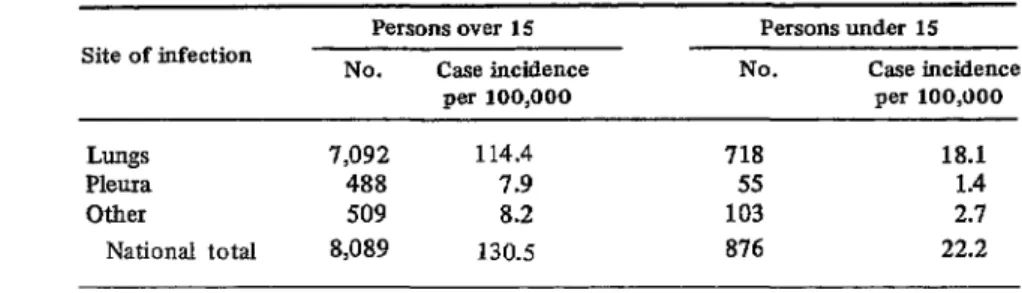
Although these data relate only to pulmo- nary tuberculosis, case-reporting in Chile covers all forms of the disease. Table 6 shows the incidence of reported cases in 1972, broken down by the patient’s age and the site affected. It is evident that pulmonary tuber-
c
.
TABLE 5-Case diagnosis in persons over age 15, by health institution, 1972.
. Institution No. of cases diagnosed % of goal
National Health Service 6,837 93.8
Employees’ National Medical Service 245 23.3
Other institutions -
Total 7,082 82.0
Grinspun and Goldenberg . CHILE’S NATIONAL TUBERCULOSIS PROGRAM 321
TABLE 6-Incidence of reported tuberculosis cases, by age of patient and site of
infection, 1972.
Site of infection
Persons over 15 Persons under 15
No. Case incidence No. Case incidence
per 100,000 per 100,000
Lungs 7,092 114.4 718 18.1
Pleura 488 7.9 55 1.4
0th 509 8.2 103 2.7
National total 8,089 130.5 876 22.2
culosis accounted for the great majority of cases, particularly among adults, and that the incidence of pleural and extrapulmonary tuberculosis was quite low, especially in those under 15.
Figure 1 shows the age-specific incidence of tuberculosis cases and deaths reported for 1972. At about age 15 there is a sharp rise in the case rate, which thereafter remains fairly stable. On the other hand, mortality progres- sively increases with age, the most important increases occurring after age 30.
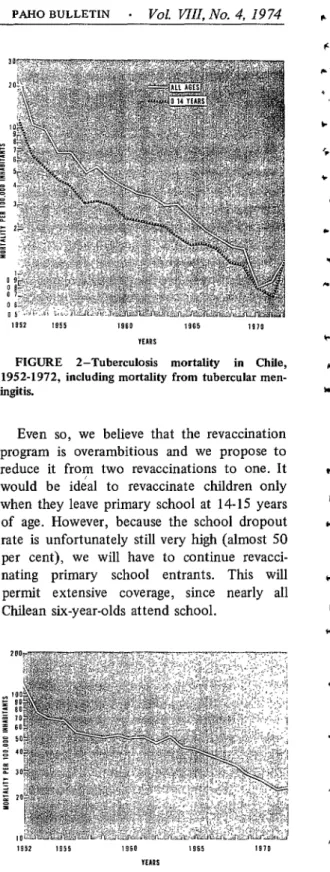
Table 7 presents follow-up data on a sample group of cases diagnosed in 1971, and Figures 2 and 3 show the mortality curves for tuberculosis and tubercular meningitis.
FIGURE 1 -Age-specific tuberculosis incidence and
mortality in Chile, 1972.
Discussion
Chile’s National Health Service, which up to about five years ago was operating a highly specialized, clinically oriented low-coverage tuberculosis program, has now changed course by integrating its anti-tuberculosis activities into its general health services. This has given the tuberculosis program a primarily epidemi- ologic orientation and has permitted extensive coverage on a national scale. Thus practically all rural areas now have a simplified program, although tuberculosis specialists are still in charge of certain activities in major urban areas.
SEFWENA, the other large health institu- tion, has not been able to integrate its activ- ities because of its organic structure, but it has simplified its methods and coordinated its work; it has also taken advantage of some National Health Service facilities. Many smaller health institutions are also tending to use facilities which the SNS has made avail- able to them. The overall result has been to
TABLE 7-Twelve-month follow-up of a group of
patients with pulmonary tuberculosis whose cases
were diagnosed by the SNS in 197 1.
No. %
No. of cases observed . . . _ . _ . 1,357 100
Treatment abandoned _ . . . . . 313 23 Treatment completed _ . . . . _ . 998 73.5
Deaths . . . _ . . . _ . . . 46 3.5
Hospitalizations . . . 903 66.5
322 PAHO BULLETIN - Vol. WII, No. 4, I9 74
organize a medical care system that affords all Chileans an opportunity for protection and cure.
Evaluation of the Program
No true evaluation of the tuberculosis pro- gram can be made until its epidemiologic impact is known. Unfortunately, the chief data required for such an evaluation-the incidence and prevalence of tuberculosis infec- tion in Chile-are not available. The incidence figures now available are too recent to show a meaningful trend, and thus the only indicator available is the trend of total tuberculosis- induced mortality. This is not the best indi- cator for our purpose, although it undoubted- ly provides some insights. As Figure 3 shows, the risk of dying from tuberculosis has fallen markedly since 1952. Mortality from tuber- cular meningitis has also declined drastically over the long run, even though the toll of deaths from this disease in 19725 represents a notable increase over the preceding year.6
It should also be mentioned that the age distribution of tuberculosis has changed signif- icantly. Twenty years ago most deaths oc- curred in the younger age groups. Today, as seen in Figure 1, most of the deaths occur among older people.
Because accurate epidemiologic evaluation is not possible at the present time, this report has concerned itself primarily with operational assessment of current levels of achievement in terms of preset goals.
BCG vaccination. It is evident that much has been accomplished with regard to BCG vaccination of newborns, since the figures show that over 75 per cent of all newborn babies were vaccinated in 1972. On the other hand, the percentage of school-age children vaccinated was lower, especially the percent- age of vaccinated primary school entrants.
‘Fifty-seven per cent of the persons dying were over 15 years of age.
CRecent data show the 1972 increase in mortality from tuberculosis to have been a passing phenomenon.
FIGURE 2-Tuberculosis mortality in Chile,
1952-1972, including mortality from tubercular men-
ingitis.
Even so, we believe that the revaccination program is overambitious and we propose to reduce it from two revaccinations to one. It would be ideal to revaccinate children only when they leave primary school at 14-15 years of age. However, because the school dropout rate is unfortunately still very high (almost 50 per cent), we will have to continue revacci- nating primary school entrants. This will permit extensive coverage, since nearly all Chilean six-year-olds attend school.
,952 ,155 ,960 1965 1910
“IARS
FIGURE 3-Mortality from tubercular meningitis
In 1973 tuberculosis mortality fell to 19.8 per
100,000 inhabitants and mortality from tubercular
Grinspun and Goldenberg . CHILE’S NATIONAL TUBERCULOSIS PROGRAM 323
Case-finding. It is interesting to note that 75.8 per cent of all tuberculosis cases reported in 1972 (including both pulmonary and extra- pulmonary types) yielded positive microscopic findings. This indicates that simple micro- scopic diagnosis would have produced as good results as X-ray examination, and at much lower cost. Since X-ray examination is still the method used for coverage of over half the population, we are striving to have microscopy made the only case-finding method, with radiology being reserved for studying cases that yield a negative microscopic diagnosis.
It is also important to note that bacterio- logic culture methods have detected relatively few cases. That is, it was necessary to prepare over 60,000 cultures in order to diagnose 870 cases of pulmonary tuberculosis. We therefore believe that this examination should be re- served for cases showing radiologic lesions but yielding negative results on microscopic exami- nation.
Treatment. Another noteworthy point is the high percentage of patients who abandon treatment. In one group of cases, for example (see Table 7), 23 per cent of the patients failed to complete 12 months of treatment. Furthermore, in this same group the percent- age of cases hospitalized was 66 per cent and the average stay in the hospital was 116.7 days. These unacceptably high figures were obtained for cohorts of patients whose cases were diagnosed in 1971. Measures taken the following year made it possible to reduce the proportion of patients abandoning treatment and to drastically reduce both the percentage of cases hospitalized and the length of the average hospital stay. These measures included the following:
1) Restricting hospitalizations to severe cases with urgent medical symptoms. Previous-
ly, hospitalization was provided for all who requested it.
2) Requiring that all hospitalized tuber- culosis patients obtain authorization from the chief of the service in order to remain in the hospital over 60 days.
3) Integrating the beds of tuberculosis fa- cilities into those of general hospitals and using them to accomodate all pathological pulmonary cases-thereby transforming the bed manage- ment attitude into one consistent with handling urgent hospital cases.
Conclusions
To sum up, it may be said that Chile’s tuberculosis program has numerous merits, among them the extensive national coverage it provides, the tendency to use uniform stand- ards in all institutions, the high BCG vaccina- tion levels achieved, the high percentage of bacteriological confirmations for diagnosed cases, and the use of uniform chemotherapeu- tic treatment regimens. The program also has weaknesses which call for immediate remedial measures. These weaknesses include the con- tinued reliance on specialized programs in urban areas, excessive use of radiology, the high percentage of patients hospitalized, and the high percentage abandoning treatment. These weaknesses all help illustrate the need to simplify the anti-tuberculosis methods em- ployed, in accordance with the conclusions of the II Regional Seminar on Tuberculosis held in Bogot& in 1972.7
7The final report of the Seminar is contained in the English edition of the Boletin de la Uficinn Sanitaria Panamericana, Volume VII, No. 1, 1973, pp. 104-l 11. For the full proceedings see ZZ Regional Seminar on Tuberculosis, Pan American Health Organization, Washington, D.C., 1973 @‘AH0 Scien- tific Publication 265).
SUMMARY
324 PAHO BULLETIN . Vol. VIII, No. 4, 19 74
presents an evaluation of the program’s 1972 activities, citing the goals set, the actions carried out, and the degree to which a satis- factory level of performance was achieved. The most striking findings include the follow- ing:
1) The BCG vaccination program suc- ceeded in vaccinating a high percentage of 1972 newborns and primary school graduates; but the percentage of primary school entrants receiving the vaccination was low in com- parison with previous years.
2) The case-finding program of the Na- tional Health Service was very effective. In comparison, the Employees’ National Medical Service achieved only about 23 per cent of its goal.
3) A positive microscopic diagnosis was obtained from over 80 per cent of the pul- monary tuberculosis cases reported, which
indicates that this simple method would have sufficed to diagnose a high proportion of these cases. Nevertheless, radiology is still used in over half of the country, despite its rela- tively high cost and low yield.
4) Koch bacillus culture examinations were found to result in detection of relatively few cases in terms of the amount of effort in- volved.
5) Within a sample of patients whose cases were diagnosed in 1971, many persons were found to abandon treatment. The proportion failing to complete 12 months of treatment was 23 per cent. In this same sample the percentage of patients hospitalized (around 60 per cent) and the average length of hospital- ization (nearly four months) were found to be excessive. These three findings led to imme- diate corrective measures which have already had a significant effect.
BIBLIOGRAPHY (I) Chile, Oficina de Planeamiento de1 Servicio Na-
cional de Salud. Boletin de planificacidn, Volume 1, August 1971.
(2) Chile, Oficina de Planeamiento de1 Servicio Na- cional de Salud. Boletin de ulanificacih Volume 3, No. 1, March 1973. . - (3) Chile. Oficina de Planeamiento de1 Servicio Na-
cional de Salud. Modelo de programacich, 1972; programa de atencih de1 ad&o; sub- programa de tuberculosis. Direction General,
Servicio National de Salud, Santiago, 1971.
(4) Chile, Sub-Departamento de Estadistica de1 Ser- vicio National de Salud. Anuario de atencidn y recursos, 1972. Direccibn General, Servicio National de Salud, Santiago, 1973.