Repositório ISCTE-IUL
Deposited in Repositório ISCTE-IUL:
2019-03-01
Deposited version:
Post-print
Peer-review status of attached file:
Peer-reviewed
Citation for published item:
Barradas, R. (2019). Financialization and neoliberalism and the fall in the labor share: a panel data econometric analysis for the European Union countries. Review of Radical Political Economics.
Further information on publisher's website:
10.1177/0486613418807286
Publisher's copyright statement:
This is the peer reviewed version of the following article: Barradas, R. (2019). Financialization and neoliberalism and the fall in the labor share: a panel data econometric analysis for the European Union countries. Review of Radical Political Economics., which has been published in final form at https://dx.doi.org/10.1177/0486613418807286. This article may be used for non-commercial purposes in accordance with the Publisher's Terms and Conditions for self-archiving.
Use policy
Creative Commons CC BY 4.0
The full-text may be used and/or reproduced, and given to third parties in any format or medium, without prior permission or charge, for personal research or study, educational, or not-for-profit purposes provided that:
• a full bibliographic reference is made to the original source • a link is made to the metadata record in the Repository • the full-text is not changed in any way
The full-text must not be sold in any format or medium without the formal permission of the copyright holders. Serviços de Informação e Documentação, Instituto Universitário de Lisboa (ISCTE-IUL)
FINANCIALIZATION AND NEOLIBERALISM AND THE FALL IN THE
LABOR SHARE: A PANEL DATA ECONOMETRIC ANALYSIS FOR THE
EUROPEAN UNION COUNTRIES
1RICARDO BARRADAS
2ABSTRACT
This paper conducts an empirical analysis of the relationship between financialization and neoliberalism and the labor share using panel data composed of 27 European Union countries over 19 years (from 1995 to 2013). Adopting a Kaleckian perspective, framed in the post-Keynesian literature, financialization and neoliberalism exert a negative influence on the labor share through three different channels: the change in the sectorial composition of economies (the increasing importance of financial activity and the decreasing importance of general government activity), the proliferation of ‘shareholder value orientation’ and the deterioration of general workers’ bargaining power. We estimate a labor share equation with the traditional variables (lagged labor share, technological progress, globalization, education and output growth) and four further measures of financialization and neoliberalism (financial activity, general government activity, ‘shareholder value orientation’ and the trade union density rate). The findings show a disruptive relationship between financialization and neoliberalism and the labor share in European Union countries, mainly through the channels of general government activity and ‘shareholder value orientation’. It is also found that financialization and neoliberalism have contributed to a fall in the labor share in European Union countries. The technological progress was the main driver of the fall in the labor share in European Union countries, whilst the output growth was the main supporter. This suggests that the trend of decline in the labor share could intensify in the future taking into account the fears of potential ‘secular stagnation’ in the current era of financialization and neoliberalism.
KEYWORDS
Financialization, Neoliberalism, Functional Income Distribution, Labor Share, European Union, Panel Data, Least-Squares Dummy Variable Bias-Corrected Estimator
1 The authors thank the helpful comments and suggestions of Elif Karaçimen, Enid Arvidson, Isabel Salavisa, Leila Davis, Marta Silva, Nina Eichacker, Paulo Marques, Sérgio Lagoa, the participants in 8th
Annual Conference in Political Economy (Berlin School of Economics and Law, September 2017), the participants in the Research Seminar in Economics II (ISCTE – Instituto Universitário de Lisboa, November 2017) and the participants in 1º Encontro Anual de Economia Política (ISCTE – Instituto Universitário de Lisboa, January 2018). The usual disclaimer applies.
2 Instituto Universitário de Lisboa (ISCTE-IUL), Dinâmia’CET-IUL, Lisboa, Portugal. ESCS - Escola Superior de Comunicação Social, Instituto Politécnico de Lisboa, Lisboa, Portugal. ISCAL - Instituto Superior de Contabilidade e Administração de Lisboa, Instituto Politécnico de Lisboa, Lisboa, Portugal. E-mail: [email protected] / [email protected]
JEL CLASSIFICATION
C23, D33, E25 and E44WORD COUNT
FINANCIALIZATION AND NEOLIBERALISM AND THE FALL IN THE
LABOR SHARE: A PANEL DATA ECONOMETRIC ANALYSIS FOR THE
EUROPEAN UNION COUNTRIES
ABSTRACT
This paper conducts an empirical analysis of the relationship between financialization and neoliberalism and the labor share using panel data composed of 27 European Union countries over 19 years (from 1995 to 2013). Adopting a Kaleckian perspective, framed in the post-Keynesian literature, financialization and neoliberalism exert a negative influence on the labor share through three different channels: the change in the sectorial composition of economies (the increasing importance of financial activity and the decreasing importance of general government activity), the proliferation of ‘shareholder value orientation’ and the deterioration of general workers’ bargaining power. We estimate a labor share equation with the traditional variables (lagged labor share, technological progress, globalization, education and output growth) and four further measures of financialization and neoliberalism (financial activity, general government activity, ‘shareholder value orientation’ and the trade union density rate). The findings show a disruptive relationship between financialization and neoliberalism and the labor share in European Union countries, mainly through the channels of general government activity and ‘shareholder value orientation’. It is also found that financialization and neoliberalism have contributed to a fall in the labor share in European Union countries. The technological progress was the main driver of the fall in the labor share in European Union countries, whilst the output growth was the main supporter. This suggests that the trend of decline in the labor share could intensify in the future taking into account the fears of potential ‘secular stagnation’ in the current era of financialization and neoliberalism.
KEYWORDS
Financialization, Neoliberalism, Functional Income Distribution, Labor Share, European Union, Panel Data, Least-Squares Dummy Variable Bias-Corrected Estimator
JEL CLASSIFICATION
C23, D33, E25 and E441. INTRODUCTION
Mainstream economics, understood as a body of traditional/classical theory, states that the labor share and the profit share are constant over time (Bowley 1937; and Kaldor 1961). Nonetheless, the labor share has decreased and the profit share has increased in the majority of economies since the 1980s (Jayadev 2007; Stockhammer 2009, 2012 and 2017; Kristal 2010; Dünhaupt 2011; Peralta and Escalonilla 2011; Estrada and Valdeolivas 2012; Lin and Tomaskovic-Devey 2013; among others).
Against this backdrop scholars of financialization and neoliberalism, framed in the post-Keynesian literature and from a Kaleckian perspective, advocate that financialization and neoliberalism represent an important driver in the fall of the labor share due to three channels (Hein 2012 and 2015; Hein and Detzer 2014; Michell 2014; Hein and Dodig 2015; among others). The first channel involves a change in the sectorial composition of economies, namely through growth in the financial sector and a reduction in general government activity. The second channel is caused by the proliferation of a corporate governance model based on ‘shareholder value orientation’. The third channel is related to the deterioration of the collective bargaining power exerted by trade unions.
Accordingly, some empirical studies have emerged in recent years to assess the relationship between financialization and neoliberalism and the labor share. Most of these studies derive and estimate labor share equations, finding statistical evidence that financialization and neoliberalism have caused a decline in the labor share (e.g. Stockhammer 2009 and 2017; Kristal 2010; Peralta and Escalonilla 2011; Dünhaupt 2013a; Lin and Tomaskovic-Devey 2013; Alvarez 2015; Barradas and Lagoa 2017; and Köhler et al. 2018).
This paper examines the impact of financialization and neoliberalism on the labor share in European Union (EU) countries between 1995 and 2013, making a threefold contribution to the literature. Firstly, it assesses in a complete way the effects of financialization and neoliberalism on the labor share by analysing the three aforementioned channels, whereas most empirical studies on this matter typically focus on a single aspect of financialization and/or neoliberalism (Köhler et al. 2018). The study by Barradas and Lagoa (2017) is the only exception, but it is centred on Portugal between 1978 and 2012 through a time series econometric analysis. Secondly, a panel data econometric analysis is performed rather than a time series econometric analysis, which allows us to determine whether financialization and neoliberalism have been responsible for a fall in the labor share in a large set of countries. A panel data econometric analysis also allows a higher number of observations, sample variability and less collinearity, improving the accuracy and reliability of the estimates. Thirdly, the study focuses on EU countries. EU countries represent an interesting case study, as they share common economic rules because they belong to the same economic and political region. Nevertheless, they also present a certain degree of heterogeneity, namely in terms of their
presence in the euro area (euro area countries and non-euro area countries), their type of financial system (‘market-based’ countries and ‘bank-based’ countries in the typology of Bijlsman and Zwart 2013; and Haan et al. 2015) and their variety/model of capitalism (‘liberal market’ countries, ‘coordinated market’ countries, ‘hybrid/mixed market’ countries and ‘transition’ countries in the spirit of Hall and Soskice 2001; and other related works in the field of comparative political economy). Despite this diversity, there has been a fall in the labor share in most of these countries (Figure A1 in the Appendix), concurrent with growth in the financial sector (Figure A6 in the Appendix), a reduction in general government activity (Figure A7 in the Appendix), an increase in the ‘shareholder value orientation’ (Figure A8 in the Appendix) and a weakening of trade unions (Figure A9 in the Appendix). It would therefore be interesting to determine whether there is a disruptive relationship between financialization and neoliberalism and the labor share and the extent to which financialization and neoliberalism have contributed to the fall in the labor share.
We estimate a labor share equation using standard variables (lagged labor share, technological progress, globalization, education and output growth) and four additional variables linked to financialization and neoliberalism (financial activity, general government activity, ‘shareholder value orientation’ and trade union density rate). The results confirm that financialization and neoliberalism exert a negative influence on the labor share in EU countries, mainly through general government activity and ‘shareholder value orientation’. It is also found that financialization and neoliberalism have indeed contributed to the fall in the labor share in EU countries.
The remainder of the paper is organized as follows. In Section 2 we present a short literature review on the relationship between financialization and neoliberalism and the fall in the labor share. A labor share equation is built in Section 3. The data and econometric methodology are described in Section 4. Section 5 presents the main findings and the respective discussion. Finally, Section 6 concludes.
2. THE RELATIONSHIP BETWEEN FINANCIALIZATION AND
NEOLIBERALISM AND THE FALL IN THE LABOR SHARE
Functional income distribution is the way in which output is divided between the different factors of production, namely labor and capital (Dünhaupt 2013b). Thus, the labor share and the profit share correspond to the fraction of the national income that is directed to labor (employees) and capital (shareholders), respectively.
Against this background mainstream economics argues that these shares are constant over time. This idea is so embedded in the traditional/classical theory that it is commonly
referred to as a ‘law’ (Bowley 1937) or even as a ‘stylized fact’ of economic growth (Kaldor 1961).
Nonetheless, the labor share has declined in the major advanced economies since the early 1980s, with a corresponding increase in the profit share (Jayadev 2007; Stockhammer 2009, 2012 and 2017; Kristal 2010; Dünhaupt 2011; Peralta and Escalonilla 2011; Estrada and Valdeolivas 2012; Lin and Tomaskovic-Devey 2013; among others). Despite some heterogeneity in that evolution, EU countries are not an exception of the global trend of decline in the labor share since the mid-1990s (Figure A1 in the Appendix)1. Moreover, it is important
to note that in some countries the labor share already represents less than half of the national income. This is the case of the Czech Republic, Greece, Lithuania, Hungary, Poland, Romania, Slovakia, Latvia, Norway, Ireland, Malta and Sweden. This seems to put into question the constancy of the labor share over time, which is even considered as ‘a mirage’ (Keynes 1939) or a ‘bit of a miracle’ (Solow 1958).
This unequal distribution of the national income has increased the conflict of corporations and shareholders against wage earners (Dünhaupt 2013a), taking into account that the importance of the shares of rents, profits and wages provides an indication of the relative power of different groups in a certain society (Atkinson 2009). Several consequences can be identified in the literature regarding the fall in the labor share. The first is the emergence of social strains (Dünhaupt 2011). The second is the reduction in the aggregate demand because the economic growth in most OECD countries is characterized by a ‘wage-led’ model instead of a ‘profit-led’ model (Naastepaad and Storm 2007; Hein and Vogel 2008; and Dünhaupt 2013a). This is also confirmed by Onaran and Obst (2016) for the EU-15. These authors conclude that the reduction of wages leads to lower economic growth in Finland, France, Germany, Greece, Italy, Luxembourg, Netherlands, Portugal, Spain, Sweden and the United Kingdom, whereas it boosts economic growth in Austria, Belgium, Denmark and Ireland. Considering the EU-15 as a whole, these authors confirm that the fall in the labor share has delineated a deceleration of economic activity because the EU-15 is a ‘wage-led’ economy. Note that wage incomes are normally related to higher consumption propensities than profit incomes and therefore generate a greater aggregate demand (Stockhammer 2012). The third is the undermining of the sustainability of social security systems, since their main funding source in some countries is based on contributions that depend on the level of wages (Cichon et al. 2004). The fourth is the increase in households’ indebtedness to mitigate the fall in wages and to sustain conspicuous consumption (‘keeping up with the Joneses’) (Hein 2012). The fifth is the increase in inequality in personal incomes (Karanassou and Sala 2013).
1 As highlighted in Section 4, our sample covers the period from 1995 and 2013. However, the decreasing trend of the labor share is also a distinctive feature of EU countries since the 1980s.
Against this backdrop scholars on financialization and neoliberalism, framed in the post-Keynesian literature2, claim that financialization and neoliberalism are one of the drivers of
the fall in the labor share in the last three decades. Adopting a Kaleckian perspective, these authors stress that the relationship between financialization and neoliberalism and the fall in the labor share works through three different channels and several sub-channels (Hein 2012 and 2015; Hein and Detzer 2014; Michell 2014; Hein and Dodig 2015; among others) – Figure 1.
[Figure 1 around here]
The first channel is related to a change in the sectorial composition of economies, namely through the increasing importance of the financial sector in relation to the non-financial sector and the decreasing weight of general government activity.
On the one hand, Hein (2012 and 2015) stresses that the increasing importance of the financial sector implies a decrease in the fall in the labor share, because the labor share of the financial sector is traditionally smaller than the labor share of the non-financial sector. Additionally, Kus (2012) highlights that the expansion of the financial sector is responsible for the shrinkage in the profitability of the non-financial sector, which is reflected in the contraction of the wages of middle-class and blue-collar workers in the non-financial sector. This author also stresses that this change in the sectorial composition of economies from non-financial to financial activities has contributed to the weakening of certain policies and institutions that normally mitigate the effects of poverty and inequality, for instance trade unions and/or minimum wage laws that function as institutional mechanisms that tend to support wages.
On the other hand, Hein (2012 and 2015) and Dünhaupt (2013a) admit that the decreasing weight of general government activity also fosters the reduction in the labor share because the general government is a ‘non-profit’ institutional sector from the point of view of national accounts that by definition does not produce any capital income. In the same vein, Dünhaupt (2013b) reiterates that the privatization of public corporations is also associated with a fall in the labor share, because public corporations have a larger labor share than private ones. The reduction in general government activity (either directly or indirectly through public corporations) is explained by the financialization logic, which aims to enlarge market-financial interests to areas that were previously under the control of the public sector (Fine 2011). These include domains such as health provision, water provision, construction and management of
2 As emphasized by Stockhammer (2009), we recognize that there are other schools of thought explaining the fall in the labor share. For instance, neoclassical economics emphasizes the role of technological progress and preferences, Keynesian/Kaldorian economics evokes the importance of the aggregate demand and Marxian economics highlights the relative power relations in the class struggle. Nonetheless, these schools of thought are only applied in a highly restrictive long-term equilibrium of a closed economy characterized by full capacity utilization (Stockhammer 2009). Thus, they cannot be used to analyse the medium-term changes in income distribution of economies in which the capacity is underutilized and that are open to trade and international and financial capital. These caveats are our main reasons for following the post-Keynesian literature and a Kaleckian perspective.
public infra-structures (mainly highways) and housing provision. Overall, these changes largely reflect the increasing influence of financial and construction groups (which are often interlinked) in key Government decisions involving large infrastructural investments and/or the use of public-private partnerships financed by banks that, in some cases, are also shareholders of the partnerships (Barradas et al. 2018).
The second channel is connected with the emergence of a new design of corporate governance that favours the maximization of shareholder value over the other constituents of corporations, which tends to favour a rise in top management wages, a rise in the profit claims of rentiers and a cut in the labor costs3. This is the so-called ‘shareholder value orientation’
(Aglietta 2000; Lazonick and O’Sullivan 2000; Stockhammer 2010; among others). This corporate governance model has proved to be detrimental for the real investment of non-financial corporations and, consequently, for the labor share via shortening the planning horizons and increasing uncertainty (Orhangazi 2008; Hein 2012 and 2015; among others). The fall in the labor share is also explained by the so-called ‘neoliberal paradox’, according to which shareholders’ demand for higher and higher levels of profits force non-financial corporations to cut their labor costs (Crotty 2005).
The third channel involves the deterioration of workers’ bargaining power, typically measured by the collective bargaining power played by trade unions, which tends to support a decrease in wages (Stockhammer 2009). Hein (2012 and 2015) offers five explanations for the weakening of trade unions.
Firstly, the ‘shareholder value orientation’ has promoted a strategy based on short-term profitability with deleterious effects on real investment, economic growth and employment (Orhangazi 2008; Hein 2012 and 2015; among others), which implies a fading of trade unions.
Secondly, the increasing importance of the financial sector vis-à-vis the non-financial sector has also been responsible for weakening trade unions, taking into account that the unionization levels are normally stronger in the non-financial sector (and mainly in manufacturing activities).
Thirdly, the downsizing activity of the general government sector has also hurt the power of trade unions, because public servants tend to present higher unionization levels than private servants. Additionally, the abandonment of Keynesian demand-side policies aimed at low levels of unemployment and the proliferation of Monetarist supply policies aimed at low levels of inflation have originated huge flexibility in the labor market and an increase in unemployment, which also restrains collective wage bargaining (Kus 2012).
3 However, the rise in top management wages could have a positive impact on the labor share, because these wages are also included in that share (Hein 2012 and 2015; Hein and Detzer 2014). These authors also note that the labor share excluding top management wages has fallen even more than the total labor share. This conclusion is also corroborated by Mohun (2006), namely by stressing that the decrease in the wages paid to the productive labor has not counterweighted the increase (even higher) to those paid to supervisory workers and management staff since the 1980s.
Fourthly, the deregulation of labor markets has also undermined the bargaining power of trade unions. The flexibility of labor markets has been adopted as an excuse to decrease the unemployment levels, because they tend to be attributable to a rigid labor market and overgenerous welfare states. Against this backdrop a majority of measures have been focused on reducing the level and duration of unemployment benefits, decreasing employment protection and decentralising collective and wage bargaining (Stockhammer 2004).
Fifthly, liberalization and globalization have facilitated the relocation of corporations’ production from high- to low-wage countries, seeking a reduction in costs and an increase in profits. Corporations are becoming ‘nomadic’, because they are not engrained in any specific country, which tends to decrease their feeling of responsibility towards local communities, employees and other stakeholders (Zamagni 2003). This phenomenon has increased the competition among workers through the ‘threat effect’ of corporations, because the utilization of outsourcing and the relocation of production to low-wage countries reduce the power of trade unions, as they are predominantly organized at the national level (Hein 2012 and 2015). As this delocalization is more notorious in the case of manufacturing corporations, the consequence has been the replacement of jobs in the manufacturing sector (which are normally better paid and more unionized) with jobs in the service sector (which are normally lower paid and less unionized). At the same time, liberalization and globalization have delineated an increase in multi- and transnational corporations, in which labor’s position is weaker than in national corporations.
Despite the growing body of theoretical work on the relationship between financialization and neoliberalism and the fall in the labor share, there are few empirical studies on the subject (Peralta and Escalonilla 2011; Dünhaupt 2011 and 2013a; Alvarez 2015; and Köhler et al. 2018). Nonetheless, we can identify in the literature some empirical studies estimating labor share equations for several countries to conduct an econometric analysis of financialization’s and neoliberalism’s impact on the labor share. Most of these studies find it to be harmful.
Stockhammer (2009 and 2017), Kristal (2010), Peralta and Escalonilla (2011), Dünhaupt (2013a) Lin and Tomaskovic-Devey (2013), Alvarez (2015), Barradas and Lagoa (2017) and Köhler et al. (2018) are good examples of econometric studies on this matter. However, they do not study directly all three aforementioned channels related to the influence of financialization and neoliberalism on the labor share. By incorporating only some channels into their estimates, they do not assess correctly and completely the effects of financialization and neoliberalism on the labor share. Köhler et al. (2018) argue that these papers are typically centred on a single aspect of financialization and/or neoliberalism but that they also do not include in their estimates any variables linked with the first channel. The study by Barradas and Lagoa (2017) is the only exception, but it focuses only on Portugal. They perform a time series econometric analysis from 1978 and 2012 using an autoregressive distributed lag model. Their
results show that financialization and neoliberalism has exerted an influence on the evolution of the Portuguese labor share, notably through channels linked with the general government activity and trade unions.
This paper aims to make an empirical assessment of the relationship between financialization and neoliberalism and the fall in the labor share using a large set of countries, the EU countries. To the best of our knowledge, this is the first paper to conduct a panel data econometric analysis for a group of countries over time about the relationship between financialization and neoliberalism and the labor share. This approach will allow us to perceive whether the prejudicial effects of financialization and neoliberalism have been generalized and are transversal to this large set of countries or whether they only affected specific countries from a macroeconomic view-point4.
3. FINANCIALIZATION AND NEOLIBERALISM AND THE LABOR SHARE:
AN ECONOMIC MODELIZATION
In the following we estimate an equation in which the labor share is a function of two different groups of variables. Firstly, we include four variables that are normally considered to be traditional explanations for the evolution of the labor share: lagged labor share, technological progress, globalization, education and output growth. Secondly, as described previously, we incorporate four variables linked to the three channels related to the effects of financialization and neoliberalism on the labor share: financial activity, general government activity, ‘shareholder value orientation’ and trade unions.
Accordingly, our labor share equation takes the following form:
(1)
where is the country, is the time period (years), is the labor share of country at time , is the technological progress of country at time , is the globalization degree of country at time , is the education level of country at time , is the output growth of country at time , is the financial activity of country at time , is the general government activity of country at time , is the ‘shareholder value orientation’ of country at time , is the importance of trade unions of country at time and µ is the
4 From an econometric view-point, panel data econometric analysis has several other advantages over simple time series econometric analysis, as pointed out by Baltagi (2005) and Brooks (2008), among others. The majority of these advantages are directly related to the possibility of collecting a higher number of observations with more variability and less collinearity, which tends to improve the accuracy and the reliability of estimates.
i
t
LS
i
t TP
i
t
GL
i
t ED
i
t
OG
i
t FA
i
t
GA
i
t
SO
i
t
TU
i
t
t, i t, i 9 t, i 8 t, i 7 t, i 6FAb
GAb
SOb
TUµ
b
+ + + + + + + + + + + = 0 1 it,-1 2 it, 3 it, 4 it, 5 it, t, i LS TP GL ED OG LSb
b
b
b
b
b
two-way error term component of country at time by accounting for unobservable country-specific effects and time-country-specific effects.
We include the lag of the dependent variable, taking into account the persistence degree that is present in macroeconomic variables in general and in wages in particular. This also allows us to control the labor adjustment costs (Karanassou and Sala 2013) and wage inertia or sluggishness (higher/lower wages normally lead to higher/lower subsequent wages, which means that current wages depend on past wages). Wage inertia is a well-recognized empirical fact in labor economics (Blanchard and Katz 1997; and Montuenga-Gómez and Ramos-Parreño 2005).
All the variables are expressed as ratios (labor share, globalization, education, financial activity, general government activity, ‘shareholder value orientation’ and trade unions) or growth rates (technological progress and output growth). This approach has two different advantages. Firstly, it allows us to use variables from different countries that are expressed in different currencies, avoiding the utilization of exchange rates to convert them into the same currency. Secondly, it facilitates the interpretation of coefficients in terms of elasticities.
Note that we are proposing to estimate an aggregate function for the labor share, following for example Stockhammer (2009), Kristal (2010), Peralta and Escalonilla (2011), Dünhaupt (2013a), Karanassou and Sala (2013) and Barradas and Lagoa (2017). This approach introduces some limitations into the analysis of our results. On the one hand, it prevents the assessment of the effects of financialization and neoliberalism on the wages of workers from different countries, sectors, industries and/or corporations (taking into account their dimension or ownership). On the other hand, it tends to despise the historical, social and economic circumstances responsible for the evolution of the labor share in each country, because a panel data econometric analysis estimates an average effect of several countries. Here we follow a macroeconomic perspective to assess the role of financialization and neoliberalism in the fall of the labor share in EU countries. Thus, if the four channels of financialization and neoliberalism are found to have a macroeconomic effect, we cannot determine whether it is due to the impact of some countries/sectors/industries/corporations or whether it is more generalized across all of them. If we do not find any macroeconomic effect, we cannot exclude the possibility that they affect a subset of countries/sectors/industries/corporations, which, however, is not enough to create a macroeconomic effect on the labor share.
Accordingly, the lagged labor share, education, general government activity and trade unions are expected to influence the labor share positively, while technological progress, globalization, financial activity and ‘shareholder value orientation’ are expected to exert a negative influence on the labor share. Output growth could have a positive or a negative influence on the labor share. Thus, the coefficients of these independent variables should have the following signs:
(2)
Technological progress is expected to exert a negative influence on the labor share, because it has been associated with a reduction in the number of units of labor required by the majority of corporations (Guerriero and Sen 2012). Indeed, technological progress has become capital augmenting since the beginning of the 1980s, instead of labor augmenting as in the 1960s or 1970s (Stockhammer 2009; Guerriero and Sen 2012; and Dünhaupt 2013b). These authors suggest that the proliferation of information and communication technologies has only favoured high-skilled labor, being a substitute for low-skilled labor. This argument is reinforced by the European Commission (2007), according to which new technologies have substituted low-skilled or unskilled labor and complemented high-skilled labor. The result has been an increase in the labor share of high-skilled labor, which has not been sufficient to compensate for the decline in the labor share of low-skilled labor, resulting in a decrease in the labor share as a whole.
Globalization is also expected to exert a negative effect on the labor share. According to Guerriero and Sen (2012) and Dünhaupt (2013b), this hypothesis rests on Stolper and Samuelson’s (1941) theorem on the Hecksher-Ohlin model, according to which globalization raises the return on the factor that is relatively abundant (capital and the corresponding profits in the case of northern countries) and lowers the return on the non-abundant factor (labor and the corresponding wages in the case of southern countries). Concurrently, as discussed in the previous section, globalization also reduces the labor share due to its harmful effect on the power of trade unions.
In addition, the labor share is expected to depend positively on the education level of the respective labor force due to its positive impact on employment and wages (Diwan 2000; Daudey and García-Peñalosa 2007; and Guerriero and Sen 2012). Lin and Tomaskovic-Devey (2013) confirm this relationship by arguing that education levels are related to the workforce’s skills in a context in which a higher (lower) education level indicates that a larger (smaller) proportion of the workforce is skilled (unskilled) and has higher (lower) wages.
Output growth has an undetermined effect on the labor share. A positive effect is expected whenever the labor share is procyclical. Here, the argument is inspired by the relationship between output growth and unemployment following the Phillips curve (Estrada and Valdeolivas 2012). This indicates that, when the aggregate demand increases (decreases), unemployment tends to decrease (increase), which favours a rise (decline) in employment and wages. A negative effect occurs when the labor share is countercyclical by increasing (decreasing) during recessions (expansions) (Dünhaupt 2013a and 2013b). Three explanations are provided by Willis and Wroblewski (2007) to justify the countercyclical behaviour of the labor share. Firstly, wages are sluggish; that is, they need some time to adjust, which normally occurs once a year. Secondly, corporations tend to delay employment adjustments due to the
costs of firing and hiring workers, which are particularly relevant in times of macroeconomic uncertainty. Thirdly, there is risk sharing between employers (corporations) and employees (workers), because the latter tend not to demand an increase in their wages during expansions in exchange for wage security in recessions.
Finally, as discussed in the previous section, financial activity tends to lower the labor share, because it is smaller than the labor share of the non-financial sector. General government activity has a positive effect on the labor share, taking into account that the general government is a ‘non-profit’ institutional sector that does not generate any capital incomes. The ‘shareholder value orientation’ should constrain the labor share, given the pressures of shareholders to generate short-term profits, which are normally associated with a cut in the labor costs. Trade unions are expected to influence the labor share positively by reflecting the greater bargaining power of workers.
4. DATA AND METHODOLOGY: THE ECONOMETRIC FRAMEWORK
4.1. DATA
With the aim of assessing the relationship between financialization and neoliberalism and the fall in the labor share in EU countries, annual data from 1995 and 2013 were collected for a set of 27 countries (Austria, Belgium, Bulgaria, Cyprus, the Czech Republic, Denmark, Estonia, Finland, France, Germany, Greece, Hungary, Ireland, Italy, Latvia, Lithuania, Luxembourg, the Netherlands, Norway, Poland, Portugal, Romania, Slovakia, Slovenia, Spain, Sweden and the United Kingdom). Due to the lack of available data, Malta was the only EU country that had to be excluded. Table 1 exhibits the sample period, the number of observations and the number of missing values per country.
[Table 1 around here]
This is the period and the frequency for which data for all the variables are available, which are appropriate for the study for three reasons. Firstly, financialization became more preponderant in the 1990s (van der Zwan 2014). Thus, our sample covers the period when financialization was more notorious. Secondly, the decline in the labor share started in the 1980s, and therefore it is reasonable to have a sample starting in the mid-1990s (Köhler et al. 2018). Thirdly, the fall in the labor share is a long-term structural phenomenon, and hence annual data are likely to capture the determinants of the labor share better than higher-frequency data.
Accordingly, panel data (or longitudinal data) were constructed, since data were collected for a set of 27 cross-sectional units (N=27) observed over time between 1995 and
2013 ( ). However, unbalanced panel data were obtained taking into account that it was not possible to collect data for all the variables for all the years for each country. Our sample has 70 missing values, therefore being composed of a total of 443 observations.
With regard to the definition of the data and the corresponding sources, we use the adjusted labor share5 as a percentage of the gross domestic product, available in the AMECO
database. This variable is quantified as the ratio between the compensation per employee and the gross domestic product at current market prices per employee.
Technological progress is proxied by the annual growth rate of the total factor productivity of the total economy at 2010 market prices, available in the AMECO database.
We use the exports plus imports as a percentage of the gross domestic product to measure globalization, which tends to be related to the degree of openness of a certain country. These two variables were collected from the AMECO database at current prices and in billions of national currency.
The total general government expenditure on education as a percentage of the gross domestic product is used as a proxy for education. This variable was collected from the government finance statistics, available from Eurostat. This is the only education-related variable available for our sample. However, our assumption is that an increase (decrease) in the general government expenditure on education tends to promote an increase (decrease) in the education level of the labor force. This assumption has been widely supported from an empirical point of view (Winter-Ebmer and Wirz 2002).
The evolution of output growth is assessed by the annual growth rate of the gross domestic product at 2010 market prices, collected from the AMECO database.
We use the gross value added of the financial sector (activities classified into category K following the second revision of NACE) as a percentage of the gross value added of the total economy. These variables were collected from European national accounts at currency prices and in millions of national currency, available from Eurostat.
The general government activity corresponds to the ratio between the gross value added of the general government and the gross value added of the total economy. These variables were collected from the European sector accounts at current prices and in millions of national currency, available from Eurostat.
The proxy for ‘shareholder value orientation’ used here is the difference between the financial payments (the sum of the interest and the distributed income of corporations in which dividends are included6) paid by non-financial corporations and the financial receipts (the sum
5 The choice of the adjusted labor share rather than the labor share by itself allows us to include both dependent and self-employed workers. Therefore, the adjusted labor share allows us to circumvent the possible bias regarding the problem that the earnings of the self-employed are treated as labor income in certain cases and as capital income in others (Dünhaupt 2013a).
6 The distributed income of corporations includes dividends and withdrawals from the income of quasi-corporations (the amounts that entrepreneurs withdraw for their own use from the profits earned by the quasi-corporations that belong to them).
19
T
=
of the interest and the distributed income of corporations in which dividends are included) received by non-financial corporations as a percentage of the gross value added of non-financial corporations. These variables were collected from the European sector accounts at current prices and in millions of national currency, available from Eurostat.
Finally, we used the traditional variable of the trade union density rate to assess the importance of trade unions. This variable conveys the number of union members who are employees as a percentage of the total number of employees7. This variable was collected from
the Labour Force Statistics, available from the OECD database. When not available from the OECD (or when only some observations were available), observations of this variable were completed with data from both the ICTWSS and the International Labour Organization databases.
Table A1 in the Appendix contains the descriptive statistics of the data and Figure A1 to Figure A9 in the Appendix represent the respective plots. All the correlations are lower than 0.8 in absolute terms8, precluding the existence of multicollinearity between our variables
(Studenmund, 2005). The only exception is the correlation between technological progress and output growth. Nonetheless, the variance inflation factor (VIF) of each variable is smaller than 5 (Table A2 in the Appendix), which rejects the possibility of multicollinearity between our variables (Studenmund 2005)9.
In addition, note that all the variables that are expected to exert a negative influence on the labor share are negatively correlated with it. The variable of financial activity is the only exception.
4.2. METHODOLOGY
Our labor share equation is estimated using the least-squares dummy variables bias-corrected (LSDVBC)10 estimator, introduced by Nickel (1981), Kiviet (1995) and Bun and
Kiviet (2003). Bruno (2005a and 2005b) extends this estimator to unbalanced panels. This is the most appropriate estimator to carry out our estimates taking into account that we have a dynamic panel data model (with the inclusion of a lagged dependent variable among the independent variables), an unbalanced panel (with some missing values in our sample) and a macro panel (with a relatively small cross-sectional dimension ).
Four different reasons can be highlighted to underline the appropriateness of the LSDVBC estimator. Firstly, the traditional panel data estimators (e.g. pooled ordinary least
7 It should be noted that this variable could underestimate the collective bargaining power of general workers, because the number of trade union members tends to be lower than the number of workers covered by other collective bargaining agreements (Bassanini and Duval 2006; and OECD 2006). In addition, this variable tends to exclude the trade union members who are not in paid employment, for instance the self-employed, unemployed and retired, among others.
8 Results available upon request. 9 Results available upon request.
10 We follow the ‘xtlsdvc’ instruction from the Stata software.
squares, least-squares dummy variables, fixed effects and random effects) are biased and/or inconsistent, because the lagged dependent variable is correlated with fixed effects in the error term (Nickel 1981; Baltagi 2005; Cameron and Trivedi 2009; among others). Secondly, the standard panel data estimators for dynamic panel data models (e.g. Anderson and Hsiao 1982; Arrelano and Bond 1991; Arrelano and Bover 1995; and Blundell and Bond 1998) are severely biased and imprecise in the case of macro panels in which the cross-sectional dimension is relatively small (Bruno 2005a and 2005b). Thirdly, Monte Carlo evidence has shown that the LSDVBC outperforms the former estimators in terms of bias and root mean squared error (efficiency) when in the presence of macro panels (Kiviet 1995; Judson and Owen 1999; and Bruno 2005a and 2005b). Fourthly, Monte Carlo evidence has also revealed the good performance of this estimator in terms of bias and efficiency even when we have endogenous variables among the independent variables (Behr 2003).
According to Bruno (2005a and 2005), the LSDVBC estimator operates in two different steps. In the first one, it produces consistent estimates by requiring the definition of an initial matrix of starting values that can be performed using three different consistent estimators (Anderson and Hsiao 1982; Arrelano and Bond 1991; and Blundell and Bond 1998). Nevertheless, the option for one of these three different estimators does not affect significantly the estimates produced (Bun and Kiviet 2001; and Bruno 2005a and 2005b). In the second one, it corrects the bias by undertaking a set of multiple replications to bootstrap the standard errors.
In the next section, we analyse the results of our estimations for EU countries. Some robustness analyses are also carried out with the aim of assessing whether the results exhibit some sensitivity to other specifications and/or sub-samples. In all the estimations, we use the Arrelano and Bond estimator to initialize the LSDVBC estimator and a number of replications equal to 250. Time dummies are included in all the specifications as well as a WALD test to assess their joint significance.
5. EMPIRICAL RESULTS AND DISCUSSION
This section presents the results of our estimates. We start by estimating our baseline labor share equation for all years and all countries by presenting three different specifications. Specification I includes only the control variables to compare with the results obtained by other authors who did not take into account the role of financialization and neoliberalism in the explanation of the labor share. In specification II we incorporate only the variables linked with financialization and neoliberalism. Specification III comprizes all the variables. The results are presented in Table 3.
[Table 3 around here]
In relation to specification I, all the variables are statistically significant at the conventional significance levels with the exception of education and globalization. However, these two variables are almost statistically significant and have the expected positive and negative signs, partially confirming their positive and negative impact on the labor share, respectively. On the other hand, all the coefficients of the statistically significant variables have the expected signs. In fact, the lagged labor share and output growth exert a positive influence on the labor share, and technological progress negatively influences the labor share. These results are corroborated by the literature, namely by confirming that the lagged labor share is a strong determinant of the current labor share (Blanchard and Katz 1997; Montuenga-Gómez and Ramos-Parreño 2005; Judzik and Sala 2013; Karanassou and Sala 2013; and Köhler et al. 2018) and that the labor share is strongly procyclical in relation to output growth (Estrada and Valdeolivas 2012; and Barradas and Lagoa 2017). Our results also confirm the neoclassical hypothesis of skill-biased technological change. Overall, we obtain quite similar results to other works that did not take into account the role of financialization and neoliberalism in the fall in the labor share (European Commission 2007; International Monetary Fund 2007; Jayadev 2007; Stockhammer 2009; Judzik and Sala 2013; Karanassou and Sala 2013; and Köhler et al. 2018).
With regard to specification II, all the variables are statistically significant at the traditional significance levels with the exception of the trade union density rate. The non-significance of trade unions is also found by Dünhaupt (2013a), which could be explained by the fact that the trade union density underestimates the collective bargaining power of general workers (Bassanini and Duval 2006; and OECD 2006). The remaining variables have the expected signs with the exception of financial activity. In fact, financial activity exerts a positive influence on the labor share, which is not in accordance with the literature. This suggests that the growth in the financial sector does not have a detrimental impact on the labor share in EU countries. This could be explained by the higher wages of the financial sector vis-à-vis the wages of the other sectors in EU countries, namely the so-called ‘financial sector wage premium’ (Denk 2015). The general government activity exerts a positive influence on the labor share, which is consistent with the literature and the results obtained by Dünhaupt (2013a), Barradas and Lagoa (2017) and Stockhammer (2017). Finally, as expected, the labor share is negatively influenced by the ‘shareholder value orientation’, as in Dünhaupt (2013a) and Alvarez (2015).
Regarding specification III, the results do not change dramatically in comparison with the results of the two previous specifications. The majority of the variables maintain their statistical significance and the same sign, confirming the robustness of our results. The only exceptions are the variables of education and financial activity, which lost their statistical significance definitively. Given that education and financial activity remain relatively stable in our sample (Figure A4 and Figure A6 in the Appendix), their lack of statistical significance is not too surprising.
The results presented on Table 3 show the average effect in EU countries as a whole of each independent variable on labour share. Now by taking advantage of the cross-sectional dimension of our panel data we determine whether the labor share has been affected in the same manner and/or degree in the different EU countries, taking into account the heterogeneity existing between them, specifically in terms of their presence in the euro area (euro area countries and non-euro area countries), their type of financial system (‘market-based’ countries and ‘bank-based’ countries) and their variety/model of capitalism (‘liberal market’ countries, ‘coordinated market’ countries, ‘hybrid/mixed market’ countries and ‘transition’ countries). In all three cases, our sample is divided into sub-samples, which also allow us to confirm the robustness of our results to resampling11. These analyses are carried out only for specification
III to avoid the problem of omitted variables and therefore increase the consistency of our estimates.
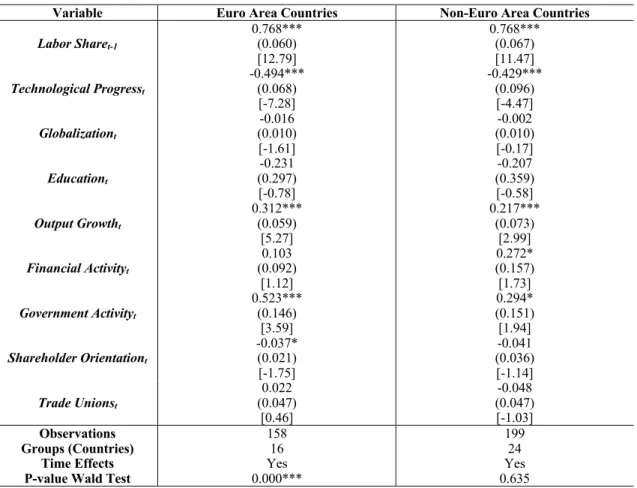
Table 4 exhibits the results of our estimates for the euro area countries and non-euro area countries12. Two important conclusions deserve our attention. Firstly, the results for the
euro area countries are quite similar to the results obtained for all the countries in terms of statistical significance and signs. Effectively, the variables that are statistically significant in the case of euro area countries are just the same in the case of all the countries and they have the same influence on the labor share. Secondly, the results for the non-euro area countries also do not change dramatically. On the one hand, ‘shareholder value orientation’ lose their statistical significance, albeit maintaining their negative coefficient. On the other hand, financial activity becomes statistically significant, influencing the labor share positively.
[Table 4 around here]
The results of our estimates for ‘market-based’ and ‘bank-based’ countries are presented in Table 513. The results for ‘market-based’ countries show that the lagged labor share is the
only statistically significant determinant of the labor share. All the remaining variables are not statistically significant at the conventional significance levels. This should be caused by the relatively small sample that makes up the ‘market-based’ group of countries. The results for ‘bank-based’ countries confirm that the lagged labor share, output growth, financial activity and
11 In order to do that, we try to follow a certain rational to split countries in several sub-samples following any institutional setting that are transversal among them, like the presence in the euro area, the type of financial system and the variety/model of capitalism.
12 The euro area countries are composed of Austria (after 1998), Belgium (after 1998), Cyprus (after 2008), Estonia (after 2010), Finland (after 1998), France (after 1998), Germany (after 1998), Greece (after 2000), Ireland (after 1998), Italy (after 1998), Luxembourg (after 1998), the Netherlands (after 1998), Portugal (after 1998), Slovakia (after 2008), Slovenia (after 2006) and Spain (after 1998). The non-euro area countries consist of the remaining years and countries.
13 According to Bijlsman and Zwart (2013) and Haan et al. (2015), the group of ‘market-based’ countries is constituted by Belgium, Finland, France, the Netherlands, Sweden and the United Kingdom. The remaining countries are characterized as ‘bank-based’ countries.
general government activity exert a positive influence on the labor share, while technological progress and ‘shareholder value orientation’ maintain their negative influence.
[Table 5 around here]
Table 6 contains the results of our estimates for each variety/model of capitalism14.
These results should be analysed with caution, because we obtain small samples to make up each group of countries, particularly in the case of ‘liberal market’ countries. With regard to ‘liberal market’ countries, education, output growth, financial activity, general government activity and ‘shareholder value orientation’ are the only variables that are statistically significant, and all of them positively influences the labor share. The most perverse result concerns ‘shareholder value orientation’, because typically this variable tends to exert a negative effect on the labor share. This seems to suggest that a higher level of (net) financial payments (interest and dividends) is associated with an increase in general wages. Two different mechanisms could explain this result. Firstly, non-financial corporations tend to increase their wages when they are in a better economic and financial situation, that is, when they have higher profits, which also determine a higher level of payout ratios. Secondly, non-financial corporations tend to give bonuses (included in wages) based on their profits, indicating that higher profits imply higher wages and higher payout ratios. This is especially relevant in the case of top management, for which variable wages (as a function of profits) are gaining preponderance. As argued by Mohun (2006), Hein (2012 and 2015) and Hein and Detzer (2014), this result seems to confirm that the rise in top management wages has in fact delineated an increase in the labor share in these countries. In the case of ‘coordinated market’ countries, the lagged labor share, output growth, financial activity and general government activity maintain their statistical significance and their positive influence on the labor share. Technological progress and trade unions are also statistically significant at the conventional significance levels, albeit exerting a negative effect on the labor share. The coefficient of trade unions seems to be quite controversial, notably because unionization levels are regularly a positive determinant of the labor share (Stockhammer 2009; Kristal 2010; Judzik and Sala 2013; Lin and Tomaskovic-Devey 2013; Barradas and Lagoa 2017; and Köhler et al. 2018). This indicates that unionization levels exert a negative influence on wages in ‘coordinated market’ countries, probably because trade unions have privileged the maintenance and creation of jobs rather than an increase in wages due to the increasingly globalized competitive environment
14 The distribution of countries according to their variety/model of capitalism was carried out taking into account the seminal contribution of Hall and Soskice (2001) and other related works in the field of comparative political economy. Accordingly, Ireland and the United Kingdom belongs to ‘liberal market’ countries; Austria, Belgium, Denmark, Finland, Germany, Luxembourg, the Netherlands, Norway and Sweden belongs to ‘coordinated market’ countries; Cyprus, France, Greece, Italy, Portugal and Spain belongs to ‘hybrid/mixed market’ countries; and Bulgaria, the Czech Republic, Estonia, Hungary, Latvia, Lithuania, Poland, Romania, Slovakia and Slovenia belongs to ‘transition’ countries.
since the 1990s. This is confirmed by Hein and Schulten (2004), who stress that this change in the collective bargaining arrangements occurred at both the corporation and the national level. At the corporation level, these authors highlight the emergence of ‘pacts for employment and competitiveness’ following the principle of ‘concession bargaining’ whereby employees agreed to labor cost reductions (a decrease in wages and/or extension of working time) in exchange for limited job guarantees given by corporations. At the national level, these authors emphasize the materialization of tripartite social pacts that established a certain 'competitive corporatism' the primary aim of which was to secure a policy of wage moderation to strengthen the national competitiveness. In relation to ‘hybrid/mixed market’ countries, the labor share is negatively influenced by technological progress and ‘shareholder value orientation’ and positively influenced by the lagged labor share, output growth and trade unions. Finally, regarding ‘transition’ countries, only the lagged labor share, technological progress, output growth and trade unions are statistically significant at the traditional significance levels. They exhibit the expected signs with the exception of trade unions, which again become a negative determinant of the labor share, as in the case of ‘coordinated market’ countries. Note that the negative impact of the trade union density on the labor share occurs only in the case of ‘coordinated market’ countries and in the case of ‘transition’ countries. This is because the majority of these countries follow an export-led growth model, which requires by itself a higher level of competitiveness.
[Table 6 around here]
Despite the institutional differences across the EU countries, our results definitively confirm that financialization and neoliberalism have harmful effects on the labor share in the EU countries either as a whole or in the different sub-samples analysed here.
Finally, we present the economic significance of our statistically significant estimates (McCloskey and Ziliak 1996; and Ziliak and McCloskey 2004). This allows us to identify better the role of financialization and neoliberalism (and the other determinants) in the evolution of the labor share in EU countries since 1995. The results are available in Table 7.
[Table 7 around here]
In the majority of countries, output growth was the main driver of the labor share, whilst technological progress had the worst impact. In fact, the acceleration of technological progress favoured a decrease in the labor share of around 20, 7, 24, 11, 18, 6 and 68 per cent in all the countries, euro area countries, non-euro area countries, ‘bank-based’ countries, ‘coordinated market’ countries, ‘hybrid/mixed market’ countries and ‘transition’ countries, respectively. The output growth contributed to a rise in the labor share of about 34, 19, 19, 21, 26, 47, 22 and 93
per cent in all the countries, euro area countries, non-euro area countries, ‘bank-based’ countries, ‘liberal market’ countries, ‘coordinated market’ countries, ‘hybrid/mixed market’ countries and ‘transition’ countries, respectively. This is a matter of concern taking into account the fears around the emergence of a new ‘secular stagnation’ in the current era of financialization and neoliberalism that could delineate a strong fall in the labor share in the coming years. The remaining variables had smaller economic impacts on the labor share, because they exhibited lower growth rates from 1995 to 2013. Note that technological progress and output growth are the two variables that denote the highest growth rates, even though the pronounced drop in the recent crisis. Hence, the variables linked with financialization and neoliberalism also explained the evolution of the labor share, although their economic effects differed across countries. Considering all the countries as a whole, the decrease in the general government activity contributed to a decline in the labor share of about 3 per cent. This effect did not compensate for the concomitant decline in net financial payments, which only contributed to an increase in the labor share of about 2 per cent. In general terms, the global net effect of financialization and neoliberalism was marginally negative. In euro area countries, the global net effect of financialization and neoliberalism on the labor share was positive. Effectively, the increase in general government activity and the reduction in net financial payments delineated a rise in the labor share of about 16 and 2 per cent, respectively. In non-euro area countries, the global net effect of financialization and neoliberalism were prejudicial, in a context in which the labor share would have been larger by about 11 and 1 per cent without the fall in the financial activity and the general government activity, respectively. In ‘bank-based’ countries, the decrease in financial activity and general government activity were responsible for a fall in the labor share by around 2 and 4 per cent, respectively. These effects were not sufficient to compensate for the rise in the labor share of about 5 per cent caused by the reduction in net financial payments. In ‘liberal market’ countries, the growth in financial activity, general government activity and net financial payments favoured an increase in the labor share of about 26, 38 and 2 per cent, respectively. In ‘coordinated market’ countries, the global net effect of financialization and neoliberalism was detrimental to the labor share. The labor share would have been larger of about 1 and 5 per cent if had there not been a fall in both financial and general government activities. This harmful effect was not compensated for the rise in the labor share of around 5 per cent due to the reduction in the trade union density rate. In ‘hybrid/mixed market’ countries, the fall in net financial payments favoured a rise in the labor share of about 8 per cent, which was sufficient to compensate for the reduction in the labor share of about 2 per cent due to the fall in the unionization levels. In ‘transition’ countries, financialization and neoliberalism favoured a rise in the labor share of about 50 per cent due to the substantial reduction in the unionization levels.
To sum up, financialization and neoliberalism have indeed contributed to the fall in the labor share in EU countries as a whole. These effects were more notorious in the case of non-euro area countries, ‘bank-based’ countries and ‘coordinated market’ countries.
6. CONCLUSION
This paper aimed to analyse the relationship between financialization and neoliberalism and the fall in the labor share in EU countries by performing a panel data econometric analysis for 27 EU countries between 1995 and 2013.
Conventional economic theory stresses that the labor share and the profit share remain relatively stable over time (Bowley 1937; and Kaldor 1961), despite the decreasing (increasing) trend of the labor (profit) share in the majority of economies since the 1980s (Jayadev 2007; Stockhammer 2009, 2012 and 2017; Kristal 2010; Dünhaupt 2011; Peralta and Escalonilla 2011; Estrada and Valdeolivas 2012; Lin and Tomaskovic-Devey 2013; among others). Scholars on financialization and neoliberalism, framed in the post-Keynesian literature and adopting a Kaleckian perspective, claim that financialization and neoliberalism are one of the drivers of the fall in the labor share due to three channels (Hein 2012 and 2015; Hein and Detzer 2014; Michell 2014; Hein and Dodig 2015; among others): the change in the sectorial composition of economies (visible in the increasing importance of financial activity and the decreasing importance of general government activity), the emergence of ‘shareholder value orientation’ and the deterioration general workers’ bargaining power of through the weakening of trade unions.
We estimate a labor share equation using the standard variables (lagged labor share, technological progress, globalization, education and output growth) and four further variables to reflect the three channels of financialization and neoliberalism (financial activity, general government activity, ‘shareholder value orientation’ and trade union density rate). As we have a dynamic panel data model, an unbalanced panel and a macro panel, our labor share equation is estimated using the LSDVBC estimator.
We find that the channels of general government activity and ‘shareholder value orientation’ are positive and negative determinants, respectively, of the labor share in EU countries, in accordance with the literature and other empirical studies concerning this matter (Dünhaupt 2013a; Alvarez 2015; Stockhammer 2015; and Barradas and Lagoa 2017). We also confirm the findings of other empirical studies that do not take into account the role of financialization and neoliberalism (European Commission 2007; International Monetary Fund 2007; Jayadev 2007; Stockhammer 2009; Judzik and Sala 2013; Karanassou and Sala 2013; and Köhler et al. 2018), namely that the labor share of the EU countries is sluggish, strongly procyclical and negatively influenced by technological progress. It is also concluded that


![Table 4 – Estimations of the labor share equation by type of financial system Variable ‘Market-based’ Countries ‘Bank-based’ Countries Labor Share t-1 0.793*** (0.095) [8.32] 0.718*** (0.049) [14.66] Technological Progress t -0.041 (0.191) [-0.21](https://thumb-eu.123doks.com/thumbv2/123dok_br/18663902.913357/33.892.130.767.127.613/estimations-equation-financial-variable-countries-countries-technological-progress.webp)