
Carla Isabel Lopes Daniel
Mestre em Engenharia Química e Bioquímica
Development and Modulation of Magnetic
Responsive Supported Ionic Liquid Membranes
Dissertação para obtenção do Grau de Doutor em
Engenharia Química e Bioquímica Especialidade Engenharia Química
Orientador: João Paulo Goulão Crespo, Professor Catedrático, Faculdade de Ciências e Tecnologia - Universidade Nova de Lisboa
Co-orientadora: Carla Alexandra Moreira Portugal, Investigadora, Faculdade de Ciências e Tecnologia - Universidade Nova de Lisboa
Júri
Presidente: Prof. Doutor Manuel Nunes da Ponte Arguentes: Prof. Doutora Patrícia Luís Alconero
Prof. Doutor Carlos Manuel Silva
Development and Modulation of Magnetic Responsive Supported Ionic Liq-uid Membranes
Copyright © Carla Isabel Lopes Daniel, Faculdade de Ciências e Tecnologia, Universidade NOVA de Lisboa.
inves-Acknowledgements
Com imenso gosto, quero agradecer em primeiro lugar aos meus orientadores João Paulo Crespo e Carla Portugal, pela oportunidade de fazer parte deste projecto de investigação que durante estes 5 anos desenvolvemos em conjunto. Foi pela orientação científica, disponibilidade, sentido crítico, exigência e rigor da vossa parte que me fizeram aprender cada dia mais e mais e crescer muito a nível profissional. Agradeço sempre a amizade e apoio demonstrados a nível pessoal em todos os momentos passados ao longo destes anos, os quais não esquecerei nunca. Agradeço também as oportunidades de colocabo-rações científicas nacionais e internacionais que me aconselharam a experienciar, pois sem dúvida, foram as que mais me fizeram crescer a todos os níveis, profissional e pessoal, onde conheci pessoas inesquecíveis. Um gigante Obrigado por tudo João Paulo e Carla!!!
Quero agradecer ao Professor Pedro Sebastião, do Instituto Superior Técnico, pela oportunidade de colaborar e integrar o seu grupo de investigação durante quatro anos. Ao longo desta colaboração aprendi um novo mundo sobre a “encantada” Física, que me fez interligar com todo o meu PhD e foi crucial para todos os avanços que fui alcançando com a imensa ajuda, apoio, paciência que o Pedro teve para comigo. Foram as longas e inúmeras discussões sobre o trabalho que mais fizeram ter uma visão de qual o passo seguinte! Aprendi imenso e cresci muito com esta colaboração! Um grande obrigado a si Pedro!
Ao Professor Angel Irabien, da Universidade de Cantabria, Santander - Espanha, quero agradecer pela oportunidade do meu primeiro estágio em 2012, no seu grupo de investigação, no qual desenvolvi uma parte do meu PhD, e também agradecer a colab-oração no Projecto ERA-CHEMISTRY no qual tive oportunidade de trabalhar. Agradeço a todo o grupo com quem trabalhei em Santander, pois jamais esquecerei o quanto me ajudaram desde o primeiro dia até ao ultimo!
Aos Professores Paul Scovazzo e Jonh O´Haver da Universidade do Mississippi, Ox-ford - EUA, agradeço pela colaboração na recta final da minha tese, no desenvolvimento de micelas magnéticas, e pelo facto de me ter recebido no seu grupo em 2013 no meu segundo estágio, nos EUA! Foi uma experiência inesquecível, a trabalhar com pessoas fantásticas, tendo aprendido imenso.
Aos Professores Gaspar Martinho e José Paulo Farinha, do Instituto Superior Técnico, pela ajuda nas análises por DLS, na última parte deste trabalho.
À Professora Isabel Marrucho, do ITQB, pela oportunidade que me facultou de fazer medidas de condutividade no seu laboratório.
À Professora Margarida Cardoso, da FCT/UNL, pela ajuda na última parte deste trabalho, pelas sugestões e reuniões que tivemos. Obrigada pela disponibilidade!
Ao Doutor Fabian Chávez, da Universidade Nacional de Córdoba, com quem trabal-hei no IST em colaboração com o Professor Pedro Sebastião, quero agradecer a imensa ajuda desde o primeiro dia até ao final da minha tese, toda a disponibilidade e atenção e interesse por este trabalho e toda a simpatia demonstrados sempre!
Gostaria de agradecer a todos colegas do grupo BPEG e aos que já não estão no grupo e que a amizade e contacto ficaram, por ao longo destes anos demonstrarem sempre interajuda e disponibilidade para quando no dia a dia precisei de ajuda nas questões e duvidas de trabalho. A todas as pessoas que conheci ao longo deste PhD que foram mais que muitas, em cursos e conferências, e que de alguma forma também ajudaram!
Em especial quero agradecer à minha grande amiga Luísa, pela amizade gigante, apoio incondicional, disponibilidade total e por me conhecer como ninguém, sempre esteve e está lá comigo!!! OBRIGADA!!! OBRIGADA!!!
Igualmente especial à Mónica e Cristiana, pela grande amizade, todo o apoio no dia a dia, momentos muito bem passados e o companheirismo ao longo deste anos. O meu muito Obrigado!!!
Um agradecimento também muito muito especial, aos meus queridos amigos espan-hóis, Jonathan e Esther, pela amizade, apoio, diversão, ânimo, durante os estágios que fiz em Espanha e vocês em Portugal! Foram dos momentos mais bem passados e aproveita-dos!!! A todos os grandes amigos que ficam para toda a vida que conheci em Espanha, os quais me fizeram sentir muito feliz!!! Fortissimos sempre!!
Agradeço aos amigos que conheci nos EUA e que ficam também para sempre, Frances e familia, Martinha, Rui, Fábio e todas as outras pessoas, o muito Obrigada ao apoio que tive a Kms de Portugal durante dois meses!!! Outstanding!!!
À Liliana e Sandra, as minhas meninas do ITQB, pela amizade, apoio e indiscutiveis melhores momentos de pura diversão!!! Principalmente além fronteiras!
Ao pessoal do grupo de investigação da FFarmácia, principalmente, Carlos, Jaime, Andreia, Roberta, Filipa e todos os que conheci, pelo companheirismo, imensa ajuda e muita diversão que passámos no Lab! Muito Obrigada!
Agradeço a imensa e fundamental ajuda do Bruno Candeias do DI/FCT na parte de edição da tese em Latex!
À minha grande amiga e mana Isabel, que apesar de separadas, estamos sempre juntas com toda a amizade, carinho e apoio, que já dura à 24 anos!
A todos os outros grandes grandes amigos como, Ana Rodrigues, Alice, Natacha, Lina, Humberto, Joana, Pedro, agradeço a imensa amizade, ajuda, conversas, cafés, e tudo o que já passámos juntos!!! O meu muito Obrigado!
A todos os outros amigos e colegas que são mais que muitos, que mesmo longe, sei que me apoiam e agradeço pelas lembranças sempre! Aos mais recentes amigos, Liliana, Telmo, Cláudia pela amizade, boa disposição e todos os momentos de grandes risadas!
Aos meus manos, cunhadas e sobrinhos, pelos momentos em familia bem passados, e pelo apoio e preocupação demonstrados e pelas conversas sempre!
Por último, mas o maior dos agradecimentos aos MEUS PAIS, Teresa e Daniel! As duas pessoas mais presentes na minha vida, apesar da distância física, e que muitas vezes fizeram falta estarem mais perto, agradeço por me conhecerem como mais ninguém sabe, pelo apoio, as longas conversas por telefone, os conselhos que foram, são e serão tudo para seguir em frente! Obrigada mãe e pai por acreditarem em mim e nos momentos que mais foram difíceis, vocês estão sempre comigo, e por todos os mimos!
Abstract
The work presented in this thesis aims at developing a new separation process based on the application of supported magnetic ionic liquid membranes, SMILMs, using mag-netic ionic liquids, MILs. MILs have attracted growing interest due to their ability to change their physicochemical characteristics when exposed to variable magnetic field conditions. The magnetic responsive behavior of MILs is thus expected to contribute for the development of more efficient separation processes, such as supported liquid
mem-branes, where MILs may be used as a selective carrier. Driven by the MILs behavior, these membranes are expected to switch reversibly their permeability and selectivity by
in situand non-invasive adjustment of the conditions (e.g. intensity, direction vector and uniformity) of an external applied magnetic field.
The development of these magnetic responsive membrane processes were anticipated by studies, performed along the first stage of this PhD work, aiming at getting a deep knowledge on the influence of magnetic field on MILs properties. The influence of the magnetic field on the molecular dynamics and structural rearrangement of MILs ionic network was assessed through a1H-NMR technique. Through the1H-NMR relaxometry analysis it was possible to estimate the self-diffusion profiles of two different model MILs,
[Aliquat][FeCl4] and [P66614][FeCl4]. A comparative analysis was established between
the behavior of magnetic and non-magnetic ionic liquids, MILs and ILs, to facilitate the perception of the magnetic field impact on MILs properties. In contrast to ILs, MILs show a specific relaxation mechanism, characterized by the magnetic dependence of their self-diffusion coefficients. MILs self-diffusion coefficients increased in the presence of
magnetic field whereas ILs self-diffusion was not affected.
In order to understand the reasons underlying the magnetic dependence of MILs self-diffusion, studies were performed to investigate the influence of the magnetic field
on MILs’ viscosity. It was observed that the MIL´s viscosity decreases with the increase of the magnetic field, explaining the increase of MILs self-diffusion according to the
modified Stokes- Einstein equation.
Different gas and liquid transport studies were therefore performed aiming to
a series of phosphonium cation based MILs, containing different paramagnetic anions.
Transport studies were conducted in the presence and absence of magnetic field at a maximum intensity of 1.5T. The results revealed that gas permeability increased in the presence of the magnetic field, however, without affecting the membrane selectivity. The
increase of gas permeability through SMILMs was related to the decrease of the MILs viscosity under magnetic field conditions.
Two distinct case studies were performed to evaluate the influence of magnetic field in the transport of two model solutes, ibuprofen andα-pinene, in organic liquid phases,
dodecane and hexane. Transport studies in liquid phase were carried out using SMILMs prepared by immobilization of imidazolium based MILs, which depicted good structural stability when in contact with the selected organic phases. Identical to that observed in gas transport studies, the magnetic field induced an increase of the permeability of ibuprofen andα-pinene through the SMILMs tested. In this case, the increase of solute permeability was not only ascribed to the magnetically induced decrease of MILs viscosity but also to the increase of solutes solubility in MILs, promoted by the magnetic field.
This work demonstrates the possibility to modulate the physicochemical characteris-tics of MILs, e.g. self-diffusion and viscosity, by non-invasive andin situadjustment of
the magnetic field conditions. It was also shown that the magnetic modulation of such variables impacts on the permeability of the SMILMs and on solute diffusion in gas and
liquid separations.
Keywords: Magnetic Ionic Liquids (MILs), Proton Nuclear Magnetic Resonance (1
H-NMR), Supported Magnetic Ionic Liquid Membranes (SMILMs), magnetic field, gas and liquid transport.
Resumo
O trabalho apresentado nesta tese tem como objetivo o desenvolvimento de uma nova geração de processos de separação baseados na aplicação de membranas líquidas suporta-das, usando líquidos iónicos magnéticos. Estes líquidos iónicos magnéticos têm merecido um interesse crescente devido à sua capacidade em modificar reversivelmente as suas propriedades físico – químicas quando sujeitos à presença de um campo magnético. En-quanto transportadores líquidos, integrantes de membranas líquidas suportadas, será de esperar que o seu comportamento magnético se possa traduzir na capacidade de modular de modo não-invasivo, a permeabilidade e o transporte seletivo de solutos através destas membranas, por ajuste das condições (intensidade, direção do vetor magnético e unifor-midade de campo) de um campo magnético externo. Como tal, poderão contribuir para o desenvolvimento de processos de separação mais eficientes de forma não invasiva.
O desenvolvimento destes processos de separação, baseados em membranas com pro-priedades magnéticas, foi antecipado por estudos realizados numa primeira fase deste trabalho de douramento, que tiveram como objetivo obter um conhecimento profundo acerca da influência do campo magnético nas propriedades dos líquidos iónicos magnéti-cos. O impacto do campo magnético na dinâmica molecular e nos rearranjos estruturais da rede iónica destes líquidos foi avaliado através da técnica1H-NMR (Relaxação
Mag-nética Nuclear de Protão). Esta técnica de análise de relaxometria permitiu estimar os perfis de autodifusão de dois líquidos iónicos magnéticos modelo, [Aliquat][FeCl4] e
[P66614][FeCl4] em função do campo magnético. Foi efetuada uma análise comparativa
entre o comportamento dos líquidos magnéticos e não magnéticos, de modo a facilitar a compreensão do impacto do campo magnético nas propriedades dos líquidos iónicos magnéticos. Contrariamente aos líquidos não magnéticos, os líquidos iónicos magnéticos evidenciaram a presença de um mecanismo específico de relaxação, caracterizado pela dependência magnética dos seus coeficientes de autodifusão. Foi verificado que os coefi-cientes de autodifusão destes líquidos aumentam na presença de um campo magnético. Contudo a autodifusão dos seus análogos não magnéticos não foi afetada.
magnéticos diminui com o aumento da intensidade do campo magnético, o que, em con-cordância com a equação modificada de Stokes-Einstein, permitiu explicar o aumento da autodifusão dos líquidos iónicos.
Foram realizados estudos de transporte em meio gasoso e líquido com o objetivo de de-terminar a influência do comportamento magnético dos líquidos iónicos no transporte de diferentes gases, CO2, N2e Ar, através de membranas líquidas suportadas. Estes estudos
de permeação gasosa foram realizados usando diferentes membranas líquidas suportadas, preparadas por imobilização de líquidos iónicos magnéticos distintos, compostos pelo ca-tião fosfónio e diferentes aniões paramagnéticos. Estes estudos de transporte foram feitos na presença e ausência de campo magnético a uma intensidade máxima de 1.5Tesla. Os resultados revelaram que a permeabilidade dos gases aumentou na presença do campo magnético, no entanto, sem efeito na seletividade da membrana líquida suportada. O aumento de permeabilidade de solutos na presença de campo magnético foi relacionada com a diminuição da viscosidade destes líquidos quando expostos ao efeito do campo magnético.
Foram testados dois casos de estudo distintos para verificar a influência do campo magnético no transporte de solutos presentes entre fases líquidas: transporte de ibupro-feno e α-pineno, em meio orgânico de dodecano e hexano. Os estudos de transporte
foram realizados usando membranas líquidas suportadas com a incorporação dos líqui-dos iónicos magnéticos com o catião imidazolium, as quais demonstraram possuir boa estabilidade mediante o contacto com as fases orgânicas selecionadas. Identicamente ao que foi observado no transporte de gases, o campo magnético induziu um aumento da permeabilidade dos dois solutos, ibuprofeno eα-pineno através das membranas líquidas
suportadas testadas. Neste caso, o aumento da permeabilidade dos solutos não foi apenas atribuído à diminuição da viscosidade dos líquidos iónicos induzida pelo campo magné-tico, mas também devido ao aumento da solubilidade dos solutos nos líquidos iónicos magnéticos, promovido pelo campo magnético aplicado.
Este trabalho demonstra a possibilidade de modular as propriedades físico-químicas dos líquidos iónicos magnéticos, tais como, autodifusão e viscosidade, de forma não inva-siva por ajuste das condições do campo magnético. Foi também possível mostrar que a modulação magnética destas variáveis tem impacto na permeabilidade das membranas magnéticas líquidas suportadas e na difusão dos solutos em fase gasosa e líquida.
Palavras-chave: Líquidos Iónicos Magnéticos, Ressonância Magnética Nuclear, Membra-nas Líquidas Suportadas com líquidos iónicos magnéticos, campo magnético, transporte em meio líquido e gasoso.
Abbreviations
[Aliquat+] Methyltrioctylammonium cation [Aliquat][Cl] Methyltrioctylammonium chloride
[Aliquat][FeCl4] Methyltrioctylammonium tretrachloroferrate B Magnetic field,T esla
BPP Bloemberger, Purcel and Pound relaxation model
[C11H21N2O][GdCl3Br3]1-butyl-3-(3-hydroxy-2-methylpropyl)imidazolium hexabromidechlorogadolinium [C4mim][FeCl4] 1-butyl-3-methylimidazolium tetrachloroferrate
[C8mim][FeCl4] 1-octyl-3-methylimidazolium tetrachloroferrate [Cnmim]+ Imidazolium cation
[CoCl4]– 2 Cobalt tetrachloride
CMC Critical Micellar concentration,mM
CR Cross relaxation contribution DMSO Dimethyl sulfoxide
[FeCl4]– Iron tretrachlororide
[GdCl6]– 3 Gadolinium hexachloride
GC Gas Chromatography
1H-NMR Proton Nuclear Magnetic Resonance Relaxometry
1H-NMRD Proton Nuclear Magnetic Resonance Relaxometry Dispersion
ICP Inductively coupled plasma
ILs Ionic Liquids
[MnCl4]– 2 Manganese tetrachloride
MILs Magnetic Ionic Liquids MPD Mean percentage deviation
mVFT modified Vogel-Fulcher-Tamman equation
[n-bmim][FeCl4] 1-butyronitrile-3-methylimidazolium tetrachloroferrate [P66614]+ Trihexyl(tetradecyl)phosphonium cation
[P66614][Cl] Trihexyl(tetradecyl)phosphonium chloride
[P66614][FeCl4] Trihexyl(tetradecyl)phosphonium tretrachloroferrate [P66614]2[CoCl4] Trihexyl(tetradecyl)phosphonium tretrachlorocobaltate [P66614]2[MnCl4] Trihexyl(tetradecyl)phosphonium tretrachloromanganate [P66614]3[GdCl6] Trihexyl(tetradecyl)phosphonium hexachlorogadolinium PM Paramagnetic relaxation contribution
PRE Proton relaxation enhancement PFG Pulse field-gradient
PVDF Polyvinylidene fluoride
Rot Molecular rotations/reorientations contribution RTILs Room Temperature Ionic Liquids
SD Translational self-diffusion contribution
SMILMs Supported Magnetic Ionic Liquid Membranes VFT Vogel-Fulcher-Tamman equation
ZFS Zero-field-splitting
Variables
a,bandc Coefficients of density equation
AandB Orrick-Erbar model parameters for the viscosity estimation A∗andB∗ Normalized parameters of Orrick-Erbar model
A−andB− Parameters of anion contribution for the viscosity estimation A+andB+ Parameters of cation contribution for the viscosity estimation Am Membrane area,cm2
ACRi Parameter related to the strength of interaction in cross relaxation,s−2
ARoti Parameter related to the strength of interactions in rotations/reorientations,s−
2
ARot1,ARot2 Parameters related with the strength of the interaction in rotations/reorientations
contribution,s−2
c Quantity proportional to the molar concentration of
magnetized particles,[M],molL−1
[C] Concentration of the paramagnetic particles,molL−1
C Constant that depends on the MIL molar massMwand the molar volumeV to calculate the viscosity
CF Concentration in the feed phase,mol cm−3
CS Concentration in the stripping phase,mol cm−3
d Molecular width,m
D Diffusion Coefficient,m2s−1
D0 Diffusion Coefficient at zero magnetic field,m2s−1
Dio Diffusion coefficient of the solute i in the impregnated liquid phase,m2s−1
d1ande Parameters of the accumulation equation
H Gas partition coefficient
JF Flux of the solute in the feed phase,mol cm−2s−1
JS Flux of the solute in the stripping phase,mol cm−2s−1
K Overall mass transfer coefficient,cm s−1
kimo Mass transfer coefficient through the liquid phase impregnated in the support,cm s−1
Mw Molar mass,gmol−1
n Density of1H spins,spins m−3
ni number of chains of the phosphonium cation
N Avogadro constant,mol−1
pperm Pressure in the permeate compartment,Pa pf eed Pressure in the feed compartment,Pa
P Permeability, Barrer orcm2s−1
P1 Pressure,MPa
rFeH Distance between the magnetic ions and the solvent DMSO molecules for
isrelaxation contribution,Å
r1 Relaxivity of the contrast agent,mM−1s−1
rief f Effective inter-spin distance,m
R1 Relaxation rate,s−1
RFeH Distance between the magnetic ions and the solvent DMSO molecules for
osrelaxation contribution,Å
Rot1,Rot2 Molecular rotations/reorientations contribution
S Solubility
S1 Electronic spin
Sc Sub component of electronic spin - time average spin
t Time,s
T Absolute temperature,K or℃
T1 Spin-lattice relaxation time,s
T2 Spin-spin relaxation time,s
(T1−1)is Relaxation rate of inner-sphere relaxation contribution,s−1 (T1−1)os Relaxation rate of outer-sphere relaxation contribution,s−1
V Molar volume,m3mol−1orÅ3 VF Volume of the feed phase,cm3
VS Volume of the stripping phase,cm3
Y∗andX∗ Normalized variables
(VC)acc Term for solute accumulation in the membrane,mol
p
r2 Mean-square jump distance,
m
Greek Letters
α1 Association degree
α andβ Fitted parameters of the density correlation,Å3Kg−1MPaandÅ3K−1Kg−1
β1 Geometric factor,m−1
γ 1H gyromagnetic ratio,MHz γS Electron’s gyromagnetic ratio,MHz
δ Gradient length,ms
δ1 Membrane thickness,m
∆ Delay between the gradients experiment,ms
∆2 Mean square fluctuations of the electronic zero-field-splitting (ZFS) relaxation contribution,s−2
ǫ Porosity of the membrane η Viscosity,Pa.sorcP
λ Wavelength,nm
νL Proton Larmor frequency,Hz
Ω spectral density function
T dimensionless analytical function depends on the average
time between diffusion jumps
ρ Density,g cm−3
ω Proton angular Larmor frequency,Hz
τ1,τ2 Correlation times in rotations/reorientations contribution,s
τCRi Correlation time of the cross relaxation contribution,s
τd Diffusion correlation time of paramagnetic contribution,s
τd1 Diffusion translational correlation time of paramagnetic contribution,s
τd0 Diffusion correlation time of paramagnetic contribution at zero magnetic field,s τD Diffusion correlation time of self-diffusion contribution,s
τD0 Diffusion correlation time of self-diffusion contribution at zero magnetic field,s
τm Membrane tortuosity
τmH Correlation time for theisinner relaxation,s
τRoti Correlation time related with the rotations/reorientations,s
τs Longitudinal electronic relaxation time,s
τv1andp1 Parameters that explained the decay of viscosity withB χmT Magnetic susceptibility,emu.K. mol−1
Subscripts
0 absence of magnetic field B presence of magnetic field
cal calculated property (density and viscosity) exp experimental(density and viscosity) max maximum value of the variables min minimum value of the variables
i initial conditions
f feed phase
s stripping phase
eq equilibrium
Contents
List of Figures xxi
List of Tables xxiii
1 Introduction 1
1.1 Background and Motivation . . . 1
1.2 Research strategy . . . 4
1.3 Thesis Outline . . . 6
2 1H-NMR and viscometry studies of MILs and ILs 9 2.1 Summary . . . 9
2.2 Introduction . . . 10
2.3 Experimental . . . 11
2.3.1 Materials . . . 11
2.3.2 Methods . . . 12
2.3.2.1 Viscosity measurements . . . 12
2.3.2.2 Nuclear Magnetic Resonance . . . 12
2.4 Results . . . 13
2.5 Analysis and discussion . . . 15
2.5.1 Theoretical models . . . 16
2.5.1.1 Translational self-diffusion . . . 16
2.5.1.2 Rotations/reorientations . . . 16
2.5.1.3 Cross-relaxation . . . 16
2.5.1.4 Paramagnetic relaxation . . . 17
2.5.2 Model fits to the experimental results . . . 17
2.6 Conclusions . . . 23
3 1H-NMR study of a MIL as a potential contrast agent 25 3.1 Summary . . . 25
3.2 Introduction . . . 26
3.3 Experimental . . . 28
3.3.1 Materials . . . 28
C O N T E N T S
3.3.2.1 1H-NMR assays . . . 28
3.3.2.2 Viscosity measurements . . . 29
3.4 Results . . . 29
3.5 Analysis and Discussion . . . 31
3.6 Conclusions . . . 37
4 A group contribution method for MILs viscosity 39 4.1 Summary . . . 39
4.2 Introduction . . . 40
4.3 Experimental . . . 41
4.3.1 Materials and Methods . . . 41
4.4 Results and Discussion . . . 41
4.5 Conclusions . . . 51
5 Permeability modulation of SMILMs 53 5.1 Summary . . . 53
5.2 Introduction . . . 54
5.3 Experimental . . . 55
5.3.1 Materials . . . 55
5.3.1.1 Gas Permeation experiments in Supported Magnetic Ionic Liquid Membranes (SMILMs) . . . 55
5.3.1.2 Experimental viscosity determination . . . 57
5.4 Results and Discussion . . . 57
5.4.0.1 Permeability-viscosity data in the absence of a magnetic field . . . 57
5.4.0.2 Separation performance of SMILMs in the presence of an external magnetic field . . . 58
5.4.0.3 Permeability dependence on magnetic susceptibility . . 60
5.4.0.4 Influence of the magnetic field on MILs viscosity and CO2 permeability of SMILMs . . . 61
5.4.0.5 Permeability-viscosity correlation in the presence of a mag-netic field . . . 61
5.5 Conclusions . . . 63
6 Magnetic modulation of the transport in SMILMs 65 6.1 Summary . . . 65
6.2 Introduction . . . 66
6.3 Experimental . . . 67
6.3.1 Materials and Methods . . . 67
6.3.1.1 Magnetic Ionic Liquids (MILs) . . . 67
C O N T E N T S
6.3.1.3 Preparation of Supported Magnetic Ionic Liquid
Mem-branes (SMILMs) . . . 69
6.3.1.4 Transport studies . . . 69
6.3.1.5 Analytical methods . . . 70
6.3.1.6 Viscosity Measurements . . . 71
6.4 Results and Discussion . . . 71
6.4.0.1 Transport results . . . 71
6.4.0.2 Viscosity results . . . 76
6.5 Conclusions . . . 79
7 General Conclusions 81 8 Future Work 85 Bibliography 89 A Appendix - Supporting Information 99 A.0.1 Theoretical models . . . 99
A.0.1.1 Translational self-diffusion . . . 99
A.0.1.2 Rotations/reorientations . . . 99
A.0.1.3 Cross-relaxation . . . 100
A.0.1.4 Paramagnetic relaxation induced by superparamagnetic particles . . . 100
A.0.1.5 Relaxivity Dispersion . . . 101
List of Figures
1.1 Scheme description of the facilitated transport using a magnetic responsive membrane in the presence and absence of a magnetic field. . . 4
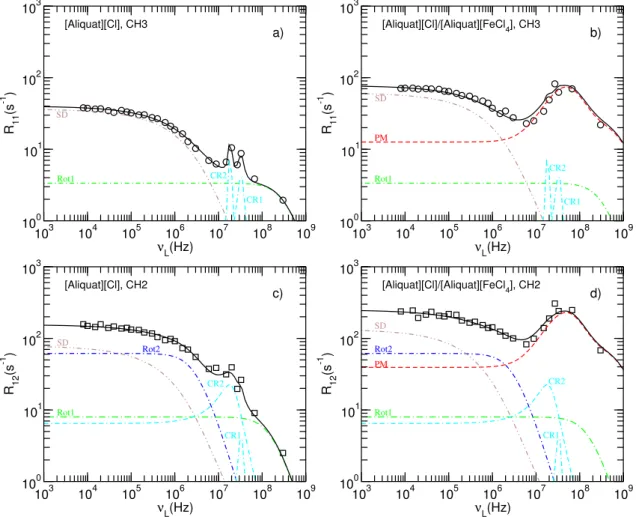
2.1 Molecular structure of the [Aliquat] cation. . . 12 2.2 Larmor dependence of the proton spin lattice relaxation rateR1for the studied
systems: non-magnetic ionic liquid [Aliquat][Cl], a) and MIL [Aliquat][Cl]/ [Aliquat][FeCl4] 1% (v/v) mixture, b). . . 14
2.3 Viscosity measured for the [Aliquat][Cl] and [Aliquat][Cl]/ [Aliquat][FeCl4]
systems. The solid line corresponds to the fit using eq. 2.9. Dashed curves correspond to the extrapolated values of viscosity as a function of the magnetic field estimated using also eq. 2.9. . . 18 2.4 Experimental results and model fitting curves for the two spin-lattice
relax-ation rates as a function of frequency for the IL systems, as explained in the text. . . 20 2.5 Viscosity [full and empty black circles] and translational self-diffusion [full
and empty black squares] measured for the [Aliquat][Cl] and [Aliquat][Cl]/ [Aliquat][FeCl4] systems. The patterned squares (red and blue online only)
refer to the estimated diffusion values from the model fit of eq. 2.8, as
ex-plained in the text. Flat dashed curves correspond to the extrapolated values of viscosity and diffusion as a function of the magnetic field. The
dashed-dot curve and the red (online only) patterned circle were obtained using eq. 2.9. The self-diffusion coefficient measured at 7T and 14.1 T were
fit-ted together with the value at zero field obtained from NMRD. The phe-nomenological magnetic field dependence of α1 for both [Aliquat][Cl] and
[Aliquat][Cl]/[Aliquat][FeCl4] are also plotted. . . 22
3.1 Molecular structure of the [P66614]+ cation. The charge is localized at the
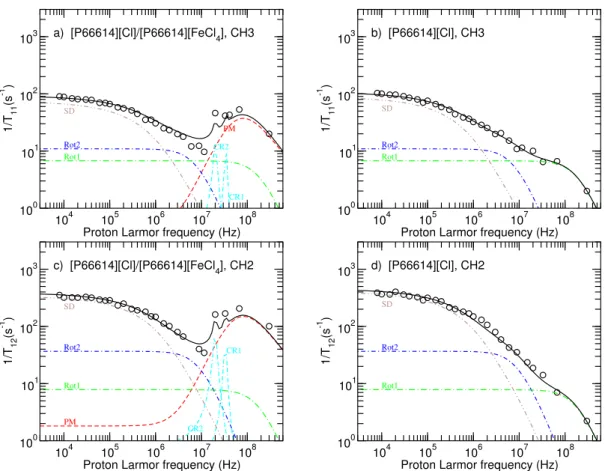
phosphorous atom. . . 29 3.2 Larmor frequency dependence of proton spin lattice relaxation rates for the
systems [P66614][Cl] and MIL [P66614][Cl]/[P66614][FeCl4] 1% (v/v) mixture:
L i s t o f F i g u r e s
3.3 Experimental results and model fitting curves for the two spin-lattice relax-ation rates as a function of frequency for the IL systems, as explained in the text. . . 33 3.4 Experimental results and model fitting curves for the relativity as a function
of frequency for the 10mM DMSO/[P66614][FeCl4] system, as explained in the
text. . . 35 3.5 Experimental results of the DMSO spin-lattice relaxation as a function of
[P66614][FeCl4] concentration. Relaxivities were estimated for three selected
Larmor frequencies, as explained in the text. The arrow in the inset figure rep-resent the concentration corresponding to the mixture [P66614][Cl]/[P66614][FeCl4]
studied here. . . 36 4.1 Normalized viscosity fitted for all the MILs by Orrick-Erbar correlation using
Fitteiasoftware. . . 46 4.2 Experimental and calculated dimensionless MILs viscosity results using
Orrick-Erbar correlation. . . 48 5.1 Experimental setup for CO2separation in the presence of an external magnetic
field. . . 57 5.2 Correlation for CO2permeability versus viscosity. . . 58
5.3 Upper bound correlation for CO2/N2separation (1 Barrer = 10−10cm3(STP)cm cm−2
s−1cmHg−1) . . . . 60
5.4 Gas permeability behavior depending on MILs magnetic susceptibility. . . . 61 5.5 CO2permeability ratio (P(B)/P(0)) at different magnetic field intensities. . . . 62
5.6 CO2permeability vs.MILs viscosity ratio . . . 63
6.1 Experimental set-up showing the diffusion cell placed between the
electro-magnet poles during a transport study. . . 70 6.2 Normalized solute concentration profiles fitted along time in the stripping
phase for theα- pinene transport through SMIMLs with immobilized [C8mim][FeCl4]
and [C4mim][FeCl4] . . . 74
6.3 Normalized solute concentration profiles fitted along time in the feed and stripping phases for the ibuprofen transport through SMIMLs with immobi-lized [C11H21N2O]3[GdCl3Br3] . . . 74
6.4 Ibuprofen normalized accumulation fittings curves along the time for the MIL 75 6.5 Normalized viscosity of pure MILs in the presence and absence of a magnetic
field with intensities up to 2.0 Tesla . . . 76 8.1 [Aliquat][FeCl4] micelles solution (dark region) in equilibrium with D2O (clear
region): a) with magnetic field OFF and b) with magnetic field ON. . . 87
List of Tables
2.1 IL physical parameters. The molar concentration of [Aliquat][FeCl4] in the
[Aliquat][Cl]/[Aliquat][FeCl4] mixture is 0.012 mol/L. . . 12
2.2 Viscosity and diffusion experimental results for the [Aliquat][Cl]/ [Aliquat][FeCl4]
1% (v/v) MIL (in parenthesis the values for the [Aliquat][Cl] IL). . . 15 2.3 Relaxation model parameters obtained for the best fit of eq. 2.8 to the R1
experimental results for the [Aliquat][Cl] and [Aliquat][Cl]/ [Aliquat][FeCl4]
1% (v/v) IL systems, as explained in the text. The follow fitting parameters are common for both IL systems: τD0= (2.8±0.2)×10−
9s,d
≃7.3×10⁻¹⁰m,M≃
0.012mol/L,S1≃370±10,n= 8×1028spins/m3,p1≃2.4, andτv1≃7×10−
10s,
p2≃1.2, andτv2≃9.3×10−
10s,ω
1/(2π)≃33MHz, andω2/(2π)≃18MHz . . 19
3.1 Physical parameters of the ionic liquid systems used. The molar concentration of [P66614][FeCl4] in the [P66614][Cl]/[P66614][FeCl4] mixture is 0.014 mol/L. 29
3.2 Viscosity determined experimentally as a function of applied magnetic field for the [P66614][Cl]/[P66614][FeCl4] 1% (v/v) solution (in parenthesis the values
for the [P66614][Cl] IL). The viscosity of DMSO/[P66614][FeCl4] 1% (v/v) was
ηDMSO= 2.15 Pa.s, independent of the applied magnetic field. . . 31
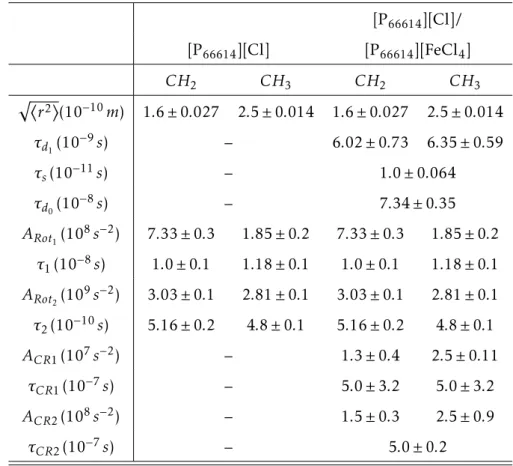
3.3 Relaxation model parameters obtained for the best fit of eq 3.1 to the R1
experimental results for the [P66614][Cl] and [P66614][Cl]/[P66614][FeCl4]
sys-tems. The follow fitting parameters are common for both systems: τD0 =
(1.46±0.06)×10−8s, d ≃7.3×10⁻¹⁰m, M ≃0.014mol/L, S1 ≃400, n = 7×
1028spins/m3,p≃1.13, andτv≃3.85×10⁻¹⁰s,ω1/(2π)≃33MHz, andω2/(2π)≃
20MHz . . . 34
4.1 Properties of the magnetic ionic liquids . . . 42 4.2 Experimental Viscosities and densities of the MILs at different temperatures 43
4.3 Fitted parameters for the prediction of the density of the studied MILs . . . 44 4.4 Absolute and normalized variables for MILs viscosity and temperature . . . 45 4.5 Group contribution to the dimensionless viscosity . . . 46 4.6 MILs viscosity, dimensionless viscosity Y∗and group contribution descriptors 47 4.7 Group contribution parameters fitted by Orrick-Erbar correlation eq 4.2 for
L i s t o f T a b l e s
4.9 Absolute values of the parameters of Orrick-Erbar correlation for viscosity of the MILs . . . 49 4.10 Comparison of the A and B parameters of Orrick-Erbar correlation for different
cations of MILs and ILs . . . 50 4.11 Comparison of the A and B parameters of Orrick-Erbar correlation for different
anions of MILs and ILs . . . 50 5.1 Main properties of the Magnetic Ionic Liquids (MILs) studied. . . 56 5.2 Literature data used for the permeability-viscosity correlation shown in Figure
5.2 . . . 59 5.3 Gas permeability (P) increase at 1.5 Tesla intensity magnetic field and gas
permeability ratio. . . 60 5.4 MILs viscosity at different magnetic field intensities from 0 to 2 Tesla. . . 62
5.5 Gas permeability - viscosity product for the different SMILMs studied. . . . 63
6.1 MILs properties . . . 68 6.2 K and P values resulting from the mathematical fittings for the two sets of
experiments forα- pinene . . . 75
6.3 K and P values resulting from the mathematical fittings for the ibuprofen . . 76 6.4 Absolute viscosity results and percentage of reduction under a magnetic field. 77 6.5 Estimation of the D values using the Wilke Chang and Scheibel correlations
and solubility values calculated for each MIL and system . . . 78
C
h
a
p
t
e
r
1
Introduction
1.1 Background and Motivation
Membrane separations are attracting a significant attention due to their versatility and po-tential application in different fields, such as: environment protection, energy, chemical
industry, biomedicine, food and pharmaceutical industry. Efficient separation processes
require membranes with high permselectivity and high chemical, mechanical and ther-mal stability [1]. A key property, is the ability of the membrane to control the permeation rate of chemical species. Over the years different strategies have been developed to design
new membranes and improve their properties, mainly, their permeability, selectivity and stability, for a high performance in a broad range of fields [2].
Supported Liquid Membranes (SLMs), based processes have turned out to be an alter-native technique to conventional membrane processes for the separation and isolation of many different compounds in dilute streams [3, 4, 5, 6, 7]. SLMs offer the possibility of
achieving high separation factors, while allowing for a one step mass transfer using small amounts of carrier (internal liquid phase). However, the main limitation of this kind of membrane system is its low stability [8], which is due to volatilization and solubilization of the carrier and loss into the adjacent phases during the process. This behavior impacts in the membrane fluxes, permeability and selectivity, reducing the efficiency of these
membrane systems, limiting their implementation in large scale processes [7].
Different procedures have been followed and suggested as an attempt to circumvent
C H A P T E R 1 . I N T R O D U C T I O N
The functionalization of materials with reversibly switchable physicochemical prop-erties allows for the development of stimuli-responsive membranes capable to adjust their properties to an external stimuli: temperature, pH, solution ionic strength, light, electric and magnetic fields. An interesting fact that could be translated in an advantage is that reversible changes may occur locally at a fast rate and with high selectivity. Some strategies have been adopted to develop responsive membranes, according to their nature, and with the type of the stimulus applied. Porous membranes are usually made stimuli responsive, by grafting responsive polymer layers from the membrane external surface and the pore walls. Non-porous membranes are generally made responsive by incorporat-ing stimuli-responsive groups in the bulk of the membrane material. Stimuli-responsive membranes characteristics are based on changes of conformation, polarity, solubility and reactivity of the responsive materials, leading to reversible changes in the permeability and selectivity of the membranes, influencing their ability to bind and release a target compound. Modified responsive polymers have been used in many systems and devices that require reversibly switchable material properties [14].
Magnetic responsive materials/particles have been studied due to their promising unique features under an applied external magnetic field [15, 16, 17, 18]. Among the responsive materials, Magnetic Ionic Liquids, MILs [19, 20, 21], are a specific class of Ionic Liquids, ILs, which due to the presence of a paramagnetic component are able to re-spond to the magnetic field, by changing their physicochemical properties. ILs, have been recognized as an alternative to classic organic solvents, due to their unique properties. These liquids are salt-like materials, usually composed by a large asymmetric organic cation and an inorganic or organic anion. They present advantageous characteristics such as, extremely low volatility, good thermal stability and capacity over a wide range of temperatures 300-400℃, good electric and ionic conductivity, have a reduced solubility in various solvents, being non-flammable and reusable [22]. Moreover, ILs are versatile solvents, which can be designed in order to meet the desirable characteristics by simple combination of suitable cations and anions along their synthesis. All these properties have motivated the selection of ILs as main components in different applications, namely
as selective separation media. In this way, they are regarded as alternative liquid carriers, which may integrate the structure of SLM, conferring them improved stability, thus elim-inating the problems of the solvent displacement by the evaporation that typically occur in these membranes [22, 23, 24].
MILs have been recently applied in different areas, including, fluid-fluid separation,
extraction processes, catalytic reactions, polymer chemistry, electrochemical and medical devices [25]. A variety of MILs under study, showed the influence of the magnetic field on their properties (e.g. solubility in gas and liquid medium) [19, 20, 21]. A mixture of MIL and water under magnetic field conditions, demonstrated an increase of the MIL solubil-ity in water, in comparison with no magnetic field applied [19]. Moreover, the benzene solubility increases in a MIL when applying a rotational magnetic field [21]. These evi-dences motivated the present work for studying the modulation of MILs physicochemical
1 . 1 . BAC KG R O U N D A N D M O T I VAT I O N
properties under a magnetic stimuli, with a potential impact of their magnetic behavior on the transport of solutes through SLMs.
The recovery or removal of a specific compound or contaminant, from a liquid or gas stream, are important challenges in membrane technology, since it requires high separation selectivity. SLMs have been designed with this purpose, namely for separa-tion/capture of CO2and the recovery of added value compounds [26].
The different environmental problems posed by the high and prejudicial CO2
emis-sions and consequent amplification of greenhouse effect, have been discussed over the
years, in order to define solutions that may allow for an improved CO2 capture from
gases mixtures with minimal impact to the economic feasibility of the processes. The environmental problems involving CO2, due to the high and prejudicial emission, since
CO2acts has a trap for UVs rays, have been discussed over the years, in order to improve
the efficiency to capture and separate the CO2 from gas mixtures and reduce the costs
associated with this process [27, 28, 29, 30]. The processes used for the capture of CO2
include: absorption, adsorption, cryogenic separation and membrane processes. Mem-branes for gas separation, have been widely investigated in order to define an alternative solution to absorption, adsorption cryogenic separation, with improved CO2removal
ca-pacity. Ideal membrane systems should exhibit high permeability and selectivity to CO2.
Also they should present enhanced chemical, mechanical and thermal stability at high temperatures and pressures. In this respect, SLMs, have been intensive explored due to the high diffusivity and solubility of gases through them, leading to higher permeability
values, when compared with dense membranes.
As for gas streams, the membranes systems using SLMs are intensively applied for separation, purification and recovery of added value compounds contained in liquid streams obtained from: metal ions from wastewater, amines in rainwater, sugars, amino acids from aqueous solution, and some drugs from body fluid samples [3, 4, 5, 6, 7]. The development of these membranes requires an enhancement of their permeability and selectivity, through the selection of the suitable carrier used for a task specif application.
This PhD project aims at developing Supported Magnetic Ionic Liquid Membranes (SMILMs) with tunable permeability and selectivity, profiting from the unique properties of MILS. The design of SMILMs with good performance requires to understand the im-pact of magnetic field on the MILs physicochemical properties, since they are expected to rule the magnetic responsive ability of the SMILMs. Thus, the first objective of the work is focused on the characterization of the physicochemical properties (solubility, rheological behavior, solvation capacity) and structural characteristics of the MILs, and how they are influenced by an uniform magnetic field. The magnetic influence on the ability of the MILs to change reversibly their properties may be accessed through the establishment of relationships between the structural characteristics of MILs and their physicochemical properties (e.g. viscosity, solubility and self-diffusion). The second major objective is the
C H A P T E R 1 . I N T R O D U C T I O N
anin situdynamic control of solute transport as described in Figure 1.1, contributing to the enhancement of the separation processes efficiency under a magnetic field. The
eval-uation of membrane performance is based on SMILMs descriptors, such as: membrane permeability and selectivity.
Figure 1.1: Scheme description of the facilitated transport using a magnetic responsive membrane in the presence and absence of a magnetic field.
1.2 Research strategy
The work was carried out to evaluate the impact of an external magnetic field on the intrinsic physicochemical and structural properties of MILs used as carriers, for the de-velopment of SLMs with modulated transport properties.
The MILs [Aliquat][FeCl4], [P66614][FeCl4], [P66614]2[CoCl4], [P66614]2[MnCl4], [P66614]3
[GdCl6], [C4mim][FeCl4], [C8mim][FeCl4] and [C11H21N2O]3[GdCl3Br3] composed by
paramagnetic anions with different magnetic susceptibility, like, [FeCl4]−, [GdCl6]3−,
[CoCl4]2−and [MnCl4]2−and comprising cations with different alkyl chains, such as
qua-ternary ammonium – [Aliquat]+, phosphonium – [P
66614]+and imidazoliums – [Cnmim]+ were studied.
Characterization studies of the physicochemical properties of the MILs were con-ducted in order to evaluate the ability to modulate intrinsic properties - viscosity and molecular dynamics of the MILs when a magnetic stimulus is applied. Uniform magnetic field was applied at intensities up to 2.5 T, using an electromagnet (GMW electromagnet 3473-70, GMW Associates, USA). The influence of the magnetic field on the molecular dy-namics of MILs was investigated through1H-NMR – proton nuclear magnetic resonance relaxometry analysis. Based on the detection of proton mobility, this technique provided information about the diffusion mechanisms which are related with the structure, motion
and orientation of the MILs molecules under magnetic field. The 1H-NMR relaxation technique is described by the energy that is exchanged between the proton spins of the hydrogen nuclei and the energy exchanged between the spin system and the surrounding lattice [31]. The energy exchanged can be described by two different relaxation times:
1 . 2 . R E S E A R C H S T R AT E G Y
spin-lattice relaxation time: T1 (exchange energy between spins of protons and the
en-vironment) and spin-spin relaxation time: T2 (exchange energy between the spins of
the protons in the system). These relaxation times are obtained after the application of the magnetic field by a radiofrequency irradiation in the sample, being the spins of the protons polarized. Returning the spins system to the equilibrium, 1H-NMR electrical
signals are detected and the relaxation times are measured. The relaxation values of T1were the main focus of this study, depending on the temperature, diffusion constant,
intermolecular distance and concentration of the magnetic anion.
The strategy adopted to follow this study involved the selection of to two different
magnetic ionic liquids systems, each one composed by the MIL and its non-magnetic analogue. The model MILs were composed by the same anion, [FeCl4]−, but different
cations having different alkyl chains with distinct lengths: [Aliquat]+and [P66614]+. Their
relaxation behavior and the impact on the self-diffusion of the two MIL systems over a
wide range of frequencies was determined and compared to the proton relaxation profiles obtained for a pure solution of the non-magnetic ionic liquid. Furthermore, this technique allows at inferring about the ability of MILs to undergo fast and reversible switch of their intrinsic physical properties and consequently their capacity to promote modulated separation processes. Magnetic induced molecular dynamics of the MILs were correlated to the magnetic dependence exhibited by some intrinsic physicochemical properties of MILs, such as viscosity and self-diffusion. It was used a modified Stokes-Einstein equation
to relate the viscosity and diffusion [32, 33].
After concluding about the impact of the magnetic field on the MILs behavior, the second objective of this thesis was the development and characterization of new magnetic membranes: supported magnetic ionic liquid membranes – SMILMs. The main objective was to develop magnetic responsive membranes with high stability, able to switch their permeability to specific solutes and membrane selectivity through a fine tuning of the magnetic field conditions. Supported liquid membranes were prepared by immobiliza-tion of MILs in the porous structure of a polymeric membrane, following an adequate methodology which lead to an efficient pore filling and good membrane stability.
Dif-ferent transport case-studies were performed in gas and liquid media, using a diffusion
cell under different magnetic conditions. Transport studies in gas and liquid phases were
performed in the absence and presence of an external magnetic field. The performance of SMILMs was evaluated taking into account the membrane permeability to target solutes, separation selectivity and membrane stability as performance descriptors.
The impact of magnetic field on gas permeation was tested using three different gas
streams: CO2, N2and air. Transport studies in liquid phase were also conducted. In this
case, α-pinene, an apolar compound, and ibuprofen, with amphiphilic character were
C H A P T E R 1 . I N T R O D U C T I O N
1.3 Thesis Outline
The present work is divided into eight chapters. Chapters 2, 3 and 4 describe the studies dedicated to the physicochemical and structural characterization of the magnetic ionic liquids under controlled magnetic field conditions, developed along the first part of the PhD work.
Chapter 5 and 6 include the work developed in the second part of this thesis, about the design and characterization of supported magnetic ionic liquid membranes incorporating MILs as the liquid carrier. In particular, these chapters include studies which aimed to understand the ability to modulate the permeability of different model solutes contained
in gas and liquid feed streams by adjustment of the magnetic field.
Chapter 5 is related with gas transport studies and Chapter 6 is dedicated to solute transport in liquid phase. Each chapter defines clearly the objectives, starting with the state of the art and motivation, followed by a detailed description of the experimental methods used, with a specific analysis and interpretation of the results and the respective conclusions. This PhD work has led, so far to the publication of four scientific papers, referred in the ISI Web of Science which include the work described in the Chapters 2, 3, 4 and 5 and one additional paper submitted, containing the work presented in Chapter 6. Chapter 1 presents the background, the motivation and the strategy used to accom-plish the main goals of this thesis.
Chapter 2 and 3 include the description of the1H-NMR relaxometry technique used
to characterize the self-diffusion mechanism of the MILs under magnetic field, with a
molecular interpretation of their behavior when distinct magnetic stimuli are applied. It was explored the molecular dynamics of the MILs through the study of a relaxation model with different contributions to explain the magnetic behavior, the translation and
rotation mechanisms and the self-diffusion contribution. This molecular interpretation
was related with the rheological behavior of the MILs, trying to obtain an explanation of the response of MILs under the magnetic field.
Following the viscosity study of MILs, Chapter 4 is focused on the application of a model based on the group contribution method in order to estimate the contribution of the cationic and anionic counter-parts in MILs viscosity at different temperatures. This
study was developed using four different MILs containing distinct magnetic anions and
the same phosphonium cation. The chance of modeling the physicochemical properties of MILs represents an advantage to the design of new MILs since it allows an a priori selection of the most suitable combination of cations and anions, leading MILs with the desired properties.
Chapter 5 and 6 describe the work about the development and the characterization of the magnetic responsive supported liquid membranes and evaluate the possibility to modulate the transport of solutes using these membranes. Chapter 5 is dedicated to gas permeation studies using CO2, N2and air as model gas streams whereas Chapter 6 is
focused on the transport ofα-pinene and ibuprofen between organic liquid solutions.
1 . 3 . T H E S I S O U T L I N E
Chapter 7, includes an overview of the main conclusions of the work. Chapter 8 describes suggestions of future work aiming at gathering additional studies which may bring complementary information about the magnetic characterization of MILs. New challenges concerning different uses of MILs as responsive materials are identified and
C
h
a
p
t
e
r
2
1
H-NMR Relaxometry, Viscometry, and PFG
NMR Studies of MILs and ILs
Published as: Carla I. Daniel, Fabián Vaca Chávez, Gabriel Feio, Carla A.M. Portugal, João G. Crespo, Pedro
J. Sebastião “1H-NMR Relaxometry, Viscometry, and PFG NMR Studies of Magnetic and Non-magnetic Ionic
Liquids”, Journal of Physical Chemistry B, 117 (2013) 11877–11884.
2.1 Summary
A study is presented of the molecular dynamics and of the viscosity in pure [Aliquat][Cl] ionic liquid and in a mixture of [Aliquat][Cl] with 1% (v/v) of [Aliquat][FeCl4]. The 1H spin-lattice relaxation rate,R
1, was measured by NMR relaxometry between 8 kHz
and 300 MHz. In addition, the translation self-diffusion, D, was measured by pulse
field gradient NMR. The ILs’ viscosity was measured as a function of an applied mag-netic field, B, and it was found that IL mixture’s viscosity decreased with increasingB, whereas the [Aliquat][Cl] viscosity is independent ofB. All experimental results were
ana-lyzed taking into account the viscosity’s magnetic field dependence, assuming a modified Stokes-Einstein diffusion/viscosity relation.
The main difference between the relaxation mechanisms responsible for R1in the two
IL systems is related with the additional paramagnetic relaxation contribution associated to the1H spins – [FeCl4] paramagnetic moments’ interactions. Cross-relaxation cusps
in theR1dispersion, associated with35Cl and1H nuclear spins in the IL systems, were
detected. TheR1 model considered was successfully fitted to the experimental results
and it was possible to estimate the value ofDat zero field in the case of the IL mixture
which was consistent with the values ofDmeasured at 7 Tesla and 14.1 T and with the
C H A P T E R 2 . 1H - N M R A N D V I S C O M E T RY S T U D I E S O F M I L S A N D I L S
a ”super-paramagnetic”-like effect and to change the IL mixture’s molecular dynamics
and viscosity and to allow for their control with an external magnetic field.
2.2 Introduction
Ionic Liquids (ILs) belong to a class of liquids comprised by ions, recognized as novel solvents. The ILs are liquid salts over a wide range of temperatures, usually lower than 100℃. In particular, those that are liquids at room temperature are designated Room Temperature Ionic Liquids (RTILs). ILs have extreme low volatility and are thermal stable, non-flammable and reusable. They have gained interest for various applications in separation, electrochemistry, material science as well as in organic synthesis and catalysis, and it is expected that they can contribute to reduce or eliminate the hazards associated with the use of organic solvents. Depending on the application, ILs can be composed by different cation – anion combinations, and for this reason are called by ”designer solvents”
[22].
A new class of magnetic sensitive ionic liquids – magnetic ionic liquids (MILs) has been recently synthesized and have gained interest due to their strong response to external magnetic fields [19, 34, 35]. MILs are ionic liquids comprised by metal anion complexes having physical properties such as: solubility, viscosity, surface tension and/or molecular orientation that may be influenced by applied magnetic fields [19, 20, 34, 35]. Actually, the magnetic field influence on the IL solubility was confirmed by the dependence found between the concentration of MILs in binary water mixtures and the applied magnetic field strength [19]. The potential applications of MILs that have been presented recently include the development of magnetic fluids based on nanoparticles, the use of MILs in transport and separation of different solutes, in catalysis, in extraction processes, and in
electrochromic devices [21, 36, 37, 38, 39, 40, 41].
The dependence between the magnetic field intensity and molecular orientation of MILs also suggests that the magnetic field can be used to control the distribution of charge density, solubility or capacity to solvate different chemical species within the ILs,
causing a significant impact in the solute transport through the IL media. For this, it is important to acquire a better comprehension about the influence of the magnetic field on the MILs magnetic behavior and how it should be tuned in order to get the adequate MILs properties. Since the macroscopic properties of MILs are related with the microscopic structure it is expected that the local magnetic structures play a key role in the MILs response to magnetic fields [20].
The viscosity,η, which is larger in ILs than that of most common organic solvents, is
one of the most important macroscopic properties of these materials. The ILs viscosity depends essentially on the nature and combinations of cations and anions comprising ILs structure. Since the viscosity is directly related with the relative diffusion of ionic
species comprising ILs network, self-diffusion, it is important to study the dependence
2 . 3 . E X P E R I M E N TA L
of both physical properties with the magnetic field and to get a better knowledge about their mutual relation in order to understand and optimize these systems for applications.
Nuclear Magnetic Resonance (NMR) is a well known experimental technique used to study the molecular order and dynamics in different materials. In particular, the
self-diffusion coefficient, D, can be measured directly by pulse field-gradient (PFG) NMR
methods [31].
It was reported that for ionic liquids the viscosity and translational self-diffusion
relationship given by the Stokes-Einstein expression for conventional fluids is still valid provided some corrections to the original expression are considered [32]. In particular, molecular polar interactions also determine theDvs.ηdependence [33].
In view of the fact that in MILs, the viscosity and the intrinsic diffusion of their ionic
component species can be affected by external magnetic fields, a coherent estimate of both
parameters requires the use of different experimental techniques to independently access
each one of them. In fact, viscosity measurements using classical capillary viscometers can be made in the presence of magnetic fields up to 2 Tesla, however, D is mostly
measured directly by PFG NMR at much higher magnetic fields. Therefore, theDvs.η
dependence for the same magnetic field requires the estimation of D at low magnetic
fields. As the spin-lattice relaxation time is sensitive to molecular motions, by using1H
NMR relaxometry it is possible not only to characterize the system from the molecular motions point of view but also to obtain the value ofDat low magnetic fields.
The aim of this work is to study the influence of external magnetic fields on the molecular dynamics and on the viscosity of [Aliquat][Cl] and on a mixture [Aliquat][Cl]/ [Aliquat][FeCl4]. Viscosity measurements as a function of the magnetic field and proton
spin-lattice relaxation measurements for the frequency range 10 kHz - 300MHz (1
H-NMRD) were complemented by direct measurements of the self-diffusion coefficient by
PFG NMR at magnetic fields of 7 Tesla and 14.1 T.
2.3 Experimental
2.3.1 Materials
The ILs selected for this study were the non-magnetic [Aliquat][Cl] and its magnetic analogue [Aliquat][FeCl4], where the [Cl] anions are substituted by iron anions [FeCl4].
The IL and MIL were synthesized at the Faculdade de Farmácia, Universidade de Lisboa, according to the experimental procedure reported in literature [36, 39]. Their molecular weight, density, water content and concentration of magnetic particles, at room tem-perature, are listed in Table 2.1. The ILs density was determined gravimetrically with a pycnometer, the water content was measured by thermogravimetry, and the concentration of magnetic particles by Inductively coupled plasma (ICP). Two samples were prepared: a sample of [Aliquat][Cl] and a mixture of [Aliquat][Cl]/[Aliquat][FeCl4] 1% (v/v). The
C H A P T E R 2 . 1H - N M R A N D V I S C O M E T RY S T U D I E S O F M I L S A N D I L S
Figure 2.1: Molecular structure of the [Aliquat] cation.
Table 2.1: IL physical parameters. The molar concentration of [Aliquat][FeCl4] in the
[Aliquat][Cl]/[Aliquat][FeCl4] mixture is 0.012 mol/L.
IL Molecular Weight (g mol−1) Density (g cm−3) Water Content (% wt)
[Aliquat][Cl] 404.16 0.88 5.8
[Aliquat][Cl]/
[Aliquat][FeCl4] 405.8 1.03 5.5
2.3.2 Methods
2.3.2.1 Viscosity measurements
The viscosity of the two IL systems was measured by capillary viscometry following the procedure reported in the literature [42]. The capillar used was manufactured and calibrated by Cannon – Instrument Company. The influence of an external magnetic field on the MIL viscosity was evaluated using a glass capillary viscometer Ubbelohde Viscometer – 3C and a GMW Dipole Electromagnet 3473-70 with a 75 mm poles gap by GMW Associates, USA.
The measurements were carried out with a capillar viscometer placed between the electromagnet poles. The viscosity was measured for magnetic fields between 0 and 2 Tesla. In order to decrease the experimental uncertainty, averages of six measurements were obtained with deviations from the mean smaller than±0.2% at a room temperature
of 22℃.
2.3.2.2 Nuclear Magnetic Resonance
The proton spin-lattice relaxation rate, R1(≡1/T1), was measured as a function of the
Larmor frequency, νL=γB/(2π), on the range 10 kHz to 300 MHz, using three different
NMR equipments. In the range 10 kHz – 8.9 MHz the data were obtained with a home developed fast field-cycling (FFC) spectrometer [43] operating with a polarization and detection fields of 0.215 T and a switching time less than 3 ms. Between 10 and 91 MHz a variable-field iron-core magnet equipped with a Bruker Avance II console was used. Bruker Avance II spectrometers were used for the self-diffusion and spin-lattice
2 . 4 . R E S U LT S
relaxation measurements at 300 MHz. For frequencies above 10MHz R1was measured
using the inversion recovery ((π)x−τ−(2π)x,−x−Acq) sequence. AllR1measurements were
performed at 22℃ and the experimental error for the eachR1was±10%.
The diffusion coefficient,D, was measured using the stimulated spin-echo sequence
[44] and a Bruker Diff30 gradient unit at 7 T and a Bruker TCI CryoProbe at 14.1 T. D
was obtained from the echo decay according to
I=Ioexp[−γ2g2δ2D(∆−δ3)] (2.1)
whereγ is the1H gyromagnetic ratio,gis the gradient strength,δis the gradient length,
and∆is the delay between the gradients experiment. The valuesδ= 2 ms and∆= 50 ms for the measurements at 7 T andδ= 6 ms and∆= 500 ms in the case of 14.1 T were used.
2.4 Results
The1H-NMR relaxometry results are represented in the Figure 2.2 for the two IL systems.
Obviously the1H NMR signal comes only from the cations since the anions do not contain
protons. The proton spin-lattice relaxation rate is presented, in a log-log scale, as a function of the Larmor frequency in the range 10 kHz – 300 MHz.
For both samples, a bi-exponential decay of the time recovery of the longitudinal mag-netization was observed, with two relaxation ratesR11≡T11−1andR12≡T12−1, in the whole
frequency range. The two relaxation rates,R11andR12 were attributed to the CH3and
CH2groups in the aliphatic chains, respectively. This assumption is reasonable in view
of the fact that the interdigitation of aliphatic chains of different [Aliquat] cations might
reduce significantly the mobility of the ethyl groups in comparison with the terminal methyl groups. The weighting factor for each component was fixed depending on the corresponding number of protons.
In the case of the [Aliquat][Cl], the two relaxation rates are very close at high frequen-cies and quite different at low frequencies. In view of the log-log scale used to represent
the data in Figure 2.2a) it is clear that R11is not simply proportional toR12, but is the
result of a different combination of relaxation contributions. In Figure 2.2a), an
enhance-ment on the proton relaxation rate can be also observed at frequencies around 20 and 30 MHz. This behavior was consistently observed for both IL systems and can not be associated with an increased scattering of data at these frequencies. In fact, it can be inter-preted in terms of a cross-relaxation process between the1H and the35Cl spins systems [45].
In the case of the [Aliquat][Cl]/[Aliquat][FeCl4] system it is clear that for frequencies
above 9 MHz the increase ofR1with frequency is more pronounced than that observed
C H A P T E R 2 . 1H - N M R A N D V I S C O M E T RY S T U D I E S O F M I L S A N D I L S
103 104 105 106 107 108 109 ν
L(Hz) 100
101 102 103
R1
(s
-1 )
[Aliquat][Cl] R11(CH3) R12(CH2)
a)
103 104 105 106 107 108 109
ν
L(Hz) 100
101 102 103
R1
(s
-1 )
[Aliquat][Cl]/[Aliquat][FeCl4] 1% (v/v) R11(CH3)
R12(CH2)
b)
Figure 2.2: Larmor dependence of the proton spin lattice relaxation rate R1 for the
studied systems: non-magnetic ionic liquid [Aliquat][Cl], a) and MIL [Aliquat][Cl]/ [Aliquat][FeCl4] 1% (v/v) mixture, b).
colloidal suspensions of super-paramagnetic particles. In systems of this type, the relax-ation is induced by the local magnetic field gradient associated with the presence of the paramagnetic species and is called Curie relaxation [46]. This relaxation process becomes quite important in the high frequency range. The relaxation profiles presented here for the magnetic ionic liquid are consistent with those reported byRoch et al.in a suspension of magnetic particles [47].
The additional increase ofR1at specific Larmor frequencies in the range 20–30 MHz
is also observed in the MIL system.
In Table 2.2 are presented the values measured for the viscosity,η, and the diffusion
coefficients for the two IL systems. For sake of simplicity, the values for the [Aliquat][Cl]
are presented in parentheses. Due to experimental constraints it was not possible to measure the viscosity for magnetic fields above 2 T. In addition, it was not possible to measure the diffusion coefficient magnetic fields below 7 T. It is interesting to note thatη
2 . 5 . A N A LYS I S A N D D I S C U S S I O N
[Aliquat][Cl] does not change with the applied magnetic field. The viscosities of both IL systems at the earth magnetic field are similar.
Table 2.2: Viscosity and diffusion experimental results for the [Aliquat][Cl]/
[Aliquat][FeCl4] 1% (v/v) MIL (in parenthesis the values for the [Aliquat][Cl] IL).
B(T) η(Pa.s) D(10−12m2s−1) ∼45×10−6 1.26 (1.33) –
0.47 1.24 (1.33) –
1 1.22 (1.33) –
1.3 1.20 (1.33) –
1.8 1.17 (1.33) –
7 – 3.0 (1.3)
14.1 – 4.7
2.5 Analysis and discussion
It is known that the frequency dependence of the proton nuclear magnetic spin-lattice relaxation rate is related with different molecular dynamic processes, such as rotational
and translational diffusional mechanisms in isotropic fluids, and also with slow molecular
motions in the case of mesomorphic materials [48, 49, 50]. In the case of isotropic fluids, rotations/reorientations of the molecules and translational self-diffusion are the motions
that effectively modulate the dipolar spin interactions in the frequency range accessible by
NMR. In particular, translational diffusion can become more important than molecular
rotations/reorientations in the case of viscous fluids. In this case, the correlation times of the translational diffusion processes become larger that the correlation times of the
rotational motions. This difference can be noticed in the R1 dispersion, since at high
frequenciesR1is influenced more by the faster motions and at low frequenciesR1is more
sensitive to slow motions.
The 1H-NMR R1 dispersions observed for the studied IL systems are dominated
mainly by the relaxation mechanisms associated with the motions of the protonated cations, rotations/reorientations and translational diffusion. Due to the presence of Cl in
the IL anions, cross relaxation between1H and35Cl might also be detected. In the case of magnetic ionic liquid the [FeCl4]– anions might influence the proton spin-lattice

![Table 2.1: IL physical parameters. The molar concentration of [Aliquat][FeCl 4 ] in the [Aliquat][Cl]/[Aliquat][FeCl 4 ] mixture is 0.012 mol/L.](https://thumb-eu.123doks.com/thumbv2/123dok_br/16484556.732668/36.892.129.786.420.545/table-physical-parameters-concentration-aliquat-aliquat-aliquat-mixture.webp)
![Figure 2.2: Larmor dependence of the proton spin lattice relaxation rate R 1 for the studied systems: non-magnetic ionic liquid [Aliquat][Cl], a) and MIL [Aliquat][Cl]/](https://thumb-eu.123doks.com/thumbv2/123dok_br/16484556.732668/38.892.289.603.156.689/figure-larmor-dependence-lattice-relaxation-magnetic-aliquat-aliquat.webp)
![Figure 2.3: Viscosity measured for the [Aliquat][Cl] and [Aliquat][Cl]/ [Aliquat][FeCl 4 ] systems](https://thumb-eu.123doks.com/thumbv2/123dok_br/16484556.732668/42.892.256.639.141.461/figure-viscosity-measured-aliquat-aliquat-aliquat-fecl-systems.webp)
![Figure 2.5: Viscosity [full and empty black circles] and translational self-di ff usion [full and empty black squares] measured for the [Aliquat][Cl] and [Aliquat][Cl]/](https://thumb-eu.123doks.com/thumbv2/123dok_br/16484556.732668/46.892.255.639.531.853/figure-viscosity-circles-translational-squares-measured-aliquat-aliquat.webp)
![Figure 3.2: Larmor frequency dependence of proton spin lattice relaxation rates for the systems [P 66614 ][Cl] and MIL [P 66614 ][Cl]/[P 66614 ][FeCl 4 ] 1% (v/v) mixture: R 12 , a) and R 11 , b).](https://thumb-eu.123doks.com/thumbv2/123dok_br/16484556.732668/54.892.288.605.151.689/figure-larmor-frequency-dependence-lattice-relaxation-systems-mixture.webp)
![Figure 3.4: Experimental results and model fitting curves for the relativity as a function of frequency for the 10mM DMSO/[P 66614 ][FeCl 4 ] system, as explained in the text.](https://thumb-eu.123doks.com/thumbv2/123dok_br/16484556.732668/59.892.256.633.153.458/figure-experimental-results-fitting-relativity-function-frequency-explained.webp)
