environment: rethinking how the links between the
production and reception assign meanings to the Rio 2016
Games
1DOI: 10.1590/1809-5844201834
Beatriz Becker1
https://orcid.org/0000-0001-6665-8911
Heitor Leal Machado1
https://orcid.org/0000-0003-3788-3102
Igor Waltz1
https://orcid.org/0000-0003-1903-6153
Joana Tassinari1
https://orcid.org/0000-0002-2473-2842
1(Universidade Federal do Rio de Janeiro, Escola de Comunicacão, Programa de Pós-Graduação em
Comunicação e Cultura. Rio de Janeiro – RJ, Brasil).
Abstract
This article proposes an analysis of the television news coverage of the Rio 2016 Games and the interactions between production and reception in the convergent media environment. From the theoretical and methodological dimensions of the Televisual Analysis and the Semiology of Social Discourses, this paper presents a critical reading of the coverage of Rio 2016 by Jornal Nacional and of audiences’ comments in the page of Facebook of this TV newscast. This paper reveals the interactions in digital platforms during live broadcasting are embedded in emotional motivations, which can shift the interest of the audience from the event itself to Politics. We observe the audiences tend to produce different significations about the Olympic Games in relation to the frames and meanings generated by the journalistic enunciations.
Keywords: GamesRio 2016. TV. Television journalism. Audiences. Emotion.
Introduction
The television in transition interacts with emerging media and audiences and expands
itself to multiple platforms. Nevertheless, audience ratings and financial investments on TV
in different parts of the world show that broadcast television has not ceased to be central to contemporary media and to large news coverage (BECKER, 2016). In live broadcasts to millions of viewers, the television reasserts its mediation, directing conversations and
debates that provoke outrage and commotion. These television broadcasts are named as tele-ceremonials by Dayan and Katz (1999) and are interpreted as festivities that emphasize a certain value or important aspect of collective memory. The opening and closing ceremonies of the Olympic Games are examples of media events with characteristics that mark the traditional model of mass television of the twentieth century.
However, the forms of mediation between production and reception are increasingly complex in the convergent media environment. The construction of events results from a
sequential ordering of representations, but their significations are not only in production.
They emerge from discursive disputes in the consumption and (re)circulation of audiovisual content and formats in social networks. There is no deterministic logic capable of conferring
a fixed ideological sense to a message since it is multi-referential (PINTO, 1999; HALL,
2003). An understanding of the ways in which the meanings of television broadcasts of major events are produced requires describing the enunciative strategies of broadcasters and the interactions of reception. Such strategies are determined by the contracts of reading
- a set of rules and instructions constructed by the field of the emission, followed and recognized by the field of reception, that is, the ways of saying, the procedure how the
various subjects or the various voices organize themselves and dialogue in the discourses in a certain situation of communication (BECKER, 2005). Thus, understanding the construction and reconstruction of meaning implies analyzing how production and reception articulate
themselves in a given communicative process and in a specific context, reproducing or not dominant systems (HALL, 2003).
We hypothesize that the forms of interaction of TV and the audiences manifested in the digital platforms and social networks during the live broadcasts of great events are imbricated in emotional motivations by the public and can displace the interest of the
audiences of the event itself for politics, stirring up conflicts and revealing antagonistic
positions that tend to overlap with the meanings generated by the mediatic events themselves. Although production may attempt to tie audiences to a meaning of an event at
a specific historical moment, interactions with television broadcasts of a significant event
in the digital media may lead them to further value their political disputes more than the
event itself. In this sense, we seek to understand in this article how television reaffirms its
mediation and how the emotional performance of audiences are manifested in the media
environment. We focus on the production-reception dialectical movements of significance
of the Rio 20162, more specifically the audiovisual journalistic coverage of the highest rated
2 Rio 2016 Olympic Games were the most followed in history, watched on TV by the half world’s population and 63 million people in
Brazil, an increase of almost 8% of consumption of television content compared with the London Olympics in 2012. Via digital platforms,
the competitions generate 187 million tweets, 1.5 billion Facebook interactions, more than two billion snaps and one billion minutes of videos watched on YouTube. Available at: https://www.kantaribopemedia.com/um-retrato-das-olimpiadas/;
https://stillmed.olympic.org/media/Do-cument%20Library/OlympicOrg/Games/Summer-Games/Games-Rio-2016-Olympic-Games/Media-Guide-for-Rio-2016/Global-Broadcast
newscast in Brazil, Jornal Nacional (JN), and the interactions established between the news and its public on Facebook. Thus, we conducted a quantitative and qualitative study of
3.546 comments published on the official JN Facebook page in the opening and closing of the Rio 2016 Games, supported, especially, by the theoretical-methodological contributions of Semiology of Social Discourse and of the historicity of the emotion (ROSENWEIN,
2011; PINTO, 1999). Later, we conducted a Televisual Analysis (BECKER, 2012) of the 15
editions of the Jornal Nacional (JN) broadcast on national network from August 5th to 22nd
2016, whose audio and video content totaled 11 hours of duration, in order to observe the modes Rede Globo and this TV News program attributed meanings to the event. We explain this methodological path next.
Theoretical Foundation and Methodological Path
Media events are a struggle of meanings, in which audiences imbued by the power of emotions construct particular versions of reality, which shared in today’s social networks. Thus, it is not only media enunciations that attribute meanings to media events, they are also
remodeled by the relations established between production and reception (VERBALYTÈ,
2016). The media content appropriated by the audience is imbricated in processes of
subjectivization and adherence of certain emotional or social communities, as defined by
Rosenwein (2011), that is, groups whose “members adhere to the same valuations on the
emotions and their forms of expression” (ROSENWEIN, 2011, p.7), who define and deem
events as valiant or prejudicial to themselves. These dynamic movements of forces between different emotional communities require the researcher to concentrate on and to unveil their systems of feeling, an attitude that approaches the analysis of interpretive communities due to the observation of the ways in which a certain group of discursive positions shares some common decoding frames in contrast to others.
Thus, we try to demonstrate in the work how the forms of interaction of the TV with the audiences in the 20th century, in the live transmissions of great events, are characterized by intense discursive disputes mobilized by affections and emotions that manifest subjectivities. The concept of affection, originating from Spinoza and retaken by Deleuze and Guatarri, refers to a passage from one experiential state to another, from the encounter between an “affecting” and an “affected,” implying in the increase or diminution of the
body action capacity (MASSUMI, 1987; SHOUSE, 2005). In the words of Sodré (2006)
interpretation and labeling of personal experiences based on individual predispositions and previous experiences. Shouse (2005) explains that the feeling is tied to the biography of each social individual, since each carries a framework of experiences with which to interpret and classify it. Emotion, therefore, are part of a system of senses and values proper to a
social group, acquired with the particular modalities of socialization (LE BRETON, 2009).
The emotions and the forms as they are experienced, expressed and interpreted are linked
to cultural, social, economic and political transformations (COELHO; REZENDE, 2010; FREVERT, 2011; LE BRETON, 2009; ROSENWEIN, 2010, 2011). Studies of journalism
and television also point to the need to explore new ways of understanding how emotions affect the processes of production and reception of events and news. The use of emotion in journalism acts as a way of capturing the public’s attention, as well as creating an affective
bond with the viewer (MORETZSOHN, 2013). Emotion is also understood as a kind of
more or less stable and sense-producing discursive formation that is materially inscribed
in the discourses (BENETTI; REGINATO, 2014). Television studies take the medium as a
sensory device, which summons its audiences to feel with the other the same experience of
watching TV, especially in live broadcasts (FECHINE, 2006;OROZCO GÓMEZ, 2014).
Nevertheless, the links established by the audiences with the great events do not respond only to the strategies inscribed in the media discourses. They also attribute meanings to messages in other instances of social everyday life beyond the screen, which contributes to a polysemy of television narratives, even though there is no symmetry between the public and the large media vehicles, which tend to produce representations of the world with synchrony dominant values and ideologies (BECKER, 2016). Thus, from the understanding of emotions as instruments of sociability and component of mediation practices within emotional communities, we suggest that, in addition to sensitive media strategies, there are also sensitive audience strategies. The public establishes an affective and emotional connection to the media contents and the multiple senses it constructs are a contemporary form of subjectivity production, increasingly linked to digital networks. The subjectivity, previously internalized, moves to other spaces of construction, making the
boundaries between public and private diffuse (SIBILIA, 2008), which makes the analysis
of these processes complex and challenging.
We aim to understand the meanings built by Rede Globo and JN of Rio 2016 Games
and the emotional and affective bonds of the audiences with the broadcasts of Opening and Closing Days of the Olympic Games in a context of strong political, economic and social crisis, by means of two distinct and complementary methodological pathways. We study the
users´ comments published on the official website of the Jornal Nacional on Facebook3, the
platform that gathered the largest number of followers of this TV News program, between
August 5th and 22nd, 7.8 million people4 in the Opening and Closing Days of the Olympic
Games. We analyzed the comments collected from the 12 publications of the official
page of the Jornal Nacional on Facebook on August 5th, Opening Day, and the other 12
publications on August 22nd, the Monday following the Closure of the Olympic Games on
Sunday, 21st. This set of 24 publications generated 3.546 comments, whose collection was
always made after the edition of the day through prints. Seeking to know how the public attributed meanings to the Rio 2016 Olympic Games and established relationships and
links with JN, we also made a qualitative analysis of the audiences’ interactions with the
news, supported by the contributions of Semiology of Social Discourses, more specifically
in the categorization proposed by Pinto (1999): Show – naming or designating objects and
subjects with adjectives and valuations; Interacting – interpellating and constituting power
relations between receivers, reproducing social hierarchies in a communicative act; and
Seducing – demonstrating a favorable or unfavorable affective reaction to subjects, objects and events, reinforcing or modifying existing hegemonic values. In these three functions of language within discursive acts, are employed the social uses of emotions. For this reason, in order to observe the emotions valued, depreciated or ignored by audiences and the nature of the affective bonds they establish, we also draw inspiration from the theoretical-methodological guidelines of Rosenwein’s (2011) study of the historicity of emotions, which offer the possibility of identifying in an given context the dominant communities – with hegemonic positions recognized by a large portion of society – and the marginal communities – those who organize themselves in spaces of “refuge” –, both in dynamic formations and dissolution. We still incorporate the typology proposed by Becker (2014) and we classify the set of publications and testimonies that correspond to these discursive
manifestations, such as Compliments and Critics. We found that many comments from
the audiences that gave positive or negative ratings to the Olympic Games on the Jornal
Nacional’s Facebook page gave more emphasis to the country’s political economic moment than to sports competitions, as we articulate ahead.
In order to identify the organization of the enunciative strategies and the discursive
practices of Jornal Nacional (JN), in the televising coverage and transmissions of the
Opening and Closing Ceremony of Rio 2016 Olympic Games, we use the Televisual Analysis (TA) proposed by Becker (2012), constituted by three distinct and complementary phases: the Description or contextualization of the production conditions of the audiovisual work to be analyzed, the Televisual Analysis itself, formed by a quantitative and qualitative analysis, and the Interpretation of Results. In the quantitative analysis six categories are
applied: Structure of Text, Thematic, Enunciators, Visuality, Sound, and Editing; and
in the qualitative analysis three principles of enunciation are applied: Fragmentation,
Dramatization, and Definition of Identities and Values (BECKER, 2012). We have adopted
this methodology for help understanding the ways Rede Globo de Televisão attributed meanings to the event from August 5th to 22nd in the 15 editions of JN in national broadcasts
transmissions. 330 news videos with 660 minutes of running time, available on the digital
platform GloboPlay (https://globoplay.globo.com/jornal-nacional/p/819/), form the corpus
of the JN coverage of the Olympics.
Televisional Analysis of the Rio 2016 Olympic Games at JN
The Methodological Path of Televisual helped us to understand how the Rede Globo’s
Jornal Nacional (JN) constructed the Rio 2016 Olympic Games and we systematize the main
results achieved here. The broadcaster was a sponsor of the Olympic Games and had financial
investments from advertisers of large organizations. About US$ 250 million were spent on
the open and paid broadcast, via the internet and mobile5, and Rede Globo itself announced
that the coverage was the grandest in its 50-year trajectory with 160 hours on air during the 17 days of competition, which 110 hours of live broadcast and more than 2.500 reports involving
the Olympics theme until the end of the competition6. Organizações Globo also hired nearly
2.000 professionals only to cover the event7, as well as former Brazilian renowned athletes as
commentators. Fifty-four reporting teams were made available, as well as 32 live entry points
and exclusive cameras at all competition locals8. The network installed a studio with 500m²
inside the Olympic Park, in the West Zone of Rio de Janeiro, used by the presenters during the
coverage of the Rio 2016. From there, journalist Renata Vasconcellos and sports commentator Galvão Bueno commanded the Olympic news, while news editor-in-chief William Bonner
anchored the news of JN’s traditional bench at the broadcaster’s studio. The exception was
the August 5th edition, the date of the Opening Ceremony, when the presenter traveled to
Maracanã to do the broadcast next to his colleagues. On Opening Day, the television news edition was presented one hour before the Opening Ceremony, the largest audience event during the Olympics9, officiating the start of competitions on the TV screen. Spectators,
ceremony organizers and reporters themselves praised the celebration, seeking to awake the Brazilian people´s pride in hosting the event. The international press also highlighted the beauty of the ceremony and the complimentary appreciation of foreigners about the success
of the Olympics was highlighted in the August 20th and 22nd editions. On the Saturday after
the party, August 6th, JN referred to the participation of the interim president Michel Temer,
5 Available at: https://tvefamosos.uol.com.br/noticias/ooops/2016/08/21/exclusivo-globo-investiu-us-250-mi-na-rio-2016-veja-gastos--de-outras-tvs.htm. Accessed on: March 30, 2017.
6 Olympic Games Project Rio 2016. Available from BIP, Edition 609, oct/2015. Available at: http://comercial2.redeglobo.com.br/bipon-line/BIP/BIP_609.pdf. Accessed on: March 30, 2017.
7 Information served on the report displayed in the Fantástico edition of July 31, 2016.
noting that there was a breach of protocol on the part of the government when deciding not to
announce his presence. The boos of the audience at Maracanã to the president-in-office were
drowned out by music. Despite that, the reporting that began the television news on the same date, highlighted the relevance of care for nature, and ended with the planting of at least 12
thousand tree seeds in the Radical Park of Deodoro, in the West Zone of the city. Nonetheless,
the television newscast did not remark the Rio de Janeiro’s debt with the environmental legacy, promised in the application dossier submitted by the Brazilian authorities to the International Olympic Committee (IOC).
There was a relaxation of duration of the blocks and their formats with the increase of constant live entries of reporters spread by different cities of the country in
all the editions of the study period. Rede Globo and JN assumed in their enunciations
the responsibility to organize and narrate the main facts and events for the viewers, as well as to announce the next day’s competitions, highlighting the concentration rituals and the reactions of the athletes. The presenters interviewed 13 medal-winning athletes live at
JN’s Olympic Park studio, always cheered by journalists and displaying conquered medals.
Both interviews and reports highlighted the breakdown of athletes’ limits and overcoming
difficulties. Renata Vasconcellos presented Rafaela Silva, responsible for Brazil’s first gold medal, in Lightweight Women’s Judo, in the Aug. 8th edition as a young woman “typically
Brazilian, of claw and overcoming”. When Thiago Braz won the gold medal in the Pole
Vault, the National Anthem was reproduced integrally in the edition of August 16th, used
as a prominent sound element, as well as the “Brasil, sil, sil” vignettes. The recognition of the athletes and the “Olympic spirit” were values that marked the discourses of the
JN reflected in the way in which the television news program sought to recover the
self-esteem of the Brazilians and to value the national identity. On the 20th, one day before the
Closing, Jornal Nacional reached the highest audience of 2016 with the repercussion of
the country’s conquest of the gold medal in men’s soccer and the apology of American
swimmer Ryan Lochte, who lied about a robbery after vandalizing a toilet at a gas station
with his colleagues and lost his patronage10. The Olympic Games have gained significant
prominence in the editorialization of the television news, responding to an increase in newscast ratings and 78,7% of news content, corresponding to 504 minutes of audiovisual news production and 251 of the 330 audios and videos analyzed. Only two other news about sports activities not included in the Olympics was presented during the coverage of
the Games, both on the Brazilian Football Championship, and the August 10th edition was
the only one that started with news unrelated to the Games. Twenty-eight reports were
broadcast on the impeachment of former President Dilma Rousseff, but this event was
presented as a constitutional normality, without the complexity of the political situation
faced by Brazilian society being considered by television news. The main enunciators of the television news were William Bonner and Renata Vasconcellos. Between August
1st and 20th, Galvão Bueno also presented JN. The other voices of the TV newscast were
journalists, official sources and athletes. Meteorological information corresponded to 23
minutes of production and 3,5% of news content in 12 of the 15 editions of the corpus
analyzed, more privileged by JN than the 11 reporting news from the International Section,
with 14 minutes in length that reached only 2,1% of the time of the television news during the coverage of the Olympic Games. The majority of this news was about Donald Trump, Hillary Clinton and the disputes that marked the US presidential elections. The shock of a
Syrian boy after a bombing was shown in brief news, reflecting the inhumanities suffered
by the population in Syria at war. However, this image has dissipated, swallowed up by the discourse of celebration of joy and respect between athletes-representatives of different peoples and cultures in sports competitions, revealing a journalistic coverage marked by a fragmented construction of the reality of Brazil and the world. The news program prioritized the network and Globo Organizations’ publicity, worshipping the quality of the companies that form this media group in four areas: about the “Olympic area”, the GloboPlay platform, the work of the teams involved in covering the Games, and The IOC president’s visit to the international broadcaster’s studio.
The Televisual Analysis of the Jornal Nacional’s coverage revealed that the television
newscast was the main mediator between society and the Olympic Games. During the
competitions, JN assumed the responsibility of “supervising agent” of the Games. The TV
News program made an extensive coverture of the problem of green pools in the Maria
Lenk Aquatic Complex, answered quickly by the Olympic Committee, and was involved in the investigation of the damage caused by swimmer Ryan Lochte and his colleagues. In
addition, Jornal Nacional inspected the entrance and feeding queues of the Olympic Park
and monitored the city’s security. Moreover, JN emphasized the positive aspects of Rio
2016, celebrating the Opening Ceremony, the exceptional Rio de Janeiro’s geography, the welcoming of its residents to foreign visitors, the performance of the athletes and opened space for organizers to make a positive “overall balance” of the event, such as the interviews with the president of the IOC, Thomas Bach, and with the then mayor of the Rio Eduardo Paes. The emotions of the athletes and the public, awakened by victories, defeats and record breaks, were recorded in different plans and frameworks and functioned as essential elements of dramatization in the narratives of the television news program, celebrating not
only the sports competitions, but also the performance of JN.
Quantitative and qualitative study of audience interactions
We conducted our analysis of audience interactions with television news, through
regarding the 12 publications of the Jornal Nacional on its Facebook page11 at the opening of
the Games and the other 12 news publications at the close of the Olympics. The collection of
the testimonies generated by these 24 publications of the JN on Facebook was always made
after the issue of the day and the next day. We consider all published enunciations, including
those composed exclusively of emoticons, stickers, and memes. We list in Compliments the
public enunciations that responded positively to the Jornal Nacional, the Olympic Games
and the political, social and cultural context. In this category, the statements that refer to the program and to the broadcaster represent the satisfaction bond of its viewers with television news in its 45 years. The testimony of the audience that compliments the political and
economic situation of Brazil at that time also on August 5th can be exemplified by Gloria
Saraiva’s comment regarding the news about former President Lula’s investigation carried
on this same day: “Why do they only talk badly about Globo? The supporters of the Partido
dos Trabalhadores (PT) think that Globo influences the population, that is to say that we
are all a bunch of illiterates, we are being guided by the broadcaster(...)”. The Critics category brings together the most negative testimonials and which reveal opposition to the broadcaster, the newscast, the Olympic Games and the sociocultural and political context. Contrary to the realization of the Games in Brazil, Roberto da Silva declared in the Opening
of the event: “I hope Brazil cannot win even a crap of medal because that’s the only way
people will pay attention to the difficulties the country has, such as problems in health, education, and all the robbery that was with this crap (...)”. Most of the critical comments accused Rede Globo of acting discursively in favoring the process of impeachment of the
former President Dilma Rousseff. As examples we have the testimonies of Gessé Lima
also on August 5th: “It is the JN distilling poison and manipulating opinions, a people without memory turns mass of maneuver into the hands of the coup media! In the silence
of the Olympics treacherous plans are well known, pay attention(...)” and the oneof Derly
Ferreira on August 22nd: “As the coup of impeachment advances, popular manifestations
FORA TEMER begin to emerge in Brazil.”. In the Other category, we have gathered phrases
or images that could not be identified as criticisms or compliments and manifested diverse
interests and curiosities, such as superhero stickers, links to music videos or pranks. We also inserted offensive comments and swearing, like “globosta” or “luladrão”, in this category.
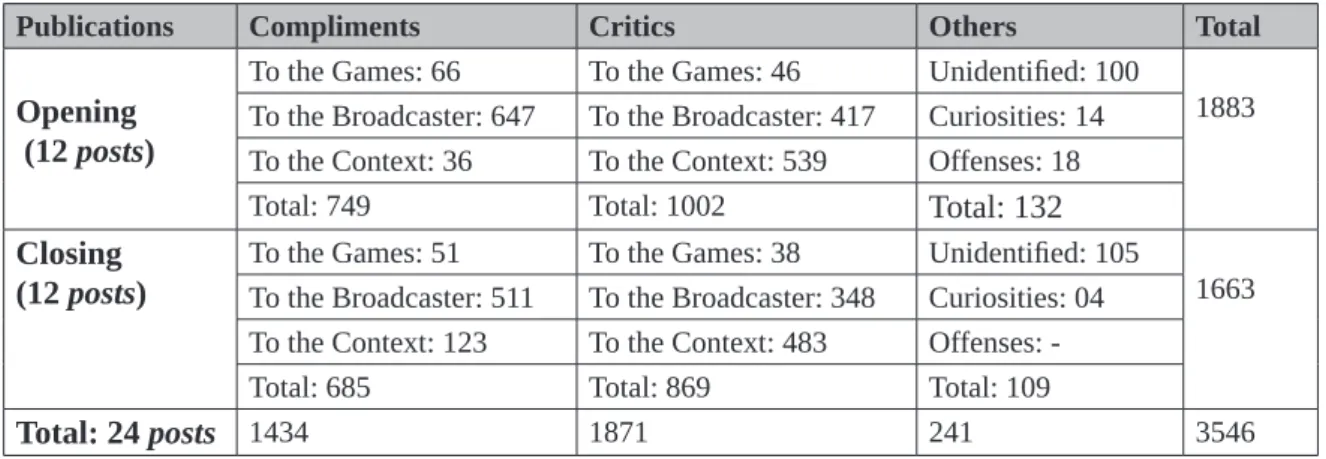
Thus, we classified 1.883 testimonials related to the issue of the news on Opening Day and 1.663 after the Closure of the Olympic Games; a total of 3.546 comments, as demonstrated
in Table 01:
Table 01 – Quantitative Analysis of Facebook´s Interactions
Publications Compliments Critics Others Total
Opening (12 posts)
To the Games: 66 To the Games: 46 Unidentified: 100
1883 To the Broadcaster: 647 To the Broadcaster: 417 Curiosities: 14
To the Context: 36 To the Context: 539 Offenses: 18
Total: 749 Total: 1002 Total: 132
Closing (12 posts)
To the Games: 51 To the Games: 38 Unidentified: 105
1663 To the Broadcaster: 511 To the Broadcaster: 348 Curiosities: 04
To the Context: 123 To the Context: 483 Offenses:
-Total: 685 Total: 869 Total: 109
Total: 24 posts 1434 1871 241 3546
Source: Own authorship.
The positive and negative comments correspond, respectively, to 40,4% and 52,7% of the set of statements that form the corpus of this study. An amount of 1.434 complimentary comments greeted presenters or praised the network’s effort. The majority of the 1.871 critical
comments questioned the legitimacy and impartiality of the broadcaster and the JN in biased
reports of political facts reported on the news. The Olympic Games were a recurring theme in the analyzed comments, but not the main one. Among the 1.434 positive comments collected
during the Jornal Nacional’s Opening and Closing period, only 117 (8,1%) made direct
mention to Rio 2016 Olympic Games. Among the critical comments, a number of 1.871, 84 (4,4%) referred to the event. Most of the compliments at the Opening and Closing referred
to Rede Globo and JN, and most of the critical statements corresponded to demonstrations
against the socio-political-economic context of the country and to the station’s performance in the impeachment of former president Dilma Rousseff. The comments of the people who
responded to the 24 JN’s publications on Facebook established a polarized political debate,
for and against the interim government of Michel Temer, marked by an aggressive and little dialogical tone. The main issue discussed by the hearings at the opening of the Games was
the absence of the official announcement of Temer’s presence in Maracanã. Simone Mansur
said: “The newspapers are posting that President Michel Temer was not quoted... Just
remembering, Michel Temer himself asked not to be quoted... He is a gentleman, he is not yet President, he is interim, he respected the DONKEY! Congratulations Michel Temer (...)”. At that moment, the Critics’ comments to Rede Globo also challenged the broadcaster to show the boos of the audience that was in Maracanã. As an example, we have the testimony
of Margarida Costa: “Goodnight ridiculous people, your sweetheart was booed last night
at maracanã. So, are you going to comment on JN garbage today? Kkkkkk”. The audiences questioned the relevance given to the Olympics by the TV News program and also revealed
August 22nd, after the Closing of Rio 2016: “Even when you’re going to use the Olympics
to pad out, you don’t know what to say anymore?(...) we are obliged to change channels,
(...) which is more concerned with showing what is happening in the world.” On August 5th,
Marly Alcantara also wrote: “(...) I went to the market just not to see this Olympian Shame.
If the country had everything in order just like the 1st. world countries, it would be right but a. Starving country. It is a shame. (...). I hate hypocrisy.” It was also possible to notice that users repeatedly shared nauseated illustrations in the comments section of some publications that displeased them, a discursive practice named “vomit” with strong emphasis and political repercussion. Thus, we observe that a considerable part of the users use emojis, emoticons stickers and memes to express their emotions and affections. Compared to the content of the Games, the news about the national political scene received many more comments, all
reflecting the strong political polarization that took the Brazilian population. We counted
159 (11%) comments of Compliments regarding the social, cultural and political context, against 1.022 Critics (54,6%). In this way, among compliments and critics about actions of
several politician– such as Lula and Dilma Rousseff from Partido dos Trabalhadores (PT),
Michel Temer e Eduardo Cunha, from the so Partido do Movimento Democrático Brasileiro
(PMDB) and Aécio Neves and José Serra, from the Partido da Social Democracia Brasileira
(PSDB) –, the comments reveal dissatisfaction, resentment and discredit of the audiences in relation to politics, institutions and parliamentary representation. This atmosphere created a kind of “common symbolic terrain” among the interacting agents, regardless of political and ideological positioning. In the news of the MPF’s investigation of former President
Lula, broadcast on August 5th, most of the comments were outraged by the delay in justice.
Nilzete Franco was one of them: “Arrest him, what are you waiting for?” stated. At the same
time, many users also defended the PT leader of the accusations, including the conduct of
investigations, such as Carlos Rebouças: “(...) Let us celebrate when the Due Constitutional
Criminal Procedure reaches a condemnatory sentence. (...) I will never applaud accusations
before the Contradictory and Full Defense, because tomorrow the victim can be any ordinary
citizen! Beware!”.
Based on this quantitative analysis, which revealed the little public engagement of the Jornal Nacional page with the Olympic Games, we sought to observe in the qualitative analysis the ways audiences discursively express their emotions imbricated in their comments and positions that encourage, tolerate or deplore the event and their own conversations (ROSENWEIN, 2011). Inspired by the analytical categories of “dominant” and “marginal” emotional community associated with the analytical procedures of Semiology of Social Discourses, we sought to identify and analyze how emotions are applied in the relational
dynamics between interactors on the Jornal Nacional page on Facebook. During the opening
the political-economic crisis. In addition, it was possible to verify the relevance of “positive” emotions – joy, pride, hope – in the scope of the strategies of the media event, synthesizing an Olympic spirit of union and tolerance. It was also possible to observe a change in the “state of mind” of the Brazilian in relation to the Olympic Games. Days before the event,
a survey revealed that half of the Brazilians were against their realization12, but after the
games, another survey showed that this pessimism suffered a great setback from the opening,
leading Brazilians to pride13. Thus, we could point to the expression of a dominant emotional
community, which sought to consolidate an interpretation of the historical moment in which
positive emotions of joy, pride and hope were valued, mediated by JN enunciations. In spite
of all the structural problems, the intensification of political polarization and the worsening of
the economic crisis in Brazil, it was proposed at that moment the compliment of a reading that
appreciated the festive framework. These interpretations have gained support among Jornal
Nacional “fans” on Facebook, exemplified in Otília Martins’ commentary on the opening of
the Games “Good evening Brazil- Let’s all go together- the magic of the Olympics Opening
will provide us with a beautiful spectacle- A Good and happy weekend and in the statement
of Edna Maria Almeida Santos: My God! What a magnificent opening. Congratulations Rede
Globo! Cheers for Brazil!”. These comments are related to a “way of saying” that Pinto (1999) categorizes as Seduction, that is, demarcates the event with positive values and seeks to estimate an affective reaction favorable to the Olympic Games and the broadcaster, by using adjectives
such as “beautiful party,” “magnificent,” “wonderful”. This way of saying that a priori would be characteristic of the transmitter that transmits the opening and closing ceremonies, gains support and resonance between these portions of the audience, characterizing the emergence of an interpretive community linked to the proposed reading paths by the issuer.
However, our analysis of audience interactions reveals that more than half of the critical comments and 1/3 of the set of all the statements analyzed questioned the political and economic context of Brazil and did not refer exactly to the Olympic Games. The mediatic event worked as a trigger for the expression of a political position, but not in the name of
a qualified, plural and democratic public debate, as observed in the following comments
by Rodrigo Ortiz (“Good evening. Who should offer to ascend the Olympic pyre should be
our former worthy president Dilma Rousseff as a human torch. It would be an opportunity
to make peace with the Brazilian people and still enter into history as a martyr”) and
Genivaldo Matos (“Criminal coupist would never be president if not stabbing other people,
I only regret to have an illegitimate president I only regret for Brazil”). These comments differ from the meanings assigned by the media to the Olympics and connote negative
values to the event and the political scenario, manifested in emotional positions, reflecting
anger, resentment, disappointment and indignation with the political and economic context of Brazil. Despite that, in the study of these testimonies, there is little interest in establishing interactions by audiences capable of generating dialogues, consensus or common agendas. The recurrent mediated self-expression and the manifestation of own opinion refer to the
intensification of individuation and antagonism. The testimonies analyzed do not promote the confluence of different voices and political views, tending more to the noise than to the
polyphony and reveal the emergence of marginal emotional communities ruled by violent, anti-democratic and totalitarian statements. On the other hand, if these manifestations are more personalized actions than notions resulted from social articulations, and privilege “feelings” rather than “thinking”, they reveal an opposition to the media dominant discourses, unveiling tensions in the sociocultural practices that minimally bother power
relations accommodated in the social order, indicating possible destabilization of fixed and recognized models of communication (WILLIAMS, 1977).
Conclusions
Television broadcasts and hosting by the Rio 2016 Olympic Games hearings have turned the possible failure of the Olympics into a media celebration. This work showed
how Rede Globo’s Jornal Nacional gave preferential meanings to the Olympic Games,
which enhanced the self-esteem of Brazilians and the nation, strengthening the mediation of the television and the TV newscast in the construction of social reality. However, the survey results also revealed that audiences were willing to re-signify the Olympics in their
interactions with the Opening and Closing televised broadcasts of the Games. A significant
part of these interactions reveals a rupture of the reading contract proposed by the mediatic frameworks, in addition to the models of decoding media messages proposed by Hall (2003), in which audiences attribute dominant, opposing or negotiating meanings to events.
Our analysis points out that television broadcast of major events, such as the Rio 2016 Olympic Games, tune into large audiences in the celebration of the event. However, it also becomes “pretexts” for an emotional expression of opinions on digital platforms that tend to reassess the relevance of the media event and to shift the attention to Politics, without
necessarily collaborate to the texture of a more inclusive public sphere. We reflect on the new
forms of appropriation of audiovisual news content and the conformation of a communication model still in the phase of transition expressed in strongly self-referential utterances and discourses, focused especially on the expression of self rather than for expression of citizenship, which tend not to contribute to democratic and dialogical practices. Though, we suggest that if these personalized forms of ideological manifestations are ineffective
in their specific dimension, they evidence an embryonic experience of social articulation
the “social experiences in solution” proposed by Williams (1977), that is, experiences that
can be configured as disturbances or modifications of the dominant ideology and of the
discourses of the media. However, these personalized or active ways of interacting with the television on digital platforms are also subject to certain constraints. These forms are embedded in certain political and cultural contexts and respond to calls, content and media
rituals relating to the Olympics, which shape or influence their conversations on digital platforms and smartphones (TANG; COOPER, 2017).
Our research also reveals that the centrality of TV in the media environment has not been broken, nor the traditional ways of tracking television broadcasts, indicating that there is a tendency for large media groups to try to integrate discussions of social networks in their enunciations and that different media are used simultaneously by audiences. Certainly, television broadcasters and other media industries are interested in “colonize” the social media space, but we understand that we cannot reduce the understanding of media communication processes to the imposition of an ideology on the media by the media or a perception about a great event. This research points out that the comments on the Jornal Nacional’s Facebook page carry clues to understanding the current forms of subjectivization and interpretation of media phenomena, of the consumption of audiovisual
news content and of the reconfiguration of mediations between television and audiences.
References
BECKER, B. Televisão e telejornal: transições. São Paulo: Estação das Letras e Cores, 2016.
_______. Televisão e novas mídias: repensando o papel das audiências nos telejornais. E-Compós, v.17, n.2, 2014. Available at: http://www.compos.org.br/seer/index.php/e-compos/article/view/1072/768. Accessed on: 13 jan. 2018.
_______. Mídia e Jornalismo como formas de conhecimento: uma metodologia para leitura crítica das narrativas jornalísticas audiovisuais. Matrizes, São Paulo, v.5, n.2, 2012. Available at: http://dx.doi.org/10.11606/ issn.1982-8160.v5i2p231-250. Accessed on: 2 feb. 2018.
_______. A linguagem do telejornal: um estudo da cobertura dos 500 Anos do Descobrimento do Brasil. Rio de Janeiro: E-Papers, 2005.
BENETTI, M.; Reginato, G. D. O vínculo emocional do leitor ao jornalismo: Estudo da revista Veja no Facebook. Revista Famecos, v.21, n.3, 2014. Available at: http://revistaseletronicas.pucrs.br/ojs/index.php/ revistafamecos/article/view/17847/12568. Accessed on: 2 feb. 2018.
COELHO, M. C.; REZENDE, C. B. Antropologia das Emoções. Rio de Janeiro: FGV, 2010.
DAYAN, D.; Katz, E. A história em directo: os acontecimentos mediáticos na Televisão. Coimbra: Ed. Portuguesa Minerva, 1999.
FECHINE, Y. Uma proposta de abordagem do sensível na TV. In: 15º ENCONTRO ANUAL DA COMPÓS - ASSOCIAÇÃO NACIONAL DOS PROGRAMAS DE PÓS-GRADUAÇÃO EM COMUNICAÇÃO. Bauru, 2006. Anais.... Available at: http://www.compos.org.br/data/biblioteca_500.pdf. Accessed on: 20 dec. 2017.
HALL, S. Da diáspora: identidades e mediações culturais. Belo Horizonte: UFMG, 2003. LE BRETON, D. As paixões ordinárias. Petrópolis: Vozes, 2009.
MASSUMI, B. Notes on the Translation and Acknowledgements. In: Deleuze, G.; Guatarri, F. A Thousand Plateaus. Minneapolis: University of Minnesota, 1987, p.xvi-xix.
MORETZSOHN, S. D. Noticiar a dor: possibilidades e dificuldades do jornalismo na tragédia de Santa Maria. In: ENCONTRO ANUAL DA COMPÓS - ASSOCIAÇÃO NACIONAL DOS PROGRAMAS DE PÓS-GRADUAÇÃO EM COMUNICAÇÃO, Salvador, 2013. Anais.... Available at: <http://compos.org.br/data/ biblioteca_2069.pdf>. Accessed on: 18 jan. 2018.
OROZCO GÓMEZ, G. Televisão: causa e efeito em si mesma. In: CARLÓN, M.; FECHINE, Y. (Eds.). O fim
da televisão. Rio de Janeiro: Confraria do Vento, 2014. p. 96-113.
PINTO, M. J. Comunicação e discurso: Introdução à análise do discurso. São Paulo: Hacker, 1999.
ROSENWEIN, B. H. Problems and methods in the history of emotions. Passions in Context: International Journal for the History and Theory of Emotions, v.1, n.1, p.1-32, 2010.
______. História das emoções: Problemas e métodos. São Paulo: Letra & Voz, 2011.
SHOUSE, E. Feeling, Emotion, Affect. Journal of Media and Culture, v.8, n.6, dez. 2005. Available at: http:// journal.media-culture.org.au/0512/03-shouse.php. Accessed on: 14 apr. 2017.
SIBILIA, P. O show do eu: a intimidade como espetáculo. Rio de Janeiro: Nova Fronteira, 2008. SODRÉ, M. As estratégias sensíveis: Afeto, mídia e política. Petrópolis: Vozes, 2006.
TANG, T.; COOPER, R. The most social games: Predictors of social media uses during the 2016 Rio Olympics. Communication & Sports, 2017. Available at: http://dx.doi.org.10.1177/2167479516688438. Accessed on: 06 mar. 2017.
VERBALYTÈ, M. Critical Role of Emotions in Media Events: Anger Dynamics in Political Scandals. In: FOX, A. Global Perspectives on Media Events in Contemporary Society. UK: IGI Global, 2016, p.41-58. Available at: <http://www.igi-global.com/chapter/critical-role-of-emotions-in-media-events/146612>. Accessed on: 16 nov. 2017.
WILLIAMS, R. Marxismo y literatura. Península: Barcelona, 1977.
Beatriz Becker
PhD Associate Professor of the Graduate Program in Communication and Culture (PPGCOM-ECO/ UFRJ) and of the Department of Expression and Languages of the School of Communication of Federal University of Rio de Janeiro (DEL-ECO/UFRJ). Her Post-Doctoral studies were hold at Goldsmiths College, University of London, and at the Pontifical Catholic University of São Paulo. She holds a Research Productivity Grant of CNPq, Brazil. She is also the leader of the Research Group Media, Audiovisual Journalism and Education (MJAE). She wrote the books “Television and Tv Journalism: Transitions” (2016), “Thinking and Doing Audiovisual Journalism” (2012), “The Language of TV News” (2005) and coauthored “Pantanal: The Reinvention of Soap Opera” (2008). E-mail: [email protected].
Heitor Machado
of Federal University of Rio de Janeiro. He holds a Master´s degree in Communication and Culture from the same institution and is a member of the Research Group Media, Audiovisual Journalism and Education (MJAE). E-mail: [email protected].
Igor Waltz
PhD Student of the Graduate Program in Communication and Culture of the School of Communication of Federal University of Rio de Janeiro. He holds a Master´s degree in Communication and Culture from the same institution and a CAPES scholarship, Brazil. He is also a journalist and a member of the Research Group Media, Audiovisual Journalism and Education (MJAE). E-mail: igor.waltz@ gmail.com.
Joana Tassinari
She holds a Master´s degree in Communication and Culture of the Graduate Program in Communication and Culture of the School of Communication of Federal University of Rio de Janeiro and is a member of the Research Group Media, Audiovisual Journalism and Education (MJAE). E-mail: jotass@ hotmail.com.
Received on: 02.07.2018 Accepted on: 11.16.2018