ENVIRONMENTAL
MANAGEMENT: GROUNDED
THEORY PROPOSALS
Mireya Palavecinos Tapia
1; Daniel Henríquez Fernández
2; Bartomeu Vidal Moranta
3 Mireya Palavecinos Tapia. Phd. Social Psychology, Autonoma University, Madrid, Spain Filiation; Associate Professor at the Department of Psychology. Director of the Master in Community Psychology. University of La Frontera, Temuco, Chile. Postal address: Montevideo , Temuco, Chile. Email: mireya.palavecinos@ ufrontera.cl
Daniel Henríquez Fernández. Master in Community Psychology. University of La Frontera. Filiation. Lecturer at the Department of Psychology, University of La Frontera, Temuco, Chile. Postal address: Montevideo , Temuco, Chile. Email: [email protected]
Bartomeu Vidal Moranta. Phd Social Psychologist, Barcelona University, Spain. Filiation Professor at the Faculty of Psychology, University of Barcelona, Catalonia, Spain. Email: [email protected]
ABSTRACT: The environmental crisis and the growth of cities has made life in modern cities become more complex. The environmental management of the responsible institutions has been faced with generating new strategies and communicating with citizens to solve the environmental problems. This research describes the methodology used and the political dimension of citizen complaint behavior before the public administration. The results offer a more effi cient management option that guarantees citizen participation as a quality strategy and considers their proposals for the solution of urban environmental problems. The mixed method is used, and the analysis of the data is based on the Grounded Theory to know the reality and the diffi culties of the people involved, considering their interpretations, having as object of investigation the perception about the environmental confl icts. The research was structured in stages and successive phases, interviews and surveys were carried out with experts. Analyzed complaints (532 suggestion and complaint fi les, for situations of urban environmental confl icts). Group interviews with neighbors, representatives of social movements, offi cials and students of a University. Finally, virtual surveys and individual interviews with group participants were conducted. The results allow to describe and propose a Participatory Environmental Management Model, which considers as criteria for effectiveness, the validation of the role of people in the solution to problems, allowing to implement solutions more relevant to local needs and to solve urban environmental confl icts in public management.
KEYWORDS: participatory environmental management; citizen complaint; grounded theory.
RESUMO: Ante a crise ambiental e o crescimento das cidades, a vida moderna tornou-se mais complexa. Gestão ambiental das instituições responsáveis viu-se enfrentada a gerar novas estratégias e comunicar com a cidadania para solucionar os problemas ambientais que enfrentam a diário. Descreve-se a metodologia utilizada e a dimensão política do comportamento de denúncia cidadã ante a administração pública. Os resultados oferecem uma opção de gestão mais efi ciente, que garanta a participação cidadã como estratégia de qualidade e considere suas propostas para a solução dos problemas ambientais urbanos. Recorre-se ao método misto, e fundamenta-se a análise dos dados na Teoria Fundamentada para conhecer a realidade e as difi culdades das pessoas envolvidas, considerando suas interpretações, tendo como objeto de investigação a percepção sobre os confl itos ambientais. A investigação estruturou-se em etapas e fases sucessivas, realizaram-se entrevistas e pesquisas de especialistas. Analisaram-se denúncias apresentadas ao
município (532 fi chas de sugestões e reclamações, por situações de confl itos ambientais urbanos). Entrevistas grupais a vizinhos, representantes de movimentos sociais, servidores públicos e estudantes de uma Universidade. Finalmente foram realizadas pesquisas virtuais e entrevistas individuais a participantes dos grupos. Os resultados permitem descrever e propor um Modelo de Gestão Ambiental Participativa, que considere como critérios para a efetividade, a validação do papel das pessoas na solução aos problemas, permitindo implementar soluções mais pertinentes às necessidades locais e resolver os confl itos ambientais urbanos no gerenciamento público. PALAVRAS-CHAVE: gestão ambiental participativa; denúncias cidadãs; teoria fundamentada.
RESUMEN: Ante la crisis ambiental y el crecimiento de las urbes, la vida en ciudades modernas se ha complejizado. La gestión ambiental de las instituciones responsables se ha visto enfrentada a generar nuevas estrategias y comunicarse con la ciudadanía para solucionar los problemas ambientales que enfrentan a diario. Se describe la metodología utilizada y la dimensión política del comportamiento de denuncia ciudadana ante la administración pública. Los resultados ofrecen una opción de gestión más efi ciente, que garantice la participación ciudadana como estrategia de calidad y considere sus propuestas para la solución de los problemas ambientales urbanos. Se recurre al método mixto, y se fundamenta el análisis de los datos en la Teoría Fundamentada para conocer la realidad y las difi cultades de las personas involucradas, considerando sus interpretaciones, teniendo como objeto de investigación la percepción sobre los confl ictos ambientales. La investigación se estructuró en etapas y fases sucesivas, se realizaron entrevistas y encuestas a expertos. Se analizaron denuncias presentadas al municipio (532 fi chas de sugerencias y reclamaciones, por situaciones de confl ictos ambientales urbanos). Entrevistas grupales a vecinos, representantes de movimientos sociales, funcionarios y estudiantes de una Universidad. Finalmente fueron realizadas encuestas virtuales y entrevistas individuales a participantes de los grupos. Los resultados permiten describir y proponer un Modelo de Gestión Ambiental Participativa, que considere como criterios para la efectividad, la validación del rol de las personas en la solución a los problemas, permitiendo implementar soluciones más pertinentes a las necesidades locales y resolver los confl ictos ambientales urbanos en la gestión pública.
PALABRAS-CLAVE: gestión ambiental participativa; denuncia ciudadana; teoría fundamentada.
490
.
INTRODUCTIONInstitutions in charge of city administration, such as municipalities, have sought for structures which guarantee quality management and performing greater control over its administration mecha-nisms. To guarantee the needed transparency and governance, these institutions are searching for considering citizen participation in the process, by receiving complaints or grievances, thus creating technical instances for on-the-fi eld interven-tions and looking for support at universities for researching these issues. Th e present study is an example of this link.
Th e creation of systems for issuing complaints and their proper reception has been one of the measures requested to modern administration to guarantee citizens spaces for relationship and trust, as well as governance. However, this has only been actively incorporated to public admin-istration very recently.
One of the spaces recently created has been considering the opinion of people, mostly on how resources are administered and on how envi-ronmental confl icts are solved within cities. It is a relatively new process which has important aspects to be developed.
One of the most common problems is the confu-sion regarding handling data and the opportunities off ered by the data obtained after communication with citizens. Th ey do not know how this infor-mation contributes to the processes of institutional management. Most of the time, the information provided by people to the public administration is not properly used or is undervalued by organiza-tions, therefore the contribution they can off er as feedback for improving the quality of management is wasted. Th e solutions still do not consider the citizens’ insights, and they are based exclusively on technical decisions or on political reasoning, so they risk not being adequate or relevant. Because of this, problems linger, expenses increase, and distrust from people towards central administration and the responsible political authorities keeps increasing. Citizens consider that their needs are not being considered, and what is worse, they verify day by day that environmental problems persist or even aggravate. At the administration level, managers eventually end up implementing interventions and technical decisions that are not relevant or properly
allocated. (Palavecinos, Martin, Díaz, Piñeiro, Benayas, y Alonso, ).
Th e study of the complaint as a specifi c behavior, and particularly citizen complaints regarding environmental issues, seems to be an interesting gateway to understanding this emerging phenomenon. Defi ning the boundaries for the research problem for this study, meant a long journey, starting from the existence of a real problem: the meagre results obtained in solving the environmental problems of a capital city in Spain, despite the increasing economic investment that the municipality has made to address the problems derived from poor environmental management in the city (such as mass education campaigns, high investment in infrastructure and resources).
In this context, the City Council contacted the Department of Ecology of a local University, as a result of this, an agreement was signed to carry out research aiming to understand the situation in the city and the social phenomenon of increasing complaints, and also to generate proposals for improving environmental management results.
Th e following research objectives were stab-lished: a) To build a comprehensive model of citizen complaints regarding environmental issues, identifying the meaning people give to the presentation of their complaints, b) To achieve the detection of entanglement in the environ-mental management process and c) To evaluate the management system used by the municipality, and then propose an administration model that improved effi ciency in municipal management for solving existing urban confl icts.
.
People seek to enjoy their capacity to achieve satisfaction and comfort in the environments they occupy. According to Daniel Stokols, the environment is an end in itself, it is the context in which the human beings develop and fulfil themselves. In this vision, symbolic, affective, psychological, social and cultural meanings are emphasized and awareness, also promoting participation and cohesion of human beings occupying their spaces (Stokols, ).
Along the same line, the socio-constructionist conception postulates that the meanings of the environment are elaborated under certain political,
491
v. 8, n. 3 (2019): set./dez
economic and social contexts that eventually defi ne the considerations, conceptions and uses of the environment by the users (Wiesenfeld, ).
From a number of perspectives, beliefs have taken a decisive role in understanding the rela-tionship between human beings and the environ-ment. In fact, the ongoing problem of growing ecological and social deterioration has been attributed to certain generalized assumptions in keeping with «what the world is like» (Clark, ; Milbrath, , White, ).
Milbrath () postulates that modern indus-trial societies are not sustainable, since social thinking is based on premises or beliefs based on human progress at the expense of nature’s domain. Th e relationship between human beings and the environment is determined by beliefs regarding their own nature, the physical world, their own fate and “what we do in terms of ecology depends on our ideas about the relationship with Nature” (White, , p. ).
I order to achieve the objectives set for this research, it has been considered important to use a mixed research method which allows for estab-lishing trends and quantitative data in the diag-nosis of the situation, but at the same time giving strength to the voice of those involved in urban environmental confl icts. Th us, giving a funda-mental role to the needs expressed by the citizens who endure the problems in order to know the reality that aff ects them, is considered a neces-sary starting point to build effi cient technical
solutions, which are also relevant and pertinent to the local reality.
From the theoretical point of view, four constructs related to the case under study will be addressed. Th ese constructs are essential for understanding the dimensions considered by the study: Pro-Environmental Behavior, Complaint Behavior, Participation (social and environmental) and Environmental Governance.
. - ()
It can be defi ned as the action carried out by a person, individually or collectively, in favor of the conservation of natural resources and aiming at procuring better quality for the environment. Sustainable development and sustainable behavior are linked to the idea of motivated and intentional behavior (Brundtland Report, UN ).
Th is behavior has also been defi ned by its impact, the degree in which it is able to change the availability of the environment’s materials or energy, or to alter the structure and dynamics of the ecosystem or biosphere. From the actors’ point of view, it is considered as a committed behavior or with the intention of changing (benefi ting) the environment (Hernández, and Suárez, , Stern, ; Stern, b; Stern and Gardner, ). It must be taken into account that there are several barriers (mainly contextual factors) which might constrain or stimulate the development of pro-environmental actions (Gardner and Stern, ; Tanner, ; Stern, b).
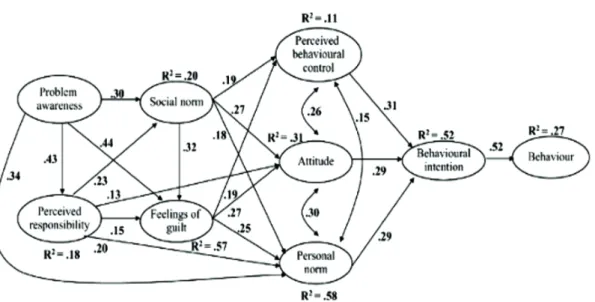
Figure 1. MASEM results.
492
Bamberg and Möser () carried out a new review of determining factors mentioned in scien-tifi c literature. Among the results of this macro comparative study, it can be highlighted that there are signifi cant correlations between psychosocial variables and pro-environmental behavior, which are similar to the ones reported by Hines, et al., . Th ese correlations confi rm that the variable Intention of pro-environmental behavior medi-ates the impact of all other psychosocial variables (accounting for of the variance). Th e results also confi rm that after Attitude and Behavioral Control, Personal Moral Norms are the third predictor of Intention of pro-environmental behavior (accounting for of the variance).
. ()
Th ere are psychological-cultural barriers in our society that are preventing us from developing sustainable behavior, thus destructive behaviors are sustained and become resistant to change. Despite this, people›s concern for their environment’s situ-ation can be seen, for example, in the large number of complaints fi led at their municipality regarding environmental problems in the city. How can this be explained? Developing an understanding of the characteristics of the particular situation and the sense people give to their behavior of complaints in environmental matters is the main objective of the present investigation.
Th ere is agreement among scientists in under-standing Th e Complaint as the result of an expe-rience defi ned as unsatisfactory by consumers. No studies were found that compare the presentation of complaints to public institutions and the diff er-ences that this could have with those presented to private organizations. Most authors tend to provide defi nitions that refl ect the multidimen-sional nature of complaint behavior, which is not only limited to the sole act of complaint, but also covers other responses to dissatisfaction after a purchase (Singh, a; Singh and Wilkes, ; Liu and McClure, ).
Singh and Wilkes () propose a defi nition in which a customer complaint includes all the possible behavioral responses a client might use to address their dissatisfaction. Singh (a) iden-tifi es complaint behavior as the style of response from a dissatisfi ed customer. Crie () defi nes the customer›s complaint behavior as a process that constitutes a subset of all possible responses
to dissatisfaction perceived around a purchase episode, either during consumption or posses-sion of the goods or services. Crie also states that a complaint behavior is not an instant response, but a process that does not depend directly on its initial factors, albeit on an evaluation of the situ-ation by the client, and further evalusitu-ation over a period of time.
Th e public complaint refers to actions of direct complaints, which include the search for direct reparation by the supplier or manufacturer, as well as legal action (Bearden ; Bearden & Oliver ; Cornwell, Bligh, and Babakus ). Public actions a person may carry out include verbal complaint, written complaint or letters of complaints sent to newspapers, or complaints handled by consumer advocates (Heung & Lam ). Th us, public complaint behavior is a set of communications initiated by the consumer towards the manufacturer, intermediaries or public insti-tutions, in order to solve problems arising from a purchase or the use of a product in a certain trans-action (Westbrook, ).
Th e available evidence indicates that only a small percentage of unsatisfi ed clients actu-ally complain and that the demographic and psychological characteristics of the clients them-selves play an important role in determining their response (McAlister and Erff meyer ; Lovelock and Wirtz ; Zeithaml, Bitner and Gremler , ). Th e infl uence of cultural diff er-ences on complaining customers’ behavior has been examined and yield confl icting data (Liu et al ; Mattila ; Mattila and Patterson ; Zeithaml et al ). A study conducted by the Ecological Institute of Berlin () describes four types of complaint behavior:
Private actions. Public institutions are not involved. Complaints are commented among families and friends after a poorly evaluated purchase or service. In general, it is decided not to use the service any more or not to buy the product again. The complaint might be directed to the seller verbally.
Legal actions. A legal approach is consid-ered to remedy the action: complaints are filed with public agencies, senators, defenders of the people or payments to the companies involved are stopped.
Public actions. Complaints are filed with the companies involved in order to find a solution. It involves confrontation and the request for a
493
v. 8, n. 3 (2019): set./dez
return or product repair, file complaints with consumer agencies or writing to newspapers.
No complaints. No action is taken after the bad experience.
As already mentioned, complaint behavior (CB) might be infl uenced by multiple factors, among which market structure, socioeconomic variables, involvement and probability of success, are highlighted as the most studied and signifi -cant. Whether or not the socioeconomic situation of consumers can condition this behavior has also been studied (Moyer, ).
In diff erent studies carried out in Spain, Moliner (, , ) proposed to classify the determinants responsible for complaint behavior in the context of consumption, in order to iden-tify the variables that have been investigated most frequently and off er a wider vision regarding the formation of complaint behavior. Th is classifi ca-tion groups the determinants into four types: a) Determinants that refer to the characteristics of the consumer (general and specifi c to the unsatis-factory experience). b) Determinants related to the company providing the product or service causing the dissatisfaction. c) Determinants relative to the environment in which the purchase and/or delivery of service happens. d) Determinants that are intrinsic to the product or service provided (Moliner, ).
Th ere are occasions in which the procedures established for the reception, processing and reso-lution of the complaint cause the customers more inconvenience than the failure itself. Conducting an eff ective process of handling complaints in organizations can constitute a diff erentiation criterion for companies and opens the possibility of permanent feedback relative to customer satis-faction. (Moreno Pino, et al, ).
According to Broadbridge and Marshall (), the complaint helps companies identify the determinants of the quality of their off er, thus making the appropriate improvements in their processes (Fornell and Wernerfelt, ). Public actions allow consumers to accumulate information about the problems and defects of the products and services off ered. Besides, it also provides the product or service provider a second chance to satisfy the consumer. Complaints are also considered as useful tools to make stra-tegic and operational decisions. Th erefore, the complaint represents the origin of the solution of the problems and the possibility of retaining the
customer. Th e absence of complaint removes any possibility of eliminating the source of dissatis-faction. Finally, if the complaint is satisfactorily resolved for the consumer, this will infl uence the improvement of the company›s image (Richins, a). Satisfaction after the resolution of the complaint has been studied in diff erent empirical investigations aiming to demonstrate the impor-tance of motivating individuals to present their complaints, as well as the way they are subse-quently addressed. (Oliver, ).
Environmental complaints have not yet had signifi cant presence in scientifi c studies, and they have recently been included as a concern in public administration. One mechanism is the one put forth by the European Environment Commission (DG), in which stages for a typical procedure are proposed for the analysis of complaints; Awareness - Acknowledging complaints. Evaluating the complaints received and prioritize them. Planning research on these topics. Investigating complaints. Answering them with a clear decision. Following up on services. Considering whether they consti-tute systemic problems.
.
Participation may take various forms depending on the characteristics and objectives of institutional interventions. Th e “citizen participation” label summarizes the basic principle of co-responsibility and multilateral commitment by institutional agents, citizens, technicians and interest groups, which constitutes the basis of a democratic project (Bonet, Di Masso , Duque, Ëcija, Pol, ).
Participation is a process through which communities intervene in their reality by orga-nizing and setting priorities according to their needs in order to achieve improvements in quality of life and general well-being. It aims to improve the possibilities of access to goods and services. It allows for integration to ongoing processes in a society. It improves the oppor-tunities to fulfi l a life project, to make citizens feel as protagonists deliberately building a future and, ultimately, to strengthen their self-esteem. At present, the most interesting participation processes are those designed to broaden consul-tation, processes in which an attempt is made to achieve greater citizen involvement and in which decision-making based on experts’ technical
494
criteria, rational decision, and citizens’ prefer-ences are combined (Pont Vidal, ).
In participation processes, communication is materialized in proposals and action programs that distribute knowledge, objectives, means and specifi c responsibilities among all the participants. Th ese proposals can be classifi ed around three basic criteria:
a) Degree of involvement of the diff erent social agents (level of demand for attention, eff ort and involvement) b) Degree in which power and responsibility are granted.
c) Level at which the diff erent social agents have the capacity to get involved in evaluation and decision processes.
In the case of the opening of channels for the citizen to express complaints to situations they detect in the managed urban space by public institutions, it is possible they risk these channels remain in the system without greater possibility of incidence for the administration of solutions to the problems. If so, we would face the lowest profi le of the three criteria; that is, low involvement of social agents, low empowerment, and poor capacity to get involved in decision-making processes.
To achieve effi ciency in the intervention in environmental problems, this intervention must be based on knowledge of the local psychosocial processes linked to the environmental problem. To this end, novel forms and channels of commu-nication that encourage citizens to participate must be strengthened and created, overcoming the sole mediation of representatives in organi-zations. Participation must be seen as a planned process, aiming towards transformation, capable of giving new value to the power of citizens and pointing to the development of the refl ective capacity in political decision making (empower-ment), thus improving the quality of democracies (Bonet et al., ).
Other types of participation proposed and linked to the subject of research are: Participation in decision-making and social control of assumed public commitments. It refers to the intervention by community agents (individuals, community groups) in decision-making processes, as well as in the formulation of public policies, in their designs and programs, and in the supervision and control that may be enforced by the community. Th is element implies exercising citizen rights, the right to be informed, the right to give opinions
and to complain, the right to appeal and challenge decisions by the authority, to confront ideas, to reach consensus and to decide; Th e Participation Associated to the Execution and Management of Programs refers to the assessment of participa-tion as an instrument that contributes to improve the quality of the Government›s social action. It aims to stimulate, favor, and promote, in diff erent degrees and levels, the direct participation of the benefi ciary population in the administration of social programs and projects.
Environmental Participation is a particular form of citizen expression which describes the set of behaviors that aim to infl uence decision-making in regard to some aspect associated to the envi-ronment, especially referring to its conservation, protection and quality. It refl ects the proposals for collective action by environmental activism.
In contrast to the models developed from polit-ical psychology, psychoenvironmental research has approached the study of the participation process in relation to the environment and nature from perspectives that aim for the evaluation of the eff ect of environmental contents on participa-tory behavior. It is about analyzing the eff ect the ecological situation or, more specifi cally, its social interpretation, has on participation (Suarez, ).
Environmental participation is characterized as a set of action forms coming from the existence of organized patterns of collective activity, both intentional and functionally instrumental, whose objectives are associated with some kind of social change and that contribute to the achievement of collective benefi t (Khan, ). Th erefore, under the umbrella term of environmental participation, these actions are grouped among diff erent behav-iors, which respond to diff erent degrees of involve-ment in collective actions.
Environmentalism and activism around condi-tions, changes, defense and protection of the envi-ronment and nature stand out essentially as some of the most characteristic examples of what is understood by new social movements. Regarding the kind of behaviors grouped under the topic of pro-environmental participation, they range from voting to green parties, attendance to rallies and / or participations, participation in boycotts, signing of petitions, participating in public debates, writing opinion articles, or providing economic support. All of them imply an eff ort to change the attitudes and actions held by policy makers and citizens in
495
v. 8, n. 3 (2019): set./dez
relation to the conditions of threats to environ-mental quality (Manzo and Weinstein, ).
Environmental participation can also be understood as a specifi c form of social respon-sibility execution regarding environment and nature. It diff ers from other pro-environmental actions due to the collective dimension that defi nes it. Activism or militancy constitutes the second notion related to participation.
Environmental participation has been perceived from a double perspective. On the one hand, as a result of the reaction to environmental conditions to which people are exposed. On the other, as a product of the general system of atti-tudes and beliefs still remaining regarding the environment.
.
What are the contributions and challenges of environmental governance? What is the role of deliberation in building consensus? Th e concept of governance is approached from the political point of view, in which consensual decision making becomes the center of analysis.
Th e notion of governance was born in the years of intense globalization, as a way out of a series of phenomena worldwide such as environ-mental degradation, nuclear danger, economic crises together with high unemployment, the rise of terrorism and organized crime. Th is new construction of the concept of governance allows us to take the diff erent confl icts of societies in risk to the search for concrete and specifi c solu-tions, marked by the scales of action and the commitments made by the diff erent actors (Alfi e et al., ).
In recent years, the three pillars of the contemporary modern state have been directly aff ected: security, governance and sovereignty. At the same time, the socio-economic changes and transformations of the last twenty years have given rise to the consolidation of non-gov-ernmental organizations (NGOs), international organizations (IO) and multinational corpora-tions (MC) as important actors within the polit-ical scene (Alli Aranguren, ).
Some theorists forecast the imminent loss of political power by the State as an irremedi-able fact. Its role as an intermediary in political, economic and social processes is diminished due to its loss of infl uence in decision making and
control over investment fl ows, territorial re-loca-tion of the actual factors relatives to producre-loca-tion of goods and services (by regions or cities and not countries), and the intensive use of information technologies (Ohmae, ). In essence, the State has changed and, as part of this transformation, public and private agencies have become part of a broad network of multi-level regulation, gaining ground against a more traditional State-centered conception (Beck, ).
In this context, the term of governance emerged some years ago as opposed to a vertical vision in the decision-making process that used to fundamentally present the nation-state as the sole actor. Etymologically, the word governance comes from the Greek kubernan (leading or guiding) and was used by Plato when referring to a system of rules to govern.
Th e concept has been used as a synonym for government, but also as the act or the way of governing, or the government function itself. Beginning in the s, Political Science scholars gave a broader connotation to the use of the term governance, by incorporating civil society into the concept as an actor of great relevance in deci-sion-making and, therefore, an engine for the transformations experienced within the relation-ship between society and the State (Alfi e, Cohen,, Díaz and Castañeda, ).
Governance, in general terms, is part of stab-lishing channels for communication between the government and civil society, both for dialogue and joint action in agreement, exercised auton-omously and diff erently from the traditional mechanisms of aggregation, corporatization and participation within political parties and the state in general. Governance refers to a fl uid, trans-parent, fl exible, participatory and creative admin-istration, in which there are anonymous, silent and minority groups spread across multiple levels and contexts to participate in decisions that are rele-vant to them. In this governance, new collective practices based on negotiation and consensus, together with citizen networks of fl ows and inter-actions that operate along with the State in the decision-making process are registered.
Th e contributions of Aguilar Villanueva stand out in the fi eld of public administration research. Th is author considers that the creation of a “new public administration” and / or the “new gover-nance” allows, on the one hand, the balance of fi scal and administrative malformations of
496
governments and, on the other, permits a greater capacity for governmental response to the social and economic transformations that contemporary societies experience. Th is conception of adminis-tration in charge of the State, seeks the promo-tion of the public exercise legitimacy through democratic and socially inclusive practices in the construction of consensus for the resolution of specifi c confl icts (Aguilar Villanueva, ).
Governments today must prove their ability to provide public services with effi ciency and quality, while at the same time solving the soci-ety’s problems and rebuilding the social trust that has suff ered signifi cant erosion in general. In order to achieve this, modernization and innovation within the public administration is urgent, both in its organization and in its management and opera-tion. (Aguilar Villanueva, ).
Although it is certain that the phenomenon of governance has led to the reformulation of public administration when trying to provide effi ciency in governmental tasks, it can also be seen how governance, in the fi eld of politics, falls within the orbit of the Deliberative Democracy (DDF). (Bäckstrand et. al., ).
Regarding environmental crisis, the results of international environmental administration have been insuffi cient in the face of the accel-erated rhythm of environmental degradation on the planet. Some indicators even reveal that the general environmental situation has deterio-rated, despite the signing of international agree-ments on the subject.
Part of the explanation for this problem can be found in the institutional and structural ineffi ciency of the United Nations Environment Program (UNEP), as well as in the low budget allocated to fi ght deterioration, the ineff ectiveness of intergov-ernmental mechanisms and non-binding nature in the enforcing of norms, conventions, treaties and protocols. Th is has prevented assigning clear and concrete responsibilities for environmental risk. Other scholars consider that the key to this failure is found in the existence of more than multilateral environmental agreements, since they overlap, are dispersed and even confl ict with each other, undermining opportunities to carry out eff ective coordinated actions (BierMann and Benhüneryanna, ).
For James Meadowcroft (), the notion of deliberative democracy in Environmental Governance can signifi cantly improve the ability of
the society to address the problems of the coming decades. Politicians should take into account a variety of dynamics between natural resources, market and social conditions as these decisions will require broad support, a boost to joint learning and the extension of interactions both collabora-tive and deliberacollabora-tive based on groups that bring together stakeholders, the government, companies and civil society.
Th e exercise of environmental governance is based on intersectoral collaboration as a tool to reconnect citizens with the construction of a common purpose and the improvement of deci-sion-making processes. Th e construction of civic environmentalism based on environmental protec-tion, with bottom-up actions and approaches in which the territory takes a key role. Th e collab-orative administration of natural resources and ecosystem management is sought in order to adapt solutions to local conditions and overcome bureau-cratic fragmentation (Meadowcroft, ).
Environmental governance will have to implement available social resources for its good performance. Some of these resources are: the participation of agents committed to the situation at hand, the use of clear language, the promotion of intersectoral relations with a common purpose, decentralization and the implementation of justice and environmental equity as a core value.
.
Th e research is framed within the qualitative para-digm, which according to Rey () is based on three epistemological principles: a) understanding knowledge as a constructive-interpretive produc-tion, in which the role of the researcher is to inte-grate, make sense, rebuild and present a complex set of facts in complex categories, b) assuming the interpretation as a process of progressive complexity, which is developed through the signifi cance of various forms of what is studied, c) its interactive nature in the production of knowl-edge as long as the researcher interacts dynami-cally with the subjects. Th erefore, it is an inductive method that addresses human fl exibility from the context of the development of events. Scientifi c knowledge thus understood is not legitimized by the number of subjects, but by the quality of its expression according to the need for the discovery process that is being generated during the ongoing investigation (Rey, ).
497
v. 8, n. 3 (2019): set./dez
Consistent with the qualitative aspect, it is important to highlight participation as a central axis of the construction of knowledge. Geilfus () points out that the participants should be considered not only as sources of information, but as co-researchers who contribute in deci-sion-making, analysis and the proposal of solution through joint actions. In a review carried out by Rivadeneira () some epistemological principles are rescued, given to the research by the partic-ipatory dimension: a) consideration of diff erent perspectives, b) consideration of the reality of the members of the process, c) contextualization of the historical dimension, d) construction of theory from practice, e) popular participation, f) political commitment of the researcher, g) recognition of the political and ideological nature of the scientifi c undertaking, h) conversion of research, education and action into methodological moments of a single process for social transformation. Th erefore, accepting this notion of an intersubjective co-con-struction of reality (Schutz, ) implies refuting the critical objectivism demanded by positivist science, since the subject-object dichotomy becomes indefensible (Crotty, ).
For this case study, the Grounded Th eory was used as a guide for the process in general, since this tradition is characterized by inductive proce-dures that facilitate an approach to the daily life of subjects through their own interpretations, having as an object of investigation human action (Merleau-Ponty, ). For the data analysis, an open, axial and selective coding is used, resulting in a set of conceptual categories that operate as translations of the subjects› experience. Grounded theory fi nds its basis in symbolic interactionism (Blumer, ), whereas understanding (Verstehen) of intersubjectively constructed meanings overlaps causal explanation (Erklären), therefore, building interpretations based on the subjects’ narratives is sought, having human action as their object of investigation. From this perspective, it is suggested that we are the result of our relations in and with the world (Merleau-Ponty, ).
A single case design was chosen, therefore its analysis is focused on one case and its use in this particular case is justifi ed as it has a critical nature, which allows for confi rming, modifying or expanding the knowledge about the study ( Yin, ), expanding knowledge and theoret-ical construction (Stake, ; Yin, ). Th e case under study is limited to the manifestation
of complaints from citizens, in the experience of environmental confl icts presented to the public institution. Th is design seems to be the most suit-able for its approach in accordance with the reality observed and the general objective of contributing with theoretical knowledge in a social phenom-enon that, to this date, has been scarcely studied.
.
During the investigation, it was sought to favor and increase participation from diff erent levels of involvement in the case, in order to achieve this, the collected data was triangulated and problema-tized in diff erent instances with the participants, applying techniques of diff erent origin or nature, thus obtaining diff erent type of data of from various actors and perspectives. Th e three stages that shape the study and the objectives in Figure are described below. In Figure , the participants, procedure and analysis techniques used for each of them are described.
Achieving the objectives required the collec-tion of diff erent types of data and the seleccollec-tion of multiple sources of information organized in specifi c forms of analysis forms for each type of data, in the three stages set for the investigation.
.
Th e data will be presented as they appear in each of the three stages of the study.
Stage . Delphi Groups with Experts.
Th e results yielded by the Delphi group with experts in the diff erent central themes of the study (individual interviews, surveys and group discus-sion) allow us to reach the following proposal: the behaviors of complaint, pro-environmental and social participation are linked to each other. Sustainable behavior would include all three types of behavior, since it includes pro-ecological actions (or care for the environment) and acts of care for the social environment. Th erefore, it includes social participation.
For this group of experts, there would be a deep link between environmental complaint behavior with responsible citizen behavior, the notion of citizenship and especially the concept of active citizenship, since it is required that indi-viduals and groups are empowered, proactive and
498
Figure 2. Stages and objectives of the study.
Source: Prepared by the authors.
Stage I. Arbiter Evaluation. Objective: To elaborate a comprehensive interpretation of the environmental
issue complaint from the integration of the theoretical input by experts.
Stage II. Analysis of Complaints. Objective: To classify the contents described by citizens in environmental
issue complaints fi led within the SyR system of city council.
Stage III. Dialog with citizens. Objective: To propose a theorization in order to understand complaint
behavior in environmental issues.
Figure 3. Types of data and analysis according to stages of the research.
Source: Prepared by the authors.
Stage I. Arbiter Evaluation. Experts. Delphi method. Online survey. Content análisis. Frequencies Stage II. Analysis of Complaints. fi les (SyR). problems or incidents. Frequency maps
Analysis of multiple correspondence, Hierarchical and optimal segmentation
Stage III. Dialog with citizens. groups of neighbors. groups members of ONG and group UAM. Group
interview ( people) and individuals ( people). Surveys ( people). Statistical analysis techniques (factorial analysis, MCP, Varimax). Qualitative techniques (open and axial coding, MCC, content saturation)
499
v. 8, n. 3 (2019): set./dez
having the feeling that with their actions they can eff ectively achieve the desired changes.
Th e complaint is then described on environ-mental issues as a vindicating and participatory behavior, either collective or individual, specifi c or situational (depending on the type of problem). It is a fi nalist action (aiming at achieving something for someone) and externally motivated, seeking to put on the public agenda those issues related to the preservation of the environment. Th ey are vindicating activities, justifi ed in defense of what are considered rights. It is an action of individual and / or collective protest for a process that has a negative impact. Its purpose is to show opposi-tion and / or rejecopposi-tion to other people›s behavior or decisions taken at diff erent levels which are perceived as harmful to the environment (Delphi Group of the study).
In summary, for the experts consulted, the environmental complaint would be another pro-en-vironmental behavior, a behavior for the provision of information, vindication and action, aiming at modifying the way in which resources are admin-istered in relation to their impact on the environ-ment. In this sense, it can be considered a virtual or direct behavior, product of a visual impact or the perception of insecurity which, for its manifesta-tion, requires strategies that address the complaint appropriately. Confi dence in the process and in the capacity to respond; knowledge of the proce-dure to fi le the complaint; having social support; the perception of justice or equality; toghether with awareness and concern for the environment can be mention as necessary conditions. Th e envi-ronmental complaint is a behavior that arises from the non-confi rmation of expectations. It depends on some demographic and psychographic charac-teristics related to the individual, and also the level of information and interest in politics they have.
Stage . Analysis of the system for fi ling complaints
and claims (SyR fi les).
Ensuring the premise of citizen participation in the study, another of the data sources used in the corpus of this research were the Suggestions and Claims Sheets (SyR) the institution makes avail-able to people to fi le complaints regarding situ-ations of urban environmental confl ict aff ecting them. In this case, selected fi les were analyzed (when reaching the defi ned criteria presented in the last three months, all the data completed,
and cases defi ned as closed by the administration of the institution).
Unlike what was previously believed by the agents, the records show that the people who complained were men and women distributed in similar quantities and residing in the diff erent districts or neighborhoods of the city. Th ey pref-erably used the telephone or internet to fi le the complaint. Th e departments of Cleaning and Waste management are mainly involved, which happened in very similar proportions.
Th e most reported problems are related to the perception of a poor environmental administra-tion due to the delivery of services with a lower quality than expected, particularly in relation to problems of cleaning and waste collection in the city. Th e most recurring complaints have to do with the frequency and the established schedules for the collection of waste, the amount of infra-structure available for this work, and the way in which public space is used for the installation of infrastructure that takes away room originally intended for other purposes.
A very important meaning is assigned to the public space. Great value is already given for social gatherings, recreation and leisure, all of which would be negatively aff ected by the type of administration according to the perception of citizens. Special importance is given by people to the places› appearance, a value assigned to the aesthetics of places, an impact that becomes a complaint when it is negative.
In relation to the impact of environmental problems, claims are usually presented for the inconvenience caused by the situation for the community as a whole, rather than for the perceived consequences at the individual or personal level. Th e departments responsible for the management deliver responses to complaints in only of the cases, thus, only a very small percentage of them is actually receiving an eff ective solution.
Th e environmental confl icts expressed by the citizens in the registration instrument (SyR) after the classifi cation allowed for the identifi cation of a total of , problems. For the analysis, categories were formulated for its description, defi -nition of the variables and related values. Th e information was then transferred to a database on SPSS for quantitative analysis. Th e complaints were fi nally categorized in the following labels: complaint matter, type of environmental confl ict identifi ed, responsibility assigned to the problem,
500
solution or proposal off ered and, fi nally, response of the institution.
It is noteworthy that complaints are concen-trated on the issues of administration (), followed by lack of cleanliness (), and treat-ment given to waste, which accounts to of cases. Consequences are identifi ed that mainly aff ect the community (). People assign the type of services delivered () as responsible for environmental confl icts. In the same fi les, people suggest solutions to the problems, mainly aimed at environmental administration issues such as: improving the quality of services (), conducting educational campaigns (), improving control systems and current regulations (), and fi nally, Improving the environmental administration of the institution (). Th e environmental confl icts, are then focused on the quality and type of services received (), followed by issues of hygiene on public roads (), the waste treatment system applied () and confl icts generated by aff ecting the aesthetics of places ().
Th e responses given by the municipality to people›s complaints are categorized as follows: “Promises to improve the services delivered” (). “Not providing a solution to the complaint” (). Th ere are also cases that are fall within the category “Th e problem does not exist at the time of inspection” (). Th erefore, administration rarely solve the problems reported.
Finally, the analyzes carried out on the contents delivered by the people in the complaint fi les also allowed for the elaboration of charac-teristic profi les for the type of situations faced by people. Six diff erentiated profi les were identifi ed:
Profi le . Formed by complaints related to
suggestions and complaints related to the services provided by the municipality in matters of hygiene and safety in public spaces ( cases).
Profile . Group with the largest number of
grouped complaints, consisting of sugges-tions and complaints, related to quality issues in the services responsible for hygiene, but there is
also a signifi cant concern regarding the aesthetics of the place for the presentation of complaints (). It also includes problems related to the use of water for street cleaning in public spaces and for recreation.
Profile . Constituted by only problems, it
is a very compact group that still attracts atten-tion, because it is mostly made up of complaints regarding concerns about the aesthetics of places. Th ey relate to the negative impact living in an environment considered unpleasant has on people for being visually overloaded, dirty or neglected ().
Profi le . Formed by incidents, which
corre-spond to suggestions and complaints related to the type of use of public spaces (), secondly, there is evident concern here regarding the quality of services () and almost at a same level the concern for the aesthetics of the places appears again (), the problems are attributed to bad municipal administration.
Profi le . Formed by incidents, grouped
around inconvenience for the services received (), the waste collection system implemented (). A new type of problem arises here, which links environmental confl icts to issues of inequality between citizens (). Th is indicates that in this profi le there is a feeling of discriminatory treat-ment by the municipality towards people. Th e problems would not be addressed with the same criteria and measures if the incidence occurs at a diff erent place, therefore characteristics of the socio-economic context from which the complaint is made are an important infl uence.
Profi le . Th is last profi le consists of issues,
with fi les that request information or make sugges-tions to the municipality. No complaints were fi led. Th ey are suggestions for administration; improving the services received (), sugges-tions related to waste management issues () and to improve the use of public spaces (). Th e explanations for these confl icts were the little care given to public roads by the municipality and the
Citizen fi ling the
complaint Sources
Geographical origin Districts from all Madrid,
Center () Periphery ()
Motivation
Concern regarding consequences for the community and society () Figure 4. Characterization of the complaint. Profi les of citizens fi ling the complaints.
501
v. 8, n. 3 (2019): set./dez
systems implemented for the collection of waste and distribution of furniture.
Stage . Dialog with citizens.
Th ese results are the product of the moment in which group and individual interviews are conducted, as well as voluntary online surveys. It aims at having direct contact with the users of public spaces who denounce environmental confl icts.
Members of environmental organizations, neighbors, offi cials and university students who had submitted complaints participated on this stage. An open coding of the group and individual interviews was carried out. Th ere are fi ve cate-gories resulting from the codifi cation of citizen discourses: Reasons for complaints, origin of envi-ronmental problems, proposals for action-solu-tion, responsibilities for environmental problems and evaluation of the administration. Two great hypotheses appear from the application of this step of the grounded theory.
Th e axial coding of the categories yields links between some of them; Origin and types of envi-ronmental problems; Reasons for complaints and Responsibilities for environmental problems. Relationships given by everyday problems are observed, generally associated to waste thrown in public spaces, which in turn generates a set of types of problems that participants identify as evident in their daily life, given that they usually perceive them (easily) and in the same way, they aff ect them directly in their relationship with the immediate environment (e.g. dog waste).
Th us, a fi rst Hypothesis arises, derived from axial coding, which shows that; Th e obvious prob-lems (such as those derived from the possession of dogs in the city) become an environmental confl ict that worries the inhabitants of the city, which generates complaints on a permanent basis. Th erefore, the existence of easily perceived everyday environmental problems favors the iden-tifi cation and complaints due to environmental confl icts (that are evident). But this does not exclude the fact that people identify and express concern about other global environmental issues.
Just as there is a relationship between the origin of the problems and the types of environ-mental problems, there is also a link between the reasons for complaints and environmental respon-sibilities. In this case, this link is mainly given by complaints associated with the presence of vehicles
or waste containers occupying public spaces. A situation that is perceived as a consequence of the lack of a responsible actor or authority who enforces the norms regulating this confl ict, which has an impact on the use of places that are expected to be free for the use of all the commu-nity. In this sense, the responsibilities of environ-mental problems, and specifi cally of these types of problems in public spaces, would fall on the public administration, responsible for administration and management, which would not be fulfi lling its role eff ectively according to citizen perception.
Summarizing, relationships between catego-ries emerge during axial coding. Consequently, the Second Hypothesis arises: Th e obvious envi-ronmental problems tighten the relationship between citizens and the authorities that admin-ister these spaces. Precisely, it is the relationship between the presence of waste in public spaces and the discomfort that it generates in citizens what would cause tension between the citizen and the public authority. Th is as a result of the perception that the authority does not exercise its enforcing role as expected. Finally, these elements will be theorized in the discussion of the results.
During this last stage of contact with people, a virtual survey was also applied, with both open and closed questions, via email. Th e survey was answered by participants of the group inter-views. Identifi cation data was requested (member-ship in an organization, activity or profession, area of studies and place of residence). Th ey are presented with a series of fi ve open ques-tions to confi rm whether people have submitted complaints and the subject relative to their submitted complaints. Th e following questions aimed at knowing: Environmental problems that people recognize as more important in the global; what people should do to try to solve them; what actions or activities can be implemented to take care of the environment; the barriers participants identify to carry out responsible ecological behav-iors were inquired, and fi nally, how people can be helped to conduct responsible behaviors in relation to the environment. In this section respondents are asked to assign importance or priority to each of statements off ered. Th ese were collected using a Likert scale of four response categories, with the following options: It does not matter (value ), It has little importance (value ), Important (), Very important (). A factorial analysis is performed for the analysis of these data, of an exploratory nature,
502
latent factors were extracted through the Principal Components Method. It is possible to perform this type of analysis since the number of variables included is greater than . Th e number of factors selected corresponds to those that obtained eigen-values greater than one. Subsequently, a Varimax rotation of the factors was performed, through a strong or weak association between factors and questions (Hair et al., ). Th e KMO statistic was ., which warrants that this type of anal-ysis. Bartlett›s test was signifi cant, indicating that there was a correlation between the items presented. Finally, four factors were selected (with eigenvalue greater than one), which explained of the variability, statistically signifi cant data.
Th e results allowed to organize the sample in distinctive profi les, which would determine whether or not a complaint was fi led according to the characteristics of the group of belonging. It is interesting to note how people assign diff erent priorities to the factors identifi ed for environ-mental complaint behavior. Th e identifi ed factors were: Th e Environmental Commitment, expressed in the concern or discomfort when an environ-mental confl ict is perceived (which seems to be the most relevant factor for those who are volunteers or workers of environmental NGOs). Th e Trust factor in that the institution will actually accept the complaint and in the citizen›s capacity to fi le the complaint is also a shared and decisive element for the presentation of complaints for groups of volunteers and team members of environmental organizations. However, the factor knowing the procedures that guide the submission of a complaint and the consideration they give to the possibility of succeeding in this process present diff erences between them. In this case, the volun-teers do not consider it important if the complaint is accepted or not, but rather the action of carrying out the complaint has a value in its own. Th erefore, if the confl ict exists, they will complain anyway to the corresponding instances. On the other hand, the technicians and professionals in charge of the work teams in environmental social move-ments do not assign value to knowing the proce-dure for making the complaint. Th ey assign the greatest importance to the probability that this act of complaining might be successful or productive.
Finally, the group that presented the greatest comparative diff erences with the other two is the one formed by the members of the University Ecocampus. A group that we can characterize
as the most heterogeneous, and less technical or aware of the subject. Students, administration and academic staff , all of them aff ected by issues related to care for the environment, but not as a central activity in their daily lives, participated in this group. We can consider it as the closest group, according to the characteristics, to common people, to the citizens who complain, for whom the pro-environmental commitment is an option that seems to arise at the moment of perceiving a confl ict in their daily activities which pushes them to fi le a complaint. For this group, trust in that the complaint may have a positive result would be the most important element to consider when fi ling a complaint relative to environmental issues with the corresponding agencies.
Th us, it can be concluded that the determinants will diff er in relation to who fi les the complaint. Th e environmental commitment associated with pro-environmental values (internal elements to people) is the engine that motivates the actions of the ones that are most involved or aware of the environmental cause. Th e complaint would be a manifestation of their commitment, regardless of the diffi culties they might face after fi ling the complaint. Th ey aim at making an impact on the administration and the authorities so they solve the problem. On the other hand, for those who show lower or circumstantial commitment, the determining factors will be contextual and insti-tutional, such as the possibilities of reception or success when fi ling a complaint.
Taking these elements into account, it is possible to think that complaint behavior on envi-ronmental issues presents an important political component in those who already have a positive environmental concern or attitude. For the rest of the population, from a circumstantial happening to daily experience, the complaint can only seek to resolve a specifi c confl ict, since it aff ects them personally or their closest community.
.
Regarding the general objective of this research, which was to understand and characterize the situations and the sense given to behavior in envi-ronmental matters by people, we conclude that the presentation of complaints before a local munic-ipality seeks to bring satisfaction to welfare and comfort needs, however, for the most part, the complaint is also fi led as an attempt to solve an
503
v. 8, n. 3 (2019): set./dez
environmental problem that causes concern since it aff ects the community.
Within an environmental complaint (CQA), expectations regarding the role of people in today›s society can be observed, an active role in caring for the quality of life they believe they deserve. Complaints arise as a form of exercising this new citizen role, confi dent in their right to demand the authorities to carry out their function of ensuring everybody›s welfare, enforcing laws and protecting life, which is a function assigned to them by citizen mandate. Th ese expectations towards the elected authority, could be an example of the manifestation of how citizens expect repre-sentative democracy to be exercised, expressed in people›s demands to the ones they have elected.
It appears that fi ling complaints on environ-mental issues is an example of exercising popular sovereignty, or governance. Citizens make use of a technical instrument (SyR fi le) that the authority itself puts at their disposal to identify situations or confl icts that aff ect their daily lives, when these confl icts or situations seem to become a hazard or an abuse to their acquired rights.
Th e environmental complaint thus seems to be a natural eff ect and consequence of the use of a space for social participation, which has been built for the people by the same municipality. A space which will be very effi cient if it is well managed, if it is considered an opportunity to promote communication with citizens, transparency, and therefore, local democracy.
People value public spaces in the city, partic-ularly those dedicated to green areas, for resting, practicing sports and leisure (squares, parks and streets). Th ey are considered spaces belonging to all, so they must be available and in good hygienic and aesthetic conditions for public use. Th e inability to enjoy these spaces either due to being used for other purposes (e.g. garbage containers, vehicles, or terraces) or due to carelessness and lack of maintenance, causes citizens concern and discomfort, a situation that ends in complaints when this situation is perceived as disrespectful of citizen rights when the confl ict is not solved. Th e responsibility for the problem is attributed to poor administration and poor quality of services deliv-ered by the authority, that ends up being perceived as ineffi cient, incoherent and negligent, since it does not enforce the norms and does not exercise its role of control over the ones who violate them.
Although concerns and fi ling complaints are mainly focused on problems that are evident and those that aff ect people›s daily lives due to the direct impact they facts have on the lives of citizens (easily perceivable), global problems, despite less evident for people, are still present or recognized.
Th e perception of the role that people assign themselves within their cities has changed in rela-tion to the care of the environment and also in their relationship with the local political authority. With the environmental complaint, people are expressing concern regarding the poor state of their environ-ment, since they consider living in an environment free of pollution and risk a citizen›s right. Th ey express complaints as an inconvenience, trusting the public administration in solving and taking care of these confl icts. It is also interesting to note at this point that the responsibility is not only directed to the administration, also to companies, to the family, to other citizens, to society in general. Th is seems to indicate that people make both crit-icism and self-critcrit-icism regarding responsibilities in environmental deterioration, which could be a facilitator when designing an environmental inter-vention (McKenzieMohr, b), which was also mentioned by E. Wiesenfeld (, ).
Th e experts consulted conclude that the envi-ronmental complaint is a deliberate behavior, therefore, intentional and voluntary. Among their characteristics they identify what constitutes a behavior:
- Actively demanding, defi ned as an action of protest which can be collective or individual.
- It will also be specifi c and situational.
- It can also be virtual (cyberactivism) or direct (fi ling complaints or manifesting them publicly).
- It is fi nalist, since it is aimed at achieving an end in favor of the environment and placing issues relative to preservation of the environment and protection of the quality of citizens’ lives on the public agenda and municipal administration.
- It therefore has the objective to show rejection to decisions taken at other levels that are considered harmful to the environment in the city.
- It is understood that the behavior is product of the impact caused on the person or social group, a fact that visually generates confl ict or the perception of insecurity or risk.
- It arises from unfulfi lled expectations; this is the case of the evaluation of the state of the environment and the role that the public administration must carry out in these cases.
504
It seems important to emphasize that arising from the phenomenon of the complaint for envi-ronmental issues, the possibility of asking about the potential of the complaint as an opportunity to improve is derived, also as an element of educa-tion, seeking not only the avoidance of environ-mental damage, but also the strengthening of the relationship between citizen and the administra-tion. Th e complaint mobilizes people, as a shared vision, through seeing the «complaints» of others (the ones that are similar to mine). All of which could become an important and powerful input of local social organization in search of solving common and obvious concrete problems, whose impact is not only local, but also correlates socially and globally.
For the public administration, the issue should not only be about attempting to have spaces for the reception of complaints, but also about the way in which the complaint is “solved”. In addition, in its management it is key to favor its integration, not only in a global management, but to favor its social representation in local-global fashion, which will depend on the way the administration and also the rest of the participants act (companies, citizenship, associations, etc.). A participatory environmental administration, in which the roles between repre-sentatives and reprerepre-sentatives are respected and in which, in addition to demanding responsibility and from accountability, the political action is rethought as favoring empowerment and the sense of community (Sánchez-Vidal , ; Rappaport, ; Zimmerman, ). An administration in which urban environmental problems are solved, and deliberative democracy is strengthened.
Th e research contributes by delivering elements that allow to deepen a little more in the understanding of the complexity that has been produced in the relation between citizens and public authority. Particularly with the implemen-tation of democracy, legislative changes and the appearance of associated instruments that support governance, especially on environmental issues happening in the European Union.
Th e use of the mixed method allows for the analysis of varied data which, under the guidance of the Grounded Th eory principles, opened possibili-ties of analysis and access to diff erent voices, some-thing we consider to be a success, since it favors understanding from diff erent perspectives towards the phenomenon of environmental complaint.
Generating knowledge from beliefs, refl ec-tions and implicit theories of people who actually experience the problem, together with being able to put them in contrast with what is stated by the scientifi c theories and technical procedures related to the specifi c situations harbors the complexity of the phenomenon under study, which demands a multifactorial approach.
Contributions to management. Suggestions for municipal administration.
Information derived from the complaints provides indexes of users’ dissatisfaction linked mainly to administration applied to addressing environmental problems. Th e analysis of the complaints and the type of response the institu-tion gives are fundamental for the generainstitu-tion and development of quality strategies. Th ese are rele-vant elements when organizational performance and effi ciency are evaluated, also to guarantee the user or customer satisfaction. Th e information provided in the complaints allows institutions to ensure the coherence in the operational processes and support for environmental management, as well as fulfi lling the commitment of incorporating citizen participation in the administration.
Environmental complaints are an excellent tool for the evaluation of the situation or state of the built urban environment. It allows for the defi -nition of more appropriate strategies, a sectoriza-tion of the intervensectoriza-tion, diff erentiasectoriza-tion between the diff erent need needs and the distribution of resources resources in a fair and balanced way according to “local realities”.
Strengthening the mechanisms and instru-ments that favor citizen participation allows to improve administration, making it both more effi cient and relevant. Considering and incorpo-rating the suggestions that come from everyday life, allows a less technical and more real admin-istration. All of which ultimately means saving resources and improving environment care in the city. Th is is accomplished as long as an adequate analysis and treatment of complaints and sugges-tions is performed, and the data is properly incor-porated into the improvement process of the municipal administration.
Th e administration process must contem-plate the appropriate response to who fi les the complaint, describing the evaluation and the way their complaint was addressed. Particularly, the solution implemented must be included in the response. Th e intervention design must consider