Cop
yright
© ABE&M t
odos os dir
eit
os r
eser
vados
.
Determination of cortisol and
cortisone in human saliva by a
liquid chromatography-tandem
mass spectrometry method
Determinação de cortisol e cortisona na saliva por método baseado em cromatograia líquida e espectrometria de massas em tandem
José Gilberto Henriques Vieira1, Odete Hirata Nakamura1, Valdemir Melechko Carvalho1
ABSTRACT
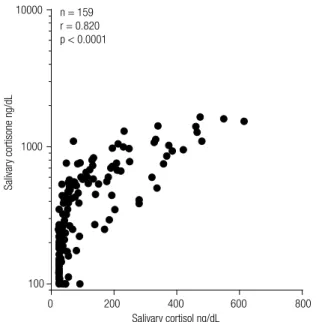
Objective: Salivary cortisol measurement plays an important role in the evaluation of adrenal func-tion. Its high correlation with free serum cortisol, the easy of sampling and the limited presence of interfering steroids, generated multiple recent studies of its application, in special in the screening of adrenal hyperfunction. In this paper we present our experience in the development of a high pres-sure liquid chromatography tandem mass spectrometry (HPLC-MS/MS) method for salivary cortisol and cortisone measurement. Materials and methods: For this study we used 181 saliva samples from our routine diagnostic laboratory. The HPLC-MS/MS method was based on a Waters Quattro Premier tandem mass spectrometer with an electrospray probe. After derivatization with hydroxyla-mine transitions monitored included cortisol and cortisone. An in-house radioimmunoassay (RIA) was used for salivary cortisol results comparison. Results: Functional sensitivity was 24 ng/dL for cortisol and linearity from 24 to 1929 ng/dL. Saliva cortisol values obtained in the 181 samples pre-sented a median of 52 ng/dL with 5-95% percentile of 24 and 374 ng/dL. With the RIA the results were 86, 25 and 436 ng/dL, respectively, with values for RIA being signiicantly higher (P < 0.0001) and high correlation (r = 0.8312, P < 0.0001). Cortisone measured in 159 samples showed a median of 278 ng/dL, with 5-95% percentile of 100 and 1,133 ng/dL. Correlation with cortisol values was signiicant (r = 0.820, P < 0.0001). Conclusion: We conclude that the HPLC-MS/MS method compares favorably with the RIA for salivary cortisol measurement, with the additional possibility of concomitant cor-tisone measurement and the evaluation of 11βHSD2 activity. Arq Bras Endocrinol Metab. 2014;58(8):844-50 Keywords
Salivary cortisol; salivary cortisone; mass spectrometry; radioimmunoassay; hypercortisolism screening
RESUMO
Objetivo: A dosagem de cortisol salivar é uma metodologia que vem tendo crescente aceitação no estudo da função adrenocortical. Sua alta correlação com a fração livre sérica, facilidade de coleta e presença limitada de interferentes têm originado múltiplas publicações, em especial no screening de pacientes suspeitos de hiperfunção. Neste trabalho apresentamos nossa experiên-cia no desenvolvimento de metodologia baseada em cromatograia líquida e espectrometria de massas (HPLC-MS/MS) para a medida de cortisol e cortisona salivares. Materiais e métodos:
Para este estudo utilizamos 181 amostras de saliva de nossa rotina diagnóstica. A metodologia de HPLC-MS/MS baseou-se num espectrômetro de massas Waters Quattro Premier. Após derivatiza-ção com hidroxilamina, as transições monitoradas incluíram cortisol e cortisona. Um radioimu-noensaio (RIE) in house foi empregado para comparação. Resultados: A sensibilidade funcional para cortisol foi de 24 ng/dL, com linearidade entre 24 e 1,929 ng/dL. Os valores de cortisol obti-dos nas 181 amostras apresentaram mediana de 52 ng/dL, com percentis 5-95% de 24 e 374 ng/dL. Com o RIE, os resultados foram 86, 25 e 436 ng/L, respectivamente, com os valores obtidos no RIE signiicativamente mais elevados (P < 0,0001), e alta correlação (r = 0,8312, P < 0,0001). Cortisona, medida em 159 amostras, mostrou mediana de 278 ng/dL, com percentis 5-95% entre 100 e 1.133 ng/dL. A correlação com os valores de cortisol foi signiicativa (r = 0,820, P < 0,0001). Conclusão:
Concluímos que o método baseado em HPLC-MS/MS compara-se favoravelmente com o RIE para a medida de cortisol salivar, com a possibilidade adicional da medida concomitante de corti-sona e avaliação da atividade da enzima 11βHSD2. Arq Bras Endocrinol Metab. 2014;58(8):844-50
Descritores
Cortisol salivar; cortisona salivar; espectrometria de massa; radioimunoensaio; triagem de hipercortisolismo
1 Steroid Laboratories, Grupo
Fleury, São Paulo, SP, Brazil
Correspondence to:
José Gilberto Henriques Vieira Av. General Valdomiro de Lima, 508 04344-010 – São Paulo, SP, Brazil [email protected]
Received on 11/Mar/2014 Accepted on 21/Ago/2014
Cop
yright
© ABE&M t
odos os dir
eit
os r
eser
vados
.
INTRODUCTION
S
erum total cortisol measurement by radioimmuno-assay (RIA) was one of the irst steroid hormone assays to be routinely available in diagnostic and research laboratories (1,2). Cortisol circulates mostly (90%) bound to corticosteroid-binding globulin (CBG), an endogenous protein with high afinity and speciicity (3). Cortisol not bound to CBG is either weakly bound to albumin (~6%) or free (~4%) and, consequently, the levels of total cortisol in serum or plasma are strongly dependent on CBG levels. Several circumstances inter-fere in CBG levels and afinity, from rare familial CBG deiciencies (hypoCBGnemias) (4), to frequent clinical conditions like pregnancy and steroid hormone contra-ceptives use. The need of methods for the evaluation of the free fraction, therefore excluding the interference of CBG levels, were described with assays mostly based on the available RIAs and serum equilibrium dialysis (5).Another alternative was to measure cortisol in urine, since only the free fraction is iltered (6), and results were very promising. Yet another possibility was the measurement of cortisol in saliva or parotid luid, since the free fraction is the main component, and several methods were successfully adapted (7,8) and when compared with free fraction in serum showed high correlation (9). Because saliva sample collection is easy, can be performed by the patient at home, and can be repeated at short intervals, cortisol in saliva is being used more and more frequently for the screening of adrenal pathologies, in special Cushing’s syndrome (10,11). The stress-free sample collection turns salivary cortisol in a biomarker for stress assessment. Actually it was shown that salivary cortisol can provide impor-tant information about hypothalamic-pituitary-adrenal (HPA) axis activity under normal and stress conditions. The introduction of a reference method, comparable within laboratories, is highly desirable (12).
Analytical speciicity shows punctual problems for routine immunoassays for total serum cortisol, mainly with synthetic corticosteroids use (e.g. Prednisone) and in patients with adrenal enzymatic defects. This obser-vation is valid despite the high speciicity of the antisera produced against cortisol-3-oxime coupled to a high molecular weight protein and the low relative concen-trations of endogenous interfering steroids (1,2). In the case in urine, the presence of several endogenous inter-fering steroids, in special cortisol metabolites, demands extraction and chromatography in order to achieve the necessary speciicity (13-15). The introduction of
tech-niques based in liquid chromatography associated with tandem mass spectrometry for the measurement of free urinary cortisol were a deinitive step forward in the improvement of the general characteristics of the assays (16,17), and additionally provided the opportunity to measure concomitantly free cortisone levels.
In saliva samples, in spite of the absence of the majority of the interfering steroids (in special cortisol metabolites) present in urine, the high levels of cor-tisone pose a potential problem for the speciicity of RIA-based techniques. Salivary epithelium cells express 11β-hydroxysteroid dehydrogenase type 2 (11β-HSD2) that converts cortisol to cortisone, protecting mineralo-corticoid receptors (MR) from cortisol binding. Con-sequently, the relative levels of cortisone/cortisol are much higher than in serum. The antisera developed against cortisol 3-oxime derivatives, even the best ones, shown cross-reactivity of 5 to 10% with cortisone (14), driving the interest for more speciic techniques.
Recent literature concerning the screening for Cushing’s syndrome provides strong evidence for the convenience and diagnostic speciicity of saliva corti-sol measurements, with emphasis for late night samples (10,11,18,19). These publications provided stimulus for the potential improvement of saliva cortisol assays with the introduction of high-pressure liquid chroma-tography coupled to tandem mass spectrometry based methods (HPLC-MS/MS) (20-23). In this paper we present our experience in the development of a HPLC-MS/MS method for the measurement of salivary corti-sol and cortisone and the comparison of the new tech-nique with of a time-validated direct RIA.
MATERIALS AND METHODS
Samples
phar-Cop
yright
© ABE&M t
odos os dir
eit
os r
eser
vados
.
macological induced variation (post-Dexametasone use), and pathological conditions (samples from two known Cushing’s disease patients are included). After analysis for salivary cortisol using the routine RIA method, samples had their cortisol and cortisone contents measured with the new HPLC-MS/MS method. A total of 181 samples were evaluated using both methods and in 159 of these samples, cortisone levels were also measured by HPLC-MS/MS. Values are expressed in ng/dL for cortisol and cortisone. To convert to nmol/L multiply by 0.0276 (e.g. 100 ng/dL corresponds to 2.76 nmol/L).
Statistical methods
The statistical methods used for assay comparison were non-parametric (Prism 6, GraphPad Inc, San Diego, CA, USA) and the program used for extrapolating de-cision points and method validation was EP Evaluator (David Roads Assoc., Kennett Square, PA, USA).
Assay procedures
Radioimmunoassay: the in house RIA method used the antiserum described in our original publication, produced by immunizing rabbits with a cortisol-3-oxime derivative coupled to bovine serum albumin (2), modiied for sa-liva samples (9). The speciicity study for the antiserum (F9-1) is depicted in table 1. All steroids were purchased from Steraloids Inc., Newport, RI, USA. Saliva samples (20 µL) were added directly, tritiated cortisol (New Eng-land Nuclear, Boston, USA) was used as tracer, and dex-tran-coated charcoal solution to separate bound and un-bound phases. Functional sensitivity was 25 ng/dL, with linearity ranging from 25 to 750 ng/dL, and intra-assay and inter-assay precision of 8.7 and 10.7%, respectively.
HPLC-MS/MS
The assay was based on a 2777 Waters autosampler and a Waters Quattro Premier tandem mass spectrometer with an electrospray probe (Waters/Micromass, Manchester, UK). Deuterated cortisol (9, 11, 12, 12-D4,98%, code DLM-2218) and cortisone (2,2,4,6,6,12, 12-D7, 98%, code DLM-9142) were used as internal standards, and acquired from Cambridge Isotope Laboratories. An ali-quot of 2 µL of each standard, corresponding to 2 ng of each (in water) was added to the saliva samples prior processing. Saliva samples (0.5 mL) were irst deprotein-ized with a 0.2 mol/L zinc sulphate/methanol solution (20/80, v/v) and the supernatant extracted in Strata X minicolumns (Phenomenex, Torrance, CA, USA). After
methanol elution, the samples were evaporated (Speed Vac) and derivatized with 0.3 mL of a 1.5 mol/L hy-droxylamine/methanol (50:50, v/v) solution for 90 min at 70°C. After cooling and centrifugation, 200 µL of the solution were injected directly in the HPLC sys-tem that consists in a Onyx C18 25x4.6 mm column eluted with 0.5 mol/L ammonium formate and metha-nol at 0.3 mL/min. A linear gradient ranging from 2 to 60% methanol of the mobile phase was applied in 3.25 minutes. The eluate was directly analysed by the MS/ MS operated in electrospray positive mode. The transi-tions monitored were m/z 393>136 and 393>91 (corti-sol), 397>136 and 397>91 (D4-corti(corti-sol), 391>167 and 391>149 (cortisone) and 398>167 and 398>149 (D7-cortisone). Analysis employed the QuanLynx software.
The validation of the assay included the speciicity study were solutions of 5,000 ng/dL of each of the steroids listed in table 1, were studied, showing no
in-Table 1. Cross-reactivity levels of antibody F79-1, as calculated in
percentage (%), according to Abraham (24) and the same steroids as percentage (%) in terms of area under de curve (AUC) with (limit of quantiication 24 ng/dL for cortisol and 100 ng/dL for cortisone) as reference for the HPLC-MS/MS method
Steroid
Cross reactivity
RIA (%) HPLC-MS/MS (AUC)
(%)
Cortisol 100 100
Cortisone 8.5 100
Corticosterone 1.2 < 0.5
Aldosterone < 0.012 < 0.5
DOC 0.42 < 0.5
5β-tetrahydrocortisone < 0.012 < 0.5
Cortisol-21-glucoronate 0,26 < 0.5
Cortisol-21-sulphate 0.37 < 0.5
21-deoxycortisol 12.2 < 0.5
5α-dihydrocortisol 10.0 < 0.5
5β-dihydrocortisol 2.8 < 0.5
20α-dihydrocortisol 0.09 < 0.5
20β-dihydrocortisol 0.82 < 0.5
6β-hydroxycortisol 2.5 < 0.5
5α-tetrahydrocortisol 5.0 < 0.5
5β-tetrahydrocortisol 0.03 < 0.5
Betametasone 0.075 < 0.5
Dexametasone < 0.012 < 0.5
Prednisolone 52.0 < 0.5
Prednisone 3.1 < 0.5
6α-metilprednisolone 17.7 < 0.5
Cop
yright
© ABE&M t
odos os dir
eit
os r
eser
vados
.
In igure 2 data are shown as a Bland-Altman plot pre-senting the differences (ng/dL) obtained between the two measurements (HPLC-MS/MS – RIA) against the average of the two individual values for each of the 181 samples. Both igures show clearly that the values ob-tained with the RIA are higher and that the dispersion increased with increasing values of samples. Regression analysis of the cortisol values with the two methods re-sulted in the equation Y = 0.85X-11-4, were Y corre-sponds to the HPLC-MS/MS result and X to the RIA result. Plotting cortisol values against time of sample col-lection showed the expected circadian rhythm (Figure 3). terference. All steroid standards were prepared in house
based on DMSO solutions of 1 mg/mL. The inal standard solution for assay use was 1% DMSO/water. Functional sensitivity, deined as a CV of less than 20% in the reading of the area under the curve (AUC), was 24 ng/dL for cortisol and 100 ng/dL for cortisone.
Linearity, studied by sequential dilution, ranging from 24 to 1920 ng/dL for cortisol, 100 to 2,400 ng/dL for cortisone; recovery studies varied between 90,4 and 107.1%, for cortisol and 90.3 to 101.3% for cortisone. Intra and inter assay precision for cortisol were 5.6 and 7.9% for a sample with mean value of 84 ng/dL and 4.7 and 5.3% for a sample with mean value of 413 ng/dL, respectively, and 9.1 and 6.8% for samples with mean value of 578 and 1453 ng/dL for cortisone.
RESULTS
In the 181 samples the RIA method showed a median of 86 ng/dL, with the percentile 5% of 25 ng/dL and 95% of 436 ng/dL; 17/181 were ≤ 24 ng/dL. With the HPLC-MS/MS method, the numbers were: median 52 ng/dL, percentile 5% 24 ng/dL and 95% 374 ng/dL; 48/181 samples were ≤ 24 ng/dL. Spearman correlation provided a high positive value of r = 0.8312 (P < 0.0001). The application of the Wilcoxon matched-pairs signed rank test showed a P value of < 0.0001, conirming a signiicant difference between results obtained with the two methods; values with the RIA method being higher than the obtained with HPLC-MS/MS. A graphic pre-sentation of the paired measures is depicted in igure 1.
Figure 1. Correlation between salivary cortisol measurements obtained
with the RIA and with the HPLC-MS/MS methods. 1000
100
10
10 100 1000
Salivary cortisol RIA ng/dL
Salivar
y cortisol HPLC-MS/S ng/dL
n = 181 p < 0.0001
1000 Average 100
400
200
0
-200
-400
Difference
300
200
100
0
4 8
Time of collection
Cortisol HPLC-MS/MS ng/dL
12 16 20 24
Figure 2. Bland-Altman presentation of the differences (ng/dL) obtained
between the two salivary cortisol methods (HPLC-MS/MS – RIA) plotted against the average of the two individual values for the 181 samples.
Figure 3. Median, 25, and 75 percentiles of salivary cortisol obtained in
the three windows of sample collection: 8:00 to 9:00, 16:00 to 17:00 and 23:00 to 24:00h.
Cop
yright
© ABE&M t
odos os dir
eit
os r
eser
vados
.
DISCUSSION
Steroid measurements in clinical and research labora-tories are gradually shifting from RIA-based method-ology to HPLC-MS/MS, as predicted by Schackleton more than 20 years ago (26) and reviewed recently by Carvalho (27,28). Concerning cortisol measurements, one important point is the media where the measure-ment is being made. For total serum cortisol, the levels of potential interfering steroids are low, and the need for more analytically speciic assays is doubtful. The real problem of clinical speciicity in serum cortisol mea-surements are the luctuations of the binding protein (CBG) levels, since up to 90% of cortisol circulates bound to CBG (3). The free hormone hypothesis im-plies that the biologically active hormone is restricted to the free fraction (29) and led to the development of free serum cortisol methods (5), that, to be truly valid imply that certain requirements be met, including the need of equilibrium dialysis or ultrailtration prior to the assay, with all the practical and economic limitations behind this kind of methodology (30).
Cortisol is present in urine and saliva, media where CBG is absent, so that glomerular iltration or saliva production, can be viewed as the in vivo equivalent to an in vitro dialysis. One problem of free urinary or sali-vary cortisol measurements is the presence of a higher concentration of potentially interfering steroids. This is true for traditional RIA methods, even employing the best anti-cortisol antibodies, as was patent for free
urinary cortisol measurement since the irst described methods (13,14).
The introduction of HPLC-MS/MS methods to clinical steroid measurements is a landmark equivalent to the introduction of RIA methods more than 40 years ago (25). The long maturation of the methodology, concerning its routine use, paralleled the development of HPLC and MS/MS equipment and technology and, nowadays, they may be considered prime for clinical laboratory use. Our experience with the introduction of free urinary cortisol measurement using HPLC-MS/MS, substituting traditional chromatography and RIA techniques, made clear the speciicity advantage of the new methodology (16). Higher speciicity implies lower and more comparable results, assuming the use of HPLC-MS/MS comparable technology.
Concerning salivary cortisol measurements, several points should be discussed. First, saliva is easy to col-lect, can be repeated several times in sequence and can be performed at home by the patient (11). The need of venipuncture for serum cortisol (free or total) sampling and the cumbersome 24h urine collection are circum-vented. Cortisol in saliva is stable and can be stored for long periods (24). With the availability of the commer-cial sampling devices, like the one described in this pa-per, the only real point is to avoid saliva contamination with any oral bleeding. Instructions of oral washing and avoiding teeth brushing in the hours before collection are essential.
Another point to be discussed is the peculiarity of salivary epithelium of harboring signiicant quantities of the enzyme 11βHSD2. This enzyme acts as a pro-tector of the speciicity of mineralocorticoid receptor (MR) by metabolizing cortisol to cortisone that has no afinity for the MR (31). 11βHSD2 is present in other epithelial tissues, mainly in the kidney, sweat glands and intestinal epithelium, tissues responsible for the control of sodium excretion (32). The additional possibility of measuring concomitantly cortisone in the saliva sam-ples permits the evaluation of 11βHSD2 activity, with potential interest in several circumstances.
Our results are comparable to the ones recently re-ported in the literature (20-23). Salivary cortisol values obtained with the HPLC-MS/MS method were sig-niicantly lower than the ones obtained with the direct RIA technique. That result was expected in function of the greater analytical speciicity of the HPLC-MS/MS methodology. The regression equation generated with our data is quite similar to one reported recently by 10000 n = 159
r = 0.820 p < 0.0001
1000
100
0 200 400 600 800
Salivar
y cortisone ng/dL
Salivary cortisol ng/dL
Figure 4. Correlation between salivary cortisol and cortisone values
Cop
yright
© ABE&M t
odos os dir
eit
os r
eser
vados
.
McWhinney and cols. (33), utilizing similar methods. Additionally, the lower coeficient of variation obtained with HPLC-MS/MS provides more precision for the saliva measurement. This open the possibility of easier and more realistic assay comparison, provided they are based in HPLC-MS/MS methods, and should permit the deinition of cut-off values with more precision. Consequently better performance for screening me-thods, in special for Cushing’s syndrome with late night collected saliva samples, should be expected.
The salivary cortisone values found in this study, higher than the cortisol levels, showed a mean relation cortisol/cortisone of 0.19, which is in accordance to reported values using similar methods (33). In urine a relation of 0.28 was reported (17,33), and both num-bers are completely different from the one in serum, were the relation of cortisol/cortisone is around 5.0. These indings can be explained mainly by two observa-tions. The irst one is based on the fact that free frac-tion of cortisone is higher than free fracfrac-tion of cortisol (3), consequently the iltered proportion of cortisone is higher. The second observation concerns the 11βHSD2 activity in salivary gland acinar cells, with cortisone pro-duction directly reaching saliva; in urine the enzyme is located in tubular cells, with cortisone added as the glomerular iltrate lows through the tubules.
From a methodological point of view, RIE tech-niques for salivary cortisol (mainly when using high quality antisera) are simpler, cheaper and wildly avail-able, when comparing to LC-MS/MS methods. The use of alternative labeling techniques (non-radioac-tive) turns direct salivary cortisol measurement a sim-ple and affordable method. HPLC-MS/MS me thods provide better speciicity, allow the concomitant mea-surement for salivary cortisone, but they are only cost-effective in laboratories that already have made the important investments in installation, equipment and staff training, that a steroid lab based on HPLC-MS/MS requires.
The analysis of hormones, in special cortisol, in sa-liva is a methodology that has been in maturation for the last decades. The availability of simple collection devices, the easiness and out of clinic/hospital sample collection by the patient, and now the maturation of methods of high precision and speciicity, like the one described in this paper, should increase the acceptance of this methodology by clinicians in general (34).
Author contributions: all authors conirm their participation in the development, drafting and approval of the article.
Disclosure: José Gilberto Henriques Vieira, Odete Hirata Naka-mura, Valdemir Melechko Carvalho are employees, Grupo Fleu-ry, São Paulo. José Gilberto Henriques Vieira owns stock of Gru-po Fleury (FLRY3).
REFERENCES
1. Riad-Fahmy D, Read GF, Hillier SG. Some observations on the de-termination of cortisol in human plasma by radioimmunoassay using antisera against cortisol-3-BSA. Steroids. 1975;26:267-80. 2. Vieira JG, Russo EMK, Germeck AO, Antunes LNA. Método
ra-dioimunológico para a dosagem de cortisol sérico. Rev Bras Patol Clin. 1979;15:125-30.
3. Dunn JF, Nisula BC, Rodbard D. Transport of steroid hormones: binding of 21 endogenous steroids to both testosterone-binding globulin and corticosteroid-binding globulin in human plasma. J Clin Endocrinol Metab. 1981;53:58-68.
4. Brunner E, Baima J, Vieira TC, Vieira JG, Abucham J. Hereditary corticosteroid-binding globulin deiciency due to a missense mu-tation (Asp367Asn, CBG Lyon) in a Brazilian kindred. Clin Endo-crinol. 2003;58:756-62.
5. Vieira JG, Noguti KO, Russo EMK, Hidal JT, Maciel RMB. Adapta-ção de um radioimunoensaio de cortisol para a dosagem da fra-ção livre do soro obtida por diálise. Arq Bras Endocrinol Metab. 1982;26:105-8.
6. Borsi L, Manelli M, Barbieri U, Giannotti P, Serio M. Measurement of urinary free cortisol by radioimmunoassay and its clinical ap-plications. J Nucl Biol Med. 1976;20:160-4.
7. Walker RF, Riad-Fahmy D, Read GF. Adrenal status assessed by direct radioimmunoassay of cortisol in whole saliva or parotid saliva. Clin Chem. 1978;24:1460-3.
8. Silver AC, Landon J, Smith DS, Perry LA. Radioimmunoas-say of cortisol in saliva with the “GammaCat” kit. Clin Chem. 1983;29:1869-70.
9. Vieira JG, Noguti KO, Hidal JT, Russo EMK, Maciel RMB. Ensaio do cortisol na saliva como um método para a avaliação da fração livre sérica. Arq Bras Endocrinol Metab. 1984;28:8-10.
10. Luthold WW, Marcondes JA, Wajchenberg BL. Salivary corti-sol for the evaluation of Cushing’s syndrome. Clin Chem Acta. 1985;151:33-9.
11. Castro M, Elias PCL, Quidute ARP, Halah FPB, Moreira AC. Out-patient screening for Cushing’s syndrome: the sensitivity of the combination of circadian rhythm and overnight dexamethasone suppression salivary cortisol tests. J Clin Endocrinol Metab. 1999;84:878-82.
12. Jessop DS, Turner-Cobb JM. Measurement and meaning of sali-vary cortisol: a focus on health and disease in children. Stress. 2008;11:1-14.
13. Pearson Murphy BE. Lack of speciicity of urinary free cortisol determinations: why does it continue? J Clin Endocrinol Metab. 1999;84:2258-9.
14. Vieira JG, Noguti KO, Rayol MP, Maciel RMB. Desenvolvimento e caracterização de método para a dosagem de cortisol livre urinário. Arq Bras Endocrinol Metab. 2000;44:233-8.
15. Morineau G, Gosling J, Patricot MC, Soliman H, Boudou P, al Hanak A, et al. Convenient chromatographic prepuriication step before measurement of urinary cortisol by radioimmunoassay. Clin Chem. 1997;43:786-93.
16. Taylor RL, Machacek D, Singh RJ. Validation of a high-throughput liquid chromatography-tandem mass spectrometry method for urinary cortisol and cortisone. Clin Chem. 2002;48:1511-9. 17. Vieira JG, Nakamura OH, Carvalho VM. Dosagem de cortisol e
as-Cop
yright
© ABE&M t
odos os dir
eit
os r
eser
vados
.
sociada a espectrometria de massa em tandem (LC-MS/MS). Arq Bras Endocrinol Metab. 2005;49:291-8.
18. Raff H, Raff JL, Findling JW. Late-night cortisol as a screening test for Cushing’s syndrome. J Clin Endocrinol Metab. 1998;83:2681-6. 19. Raff H. Update on late-night salivary cortisol for the diagnosis of
Cushing’s syndrome: methodological considerations. Endocrine. 2013;44:346-9.
20. Baid SK, Sinaii N, Wade M, Rubino D, Nieman LK. Radioimmuno-assay and tandem mass spectrometry measurement of bedtime salivar cortisol levels: a comparison of assays to stablish hyper-cortisolism. J Clin Endocrinol Metab. 2007;92:3102-7.
21. Perogamvros I, Owen LJ, Newell-Price J, Ray DW, Trainer PJ, Kee-vil BG. Simultaneous measurement of cortisol and cortisone in human saliva using liquid chromatography-tandem mass spec-trometry: application in basal and stimulated conditions. J Chro-matogr B. 2009;877:3771-5.
22. Miller R, Plessow F, Rauh M, Gröschl M, Kirschbaum C. Com-parison of salivary cortisol as measured by different immunoas-says and tandem mass spectrometry. Psiconeuroendocrinology. 2013;38:50-7.
23. Zerikly RK, Amiri L, Faiman C, Gupta M, Singh RJ, Nutter B, et al. Diagnostic characteristics of late-night salivary cortisol using liquid chromatography-tandem mass spectrometry. J Clin Endo-crinol Metab. 2010;95:4555-9.
24. Garde AH, Hansen AM. Long-term stability of salivary cortisol. Scand J Clin Lab Invest. 2005;65:433-6.
25. Abraham GE. Radioimmunoassay of steroids in biological mate-rials. Acta Endocrinol (Kbh). 1974;183(Suppl):1-42.
26. Shackleton CH. Mass spectrometry in the diagnosis of steroid-related disorders and hypertension research. J Steroid Biochem Mol Biol. 1993;45:127-40.
27. Carvalho VM, Nakamura OH, Vieira JG. Simultaneous quantita-tion of seven endogenous C-21 adrenal steroids by liquid chro-matography tandem mass spectrometry in human serum. J Chromatogr B Analyt Technol Biomed Life Sci. 2008;872:154-61. 28. Carvalho VM. The coming of age of liquid chromatography coupled
to tandem mass spectrometry in the endocrinology laboratory. J Chromatogr B Analyt Technol Biomed Life Sci. 2012;883-884:50-8. 29. Mendel CM. The free hormone hypothesis: a physiologically
based mathematical model. Endocr Rev. 1989;10:232-74. 30. Ekins R. The free hormone hypothesis and measurement of free
hormones. Clin Chem. 1992;38:1289-93.
31. Funder JW, Pearce PT, Smith R, Smith AI. Mineralocorticoid ac-tion: target speciicity is enzyme, not receptor mediated. Science. 1988;242:583-5.
32. Smith RE, Maguire JA, Stein-Oakley AN, Sasano H, Takahashi KI, Fukushima K, et al. Localization of 11β-hydroxysteroid dehy-drogenase type II in human epithelial tissues. J Clin Endocrinol Metab. 1996;81:3244-8.
33. McWhinney BC, Briscoe SE, Ungerer JPJ, Pretorius CJ. Measure-ment of cortisol, cortisone, prednisolone, dexamethasone and 11-deoxycortisol with ultra high performance liquid chromatog-raphy-tandem mass spectrometry: Application for plasma, plas-ma ultrailtrate, urine and saliva in a routine laboratory. J Chro-matogr B Analyt Technol Biomed Life Sci. 2010;878(28):2863-9. 34. Gröschl M. Current status of salivary hormone analysis. Clin