Cop
yright
© ABE&M t
odos os dir
eit
os r
eser
vados
.
Mutation screening of the sodium
iodide symporter gene in a
cohort of 105 China patients with
congenital hypothyroidism
Análise de mutações no gene simportador sódio/iodeto em coorte de 105 pacientes chineses com hipotireoidismo congênito
Chunyun Fu1, Shaoke Chen1, Rongyu Chen1,
Xin Fan1, Jingsi Luo1, Chuan Li1, Jiale Qian1
ABSTRACT
Objective: Dyshormonogenetic congenital hypothyroidism (CH) was reported to be associated with a mutation in the sodium iodide symporter (NIS) gene. The present study was undertaken in the Guangxi Zhuang Autonomous Region of China, to determine the nature and frequency of NIS gene mutations among patients with CH due to dyshormonogenesis. Subjects and me-thods: Blood samples were collected from 105 dyshormonogenetic CH patients in Guangxi Zhuang Autonomous Region, China, and genomic DNA was extracted from peripheral blood leukocytes. All exons of the NIS gene together with their exon-intron boundaries were screened by next-generation sequencing. Results: Two silent variations (T221T and T557T) and one mis-sense variation (M435L), as well as two polymorphisms (rs200587561 and rs117626343) were found. Conclusions: Our results indicate that the NIS mutation rate is very low in the Guangxi Zhuang Autonomous Region, China, and it is necessary to study mutations of other genes that have major effects on thyroid dyshormonogenesis and have not as yet been studied in this population. Arq Bras Endocrinol Metab. 2014;58(8):828-32
Keywords
Congenital hypothyroidism; sodium iodide symporter gene; gene mutations; China; next-generation sequencing
RESUMO
Objetivo: O hipotireoidismo congênito disormonogenético (CH) foi relatado como associado a uma mutação no gene simportador sódio/iodeto (NIS). O presente estudo foi feito na região au-tônoma de Guangxi Zhuang na China para se determinar a natureza e a frequência das mutações no gene NIS entre pacientes com CH causado por disormonogênese. Sujeitos e métodos: Amos-tras de sangue foram coletadas de 105 pacientes com CH disormonogenéticos e o DNA genômi-co foi extraído de leucócitos do sangue periférigenômi-co. Todos os éxons do gene NIS, junto genômi-com seus limites éxon-íntron, foram analisados por sequenciamento de nova geração. Resultados: Foram encontradas duas variações silenciosas (T221T e T557T) e uma variação missense (M435L), assim como dois polimorismos (rs200587561 e rs117626343). Conclusões: Nossos resultados indicam que a taxa de mutação em NIS é muito baixa na região de Guangxi Zhuang. É necessário estudar mutações de outros genes que tenham efeitos maiores na disormonogênese da tiroide e que ainda não tenham sido estudados nesta população. Arq Bras Endocrinol Metab. 2014;58(8):828-32
Descritores
Hipotireoidismo congênito; gene simportador sódio/iodeto; mutações genéticas; China; sequenciamento de nova geração
1 Department of Genetic Metabolism, Children’s Hospital, Maternal and Child Health Hospital of Guangxi Zhuang Autonomous Region, Nanning 530003, People’s Republic of China
Chunyun Fu and Shaoke Chen contributed equally to this work
Correspondence to: Shaoke Chen
Department of Genetic Metabolism, Children’s Hospital, Maternal and Child Health Hospital of Guangxi Zhuang Autonomous Region, 59 Xiangzhu Road, Nanning 530003 – Guangxi Zhuang Autonomous Region, P.R. China [email protected]
Received on Apr/28/2014 Accepted on Aug/4/2014
Cop
yright
© ABE&M t
odos os dir
eit
os r
eser
vados
.
INTRODUCTION
C
ongenital hypothyroidism (CH) is a commonendocrine disorder in newborns, with prevalence ranging from 1:2000 to 1:4000 (1,2). The etiology of congenital hypothyroidism is heterogeneous. Eighty to eighty-ive percent of cases are caused by disorders of thyroid gland development (3), which has been linked to mutations in TSHR, PAX8, NKX2.1, NKX2.5 and FOXE1 genes (3); the remaining 15-20% of cases are due to the abnormalities in thyroid hormone synthesis (dyshormonogenesis) (4).
Defects in the human NIS gene are reported to be one of the causes of CH due to dyshormonogenesis (5). NIS is a specialized plasma membrane glycoprotein that has an important role in active trapping of iodine from the bloodstream into thyrocytes, the key step in the bio-synthesis of the iodine-containing thyroid hormones T3 and T4 (6). NIS gene mutations can cause iodide trans-port defects (ITD) (7-9), a disorder that if not diag-nosed and treated during the early infancy period would result in CH due to dyshormonogenesis. Up to now, the mutational spectrum of the NIS and the genotype-phe-notype relationships has not yet been fully established, and there is also no report of human NIS mutations in the Chinese population. Here, we report an investiga-tion on the prevalence of inactivating NIS mutainvestiga-tions in the Guangxi Zhuang Autonomous Region, China. The primary objective was to screen for the presence of muta-tions in NIS gene among patients with dyshormonoge-netic CH in the Guangxi Zhuang Autonomous Region.
SUBJECTS AND METHODS
Subjects
We enrolled 105 patients with dyshormonogenetic CH, who were identiied through newborn screening among 353,000 newborns in the Guangxi Zhuang Au-tonomous Region, China, from October 2010 to June 2013. All of the subjects underwent neonatal screening using ilter paper for CH at 72h after birth when blood samples were collected from the heel and TSH levels were measured by enzyme-linked immunosorbent as-say. Subjects with increased TSH (TSH ≥ 10 uU/mL) levels observed during neonatal screening were recalled for further evaluation. Serum TSH and FT4 were de-termined by electrochemiluminescence assay. Diagnosis of CH is based on elevated TSH levels (normal range 0.27-4.2 µIU/mL) and decreased FT4 levels (normal
range 12-22 pmol/L). The etiology of CH was deter-mined by thyroid scan and/or ultrasound before treat-ment in the neonatal period or at the age of 3 years after conirming the permanency of CH. Patients with normal size or enlarged thyroid gland were considered to have dyshormonogenesis. The study was approved by the local Medical Ethics Committee. Informed con-sent was obtained from the parents of the patients.
Mutation detection
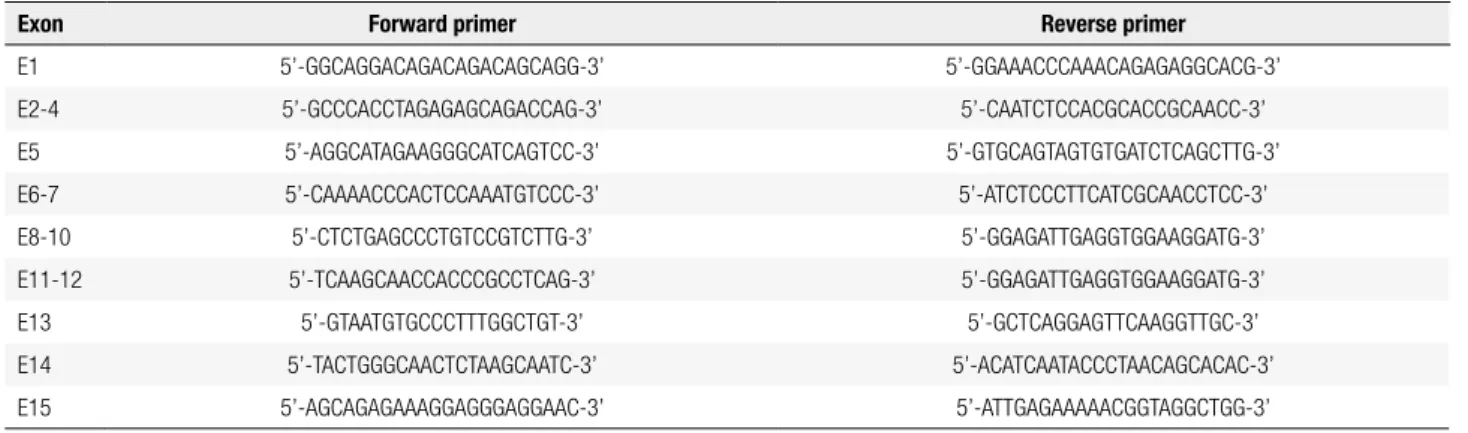
Peripheral venous blood samples were collected from the patients. Genomic DNA was extracted from pe-ripheral blood leukocytes using QIAamp DNA Blood Mini Kit (Qiagen, Germany) according to the manu-facturer’s protocol. Exons 1 to 15 of NIS with their lanking intronic regions were ampliied in a 50 µL re-action using the primers shown in table 1. The 50 µL of PCR reaction mixture containing 100-250 ng of ge-nomic DNA, 1× Taq Buffer with 50 mM of KCl, 2.5 mM of MgCl, 200 µM of dNTP, 1unit of Taq DNA polymerase (Fermentas, USA), and 20 pmol of for-ward and reverse primers were prepared. Thirty cycles of ampliication were carried out with a standard PCR protocol. PCR products were puriied using QIA quick PCR puriication kit (Qiagen, Germany) following the manufacturer’s instructions. The puriied PCR pro-ducts were sequenced using Illumina MiSeq next gen-eration sequencing instrument (Illumina, America). A control group of 600 healthy subjects without thyroid disease was also screened for the same mutations. All control subjects had normal FT4 (12-22 pmol/L) and TSH levels (0.27-4.2 µIU/mL).
Functional prediction of mutation
The potential functional impact of variations were pre-dicted using both sorting intolerant from tolerant (SIFT) and Polymorphism Phenotyping 2 (PolyPhen-2), to pre-dict the degree of (possible) impact of an amino acid sub-stitution on the structure and function of a human pro-tein. The functional impact of the mutation was depicted as “tolerated” or “damaging” for SIFT and predicted as “benign”, “possibly damaging”, “probably damaging”, or “unknown” for PolyPhen.
RESULTS
varia-Cop
yright
© ABE&M t
odos os dir
eit
os r
eser
vados
.
tions include two silent variations (T221T and T557T), one missense variation (M435L) and two polymor-phisms (rs200587561 and rs117626343). The unre-ported variations in the NIS gene were tested against DNA samples from 600 healthy control subjects.
The NIS protein sequences of different species, in-cluding Homo sapiens, Mus musculus, Rattus norvegi-cus, Bos taurus, Danio rerio and Sus scrofa were obtained from the National Center for Biotechnology
Informa-Figure 1. Multiple sequence alignment of sodium iodide symporter (NIS) genes from Homo sapiens, Mus musculus, Rattus norvegicus, Danio rerio, Sus
scrofa and Bos taurus. The arrow indicates that the glycine 435 residue is located within a highly conserved region.
Figure 2. Functional prediction of the M435L variation. (A) The functional impact of the variation was depicted as “tolerated” for SIFT. (B) The functional
impact of the variation was depicted as “benign” for PolyPhen-2.
tion (NCBI) website. Using DNAMAN software, we observed multiple sequence alignment of the NIS gene family of various species. We found that codon 435 where the missense mutation (p.M435L) was identiied, was lo-cated in a highly conserved region of NIS (Figure 1).
The potential functional impact of M435L was dicted using both SIFT and PolyPhen-2 and the pre-diction result was depicted as “tolerated” for SIFT and “benign” for PolyPhen-2 (Figure 2).
Table 1. List of NIS primers
Exon Forward primer Reverse primer
E1 5’-GGCAGGACAGACAGACAGCAGG-3’ 5’-GGAAACCCAAACAGAGAGGCACG-3’ E2-4 5’-GCCCACCTAGAGAGCAGACCAG-3’ 5’-CAATCTCCACGCACCGCAACC-3’ E5 5’-AGGCATAGAAGGGCATCAGTCC-3’ 5’-GTGCAGTAGTGTGATCTCAGCTTG-3’ E6-7 5’-CAAAACCCACTCCAAATGTCCC-3’ 5’-ATCTCCCTTCATCGCAACCTCC-3’ E8-10 5’-CTCTGAGCCCTGTCCGTCTTG-3’ 5’-GGAGATTGAGGTGGAAGGATG-3’ E11-12 5’-TCAAGCAACCACCCGCCTCAG-3’ 5’-GGAGATTGAGGTGGAAGGATG-3’ E13 5’-GTAATGTGCCCTTTGGCTGT-3’ 5’-GCTCAGGAGTTCAAGGTTGC-3’ E14 5’-TACTGGGCAACTCTAAGCAATC-3’ 5’-ACATCAATACCCTAACAGCACAC-3’ E15 5’-AGCAGAGAAAGGAGGGAGGAAC-3’ 5’-ATTGAGAAAAACGGTAGGCTGG-3’
Table 2. Previously reported and novel variations identiied in the present study
Exon NIS gene variants Type Reference
Frequency of minor alleles in dyshormonogenetic CH
patients (210 alleles)
Frequency of minor alleles in healthy control
subjects (1200 alleles)
7 C310C SNP rs200587561 0.0048 NA 10 L408L SNP rs117626343 0.0048 NA 5 T221T Silent variation Not reported 0.0048 0.0050 14 T557T Silent variation Not reported 0.0048 0.0058 11 M435L Missense variation Not reported 0.0142 0.00
Cop
yright
© ABE&M t
odos os dir
eit
os r
eser
vados
.
DISCUSSION
Human NIS gene was cloned for the irst time in 1996. It is located on chromosome 19p12-13.2 and consists of 15 exons, and encodes a protein of 643 amino aci ds with a molecular mass of approximately 70-90 kDa (10). The secondary structure of NIS is an intrinsic membrane protein with 13 transmembrane segments, an extracellular amino-terminus and an intracellular carboxyl-terminus (11,12). Up to now, 15 mutations in this symporter gene that causes ITD have been iden-tiied: -54C >T, V59E, G93R, R124H, ∆142-323, Q267E, C272X, ∆287-288, T354P, G395R, ∆439-443, frameshift 515X, ∆439-∆439-443, Y531X, and G543E (13-15). Some of these ITD mutants, including V59E, G93R, ∆439-443, R124H, Q267E, T354P, G395R, and G543E, have been studied in detail and have pro-vided key mechanistic information on NIS (15-22).
Because NIS mutations are inherited in an autoso-mal recessive manner, heterozygous individuals do not present with the phenotype. NIS gene defects can be detected only when both alleles are mutated. Further-more, under the conditions of high iodine intake, when full preservation of iodine concentrating function is not required to achieve normal thyroid hormone synthesis, mutations causing impairments of function may not be detected even in the homozygous patients. For these reasons, the actual prevalence of NIS gene mutations may be much higher than that reported.
To conirm our hypothesis and to investigate the frequency of NIS gene mutations in China, we screened NIS mutations in a cohort of 105 dyshor-monogenetic CH patients from the Guangxi Zhuang Autonomous Region in China. In all, two silent varia-tions (T221T and T557T) and one missense variation (M435L), as well as two polymorphisms (rs200587561 and rs117626343) were found. The mutated Met435 residue lies in the midst of the putative eleventh trans-membrane segment of the NIS protein, although it is conserved among species, in addition, the M435L vari-ation was not found in 600 control individuals (Table 2), yet the potential functional impact of the variation was predicted to be “benign” both by SIFT and Poly-Phen-2.
In the current study, we did not ind any inactivating mutation of NIS gene among the studied population. The following two possibilities could account for the obtained results: 1) the NIS mutation rate is very low in our CH patients and 2) we studied CH patients with thyroid dyshormonogenesis without selection based on
etiology, as ITD is a rare form of dyshormonogenetic CH. The identiication criteria for ITD includes low or absent radioiodide uptake (RIUT) by the thyroid and several extrathyroidal tissues [such as the salivary glands, lactating mammary gland and gastric mucosa (23-27)], and a low iodide saliva-to-plasma (S/P) ratio (28).
Understandably, most of the parents of CH patients did not allow the radioiodine uptake test to be under-taken and the etiology of CH was determined mostly by ultrasonography and not by thyroid scintigraphy, the radioiodine uptake test was not performed in our studied population.
In addition, there was no facility to measure the iodide saliva-to-plasma (S/P) ratio in our current set-tings.
Taken together, by studying a large sample of pa-tients with accurate determination of the etiology of thyroid dyshormonogenesis, mutations in NIS gene may be found in the patients.
Interestingly, we also found that some of the pa-tients had normal sized thyroid gland as determined by clinical examination, but goiter could present in them later although not in the irst years of life. This may be due to early diagnosis and treatment of these patients.
In conclusion, our results indicate that mutations of NIS gene do not play a major role in the etiology of thyroid dyshormonogenesis among patients with CH in the Guangxi Zhuang automous region of Chi-na. Future studies may include mutation detection of other genes that have major effects on thyroid dyshor-monogenesis and have not as yet been studied in our population.
Acknowledgments:we thank all members of the research group for their contributions to this investigation. We thank the Na-tional Natural Science Foundation of China (81260126) and Guangxi Natural Science Foundation Program (2012GXNS-FAA053174) for inancial support. The authors would like to thank Dr. Dev Sooranna, Imperial College London, for helping to edit the manuscript.
REFERENCES
1. Rastogi MV, LaFranchi SH. Congenital hypothyroidism. Orphanet J Rare Dis. 2010;5:17.
2. Park SM, Chatterjee VK. Genetics of congenital hypothyroidism. J Med Genet. 2005;42(5):379-89.
Cop
yright
© ABE&M t
odos os dir
eit
os r
eser
vados
.
4. Jain V, Agarwal R, Deorari AK, Paul VK. Congenital hypothyroid-ism. Indian J Pediatr. 2008;75(4):363-7.
5. Targovnik HM, Citterio CE, Rivolta CM. Thyroglobulin gene mutations in congenital hypothyroidism. Horm Res Paediatr. 2011;75(5):311-21.
6. Paroder V, Nicola JP, Ginter CS, Carrasco N. The iodide-transport-defect-causing mutation R124H: a δ-amino group at position 124 is critical for maturation and traficking of the Na+/I- symporter. J Cell Sci. 2013;126(Pt 15):3305-13.
7. Dohan O, De la Vieja A, Paroder V, Riedel C, Artani M, Reed M, et al. The sodium/Iodide symporter (NIS): characterization, regula-tion, and medical signiicance. Endocrine Rev. 2003;24(1):48-77. 8. Spitzweg C, Morris JC. The sodium iodide symporter: its
patho-physiological and therapeutic implications. Clin Endocrinol. 2002;57(5):559-74.
9. Riesco-Eizaguirre G, Santisteban P. A perspective view of sodium iodide symporter research and its clinical implications. Eur J En-docrinol. 2006;155(4):495-512.
10. Smanik PA, Ryu KY, Theil KS, Mazzaferri EL, Jhiang SM. Ex-pression, exon-intron organization, and chromosome map-ping of the human sodium iodide symporter. Endocrinology. 1997;138(8):3555-8.
11. Levy O, De la Vieja A, Ginter CS, Riedel C, Dai G, Carrasco N. N-linked glycosylation of the thyroid Na+/I- symporter (NIS). Implications for its secondary structure model. J. Biol. Chem. 1998;273(35):22657-63.
12. Riedel C, Levy O, Carrasco N. Post-transcriptional regulation of the sodium/iodide symporter by thyrotropin. J Biol Chem. 2001;276(24):21458-63.
13. Spitzweg C, Morris JC. Genetics and phenomics of hypothy-roidism and goiter due to NIS mutations. Mol Cell Endocrinol. 2010;322(1-2):56-63.
14. Nicola JP, Nazar M, Serrano-Nascimento C, Goulart-Silva F, So-brero G, Testa G, et al. Iodide transport defect: functional charac-terization of a novel mutation in the Na+/I- symporter 5’-untrans-lated region in a patient with congenital hypothyroidism. J Clin Endocrinol Metab. 2011;96(7):E1100-7.
15. Li W, Nicola JP, Amzel LM, Carrasco N. Asn441 plays a key role in folding and function of the Na+/I- symporter (NIS). FASEB J. 2013;27(8):3229-38.
16. Paroder-Belenitsky M, Maestas MJ, Dohan O, Nicola JP, Reyna-Neyra A, Follenzi A, et al. Mechanism of anion selectivity and stoi-chiometry of the Na+/I-symporter (NIS). Proc Natl Acad Sci U S A. 2011;108(44):1793-38.
17. Reed-Tsur MD, De la Vieja A, Ginter CS, Carrasco N. Molecu-lar characterization of V59E NIS, a Na+/I_symporter mutant
that causes congenital I- transport defect. Endocrinology. 2008;149(6):3077-84.
18. De la Vieja A, Reed MD, Ginter CS, Carrasco N. Amino acid resi-dues in transmembrane segment IX of the Na+/I- symporter play a role in its Na+ dependence and are critical for transport activity. J Biol Chem. 2007;282(35):25290-98.
19. De La Vieja A, Ginter CS, Carrasco N. The Q267E mutation in the sodium/iodide symporter (NIS) causes congenital iodide trans-port defect (ITD) by decreasing the NIS turnover number. J Cell Sci. 2004;117(Pt5):677-87.
20. De la Vieja A, Ginter CS, Carrasco N. Molecular analysis of a congenital iodide transport defect: G543E impairs matura-tion and traficking of the Na+/I-symporter. Mol Endocrinol. 2005;19(11):2847-58.
21. Dohan O, Gavrielides MV, Ginter C, Amzel LM, Carrasco N. Na(+)/I(-) symporter activity requires a small and uncharged ami-no acid residue at position 395. Mol Endocriami-nol. 2002;16(8):1893-902.
22. Levy O, Ginter CS, De la Vieja A, Levy D, Carrasco N. Identiication of a structural requirement for thyroid Na+/I+ symporter (NIS) function from analysis of a mutation that causes human congeni-tal hypothyroidism. FEBS Lett. 1998;429(1):36-40.
23. Tazebay UH, Wapnir IL, Levy O, Dohan O, Zuckier LS, Zhao QH, et al. The mammary gland iodide transporter is expressed during lactation and in breast cancer. Nat Med. 2000;6(8):871-8. 24. Wapnir IL, van de Rijn M, Nowels K, Amenta PS, Walton K,
Mont-gomery K, et al. Immunohistochemical proile of the sodium/io-dide symporter in thyroid, breast, and other carcinomas using high density tissue microarrays and conventional sections. J Clin Endocrinol Metab. 2003;88(4):1880-8.
25. Altorjay A, Dohán O, Szilágyi A, Paroder M, Wapnir IL, Carrasco N. Expression of the Na+/I- symporter (NIS) is markedly decreased or absent in gastric cancer and intestinal metaplastic mucosa of Barrett esophagus. BMC Cancer. 2007;7:5.
26. Nicola JP, Basquin C, Portulano C, Reyna-Neyra A, Paroder M, Carrasco N. The Na+/I− symporter mediates active iodide uptake in the intestine. Am J Physiol. 2009;296(4):C654-62.
27. Nicola JP, Reyna-Neyra A, Carrasco N, Masini-Repiso AM. Di-etary iodide controls its own absorption through post-transcrip-tional regulation of the intestinal Na+/I- symporter. J Physiol. 2012;590(Pt23):6013-26.