11
Revista da Sociedade Brasileira de Medicina Tropical 49(1):11-23, Jan-Feb, 2016
http://dx.doi.org/10.1590/0037-8682-0176-2015
Review Article
Corresponding author: Dr. Francisco José Dutra Souto. e-mail: [email protected]
Received 25 May 2015 Accepted 17 July 2015
Distribution of hepatitis B infection in Brazil:
the epidemiological situation at the
beginning of the 21
st
century
Francisco José Dutra Souto
[1][1]. Hospital Universitário Júlio Muller, Universidade Federal de Mato Grosso, Cuiabá, Mato Grosso, Brazil.
ABSTRACT
Brazil was formerly considered a country with intermediate hepatitis B endemicity, with large heterogeneity between Brazilian
regions and areas of high prevalence, especially in the Amazon basin. Systematic vaccination of children was initiated in 1998.
Between 2004 and 2009, a large population-based study reported decreased prevalence in all regions of Brazil. This review
analyzed the current hepatitis B epidemiological situation in Brazil through a systematic search of the scientifi c literature in
MEDLINE, LILACS, and CAPES thesis database, as well as disease notifi cations to the Information System for Notifi able
Diseases. The search strategy identifi ed 87 articles and 13 theses, resulting in 100 total publications. The most recent results
indicate reduced hepatitis B prevalence nationwide, classifying Brazil as having low endemicity. Most studies showed HBV
carrier prevalence less than 1%. However, there are still isolated regions with increased prevalence, particularly the Amazon, as
well as specifi c groups, such as homeless people in large cities and isolated Afro-descendant communities in the center of the
country. This review alsao detected successful vaccination coverage reported in a few studies around the country. The prevalence
of anti-HBs alone ranged from 50% to 90%. However, isolated and distant localities still have low coverage rates. This review
reinforces the downward trend of hepatitis B prevalence in Brazil and the need to intensify vaccination strategies for young
people and adults in specifi c regions with persisting higher HBV infection prevalence.
Keywords
: HBV. Brazil. Epidemiology. Prevalence. Incidence. Vaccine.
INTRODUCTION
Hepatitis B is a viral infectious disease responsible for
signifi cant worldwide human morbidity and mortality. This
disease burden is due mainly to complications of chronic
infections, such as liver cirrhosis and hepatocellular carcinoma
(1) (2).
The hepatitis B virus (HBV) is transmitted person-to-person
through contact with blood, exudates, and other body fl uids
such as semen and vaginal secretions. Although iatrogenic
dissemination was a common route of transmission throughout
the second half of the 20
thcentury due to blood product
transfusion and sharing or reuse of syringes and needles,
natural routes of transmission are mainly responsible for the
high disease prevalence, including sexual, vertical (perinatal,
from mother to newborn), and horizontal transmission from
environmental exposure in the home, prisons, and other
confi nement institutions.
PREVALENCE AND GLOBAL DISTRIBUTION
OF HEPATITIS B VIRUS
The World Health Organization (WHO) classifi es hepatitis
B endemicity according to the prevalence of the serological
marker of viremia, the hepatitis B surface antigen (HBsAg)
(3).
The WHO currently categorizes endemicity as low, intermediate
low, intermediate high, or high
(Table 1)
.
The disease distribution is quite heterogeneous, with higher
prevalence in densely populated Asiatic locations and regions
lacking economic and hygienic resources. The most affected
region with high endemicity is Southeast Asia. Sub-Saharan
Africa, Oceania, and the Amazon basin are other hyperendemic
areas. This last region is traditionally considered hyperendemic
despite being sparsely inhabited. Indeed, high prevalence rates
also have been reported in other populations in remote and
poorly inhabited locations, such as among the native Inuits of
the Arctic Circle
(4). Industrialized countries (North America,
Australia, Western Europe, and Scandinavia) have lower
endemicity rates. As countries become industrialized, there is
a progressive reduction of hepatitis B endemicity concomitant
with increasing access to better housing conditions, hygiene,
and infrastructure, as reported in Taiwan
(5).
12
Souto FJD - Distribution of hepatitis B in Brazil
TABLE 1 - World Health Organization classifi cation of hepatitis B
virus endemicity, 2015(3).
Prevalence
low intermediate intermediate high low high
HBsAg+ individuals <2% 2-4% 5-7% ≥8%
HBsAg: hepatitis B surface antigen.
campaigns and public policies. Evidence from across the globe
reveals the effectiveness of vaccination to achieve medium-
and long-term endemicity reductions
(6) (7) (8) (9) (10). Follow-up of
children in Taiwan indicated that it was possible to transform
hyperendemic levels to low endemicity
(5). Even more striking
was the signifi cant decrease in the incidence of liver cancer
because of the universal vaccination of youngsters.
The WHO suggests that these changes have decreased the
number of HBV carriers and estimates that there are currently
about 240 million carriers worldwide
(3) (11) (12).
HISTORICAL DISTRIBUTION OF
HEPATITIS B VIRUS IN BRAZIL
At the end of the 20
thcentury, Brazil was classifi ed as having
moderate hepatitis B endemicity. Detailed analysis showed
a highly heterogeneous distribution of the disease in Brazil.
It was long known that the prevalence of hepatitis B increased
from the Southern to the Northern regions of the country. The
Amazon region has the highest endemicity in Brazil, particularly
in Acre, south of the Amazon, as well as Rondônia, Pará, and
Northwestern Mato Grosso
(13) (14) (15) (16) (17). Data available up to
1999 classifi ed the Southeast, Northeast, and Midwest as regions
with low to moderate prevalence, with the exception of the North
of Mato Grosso and the mountainous region of Espírito Santo.
However, even in southern parts of the country with relatively
low endemicity, populations with moderate or high endemic
state have been identifi ed, especially in the western parts of the
States of Paraná and Santa Catarina
(18).
INITIATION OF CHILD VACCINATION IN BRAZIL
AND THE NATIONAL EPIDEMIOLOGICAL SURVEY
IN BRAZILIAN STATE CAPITALS
In 1998, the National Immunization Program [Programa
Nacional de Imunizações (PNI)] of the Ministry of Health in
Brazil mandated vaccination of children against hepatitis B in
their fi rst years of life. This policy was gradually extended to
cover larger parts of the population as the vaccine became more
accessible and the country became self-suffi cient in its production.
Currently, the hepatitis B vaccine is widely available and
recommended for citizens up to 49 years of age. Vaccine coverage
has been considered satisfactory, despite the persistent challenge
of vaccinating diffi cult-to-access populations. However, more
precise information was required to analyze the effectiveness of
the vaccination strategy and the current endemic situation.
Thus, in the past decade, the Ministry of Health has
sponsored an ambitious project to estimate the prevalence of
viral hepatitis in Brazil. The survey, based on a robust multistage
random sampling methodology, evaluated almost 20,000
residents from more than 9,000 households in the 27 Brazilian
capitals between 2004 and 2009
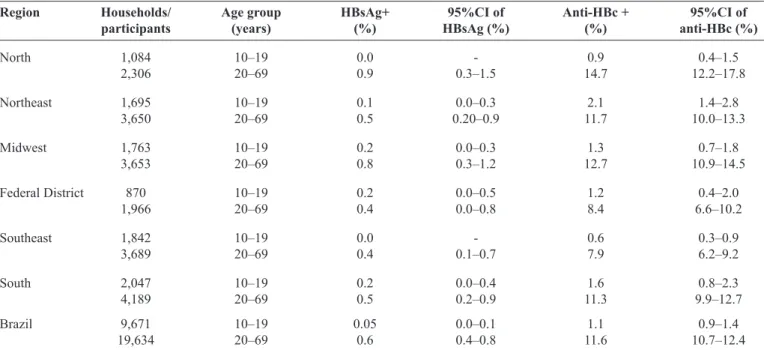
(19). The results indicated a
lower than expected prevalence of hepatitis B in all regions
(20).
Exposure to HBV [measured by levels of antibodies against the
core antigen (anti-HBc)] varied in participants 10 to 19 years of
age, from 0.6% in the southeast to 1.6% in the South. Among
individuals 20 to 69 years of age, the prevalence ranged from
7.9% in the Southeast to 14.7% in the North. The prevalence
rates of virus carriers (HBsAg-positive) among those 10 to
19 years of age did not exceed 0.2% in any region. For those
between 20 and 69 years of age, the HBsAg prevalence ranged
from 0.4% in the Southeast and the Federal District to 0.9% in
the Northern region
(Table 2)
. These numbers moved Brazil to
a low-prevalence hepatitis B endemicity classifi cation
(3).
CURRENT HEPATITIS B EPIDEMIOLOGICAL
DATA IN BRAZIL
This decline was expected, considering the significant
socioeconomic improvements for a large portion of the Brazilian
population and effective vaccination coverage, especially
among children, from the end of the 20
thcentury. However, the
fi ndings of the National Survey remain controversial. The main
criticism, acknowledged by the authors, was that limiting the
sample to large urban centers (state and federal capitals) could
have underestimated the true hepatitis B prevalence in localities
with worse health and economic conditions
(21).
By excluding the more remote and poorer regions, the
study did not sample localities with the highest historical
prevalence of hepatitis B in Brazil. For example, the Purus and
Juruá River basins in Amazonas historically had the highest
rates
(22). In the State of Espírito Santo, Cachoeiro de Itapemirim
municipality was hyperendemic
(23), such as some municipalities
in Northwestern Mato Grosso near the border with States of
Rondônia and Amazonas
(17) (24). The same situation was reported
in Cascavel and Francisco Beltrão municipalities of the State of
Paraná, and in other countryside of the States of Santa Catarina
and Minas Gerais
(18) (25). These regions are far from the capital,
where improvements in living and hygiene conditions are
usually implemented more slowly.
By the beginning of the 21
stcentury, Brazil had become a
cosmopolitan and urbanized country, with 84% of the population
living outside rural areas [Censo 2010, Instituto Brasileiro de
Geografi a e Estatística
(IBGE)]. Considering that less than
one-fi fth of the population lives in rural areas, it remains unclear
whether the results of the National Survey refl ect the overall
hepatitis B prevalence.
13
Rev Soc Bras Med Trop 49(1):11-23, Jan-Feb, 2016
TABLE 2 - Prevalence of markers of current infection (HBsAg-positive) and HBV exposure (anti-HBc-positive) in a population-based survey of capitals of Brazil, coordinated by the UPE and supported by the Ministry of Health and the PAHO(20).
Region Households/ Age group HBsAg+ 95%CI of Anti-HBc + 95%CI of
participants (years) (%) HBsAg (%) (%) anti-HBc (%)
North 1,084 10–19 0.0 - 0.9 0.4–1.5
2,306 20–69 0.9 0.3–1.5 14.7 12.2–17.8
Northeast 1,695 10–19 0.1 0.0–0.3 2.1 1.4–2.8
3,650 20–69 0.5 0.20–0.9 11.7 10.0–13.3
Midwest 1,763 10–19 0.2 0.0–0.3 1.3 0.7–1.8
3,653 20–69 0.8 0.3–1.2 12.7 10.9–14.5
Federal District 870 10–19 0.2 0.0–0.5 1.2 0.4–2.0
1,966 20–69 0.4 0.0–0.8 8.4 6.6–10.2
Southeast 1,842 10–19 0.0 - 0.6 0.3–0.9
3,689 20–69 0.4 0.1–0.7 7.9 6.2–9.2
South 2,047 10–19 0.2 0.0–0.4 1.6 0.8–2.3
4,189 20–69 0.5 0.2–0.9 11.3 9.9–12.7
Brazil 9,671 10–19 0.05 0.0–0.1 1.1 0.9–1.4
19,634 20–69 0.6 0.4–0.8 11.6 10.7–12.4
HBsAg: hepatitis B surface antigen; HBV: hepatitis B virus; anti-HBc: antibodies against hepatitis B core antigen; UPE: University of Pernambuco; PAHO: Pan American Health Organization; 95%CI: 95% confi dence interval.
METHODOLOGY
In order to validate and extend the fi ndings of the National
Survey, a systematic review was performed using data from
independent epidemiological studies on disease prevalence and
incidence in Brazil, including historical series.
Scientifi c publications with primary data on the epidemiology,
prevalence, or incidence of hepatitis B in Brazil from 1999 to
early 2015 were systematically analyzed. This time interval
was defi ned based on the existence of a publication from 1999
that had compiled all available data available to that time
(18).
The MEDLINE, LILACS, CAPES/MEC, and SINAN/MS
(
Sistema Nacional de Agravos de Notifi cação, Ministério da
Saúde) databases were accessed. In MEDLINE, the following
descriptors were entered only in the title/abstract fi eld: (brazil
OR brazil*) AND (epidem* OR survey OR prevalence OR
incidence OR cross-sectional) AND (hepatitis B OR HBV
OR HBsAg). In LILACS, the following descriptor terms in
Portuguese, Spanish, and English were used: hepatitis OR
hepatite [Words in Title] and epidemiologia OR epidemiology
OR prevalencia OR prevalence OR incidencia OR incidence
OR survey OR inquerito OR encuesta [Words in Title], and
brasil OR brazil [Country of affi liation].
The CAPES/MEC database was queried to fi nd unpublished
data. The search strategy used as descriptors hepatitis B and
epidemiology
or prevalence and incidence or survey in the fi eld title
or abstract. We had the helpful assistance of the call center staff,
available through the electronic address (mec.cube.callsp.inf.br/
auto-atendimento). The SINAM/MS database was used to collect
data on hepatitis B incidence (http://dtr2004.saude.gov.br/sinanweb/).
RESULTS
The MEDLINE search (http://www.ncbi.nlm.nih.gov/
pubmed) performed on April 4, 2015, resulted in 304 citations.
After reviewing the titles and abstracts, studies referring to
aspects other than the prevalence or incidence of hepatitis B
were discarded, as well as those that focused on subpopulations
with increased risk for HBV infection, such as patients with
human immunodeficiency virus (HIV), patients in renal
replacement therapy, poly-transfused patients, patients with
chronic liver disease or scleral jaundice, or patients with sexually
transmitted diseases. Articles on prevalence in prison inmates,
sex workers, or injectable drug users were discarded because
these subpopulations were also considered to have increased
risk. Non-injectable drug users, however, were retained in
this review. Studies that focused on describing the genotypic
distribution of HBV among chronic carriers and research on
occult infections were also discarded. After this evaluation, 76
articles remained. Two publications had no data on infection
prevalence. One focused only on seroprevalence of vaccine
coverage
(26), while the other was part of the results of the
National Epidemiological Survey in Brazilian State Capitals
(20).
Thus, 74 articles was retrieved.
14
The
CAPES
database
query
identifi
ed
136
masters
or
doctoral
theses.
Most
dealt
with other aspects of HBV
infection,
ranging from molecular biology to vaccine
considerations. Thirty-four
reported
prevalence in cross-sectional studies
.
A
mong thes
e, 12 had already been
identifi
ed
in
the
MEDLINE
and
LILACS
searches. O
f the remaining 22, two studies
were based in other countries,
and seven
included
only
risk
groups.
Finally
,
13
dissertations
were
identifi
ed
with
unique
data, resulting in 100 studies.
The
re
sult
s of t
hese
studie
s are prese
nte
d
below
, in four groups.
T
able 3
presents the
results of studies from the beginning of the
current millennium, among which many
references were related to research and
surveys carried out in the 1990s.
The most
recent
population
studies
or
those
in
specifi
c
groups (without increased risk) are shown
in
T
able 4
.
T
able 5
and
T
able 6
contain
data
specifi
c
to
pregnant
women
and
blood
donors,
respectively
. The
results
in
pregnant
women are presented separately owing to
the
fa
ct
t
ha
t t
he
se
st
udi
es ha
ve
be
com
e
very common in recent years in Brazil and
b
ec
ause
t
h
ey
re
p
re
se
n
t
in
pa
rti
cu
la
r t
h
e
risk of vertical transmission. Blood donors
were also separated as a group, with notably
reduced prevalence due to increasingly
insightful recruitment by blood banks to
select individuals with minimal risk.
Results fr
om the turn of the century
The data in
T
able 3
show prevalence
acros
s the country
, w
ith the highes
t rates
concentrated in the
Amazon region, including
Mato Grosso
(27) (28) (29) (30) (31) (32) (33) (34) (35) (36) (37) (38) (39) (40) (41) (42) (43) (44). In all, there were 21
reports, ni
ne (42.8%) wi
th i
nte
rm
edi
at
e t
o
high prevalence (>2%). Of these nine, two
ha
d pre
va
le
nce
rat
es a
bove 9%, nam
el
y
indigenous people in Lábrea,
Amazonas,
and i
sol
at
ed
Afri
ca
n de
sc
enda
nt
s i
n t
he
State of Mato Grosso do Sul
(30)
(36)
. The
high
prevalence was concentrated, as expected, in
the northern region. Howeve
r, t
wo studie
s
identified high endemicity outside the
Amazon basin, in the semi-arid region of the
State of Bahia and in
African descendants
from
the
Cerrado
of
the State of Mato Grosso
do Sul
(34)
(36)
. Five studies reported prevalence
below 1%, and the other six assessed
anti-HBc positivity rather than HBsAg.
The
prevalence of this marker in these studies
ranged from 1.2% to 58.4%
(27) (29) (44)
.
TABLE 3 - Prevalence of hepatitis B virus infection in Brazilian studies from the early 2000s, including data from the 1990s, according to geographic region.
Region State Subregion Municipalities Sample Number HBsAg (%) Anti-HBc (%) Endemicity* Year Ref.
North Acre East Rio Branco General population 2,684 - 58.4 - 2000 27
” ” ” ” 390 3.3 40.0 Intermediate 2004
Amazonas Center Manaus ” 613 - 21.4 - 2000 29 ” Southwest Lábrea Indigenous 688 9.7 54.5 High 2001 30 ” Southwest Purus General population 349 5.2 66.2 High intermediate 2001 31 ” Southwest Lábrea ” 605 3.3 49.4 Low intermediate 2004 32 Northeast Pará Northeast Igarapé ” 58 0.0 12.4 Low 2003 33
Ceará Fortaleza Fortaleza ” 489 - 1.2 ” 2000 29
Bahia Semi-arid Rural area ” 476 2.6 9.8 Low intermediate 2006** 34 Midwest Mato Grosso do Sul Central Sidrolândia Indigenous 312 0.0 2.2 Low 2002 35 ” Central Furnas Dionísio IADC 260 9.2 42.7 High 2003 36 Goiás Central Goiânia Dentists 90 0.0 10.0 Low 2003 37 ” ” ” Psychiatric patients 433 1.6 22.4 ” 2004 38 Mato Grosso Mid-North Nova Mutum General population 754 3.0 31.0 Low intermediate 2001 39
” North Apiacás Prospectors 520 7.1 82.9 High intermediate 2001 40
” North Peixoto e Azevedo Schoolchildren 487 1.2 11.1 Low 2004 41
” Northwest Cotriguaçu General population 838 2.1 40.0 Low intermediate 2004 42 Southeast São Paulo North Ribeirão Preto ” 632 0.3 13.9 Low 2000 43
Rio de Janeiro Central Rio de Janeiro ” 2,090 - 5.5 - 2000 29
” North Macaé ” 1,100 - 15.3 - 2002 44
South Rio Grande do Sul Porto Alegre Porto Alegre ” 461 - 7.6 - 2000 29
HBsAg: hepatitis B surface antigen; anti-HBc: antibodies against hepatitis B core antigen; HBV: hepatitis B virus; WHO: World Health Organization; IADC: isolated Afro-descendant communities. Ref: references.
*The HBV infection endemicity classifi cation was based on the WHO categorization using HBsAg positivity prevalence. When there were only results for anti-HBc, we used previous WHO classifi cations: ≤20%,
low; 21-60%, intermediate; and >60%, high. **Article was published in the 2000s, but presented data from the 1990s.
Souto FJD -
Distribution of hepatitis B in Brazil
15
TABLE 4 - Prevalence of hepatitis B virus infection in Brazilian studies since 2005 by geographic region.
Region State Subregion Municipalities Sample Number HBsAg (%) Anti-HBc (%) Endemicity* Year Ref.
North Acre - Several General population 2,656 3.3 61.2 Low intermediate 2005 45
Amazonas Southwest Lábrea ” 1,510 6.2 52.1 High intermediate 2012 46
Rondônia North Montenegro Rural population 267 4.8 61.8 ” 2005 47
” North Porto Velho ” 660 1.8 50.7 Low 2012 48
Pará North Belém Recruits 298 0.3 6.0 ” 2007 49
” Southeast Altamira Indigenous 167 5.4 55.7 High intermediate 2007 50
” West Juruti Rural population 232 0.0 2.2 Low 2010 51
” North Cametá ” 181 0.0 1.1 ” 2011 52
” ” Belém Dentists 98 0.0 6.2 ” 2012 53
” ” Belém Laboratory technicians 528 0.4 8.0 ” 2012 54
” ” Tucuruí ” 668 1.9 28.0 ” 2012 55
” Southeast São Felix do Araguaia ” 91 1.1 49.5 ” ” ”
Northeast Bahia Coast Salvador Dentists 120 0.0 5.8 Low 2005 56
” ” ” NIDU 125 0.8 - ” 2007 57
” ” ” University students 766 0.0 1.7 ” 2012 58
” ” ” General population 780 1.3 - ” 2013 59 Maranhão B. Munim Morros, Axixá ” 1,249 1.7 39.6 ” 2014 60
Midwest Mato Grosso do Sul Rural area Several IADC 1,058 2.2 19.8 Low intermediate 2005 61
” Central Campina Grande Dentists 474 0.6 10.8 Low 2006 62
” Pantanal Corumbá General population 321 1.6 36.5 ” 2009 63
” Central Campina Grande PPL 409 0.5 17.8 ” 2009 64
” ” Goiânia Firemen 308 1.0 6.5 ” 2012 65
Goiás ” ” Laboratory technicians 648 0.7 24.1 ” 2005 66
” ” ” Dentists 680 0.0 6.0 ” 2008 67
” All Several Truck drivers 641 1.4 18.9 ” 2008 68
” North Cavalcante IADC 878 1.8 35.4 ” 2009 69
” Central Goiânia PPL 148 0.7 18.9 ” 2010 70
” ” ” Garbage collectors 431 0.7 12.8 ” 2014 71
Mato Grosso East Barra do Garças Adolescents 576 0.7 5.0 ” 2011 72
” Central Várzea Grande Leprosy patients 191 1.0 27.7 ” 2011 73
All - - NIDU 852 1.0 14.0 ” 2009 74
Southeast São Paulo North Ribeirão Preto Health workers 1,433 0.8 9.4 Low 2005 75
” ” ” Administ. workers 872 0.2 - ” ” ”
” East São Paulo Homeless 330 3.3 30.6 Low intermediate 2007 76
” Coast Santos Children 4,680 0.02 0.1 Low 2014 77
Rio de Janeiro ” Rio de Janeiro ” 1.217 1.8 3.6 ” 2014 78
” ” ” Recruits 433 0.0 4.1 ” 2015 79
Espírito Santo Central Vitória Women 1,029 0.9 4.2 ” 2008 80
South Santa Catarina Coast Florianopolis Recruits 371 0.0 1.6 Low 2011 81
” ” ” Adolescents 384 0.0 0.5 ” 2010 82
” ” Itajai ” 353 0.6 1.1 ” 2011 83
” West Chapecó ” 418 0.2 1.4 ” 2011 84
” East Blumenau Children 393 0.8 1.0 ” ” 85 ” South Tubarão Elderly 820 0.6 15.1 ” 2013 86
Paraná South Rural area Indigenous 214 0.0 15.4 ” 2006 87
Rio Grande do Sul Central Caxias do Sul General population 60,604 1.6 - ” 2014 88
Brazil Multicenter Several Psychiatric patients 2,238 1.6 14.7 Low 2009 89**
” ” ” ” 2,206 2.0 17.1 Low intermediate 2014 90**
HBsAg: hepatitis B surface antigen; anti-HBc: antibodies against HBV core antigen; NIDU: non-injectable drug user; IADC: isolated Afro-descendant communities; PPL: people deprived of their freedom;
HBV: Hepatitis B Virus; WHO: World Health Organization; Ref: references. *The HBV infection endemicity classifi cation was based on WHO categorization using HBsAg positivity prevalence. When only
anti-HBc results were available, we used previous WHO classifi cations: ≤20%, low; 21–60%, intermediate; >60%, high. **These publications report on the same historical series.
Rev Soc Br
as Med
T
rop
49(1):11-23, Jan-F
16
TABLE 5 - Prevalence of hepatitis B virus infection among pregnant women in Brazilian studies since 2000, according to geographic region.
Region State Subregion Municipalities Number HBsAg Anti-HBc Endemicity* Year Ref.
(%) (%)
North Amazonas Juruá - 218 8.7 75.9 High 2003 91
“ Middle Amazon - 118 0.0 12.7 Low “ “
“ East Manaus 674 0.7 - “ 2010 92
Acre East Rio Branco** 283 2.1 - Low intermediate 2006 93
Northeast Pernambuco Coast Recife 1,584 0.6 - Low 2003 94
Maranhão Coast São Luís 541 0.9 6.4 “ 2012 95
Bahia Coast Salvador 692 0.3 - “ 2014 96
Midwest Mato Grosso do Sul Central Campo Grande 119,774 0.3 0.6 Low 2008 97
“ All Several 32,512 0.3 - “ 2007 98
Goiás South Catalão 2,037 - 5.6 “ 2014 99
Southeast São Paulo East São José dos Campos 224 0.9 4.5 Low 2003 100
“ “ São Paulo 554 1.8 - “ 2010 101
“ North Ribeirão Preto 5,191 0.5 - “ 2005 102
Rio de Janeiro Central Rio de Janeiro 874 0.5 7.2 “ 2002 103
Espírito Santo “ Vitória 1,608 1.1 - “ 2001 104
“ “ Vitória 534 1.1 - “ 2009*** 105
South Paraná North Londrina 1,502 0.8 - Low 2000 106
“ West Cascavel 496 1.4 24.0 “ 2006 107
“ “ Francisco Beltrão 442 3.8 38.5 Low intermediate “ “
“ East Curitiba 458 0.7 7.2 Low “ “
“ North Londrina 335 0.6 12.8 “ “ “
“ “ Maringá 379 1.8 10.8 “ “ “
“ Northwest Several 1,534 0.5 - “ 2013 108
Santa Catarina Coast Itajaí 10,147 0.4 - “ 2012 109
Rio Grande do Sul North Passo Fundo 3,573 0.7 - “ 2009 110
HBsAg: hepatitis B surface antigen; anti-HBc: antibodies against HBV core antigen. *The HBV infection endemicity classifi cation was based on WHO categorization using HBsAg positivity prevalence. When only anti-HBc results were available, we used previous WHO classifi cations: ≤20%, low; 21–60%, intermediate; >60%, high. Ref: references. **The study by Santos included seven municipalities bordering the Rio Amazonas: Bragança, Castanhal, Combu, Alenquer, Santarém, Óbidos and Oriximiná. ***Article published later in the 2000s but included data from the 1990s.
Recent prevalence data
Analysis of data from more recent studies
(Table 4)
suggests
lower prevalence rates nationwide
(45) (46) (47) (48) (49) (50) (51) (52) (53) (54) (55) (56) (57) (58) (59) (60) (61) (62) (63) (64) (65) (66) (67) (68) (69) (70) (71) (72) (73) (74) (75) (76) (77) (78) (79) (80) (81) (82) (83) (84) (85) (86) (87) (88) (89) (90). These studies represent
more than 90,000 individuals. Among 48 reports, only seven
(14.6%) found intermediate to high prevalence. In 28 (58.3%)
studies, the prevalence of HBsAg-positive individuals was
below 1%. However, there is no guarantee that individuals were
not sampled in more than one such study.
Three Amazonian communities had prevalence higher than
4%, namely Lábrea (6.2%), a rural population in Rondônia
(4.8%), and indigenous peoples in Southeastern Pará (5.4%)
(46) (47) (50). However, in general, the prevalence rates in most recent
studies were systematically lower than those in previous studies.
Only two studies showed intermediate-low endemicity outside
the Amazon Region (3.3% among homeless in São Paulo, a
population considered to be at increased risk, and isolated
populations of African descendants in the State of Mato Grosso
do Sul)
(61) (66). It should also be emphasized that, contrary to
studies performed in the 1990s, the prevalence in more recent
studies was less than 7%.
Evaluation of pregnant and postpartum women
Table 5
presents the results of 25 surveys carried out in
pregnant and postpartum women that reported low prevalence,
with 16 (64%) of 25 reports showing that HBsAg was present
in less than 1.0% of women
(91) (92) (93) (94) (95) (96) (97) (98) (99) (100) (101) (102) (103) (104) (105) (106) (107) (108) (109) (110). Three studies reported intermediate
or high endemicity. Two studies were in the Amazon: in Juruá,
Amazonas (8.7% of carriers) in a study from 2003 and in
Rio Branco, Acre (2.1%)
(9) (93). The third study took place in
Francisco Beltrão, in Paraná, with 3.8% endemicity in this
population
(107).
Blood donor data
The 15 reports on blood donors totaled over 500,000
donations (
Table 6
)
(75) (111) (112) (113) (114) (115) (116) (117) (118) (119) (120). It
was also not possible to rule out double participation between
these studies. None of the studies showed prevalence above
0.7%, and 10 reported prevalence below 0.4%.
17
TABLE 6 - Prevalence of hepatitis B virus infection among blood donors in Brazilian studies since 2005, according to geographic region.
Region State Subregion Municipality Number HBsAg Anti-HBc Endemicity* Year Ref.
(%) (%)
North Amazonas Manaus Manaus 1,199 0.2 4.7 Low 2008 111
Northeast Bahia Coast Salvador 1,201 0.2 4.0 Low 2008 111
Pernambuco Coast Recife 28,364 0.3 5.1 “ 2013 112
Midwest Goiás Southwest Several 984 - 6.9 Low 2011 113
Mato Grosso do Sul Central Campo Grande 8,840 0.2 3.0 “ 2013 114
Southeast São Paulo North Ribeirão Preto 2,583 0.2 - Low 2005 75
“ East Sao Paulo 1,198 0.7 5.2 “ 2008 111
“ “ “ 43,523 0.2 3.0 “ 2013 112
“ “ “ 25,891 0.6 8.7 “ 2005 115
Rio de Janeiro Central Rio de Janeiro 128,497 0.3 3.7 “ 2006 116 Minas Gerais Southeast Belo Horizonte 21,823 0.3 3.7 “ 2013 112
South Paraná North Maringá 8,337 0.1 2.2 Low 2013 117
Santa Catarina Coast Florianópolis 3,180 0.1 2.1 “ 2013 118
“ Coast Florianópolis 2,583 0.7 9.2 “ 2000 119
Rio Grande do Sul All - 263,795 0.6 5.3 “ 2003 120
HBsAg: hepatitis B surface antigen; anti-HBc: antibodies against hepatitis B core antigen; WHO: World Health Organization; Ref: references. *The classifi cation of HBV infection prevalence was based on WHO categorization using HBsAg positivity prevalence. When only anti-HBc results were available, we used the previous WHO classifi cation: ≤20%, low; 21-60%, intermediate; >60%, high.
Vaccine coverage
Among studies included in this review, some also analyzed
vaccine coverage by measuring the seroprevalence of antibodies
against HBsAg (anti-HBs)
(26) (52) (58) (72) (78) (79) (82) (83) (85). These
reports were predominantly conducted in adolescents and young
adults. As it is common for people to lose documents certifying
vaccination in Brazil, authors often use positivity for anti-HBs
positivity alongside negativity for HBsAg and anti-HBc as
evidence of vaccine coverage. Most of these reports found a
prevalence of anti-HBs alone between 55% and 60%, considering
the cutoff of 10UI/L as the lower level of anti-HB positivity. When
anti-HB titers lower than 10UI/L were considered, prevalence
reaches approximately 90%
(Table 7)
. However, two studies
(Amazon and northeast) suggested low vaccine coverage
(52) (60).
Incidence data
Several studies presented incidence data, including three
studies conducted in Santa Catarina. Kupeck (2001) estimated
the risk of HBsAg transmission by studying historical blood
donor series in the State of Santa Catarina in the 1990s
(109)and
concluded that despite reduced risk, the incidence density would
be three infections per 1,000 person-years. More recently, Silva
et al.
(121)analyzed notifi cations to the Information System for
Notifi able Diseases and estimated that the incidence in 2009
in Brazil and Santa Catarina was 11.5 and 17 infections per
100,000 inhabitants, respectively
(121). Finally, Marcon et al.
(122)also studied notifi cations in the same state and concluded that
there was a decrease in incidence starting in 2006
(122).
The Brazilian offi cial data about hepatitis (SVS/MS, 2012)
presents data relating to hepatitis B case notifi cations from
1999 to 2011
(123). There is a trend of year-to-year growth. There
were fewer notifi cations among youth <20 years of age in Brazil
and in all macroregions.
Figure 1
presents reported case data in Brazil from 2007
to 2013 (SINAN) according to age group, with an increasing
number of notifi cations each year. The majority of the cases
are concentrated in the 20- to 59-year-old age group. However,
below 20 years of age, the number of reported cases is stable.
Reports among this age range were 10% and 5.9% of the total
cases in 2007 and 2013, respectively.
DISCUSSION
This review shows an improved epidemiological environment
in Brazil compared to the end of the last century, likely due to
improved quality of life and the increasingly comprehensive
deployment of systematic youth vaccination programs. The
results presented in
Table 3
, which correspond to samples
obtained at the end of the 1990s, are similar to reports from
previous studies, with carrier prevalence exceeding 7% in some
regions, characterizing them as highly endemic
(30) (36) (39). In more
recent studies, however, this situation has improved, with low
to intermediate-high prevalence and no prevalence rates above
7%
(Table 4)
.
However, there are still foci of intermediate endemicity,
especially in areas diffi cult to access or with low population
densities, such as riverine populations in the Amazon Basin
and among isolated populations of African descendants
(quilombolas) in the Midwest
(30) (36).
18
TABLE 7 - Prevalence of vaccine-induced protection profi le (anti-HBs-positive only) in Brazilian studies.
Region State Municipalities Number Age group Anti-HBs Year Ref.
(years) isolated (%)
North Pará Cametá 181 32* 18.0 2011 52
Northeast Bahia Salvador 766 17–66** 92.7 2012 58
Maranhão Axixá, Morros 286 1–10 34.3 2014 60
“ “ 301 11–20 28.2 “ “
Midwest Mato Grosso Barra do Garças 576 12–20 56.1 2011 71
Southeast Rio de Janeiro Rio de Janeiro 1,217 0–18 85.0 2014 78
“ “ 433 18–25 57.0 2015 79
South Santa Catarina Florianópolis 384 10–16 58.8 2010 82
“ “ 371 18–19 57.0** 2011 26
“ Itajaí 353 10–15 83.6** 2011 83
“ Blumenau 371 10–15 89.8** 2011 85
Anti-HBs: antibodies against HBV surface antigen; Ref: references. *Average sample age. The study was conducted in a riverside community in the Amazon interior. **Study of university students between 17 and 66 years of age.**Considering any anti-HBs titer.
1,046 (10.0%)
1,183 (10.0%)
1,215 (8.8%)
964 (8.4%)
1,361 (8.9%)
1,436 (10.2%)
1,567 (9.7%)
660 (6.3%)
832 (7.2%)
1,076 (7.8%)
1,068 (7.6%)
1,112
(7.2%) 874
(6.1%)
954 (5.9%) 5,400
9,000
8,000
7,000
6,000
5,000
4,000
3,000
2,000
0-19
20-39
40-59
60+
1,000
2007 2008 2009 2010 2011 2012 2013 0
(51.9% )
5,957 (50.6%)
6,873 (49.9%)
4,411 (34.8%)
5,659
(36.8%) 5,347
(37.7%)
6,068 (37.3%)
3,303 (31.7%)
3,790 (32.2%)
4,617 (33.5%)
6,220 (49.1%)
7,235 (47.1%)
6,539 (46.0%)
7,654 (47.1%)
Total
10,409 11,762 13,781 12,663 15,367 14,196 16,243
FIGURE 1 - Number (and percentages) of notifi cated cases of hepatitis B (HBsAg+) in Brazil by age ranges between 2007 and 2013 by age. Source: SINAN/SVS/MS. HBsAg: HBV surface antigen; SINAN/SVS/MS: Sistema Nacional de Notifi cação de Agravos/Secretaria de Vigilância à Saúde/Ministério da Saúde.
19
of the country. A hepatitis B intermediate to high endemicity
condition was observed in West States of Paraná and Santa
Catarina in the 1990s. Since then, many studies have been
conducted, and the states and regional health authorities have
worked to identify risk groups and increase vaccine coverage.
More recent studies from the Southern regions have reported
prevalence rates lower than previously observed, with the
exception of pregnant women in Francisco Beltrão
(107). These
findings suggest successful vaccination coverage in this
region
(26) (82) (83) (85).
Second, data from northeast Brazil remain relatively scarce,
perhaps because hepatitis B has never been a major problem
in this region compared to the Northern and Southern states.
However, there may be locations in the interior that require a
better approach, as observed by Almeida et al.
(34)in the semi-arid
region of Bahia during the 1990s
(34).
At-risk groups were not addressed in this review because they
are a signifi cant minority of the Brazilian population. However,
they are a potential reservoir for dissemination of HBV. Groups
such as prisoners, homeless people, drug addicts, people with
HIV, and sex workers need specialized approaches to benefi t from
vaccination and, where appropriate, antiviral therapy.
The data obtained in the SINAN are unreliable as a historical
series, as there is no separation between acute and chronic cases,
making it impossible to determine when the infection occurred.
As a result, the data do not represent incidence rates of new
cases. Furthermore, recent infections are added to previous
infections that were only recently detected. In addition, the
increase in the number of notifi cations appears to correspond
to improvements in the epidemiological surveillance system
and notifi cations for communicable diseases in Brazil. Despite
improved socioeconomic conditions and hygiene in a large
part of the country, notifi cations have increased, generating the
false impression that the prevalence of many infectious diseases
is increasing in Brazil. The same phenomenon has also been
observed in hepatitis A. Although analysis of the raw numbers
of notifi cations does not suggest imminent control of hepatitis B
in Brazil, the positive trend of decreased or stabilized prevalence
among children under 20 years of age indicates the positive
effects of vaccination.
Although fewer in number than studies on the prevalence
of HBV infection, studies reporting the prevalence of anti-HBs
antibodies alone indicate that the levels of coverage offered by
vaccination are comparable to those in countries with high vaccine
coverage
(5) (8). Similar to reports of reduced HBV incidence and
prevalence in these countries, Brazil should detect a similar
downward trend in the next decade. It is, however, worrying
that vaccine coverage was insuffi cient in remote communities of
the Amazon Region and in the Northeast. Efforts must be made
to increase vaccination coverage in these localities. In a remote
Amazonian community of the State of Mato Grosso, efforts to
increase vaccination coverage resulted in reduced prevalence
from the high levels previously reported
(17) (42).
In short, a systematic literature review of 100 studies on
hepatitis B prevalence, incidence, and vaccine coverage suggest
that Brazil is progressing toward low endemicity, with specifi c
foci of increased fragility, mainly in the interior of the Amazon
region and among remote small communities. The National
Survey of the last decade captured the declining trend in major
urban regions of the country
(20). This review also observed
decreasing prevalence in Brazil’s innermost part. However,
the situation is far from safe. On the contrary, this review
underscores the need for increased efforts to control HBV in
these specifi c communities and populations.
REFERENCES
The author declare that there is no confl ict of interest.
CONFLICT OF INTEREST
1. Ganem D, Prince AM. Hepatitis B virus infection – natural history and clinical consequences. N Engl J Med 2004; 350:1118-1129.
2. Perz JF, Armstrong GL, Farrington LA, Hutin YJ, Bell BP. The contributions of hepatitis B virus and hepatitis C virus infections to cirrhosis and primary liver cancer worldwide. J Hepatol 2006; 45:529-538.
3. World Health Organization (WHO). Guidelines for the prevention, care and treatment of persons with chronic hepatitis B infection. WHO; 2015. Available at: http://www.who.int/hiv/pub/hepatitis/hepatitis-b-guidelines/en/
4. Skinhoj P. Hepatitis and hepatitis B-antigen in Greenland. II: ocurrence and interrelation of hepatitis B associated surface, core and e antigen-antibody system in a highly endemic area. Am J Epidemiol 1977; 105: 99-106.
5. Ni YH, Huang LM, Chang MH, Yen CJ, Lu CY, You SL, et al. Two decades of universal hepatitis B vaccination in Taiwan: impact and implication for future strategies. Gastroenterol 2007; 132:1287-1293.
6. Whittle HC, Maine N, Pilkington J, Mendy M, Fortuin M, Bunn J, et al. Long-term effi cacy of continuing 259 hepatitis B vaccination in infancy in two Gambian villages. Lancet 1995; 345:1089-1092. 7. Perz JF, Elm Jr JL, Fiore AE, Huggler JI, Kuhnert WL, Effl er
PV. Near elimination of hepatitis B virus infections 254 among Hawaii elementary school children after universal infant hepatitis B vaccination. Pediatrics 2006; 118:1403-1408.
8. Zacharakis G, Kotsiou S, Papoutselis M, Vafi adis N, Tzara F, Pouliou E, et al. Changes in the epidemiology of hepatitis B virus infection following the implementation of immunization programmes in northeastern Greece. Euro Surveill 2009; 1-6.
9. Coppola N, Masiello A, Tonziello G, Pisapia R, Pisaturo M, Sagnelli C, et al. Factors affecting the changes in molecular epidemiology of acute hepatitis B in a Southern Italian area. J Viral Hepat 2010; 17:493-500. 10. Lim SG, Mohammed R, Yuen MF, Kao JH. Prevention of
hepatocellular carcinoma in hepatitis B virus infection. J Gastroenterol Hepatol 2009; 24:1352-1357.
11. Ott JJ, Stevens GA, Groeger J, Wiersma ST. Global epidemiology of hepatitis B virus infection: new estimates of age-specifi c HBsAg seroprevalence and endemicity. Vaccine 2012; 30:2212-2219.
12. Goldstein ST, Zhou F, Hadler SC, Bell BP, Mast EE, Margolis HS. A mathematical model to estimate global hepatitis B disease burden and vaccination impact. Int J Epidemiol 2005; 34:1329-1339.
13. Bensabath G, Boshell J. Presença do antígeno Austrália em populações do interior do Estado do Amazonas, Brasil. Rev Inst Med Trop Sao Paulo 1973; 15:284-288.
20
14. Bensabath G, Soares MCP. A hepatite B e delta em Boca do Acre, alto Purus. Moderna Hepatol 1989; 14:36-40.
15. Santos EO, Loureiro ECB, Jesus IM, Brabo E, Silva RSU, Soares MCP, et al. Diagnóstico das condições de saúde de uma comunidade garimpeira na região do Rio Tapajós, Itaituba, Pará, Brasil, 1992. Cad Saude Publica 1995; 11:212-225.
16. Menezes RC, Martins SJ, Soares CP. Prevalência de hepatite B em uma população indígena da Amazônia oriental. In: Anais do XXIX Congresso da Sociedade Brasileira de Medicina Tropical, Fortaleza; 1993. p. 312.
17. Souto FJ, Fontes CJ, Gaspar AM. Outbreak of hepatitis B virus in recent arrivals to the Brazilian Amazon. J Med Virol 1998; 56:4-9.
18. Souto FJ. Distribuição da hepatite B no Brasil: atualização do mapa epidemiológico e proposições para o seu controle. GED Gastroenterol Endosc Dig 1999; 18:143-150.
19. Ximenes RA, Pereira LM, Martelli CM, Hamann EM, Stein AT, Figueiredo GM, et al. Methodology of a nationwide cross-sectional survey of prevalence and epidemiological patterns of hepatitis A, B and C infection in Brazil. Cad Saude Publica 2010; 26:1693-1704. 20. Pereira LM, Martelli CM, Hamann EM, Montarroyos UR, Braga MC,
Lima ML, et al. Population-based multicentric survey of hepatitis B infection and risk factor differences among three regions in Brazil. Am J Trop Med Hyg 2009; 81:240-247.
21. Pereira LM, Ximenes RA, Moreira RC, Braga MC, Montarroyos UR. Estudo de prevalência de base populacional das infecções pelos vírus das hepatites A, B e C nas capitais do Brasil. Recife: Universidade de Pernambuco; 2010.
22. Bensabath G, Hadler SC, Soares MP, Fields H, Dias LB, Popper H, et al. Hepatitis delta virus infection and labrea hepatitis: prevalence and role in fulminant hepatitis in the Amazon Basin. JAMA 1987; 258:479-483.
23. Ferreira CR, Yoshida CF, Mercadante LA, Gomes DF, Oliveira JM, França MS, et al. Immunization against Hepatitis B in children from endemic zone: evaluation of the antibody response against the DNA recombinant vaccine (Engerix B - 20 mcg). Rev Inst Med Trop Sao Paulo 1993; 35:89-92.
24. Souto FJ, Fontes CJ, Gaspar AM, Lyra LG. Hepatitis B virus infection in immigrants to the southern Brazilian Amazon. Trans R Soc Trop Med Hyg 1998; 92:282-284.
25. Serufo JC, Silva RA, Lara RG, Rayes AA, Drummond SC, Teixeira R, et al. Alta prevalência de hepatite B em área endêmica de esquistossomose mansoni. In: Anais do XXXIII Congresso da Sociedade Brasileira de Medicina Tropical. Belo Horizonte; 1997. p. 39.
26. Passos AM, Treitinger A, Spada C. Hepatitis B immunity and vaccination coverage among young adult males in the Air Force in South Brazil. Vaccine 2011; 29:9284-9288.
27. Nascimento LC, Lopes CM. Sexual activity and sexually transmitted diseases in high school students in Rio Branco-Acre, Brazil. Rev Lat Am Enfermagem 2000; 8:107-113.
28. Tavares-Neto J, Almeida D, Soares MC, Uchoa R, Viana S, Darub R, et al. Seroprevalence of hepatitis B and C in the Western Brazilian Amazon region (Rio Branco, Acre): a pilot study carried out during a hepatitis B vaccination program. Braz J Infect Dis 2004; 8:133-139. 29. Clemens SA, Fonseca JC, Azevedo T, Cavalcanti A, Silveira TR,
Castilho MC, et al. Hepatitis A and hepatitis B seroprevalence in 4 centers in Brazil. Rev Soc Bras Med Trop 2000; 33:1-10.
30. Braga WS, Brasil LM, Souza RA, Castilho MC, Fonseca JC. The occurrence of hepatitis B and delta virus infection within seven Amerindian ethnic groups in the Brazilian western Amazon. Rev Soc Bras Med Trop 2001; 34:349-355.
31. Paula VS, Arruda ME, Vitral CL, Gaspar AM. Seroprevalence of viral hepatitis in riverine communities from the Western Region of the Brazilian Amazon Basin. Mem Inst Oswaldo Cruz 2001; 96:1123-1128. 32. Braga WS, Brasil LM, Souza RAB, Melo MS, Rosas MDG, Castilho
MC, et al. Prevalência da infecção pelos vírus da hepatite B (VHB) e da hepatite Delta (VHD) em Lábrea, Rio Purus, Estado do Amazonas. Epidemiol Serv Saude 2004; 13:35-46.
33. Gadelha MA. Prevalência da infecção pelo vírus da hepatite B em duas comunidades ribeirinhas de afl uentes do Tocantins. 2003. 37p. (Master Thesis). Universidade Federal do Pará; 2003 Belém. 34. Almeida D, Tavares-Neto J, Vitvitski L, Almeida A, Mello C, Santana
D, et al. Serological markers of hepatitis A, B and C viruses in rural communities of the semiarid Brazilian northeast. Braz J Infect Dis 2006; 10:317-321.
35. Aguiar JI, Souza JA, Aguiar ES, Oliveira JM, Lemos ER, Yoshida CF. Low prevalence of hepatitis B and C markers in non-amazonian indigenous population. Braz J Infect Dis 2002; 5:269-270.
36. Castro AR, Yoshida CF, Lemos ER, Oliveira JM, Cunha RV, Ximenez LL, et al. Seroprevalence of Hepatitis B virus infection among an Afro-descendant community in Brazil. Mem Inst Oswaldo Cruz 2003; 98:13-17.
37. Carneiro AF, Daher RR. Serum prevalence of hepatitis B virus in anesthesiologists. Rev Bras Anestesiol 2003; 53:672-679.
38. Souza MM, Barbosa MA, Borges AM, Daher RR, Martins RM, Cardoso DD. Seroprevalence of hepatitis B virus infection in patients with mental problems. Rev Bras Psiquiatr 2004; 26:35-38.
39. Souto FJ, Santo GA, Philippi JC, Pietro BR, Azevedo RB, Gaspar AM. Prevalence of and factors associated with hepatitis B virus markers in a rural population of central Brazil. Rev Panam Salud Publica 2001; 10:388-394.
40. Souto FJ, Fontes CJ, Gaspar AM. Prevalence of hepatitis B and C virus markers among malaria-exposed gold miners in Brazilian Amazon. Mem Inst Oswaldo Cruz 2001; 96:751-755.
41. Assis SB, Valente JG, Fontes CJ, Gaspar AM, Souto FJ. Prevalence of hepatitis B viral markers in children 3 to 9 years old in a town in the Brazilian Amazon. Rev Panam Salud Publica 2004; 15: 26-34. 42. Souto FJ, Fontes CJ, Oliveira SS, Yonamine F, Santos DRL, Gaspar AM.
Prevalência da hepatite B em área rural de município hiperendêmico na Amazônia Mato-Grossense: situação epidemiológica. Epidemiol Serv Saude 2004; 13:93-102.
43. Miranda LV, Passos AD, Figueiredo JF, Gaspar AM, Yoshida CF. Serological markers of hepatitis B in people submitted to blood testing in health care clinics. Rev Saude Publica 2000; 34:286-291.
44. Gaze R, Carvalho DM, Werneck GL. Hepatitis A and B seroprevalence in Macaé, Rio de Janeiro State, Brazil. Cad Saude Publica 2002; 18:1251-1259.
45. Viana S, Paraná R, Moreira RC, Compri AP, Macedo V. High prevalence of hepatitis B virus and hepatitis D virus in the western Brazilian Amazon. Am J Trop Med Hyg 2005; 73:808-814.
46. Braga WS, Castilho MC, Borges FG, Martinho AC, Rodrigues IS, Azevedo EP, et al. Prevalence of hepatitis B virus infection and carriage after nineteen years of vaccination program in the Western Brazilian Amazon. Rev Soc Bras Med Trop 2012; 45:13-17.
47. Khouri M, Duarte LS, Ribeiro RB, Silva LF, Camargo LM, Santos VA, et al. Seroprevalence of hepatitis B virus and hepatitis C virus in Monte Negro in the Brazilian western Amazon region. Clinics (Sao Paulo) 2005; 60:29-36.
48. Silva ACB. Perfi l soro-epidemiológico da hepatite B nas localidades de Cachoeira de Teotônio e Vila Amazonas, Porto Velho – RO, Brasil. 2012. 72 p. (Masters´ Dissertation). Universidade Federal de Rondônia; 2012 Porto Velho.
21
49. Azevedo LK. Soroprevalência de marcadores para os vírus da hepatiteB (VHB) e vírus da hepatite C (VHC) em militares da ativa que servem em Belém, Pará, Brasil. 2007, 98 p. (Masters Dissertation). Universidade Federal do Pará; 2007 Belém.
50. Nunes HM, Monteiro MR, Soares MC. Prevalence of hepatitis B and D serological markers in the Parakanã, Apyterewa Indian Reservation, Pará State, Brazil. Cad Saude Publica 2007; 23:2756-2766.
51. Nunes HM, Soares MC, Oliveira EM, Costa OS, Alves RS, Maia NC. Prevalência das infecções pelos vírus das hepatites em localidade rural sob infl uência de um projeto de mineração. Rev Para Med 2010; 24.
52. Oliveira CS, Silva AV, Santos KN, Fecury AA, Almeida MK, Fernandes AP, et al. Hepatitis B and C virus infection among Brazilian Amazon riparians. Rev Soc Bras Med Trop 2011; 44:546-550.
53. Reis ACS. Soroepidemiologia da Infecção pelo Vírus da Hepatite B (VHB) e pelo Vírus da Hepatite C (VHC) cirurgiões-dentistas da cidade de Belém, Pará. 2006. 97 p. (Masters Dissertation). Universidade Federal do Pará; 2006 Belém.
54. Oliveira CM, Nunes MRT, Nunes HM, Soares MC. Prevalência de marcadores sorológicos do vírus da hepatite B em profi ssionais de saúde de um laboratório de pesquisa na Amazônia oriental, Estado do Pará, Brasil, 2007 a 2009. Epidemiol Serv Saúde 2012; 21:601-616.
55. Almeida MK, Santos KN, Fecury AA, Oliveira CS, Freitas AS, Quaresma JA, et al. Prevalence of viral hepatitis B and C in riverside communities of the Tucuruí Dam, Pará, Brazil. J Med Virol 2012; 84:1907-1912.
56. Braga AS. Prevalência de marcadores sorológicos do vírus da hepatite B em cirurgiões-dentistas de Salvador-BA, após vacinação. 2005. 99 p. (Masters Dissertation). Universidade Federal da Bahia; 2008 Salvador.
57. Nunes CL, Andrade T, Castro BG, Bastos FI, Reingold A. Assessing risk behaviors and prevalence of sexually transmitted and blood-borne infections among female crack cocaine users in Salvador - Bahia, Brazil. Braz J Infect Dis 2007; 11:561-566.
58. Carvalho P, Schinoni MI, Andrade J, Vasconcelos MA, Marques P, Meyer R, et al. Hepatitis B virus prevalence and vaccination response in health care workers and students at the Federal University of Bahia, Brazil. Ann Hepatol 2012; 11:330-337.
59. Matos SB, Jesus AL, Pedroza KC, Sodre HR, Ferreira TL, Lima FW. Prevalence of serological markers and risk factors for bloodborne pathogens in Salvador, Bahia state, Brazil. Epidemiol Infect 2013; 141:181-187.
60. Silva IM. Soroprevalência da infecção pelo vírus da hepatite B e D em dois municípios da região do Baixo Munim, Maranhão, Brasil. 2014. 128 p. (Doctoral thesis). Escola de Enfermagem de Ribeirão Preto; 2014 Ribeirão Preto.
61. Motta-Castro AR, Martins RM, Yoshida CF, Teles SA, Paniago AM, Lima KM, et al. Hepatitis B virus infection in isolated Afro-Brazilian communities. J Med Virol 2005; 77:188-193.
62. Batista SM, Andreasi MS, Borges AM, Lindenberg AS, Silva AL, Fernandes TD, et al. Seropositivity for hepatitis B virus, vaccination coverage, and vaccine response in dentists from Campo Grande, Mato Grosso do Sul, Brazil. Mem Inst Oswaldo Cruz 2006; 101:263-267. 63. Bigaton G. Soroepidemiologia da infecção pelo vírus da hepatite B
em população pantaneira. 2009. 92 p. (Master thesis). Universidade Federal de Mato Grosso do Sul; 2009 Campo Grande.
64. Stielf ACF. Estudo soroepidemiológico e molecular da infecção pelo vírus da hepatite B na população prisional de Campo Grande - MS. 2009. (Master thesis). Universidade Federal de Mato Grosso do Sul; 2009 Campo Grande.
65. Moreno LC, Andrade SM, Pontes ER, Stief AC, Pompilio MA, Motta-Castro AR. Hepatitis B virus infection in a population exposed to occupational hazards: fi refi ghters of a metropolitan region in central Brazil. Rev Soc Bras Med Trop 2012; 45:463-467.
66. Silva PA, Fiaccadori FS, Borges AM, Silva SA, Daher RR, Martins RM, et al. Seroprevalence of hepatitis B virus infection and seroconvertion to anti-HBsAg in laboratory staff in Goiânia, Goiás. Rev Soc Bras Med Trop 2005; 38:153-156.
67. Paiva EM, Tiplle AF, Silva EP, Cardoso DDP. Serological markers and risk factors related to hepatitis B virus in dentists in the Central West region of Brazil. Braz J Microbiol 2008; 39:251-256.
68. Matos MA, Martins RM, França DDS, Pessoni GC, Ferreira RC, Matos MA, et al. Epidemiology of hepatitis B virus infection in truck drivers in Brazil, South America. Sex Transm Infect 2008; 84:386-389. 69. Matos MA, Reis NR, Kozlowski AG, Teles SA, Motta-Castro AR, Mello FC, et al. Epidemiological study of hepatitis A, B and C in the largest Afro-Brazilian isolated community. Trans R Soc Trop Med Hyg 2009; 103:899-905.
70. Pessoni GC. Rastreamento sorológico e epidemiologia da infecção pelo vírus da hepatite B em reeducandas do complexo prisional da regional metropolitana de Goiás. 2010. 67 p. (Master thesis). Universidade Federal de Goiás; 2010 Goiânia.
71. Marinho TA, Lopes CL, Teles SA, Matos MA, Matos MA, Kozlowski AG, et al. Epidemiology of hepatitis B virus infection among recyclable waste collectors in central Brazil. Rev Soc Bras Med Trop 2014; 47:18-23.
72. Melo LV, Silva MA, Calçada COR, Cavalcante SR, Souto FJ. Hepatitis B virus markers among teenagers in the Araguaia region, Central Brazil: assessment of prevalence and vaccination coverage. Vaccine 2011; 29:5290-5293.
73. Ramos JM, Silva AMC, Martins RM, Souto FJ. Prevalence of hepatitis B and C virus infection among leprosy patients in a leprosy-endemic region of central Brazil. Mem Inst Oswaldo Cruz 2011; 106:632-634. 74. Ferreira RC, Rodrigues FP, Teles SA, Lopes CL, Castro ARM, Novais
AC, et al. Prevalence of hepatitis B virus and risk factors in Brazilian non-injecting drug users. J Med Virol 2009; 81:602-609.
75. Ciorlia LA, Zanetta DM. Hepatitis B in healthcare workers: prevalence, vaccination and relation to occupational factors. Braz J Infect Dis 2005; 9:384-389.
76. Brito VO, Parra D, Facchini R, Buchalla CM. HIV infection, hepatitis B and C and syphilis in homeless people, in the city of São Paulo, Brazil. Rev Saude Publica 2007; 41 (supl II):47-56.
77. Ciaccia MC, Moreira RC, Lemos MF, Oba IT, Porta G. Epidemiological, serological and molecular aspects of hepatitis B and C in children and teenagers of municipal daycare facilities schools and schools in the city of Santos. Rev Bras Epidemiol 2014; 17:588-599.
78. Villar LM, Amado LA, Almeida AJ, Paula VS, Lewis-Ximenez LL, Lampe E. Low prevalence of hepatitis B and C virus markers among children and adolescents. Biomed Res Int 2014; 2014:324638. 79. Villar LM, Ó KM, Scalioni LP, Cruz HM, Portilho MM, Mendonça
AC, et al. Prevalence of hepatitis B and C virus infections among military personnel. Braz J Infect Dis 2015; S1413-8670.
80. Miranda AE, Figueiredo NC, Schmidt R, Shafer KP. A population-based survey of the prevalence of HIV, syphilis, hepatitis B and hepatitis C infections, and associated risk factors among young women in Vitória, Brazil. AIDS Behav 2008; 12 (supl IV):S25-31.
81. Passos AM. Prevalência dos marcadores sorológicos das hepatites B e C e avaliação da imunidade à hepatite B em adultos jovens da região metropolitana de Florianópolis em 2009. 2011. 138 p. (Masters Dissertation). Universidade Federal de Santa Catarina; 2010 Florianópolis.
22
82. Voigt AR, Strazer Neto M, Spada C, Treitinger A. Seroprevalence of hepatitis B and hepatitis C markers among children and adolescents in the south Brazilian region: metropolitan area of Florianópolis, Santa Catarina. Braz J Infect Dis 2010; 14:60-65.
83. Tonial GC, Passos AM, Livramento AD, Scaraveli NG, Batschauer AP, Bueno EC, et al. Hepatitis B marker seroprevalence and vaccination coverage in adolescents in the City of Itajaí, State of Santa Catarina, Southern Brazil, in 2008. Rev Soc Bras Med Trop 2011; 44:416-419.
84. Scaraveli NG, Passos AM, Voigt AR, Livramento Ad, Tonial G, Treitinger A, et al. Seroprevalence of hepatitis B and hepatitis C markers in adolescents in Southern Brazil. Cad Saude Publica 2011; 27:753-758.
85. Livramento A, Cordova CM, Spada C, Treitinger A. Seroprevalence of hepatitis B and C infection markers among children and adolescents in the southern Brazilian region. Rev Inst Med Trop Sao Paulo 2011; 53:13-17.
86. Machado DF, Martins T, Trevisol DJ, Silva RA, Schiavon JL, Trevisol FS, et al. Prevalence and factors associated with hepatitis B virus infection among senior citizens in a southern Brazilian city. Hepat Mon 2013; 13:e7874.
87. Ferreira A, Greca D, Tavares E, Moriya Y, Spelling F, Boeira M, et al. Seroepidemiology of hepatitis B and C in Kaingang Indians in the south of Brazil. Rev Panam Salud Publica 2006; 20:230-235. 88. Menegol D, Spilki FR. Seroprevalence of Hepatitis B and C markers
at the population level in the municipality of Caxias do Sul, southern Brazil. Braz J Microbiol 2014; 44:1237-1240.
89. Guimarães MD, Campos LN, Melo AP, Carmo RA, Machado CJ, Acurcio FA. Prevalence of HIV, syphilis, hepatitis B and C among adults with mental illness: a multicenter study in Brazil. Rev Bras Psiquiatr 2009; 31:43-47.
90. Carmo RA, Melo AP, Dezanet LN, Oliveira HN, Cournos F, Guimarães MD. Correlates of hepatitis B among patients with mental illness in Brazil. Gen Hosp Psychiatry 2014; 36:398-405.
91. Kiesslich D, Fraiji NA, Crispin MA, Pereira FR, Martinho AC, Campello SC, et al. Prevalência de marcadores sorológicos e moleculares do vírus da hepatite B em gestantes do Estado do Amazonas, Brasil. Epidemiol Serv Saude 2003; 12:155-164.
92. Machado Filho AC, Sardinha JF, Ponte RL, Costa EP, Silva SS, Martinez-Espinosa FE. Prevalência de infecção por HIV, HTLV, VHB e de sífi lis e clamídia em gestantes numa unidade de saúde terciária na Amazônia ocidental brasileira. Rev Bras Ginecol Obstet 2010; 32:176-183.
93. Santos FCF. Estudo da prevalência do vírus da hepatite B em gestantes de uma maternidade de Rio Branco (Acre). 2006. (Master thesis). Universidade Federal da Bahia; 2006 Salvador.
94. Arraes LC, Sampaio AS; Barreto S, Guilherme MAS, Lorenzato F. Prevalência de hepatite B em parturientes e perfi l sorológico perinatal. Rev Bras Ginecol Obstet 2003; 25:571-576.
95. Souza MT, Pinho TL, Santos MD, Santos Ad, Monteiro VL, Fonsêca LM, et al. Prevalence of hepatitis B among pregnant women assisted at the public maternity hospitals of São Luís, Maranhão, Brazil. Braz J Infect Dis 2012; 16:517-520.
96. Boa-Sorte N, Purifi cação A, Amorim T, Assunção L, Reis A, Castro BG. Dried blood spot testing for the antenatal screening of HTLV, HIV, syphilis, toxoplasmosis and hepatitis B and C: prevalence, accuracy and operational aspects. Braz J Infect Dis 2014; 18:618-624.
97. Botelho MAO. Prevalência da soropositividade dos marcadores da hepatite B (HBsAg e anti-HBc) em gestantes do Programa de Proteção à Gestante de Mato Grosso do Sul, 2004 a 2007. 2008. 86 p. (Master thesis). Universidade de Brasília; 2008 Brasília.
98. Figueiró-Filho EA, Senefonte FR, Lopes AH, Morais OO, Souza Júnior VG, Maia TL, et al. Frequência das infecções pelo HIV-1, rubéola,
sífi lis, toxoplasmose, citomegalovírus, herpes simples, hepatite B, hepatite C, doença de Chagas e HTLV I/II em gestantes, do Estado de Mato Grosso do Sul. Rev Soc Bras Med Trop 2007; 40:181-187.
99. Fernandes CN, Alves MM, Souza ML, Machado GA, Couto G, Evangelista RA. Prevalence of seropositivity for hepatitis B and C in pregnant women. Rev Esc Enferm USP 2014; 48:91-98.
100. Ribeiro TM. Estudo de soroprevalência e da soroconversão vacinal para a hepatite B em comunidade atendida em unidade básica de saúde. 2003. 78 p. (Doctoral thesis). Universidade de São Paulo; 2003 São Paulo.
101. Gonçalves MA, Matos CC, Spegiorin LC, Oliani DC, Oliani AH, Mattos LC. Seropositivity rates for toxoplasmosis, rubella, syphilis, cytomegalovirus, hepatitis and HIV among pregnant women receiving care at a public health service, São Paulo state, Brazil. Braz J Infect Dis 2010; 14:601-605.
102. Perim EB, Passos ADC. Hepatite B em gestantes atendidas pelo Programa do Pré-Natal da Secretaria Municipal de Saúde de Ribeirão Preto, Brasil: prevalência da infecção e cuidados prestados aos recém-nascidos. Rev Bras Epidemiol 2005; 8:272-281.
103. Ximenez LL, Gaspar AM, D'Oro AC, Mercadante LA, Ginuino CF, Yoshida CF. Viral hepatitis markers in antepartum and postpartum women in Rio de Janeiro, Brazil. Mem Inst Oswaldo Cruz 2002; 97:203-204.
104. Miranda AE, Alves MC, Neto RL, Areal KR, Gerbase AC. Seroprevalence of HIV, hepatitis B virus, and syphilis in women at their fi rst visit to public antenatal clinics in Vitória, Brazil. Sex Transm Dis 2001; 28:710-713.
105. Lima LH, Viana MC. Prevalence and risk factors for HIV, syphilis, hepatitis B, hepatitis C, and HTLV-I/II infection in low-income postpartum and pregnant women in Greater Metropolitan Vitória, Espírito Santo State, Brazil. Cad Saude Publica 2009; 25:668-676.
106. Reiche EM, Morimoto HK, Farias GN, Hisatsugu KR, Geller L, Gomes AC, et al. Prevalência de tripanossomíase americana, sífi lis, toxoplasmose, rubéola, hepatite B, hepatite C e da infecção pelo vírus da imunodefi ciência humana, avaliada por intermédio de testes sorológicos, em gestantes atendidas no período de 1996 a 1998 no Hospital Universitário Regional Norte do Paraná (Universidade Estadual de Londrina, Paraná, Brasil). Rev Soc Bras Med Trop 2000; 33:519-527.
107. Bertolini DA, Pinho JR, Saraceni CP, Moreira RC, Granato CF, Carrilho FJ. Prevalence of serological markers of hepatitis B virus in pregnant women from Paraná State, Brazil. Braz J Med Biol Res 2006; 39:1083-1090.
108. Ferezin RI, Bertolini DA, Demarchi IG. Prevalência de sorologia positiva para HIV, hepatite B, toxoplasmose e rubéola em gestantes do noroeste paranaense. Rev Bras Ginecol Obstet 2013; 35:66-70. 109. Kupek E, Oliveira JF. Transmissão vertical do HIV, da sífi lis e da
hepatite B no município de maior incidência de AIDS no Brasil: um estudo populacional no período de 2002 a 2007. Rev Bras Epidemiol 2012; 15:478-487.
110. Liell AP, Weber D, Toscan C, Fornari F, Madalosso LF. Prevalência do HBsAg em gestantes de Passo Fundo, RS: estudo comparativo entre os sistemas de saúde público e privado. Arq Gastroenterol 2009; 46:75-77.
111. Nascimento MC, Mayaud P, Sabino EC, Torres KL, Franceschi S. Prevalence of hepatitis B and C serological markers among fi rst-time blood donors in Brazil: a multi-center serosurvey. J Med Virol 2008; 80:53-57.
112. Almeida-Neto C, Sabino EC, Liu J, Blatyta PF, Mendrone-Junior A, Salles NA, et al. Prevalence of serologic markers for hepatitis B and C viruses in Brazilian blood donors and incidence and residual risk of transfusion transmission of hepatitis C vírus. Transfusion 2013; 53:827-834.
23
113. Anjos GR, Martins RM, Carneiro MA, Brunini SM, Teles SA.
Epidemiology of hepatitis B virus infection in fi rst-time blood donors in the southwestern region of Goiás, central Brazil. Rev Bras Hematol Hemoter 2011; 33:38-42.
114. Ade SL, Castro ARM, Puga MA, Tanaka TSO, Torres MS, Fitts SMF, et al. Decrease in hepatitis B prevalence among blood donors in Central-West Brazil. J Venom Anim Toxins Incl Trop Dis 2013; 19:7.
115. Valente VB, Covas DT, Passos AD. Marcadores sorológicos das hepatites B e C em doadores de sangue do Hemocentro de Ribeirão Preto, SP. Rev Soc Bras Med Trop 2005; 38:488-492.
116. Andrade AF, Silva MO, Silva SG, Motta IJ, Bonvicino CR. Seroprevalence of hepatitis B and C virus markers among blood donors in Rio de Janeiro, Brazil, 1998-2005. Mem Inst Oswaldo Cruz 2006; 101:673-676.
117. Borelli SD, Mazzola JC, Matta AC, Takemoto AY, Bértoli M. Blood discard rate and the prevalence of infectious and contagious diseases in blood donors from provincial towns of the state of Paraná, Brazil. Rev Bras Hematol Hemoter 2013; 35:395-399.
118. Maccarini JL, Nazario CA, Ferreira JS, Ceglio WQ, Serpa RC, Ferreira VL, et al. Positive serology for viral hepatitis and
donor self-exclusion in Southern Brazil. Rev Soc Bras Med Trop 2013; 46:403-410.
119. Treitinger A, Spada C, Ferreira LA, Neto MS, Reis M, Verdi JC, et al. Hepatitis B and hepatitis C prevalence among blood donors and HIV-1 infected patients in Florianópolis - Brazil. Braz J Infect Dis 2000; 4:192-196.
120. Rosini N, Mousse D, Spada C, Treitinger A. Seroprevalence of HbsAg, Anti-HBc and anti-HCV in Southern Brazil, 1999-2001. Braz J Infect Dis 2003; 7:262-267.
121. Silva ACLG, Tozatti F, Welter AC, Miranda CDC. Incidência e mortalidade por hepatite B, de 2001 a 2009: uma comparação entre o Brasil, Santa Catarina e Florianópolis. Cad Saude Coletiva 2013; 21:34-39.
122. Marcon CE, Schneider IJ, Traebert J. Temporal trends in the detection rates of hepatitis B in the Santa Catarina State, Brazil. Rev Inst Med Trop Sao Paulo 2014; 56:151-155.
123. Ministério da saúde. Boletim epidemiológico de hepatites virais nº 1, ano III, 2012. Brasília: Secretaria de Vigilância à Saúde, Ministério da Saúde. Available at: http://www.aids.gov.br/sites/default /fi les/ anexos/ publicacao/2012/51820/boletim_epidemiol_gico hepatites_ virais_2012_ve_ 12026.pdf.