Prevalence of self-medication in Brazil
and associated factors
Paulo Sérgio Dourado ArraisI, Maria Eneida Porto FernandesI, Tatiane da Silva Dal PizzolII, Luiz Roberto RamosIII, Sotero Serrate MengueIV, Vera Lucia LuizaV, Noemia Urruth Leão TavaresVI, Mareni Rocha FariasVII, Maria Auxiliadora OliveiraV, Andréa Dâmaso BertoldiVIII
I Departamento de Farmácia. Faculdade de Farmácia, Odontologia e Enfermagem. Universidade Federal do Ceará. Fortaleza, CE, Brasil
II Departamento de Produção e Controle de Medicamentos. Faculdade de Farmácia. Universidade Federal do Rio Grande do Sul. Porto Alegre, RS, Brasil
III Departamento de Medicina Preventiva. Escola Paulista de Medicina. Universidade Federal de São Paulo. São Paulo, SP, Brasil
IV Departamento de Medicina Social. Universidade Federal do Rio Grande do Sul. Porto Alegre, RS, Brasil V Departamento de Política de Medicamentos e Assistência Farmacêutica. Escola Nacional de Saúde Pública
Sérgio Arouca. Fundação Oswaldo Cruz. Rio de Janeiro, RJ, Brasil
VI Departamento de Farmácia. Faculdade de Ciências da Saúde. Universidade de Brasília. Brasília, DF, Brasil VII Departamento de Ciências Farmacêuticas. Centro de Ciências da Saúde. Universidade Federal de Santa
Catarina. Florianópolis, SC, Brasil
VIII Departamento de Medicina Social. Faculdade de Medicina. Universidade Federal de Pelotas. Pelotas, RS, Brasil
ABSTRACT
OBJECTIVE: To analyze the prevalence and associated factors regarding the use of medicines by self-medication in Brazil.
METHODS: his cross-sectional population-based study was conducted using data from the
PNAUM (National Survey on Access, Use and Promotion of Rational Use of Medicines), collected
between September 2013 and February 2014 by interviews at the homes of the respondents. All people who reported using any medicines not prescribed by a doctor or dentist were classiied as
self-medication practitioners. Crude and adjusted prevalence ratios (Poisson regression) and their
respective 95% conidence intervals were calculated in order to investigate the factors associated with the use of self-medication by medicines. he independent variables were: sociodemographic
characteristics, health conditions and access to and use of health services. In addition, the most
commonly consumed medicines by self-medication were individually identiied.
RESULTS: he self-medication prevalence in Brazil was 16.1% (95%CI 15.0–17.5), with it being highest in the Northeast region (23.8%; 95%CI 21.6–26.2). Following the adjusted analysis, self-medication was observed to be associated with females, inhabitants from the North, Northeast and Midwest regions and individuals that have had one, or two or more chronic diseases. Analgesics and muscle relaxants were the therapeutic groups most used for self-medication, with dipyrone being the most consumed medicines. In general, most of the medicines used for self-medication were classiied as non-prescriptive (65.5%).
CONCLUSIONS: Self-medication is common practice in Brazil and mainly involves the use of
non-prescription medicines; therefore, the users of such should be made aware of the possible
risks.
DESCRIPTORS: Self Medication. Drug Utilization. Socioeconomic Factors.
Pharmacoepidemiology. Health Surveys. Correspondence:
Paulo Sérgio Dourado Arrais Rua Nunes Valente, 1427/802 60125-070 Fortaleza, CE, Brasil E-mail: [email protected]
Received: 14 Jan 2015 Approved: 25 Feb 2016
How to cite: Arrais PSD, Fernandes MEP, da Silva Dal Pizzol T, Ramos LR, Mengue SS, Luiza VL, et al. Prevalence of self-medication in Brazil and associated factors. Rev Saude Publica. 2016;50(suppl 2):13s.
Copyright: This is an open-access article distributed under the terms of the Creative Commons Attribution License, which permits unrestricted use, distribution, and reproduction in any medium, provided that the original author and source are credited.
INTRODUCTION
Medications are important social goods that are heavily used by the Brazilian
population4. The use of these drugs is influenced by various factors. Some of these
factors are in relation to the Brazilian population’s increase in life expectancy, the
consequent growing frequency of chronic disease, the emergence of new and old
transmittable diseases, the increasing prevalence of mood disorders, diseases arising from environmental degradation, environmental pollution and climate change, and
the growing financial investment made by the Brazilian government to ensure access
to health care services for all17.
here are still diiculties regarding access, delay and low quality of care in health services, both in the public and private sectors, all of which exist despite the advances made.
In addition to these aspects, the marketing of non-prescription drugs in the media, the existence of home-stored medication and the belief that drugs solve all health problems,
are important factors involving self-medication16.
The World Health Organizationa (1998) defines self-medication as the selection
and use of non-prescription drugs without supervision from a physician or dentist. Self-medication is a worldwide phenomenon, the prevalence of such can differ depending on the population studied, the method and the recall period employed: in Germany9, the
prevalence for medication use on a self-medication basis was 27.7%; in Portugal14, this
was 26.2%; in Spain7, 12.7%; in Cuba8, 7.3%; in Athens-Greece2, 23.4%; in the Catalonia
region of Spain20, 34.0% among men and 25.0% among women; and in Pondicherry-India22,
this was equal to 11.9%.
There have been few population-based studies in Brazil to have investigated the pattern of medication consumption for the Brazilian population as a whole5,6. A study
performed by Carvalho et al.4 (2005) showed that overall prevalence of medication use
by the section of the population older than 18 years, 15 days before interview, was 49.0% and 24.6% for self-medication. Other studies focus on the populations from Brazilian municipalities. The prevalence of self-medication ranged from 27.0% and 32.0% among residents, aged over 40 years21, from the city of Sao Paulo (Sao Paulo state); whereas the
prevalence of exclusive consumption of non-prescription drugs was 28.8% in Bambui, MG, Southeastern Brazil, a result found during a study with people aged 18 years or
over12. In Santa Maria, RS, Southern Brazil, 76.1% of the interviewed individuals claimed
to have self-medicated at least once24.
In this context, considering the small number of published studies that have a national representation, the PNAUM (National Survey on Access, Use and Promotion of Rational Use of Medicines), developed by the Brazilian Ministry of Health, makes it possible to evaluate the self-medication situation in Brazil as a relevant theme, given the inherent risks to its practice (medicinal poisoning and adverse reactions) and the possible increase in health care spending13,18,19.
herefore, the objective of this study was to analyze the prevalence and factors associated with the use of drugs by self-medication in Brazil.
METHODS
Data from PNAUM were used in this population-based cross-sectional study. he survey was conducted in Brazil, between September 2013 and February 2014 using probabilistic samples randomly drawn from eight demographic aspects according to age group and gender, the individuals involved in the study were residing in the urban areas from each Brazilian region, including the capitals, with sampling by conglomerates in three stages. During the irst stage, the municipalities were drawn (n = 60 per region); the second, the
census sectors (two in each municipality); and the third, the households. 41,433 individuals were interviewed in total. Further information regarding the sampling plan and the size of
the sample are described in PNAUM’s methodological article15.
he structured questionnaire was created and tested beforehand by a team of researchers from PNAUM. he interviews were conducted in the selected households by trained researchers, who used electronic equipment (tablets) in order to collect the data.
Information relating to those below 15 years of age and the disabled were provided by their legal guardians (proxies). he questionnaire was modiied for this population subgroup, with some blocks of questions that required the respondent’s judgment being excluded (see
methodological article15).
The outcome of the study is the use of drugs for self-medication. Information regarding
medication consumption was obtained in three ways: first, with direct questions related
to the use of medicines that had been medically indicated to treat highly prevalent
chronic diseases (hypertension; diabetes; heart disease; high cholesterol; stroke; chronic lung disease; arthritis, osteoarthritis or rheumatism; depression) and other diseases that had lasted more than six months at the time of the interview. The second, by a question regarding the use of any medications to treat acute diseases (infection; medicine for sleep or to control nervous conditions; stomach or intestinal problems; fever; pain; influenza; cold or allergic rhinitis; for nausea and vomiting or other acute problem), during the 15 days prior to the interview. The third was in regards to the use of contraceptives (oral and injectable), at the time of the interview. In the second and third methods involved asking who recommended the medicine (doctor or dentist; nurse; pharmacist; another health professional; self-employed; relative, friend or neighbor; spouse or common law partner; partner or boyfriend/girlfriend; pharmacy clerk; other). Thus, all those who reported consuming at least one medication without medical or dentist prescription, during the 15 days prior to the interview, including contraceptives, were classified as
self-medicating practitioners.
he interviewers asked all the respondents to submit to them the drugs that they continually used or those they used in the previous 15 days, at the time of the interview. he medicines were classiied according to the Anatomicalherapeutic Chemical Classiication System, namely the ATC classiication system (level 1, organs or systems; level 2, therapeutic subgroup;
level 5, drug)25 and, according to the legal category, in non-prescription drugs (NPD)b, for
sale under prescription and medicine controlledc.
The exploratory variables were as follows: sociodemographic characteristics, descriptors
for health condition, access and use of health services. The sociodemographic variables
were: gender; age in years; skin color (white, black, yellow, brown, indigenous); Region of Brazil (North, Northeast, Midwest, South, Southeast); Education in years (0-8 years, 9-11, 12 or more); economic classification (A/B, C, D/E), according to Brazilian Economic Classification Criterion of the Brazilian Association of Research Companies (CCEB 2013/ABEP – http://www.abep.org). The descriptors for health condition were: number of chronic illnesses as reported by the individual (none; one; two or more). The descriptor for access to health services was: health insurance (yes; no). The descriptor for use of health services was: hospitalization in the 12 months prior to the interview (yes; no). This study resulted in a distribution being found regarding the prevalence of self-medication in Brazil’s five regions, which were according to the
sociodemographic aspects.
An exploratory descriptive analysis was conducted on all the variables involved in the study and a presentation of the relative frequencies and their respective 95% conidence intervals (95%CI). he Poisson regression model was used to estimate the crude and adjusted prevalence ratios (PR), and the 95%CI. hese analyses were conducted with Stata version 12 statistical software, using the set of svy commands designed to analyze complex
samples and ensure the necessary weighting, with the sampling design being a matter for consideration. Variables with p < 0.20 were included in multiple model and a signiicance level of 5% was adopted to maintain the variables in the model, along with backwardselection of
the variables. he statistical signiicance of the prevalence ratios obtained from the Poisson regression models was evaluated using the Wald test.
Variable Prevalence (%)a 95%CI p
Gender < 0.001
Female 19.0 17.4–20.5
Male 13.1 11.7–14.6
Age group (years) < 0.001
0-9 6.6 5.5–8.0
10-19 12.6 10.7–14.7
20-39 21.6 19.6–23.7
40-59 17.7 16.2–19.4
≥ 60 14.3 12.9–15.8
Color < 0.001
White 15.4 14.1–16.9
Black 18.4 16.0–21.0
Yellow 25.2 19.1–32.6
Brown 17.2 15.5–19.1
Indigenous 29.8 17.6–45.7
Education (years) < 0.001
0-8 14.7 13.4–16.0
9-11 19.0 17.1–21.0
≥ 12 19.4 16.8–22.3
Economic classificationb 0.866
A/B 16.3 14.4–18.5
C 16.3 14.8–17.8
D/E 15.8 14.1–17.7
Region < 0.001
North 17.8 15.0–21.0
Northeast 23.8 21.6–26.2
Southeast 12.8 10.9–14.9
South 11.4 10.1–12.9
Midwest 19.2 17.3–21.3
No. chronic diseases < 0.001
0 14.6 13.3–15.9
1 18.8 16.8–21.1
2 + 20.4 18.6–22.3
Health insurance 0.709
Yes 16.5 14.5–18.7
No 16.1 14.7–17.5
Hospitalized in the previous year < 0.001
Yes 20.6 18.2–23.3
No 16.0 14.7–17.3
Total 16.7 15.4–18.0
Table 1. Prevalence for the use of at least one drug by self-medication, according to demographic, socioeconomic aspects, health conditions indicators and access to health services indicators. PNAUM, Brazil, 2014. (N = 40,833)
a Percentages adjusted for sample weights and post-stratified according to age and gender.
his study was conducted in accordance with the recommendations set out in the Declaration of Helsinki and Brazilian Legislation for Ethics in Research. he study was approved by the Brazilian National Commission for Ethics in Research (Protocol 398,131, of 16 September, 2013).
RESULTS
Six hundred of the 41,433 people interviewed were excluded for not providing information regarding who recommended the drug they were using.
he prevalence of self-medication in the Brazilian population was 16.1% (95%CI 15.0–17.5); the prevalence was higher in female individuals, those aged between 20-39 years, among individuals who declared themselves to be of indigenous and yellow skin color, with time spent in education equal to or greater than 12 years, residents of the Northeast region, between the one and two or more chronic illnesses and those who were hospitalized one or more times in the last year (Table 1).
In regards to the distribution of self-medication prevalence, according to the sociodemographic
aspects, based on the ive regions in Brazil (Table 2), women and people in the 20 to 39 years
age group consumed a larger quantity of self-medication drugs in all regions of the country,
when compared with men. In both situations, the highest prevalences were in the Northeast and the Midwest regions. he prevalence increased gradually from the 0-9 years to the 20-39 years age group, and subsequently declined in all the regions. he prevalence also increased along with time spent in education and with better socioeconomic level, the
exception being the North region.
Variable
Self-medication prevalence
North Northeast Southeast South Midwest
% 95%CI % 95%CI % 95%CI % 95%CI % 95%CI
Gender
Female 19.2 15.9–23.0 27.5 25.1–30.0 15.3 13.0–18.0 13.1 11.6–14.8 22.9 20.3–25.6
Male 16.3 13.4–19.6 19.6 16.9–22.6 9.9 7.8–12.4 9.5 8.1–11.2 15.5 13.1–18.4
Age group (years)
0-9 10.9 8.1–14.5 11.9 9.2–15.2 2.5 1.4–4.3 3.6 2.3–5.6 8.7 6.5–11.5
10-19 15.5 10.8–21.7 19.6 15.6–24.3 9.3 6.7–12.8 5.6 3.7–8.2 17.0 12.6–22.7
20-39 23.1 19.5–27.0 31.2 27.5–35.2 17.4 14.4–20.9 15.1 12.8–17.8 24.3 20.9–28.0
40-59 18.9 15.4–22.9 25.6 23.1–28.3 14.8 12.3–17.7 14.8 12.0–15.8 20.0 17.7–22.5
≥ 50 14.3 11.9–17.1 21.4 18.8–24.2 11.3 9.3–13.7 11.9 10.0–14.1 19.6 16.9–22.6
Education (years)
0-8 17.3 14.3–20.7 21.8 19.6–24.3 11.0 9.2–13.0 10.5 9.1–12.1 18.0 15.8–20.5
9-11 19.9 16.1–24.3 29.4 23.7–31.4 16.0 13.2–19.4 13.1 11.0–15.6 20.5 17.9–23.3
≥ 12 years 16.1 10.9–23.2 32.9 28.1–38.2 16.1 12.1–21.0 13.5 10.4–17.4 22.7 18.2–28.0
Economic classificationb
A/B 17.7 13.1–23.5 26.6 20.8–32.6 15.0 12.1–18.6 12.2 10.3–14.4 20.5 17.2–24.3
C 18.8 15.6–22.5 24.5 21.9–27.4 12.6 10.5–15.0 11.3 9.7–13.1 19.0 17.0–21.2
D/E 15.7 12.5–19.6 22.2 19.7–24.9 10.1 7.7–13.1 10.1 7.5–13.7 18.0 14.5–22.0
Table 2. Prevalence for the use of at least one drug by self-medication, according to demographic and socioeconomic aspects by geographic region. PNAUM, Brazil, 2014a. (N = 40,833)
a Percentages adjusted for sample weights and post-stratified according to age and gender.
During the multivariate analysis (Table 3), the consumption of drugs by self-medication showed a positive association for the female gender (PR 1.33; 95%CI 1.21–1.47), the 10 to 19 years (PR 2.03; 95%CI 1.66–2.47), 20 to 39 years (PR 3.46; 95%CI 2.94–4.08), 40 to 59 years (PR 2.68; 95%CI 2.26–3.17) and 60 or more years (PR 1.95; 95%CI 1.63–2.34) age groups, those residing in the North (PR 1.76; 95%CI 1.44–2.16), Northeast (PR 2.33; 95%CI 2.00–2.72) and Midwest (PR 1.74; 95%CI 1.49–2.04) regions, and those that have one (PR 1.17; 95%CI 1.06–1.29) and two or more chronic diseases (PR 1.33; 95%CI 1.18–1.50).
Variable Crude PR 95%CI p Adjusted PR 95%CI p
Gender < 0.001 < 0.001
Male 1 1
Female 1.44 1.31–1.59 1.33 1.21–1.47
Age group (years) < 0.001 < 0.001
0-9 1 1
10-19 1.89 1.54–2.33 2.03 1.66–2.47
20-39 3.25 2.72–3.89 3.46 2.94–4.08
40-59 2.68 2.22–3.21 2.68 2.26–3.17
≥ 60 2.15 1.78–2.59 1.95 1.63–2.34
Color < 0.001 0.045
White 1 1
Black 1.19 1.04–1.37 0.93 0.81–1.07
Yellow 1.63 1.25–2.13 1.11 0.88–1.40
Brown 1.11 1.00–1.23 0.90 0.82–1.00
Indigenous 1.93 1.18–3.16 1.37 0.89–2.12
Education (years) < 0.001
0-8 1
9-11 1.37 1.17–1.43
≥ 12 1.37 1.15–1.52
Economic classification* 0.858
D/E 1
A/B 1.03 0.90–1.20
C 1.03 0.93–1.13
Region < 0.001 0.001
North 1.56 1.27–1.92 1.76 1.44–2.16
Northeast 2.10 1.79–2.44 2.33 2.00–2.72
Southeast 1.12 0.92–1.36 1.18 0.97–1.42
South 1 1
Midwest 1.18 1.44–1.98 1.74 1.49–2.04
No. chronic diseases < 0.001 < 0.001
0 1 1
1 1.33 1.20–1.48 1.17 1.06–1.29
≥ 2 1.33 1.20–1.47 1.33 1.18–1.50
Health insurance 0.708
No 1
Yes 1.03 0.90–1.18
Hospitalized in the previous year < 0.001
No 1
Yes 1.29 1.14–1.47
* According to the 2013 Brazilian Economic Classification Criterion of the Brazilian Association of Research Companies (www.abep.org).
he respondents reported using 57,424 diferent kinds of drugs, 8,545 of which (17.0%) were characterized as being a self-medication type. It was not possible to identify the source of who recommended 3,258 medicines, these were therefore considered losses.
The drugs most commonly consumed, according to the first level from the ATC
classiication were those used for central nervous system (34.3%), followed by products
used for the musculoskeletal apparatus, digestive tract and metabolism, respiratory system, genitourinary system and sex hormones, anti-infective for systemic use and others.
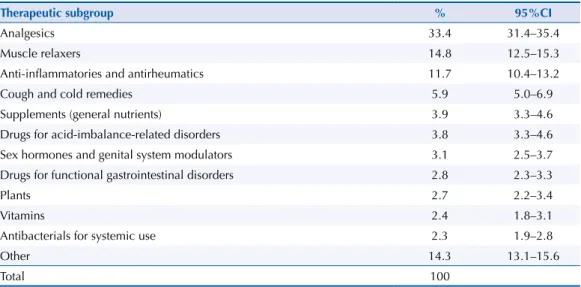
In regards to the distribution of drugs by therapeutic group from the ATC classiication (second level), the most frequent were: analgesics (33.4%; 95%CI 31.4–35.4), followed by the muscle relaxants and anti-inlammatory or antirheumatic agents, totaling 58.9% of medications consumed (Table 4).
he drugs most frequently consumed by self-medication (Table 5) were: dipyrone, single ixed-dose cafeine-orphenadrine-dipyrone and paracetamol. Most of the medications were generally classiied as non-prescription drugs (65.5%), followed by the sale of prescription medication (24.4%) and the special control drugs (0.5%) (Table 5). 48.5% of the 12 most used drugs (self-medication) were non-prescription drugs.
Therapeutic subgroup % 95%CI
Analgesics 33.4 31.4–35.4
Muscle relaxers 14.8 12.5–15.3
Anti-inflammatories and antirheumatics 11.7 10.4–13.2
Cough and cold remedies 5.9 5.0–6.9
Supplements (general nutrients) 3.9 3.3–4.6
Drugs for acid-imbalance-related disorders 3.8 3.3–4.6
Sex hormones and genital system modulators 3.1 2.5–3.7
Drugs for functional gastrointestinal disorders 2.8 2.3–3.3
Plants 2.7 2.2–3.4
Vitamins 2.4 1.8–3.1
Antibacterials for systemic use 2.3 1.9–2.8
Other 14.3 13.1–15.6
Total 100
Table 4. Distribution of drugs used in self-medication, according to the ATC classification (2nd level). PNAUM, Brazil, 2014. (N = 8,545)
Drug % 95%CI NPDb PDc
Dipyrone 15.4 13.9–17.1 X
Caffeine + orphenadrine + dipyrone 12.1 10.8–13.6 X
Paracetamol 11.4 10.2–12.8 X
Caffeine + carisoprodol + diclofenac + paracetamol 3.6 3.0–4.4 X
Diclofenac 3.5 2.7–4.5 X
Caffeine + dipyrone + isometheptene 3.3 2.5–4.2 X
Ethinylestradiol + levonorgestrel 2.5 2.0–3.0 X
Ibuprofen 2.3 1.8–3.0 X
Phenylephrine + chlorpheniramine + paracetamol 2.2 1.6–2.9 X
Omeprazole 1.8 1.4–2.4 X
Caffeine + chlorpheniramine + dipyrone 1.8 1.4–2.5 X
Nimesulide 1.6 1.2–2.1 X
Table 5. Distribution of the 12 most commonly used drugs by self-medication, according to the ATC classification (5th level) and legal category. PNAUM, Brazil, 2014a. (N = 8,545)
a Corresponds to 61.4% of the drugs used for self-medication. b Non-Prescription Drug.
DISCUSSION
he prevalence of self-medication in Brazil was lower than that found by Carvalho et al.4
(2005), in a study in Brazil, and by Knopf and Grams9 (2013), in Germany. However, the
prevalence was greater than that found in Sri Lanka26, Cuba8, and Spain7. We found variations
in ive Brazilian regions – the Northeast, Midwest and North, in which prevalences greater than the national prevalence were found.
Brazil is currently undergoing many transformations in healthcare, in which inancial and
infrastructure investment have been observed aimed at increasing the supply of health
services, mainly in the area of primary care, with the Brazilian Family Health Strategy, and
in the area of pharmaceutical care to ensure free access and rational use of medicines by
professionals, and the community in general17,23. hese transformations happen in diferent
ways among the regions, however, despite the regional inequalities being exposed, greater
access to medical services may promote less self-medication. Self-medication can also be
considered to be within an acceptable range of magnitudea, because, as was noted during
this study, the use of drugs for self-medication is restricted to self-limited acute diseases,
such as stomach or intestinal problems, fever, pain, lu, colds or allergic rhinitis, nausea and vomiting, among others, and mostly to non-prescription products (65.5%). his result is in line with the results from a study performed in Brazil by Ahmed et al.1 (1997), in which
the painful symptoms accounted for 24.3% of the motivations behind people practicing self-medication, with viral or infectious problems (high respiratory infection and diarrhea) accounting for 21.0%. Headache was found to be the main complaint for self-medication, followed by respiratory and digestive symptoms, during a study by Vilarino et al.24 A study
by Carrera-Lasfuentes et al.3 found that pain was the most reported complaint.
No signiicant association was found between the practice of self-medication and economic classiication. his result can be explained by the fact that the most frequently consumed drugs are of low cost, easy access and are most frequently prescribed4,5, including those free of
charge medications made available from the Brazilian Uniied Health System, such as those
subsidized by the Farmácia Popular (Popular Pharmacy Program) (as is true for dipyrone,
acetaminophen, and ibuprofen).
he inding that self-medication is most practiced by female individuals has also been found
in other publications2,4,9, despite national and11 international3,8,14,22,26 studies indicating that
self-medication is more prevalent among men. he results of this study may have inluenced by the fact that women sufer more with headaches, muscle pain and chronic pain conditions,
such as migraine, and use painkillers and muscle relaxers from an early age for pain relief
during menstruation or dysmenorrhoea2,19.
Self-medication was also associated with the various age groups from the study, with the most prevalent users being between the ages of 20 and 39 years. his result can generally
be attributed to health problem types that involve self-limited acute diseases, common to
all ages, and the kind of medication consumed, with analgesics being the main therapeutic
group used in the practice of self-medication4,6,8,9,11,14,20-22,24,irrespective of target population
investigated and recall period.
his fact could also explain the positive association between the practice of self-medication with the various regions in Brazil and among individuals with chronic diseases or conditions, since analgesic/antipyretic medications are generally the second most used drug in Brazil and in the ive regions of the country, second only to the antihypertensive drugs5.
In the case of the association of self-medication with age and the presence of chronic diseases, the results of this study difer from those found in Bambui, Minas Gerais12, where a negative
association was found for age and self-medication showed no association with a history of disease or selected chronic conditions. his fact may be explained by the diference concerning when the research was conducted, since the emergence of new and old infectious diseases
environmental degradation, environmental pollution and climate change17 may have intensiied
the appearance of self-limited acute diseases that encourage the practice of self-medication.
he most frequently consumed drugs were dipyrone, single ixed-dose dipyrone, orphenadrine and cafeine, and paracetamol. Similar data were found in national1,24 and international8,11
studies. hese drugs are generally found in household medical supplies10 and are normally
used to relieve signs and symptoms or acute11,12, minor or self-limited complaints.
he elevated use of painkillers for self-medication relects the high prevalence of pain in the
general population3, which is caused by tension, stressful situations or physical demand,
thereby representing a damaging aspect in people’s quality of life. Abusing analgesics can
lead to chronic headaches. A study performed in Colombia19 showed that the prevalence
of headaches due to overuse of analgesics was 4.8%, which is higher than the prevalence
in developed countries. On the other hand, the analgesic that relieves pain is the same
one that is used to treat viral febrile, bacterial or inlammatory diseases. Nonsteroidal anti-inlammatory drugs (NSAIDS) are also attractive because they act in multiple ways: analgesic, antipyretic, and anti-inlammatory. Another aspect that favors and inluences
the consumption of these products is the advertising conveyed in the general media by
pharmaceutical industry16.
Although the most drugs consumed are non-prescription drugs, it is important not to
underestimate the possible toxic and adverse efects that might follow in their users. Concerning analgesics and (NSAIDS), some of the results worth citing are gastrointestinal disorders, allergic reactions and kidney efects14. During a the study by Martinez et al.13 (2014),
the authors showed that practicing self-medication, among those interviewed, resulted in a rate for adverse efects equal to 15.1%; whereas a study by Paula, Bochner and Montilla18
(2012), which evaluated hospitalizations of the elderly due to intoxication and adverse reactions to drugs in Brazil, analgesics, antipyretics and non-opioid antirheumatics were responsible for 37.0% of hospitalizations by self-intoxication, occupying the fourth position in hospitalizations according to these situations, and were most related to cases of concussion. In this study, the place from which the drugs used in the practice of self-medications were purchased was not analyzed, but it is likely that the most of them were purchased in pharmacies or drugstores or were leftover or from reserve stocks found in pharmacies, as was evidenced by at Laste and et al.10 (2012).
Other limitations of this study are related to the diferent recall periods employed to investigate the use of medications and the possibility of memory bias. his occurs most profoundly in the case of using any drugs in the 15 days preceding the interview, and also in information given by legal guardians of 15-year-olds with some cognitive disorder or inability to answer the questions. he use of some medications may also have underestimated while the study was ongoing, such as those that are commonly used, mainly in the South region of the country, to treat respiratory problems during winter.
In conclusion, the Brazilian population, with some regional diferences, is no stranger to self-medication practice. his practice appears to be inluenced by being female, residing in the Northeast, Midwest and North regions of Brazil, and by the presence of disease or chronic
conditions. Most of the drugs consumed do not require prescription, but they are not risk-free, meaning that they deserve greater attention from managers and health professionals, as the
possible intoxication and adverse efects may increase spending on health. Considering
the aforementioned, regarding the practice of responsible self-medication, encouraged by
the World Health Organizationa, government investment must largely be used to promote
sensible use of medication and include strategies for their use in the training of future
health professionals; these aspects must be a continuous in nature or put in practice by the
REFERENCES
1. Arrais PSD, Coelho HLL, Batista MCDS, Carvalho ML, Righi RE, Arnau JM. Perfil da automedicação no Brasil. Rev Saude Publica. 1997;31(1):71-7. DOI:10.1590/S0034-89101997000100010
2. Athanasopoulos C, Pitychoutis PM, Messari I, Lionis C, Papadopoulos-Daifoti Z. Is drug utilization in Greece sex dependent? A population-based sudy. Basic Clin Pharmacol Toxicol. 2013;112(1):55-62. DOI:10.1111/j.1742-7843.2012.00920.x
3. Carrera-Lasfuentes P, Aguilar-Palacio I, Roldán EC, Fumanal SM, Hernandez MJR. Consumo de medicamentos en población adulta: influencia del autoconsumo. Aten Primaria. 2013;45(10):528-35. DOI:10.1016/j.aprim.2013.05.006
4. Carvalho MF, Oascin ARP, Souza-Junior PRB, Damacena GN Szwarcwald CL. Utilization of medicines by the Brazilian population, 2003. Cad Saude Publica. 2005;21(suppl 1):S100-8. DOI:10.1590/S0102-311X2005000700011
5. Conselho Nacional de Secretários de Saúde (CONASS). A saúde na opinião dos brasileiros: um estudo prospectivo. Brasília (DF): Conass, 2003.
6. Eticha T, Mesfin K. Self-medication practices in Mekelle, Ethiopia. PloS One. 2014;9(5):e97464. DOI:10.1371/journal.pone.0097464
7. Figueiras A, Caamano F, Gestal-Otero JJ. Socio-demographic factors related to self-medication in
Spain. Eur J Epidemiol. 2000;16(1):19-26. DOI:10.1023/A:1007608702063
8. García Milián AJ, Alonso Carbonell L, López Puig P, Yera Alós I, Ruiz Salvador AK, Blanco Hernández N. Consumo de medicamentos referidos por la población adulta de Cuba, año 2007.
Rev Cubana Med Gen Integral. 2009;25(4):5-16.
9. Knopf H, Grams D. [Medication of adults in Germany, results of the German health interview and examination survey for adults (DEGS1)]. Bundesgesundheitsblatt Gesundheitsforschung gesundheitsschutz. 2013;56(5-6):868-77. German. DOI:10.1007/s00103-013-1667-8.
10. Laste G, Deitos A, Kauffmann C, Castro LC, Torres ILS, Fernandes LC. Papel do agente comunitário de saúde no controle do estoque domiciliar de medicamentos em comunidades atendidas pela estratégia de saúde da família. Cienc Saude Coletiva. 2012;17(5):1305-12. DOI:10.1590/S1413-81232012000500024
11. López JJ, Dennis R, Moscoso SM. Estudio sobre la automedicación en una localidad de Bogotá.
Rev Salud Publica. 2009;11(3):432-42. DOI:10.1590/S0124-00642009000300012
12. Loyola Filho AL, Uchoa E, Guerra HL, Firmo JOA, Lima-Costa MF. Prevalência e fatores associados à automedicação: resultados do projeto Bambuí. Rev Saude Publica. 2002;36(1):55-62. DOI:10.1590/S0034-89102002000100009
13. Martinez JE, Pereira GAF, Ribeiro LGM, Nunes R, Ilias D, Navarro LGM. Estudo da automedicação para dor musculoesquelética entre estudantes dos cursos de enfermagem e medicina da Pontifícia Universidade Católica - São Paulo. Rev Bras Reumatol. 2014;54(2):90-4. DOI:10.1016/j.rbr.2014.03.002
14. Mendes Z, Martins AP, Miranda AC, Soares MA, Ferreira AP, Nogueira A. Prevalência da
automedicação na população urbana portuguesa. Rev Bras Cienc Farm. 2004;40(1):21-5.
DOI:10.1590/S1516-93322004000100005
15. Mengue SS, Bertoldi AD, Boing AC, NUL Tavares, da Silva Dal Pizzol T, Oliveira MA, et al. Pesquisa Nacional sobre Acesso, Utilização e Promoção do Uso Racional de Medicamentos (PNAUM): métodos do inquérito domiciliar. Rev Saude Publica. 2016;50(supl 2):4s. DOI:10.1590/S1518-8787.2016050006156
16. Naves JOS, Castro LLC, Carvalho CMS, Merchán-Hamann E. Automedicação: uma
abordagem qualitativa de suas motivações. Cienc Saude Coletiva. 2010;15(supl 1):1751-62. DOI:10.1590/S1413-81232010000700087
17. Organização Pan-Americana da Saúde (OPAS). Saúde nas Américas: edição de 2012: panorama regional e perfis de países. Washington (DC): Organização Pan-Americana da Saúde; 2012. (Publicação científica e técnica, nº 636).
19. Rueda-Sanchez M. Cefalea por uso excesivo de analgésicos en Bucaramanga, Colombia: prevalencia y factores asociados. Acta Neurol Colomb. 2013;29(1):20-6.
20. Sans S, Paluzie G, Puig T, Balañá L, Balaguer-Vintró I. Prevalencia del consumo de medicamentos en la población adulta de Cataluña. Gac Sanit. 2002;16(2):121-30.
21. Schmid B, Bernal R, Silva NN. Automedicação em adultos de baixa renda no município de São
Paulo. Rev Saude Publica. 2010;44(6):1039-45. DOI:10.1590/S0034-89102010000600008
22. Selvaraj K, Kumar SG, Ramalingam A. Prevalence of self-medication practices and its associated factors in Urban Puducherry, India. Perspect Clin Res. 2014;5(1):32-6. DOI:10.4103/2229-3485.124569
23. Vieira FS, Zucchi P. Financiamento da assistência farmacêutica no sistema único de saúde.
Saude Soc. 2013;22(1):73-84. DOI:10.1590/S0104-12902013000100008
24. Vilarino JF, Soares IC, Silveira CM, Rödel APP, Bortoli R, Leos RR. Perfil da
automedicação em município do Sul do Brasil. Rev Saude Publica. 1998;32(1):43-9. DOI:10.1590/S0034-89101998000100006
25. WHO Collaborating Centre for Drug Statistics Methodology. Guidelines for ATC classification and DDD assignment 2014. 17 ed. Oslo: WHO Collaborating Centre for Drug Statistics Methodology; 2013.
26. Wijesinghe PR, Jayakody RL, Seneviratne RA. Prevalence and predictors of self-medication in a selected urban and rural district of Sri Lanka. WHO South-East Asia Journal of Public Health.
2012;1(1):28-41.
Funding: Departments of Science and Technology (DECIT) and Department for Pharmaceutical Services and Strategic Health Supplies (DAF) from the Secretariat of Science, Technology and Strategic Inputs (SCTIE) of the Ministry of Health (Process 25000.111834/2).
Authors’ Contribution: he following authors contributed to the study’s design, analysis and interpretation of results and critical review of the intellectual content: PSDA, MEPF, ADB, SSM. All authors participated in the writing, approved the inal version of the manuscript and declared themselves responsible for all aspects of the study, thereby ensuring its accuracy and comprehensiveness.
Acknowledgements: To the Department of Science and Technology (DECIT), the Department for Pharmaceutical Services and Strategic Health Supplies (DAF) from the Secretariat of Science and the Technology and Strategic Inputs (SCTIE) of the Ministry of Health, for funding and technical support for implementing the PNAUM (Brazilian National Survey on Access, Use and Promotion of Rational Use of Medicines) and, in particular, the team that worked to collect the data, here represented by Professor Alexandra Crispim Boing, and the statistical support team for the project, represented by Amanda Ramalho Silva, Andréia Turmina Fontanella and Luciano S. P. Guimarães.