Objective: To investigate the prevalence of diiculties in adopting initial breastfeeding techniques and their association with breast disorders in postpartum women.
Methods: The cross‑sectional study was carried out with 276 randomly selected mother‑baby pairs in rooming‑in in 3 hospitals in a city of Minas Gerais State (southeast Brazil). An assessment protocol was established to evaluate the breastfeeding technique used. The association between the variables studied and breast disorders was determined by the chi‑square test followed by logistic regression, with significance level set at 0.05.
Results: The main factors indicating diiculties to initiate the breastfeeding techniques were inadequate attachment of the baby to the breast (25%), baby response to the contact with the breast (26.1%) and breast disorders (28.3%). Variables associated with postparturm breast disorders were: adolescent mothers (OR 3.35; 95%CI 1.51–7.44; p=0.003); maternal schooling
≤8 years (OR 2.07; 95%CI 1.01–4.23; p=0.048); and supplement provision to the newborn at the hospital (OR 2.36; 95%CI 1.40– 4.92; p=0.003). Mothers working outside the household (OR 0.31; 95%CI 0.16–0.61; p=0.001) served as as protective factor on the multivariate model.
Conclusions: The main difficulties in initial breastfeeding were associated with breast disorders, and the factors associated with this problem included demographic and social, variables, as well as others related to the care routine adopted by maternity hospitals.
Keywords: Breastfeeding; Lactation disorders; Risk factors.
Objetivo: Identiicar a prevalência de condições indicativas de diiculdades iniciais com a técnica da amamentação e veriicar os fatores associados com a presença de problemas na mama em puérperaso em maternidades de Hospitais Amigos da Criança.
Métodos: Estudo transversal, conduzido com 276 binômios mãe‑lactente, aleatoriamente selecionados entre os atendimentos realizados em maternidades de três Hospitais Amigos da Criança do norte de Minas Gerais. Um protocolo de avaliação da técnica da mamada foi utilizado como instrumento. A associação entre as variáveis estudadas e os problemas com a mama foi identiicada por meio do teste qui‑quadrado, seguida de análise de regressão logística, admitindo‑se o nível de signiicância de até 5% (p<0,05).
Resultados: Os principais fatores indicativos de diiculdades iniciais com a técnica da amamentação foram a pega inadequada (25,0%), a resposta do bebê ao contato com a mama (26,1%) e os problemas com a mama (28,3%). No modelo inal de regressão múltipla, associaram‑se aos problemas na mama no puerpério imediato: mãe adolescente (OR 3,35; IC95% 1,51–7,44; p=0,003); escolaridade ≤8 anos (OR 2,07;
IC95% 1,01–4,23; p=0,048); e o fato de ter recebido complemento alimentar na maternidade (OR 2,36; IC95% 1,40–4,92; p=0,003). O fato de trabalhar fora de casa (OR 0,31; IC95% 0,16–0,61; p=0,001) foi um fator de proteção no modelo inal de regressão logística.
Conclusões: Problemas com as mamas representaram a principal diiculdade inicial com a técnica da mamada e os fatores associados incluem variáveis demográicas e sociais ligadas à mãe e variáveis relacionadas às rotinas da maternidade.
Palvras‑chave: Aleitamento materno; Transtornos da lactação; Fatores de risco.
ABSTRACT
RESUMO
*Corresponding author. E‑mail: [email protected] (G.E.F. Barbosa).
aUniversidade Estadual de Montes Claros (Unimontes), Montes Claros, MG, Brazil.
Received on June 13, 2016; approved on November 25, 2016; available online on July 03, 2017.
INITIAL BREASTFEEDING DIFFICULTIES
AND ASSOCIATION WITH BREAST
DISORDERS AMONG POSTPARTUM WOMEN
Dificuldades iniciais com a técnica da amamentação e
fatores associados a problemas com a mama em puérperas
Gessandro Elpídio Fernandes Barbosa
a,*, Victor Bruno da Silva
a, Janeide Mendes Pereira
a,
Marianne Silva Soares
a, Rosemberg dos Anjos Medeiros Filho
a, Luciana Barbosa Pereira
a,
INTRODUCTION
he World Health Organization (WHO) recommends exclu‑ sive breastfeeding (EBF) for six months, and complemented until the age of 2 or more, considering the beneits proved in practice for both mother and child.1 he Ministry of Health
in Brazil has the same recommendation, and the country has one of the most advanced legislations for maternal breastfeed‑ ing in the world, ensuring several rights to women and pro‑ viding favorable conditions for breastfeeding.2 Despite the
recommendations and the measures adopted, early weaning, which is the interruption of breastfeeding before the newborn has completed 6 months of age, regardless of the reason, is still a frequent and undesirable reality.3,4
An early weaning facilitator is still little explored in national and international literature, and is related to the diiculties inherent to the breastfeeding technique. It is believed that a poor technique would make it diicult for the newborn to suck and empty the breast, thus afecting the dynamics of milk production. As a consequence, the mother can intro‑ duce other foods early, causing the weaning.5‑7
here are some very relevant aspects in the process of suck‑ ing that should be carefully assessed by health professionals in the activities for education and promotion of breastfeeding. Some behaviors observed during breastfeeding in the maternity hospital are not desirable, and seen as risk factors for weaning.8,9
Presence of nipple pain, mammary ingurgitation, mammillary lesion, fatigue and tiredness are examples of conditions that indicate diiculties with the breastfeeding technique, com‑ monly mentioned in the irst 24 hours postpartum. Besides these, other circumstnaces also have a negative impact on the duration of maternal breastfeeding, such as the presence of diiculties in handle and suction, the baby’s agitation and the perception of insuicient milk by the mother.9‑11
WHO, together with the United Nation’s Children Fund (Unicef ), recommend the use of a “sucking evaluation ile” as a strategy to monitor and identify these initial diiculties involving the breastfeeding technique.12 Despite being little
used, this instrument allows assessing behaviors that are favor‑ able or not in relation to breastfeeding, including the mother and the newborn’s posture, the responses of the pair at the beginning of sucking, the establishment of afectional bonds, the characteristics of suction, the anatomical conditions of the breast, duration and conclusion of the sucking.12‑14 his study
aimed at identifying the prevalence of conditions indicating initial diiculties with breastfeeding, based on the use of a sucking evaluation ile, and the factors associated with the presence of breast problems among mothers in the puerpe‑ rium, in maternity wards of Hospitais Amigos da Criança, in the North of Minas Gerais.
METHOD
This is a cross‑sectional, observational and analytical study, which assessed mother‑baby pairs, selected randomly, in the first 18 to 48 hours postpartum. The study was con‑ ducted in three hospitals, all named “Hospital Amigo da Criança”, in the north of Minas Gerais. The city where the study was conducted has about 390 thousand residents, and is a macro‑regional reference for several sectors of the regional economy, as well as in the health field. Sample selection was random, restricted to mother‑baby pairs assisted by the Unified Health System (SUS), who stayed in a collective accommodation after postpartum care and presented with conditions for being discharged from the hospital together.
Sample calculation was conducted to deine the mini‑ mum number of pairs analyzed in the study, considering a population of 3,000 mothers thorughout a six‑month period, with prevalence of initial problems involving the breast of 20%,13 sampling error of 5% and 95% conidence inter‑
vals (95%CI). A 10% rate was added for possible losses. herefore, the minimum number of pairs approached should be 251. he days for data collection in each hospital were deined randomly.
he following inclusion criteria were considered: mothers who received postpartum care in one of the three hospitals in the city, with term pregnancy, who were in good health con‑ ditions, according to clinical records, to respond to the ini‑ tial survey. Regarding newborns, the inclusion criteria were: good health conditions, according to clinical records, with possibility for hospital discharge and being exclusively fed with breast milk at the moment of discharge (the possible consumption of supplements in the maternity hospital was not considered as an interruption of exclusive breastfeeding). Exclusion criteria were: mothers who have not received imme‑ diate postpartum care (home parturition), mothers pregnant with twins and those whose did not stay in the group accom‑ modation. he pairs were assessed at a hospital environment (accommodation), when considered to have conditions for hospital discharge. he evaluation was conducted from 18 to 48 hours postpartum.
maternal breastfeeding and who is a monitor of the train‑ ing course in Hospital Amigo da Criança in Counseling for Maternal Breastfeeding.
he data collection instrument included the sucking eval‑ uation ile,12 which contemplates, among other elements, the
evaluation of the breasts, illed out by the direct observation of breastfeeding. Other variables were also analyzed in data colletion: social and demographic data (age, self‑reported race, schooling, paid activity, family income, marital status, num‑ ber of residents in the household, and presence of maternity leave), data about the newborn (sex, weight at birth, Apgar score at 1 and 5 minutes), besides information regarding ges‑ tational aspects, prenatal care and partum and puerperium assistance (parity, type of partum, number of prenatal appoint‑ ments, information about care with the brests, permanence in a group accommodation, among others).
he Statistical Package for the Social Sciences (SPSS), ver‑ sion 18 (SPSS Inc., Chicago, IL, USA) was used for data anal‑ ysis. he variables were assessed in a descriptive manner, by presenting absolute and relative frequencies. For the analytical stage of the analysis, problems with the breasts (engorged and irm; lat or inverted nipples; breasts or nipples with excoria‑ tions, issures or redness) were analyzed and deined as a single outcome variable (dependent). he associated variables were identiied among the other characteristics that were investi‑ gated (independent), based on the chi‑square test. he vari‑ ables associated to a 20% level (p<0.2) were assessed by the binary logistic regression, using the Backward Wald method. In this last stage, the Odds Ratio (OR) were calculated with the respective 95%CI. For the inal model, only the variables associated up to a 5% level (p<0,05) were considered.
he study was conducted according to the ethical precepts, with strict attention to Resolution 466/2012. he project was assessed and approved by the Research Ethics Committee at Universidade Estadual de Montes Claros, number 844,557, and all mothers that took part signed the informed consent form.
RESULTS
Two‑hundred and seventy‑six mother‑baby pairs or binomials were assessed. Most mothers were aged between 20 and 29 years old, and the percentage of teenage mothers was 11.6%. he prevalent self‑reported skin color was brown. More than half of the mothers reported family income of up to 1 mini‑ mum wage. Regarding schooling, most mothers reported hav‑ ing concluded from 5 to 8 years of schooling. Other sociode‑ mographic aspects are demonstrated in Table 1.
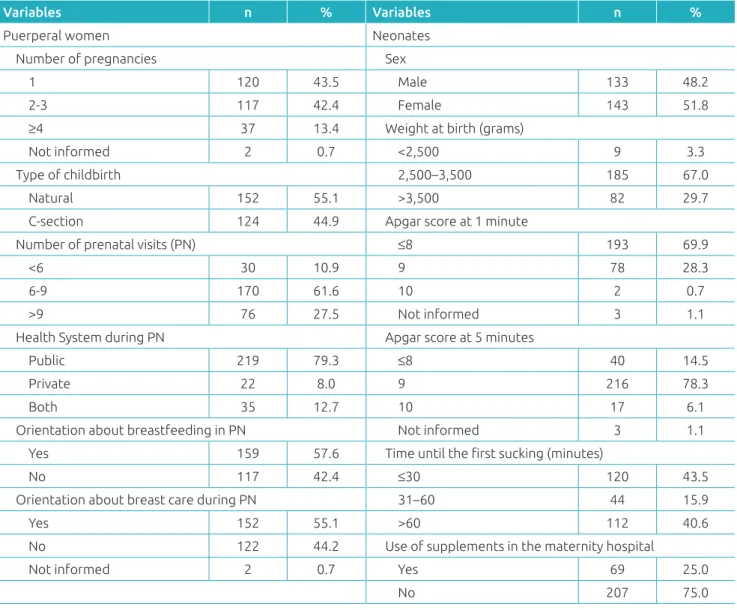
About the features regarding the pregnancy and pre‑ natal care (Table 2), most mothers were primigravid, and
55.1% of births were natural. The public health system was the most used one. 57.6 and 55.5% were advised as to breastfeeding and breast care during the prenatal period, respectively.
Less than half of the newborns was breastfed in the irst thirty minutes postpartum (43.5%), and the use of supplements
Table 1 Demographic and socioeconomic characteristics
of puerperal women; Montes Claros (MG), 2015.
Variables n %
Maternal age (years)
<20 32 11.6
20–29 170 61.6
30–39 69 25.0
≥40 5 1.8
Self‑reported race
White 43 15.6
Black 31 11.2
Yellow 16 5.8
Brown 186 67.4
Mother working outside the household
Yes 99 35.9
No 177 64.1
Family income (in minimum wages)*
≤1 144 52.2
1–2 67 24.3
>2 65 23.5
Marital status
Single 88 31.9
Married 181 65.6
Divorced 7 2.5
Father living in the household
Yes 209 75.7
No 64 23.2
Not informed 3 1.1
Maternal schooling (years)
<4 35 12.7
5–8 124 44.9
≥9 117 42.4
Number of people living in the household
≤4 184 66.7
5–7 73 26.4
>7 19 6.9
for the child in the maternity hospital was reported by 25.0% of the mothers (Table 2).
he observation of the sucking allowed identifying condi‑ tions that indicated initial diiculties with the techniques in all the assessed aspects, especially inadequate handle (25.0%), response to the contact with the breast (26.1%), and prob‑ lems with the breast (28.3%) (Table 3).
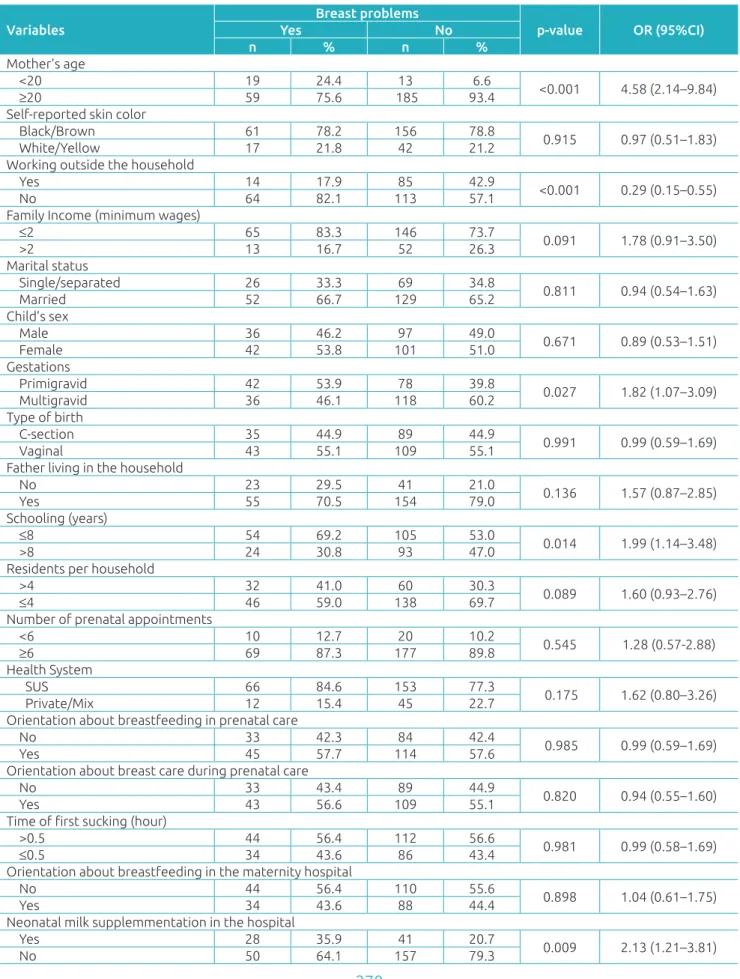
Table 3 registers the result of the bivariate analyses for the maternal and care characteristics, as well as the presence of breast problems. he variables in this table that were asso‑ ciated until up to 20% (p<0.2) were assessed together and remained in the inal multivariate model as variable associ‑ ated with breast problems: the fact of being a teenage mother (OR 3.35; 95%CI 1.51–7.44; p=0.003), schooling equal to or lower than 8 years (OR 2.07; 95%CI 1.01–4.23; p=0.048), the fact of having received supplements at the maternity
Table 2 Characteristics of gestational and prenatal care of puerperal women and characteristics of the newborns;
Montes Claros (MG), 2015.
Variables n %
Puerperal women Number of pregnancies
1 120 43.5
2‑3 117 42.4
≥4 37 13.4
Not informed 2 0.7
Type of childbirth
Natural 152 55.1
C‑section 124 44.9
Number of prenatal visits (PN)
<6 30 10.9
6‑9 170 61.6
>9 76 27.5
Health System during PN
Public 219 79.3
Private 22 8.0
Both 35 12.7
Orientation about breastfeeding in PN
Yes 159 57.6
No 117 42.4
Orientation about breast care during PN
Yes 152 55.1
No 122 44.2
Not informed 2 0.7
Variables n %
Neonates Sex
Male 133 48.2
Female 143 51.8
Weight at birth (grams)
<2,500 9 3.3
2,500–3,500 185 67.0
>3,500 82 29.7
Apgar score at 1 minute
≤8 193 69.9
9 78 28.3
10 2 0.7
Not informed 3 1.1
Apgar score at 5 minutes
≤8 40 14.5
9 216 78.3
10 17 6.1
Not informed 3 1.1
Time until the irst sucking (minutes)
≤30 120 43.5
31–60 44 15.9
>60 112 40.6
Use of supplements in the maternity hospital
Yes 69 25.0
No 207 75.0
hospital (OR 2.36; 95%CI 1.40–4.92; p=0.003) and the fact of working outside the household, which was a protective factor (OR 0.31; 95%CI 0.16–0.61; p=0.001) in the inal logistic regression model.
DISCUSSION
he results obtained in the study show high prevalence of conditions indicating initial diiculties with the breastfeed‑ ing technique. Even though there are few studies described in the literature with the same approach, other authors also revealed high prevalence of initial breastfeeding diiculties by applying the sucking evaluation ile from Unicef.8,13‑15
Carvalhaes et al., in a study conducted in a public maternity hospital working on low‑risk childbirth, assessed 50 mother‑baby binomials and showed that 18 to 34% of the pairs presented diiculties with the initial breastfeeding period, in at least one of the aspects of sucking that were observed.13 Pereira, in 2008, observed a 50% prevalence of
breastfeeding diiculties in the maternity hospital, in a sam‑ ple of 60 cases of mother‑baby dyads.15 It is important to
mention that even though the author also used the Unicef form, some mothers were advised by health professionals in relation to the breastfeeding technique when they were in the third trimester of pregnancy, and this previous training could also have inluenced the numbers. Mosele et al. also used the evaluation protocol by Uniced and showed, based on the analysis of 152 mother‑baby binomials admitted to a group accommodation, that 55% of the pairs presented at least one diiculty regarding breastfeeding. he main dii‑ culties found were: “mother with tense sholders and lean‑ ing over the baby”, “baby cannot handle the nipple”, “mam‑ mary tissue with excoriations, mammillary lesion or redness” and “suction: mouth nearly closed, pointing outward, lower lip inside; you cannot see the baby’s tongue, with tense or sunken cheeks”.14
Traditionally, the most prevalent problems with puerperal breasts, that is, mammary ingurgitation and mammillary lesions, are attributed to the inadequate position for breast‑ feeding and/or the baby’s handle.10 In a case‑control study
conducted with women admitted to a university hospital in the state of São Paulo, involving binomials in which the chil‑ dren had twisted neck, chin away from the breast and lower lip turned inside, there was 1.9, 2.9 and 4.2 times more chances of presenting with mammillary trauma during breastfeeding, respectively, in comparison with binomials who did not have these characteristics.8 hese results highlight the importance
of using a sucking evaluation ile to help identify problems with the breastfeeding technique, especially those related with inadequate handle, baby’s response to the contact with the breast and breast problems.
Breast problems may compromise the success of maternal breastfeeding. A national study identiied a high incidence of mammillary lesions in the maternity hospital, of 43.6%.7
A prospective study carried out in Malasia showed breastfeed‑ ing diiculties owed to breast problems, such as lesion and mammillary pain, as major predictive factors for the inter‑ ruption of exclusive maternal breastfeeding.16
In this study, the authors chose to assess, speciically, the factors associated with the presence of brast problems in mothers in the irst 24 hours postpartum, still inside the maternity hospitals, because the changes could be identiied more easily, with minor chances of subjective assessment by the evaluators. herefore, the variables associated with breastfeeding diiculties were mother’s age and schooling, the fact that the newborn received supplements in a hos‑ pital environment and the report that the mother worked outside the household, being the later a protective factor. Literature did not show studies associating the mother’s age with breastfeeding problems. here are, however, records
Table 3 Prevalence of conditions indicating initial diiculties with the breastfeeding technique among puerperal women; Montes Claros (MG), 2015.
Condition observed n %
Inadequate position 44 15.9
Tense shoulders 11 4.0
Distant baby 11 4.0
Twisted neck 21 7.6
Chin does not touch the breast 21 7.6 Just shoulder and head supported 22 8.0
Response to breasts’ contact 72 26.1
No response to irst contact 8 2.9
No search 5 1.8
Baby was not interested 11 4.0
Baby was agitated and crying 23 8.3
Baby cannot handle breast 25 9.1
No sign of ejection 50 18.1
Inadequate latch on the breast 69 25.0
Closed mouth 26 9.4
Lower lip turned inwards 38 13.8
Tongue is not visible 44 15.9
Sunken cheeks 24 8.7
Fast suction 23 8.3
Noise during suction 17 6.2
Breast problems 78 28.3
Firm breast 11 4.0
Flat nipple 28 10.1
Fissure 55 19.9
Stretched breast 7 2.5
Emotional diiculties 36 13.0
Mother feels insecure to hold the baby 11 4.0
No eye contact 16 5.8
Variables
Breast problems
p‑value OR (95%CI)
Yes No
n % n %
Mother’s age
<20 19 24.4 13 6.6
<0.001 4.58 (2.14–9.84)
≥20 59 75.6 185 93.4
Self‑reported skin color
Black/Brown 61 78.2 156 78.8 0.915 0.97 (0.51–1.83)
White/Yellow 17 21.8 42 21.2
Working outside the household
Yes 14 17.9 85 42.9
<0.001 0.29 (0.15–0.55)
No 64 82.1 113 57.1
Family Income (minimum wages)
≤2 65 83.3 146 73.7 0.091 1.78 (0.91–3.50)
>2 13 16.7 52 26.3
Marital status
Single/separated 26 33.3 69 34.8
0.811 0.94 (0.54–1.63)
Married 52 66.7 129 65.2
Child’s sex
Male 36 46.2 97 49.0 0.671 0.89 (0.53–1.51)
Female 42 53.8 101 51.0
Gestations
Primigravid 42 53.9 78 39.8 0.027 1.82 (1.07–3.09)
Multigravid 36 46.1 118 60.2
Type of birth
C‑section 35 44.9 89 44.9
0.991 0.99 (0.59–1.69)
Vaginal 43 55.1 109 55.1
Father living in the household
No 23 29.5 41 21.0 0.136 1.57 (0.87–2.85)
Yes 55 70.5 154 79.0
Schooling (years)
≤8 54 69.2 105 53.0 0.014 1.99 (1.14–3.48)
>8 24 30.8 93 47.0
Residents per household
>4 32 41.0 60 30.3 0.089 1.60 (0.93–2.76)
≤4 46 59.0 138 69.7
Number of prenatal appointments
<6 10 12.7 20 10.2
0.545 1.28 (0.57‑2.88)
≥6 69 87.3 177 89.8
Health System
SUS 66 84.6 153 77.3 0.175 1.62 (0.80–3.26)
Private/Mix 12 15.4 45 22.7
Orientation about breastfeeding in prenatal care
No 33 42.3 84 42.4
0.985 0.99 (0.59–1.69)
Yes 45 57.7 114 57.6
Orientation about breast care during prenatal care
No 33 43.4 89 44.9 0.820 0.94 (0.55–1.60)
Yes 43 56.6 109 55.1
Time of irst sucking (hour)
>0.5 44 56.4 112 56.6 0.981 0.99 (0.58–1.69)
≤0.5 34 43.6 86 43.4
Orientation about breastfeeding in the maternity hospital
No 44 56.4 110 55.6
0.898 1.04 (0.61–1.75)
Yes 34 43.6 88 44.4
Neonatal milk supplemmentation in the hospital
Yes 28 35.9 41 20.7 0.009 2.13 (1.21–3.81)
No 50 64.1 157 79.3
Table 4 Association between diiculties in breastfeeding and the studied variables (bivariate analysis); Montes
that teenage mothers provide less breast milk to their chil‑ dren in relation to the others, and also have more diicul‑ ties to initiate the practice of breastfeeding.17‑19 However,
the studies do not refer to breastfeeding aspects among the teenagers assessed. It is possible that anatomical factors of the puerperal breasts of teenagers may lead to more vulner‑ ability regarding the diiculties presented, but this aspect was not assessed in this study. Considering that maternal age is a non‑modiiable factor for breastfeeding, the result observed highlights that education regarding breast care should be reinforced among younger women, aiming at improving the breastfeeding practices.
It was not possible to identify scientiic articles that associ‑ ate the use of food supplement still in the hospital with breast problems, even though an association has been observed with worse scores in the breastfeeding ile.13 Chantry et al. demon‑
strated that the use of food supplements in the hospital was related to the presence of pain while breastfeeding.20 It is
not possible to establish a cause‑efect relation between both events, and the association observed could be a result of the reverse causation efect, that is, the fact of presenting breast problems would be the trigger for the use of food supplements still in the maternity hospital. Anyway, the intake of any other food during the irst months of breastfeeding, besides being a major risk factor for the development of illnesses that are common in childhood, such as pneumonia or diarrhea, also increases the chances of early weaning, since it interferes in some aspects of the sucking technique.21,22 his fact brings out
the need for more rigor in hospital institutions while ofering food supplements for newborns.
As to the association between breast problems and maternal schooling, other studies have indicated an intrinsic relation‑ ship between the practice of breastfeeding and schooling.19,23
Women with higher schooling tend to be more motivated to breastfeed for a longer period, maybe for having more access to information about the beneits and advantages caused by maternal breastfeeding for the binomial.19 It is likely that
women with higher schooling also have more motivation to care for their breasts during gestation; therefore, women with lower schooling would present more breast problems in the initial stages of breastfeeding.
This study showed that the maternal report of work‑ ing outside the household functions as a protective factor for the occurrence of problems with the puerperal breast. Even though we did not find other studies approaching this subject, the circumstance observed may be explained by the fact that working mothers have more opportunities to access positive information about breast care outside the household.
According to Roig et al., the information related to breast care and breastfeeding provided by health professionals during prenatal care are closely related with the success in maternal breastfeeding, as well as with the presence of positive previ‑ ous experiences with breastfeeding.24 herefore, this study
did not show a signiicant association between the fact that the mother received orientation during prenatal care regard‑ ing breastfeeding or breast problems, and the prevalence of initial problems with the breast in the irst 18 to 48 hours postpartum. his fact can be justiied by the lack of param‑ eters that could characterize an adequate ofer – or not – of information and the communication between the prenatal staf and the pregnant woman. he former may have given the orientation, but without signiicant emphasis during the appointments; there might have been a limitation in the preg‑ nant woman’s memory about the orientation.
he results of this study including some limitations, such as the fact that information regarding previous lactation expe‑ riences were not considered. his fact could be related to the lower prevalence of initial diiculties among multigravid women, but this data was not measured alone. Another lim‑ itation is that only women assisted in the Uniied Health System were assessed, even if many of them have received prenatal care in the private system, or both. herefore, the prevalence of initial diiculties may have been measured only in the lower social strata of the population, and the results of this study, therefore, may not be extrapolated for binomials assisted by the private health system.
he evaluation of diiculties in sucking techniques, still in the hospital environment, is a simple, economic measure that does not require a specialized professional. herefore, it can be incorporated to the criteria of hospital discharge, in order to identify and assist the binomials that present some sort of problem regarding the breastfeeding process, provid‑ ing the adequate orientation to solve these diiculties and to strengthen the mother‑baby connection.
As a future perspective, the determination of the impact of initial diiculties with the sucking technique on the dura‑ tion of exclusive maternal breastfeeding should be assessed by the longitudinal observation of the mother‑baby pair, and that may show exactly which are the factors related with the sucking technique that can be related with early weaning.
Funding
Fundação de Amparo à Pesquisa de Minas Gerais (Fapemig) inanced scientiic scholarships for the conduction of this study.
Conflict of interests
© 2017 Sociedade de Pediatria de São Paulo. Published by Zeppelini Publishers. This is an open access article under the CC BY license (http://creativecommons.org/licenses/by/4.0/).
REFERENCES
1. World Health Organization. Indicators for assessing breastfeeding practices. Geneva: WHO; 2007.
2. Brazil ‑ Ministério da Saúde. Secretaria de Atenção à Saúde. Departamento de Ações Programáticas Estratégicas. Atenção à saúde do recém‑nascido: guia para os proissionais de saúde. 2nd ed. Brasília: Ministério da Saúde; 2012.
3. Warkentin S, Taddei JA, Viana KJ, Colugnati FA. Exclusive breastfeeding duration and determinants among Brazilian children under two years of age. Rev Nutr. 2013;26:259‑69. 4. Vieira GO, Reis MR, Vieira TO, Oliveira NF, Silva LR, Giugliani
ER. Tendência dos indicadores de aleitamento materno em uma cidade do Nordeste brasileiro. J Pediatr (Rio J). 2015;91:270‑7.
5. França MC, Giugliani ER, Oliveira LD, Weigert EM, Santo LC, Köhler CV, et al. Uso de mamadeira no primeiro mês de vida: determinantes e inluência da técnica de amamentação. Rev Saude Publ. 2008;42:607‑14.
6. Mannan I, Rahman SM, Sania A, Seraji HR, Arifeen SE, Winch PJ, et al. Can early postpartum home visits by trained community health workers improve breastfeeding of newborns? J Perinatol. 2008;28:632‑40.
7. Weigert EM, Giugliani ER, França MC, Oliveira LD, Bonilha A, Santo LC, et al. Inluência da técnica de amamentação nas frequências de aleitamento materno exclusivo e lesões mamilares no primeiro mês de lactação. J Pediatr (Rio J). 2005;81:310‑6.
8. Coca KP, Gamba MA, Silva RS, Abrão AC. A posição de amamentar determina o aparecimento do trauma mamilar? Rev Esc Enferm USP. 2009;43:446‑52.
9. Gerd AT, Bergman S, Dahlgren J, Roswall J, Alm B. Factors associated with discontinuation of breastfeeding before 1 month of age. Acta Paediatr. 2012;101:55‑60.
10. Giugliani ER. Problemas comuns na lactação e seu manejo. J Pediatr (Rio J). 2004;80 Suppl 5:S147‑54.
11. Mehrparvar S, Varzandeh M. lnvestigation of decreasing causes exclusive breastfeeding in children below six months old, in Kerman City during 2008‑2009. J Fasa Univ Med Sci. 2011;1:45‑51.
12. World Health Organization and UNICEF. Breastfeeding management and promotion in a baby‑friendly hospital: an 18‑hour course for maternity staf. Geneva: WHO and UNICEF; 2009.
13. Carvalhaes MA, Corrêa CR. Identiicação de diiculdades no início do aleitamento materno mediante aplicação de protocolo. J Pediatr (Rio de J). 2003;79:13‑20.
14. Mosele PG, Santos JF, Godói VC, Costa FM, Toni PM, Fujinaga CI. Instrumento de avaliação da sucção do recém‑nascido com vistas a alimentação ao seio materno. Rev CEFAC. 2014;16:1548‑57.
15. Pereira MA, Levy L, Matos ME, Calheiros JM. Inluência da correção da pega no sucesso do Aleitamento Materno: resultados de um estudo experimental. Rev Referência. 2008;2:27‑38.
16. Tengku AT, Wan MW, Mohd IB. Factors Predicting Early Discontinuation of Exclusive Breastfeeding among Women in Kelantan, Malaysia. HEJ. 2013;4:42‑54.
17. Apostolakis‑Kyrus K, Valentine C, DeFranco E. Factors associated with breastfeeding initiation in adolescent mothers. J Pediatr. 2013;163:1489‑94.
18. Sipsma HL, Jones KL, Cole‑Lewis H. Breastfeeding among adolescent mothers: a systematic review of interventions from high‑income countries. J Hum Lact. 2015;31:221‑9. 19. Faleiros FT, Trezza EM, Carandina L. Aleitamento materno:
fatores de inluência na sua decisão e duração. Rev Nutr. 2006;19:623‑30.
20. Chantry CJ, Dewey KG, Peerson JM, Wagner EA, Nommsen‑Rivers LA. In‑Hospital Formula Use Increases Early Breastfeeding Cessation Among First‑Time Mothers Intending to Exclusively Breastfeed. J Pediatr. 2015;164:1339‑45. 21. Hanieh S, Ha TT, Simpson JA, Thuy TT, Khuong NC, Thoang
DD, et al. Exclusive breastfeeding in early infancy reduces the risk of inpatient admission for diarrhea and suspected pneumonia in rural Vietnam: a prospective cohort study. BMC Public Health. 2015;15:1166.
22. Lamberti LM, Zakarija‑Grković L, Walker CL, Theodoratou E, Nair H, Campbell H, et al. Breastfeeding for reducing the risk of pneumonia morbidity and mortality in children under two: a systematic literature review and meta‑analysis. BMC Public Health. 2013;13 Suppl 3:S18.