RELATI ONSHI P BETW EEN NURSES’ LEADERSHI P STYLES AND POW ER BASES
I n m acu lada Gar cía Gar cía1
Em ilio Sán ch ez San t a- Bár bar a2
Gar cía Gar cía I , San t a- Bár b ar a ES. Relat ion sh ip b et w een n u r ses’ lead er sh ip st y les an d p ow er b ases. Rev
Lat ino- am Enfer m agem 2 0 0 9 m aio- j unho; 1 7 ( 3 ) : 2 9 5 - 3 0 1 .
This quant it at iv e st udy aim ed t o em pir ically ev idence t he r elat ionship bet w een t he pow er bases of t he leader
and t he leader ship st y les of nur ses. The r andom sam ple consist ed of 204 nur sing pr ofessionals fr om a public
h osp it al. Th e f ollow in g m easu r em en t in st r u m en t s w er e u sed : t h e SBDQ ( Su p er v isor y Beh av ior Descr ip t ion
Quest ionnair e) t o ident ify leader ship st y les and t he Pow er Per cept ion Pr ofile t o det er m ine t he t y pes of pow er
u sed b y l ead er s. Descr i p t i v e, b i v ar i at e an d m u l t i v ar i at e an al y ses w er e u sed . Based o n t h e r esu l t s, t w o
r elat ionships pr oposed by t he SLT ( Sit uat ional Leader ship Theor y ) w er e v er ified: bet w een coer civ e pow er and
S1 lead er sh ip st y le ( t ellin g) , an d b et w een r ef er en t p ow er an d S3 lead er sh ip st y le ( p ar t icip at in g) . I n ot h er
cases, r esu lt s h av e been opposit e t o ex pect at ion s: t h e u se of pow er pr oposed by t h e m odel decr eases t h e
pr obabilit y of per for m ing t he pr escr ibed leader ship st y le.
DESCRI PTORS: nur sing st aff; pow er ; leader ship; hospit al adm inist r at ion
RELACI ÓN EN TRE ESTI LOS DE LI DERAZGO Y BASES DE PODER EN LAS EN FERMERAS
El obj et iv o del est udio es la com pr obación em pír ica de la r elación ent r e las fuent es de poder del líder y los
est ilos d e d ir ección d e las en f er m er as. Est u d io cu an t it at iv o, m u est r a eleg id a al azar con st it u id a p or 2 0 4
par t icipan t es per t en ecien t es al per son al de En f er m er ía de u n h ospit al pú blico. Los in st r u m en t os de m edida
fuer on: el SBDQ ( Super v isor y Behav ior Descr ipt ion Quest ionair e) par a ident ificar los est ilos de lider azgo y el
Per fil de Per cepción de Poder par a det er m inar los t ipos de poder ut ilizados por los líder es. Se r ealizó análisis
descr ipt iv o, biv ar iant e y m ult iv ar iant e. A par t ir de los r esult ados obt enidos, se v er ificó la r elación pr opuest a
por la TLS ( Teor ía del Lider azgo Sit uacional) ent r e el poder coer cit ivo y el est ilo de lider azgo E1 ( decir ) y ent r e
el poder r efer ent e y el est ilo de lider azgo E3 ( par t icipar ) . En ot r os casos, los r esult ados han sido opuest os a los
esper ados: la ut ilización del poder pr opuest o por el m odelo dism inuy e la pr obabilidad de desem peñar el est ilo
de lider azgo pr escr it o.
DESCRI PTORES: per son al de en fer m er ía; poder ; lider azgo; adm in ist r ación h ospit alar ia
RELAÇÃO EN TRE ESTI LOS DE LI DERAN ÇA E BASES DE PODER DAS EN FERMEI RAS
O obj et iv o dest e est udo foi com pr ov ar em pir icam ent e a r elação ent r e as bases de poder do líder e os est ilos
de lider an ça das en f er m eir as. Tr at a- se de est u do qu an t it at iv o com am ost r a aleat ór ia de 2 0 4 par t icipan t es,
pr ofissionais de enfer m agem de um hospit al público. Os inst r um ent os de m ensur ação for am : o SBDQ ( Super visor y
Beh av ior Descr ipt ion Qu est ion air e) par a iden t if icar os est ilos de lider an ça e o Per f il de Per cepção do Poder
par a det er m inar os t ipos de poder ut ilizados pelos líder es. Foi r ealizada análise descr it iva, bivar iada e m ult ivar iada.
Com base nos r esult ados alcançados, ver ificou- se a r elação pr opost a pela TLS ( Teor ia da Lider ança Sit uacional)
ent r e o poder coer cit ivo e o est ilo de lider ança E1 ( det er m inar ) e ent r e o poder r efer ent e e o est ilo de lider ança
E3 ( par t icipar ) . Em out r os casos, os r esult ados t êm sido opost os aos esper ados: a ut ilização do poder pr opost o
pelo m odelo dim inui a pr obabilidade par a desem penhar o est ilo de lider ança pr escr it o.
DESCRI TORES: r ecu r sos h u m an os de en f er m agem ; poder ; lider an ça; adm in ist r ação h ospit alar
1RN, Ph.D. in Psychology, Universidad de Granada, Spain, e- m ail: [email protected]; 2Doct or en Psicologia, Universidad de Granada, Spain e- m ail: [email protected].
I NTRODUCTI ON
T
h e c o n c e p t o f l e a d e r s h i p h a s b e e n ad d r essed f r om d if f er en t p er sp ect iv es. I t s st u d y ino r g a n i za t i o n s r e f e r s t o l e a d e r s’ i n t e n t i o n t o g a i n
cooper at ion in a com m on t ask. Resear ch on t he t hem e
has incr eased as w est er n societ ies indicat e t he need
t o count on m or e com plex or ganizat ions.
The concept of leader ship has been addr essed
b y d if f er en t t h eor ies. Most t im es, d ef in it ion s h av e
id en t if ied lead er sh ip as in f lu en ce. Am on g all t h ese
t h eor ies, t h is st u dy con cen t r at es on t h e Sit u at ion al
Leader ship Theor y( 1). I n t he sam e w ay, ot her st udies
on nur sing per sonnel hav e also used t his m odel( 2- 3).
Th i s t h eo r y d ef i n es l ead er sh i p as “ t h e p r o cess o f
influencing t he act ivit ies of an individual or a group in
effor t s t owar ds goal achievem ent in a given sit uat ion”.
Th e S i t u a t i o n a l Le a d e r s h i p Th e o r y h a s
progressed over t im e. I n it s first version, it w as called
Life Cy cle Theor y of Leader ship. I t s m ain applicat ion
w as n ot in t h e lab or con t ex t b u t it r ef er r ed t o t h e
educat ional w or k par ent s and t eacher s car r y out w it h
children in t he different st ages of life. Lat er on, t hese
au t h or s dev eloped som e aspect s of t h is m odel an d
con sider ed it w ou ld be applicable in an y leader sh ip
sit uat ion, bot h in fam ily and in educat ional or labor
c o n t e x t s . A f t e r w a r d s , i t w a s c a l l e d S i t u a t i o n a l
Leader sh ip Th eor y ( SLT) .
As it s nam e st at es, t he sit uat ion is part icularly
relevant in t his t heory. Previously, in ot her t heoret ical
ap p r oach es, t h e ef f ect iv e lead er w as con sid er ed t o
hav e a set of specific char act er ist ics or at t r ibut es. I n
t he sam e way, ot her approaches focused on ident ifying
t h e appr opr iat e beh av ior an d st y le in an y sit u at ion .
Th e SLT, w i t h o u t i n v a l i d a t i n g t h e p r e v i o u s o n e ,
em phasizes t he adj ust m ent bet w een leader s’ behavior
an d sit u at ion al dem an ds.
The SLT r ecognizes t hat each leader can have
a p r e f e r r e d st y l e , h o w e v e r, t h e e f f e ct i v e n e ss o f
leader ship depends on t he ext ent t o w hich t he leader
is ab le t o ad ap t or m od if y h is/ h er st y le w h en t h e
sit u at ion r equ ir es.
Au t h or s of t h e SLT( 1 ) id en t if y t h e lead er sh ip
s t y l e b a s e d o n t w o d i m e n s i o n s o f t h e l e a d e r ’ s
c o n d u c t : t h e y d e f i n e t h e t a s k b e h a v i o r a s a l l
con d u ct s f or w ar d ed t o d et ail t h e t ask an d f u n ct ion s
o f e a ch o f i t s m e m b e r s. Re l a t i o n sh i p b e h a v i o r i s
d e f i n e d a s t h e c o n d u c t s t h a t f a c i l i t a t e
com m u n icat ion w it h su b or d in at es, in clu d in g su p p or t
t o t h em , if n ecessar y.
I n 1 9 6 7 , t h e 3 D Le a d e r sh i p Th e o r y w a s
p r esen t ed( 4 ), in t r od u cin g ef f ect iv en ess as t h e t h ir d
dim ension. Under t his viewpoint , relat ionship and t ask
con du ct s w ou ld n ot be su f f icien t , an d ef f ect iv en ess
w ould depend on t he degr ee of adj ust m ent bet w een
t he leader’s st yle and t he circum st ance of t he sit uat ion.
Aut hor s of t he SLT( 5) pr ev iously adopt ed t he
i d e a o f a t h i r d d i m e n si o n t o a ch i e v e l e a d e r sh i p
effect iv eness. Of all possible v ar iables t hat configur e
t he sit uat ion, t hey ident ified t he subor dinat es’ m at ur it y
( o r p r e p a r a t i o n ) a s t h e m o st r e l e v a n t si t u a t i o n a l
v ar i ab l e.
Accor ding t o t his m odel, t her e is no opt im al
l e a d e r s h i p s t y l e t o i n f l u e n c e e m p l o y e e s m o r e
effect ively; t he leader ship st yle should depend direct ly
on t he pr epar at ion of t he subor dinat es, on w hom t he
leader int ends t o exert influence so as t o achieve his/
h e r a i m s . Th e r e a d i n e s s o f t h e s u b o r d i n a t e s i s
con cr et ized in t h eir abilit y an d w illin gn ess. Th e fir st
r efer s t o t he ex per ience and sk ill of t he indiv idual t o
per for m a given t ask, and t he second t o t he m ot ivat ion
t o per for m it .
Th is t h eor et ical m od el con sid er s t h at t h er e
a r e f o u r l e a d e r s h i p s t y l e s , r e s u l t i n g f r o m t h e
c o m b i n a t i o n o f t a s k b e h a v i o r a n d r e l a t i o n s h i p
behavior. These t w o dim ensions ar e independent ; four
lead er sh ip st y les em er g e f r om t h em , d escr ib ed as
f ollow s.
St y le 1 ( S1 ) - t ellin g – is ch ar act er ized b y ab ov
e-a v e r e-a g e t e-a s k b e h e-a v i o r e-a n d b e l o w - e-a v e r e-a g e
r elat ion sh ip beh av ior.
St yle 2 ( S2) - selling – is char act er ized by bot h t ask
an d r elat ion sh ip beh av ior abov e av er age.
St y l e 3 ( S3 ) - p ar t i ci p at i n g – i s ch ar act er i zed b y
a b o v e a v e r a g e r e l a t i o n sh i p b e h a v i o r a n d b e l o w
-av er ag e t ask b eh -av ior.
St yle 4 ( S4) - delegat ing - bot h r elat ionship behavior
an d t ask beh av ior below av er age.
Accor ding t o t he aut hor s of t he SLT( 1), each
level of readiness corresponds t o a cert ain leadership
st y le. Thus, lev el 1 of r eadiness cor r esponds t o S1 ,
level 2 cor r esponds t o S2 and so on.
Th e g r eat ap p eal an d d issem in at ion of t h e
m odel am on g leader s is w ell k n ow n( 6 ). Accor din g t o
sev er al r esear ch er s( 7 ), t h e p r ob ab ilit y of su ccessf u l
l e a d e r sh i p i n cr e a se s w h e n t h e st y l e r e f l e ct s t h e
appr opr iat e pow er base.
This st udy aim ed t o ver ify w het her t he pow er
bases used cor r espond t o t he t heor y, w hich led t o t he
Pow er has been defined( 8- 9) as t he pot ent ial
an indiv idual has t o influence anot her. Leader ship is
any effort exert ed t o influence and pow er is it s pot ent ial
influence, t he r esour ce t hat per m it s influencing.
On t h e o t h e r h a n d , s o m e r e s e a r c h e r s( 7 )
suppor t t he idea t hat it is not t he leader ’s pow er t hat
per m it s influencing his/ her follow er s, but act ually t he
per cept ion t hey hav e of t he leader ’s pow er.
D i f f e r e n t cl a ssi f i ca t i o n sy st e m s o f p o w e r
b a s e s h a v e b e e n p r o p o s e d . A m o n g t h e m , t h e
classif icat ion b elow is t h e m ost d issem in at ed . I t( 1 0 )
ident ifies fiv e bases of pow er.
Coer cive pow er – is t he per cept ion of t he subor dinat e
on t he leader ’s capacit y t o enfor ce punishm ent s.
Rew ar d pow er – subor dinat es r ecognize t he leader ’s
capacit y t o offer gr at ificat ions.
Legit im at e pow er - t his pow er is r elat ed t o t he leader ’s
posit ion or funct ion.
Re f e r e n t p o w e r – t h e l e a d e r i n s p i r e s p o s i t i v e
adm ir at ion and affect ion in subor dinat es.
Ex per t pow er – subor dinat es r ecognize t he leader as
som eone w it h ex per ience and abilit y.
A si x t h p o w e r b a se w a s a d d e d l a t e r, t h e
i n f or m at i on p ow er, w h i ch i s t h e l ead er ’s ab i l i t y t o
obt ain r elev ant infor m at ion for subor dinat es.
Year s lat er, t he set of pow er w as configur ed
w i t h t h e a d d i t i o n o f a n o t h e r t y p e o f p o w e r, t h e
c o n n e c t i o n p o w e r( 1 1 ), w h i c h i s d e f i n e d a s t h e
su b o r d i n at es’ p er cep t i o n o f t h e l ead er ’ s ab i l i t y t o
connect w it h influent ial people or or ganizat ions.
The SLT w as finally com plet ed by adding t he
r e l a t i o n s h i p b e t w e e n t h e p o w e r b a s e s a n d t h e
leadership st yles( 7). I n t his m odel, a specific m at ch is
pr escr ibed bet w een each of t he pow er bases and t he
m ost appr opr iat e st y le leader s should apply t o ex er t
t h e st r on g est p ossib le in f lu en ce on t h eir f ollow er s.
These assum pt ions of t he m odel are t est ed in t his st udy.
I n t h e last d ecad es, n u r ses h av e occu p ied
m anager ial j obs in t he healt h syst em . This and ot her
st u dies( 1 2 ) pr ov ide u sefu l scien t ific k n ow ledge t o t h e
ex er cise of new posit ions and com pet ences.
OBJECTI VE
Th i s st u d y a i m e d t o e m p i r i ca l l y t e st t h e
r elat ion sh ip bet w een t h e dif f er en t sou r ces of pow er
of t he leader and nur ses’ m anagem ent st y les.
Thus, t he follow ing pr em ises ar e pr esent ed:
- t he applicat ion of t he coercive pow er base increases
t he pr obabilit y of hav ing S1 st y le ( t elling) ;
- t h e u se o f t h e co n n e ct i o n p o w e r i n cr e a se s t h e
pr obabilit y of dev eloping t he S1 st y le ( t elling) ;
- t h e u se o f t h e co n n e ct i o n p o w e r i n cr e a se s t h e
pr obabilit y of using t he S2 st y le ( selling) ;
- t h e applicat ion of t h e r ew ar d pow er in cr eases t h e
pr obabilit y of hav ing t he S2 st y le ( selling) ;
- t h e u se o f t h e l e g i t i m a t e p o w e r i n cr e a se s t h e
pr obabilit y of dev eloping t he S2 st y le ( selling) ;
- t he applicat ion of t he legit im at e pow er increases t he
pr obabilit y of using t he S3 st y le ( par t icipat ing) ;
- t h e u s e o f t h e r e f e r e n t p o w e r i n c r e a s e s t h e
pr obabilit y of hav ing t he S3 st y le ( par t icipat ing) ;
- t h e u se o f t h e i n f o r m at i o n p o w er i n cr eases t h e
pr obabilit y of using t he S3 st y le ( par t icipat ing) ;
- t he applicat ion of t he infor m at ion pow er incr eases
t he pr obabilit y of hav ing t he S4 st y le ( delegat ing) ;
- t he use of t he exper t pow er incr eases t he pr obabilit y
of dev eloping t he S4 st y le ( delegat ing) .
METHOD
Ty pe of st udy : descr ipt iv e.
Par t icip an t s
Nu r sin g pr ofession als fr om a pu blic h ospit al
in Gr anada, Spain. The st udy w as aut hor ized by t he
Re se a r ch Co m m i t t e e o f t h e Vi r g e n d e l a s Ni e v e s
Hospit al, r espon sible f or com ply in g w it h t h e et h ical
aspect s of t he r esear ch.
Sa m p l e
Sim ple r andom , w it h 290 out of 980 nur sing
professionals. The nursing professionals who were part
of the sam ple were first located and then visited at their
workplace. They were given a letter of presentation with
the objectives of the research and asked to sign the free
and inform ed consent to participate in this research. Those
who accepted were inform ed how to collaborate and their
anonym it y was guarant eed.
Th e p e r c e n t a g e o f a n s w e r s w a s 7 7 . 6 %
( n = 2 2 5 ) , h ow ev er, on ly 2 0 4 p ar t icip an t s f u lly f illed
out t he quest ionnair es. Of t hose, 53.9% w er e nur ses,
7 . 9 % w er e specialist t ech n ician s an d t h e r em ain in g
38.2% w er e nur sing aux iliar ies. I n t his sam ple, 11%
of t h e par t icipan t s w as m ale. Th e av er age age w as
4 4 . 3 7 y ear s an d st an dar d dev iat ion . 6 2 y ear s. Th e
Measu r em en t in st r u m en t s
The SBDQ ( Super v isor y Behav ior Descr ipt ion
Qu est ion n air e) w as u sed t o m easu r e t h e leader sh ip
st yle( 13), as it provides dat a in t w o behavior dim ensions
( I nit iat ing St r uct ur e and consider at ion, assim ilable t o
t he t ask and r elat ionship behavior s, r espect ively) . This
inst r um ent com es fr om st udies on leader ship at Ohio
St at e Univ er sit y, Unit ed St at es. I n r ecent decades, it
has been ex t ensiv ely applied in r esear ch in differ ent
or g an izat ion s.
S B D Q i s a 4 8 - i t e m q u e s t i o n n a i r e t h a t
descr ibes t he behav ior of t he leader, using a 5- point
scale in t he answ er s. Am ong t he it em s, 28 cor r espond
t o t he dim ension of Consider at ion and t he ot her s t o
t he I nit iat ing St ruct ure dim ension. As t here is no SBDQ
n or m at iv e dat a par am et er, t h e m edian w as u sed t o
est ablish t he cut - off point bet w een t he high and low
v alues in each dim ension.
Th e Po w er Per cep t i o n Pr o f i l e w as u sed t o
m ea su r e t h e p er cep t i o n o f p o w er( 1 4 ). Ea ch o f t h e
sev en p ow er b ases is com p ar ed t o t h e ot h er s, so
as t o ob t ain 2 1 p air s of com p ar ed st at em en t s. I n
e a ch o f t h e p a i r s, t h e i n t e r v i e w e e h a s t o a ssi g n
t h r e e p o i n t s a i m i n g t o o b t a i n t h e sco r e f o r e a ch
sou r ce of p ow er. Th is in st r u m en t is d ist r ib u t ed an d
so l d i n Sp a i n b y t h e Le a d e r sh i p St u d i e s Ce n t e r,
Sp an ish Con su lt an t s, SA, ad ap t ed t o Sp an ish f r om
t h e En g l i sh or i g i n al .
Dat a an aly sis
First , descript ive analysis w as carried out , w it h
m ean, m edian, st andar d deviat ion or per cent ages and
f r equ en cies, accor din g t o qu an t it at iv e or qu alit at iv e
v ar iab les, r esp ect iv ely.
Lat er, bivar iat e an aly sis t h r ou gh con t r ast of
m eans using t he ANOVA t est was car r ied out . Finally,
t en logist ic r egr essions w er e est im at ed t o v er ify t he
p r ob ab ilit y of u sin g a d et er m in ed lead er sh ip st y le,
accor ding t o t he differ ent t y pes of pow er.
RESULTS
Descr ip t iv e an aly sis
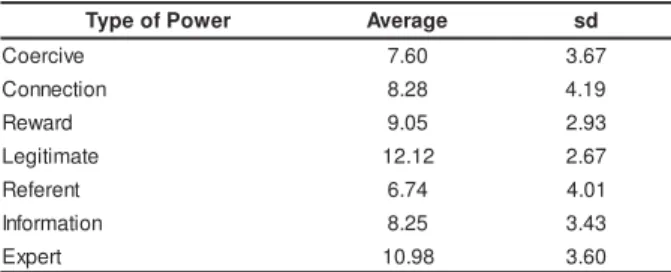
Table 1 show s t he m ean scor es int er v iew ees
at t r ibut ed t o t he pow er base used by leader s. Scor es
can r ange fr om 0 t o 18.
Table 1 – Descr ipt ion of t he t ypes of pow er
r e w o P f o e p y
T Average sd
e v i c r e o
C 7.60 3.67
n o it c e n n o
C 8.28 4.19
d r a w e
R 9.05 2.93
e t a m it i g e
L 12.12 2.67
t n e r e f e
R 6.74 4.01
n o it a m r o f n
I 8.25 3.43
t r e p x
E 10.98 3.60
Re s u l t s w e r e s u b s e q u e n t l y a n a l y z e d i n
relat ion t o t he leadership st yles t hrough t he follow ing
p r o ced u r e.
First ly, t he scores of t he 28 first it em s of t he
SBDQ w er e su m m ed, t o det er m in e t h e scor e in t h e
r elat ion sh ip dim en sion .
Secondly, t he result s of t he last 20 it em s w ere
sum m ed t o obt ain t he scor e in t he t ask dim ension.
Th i r d l y, t h e m e d i a n o f t h e r e l a t i o n s h i p
dim ension, 65, and of t he t ask dim ension, 36, w er e
used t o classify t he leader s w it h high and low scor es
in t he dim ensions.
Th e scor e 6 5 in t h e r elat ion sh ip d im en sion
w as i n cl u d ed i n t h e h i g h cat eg o r y. Th e sco r e 3 6 ,
obt ained in t he t ask dim ension, w as included in t he
h igh cat egor y.
Th e m e d i a n d i v i d e d l e a d e r s i n t o t w o
cat egor ies in bot h dim ensions:
- l o w i n t h e r el a t i o n sh i p d i m en si o n , i d en t i f i ed a s
n u m ber 1 ;
- h i g h i n t h e r el at i on sh i p d i m en si on , i d en t i f i ed as
n u m ber 2 ;
- low in t he t ask dim ension, ident ified as num ber 1;
- high in t he t ask dim ension, ident ified as num ber 2.
Th en t h e dif f er en t cat egor ies w er e r ecoded
accor ding t o t he four leader ship st yles defined by t he
m o d el .
Table 2 show s t he dist ribut ion of t he different
st y les.
Table 2 – Leader ship st y les
s e l y t s p i h s r e d a e
L Frequency %
p i h s n o it a l e r w o l d n a k s a t h g i h : 1
S 45 20
p i h s n o it a l e r h g i h d n a k s a t h g i h : 2
S 69 30.7
p i h s n o it a l e r h g i h d n a k s a t w o l : 3
S 45 20
p i h s n o it a l e r w o l d n a k s a t w o l : 4
S 66 29.3
Biv ar iat e an aly sis
Bef o r e t h e m u l t i v ar i at e an al y si s, b i v ar i at e
differ ences in t he m ean scor e of t he differ ent t y pes
o f p o w er u sed b y t h e l ead er s w h o h av e d i f f er en t
leader sh ip st y les.
. v n o i t c i d e r
P Resultv. βββββ p Exp.(ββ )β)β)β)) 95%confidenceinterval
m i l r e w o
L Upperlim
e v i c r e o
C StyleS1 0.129 0.013 1.137 1.027 1.259
n o it c e n n o
C StyleS2 -0.155 0.000 0.857 0.794 0.925
n o it c e n n o
C StyleS1 0.081 0.075 1.085 0.992 1.186
d r a w e
R StyleS2 -0.084 0.110 0.920 0.830 1.019
e t a m it i g e
L StyleS2 -0.031 0.581 0.969 0.868 1.083
e t a m it i g e
L StyleS3 -0.081 0.196 0.922 0.815 1.043
t n e r e f e
R StyleS3 0.098 0.023 1.103 1.014 1.200
n o it a m r o f n
I StyleS3 0.045 0.367 1.046 0.949 1.154
n o it a m r o f n
I StyleS4 -0.120 0.011 0.887 0.809 0.973
t r e p x
E StyleS4 -0.132 0.002 0.876 0.807 0.951
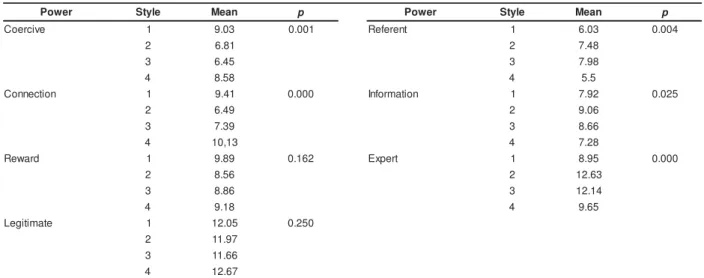
Ta b l e 3 p r e s e n t s t h e r e s u l t o f t h e
co m p a r i so n o f t h e m e a n s o f t h e se v e n t y p e s o f
p o w e r i n e a ch o f t h e l e a d e r sh i p st y l e s. S1 st y l e
h a d 3 7 q u e st i o n n a i r e s, S2 st y l e 6 3 , S3 st y l e 4 4
in t er v iew s an d S4 st y le 6 0 .
Tab le 3 – Com p ar ison of t h e av er ag e of t h e sev en t y p es of p ow er in each of t h e lead er sh ip st y les r
e w o
P Style Mean p Power Style Mean p
e v i c r e o
C 1 9.03 0.001 Referent 1 6.03 0.004
2 6.81 2 7.48
3 6.45 3 7.98
4 8.58 4 5.5
n o it c e n n o
C 1 9.41 0.000 Informaiton 1 7.92 0.025
2 6.49 2 9.06
3 7.39 3 8.66
4 10,13 4 7.28
d r a w e
R 1 9.89 0.162 Expert 1 8.95 0.000
2 8.56 2 12.63
3 8.86 3 12.14
4 9.18 4 9.65
e t a m it i g e
L 1 12.05 0.250
2 11.97
3 11.66
4 12.67
A s o b s e r v e d i n Ta b l e 3 , t h e d i f f e r e n c e s
o f t h e m e a n s c o r e s o b t a i n e d i n t h e d i f f e r e n t
l e a d e r s h i p s t y l e s a r e s t a t i s t i c a l l y s i g n i f i c a n t i n
t h e c o e r c i v e , c o n n e c t i o n , r e f e r e n t , i n f o r m a t i o n
a n d e x p e r t t y p e s .
Mu lt iv ar iat e an aly sis
Aim in g t o v er if y t h e p r ob ab ilit y t h at , u sin g
t h e p o w e r b a s e d e s c r i b e d b y t h e m o d e l , t h e
cor r esponding leader ship st y le could be det er m ined,
t en logist ic r egr essions w er e est im at ed, one for each
p ow er b ase an d t h e cor r esp on d in g lead er sh ip st y le
defined by t he m odel.
Tab l e 4 p r esen t s t h e r esu l t s, accor d i n g t o
each pow er base and cor r esponding leader ship st y le.
Table 4 – Logist ic r egr essions for t he t y pes of pow er and t he leader ship st yle
I t can be obser ved in Table 4 t hat t he r esult s
of t h e r egr ession an aly sis of t h e follow in g v ar iables
w ere not st at ist ically significant : connect ion pow er and
S1 s t y l e , r e w a r d p o w e r i n r e l a t i o n t o S2 s t y l e ,
legit im at e pow er w it h S2 st y le and w it h S3 st y le E3
and, at last , infor m at ion pow er w it h S3 st yle.
O n t h e o t h e r h a n d , t h e r e s u l t s o f t h e
r eg r ession an aly sis of t h e coer civ e p ow er w it h S1
leader sh ip st y le ar e st at ist ically sign if ican t , t h at is,
for each addit ion al poin t in leader ’s coer civ e pow er,
t he probabilit y of having S1 leadership st yle increases
Alt hough r esult s of t he analy sis bet w een t he
c o n n e c t i o n p o w e r a n d S 2 l e a d e r s h i p s t y l e a r e
st at ist ically significant , in t his case, â is negat ive and,
t h u s, t h e pr obabilit y of h av in g S2 st y le w h en u sin g
connect ion pow er decreases. For each addit ional point
in t he connect ion pow er, t he pr obabilit y of having S2
st yle decreases 0.857 t im es in r elat ion t o ot her st yles.
Regar ding t he analysis of t he r efer ent pow er
t o S3 l e a d e r sh i p st y l e , t h e r e su l t i s si g n i f i ca n t ,
m or eover, for each addit ional point in r efer ent pow er,
t he pr obabilit y of having S3 st yle incr eases 1.103 t im es
in r elat ion t o ot her leader ship st y les.
The last t w o r esult s show t hat t he infor m at ion
pow er w it h S4 st y le and t he ex per t pow er, also w it h
S4 st y le, ar e st at ist ically sign if ican t . I n bot h cases,
h ow ever, â is n egat iv e an d, t h u s, t h e pr obabilit y of
having S4 st yle decr eases w hen infor m at ion pow er is
used w it h ex per t pow er.
DI SCUSSI ON
Th e c u r r e n t r o l e o f n u r s e s i n c o r p o r a t e s
l e a d e r s h i p a n d m a n a g e m e n t f u n c t i o n s a n d
com pet ences. This has m ot ivat ed t his r esear ch, w hich
aim ed t o cont r ibut e t o t he know ledge on t he t heor et ical
m odel of leadership exert ed by nurses in t he hospit al
c o n t e x t . Re c e n t r e s e a r c h( 1 2 ) h a s u n d e r l i n e d t h e
im por t ance of t he k now ledge nur ses should hav e on
l e a d e r s h i p , m a n a g e m e n t a n d p o w e r c o n c e p t s ,
t h eor ies an d r esear ch .
I n t h e Ma n a g e r i a l Gr i s Th e o r y, l e a d e r s ’
a t t i t u d e o r o r i en t a t i o n i s m ea su r ed i n r el a t i o n t o
pr oduct ion and t o people. I n a r ecent r esear ch( 15) on
ideal leadership st yles, nurses have scor ed 9.9 – high
p r o d u ct i o n an d p eo p l e o r i en t at i o n – as p r ef er r ed ,
follow ed by 5.5 and r ej ect ed t he 9.1 and t he 1.1. I n
t his st udy, a behavior m easur e – not at t it ude m easur e
- w a s a p p l i e d t o n u r se l e a d e r s a cco r d i n g t o t h e
descr ipt ion of t heir subor dinat es.
Based on t he obt ained r esult s, t he concept s
of t he t en assum pt ions w ere ver ified: t hat is, t he use
of coer civ e pow er incr eases t he pr obabilit y of hav ing
S1 lead er sh ip st y le ( t ellin g ) . Th e sam e h ap p en s in
t h e r e f e r e n t p o w e r r e g a r d i n g t h e S 3 s t y l e
( par t icipat ing) . On t he ot her hand, in t hr ee ot her cases,
obt ained r esult s w er e opposit e t o ex pect at ions, t hat
is, t h e p r ob ab ilit y of d ev elop in g a lead er sh ip st y le
decr eases due t o t he use of t he pow er bases pr oposed
by t he m odel. These t hr ee cases ar e connect ion pow er
w it h S2 leader ship st y le, infor m at ion pow er w it h S4
st y le an d also ex p er t p ow er w it h S4 st y le. Resu lt s
ob t ain ed in t h e ot h er con cep t s ar e n ot st at ist ically
sign if ican t .
I n t h i s st u d y, w h o se a i m w a s t o t est t h e
concept of a specific r elat ionship bet w een t he bases
o f p o w e r a n d l e a d e r s h i p s t y l e s( 1 , 7 ), t h e r e w a s
i n s u f f i c i e n t e m p i r i c a l s u p p o r t . Tw o p o s s i b l e
ex plan at ion s ar e appoin t ed f or t h e obt ain ed r esu lt s
and ar e pr esent ed nex t .
Fr o m t h e p e r s p e c t i v e o f t h e s t a t i s t i c a l
pr ocedur e used, consider ing t he absence of nor m at ive
values, t he m edian w as chosen as t he cut - off point t o
d et er m in e t h e lev els, h ig h an d low , in each of t h e
dim ensions of t he leader’s conduct . Anot her possibilit y
w ould have been t o use t he m ean as t he cut - off point .
Under t he t heor et ical view point , it is pr oposed
t h at t h e effect iv en ess of leader sh ip depen ds on t h e
a d j u s t m e n t b e t w e e n m a n a g e m e n t s t y l e a n d
su b o r d i n a t e s’ l e v e l o f r e a d i n e ss. Le a d e r ’ s p o w e r
increases t he probabilit y of success w hen t he st yle is
already effect ive. I n t his research, subordinat es’ level
o f r e a d i n e ss a n d l e a d e r s’ e f f e ct i v e n e ss w e r e n o t
m easur ed. Thus, it is possible t hat r esult s do not fit
t h e m odel becau se all st y les ( t h e ef f ect iv e an d t h e
less ef f ect iv e on es) w er e in clu d ed in t h e st at ist ical
an al y si s. I f t h e l ess ef f ect i v e h ad b een ex cl u d ed ,
r esu lt s cou ld h av e b een d if f er en t . Th ese q u est ion s
should be t he subj ect of fur t her r esear ch w it h a view
t o c l a r i f y w h e t h e r t h e m o d e l c a n p r e d i c t t h e
r elat ion sh ip bet w een pow er an d leader sh ip st y le or
not and, t hus, guide nur ses m anager s in t he use of
pow er and in leadership perform ance, increasing t heir
ef f ect iv en ess.
REFERENCES
1 . Her sey P, Blan ch ar d KH. Man ag em en t of or g an izat ion al behav ior : ut ilizing hum an r esour ces. 4ª ed. Englew ood Cliffs, New Jer sey : Pr en t ice- Hall; 1 9 8 2 .
2. Galv ão CM, Tr ev izan MA, Saw ada NO, Fáver o N. O est ilo de lider ança exer cido pelo enfer m eir o de unidade de int er nação cir úr gica sob o enfoque da lider ança sit uacional. Rev Lat
ino-am En f er m agem 1 9 9 7 m ar ço/ abr il; 5 ( 2 ) : 3 9 - 4 7 .
3 . Gal v ão CM, Tr ev i zan MA, Saw ad a NO, Del a Col et a JA. Lider ança sit uacional: est r ut ur a de r efer ência par a o t r abalho d o en f er m eir o- líd er n o con t ex t o h osp it alar. Rev Lat in o- am # n f er m agem 1 9 9 8 j an eir o/ f ev er eir o; 6 ( 1 ) : 8 1 - 9 0 .
4 . Reddin WJ. Th e 3 - D Man agem en t St y le Th eor y. Tr ain in g an d Dev elopm en t Jou r n al 1 9 6 7 apr il; 2 1 ( 4 ) : 8 – 1 7 .
behav ior : ut ilizing hum an r esour ces. 3ª ed. Englew ood Cliffs, New Jer sey : Pr en t ice- Hall; 1 9 7 7
6 . S á n c h e z S a n t a - B á r b a r a E, Go n z á l e z Go n z á l e z JM . ¿D i f e r e n ci a s se x u a l e s e n l o s e st i l o s d e d i r e cci ó n e n l a adm in ist r ación pú blica? Rev ist a de Psicología del Tr abaj o y d e las Or g an izacion es 1 9 9 8 ; 1 4 ( 2 ) : 1 4 1 - 5 4 .
7 . H e r se y P, Bl a n ch a r d KH , Na t e m e y e r W E. Si t u a t i o n a l lead er sh ip , p er cep t ion an d t h e im p act of p ow er. Gr ou p & Or g an izat ion St u d ies 1 9 7 9 Decem b er ; 4 ( 4 ) : 4 1 8 - 2 8 . 8. Nyber g D. Pow er over pow er : w hat pow er m eans in or dinar y life, how it is r elat ed t o act ing fr eely, and w hat it can cont r ibut e t o a r enovat ed et hics of educat ion. I t haca: Cor nell Univer sit y Pr e ss; 1 9 8 1 .
9 . Her sey P, Blan ch ar d KH, Joh n son D. Ad m in ist r ación d el com por t am ient o or ganizacional. 7ª ed. México: Pr ent ice Hall; 1 9 9 8 .
1 0 . Fr e n ch J, Ra v e n B. Th e b a se s o f so ci a l p o w e r. I n : Car t w r i g h t D, ed i t o r. St u d i es i n so ci al p o w er. An n Ar b o r :
I n st it u t e for Social Resear ch , Un iv er sit y of Mich igan ; 1 9 5 9 . p . 1 5 0 - 6 7 .
11. Her sey P, Goldsm it h M. The changing r ole of per for m ance m a n a g e m e n t . Tr a i n i n g a n d D e v e l o p m e n t Jo u r n a l 1 9 8 0 o ct u b r e; 3 4 : 1 8 - 3 2 .
12. Lour enço MR, Shinyashik i, GT, Tr ev izan, MA. Managem ent and leader ship: analy sis of nur se m anager s’ k now ledge. Rev Lat in o- am En f er m ag em 2 0 0 5 j u lh o- ag ost o; 1 3 ( 4 ) : 4 6 9 - 7 3 . 13. Fleishm an EA. A leader behavior descr ipt ion for indust r y. I n St o g d i l l RM, Co o n s AE, ed i t o r es. Lead er b eh av i o r : i t s descr ipt ion and m easur em ent . Colum bus: Bur eau of Business Resear ch, Ohio St at e Univer sit y. Resear ch m onograph nº 88; 1 9 5 7 . p . 1 0 3 - 1 9 .
14. Her sey P, Nat em ey er WE. Per fil de per cepción del poder. Escon dido, CA: Cen t er f or Leader sh ip St u dies; 1 9 7 9 . 1 5 . Rib eir o Hig a EF, Tr ev izan MA. Os est ilos d e lid er azça id ealizad os p elos en f er m eir os. Rev Lat in o- am En f er m ag em 2 0 0 5 j an ei r o - f ev er ei r o ; 1 3 ( 1 ) : 5 9 - 6 4 .