E
NERGY AND
E
NVIRONMENT
Volume 5, Issue 2, 2014 pp.251-256
Journal homepage: www.IJEE.IEEFoundation.org
Synergistic evaluation of the biomass/coal blends for
co-gasification purposes
S Gaqa
1,2, S Mamphweli
2, D Katwire
1, E Meyer
21 Chemistry Department, University of Fort Hare, Private Bag X1314, Alice 5700, South Africa. 2 Institute of Technology, University of Fort Hare, Private Bag X1314, Alice 5700, South Africa.
Abstract
Approximately 95% of electricity in South Africa is generated from coal, which is a fossil fuel that has detrimental environmental impacts. Eskom has started investigating the possibility of co-firing coal with biomass to improve their carbon footprint. However, co-firing utilizes approximately 80% of water and results in extensive environmental impacts. This research seeks to investigate the possibility of co-gasification of coal and biomass, which is a thermochemical process that uses about a third of the water required by a coal-fired power station, and results in much lower emissions. Thermogravimetric analysis (TGA) was conducted to investigate the existence of a synergy between coal and biomass during gasification. Various coal/biomass blends were investigated using TGA. The synergistic effect between the two feedstock as determined through TGA allowed the prediction of the gasification characteristics of the blends that most likely gave the highest conversion efficiency. Preliminary results suggested the existence of this synergy.
Copyright © 2014 International Energy and Environment Foundation - All rights reserved.
Keywords: Synergy; Biomass; Coal; Co-gasification; thermal degradation.
1. Introduction
One of the most vital global issues currently is the worldwide energy crisis, which is mainly attributed to the earth’s fast depleting fossil fuel resources. To address this issue, many countries, including South Africa, promoted the use of alternative fuel sources such as biomass to generate heat and electricity. The benefit of utilizing such fuel for small-scale combustion or thermo–chemical conversion is clear since they are renewable resources that can provide inexpensive supplementary fuel. However, this application gives an opportunity to assist in waste management [1].
Global electricity demand is increasing at an enormous rate, whilst the industry is expected to reduce CO2 emissions due to global warming. As a result, there is a demand to improve the efficiency of energy
use through changes in technology and to produce energy conversion mechanism that has almost zero emissions of greenhouse gases. Co-gasification of biomass and coal can be considered as a possible fuel-base for gasification and syngas production. Combined gasification of biomass and coal gives effective consistency, decreasing the impact on the environment and most advantageous, improves the thermal efficiency of the process [2, 3].
Co-gasification of wood biomass and coal offer several advantages such as; the addition of wood biomass to coal gasification does not only reduce CO2 emissions but also reduce the problems caused by
content [4]. Biomass and coal are essentially chemical opposites, coal contains a lot of sulfur and ash, biomass contains more oxygen and nitrogen and is more prone to producing tar. Coal contains many transition metals, while biomass contains more alkali and alkaline-earth metals, usually in the form of salts (especially sodium and potassium.) Biomass is also more likely to produce ammonia, which is useful as a cleaning agent, but can be emitted as a deadly pollutant if not properly contained. Generally biomass has higher volatile content than coal [5].
The aim of this research is to establish the possibility of gasifying biomass and coal to reduce the emission impact of coal combustion and utilization of large volumes of water for electricity generation.
2 Methodology
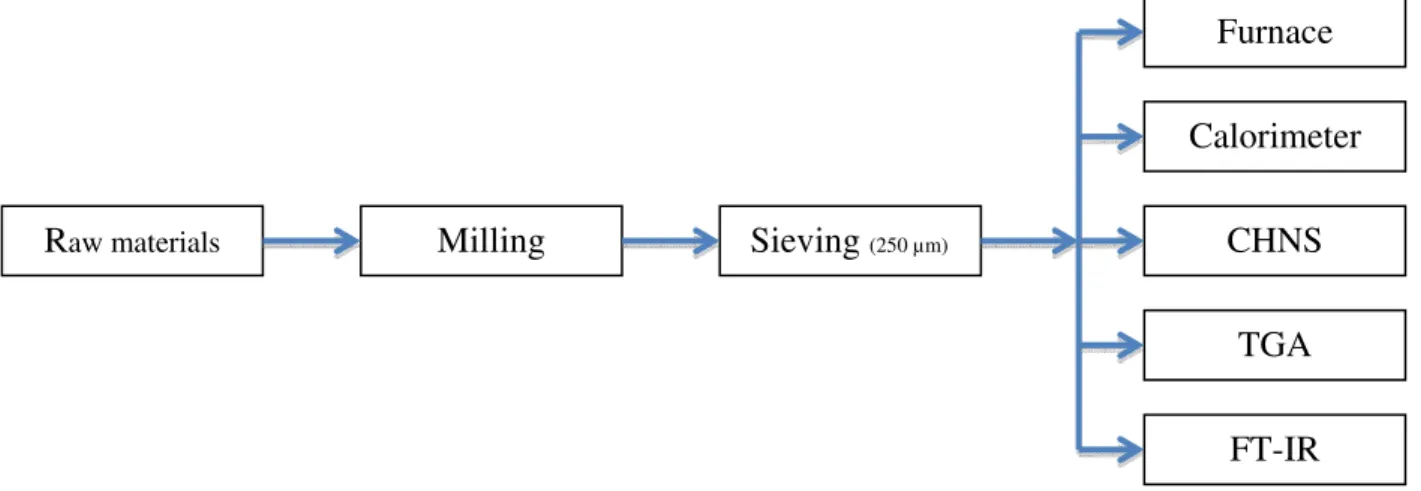
Samples of pine wood and coal chips were used for this study. The cone-and-quartering method was applied subsequent to size reduction to obtain a more representative sample (Figure 1). Chips were milled using a Condux-Werk Wolfgang bei Hanau mill equipped with a 1 mm circular blade to reduce the size of the chips, the samples were to produce samples of approximately +425 µm, which were further milled to approximately +250 µm. The samples were screened in a Retsch AS200 shaker to obtain fractions between 250 and 425 µm, where the 250 µm was used for analyses.
Figure 1. The sample analysis methods employed
A bomb calorimeter (CAL 2K model) was used for the determination of calorific values also referred to as energy values. Calorimetry is an experimental procedure used to determine higher heating values of carbonaceous material. For quantitative elemental analysis of the materials a CHNS analyser was used. Fourier Transform Infrared (FT-IR) spectroscopy is a technique used to obtain an infrared spectrum of absorption, emission and photoconductivity. An infrared spectrum represents a fingerprint of a sample with absorption peaks which correspond to the frequencies of vibrations between the bonds of the atoms making up the material. It was used in this study to observe the absorption bands of coal and pine-wood. The moisture content (MC) of the pine-wood and coal was determined using the T264 om-85 method of
the Technical Association of the Pulp and Paper Industry, 1992-1993. In brief the sample was placed in a furnace at 105ºC for one hour and the moisture content was calculated using equation (1):
C A
A B c
M M
M M M
% 1 100
% = − × × (1)
Where; MB is the weight of the sample before it was placed in the furnace and MA is the weight after it
was left in the furnace overnight at 105°C.
The ash content (AC) was obtained by placing 3.0 g of the materials in a Gallenkamp Muffle furnace at
750±25°C for 2 hours. The samples were then placed in a desiccator with silica gel to cool at room temperature. The ash content of the samples was determined using equation (2):
C S
A c
M M
M A
% 1 100
% = × × (2)
R
aw materialsMilling
Sieving
(250 µm)Calorimeter
CHNS
TGA
Furnace
2.1 Thermogravimetric analysis
Thermogravimetric analysis (TGA) is one of the most common techniques used to investigate thermal events and kinetics during pyrolysis of solid raw materials such as coal and biomass. The thermal degradation of the material was determined using a Thermal Gravitational Analyser. Sample masses were approximately 2–4 mg with a particle size of 250µm. The analysis was carried out from 40oC to 650oC at 20oC/minute with a nitrogen flow rate of 20ml/minute. TGA is used for determination of moisture content, volatile matter, fixed carbon as well as ash. It also determines the thermal behavior of carbonaceous materials.
2.2 Rate law and kinetics analysis
The rate of a solid state reaction may be described by:
) ( ) ( α
α k T f
dt
d =
(3)
Where t is the time, T is the temperature,α is the extent of reaction and f(α) is the reaction model. The explicit temperature dependence of the rate constant is introduced by replacing k(T) with the Arrhenius equation which then gives the following equation:
) ( ) exp( α α f RT Ea A dt
d = −
(4)
Where A the pre-exponential factor and E the activation energy are both the Arrhenius parameters and R
is the gas constant.
n
f(α)=(1−α) (5)
f o o W W W W − − = α (6) Where Wo is the initial weight, W is the devolatilization weight and Wf is the final weight.
3. Results and Discussions 3.1 Sample analysis
Table 1 presents the elemental composition of the materials under study. The elemental analysis of the samples was carried out using a CHNS analyser, which is an instrument that gives C, H, N and S content of the material. The composition of oxygen was calculated by difference. The results obtained did not vary from existing knowledge since coal is expected to have higher carbon and the biomass to have higher oxygen.
Table1. Elemental analysis of coal and biomass
Element Coal (Subbituminous) Coal50%–Wood50% Pine wood
%C 55.90 51.40 45.10
%H 3.20 5.10 5.80
%N 1.25 0.38 0.00
%O 39.25 41.82 47.00
%S 0.40 1.30 2.10
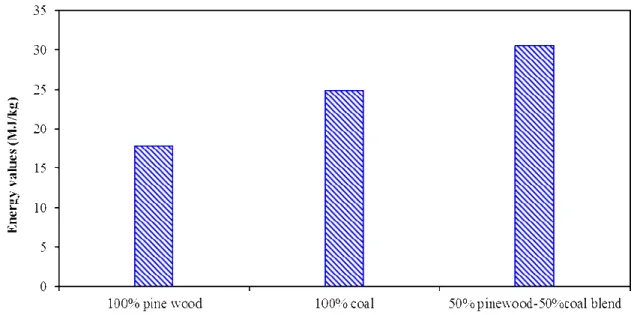
Figure 2 presents the calorific values of coal, biomass and coal/biomass blend. Calorific value of the material is the amount of energy per unit mass that is released upon complete combustion. It is defined as the total value of the precise energy of combustion, in joules per unit mass of a solid biofuel burned in oxygen in a bomb calorimeter under specified conditions [6].
Figure 2. Energy values for pinewood, coal and Coal50%–Wood50% blend
Table 2 shows the proximate analysis of coal and pinewood. Pinewood was found to have the high volatile matter (~72%) as compared to coal, which has about 3%. Coal has low moisture content (~2%) as expected and a high fixed carbon content (~17%).
Table2. Proximate analysis of Coal and Pinewood
Parameter (%) Coal Pinewood
Moisture content 2.298 3.746
Volatile matter 3.531 72.560
Fixed Carbon 17.350 15.160
Ash 0.176 0.001
3.2 Thermogravimetric analysis
Figure 3 shows the weight loss curves of 100% pinewood, 100% coal and Coal50%–Wood50%blend at
20°C/minute in an inert atmosphere. Three stages are observed, i.e. moisture content (Stage 1), volatile matter (Stage 2)and fixed carbon (Stage 3). These stages are however difficult to identify for coal since coal burns very slowly due to the long carbon-carbon chains as well as the aromatic rings.Considering Stage 1 below 300°C, the pinewood used had a higher moisture (3.8%) as compared to coal (2.3%). During the second stage of weight loss, where the devolatilization of the material takes place, there is rapid weight loss for pinewood because it has a high volatile matter content, which is released faster at temperatures within this stage.
Lignocellulosic biomass consists of cellulose, hemicellulose and lignin. Cellulose is the major structural component of plants, especially of wood and plant fibers. It is a linear homogeneous polymer and degrades at higher temperatures (around 300–900°C). Hemicellulose is a polysaccharide found in plant cell walls and it normally decompose at temperatures above 160°C up to around 300°C. Lignin is found in all vascular plants,and represents about 25% of the terrestrial plant biomass. It is a complex phenolic heteropolymer that results from oxidative polymerization [4]. It is normally lost at a slow rate over a wide temperature rate of 200°C–500oC. The Coal50%–Wood50%blend shows a synergistic effect, as
observed with the calorific values results presented in figure 1. This is due to the combustion characteristics of the two materials.
Figure 4 shows the IR spectrum of 100% coal, 100% pinewood and Coal50%–Wood50%blend. It was
more aromatic rings as compared to pinewood which explains the slow burning. Pinewood on the other hand has more O–H groups than coal, which explains the high moisture content. Considering the Coal50%–Wood50%blend, the strong signal of carbon triple bonds and aromatic rings found in coal and
pine are reduced in the blend as well as the moisture content which then gives a strong belief that the blend does actually have the synergistic effect.
Figure 3. TG curves of coal, pinewood and Coal50%–Wood50%blend
Figure 4. Transmittance spectrum of coal, pinewood and the Coal50%–Wood50%blend
O
___
H
C
___
C
C
___
C
Aro
m
4. Conclusions
The paper investigated the synergistic effect that exists during the co-gasification of biomass and coal through thermogravimetric analysis of the two materials and their blend. Proximate and ultimate analysis of the two materials and their blend was also undertaken. FT-IR was also used to determine the functional groups of the two materials and their blend. The data obtained from all the characterization techniques suggested a strong existence of synergy between biomass and coal with biomass having a catalytic effect on coal during co-gasification, pyrolysis or combustion.
References
[1] Yin C., Prediction of higher heating values of biomass from proximate and ultimate analyses. Fuel. 2011, 90(1128–1132).
[2] Chmielniak T., Sciazko M. Co-gasification of biomass and coal for methanol synthesis. Applied Energy. 2003, 74(393–403).
[3] Collot A. Matching gasification technologies to coal properties. International Journal of Coal Geology. 2006, 65(191– 212).
[4] Kumabe K., Hanaoka T. Fujimoto S., Minowa T., Sakanishi K. Co-gasification of woody biomass and coal with air and steam. Fuel. 2007, 86(684–689).
[5] Long H.A. III, Wang T. Case Studies for biomass/coal co-gasification in IGCC applications. Proceedings of ASME Turbo ExpoVancouver, Canada, 2011.
[6] Fernandez Llorente M.J., Carrasco Garcia J. E. Suitability of thermo-chemical corrections for determining gross calorific value in biomass. Thermochimica Acta. 2008, 468(101–107).
[7] McMurry J. Organic Chemistry 7th edition Thomson Learning Academic resource centre. 2008, 423-425.
Sibongiseni Gaqa is an intern at InnoVenton in the Nelson Mandela Metropolitan University, and is
due to graduate her MSc (Chemistry) at the University of Fort Hare in 2014. Ms Gaqa possesses a Bachelor of Science honours degree in chemistry from the University of Fort Hare. She also enrolled for a short course in Environment and Development at Wageningen University in Netherlands. Her current area of research interest includes biomass gasification for electricity generation and co-gasification of coal and biomass for electricity generation.
E-mail address: [email protected]
Sampson Mamphweli is a Senior Researcher at the University of Fort Hare, Institute of Technology,
he possesses a Doctor of Phylosophy degree in Physics from the University of Fort Hare, South Africa, a Master of Environmental Sciences degree from the University of Venda, South Africa. He is also in possession of a Certificate in Financing Renewable Energy and Energy Efficiency from RENAC Renewables based in Germany. Dr Mamphweli also possesses the GreenPower Mini-MBA from the GreenPower Academy based in Britain. He is a recipient of the prestigious University of Fort Hare Vice Chancellor’s Emerging Researcher medal for the year 2012. Dr Mamphweli conducts research on renewable energy technologies and their applications, and he is a respected authority in the biomass to energy field. He has published up to 18 scientific papers in peer-reviewed journals and conference proceedings including two book chapters. Dr Mamphweli reviews papers for publication in several journals in the engineering and renewable energy fields of study. His current area of research interest includes biomass gasification for electricity generation, biogas digesters, co-gasification of coal and biomass for electricity generation as well as solar energy technologies.
E-mail address: [email protected]
David M. Katwire holds a PhD degree in Chemistry; he is the Head of chemistry department at
the University of Fort Hare, Alice, South Africa. He leads a team of postgraduate students conducting research at MSc and PhD level in Analytical Chemistry.
E-mail address: [email protected]
Edson Meyer holds a PhD degree in Physics; he is the director of Fort Hare Institute of Technology at
the University of Fort Hare, Alice, South Africa. He leads a team of postgraduate students conducting research at MSc and PhD level in renewable energy, advanced engineered materials, ICT and Power engineering as well as energy policy. Prof. Meyer has published a number of papers in international Journals and conference proceedings. He is a Certified Energy Manager and a member of the South African Measurement and Verification Association as well as the South African Institute of Physics. Prof. Meyer also holds a Green Power Mini-MBA from the GreenPower Academy based in Britain. He is also a recipient of the prestigious University of Fort Hare Vice Chancellor’s Emerging Researcher medal for the year 2010. Prof. Meyer is a C2 NRF rated scientist.