Study conducted at Universidade Federal de Sergipe – UFS – São Cristóvão (SE), Brazil.
(1) Center for Speech Therapy, Universidade Federal de Sergipe – UFS – São Cristóvão (SE), Brazil.
(2) Department of Statistics and Actuarial Science, Universidade Federal de Sergipe – UFS – São Cristóvão (SE), Brazil. Conflict of interests: None
Authors’ contributions: AMCM developed the project; TPLS e CLA participated in the data collection; TPLS, CLA e AMCM participated in writing the article; OFFR participated in the statistical treatment of the data.
Correspondence adress: Andréa Monteiro Correia Medeiros. Universidade Federal de Sergipe, Núcleo de Fonoaudiologia. R. Marechal Rondon s/n, Cidade Universitária Prof. José Aloísio de Campos, Jardim Rosa Elze, São Cristovão (SE), Brazil, CEP: 49100-000. E-mail: [email protected]
Received: 7/10/2012; Accepted: 2/4/2013
Effects of gustatory stimulation on the behavioral states
of premature newborns
Efeitos da estimulação gustativa nos estados comportamentais
de recém-nascidos prematuros
Andréa Monteiro Correia Medeiros1, Thalyta Prata Leite de Sá1, Conceição Lima Alvelos1, Oscar Felipe Falcão
Raposo2
ABSTRACT
Purpose: To observe the behavioral states presented by premature new-borns in response to gustatory stimulation. Methods: Experimental, analytical and double-blind study. Ninety premature newborns born in a public maternity hospital in Sergipe took part in the test which was filmed and divided into three parts of five minutes. In the first and last, there was no stimulus; in the second, the gustatory stimulation was applied and the newborn children were divided into two groups (water or analysis for sucrose 12%). The observed behavioral states were deep sleep, light sleep, drowsy, alert, agitated/irritated and crying. The data were statistically analyzed. Results: In the sucrose group, during and after stimulation, the correlation was strong in the light sleep and alert behavioral states and decreased in the drowsy, agitated/irritated and crying states. In the water group there was an increase in correlation in the agitated/irritated and crying states after stimulation. Conclusion: The continuity or change of the behavioral state of the premature newborns was positively influenced by the administration of gustatory stimulus, pointing to the possibility of using sucrose in benefit of the favorable behavioral states of that population.
Keywords: Speech, language and hearing sciences; Neonatology; Behavior; Newborn; Premature; Sucrose
RESUMO
Objetivo: Observar os estados comportamentais apresentados por recém-nascidos prematuros a partir de oferta de estímulos gustativos. Métodos: Estudo experimental, analítico, duplo cego. Participaram 90 recém-nascidos prematuros nascidos em uma maternidade pública de Sergipe. O teste foi filmado, dividido em três etapas de cinco minutos. Na primeira e na última, não houve estímulo; na segunda aconteceu es-timulação gustativa, sendo que os recém-nascidos foram divididos em dois grupos (água ou sacarose para análise 12%). Os estados comporta-mentais observados foram sono profundo, sono leve, sonolento, alerta, irritado/agitado e choro. Os dados foram analisados estatisticamente. Resultados: No grupo sacarose houve correlação forte nos estados comportamentais sono leve e alerta, durante e após a estimulação, e redução de correlação nos estados sonolento, agitado/irritado e choro. Já no grupo água, após a estimulação houve aumento de correlação nos estados agitado/irritado e choro. Conclusão: A permanência ou mudança do estado comportamental do recém-nascido prematuro foi influenciada positivamente pela administração de estímulo gustativo, apontando para o possível uso da sacarose na contribuição de estados comportamentais favoráveis nessa população.
INTRODUCTION
The behavioral states comprehend states of conscience of the newborn (NB)(1) and were classified as deep sleep,
light sleep, drowsy, alert, agitated/irritated and crying(2,3).
According to the Ministry of Health(1), newborns spend most
of their time (90 to 95%) in a sleep state being approxima-tely 20 minutes in deep sleep. This behavioral state is what most resembles the intrauterine and seems to be necessary for the brain development, because it decreases the body temperature, requiring less oxygen consumption with less stress. During light sleep occurs increased protein synthesis in the brain cells and synapses restructure. The information is actively processed and stored in memory, and the state in which occurs most of the learning and memory. This lessens with maturing states(1).
Drowsy is considered a state of transition between sleep and alertness. The alert state, on the other hand, is a state that provides the most interaction(3), being also easier upon
feeding. The most unfavorable(3) states are: agitated/irritated
and crying and that may be related to discomfort(4,5) and/or
being hungry(5) and also intensity of crying can cause
incre-ased heart rate and also energy consumption, and decreasing in oxygen saturation in the blood and brain(1).
Moreover, stressful situations(4,5-9) as found in the Neonatal
Intensive Care Unit (NICU) environment, such as noise and intense lighting, constant handling, mother-baby separation, decreased duration of sleep and painful procedures(1,4,6), can
also cause changes in the level of the baby´s cortisol(1),
affec-ting the brain, metabolism and immune system. However, despite the potential damage caused by this environment, it is essential to monitor the premature newborn(9-14).
In the presence of these stressful impacts, some au-thors(4,15-22) refer about the usage of sucrose as a measured
nonpharmacological tool, observing that this substance has an analgesic effect and thus soothing. The sucrose was also used in research for speech, language and hearing sciences(2,23),
becoming evident as eliciting behavioral readiness upon fe-eding, particularly in alertness behavioral state, considered favorable(3).
The speech therapists performance with newborn seeks to promote sucking from the breasts and improving mother/ baby interaction in order to enhance their life´s quality. The speech therapist also works with premature NB and/or patients with specific pathologies that impair the feeding performan-ce, being his/her work related to the field of stomatognathic functions anatomy and physiology (suction, breathing, swallowing)(13). Therefore it is crucial to understand the
de-velopment and operation of the feeding – related behaviors from the human beings.
This study aimed to observe the behavioral states presented by the premature NB from gustatory stimuli (water or sucrose for analysis at 12%).
METHODS
The study was conducted in a public maternity hospital in Aracaju (SE), with the approval of the Ethics in Research Involving Humans Committee from Universidade Federal de Sergipe, under nº CAAE – 0027. 0. 107.000 – 1. All those who were responsible were informed about the research and signed a Consent Form.
This is an experimental, analytic, double-blind study with 90 premature infants of both genres, hospitalized in rooming. The Inclusion criteria were: Corrected Gestational Age (CGE) up to 36 weeks and one day of life, appropriate intrauterine growth curve for Gestational Age (AGA), and clinical stability during the test. Were excluded all subjects with the following characteristics: use of respiratory support. Diagnosed or to clarified clinical history of neurological complications and for major cardiac and syndromes and/or malformations. It is noteworthy that this study followed the same methodolo-gy used by Medeiros(2) with newborn terms, particularly in
relation to the testing procedure and the characterization of behavioral states studied.
Initially the premature NBs were selected and then the parents/guardians signed a Consent Form. Each newborn was placed in a carry-cot in the supine position, with naked torso and upper limbs. Were recorded by a digital camera mounted on a tripod, so the face and upper limbs was kept framed in the video. According to the types of stimuli that were givens, the infants were divided into 2 groups: water (46 subjects) and sucrose for analysis at 12% (44 subjects).
The shooting lasted 15 minutes, divided into three steps of five minutes. In the first step, or initial baseline (BL1), corresponding to the first 5 minutes, no stimulation was ap-plied. The second step corresponded to a gustatory stimulation (sucrose to analysis at 12% or distilled water), administrated orally through a disposable syringe. In total it was given to every newborn 1.0 ml of this solution (fractioned into five doses of 0.2 ml, administered on intervals of one by one minute, totaling fine minutes).On the last step corresponded to the final baseline (BL2), the observation was done again on the newborn for 5 minutes without applying any stimuli.
The sucrose solution or water administration was done by one of the investigators who had no knowledge of the solution administered (double-blind procedure). Numbered bottles were used, which corresponded to even for the female NBs and odd for the male.
Besides, the procedure (test itself), for the data collection the researchers had to study the baby´s medical records, re-gistering on a specific protocol (Appendix 1) the following data: NB gender, Gestational Age at Birth (GAB), Corrected Gestational Age (CGA), Apgar (1st and 5th minutes) mother´s full name and age, kind of birth, date and time of the test.
performance of the procedure, providing for the judges a way to examine the behavioral states in the baby´s footage, reliably. The judges, all members from the research in question, from the peech, language and hearing sciences field, underwent into a calibration procedure, which analyzed together some vide-os of the pilot study. From combined observation, the three judges discussed about possible divergences found, in order to determine a certain perspective regarding the observed phenomena. The main goal was to train and enhance the view of each judge, allowing a discussion and consequent cohesion on the observed behaviors (analyzed behaviors calibration).
After, the 90 infant record´s analysis, each video was watched by three judges independently, establishing itself as the only agreement criteria for the behaviors displayed by at least from two of them.
The behavioral states studied here were analyzed accor-ding to the following classifications(2,3):
- Deep Sleep (DS): regular breathing, eyes closed without the presence of nystagmus of spontaneous motor activity. - Light Sleep (LS): irregular breathing, movement with eyes
closed, eventual occurrence of eye opening, low level of motor activity.
- Drowsy (Dr): generally open eyes (blurry) with heavy eye-lids, trembling and/or closed, spontaneous motor activity variable and soft.
- Alert (Al): open eyes (looking shiny) or closed, with a clear concentration of activity, low level of global motor activity.
- Agitated/Irritated (Ag/Ir): eyes open or closed (tight) and high level of motor activity, with impulsive movements from extremities. Possible occurrence of grunts and vocalizations.
- Crying (Cr): eyes closed (tight) and high level of motor activity, presence of shock and/or tremors, presence of intense crying. It can be considered as an expression of pain(4).
The frequencies of behavioral states were recorded on the Statistical Package for the Social Sciences (SPSS, 18th version, 2008, SPSS Inc., Chicago, Illinois USA). Accounted that 15 minutes is equivalent to 900 seconds, and each occur-rence was recorded at the exact second it happened. It was recorded each of the behavioral states, second by second, and from there, done the total amount of times that these behaviors appeared on that NB. Aiming to better visualize the gestational ages (at birth and corrected), were used fractions of the week to calculate sundry days, in which a day is 0.14 weeks.
For the statistical procedure correlation were made of all newborns regardless the stimulus received, and the two groups separately (water and sucrose). For the characteriza-tion of the populacharacteriza-tion were used central tendencies measures (average), variability (standard deviance) and prevalence (absolute and relative). In order to test the normality of the data used the Saphiro-Wilk. Due to lack of normality was
used nonparametric Mann-Whitney test for means of compa-rison. The Spearman correlation test was verifiable through a correlation between the behavioral states on each time of testing. It was considered correlation values the data for poor between 0.1 and 0.3, moderate between 0.4 and 0.6, strong above 0.7, being ideal/perfect 1.0(24). All of “p” less than 5%
(p<0.05) were considered significant.
RESULTS
From the 90 newborn studied 48.9% were male and 51.1% female. The corrected gestational age average was 34.91 we-eks, the gestational age at birth was 34.14 weeks and average birth weight was 2.113 grams.
The results presented here are those considered significant, related to behavioral states studied (deep sleep, light sleep, drowsy, alert, agitated/irritated and crying) when correlated with on each time of testing (BL1 drops 1,2,3,4 and 5 and BL2).No newborn behavioral state was in DS (1), then there are no correlations for this state.
Considering the newborn in his/her total, independently of stimulus received (Table 1), it was observed that the light sleep behavioral states (2), drowsy (3), alert (4) and agitated/ irritated (5) maintained a strong correlation before (BL1) and after (BL2) stimulation. However, the states 2, 3 and 5 sho-wed decreased correlation upon the time of the stimulation, unlike what happened in the alert state (4), there was a strong correlation at all times. It is worth mentioning that the crying behavioral state (6) went from moderate correlation in BL1 to strong in BL2, but decreasing correlation during gustative stimulus times.
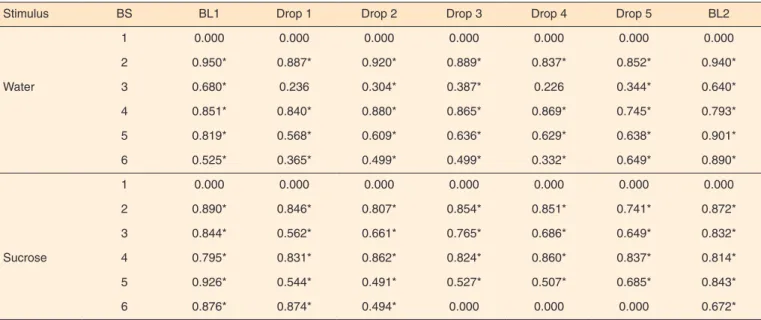
On the water group the agitated/irritated behavioral state (5) showed a strong correlation BL1, whereas BL2 correla-tion grew stronger. The drowsy behavioral state (3) showed moderate correlation in BL1, remaining so in BL2, but with lower values. In the sucrose group the drowsy behavioral state (3) and agitated/irritated (5) initiated BL1 and remained during the time of the drops on a strong correlation, but the BL2 values decreased (Table 2).
It´s important to highlight that the light sleep behavioral state (2), alert (4) showed a strong correlation before, during and after stimulation, both in the water and in the sucrose group (Table 2).
In the water group, crying behavioral state (6) went from moderate correlation in BL1 to strong in BL2. In sucrose group occurred the opposite, from strong in BL1 to moderate in BL2 (Table 2).
DISCUSSION
administered to the infant, which described the behavior wi-thout a possibility of tendencies. Another point that should be highlighted is the number of subjects who participated in the study, to get in on a sample with a significant number, when compared by other studies(2). In terms of population
(hospitalized premature newborn) this number can be consi-dered reasonably large to ensure results reliability presented. From the results, it can be inferred that during stimula-tion (BL 1 drops 1, 2, 3, 4 and 5 and BL 2) had decreasing correlation on the drowsy behavior states (3), agitated/angry (5), decreasing in values in light sleep (2) and increasing in alert (4) correlations. This suggests that at the time that it was given the stimulation, both by water and by sucrose, the newborn left a behavioral state of agitation and crying, con-sidered unfavorable by the literature(3) and remained with the
highest incidence in the sleep and alert states, the latter being considered as the most favorable interactions(1) and therefore
more readily upon feeding. In crying behavioral state (6), there was decreasing on the correlation during stimulation
and so the stimulus was terminated in this state the correlation became stronger. Since crying has been considered in the literature(4) as an expression of pain, it is assumed that the
sucrose analgesic effect may have acted as a soothing effect, since this substance reduced the crying time from the infants undergoin painful processes(21,22).
By comparing the results in both groups (water and sucro-se), when analyzed separately, it can be observed that sucrose is an effective stimulus both to maintain strong correlations of light sleep behavioral sates (2), alert (4), during and after its administration, as to reduce drowsy behavioral state (3), agitated/irritated (5) and crying (6).This demonstrates that du-ring the stimulation through sucrose it had a possible sedative effect(15,16,21,22) the studied NB, once they weren´t sleeping was
alerted the decreasing of the presence of adverse behavioral states(3), as the drowsy state, agitated/irritated and crying. On
the opposite side, there was increasing in the water group correlation from BL1 to BL2 in the agitated/irritated (5) and crying (6) states, indicating that the water does not appear to
Table 1. Correlation between behavioral states at each time of testing, regardless of the stimulus
Stimulus BS BL1 Drop 1 Drop 2 Drop 3 Drop 4 Drop 5 BL2
All (water and sucrose)
1 0.000 0.000 0.000 0.000 0.000 0.000 0.000
2 0.921* 0.874* 0.867* 0.871* 0.847* 0.816* 0.912*
3 0.777* 0.450* 0.537* 0.622* 0.535* 0.529* 0.753*
4 0.824* 0.845* 0.873* 0.847* 0.871* 0.793* 0.814*
5 0.872* 0.562* 0.550* 0.584* 0.575* 0.647* 0.877*
6 0.669* 0.570* 0.493* 0.408* 0.277* 0.534* 0.813*
* Significant values (p<0.05) – Spearman Test
Note: BS = behavioral states; BL1 = initial baseline; BL2 = final baseline; 1 = deep sleep; 2 = light sleep; 3 = drowsy; 4 = alert; 5 = agitated/irritated; 6 = crying
Table 2. Correlation between behavioral states at each time of testing, when the groups split water and sucrose
Stimulus BS BL1 Drop 1 Drop 2 Drop 3 Drop 4 Drop 5 BL2
1 0.000 0.000 0.000 0.000 0.000 0.000 0.000
2 0.950* 0.887* 0.920* 0.889* 0.837* 0.852* 0.940*
Water 3 0.680* 0.236 0.304* 0.387* 0.226 0.344* 0.640*
4 0.851* 0.840* 0.880* 0.865* 0.869* 0.745* 0.793*
5 0.819* 0.568* 0.609* 0.636* 0.629* 0.638* 0.901*
6 0.525* 0.365* 0.499* 0.499* 0.332* 0.649* 0.890*
1 0.000 0.000 0.000 0.000 0.000 0.000 0.000
2 0.890* 0.846* 0.807* 0.854* 0.851* 0.741* 0.872*
3 0.844* 0.562* 0.661* 0.765* 0.686* 0.649* 0.832*
Sucrose 4 0.795* 0.831* 0.862* 0.824* 0.860* 0.837* 0.814*
5 0.926* 0.544* 0.491* 0.527* 0.507* 0.685* 0.843*
6 0.876* 0.874* 0.494* 0.000 0.000 0.000 0.672*
* Significant values (p<0.05) – Spearman Test
have the same effect(15,16,21,22) as the sucrose in these states.
It is also important to highlight that in the water group the light sleep behavioral states (2), alert (4) showed a strong correlation before, during after stimulation, as well as in the sucrose group. So, it seems that regardless the kind of stimulation performed (water or sucrose), the premature infants in this study remained more favorable on the light sleep behavioral state (2), alert (4) than on the unfavorable state of agitated/irritated and crying which may be related to the environment rooming(3) that these newborn were, since
on the site of the environmental adversities, such as those found in a traditional intensive care units (light and sound stimuli) are controlled as recommended by the Ministry of Health(1). It is noteworthy that this type of accommodation
provides a greater contact between the baby and the mother which makes the efficiency of suction and the feeding process to take effect more quickly(25,26), favoring the permanence in
positive behavioral states and the presence of behaviors related to readiness upon feeding.
An important fact to be noted in this study is about the alleged sucrose calming effect(15,16,21,22) as the crying behavioral
state went from strong to moderate correlation in this group after stimulation, unlike what happened with the water group, the stimulus changes caused moderate, seeming not to have such an effect. Similar results was found in studies(21,22) who
observed that after the administration of sucrose solution 12% or 25% there was a significant reduction in crying time when compared with the water administration. However, another study(27) demonstrated that 12% of sucrose and water
do not appreciably reduced the duration of crying compared to sucrose 24%.
In this study I was possible to demonstrate that gustatory stimulation influences the behavioral states on the prematu-re infants. However unlike what happened with newborn at term(2), did not observe the presence of the ability to
discri-minate and tastes preferences in this population.
CONCLUSION
The permanence or change of the behavioral state of the premature newborns may be influenced by the administration of a gustative stimulus. Thus, when the NB is in a behavioral state considered unfavorable, with a stimulation accomplish-ment it is possible that it changes to a favorable state, and even greater readiness upon feeding. On the other hand, when the NB is already in a favorable state, gustatory stimulation maybe able to keep it in this state.
Thus, gustatory stimulation seems to be able to influence the behavioral states of the newborn, benefiting the occurrence of behavior related to readiness upon feeding, which can help even the absence of breast milk situation. Also, the permanen-ce in more favorable states can facilitate speeches therapist in moments of intervention and stimulation of sensory, motor,
oral systems of premature newborn.
The population profile was characterized by stable new-born on a shared rooming, with gestational age average of 34.1 week. I this general context there is a greater likelihood of behaviors related to feeding and maintaining behaviors states more favorable. Points, therefore, to the need for further research with premature gestational ages below.
REFERENCES
1. Brasil, Ministério da Saúde, Secretaria de Atenção à Saúde. Departamento de Ações Programáticas Estratégicas. Atenção humanizada ao recém-nascido de baixo peso: Método Canguru. 2ª. ed. Brasília, Ministério da Saúde, 2011. 203p.
2. Medeiros AMC. Contato das mãos com a região oral, protrusão de língua e movimentos de sucção em recém-nascidos humanos, a partir da estimulação oro gustativa. [tese]. São Paulo: Instituto de Psicologia. NEC – Neurociências e Comportamento. Universidade de São Paulo, 2002. 178p.
3. Csillag S. Os três primeiros dias de vida: uma observação dos estados comportamentais do bebê recém-nascido. [tese] São Paulo: Instituto de Psicologia. Universidade de São Paulo, 1997. 231p. 4. Fernandes AM. The efficacy of kangaroo mother care, sucrose
and pacifier to reduce responses of preterm infants to procedural pain. [tese]. Lisboa: Escola Superior de Enfermagem de Lisboa, Universidade de Lisboa, 2010. 273p.
5. Fonseca LMM, Scochi CGS. Cuidados com o bebê prematuro: orientações para a família. 2a. ed. Ribeirão Preto, SP: FIERP, 2005. 6. Madureira KT. Efeitos da posição canguru na resposta fisiológica e
no estado comportamental de recém-nascidos prematuro de muito baixo peso em ventilação mecânica. [dissertação] Belo Horizonte: Escola de Educação Física, Fisioterapia e Terapia Ocupacional, Universidade Federal de Minas Gerais, 2010.
7. Gaspardo CM, Martinez FE, Linhares MBM. Cuidado ao desenvolvimento: intervenções de proteção ao desenvolvimento inicial de recém-nascidos pré-termo. Rev Paul Pediatr. 2010;28(1):77-85.
8. Silva TM, Chaves EMC, Cardoso MVLML. Dor sofrida pelo recém-nascido durante a punção arterial. Esc Anna Nery. 2009Out-Dez;13(4):726-32.
9. Barbosa VC, Formiga CKMR, Linhares MBM. Avaliação das variáveis clínicas e neurocomportamentais de recém-nascidos pré-termo. Rev Bras Fisioter. 2007Jul-Ago;11(4):275-81.
10. Araújo BBM, Rodrigues BMRD. Vivências e perspectivas maternas na internação do filho prematuro em Unidade de Tratamento Intensivo Neonatal. Rev Esc Enferm USP 2010; 44(4):865-72.
11. Souza NL, Araújo ACPF, Costa ICC, Carvalho JBL, Silva MLC. Representações de mães sobre hospitalização do filho prematuro. Rev Bras Enferm. 2009Set-Out;62(5):729-33. 12. Marques PA, Melo ECP. O processo de trabalho em uma
13. Silva-Munhoz LF, Bühler KEB. Achados fluoroscópicos da deglutição: comparação entre nascidos pré-termo e recém-nascidos de termo. J. Soc. Bras. Fonoaudiol. 2011; 23(3):206-13. 14. Moura LTL, Tolentino GM, Costa TLS, Aline A. Atuação
fonoaudiológica na estimulação precoce da sucção não-nutritiva em recém-nascidos prematuro. Rev CEFAC. 2009;11(Supl3):448-56. 15. Aquino, FM, Christoffel, MM. Dor neonatal: medidas
não-farmacológicas utilizadas pela equipe de enfermagem. Rev Rene. 2010;11:169-77.
16. Blasco PG, Levites MR, Mônaco C. Açúcar reduz sinais de dor na vacinação de bebês. Diagn Tratamento. 2009Jan-Mar;14(1):31.
17. Gaspardo CM, Linhares MBM, Martinez FE. A eficácia da sacarose no alívio de dor em neonatos: revisão sistemática da literatura. J Pediatr. (Rio J.) 2005Nov-Dez;81(6):435-42.
18. G a s p a r d o C M , M i y a s e C I , C h i m e l l o J T, M a r t i n e z F E , Linhares MBM. Is pain relief equally efficacious and free of side effects with repeated doses of oral sucrose in preterm neonates?. PAIN. 2008Jul;137(1):16-25.
19. Gibbins S, Stevens B, Hodnett E, Pinelli J, Ohlsson A, Darlington G. Efficacy and safety of sucrose for procedural pain relief in preterm and term neonates. Nur Res. 2002Nov-Dec;51(6):375-82.
20. Gibbins S, Stevens B. The influence of gestational age on the efficacy and short-term safety of sucrose for procedural pain relief. Adv Neonatal Care. 2003Oct;3(5):241-9.
21. Allen KD, White DD, Walburn JN. Sucrose as an analgesic agent for infants during immunization injections. Arch Pediatr Adolesc Med. 1996;150(3):270-4.
22. Acharya AB, Annamali S, Taub NA, Field D. Oral sucrose analgesia for preterm infant venepuncture. Arch Dis Child Fetal Neonatal Ed. 2004;89(1)F178.
23. M e d e i r o s A M C . A e x i s t ê n c i a d e “ S i s t e m a s e n s ó r i o -motor integrado” em recém-nascidos humanos. Psicol USP. 2007;18(2):11-33.
24. Dancey CP, Reidy J. Estatística sem matemática: usando SPSS para Windows. 3a. ed. Porto Alegre: Artmed. 2006. 25. A n d r a d e I S N , G u e d e s Z C F. S u c ç ã o d o r e c é m - n a s c i d o
prematuro: comparação do método Mãe-Canguru com os cuidados tradicionais. Rev Bras Saúde Mater Infant. 2005Jan-Mar;5(1):61-9. 26. Davim RMB, Enders BC, Silva RA. Mothers’ feelings about breastfeeding their premature babies in a rooming-in facility. Rev Esc Enferm USP. 2010Sep;44(3):713-8.
Appendix 1. Data Protocol baby, the mother and the test
Data baby
Baby nº: Gender: F ( ) M ( ) Bed:
Date of Birth: Time of Birth :
GAB: GA (Examination): CGA:
Birthweight: Apgar 1st min. ________ 5th min. _______
Type of Parturition: ( ) normal ( ) cesarean ( ) AGA ( ) SGA ( ) LGA
Medical Diagnosis:
Type of food: ( ) OGC (orogastric catheter) ( ) NGC (nasogastric catheter)
( ) OBSO (oral – bottle with spout orthodontic ) ( ) OBT (oral – bottle with teat ) ( ) Glass ( ) Mother breast
Time interval between feedings baby:
Data mother
Mother’s name:
Date of Birth: Age:
Phone:
Mother ( ) right-handed Mother ( ) left-handed Mother ( ) two-handed
Father ( ) right-handed Father ( ) left-handed Father ( ) two-handed
Data test
Test date: ____/___/____ Time teste: Initiation _______ Terminus __________
Consciousness baby at the beginning of the test:
Time of last feeding (according to the records):
Time of last feeding (according to mother):