Study conducted at the Graduate Program of Speech Therapy, Pontifícia Universidade Católica de São Paulo – PUC-SP – São Paulo (SP), Brazil, funded by a grant bestowed by the Brazilian Federal Agency for Support and Evaluation of Graduate Education (Coordenação de Aperfeiçoamento de Pessoal de Nível Superior - CAPES) to the first author. Writing was supported by a PNPD-CAPES Grant.
(1) Department of Basic Psychological Processes, Institute of Psychology, Universidade de Brasília – UnB – Brasília (DF), Brazil. (2) Department of Clinical Speech Therapy, Pontifícia Universidade Católica de São Paulo – PUC-SP – São Paulo (SP), Brazil. Conflict of interests: None
Authors’ contributions: VRCP was responsible for the study design, data collection and analysis, and writing of the manuscript; TMMS was responsible for the study design, data analysis, and writing of the manuscript; MAGF was responsible for data analysis and writing of the manuscript.
Correspondence address: Valéria Reis do Canto Pereira. Instituto de Psicologia - PPB, Campus Universitário Darcy Ribeiro, Asa Norte, Brasília (DF), Brazil, Caixa Postal: 04500, CEP: 70910-900. E-mail: [email protected]
Received: 2/23/2012; Accepted: 1/8/2013
Behavioral signs of Attention Deficit Hyperactivity
Disorder and Central Auditory Processing Disorder:
impressions of Brazilian professionals
Sinais comportamentais dos Transtornos do Déficit de Atenção
com Hiperatividade e do Processamento Auditivo: a impressão de
profissionais brasileiros
Valéria Reis do Canto Pereira1, Teresa Maria Momensohn Santos2, Maria Angela Guimarães Feitosa1
ABSTRACT
Purpose: To characterize the behavioral signs of attention deficit hype-ractivity disorder (ADHD) and central auditory processing disorder (CAPD) from the perspective of the professionals who diagnose and ma-nage these conditions in Brazil. Methods: Forty-two health professionals in Brazil (medical doctors, speech therapists, psychologists, and peda-gogues) participated in this study, and they responded to a questionnaire listing 58 behavioral signs of ADHD and CAPD. The participants were asked to score the listed behavioral signs according to the frequency with which they occurred, from 1 (never) to 5 (always). The average values were compared to the results of a similar study conducted in North Ame-rica. Results: Some of the listed behavioral signs were indicated more often than others, depending on the disorder. In the case of ADHD, the behavioral signs most often mentioned were difficulty playing quietly, distraction, disorganization, inattentiveness, hyperactivity, restlessness, shifting from one incomplete task to another, poor self-control, lack of persistence, and hastiness or impulsiveness. The most evident behavioral signs of CAPD were auditory divided attention deficit, auditory selec-tive attention deficit, difficulty following instructions given orally, poor auditory association skills, difficulty hearing in a noisy environment, auditory sustained attention deficit, difficulty discriminating speech, and reduced auditory information processing rate. Conclusion: The health professionals identified some behavioral signs as being more evident in ADHD and other signs as more evident in CAPD.
Keywords: Attention deficit hyperactivity disorder; Auditory perceptual disorders; Differential diagnosis; Behavioral symptoms; Health care
RESUMO
Objetivo: Caracterizar os sinais comportamentais do Transtorno do Déficit de Atenção com Hiperatividade (TDAH) e do Transtorno do Processa-mento Auditivo (TPA), segundo a visão de profissionais que atuam no diagnóstico e intervenção relacionados a estes transtornos no Brasil. Mé-todos: Participaram 42 profissionais (médicos, fonoaudiólogos, psicólogos e pedagogos). Todos responderam a um questionário contendo 58 sinais comportamentais de TDAH e TPA. Cada participante foi orientado a classificar os comportamentos de acordo com a frequência de ocorrência, elencando-os em categorias de 1 (nunca) a 5 (sempre). Os valores da média geral deste estudo foram comparados aos valores da média apre-sentados em estudo norte americano similar. Resultados: Verificou-se que alguns sinais comportamentais foram mais citados do que outros em am-bos os transtornos. No TDAH os sinais comportamentais mais evidentes foram: dificuldade em brincar silenciosamente, distraído, desorganizado, desatento, hiperativo, irrequieto, muda de um trabalho incompleto para o outro, pouco autocontrole, falta de persistência e apressado ou impulsivo. No TPA os sinais comportamentais mais evidentes foram: déficit na aten-ção auditiva dividida, déficit na atenaten-ção auditiva seletiva, dificuldade em seguir instruções orais, habilidade de associação auditiva ruim, dificuldade de ouvir em ambiente ruidoso, déficit na atenção auditiva sustentada, dificuldade em discriminar fala e taxa reduzida de processamento da in-formação auditiva. Conclusão: Foi possível concluir que os profissionais classificaram determinados sinais comportamentais como mais evidentes no TDAH e outros mais evidentes no TPA.
INTRODUCTION
Attention deficit hyperactivity disorder (ADHD) is cha-racterized by a persistent pattern of lack of attention and/or hyperactivity occurring more frequently and more severely than typically observed in individuals at an equivalent stage of development. The diagnostic criteria include the appearan-ce of some symptoms before seven years of age; difficulties derived from symptoms manifesting in at least two different settings (e.g., at home and at school); and patent evidence of compromised social, academic, or occupational functions(1).
The prevalence of ADHD is estimated as 3 to 5% of the preschooler population, affecting mostly boys, with a male-to--female ratio varying from 4:1 to 9:1(1). ADHD represents one
of the main outpatient demands to the pediatric and adolescent healthcare system(2). These data point to the high incidence of
ADHD and lead us to reflect on the process of its assessment and diagnosis.
Central auditory processing disorder (CAPD) is defined as a deficiency in at least one of the mechanisms and processes underlying the behavioral phenomena of sound localization and lateralization, auditory discrimination, auditory pattern recog-nition, auditory temporal aspects, and auditory performance in the presence of degraded acoustic signals(3).
The close relationship between the attention deficit and auditory processing disorders is an important subject of dis-cussion in the literature(4-6). One of the main challenges to
their differential diagnosis is to establish whether the attention disorder is primary and leads to the development of CAPD or the attention disorder is a comorbidity of CAPD.
CAPD is most likely independent from ADHD, as they might occur alone or together with another disorder(4). Attention
problems might be caused by alterations of the auditory per-ception, ADHD, childhood depression or anxiety, learning disabilities, oppositional defiant disorder, dysfunctional familial conditions, or childhood trauma-induced stress. Thus, differen-tial diagnosis must be performed in a comprehensive way in the case of ADHD. Clinicians must devote considerable effort to establish whether a patient initially diagnosed with CAPD is actually a case of ADHD, or a patient initially diagnosed with ADHD is actually a case of CAPD, or if a patient presents both disorders together. This elucidation is required to provide the best care and treatment to the patients(4).
The Diagnostic and Statistical Manual of Mental Disorders, 4th edition, Text Revision (DSM-IV-TR) has been the main
refe-rence used for the diagnosis of ADHD in clinical and research settings. Although ADHD is diagnosed in several countries and cultures, caution is needed to avoid misdiagnosis(1,7). In
Brazil, some studies have addressed the close relationship between behavioral signs exhibited by patients with ADHD and CAPD(8,9). The difficulties of diagnosing both conditions
in Brazil are the same as those reported in other countries. How might one establish that a child exhibits, e.g., a learning disorder
instead of a primary auditory information processing disorder or a primary attention problem? What criteria do healthcare professionals apply to establish the prevailing disorder?
To investigate the most frequent behavioral signs exhibited by patients with ADHD and CAPD, one group of investiga-tors recruited 60 audiologists and 66 pediatricians to rate the most evident behavioral signs of the disorders of their corresponding field of expertise (i.e., CAPD for the audio-logists, ADHD for the pediatricians) in decreasing order of importance. Statistical analysis based on the calculation of the mean and standard deviation of the scores indicated that the ten most evident signs of ADHD, in order of importance, were inattention, distraction, hyperactivity, restlessness, im-pulsivity, interrupting, academic difficulties, poor self-control, poor listening skills, and shifting from one incomplete task to another. The most evident behavioral signs associated with CAPD were difficulty hearing with background noise, difficulty following instructions given orally, poor listening skills, academic difficulties, poor auditory association skills, distraction, inattention, poor language skills, poor memory, and poor problem-solving skills(5).
Other investigators expanded the above-mentioned study by increasing the number of items/behavioral signals associated with the inattentive subtype of ADHD and/or CAPD to 58. Representatives from the same healthcare professions were asked to sort the signs most frequently found in both disorders in decreasing order of importance. A total of 26 pediatricians and 38 audiologists answered the questionnaire of that study, and statistical analysis based on the calculation of the mean and standard deviation showed that the ten most frequent signs of ADHD were inattention, academic difficulties, daydreaming, distraction, poor listening skills, lack of organization, reques-ting to repeat verbal messages, auditory divided attention deficit, difficulty hearing with background noise, and difficul-ty following instructions given orally. The ten most evident signs in patients with CAPD were requesting repetitions, poor listening skills, difficulty following instructions given orally, difficulty hearing with background noise, academic difficul-ties, distraction, reduced auditory information processing rate, auditory divided attention deficit, auditory selective attention deficit, and auditory sustained attention deficit(6).
As the behavioral characteristics of both disorders fre-quently appear as comorbidities, a reflection on the accuracy of diagnosis is important. The aim of the present study was to identify the behavioral signs that best characterize CAPD and ADHD from the perspective of professionals who diagnose and manage these conditions in Brazil, based on a questionnaire employed in a similar study(6).
METHODS
0144/2003). A total of 210 professionals were invited to par-ticipate, of whom 107 agreed to participate. However, only 42 responded and returned the questionnaires: 14 speech therapists (33.3%), six psychologists (14.3%), seven pedagogues (16.7%), and 15 medical doctors, including psychiatrists, neurologists, and otorhinolaryngologists (35.7%). The proportion of partici-pants lost for analysis (60.75%) is in agreement with the rates reported in other studies(5,6). The questions corresponding to
CAPD were not answered by four psychologists, as they did not work with that population of patients.
The inclusion criteria were professionals who provided care to children with ADHD and/or CAPD, with at least five years of experience in that field, working in Brazil, and randomly recruited at specialized centers and private facilities. The pro-fessionals who did not meet those criteria were excluded from the study. The participants were requested to sign an informed consent form and send it to the investigator by regular mail or e-mail. Participants who received the material by mail also received a stamped envelope addressed to the investigator to whom they should return the completed questionnaire.
The questionnaire comprised a list of the behavioral signs most often observed in ADHD and CAPD. This questionnaire was the same as the one applied in a similar study(6), translated
into Portuguese by two of the authors of this study but not va-lidated for the Brazilian population. Importantly, the original study(6) also made no mention of the questionnaire’s having
been validated. The participants were asked to sort the most evident behavioral signs according to their occurrence in actual clinical practice. A total of 58 items/behavioral signs were scored from 1 to 5, as follows: 1 (never), 2 (almost never), 3 (sometimes), 4 (almost always), and 5 (always).
The data were analyzed in two steps. First, the behavio-ral signs most frequently indicated in both conditions were compared based on the addition of each standard deviation to the overall mean of the behavioral signs of each disorder. The aim of this step was to investigate, based on behavioral signs, whether the professionals involved in the diagnosis of ADHD and CAPD would differentiate characteristic behaviors for the two disorders. In the second step, the results of the questionnaire analysis were compared to the behavioral signs reported in the earlier study from which this questionnaire was taken(6), to
investigate whether there are similarities despite the different contexts of professional training and practice. The statistical methods used were the sum (fractions multiplied by events), and the means of standard deviations. Based on the results thus achieved, the behavioral signs of each disorder were arranged in decreasing order. The following variables were calculated for each disorder separately: mean score of each of the 58 behavioral signs listed, overall mean of the means, and standard deviation (SD) of the overall mean. For the purpose of comparison, and following the criteria used in the original study(6), only the behavioral signs with mean values above 1
SD of the overall mean were considered significant.
RESULTS
The behavioral signs reported as most frequent in ADHD and CAPD were identified and are listed in decreasing order in Table 1. The overall mean calculated for all the groups of professionals in the present study were compared to the ove-rall mean reported by the similar study(6). A list describing the
overall means of the symptoms according to professional group was elaborated (Appendix 1).
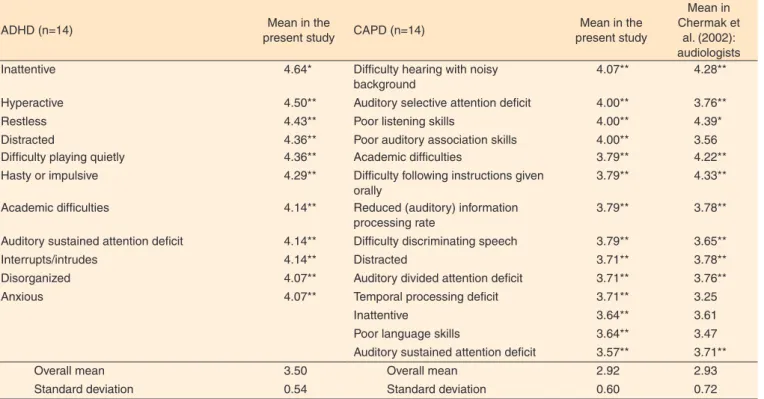
The mean frequency scores of behaviors reported by the group of speech therapists in ADHD and CAPD are listed in descending order in Table 2. The overall mean values from this group of professionals were compared to the overall mean values reported by Chermak et al.(6).
The mean frequency scores of behaviors reported by the group of psychologists and pedagogues in ADHD and CAPD are listed in decreasing order in Table 3. These two groups’ ratings were analyzed together due to similarities in their res-ponses. Our findings were not compared to the earlier study(6)
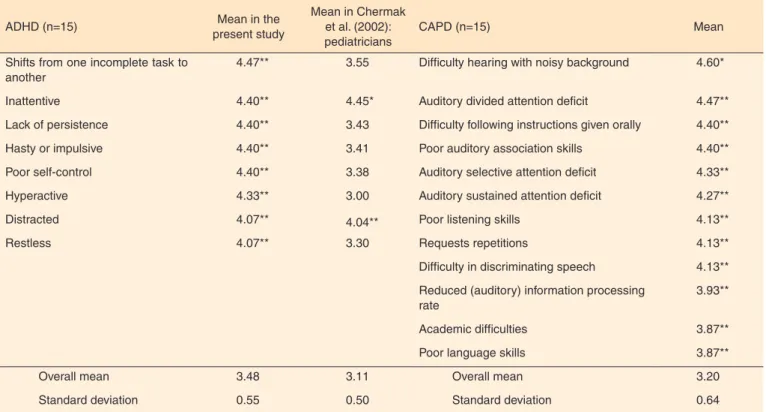
because it did not include these categories of professionals. The mean frequency scores of behaviors reported by the group of medical doctors in ADHD and CAPD are listed in decreasing order in Table 4, along with the analogous data from Chermak et al.(6).
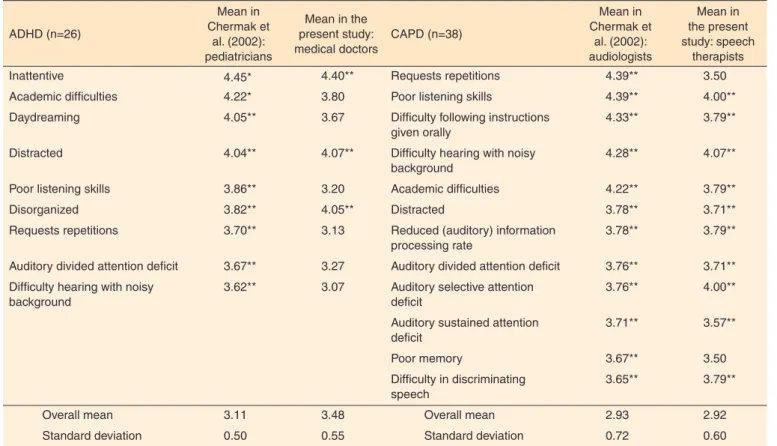
For the purpose of comparing the most prominent behavio-ral signs in Chermak et al.(6) and our study, we present their
frequencies of occurrence in Table 5, which lists in decreasing order the most frequent symptoms of ADHD according to the group of medical doctors in this study and pediatricians in the earlier study and the most frequent symptoms of CAPD according to the group of speech therapists in this study and audiologists in the earlier study.
DISCUSSION
Our analysis of the behavioral signs (Table 1) showed that in the case of ADHD, hyperactivity, hastiness or impulsivity, restlessness, shifting from one incomplete task to another, poor self-control, difficulty playing quietly, lack of persistence, and interrupting/intruding exhibited values higher than 1 SD above the corresponding mean, disagreeing with the results of Chermak et al.(6). In the case of hyperactivity, the divergence
relative to Chermak et al.(6) might have occurred because they
investigated the inattentive type of ADHD only, whereas the present study did not discriminate between this disorder’s types. Inattentiveness, distraction, disorganization, and aca-demic difficulties exhibited values more than 1 SD above the corresponding mean in both studies. In regard to CAPD, the two studies obtained very similar results, as shown by the fact that only one behavioral sign listed by Chermak et al.(6), poor
language skills, failed to reach a value higher than 1 SD above the overall mean in our study.
Table 1. Frequency of occurrence of the behavioral signs indicated by the investigated professional groups
ADHD (n=42) Mean in the present study
Mean in Chermak et
al. (2002): pediatricians
CAPD (n=38) Mean in the present study
Mean in Chermak et
al. (2002): audiologists Inattentive 4.57* 4.45* Difficult hearing with noisy
background
4.45* 4.28**
Hyperactive 4.45** 3.00 Poor auditory association skills 4.18** 3.56**
Distracted 4.38** 4.04** Poor listening skills 4.16** 4.39*
Hasty or impulsive 4.36** 3.41 Difficulty following instructions given orally
4.13** 4.33**
Restless 4.24** 3.30 Auditory sustained attention deficit
4.05** 3.71**
Shifts from one incomplete task to another
4.17** 3.55 Auditory selective attention deficit
4.03** 3.76**
Poor self-control 4.12** 3.38 Difficulty discriminating speech 4.00** 3.65**
Difficulty in playing quietly 4.10** 3.04 Reduced (auditory) information processing rate
3.97** 3.78**
Lack of organizational skills 4.05** 3.82** Academic difficulties 3.89** 4.22**
Lack of persistence 4.05** 3.43 Requests repetitions 3.89** 4.39*
Academic difficulties 4.02** 4.22* Auditory divided attention deficit 3.89** 3.76**
Interrupts/intrudes 3.98** 3.36 Poor language skills 3.79** 3.47
Distracted 3.71** 3.78**
Overall mean 3.45 3.11 Overall mean 3.05 2.93
Standard deviation 0.52 0.50 Standard deviation 0.63 0.72
* Values higher than 2 SD above the overall mean of the corresponding behavioral sign ** Values higher than 1 SD above the overall mean of the corresponding behavioral sign
Note: ADHD = attention deficit hyperactivity disorder; CAPD = central auditory processing disorder
Table 2. Frequency of occurrence of the behavioral signs indicated by the speech therapists
ADHD (n=14) Mean in the
present study CAPD (n=14)
Mean in the present study
Mean in Chermak et
al. (2002): audiologists Inattentive 4.64* Difficulty hearing with noisy
background
4.07** 4.28**
Hyperactive 4.50** Auditory selective attention deficit 4.00** 3.76**
Restless 4.43** Poor listening skills 4.00** 4.39*
Distracted 4.36** Poor auditory association skills 4.00** 3.56 Difficulty playing quietly 4.36** Academic difficulties 3.79** 4.22**
Hasty or impulsive 4.29** Difficulty following instructions given orally
3.79** 4.33**
Academic difficulties 4.14** Reduced (auditory) information processing rate
3.79** 3.78**
Auditory sustained attention deficit 4.14** Difficulty discriminating speech 3.79** 3.65**
Interrupts/intrudes 4.14** Distracted 3.71** 3.78**
Disorganized 4.07** Auditory divided attention deficit 3.71** 3.76**
Anxious 4.07** Temporal processing deficit 3.71** 3.25
Inattentive 3.64** 3.61
Poor language skills 3.64** 3.47
Auditory sustained attention deficit 3.57** 3.71**
Overall mean 3.50 Overall mean 2.92 2.93 Standard deviation 0.54 Standard deviation 0.60 0.72
* Values higher than 2 SD above the overall mean of the corresponding behavioral sign ** Values higher than 1 SD above the overall mean of the corresponding behavioral sign
Table 3. Frequency of occurrence of the behavioral signs indicated by the group of psychologists and pedagogues
ADHD (n=13) Mean CAPD (n=9) Mean
Distracted 4.77* Difficulty hearing with noisy background 4.78*
Inattentive 4.69* Poor listening skills 4.44**
Hyperactive 4.54** Auditory sustained attention deficit 4.44**
Hasty or impulsive 4.38** Reduced (auditory) information processing rate 4.33**
Disorganized 4.23** Difficulty following instructions given orally 4.22**
Restless 4.23** Academic difficulties 4.11**
Academic difficulties 4.15** Requests repetitions 4.11**
Difficulty following instructions given orally 4.08** Poor auditory association skills 4.11**
Shifts from one incomplete task to another 4.00** Difficulty discriminating speech 4.11**
Poor self-control 4.00** Pattern processing deficit 4.00**
Difficulty in playing quietly 4.00** Visual selective attention deficit 4.00**
Multiple-mode attention deficit (e.g., auditory and visual)
3.89**
Poor language skills 3.89**
Overall mean 3.35 Overall mean 3.00
Standard deviation 0.62 Standard deviation 0.83
* Values higher than 2 SD above the overall mean of the corresponding behavioral sign ** Values higher than 1 SD above the overall mean of the corresponding behavioral sign
Note: ADHD = attention deficit hyperactivity disorder; CAPD = central auditory processing disorder
Table 4. Frequency of occurrence of the behavioral signs indicated by the group of medical doctors
ADHD (n=15) Mean in the present study
Mean in Chermak et al. (2002): pediatricians
CAPD (n=15) Mean
Shifts from one incomplete task to another
4.47** 3.55 Difficulty hearing with noisy background 4.60*
Inattentive 4.40** 4.45* Auditory divided attention deficit 4.47**
Lack of persistence 4.40** 3.43 Difficulty following instructions given orally 4.40**
Hasty or impulsive 4.40** 3.41 Poor auditory association skills 4.40**
Poor self-control 4.40** 3.38 Auditory selective attention deficit 4.33**
Hyperactive 4.33** 3.00 Auditory sustained attention deficit 4.27**
Distracted 4.07** 4.04** Poor listening skills 4.13**
Restless 4.07** 3.30 Requests repetitions 4.13**
Difficulty in discriminating speech 4.13**
Reduced (auditory) information processing rate
3.93**
Academic difficulties 3.87**
Poor language skills 3.87**
Overall mean 3.48 3.11 Overall mean 3.20
Standard deviation 0.55 0.50 Standard deviation 0.64
* Values higher than 2 SD above the overall mean of the corresponding behavioral sign ** Values higher than 1 SD above the overall mean of the corresponding behavioral sign
rated inattention as the most evident behavioral sign in children with ADHD. In CAPD, some behavioral signs, such as poor auditory association skills, temporal processing deficit, inat-tention, and poor language skills, exhibited more significant values (greater than 1 SD above the overall mean) compared to the similar study(6).
The behavioral sign considered by the group of psycholo-gists and pedagogues as the most evident in CAPD was diffi-culty hearing with a noisy background. In ADHD, distraction and inattentiveness exhibited values greater than 2 SD above the overall mean, followed by hastiness or impulsiveness, hype-ractivity, disorganization, restlessness, academic difficulties, difficulty following instructions given orally, shifting from an incomplete task to another, poor self-control, and difficulty playing quietly. In this case, ADHD behavioral signs associated with the school environment prevailed, most likely as a function of the presence of the pedagogues, who benefit from observing children with ADHD under various school situations in their work setting, which is not the case of the other investigated professionals, who only see these children in the clinical setting. These results suggest that the combination of the nature of the professional experience and the environmental circumstances under which the children’s behavior is observed enable the professional to detect the specific behaviors described here. Four psychologists did not classify CAPD symptoms because
they did not treat individuals with CAPD. Finally, Table 3 does not include a comparison with the results of Chermak et al.(6) because they did not survey psychologists or pedagogues.
The group of medical doctors (Table 4) indicated difficulty hearing with a noisy background as the most evident behavioral sign in CAPD and shifting from one incomplete task to another in the case of ADHD, disagreeing with the similar study(6). The
same disagreement occurred in the case of lack of persistence, hastiness or impulsiveness, poor self-control, hyperactivity, and restlessness. In the particular case of hyperactivity, disagree-ment might have occurred because Chermak et al.(6) focused
on the inattentive type of ADHD. The most evident behavioral signs Chermak et al.(6) listed for both investigated disorders were
compared to the scores from the same categories of professio-nals in the present study, namely, medical doctors in the case of ADHD and speech therapists in the case of CAPD (Table 5). In the similar study(6), the behavioral sign most evident in ADHD
was inattentiveness, which disagrees with our findings. Other behavioral signs, such as academic difficulties, daydreaming, poor listening skills, requests for repetition, auditory divided attention deficit, and difficult hearing with noisy background were also evident in the similar study(6). In regard to CAPD, only
two behavioral signs diverged between both studies, namely, requests for repetitions and poor memory, whose values were significant only in the other study(6).
Table 5. Frequency of occurrence of behavioral signs in Chermak et al. (2002) compared to the behavioral signs in the present study
ADHD (n=26)
Mean in Chermak et
al. (2002): pediatricians
Mean in the present study: medical doctors
CAPD (n=38)
Mean in Chermak et
al. (2002): audiologists
Mean in the present study: speech
therapists
Inattentive 4.45* 4.40** Requests repetitions 4.39** 3.50
Academic difficulties 4.22* 3.80 Poor listening skills 4.39** 4.00**
Daydreaming 4.05** 3.67 Difficulty following instructions given orally
4.33** 3.79**
Distracted 4.04** 4.07** Difficulty hearing with noisy background
4.28** 4.07**
Poor listening skills 3.86** 3.20 Academic difficulties 4.22** 3.79**
Disorganized 3.82** 4.05** Distracted 3.78** 3.71**
Requests repetitions 3.70** 3.13 Reduced (auditory) information processing rate
3.78** 3.79**
Auditory divided attention deficit 3.67** 3.27 Auditory divided attention deficit 3.76** 3.71**
Difficulty hearing with noisy background
3.62** 3.07 Auditory selective attention deficit
3.76** 4.00**
Auditory sustained attention deficit
3.71** 3.57**
Poor memory 3.67** 3.50
Difficulty in discriminating speech
3.65** 3.79**
Overall mean 3.11 3.48 Overall mean 2.93 2.92
Standard deviation 0.50 0.55 Standard deviation 0.72 0.60
* Values higher than 2 SD above the overall mean of the corresponding behavioral sign ** Values higher than1 SD above the overall mean of the corresponding behavioral sign
The present study found that the behavioral signs identified as most characteristic of ADHD or CAPD varied as a function of the professional expertise. Therefore, it is worth emphasizing the relevance of subjecting the patients to multidisciplinary assessment to benefit from the diagnostic resources specifically available to each profession, which can help reach an accurate diagnosis.
Cultural differences between countries might influence the diagnosis of ADHD(1,7). The diagnostic criteria applied by the
professionals and the socially acceptable and expected beha-vioral patterns of children might vary among countries and thus influence the diagnosis of ADHD. The signs of ADHD might be minimal or absent when individuals are subjected to extremely rigorous environments, face new circumstances, participate in particularly interesting activities, are placed in situations invol-ving two participants only (such as a medical visit), or act in a setting where appropriate behaviors are frequently rewarded. Conversely, the symptoms of ADHD manifest more frequently in collective settings, such as the schoolyard, classroom, or workplace. For those reasons, clinicians should inquire about the individuals’ behavior under various circumstances and contexts(1).
The hypothesis that cultural differences influence the per-ceptions of professionals from different countries and that this phenomenon leads to different findings in studies on ADHD(1)
is interesting. A study on the prevalence of ADHD in different countries showed highly heterogeneous rates as a function of the diagnostic criteria selected, i.e., the ones provided by DSM-IV or by the 10th edition of the International Statistical
Classification of Diseases and Related Health Problems (ICD-10), the age of the patients at diagnosis, the people reporting the behavioral signs exhibited by the patients (i.e., parents or teachers), and cultural differences between the investigated countries, among others. The diagnosis of ADHD is essentially established on clinical grounds, i.e., on clear and well-defined operational criteria provided by classification systems such as DSM-IV and ICD-10. In Brazil, some indications support the adequacy of the criteria provided by the DSM-IV(11).
Appropriate guidelines for the identification of ADHD and CAPD and the presence of comorbidities could be established if the professionals involved in the diagnosis of these disorders had complete knowledge of these conditions, including their symptoms and procedures of assessment, independently of their area of specialization. The mere presence or absence of any given behavioral sign does not allow a doctor to diagnose an individual with ADHD or CAPD. The present study propo-sed the application of a questionnaire that included the most common symptoms exhibited by patients with ADHD and CAPD to identify the individuals needing specific modalities of assessment, e.g., the auditory process, to establish the final diagnosis.
Taking all these hypotheses into consideration, it is crucial to reflect once again on how the diagnosis of ADHD and CAPD
is established in Brazil, as well as to emphasize the importance of identifying eventual comorbidities in the affected individuals. This will ensure the adherence to adequate treatment guidelines.
CONCLUSION
Groups of medical doctors, speech therapists, psychologists, and pedagogues identified some behavioral signs as charac-teristic of ADHD or CAPD. In the case of ADHD, the most evident symptoms were difficulty playing quietly, distraction, disorganization, inattentiveness, hyperactivity, restlessness, shifting from one incomplete task to another, poor self-control, lack of persistence, and hastiness or impulsiveness. In the case of CAPD, the most evident symptoms were auditory divided attention deficit, auditory selective attention deficit, difficulty following instructions given orally, poor auditory association skills, difficulty hearing with a noisy background, auditory sustained attention deficit, difficulty distinguishing speech, and reduced auditory information processing rate.
REFERENCES
1. American Psychiatric Association. Diagnostic and Statistical Manual of Mental Disorders. 4th Text Revision (DSM-IV-TR). Washington: DC; 2000.
2. Barkley, RA. Driving risks in adults with ADHD: Yet more evidence and a personal story. The ADHD Report. 2006;14(5):1-10. 3. American Speech-Language-Hearing Association-ASHA. Central
auditory processing: current status of research and implications for clinical practice. Am J Audiol. 1996;5:41-54.
4. Keller WD. Auditory processing disorder or attention-deficit? In: Katz J, Stecker N, Henderson D, editors. Central Auditory Processing: a Transdisciplinary View. St. Louis: Mosby Yearbook; 1992. p.107-14.
5. Chermak GD, Somers EK, Seikel JA. Behavioral signs of central auditory processing disorder and attention deficit hyperactivity disorder. J Am Acad Audiol. 1998Fb;9(1):78-84.
6. Chermak GD, Tucker E, Seikel JA. Behavioral characteristics of auditory processing disorder and attention deficit hyperactivity disorder: predominantly inattentive type. J Am Acad Audiol. 2002Jun;13(6):332-38.
7. Rohde LA. ADHD in Brazil: the DSM-IV criteria in a culturally different population. J Am Acad Child Adolesc Psychiatry. 2002Sep;41(9):1131-3.
8. Abdo AGR, Murphy CFB, Schochat E. Habilidades auditivas em crianças com dislexia e transtorno do déficit de atenção e hiperatividade [Auditory skills in children with dyslexia and attention deficit hyperactivity disorder]. Pró-Fono. 2010;22(1):25-30. 9. Cavadas M, Pereira LD, Mattos P. Efeito do metilfenidato no
10. Faraone SV, Sergeant J, Gillberg C, Biederman J. The worldwide prevalence of ADHD: is it an American condition. World Psychiatry. 2003Jun;2(2):104-13.
11. Rohde LA, Barbosa G, Polanczyk G, Elzirik M, Rasmussen ER, Neuman RJ, et al. Factor and latent class analysis of DSM-IV ADHD symptoms in a school sample of Brazilian adolescents. J Am Acad Child Adolesc Psychiatry. 2001Jun;40(6):711-8.
Appendix 1. Occurrence of behavioral signs in ADHD and CAPD per professional group
Symptoms
Speech therapists Psychologists and
pedagogues Medical doctors
ADHD (n=14)
CAPD (n=14)
ADHD (n=13)
CAPD (n=9)
ADHD (n=15)
CAPD (n=15)
Aggressive 3.21 2.14 3.08 2.22 3.33 2.67
Anxious 4.07* 2.79 3.54 2.78 3.4 3.4
Hasty or impulsive 4.29* 2.79 4.38* 2.33 4.40* 2.53
Quarrelsome 3.5 2.07 3.15 2.44 3.87 2.53
Auditory divided attention deficit 3.14 3.71* 3.15 3.22 3.27 4.47*
Auditory selective attention deficit 3.36 4.00* 3.46 3.56 3.2 4.33*
Auditory sustained attention deficit 4.14* 3.57* 3.38 4.44* 3.67 4.27*
Visual sustained attention deficit 3.71 2.5 3.23 3.11 3.47 3.2
Visual divided attention deficit 3.57 2.43 3.15 3.44 3.13 2.73
Visual selective attention deficit 3.21 2.36 3.23 4.00* 3.07 2.6
Way of processing information deficit 3.07 3.29 3.46 4.00* 3.13 3.53
Temporal processing deficit 2.71 3.71* 3 3.11 3.13 3.53
Multiple-mode attention deficit (e.g., auditory and visual) 3.86 3 3.46 3.89* 3.53 3.33
Depressed 3 2.21 2.15 2.33 2.53 3
Defiant 3.5 2.07 2.46 2.11 3.73 2.6
Inattentive 4.64* 3.64* 4.69* 3.56 4.40* 3.6
Disorganized 4.07* 3.14 4.23* 3.78 3.87 3
Destructive 3.29 2.07 2.69 1.89 3.53 2.47
Difficulty hearing with noisy background 3.29 4.07* 3.85 4.78* 3.07 4.60*
Difficulty playing quietly 4.36* 2.57 4.00* 2.33 3.93 2.6
Difficulty discriminating speech 2.43 3.79* 3.08 4.11* 2.93 4.13*
Difficulty following instructions given orally 3.36 3.79* 4.08* 4.22* 3.47 4.40*
Academic difficulties 4.14* 3.79* 4.15* 4.11* 3.8 3.87*
Distracted 4.36* 3.71* 4.77* 3.56 4.07* 3.8
Emotionally unstable 3.79 2.64 2.85 2.44 3.8 2.87
Engages in dangerous activities 3.79 2.36 3.23 2.33 3.87 2.33
Failure to consider consequences 3.93 2.43 3.69 2.22 3.8 2.67
Lack of persistence 3.93 2.64 3.77 3.11 4.40* 2.8
Easily frustrated 3.5 3 3.69 3.44 3.87 3.13
Poor auditory association skills 3 4.00* 3.08 4.11* 2.73 4.40*
Poor listening skills 3.07 4.00* 3.62 4.44* 3.2 4.13*
Poor language skills 2.86 3.64* 3.15 3.89* 3.13 3.87*
Poor problem-solving skills 3.29 3.14 3.08 2.33 3.67 2.87
Hyperactive 4.50* 2.79 4.54* 3.11 4.33* 2.8
Hostile 3.07 2.14 2.31 1.89 3.27 2.33
Socially inadequate 3.86 2.36 3.46 1.78 3.73 2.73
Interrupts/intrudes 4.14* 2.5 3.85 2.78 3.93 2.73
Introverted 2.5 2.86 2.31 2.67 2.6 3.27
Restless 4.43* 2.71 4.23* 3.33 4.07* 3.07
Poor coordination 3.5 3.07 3 3.11 3.8 3
Fearful 2.93 2.57 2.38 2.11 2.2 3.07
Melancholic 3.29 2.71 2.54 1.78 2.33 2.93
Poor memory 3 3.5 3 2.78 3.07 3.2
Shifts from an incomplete task to another 4 2.64 4.00* 3.22 4.47* 2.93
Very sensitive 3.29 2.93 3.38 3 3.2 3.67
Unhelpful 3.5 2.5 3 2.56 3.47 2.67
Requests repetitions 3.07 3.5 3.46 4.11* 3.13 4.13*
Loses things 3.5 2.64 3.92 2.56 3.87 2.67
Poor self-control 3.93 2.5 4.00* 2.56 4.40* 2.73
Lazy 3 2.71 2.69 2 2.87 3
Symptoms
Speech therapists Psychologists and
pedagogues Medical doctors
ADHD (n=14)
CAPD (n=14)
ADHD (n=13)
CAPD (n=9)
ADHD (n=15)
CAPD (n=15)
Prone to accidents 4 2.14 3.46 2 3.87 2.93
Gives wrong answers to simple questions 3.14 3.07 3.54 3.22 3.4 3.53
Steals or lies 2.79 2 2.38 2 2.87 2.07
Daydreaming 3.14 2.64 3.08 2.33 3.67 3.33
Chatterer 3.64 2.64 3.54 3 3.73 2.73
Reduced (auditory) information processing rate 3.29 3.79* 3.15 4.33* 3.33 3.93*
Shy 2.5 2.93 2.46 2 2.2 3.4
Standard deviation 0.54 0.6 0.62 0.83 0.55 0.64
Overall mean 3.5 2.92 3.35 3 3.48 3.2
* Indicates mean greater than 1 SD above the corresponding overall mean
Note: ADHD = attention deficit hyperactivity disorder; CAPD = central auditory processing disorder