Brazilian flood plain
Catian, G.
a,*and Scremin-Dias, E.
a,b aGraduate Program in Plant Biology, Federal University of Mato Grosso do Sul, Cidade Universitária S/N, CP 549, CEP 79070-900, Campo Grande, MS, Brazil
bDepartment of Biology, Center for Biological Sciences and Health, Federal University of Mato Grosso do Sul,
Cidade Universitária S/N, CP 549, CEP 79070-900, Campo Grande, MS, Brazil *
e-mail: [email protected]
Received June 19, 2012 - Accepted October 31, 2012 - Distributed November 29, 2013 (With 3 figures)
Abstract
Nymphaeahas seven species already catalogued in the flood prone areas of the Brazilian Pantanal. However, some spe-cies remain difficult to identify and descriptions of the anatomy of vegetative organs are an important tool for infrageneric separation to aid in group taxonomy. The species collected in the Pantanal and prepared according to the usual techniques for anatomical studies showed similar structural characteristics, and data on the arrangement of vas-cular bundles in the midrib and petiole, as well as the form and distribution of sclereids, were consistent.Nymphaea oxypetalastands out from the other evaluated species for having a greater number of differential characters, including angular collenchyma and the absence of bicollateral bundles in the petiole.Nymphaea lingulatastands out as the only species to feature bicollateral bundles in the leaf blade. The results, summarised in the dichotomous key, facilitate the identification of species that use the flower as the main differentiation, but are in a vegetative stage.
Keywords:anatomical differences, aquatic macrophytes, dichotomous key, Pantanal.
(Anatomia comparativa da folha de espécies de
Nymphaea
(Nymphaeaceae)
da planície de inundação brasileira)
Resumo
Nymphaeatem sete espécies catalogadas nas áreas inundáveis do Pantanal brasileiro. No entanto, algumas espécies são de difícil identificação e descrições da anatomia dos órgãos vegetativos são uma ferramenta importante para a separação infragenérica para auxiliar na taxonomia do grupo. As espécies coletadas no Pantanal e preparadas de acordo com as técnicas usuais para estudos anatômicos mostraram as mesmas características estruturais, e os dados de arranjo dos feixes vasculares na nervura central e pecíolo, bem como a forma e distribuição de esclereides, foram consistentes.
Nymphaea oxypetalase destaca das outras espécies avaliadas por ter um maior número de caracteres diferenciais, incluindo colênquima angular e ausência de feixes bicolaterais no pecíolo.Nymphaea lingulatase destaca como a única espécie que apresenta feixes bicolaterais no limbo. Os resultados, resumidos em uma chave dicotômica, facilitam a identificação de espécies que utilizam a flor como principal diferenciação quando se encontram em estágio vegetativo.
Palavras-chave:chave dicotômica, diferenças anatômicas, macrófitas aquáticas, Pantanal.
1. Introduction
The Nymphaeaceae features cosmopolitan distribu-tion, comprising five genera and about 70 species (Löhne, Wiersema and Borsh, 2009), with the occurrence of seven species ofNymphaeaL. described for the Bra-zilian Pantanal (Pott, 1998). This family, known in Brazil as “lagartixa”, “camalote-da-meia-noite”, “dama-da-noi-te”, “batata-d’água” and “pata-de-boi”, stands out for its wide distribution, represented by fixed floating species with floating leaves attached to a submerged organ, rizhome, by long petioles (Cronk and Fennessy, 2001).
subgenusHydrocallis(Neotropical nocturnal flowering), and are pollinated by Coleoptera from the genus
Cyclocephala (Pott, 1998). According to Wiersema (1987), this subgenus is characterised by completely fused carpels, a swollen carpel appendage, and a usually tetramerous arrangement of perianth and outer stames, with or without acicular sclereids.
Investigations that characterise the morphology and chemical composition, as well as the anatomy of tissues and other secretory structures present in vegetative or-gans, are scarce for most Brazilian species, particularly aquatic macrophytes (Adamowicz, unpublished results). Knowledge of the structural peculiarities of this plant group has increased in recent years, especially with re-gard to adaptive characteristics related to the environ-ment. Nevertheless, a large part of the generated data is not yet available in the literature. Therefore, this article describes the leaf anatomy of seven species ofNymphaea
that occur in the Brazilian Pantanal, indicating consistent structures to facilitate the distinction among species, some very similar and difficult to identify the external morphology in the absence of flowers.
2. Material and Methods
2.1. Study area
The Pantanal, which features several different land-scape units from the intensity and regularity of its flood pulse (Pozer and Nogueira, 2004), has an area of 140,000 km2, of which more than half is flooded during the rainy season by the main rivers and tributaries that drain into the plain (Pott and Pott, 1994). The climate in the region is sub-humid tropical - Aw (Koeppen, 1948) with dry winters and rainy summers. Mean annual pre-cipitation ranges from 1,000 to 1,400 mm, concentrated mainly between November and April (Soriano et al., 2001). Among the miscellaneous land formations in the region are bays and lagoons, either temporarily or perma-nently flooded, with aquatic plant species of various hab-its (Pott et al., 1989). According to Junk et al. (1989), floodplains are environments rich in organic matter and suspended sediment, resulting in slightly dark-coloured water.
2.2. Samplings
The fully developed leaves (leaf blade and petiole) of three individuals from different populations of N. amazonum, N. gardneriana, N. oxypetala and N. proliferawere collected during the rainy months in the areas influenced by the Miranda and Abobral Rivers and in natural and artificial lagoons (loan boxes with sub-strate for road construction) adjacent to the Pantanal Studies Base of the Federal University of Mato Grosso do Sul (19°25’30.8” S and 57°02’50.2’’ W). The same method was adopted forN. lingulataat Rio Negro Farm (19°34’15” S and 56°14’43” W). Because of restricted distribution and difficult localisation, samples of N. belophylla(CPAP 15553) and N. jamesoniana(CPAP
13347) were obtained from exsiccate in the Herbarium of the Federal University of Mato Grosso do Sul (CGMS-UFMS). Voucher specimens were incorporated in the CGMS/UFMS herbarium for documentation: N. amazonum (CGMS 21898), N. gardneriana (CGMS 21899), N. oxypetala (CGMS 21901), N. prolifera
(CGMS 21902), andN. lingulata(CGMS 21900).
2.3. Histological preparation
Fragments were removed from the margin (1 cm2) and middle portions of the blade (1 cm2) and petiole (1 cm), fixed in neutral buffered formalin (NBF) for 24 h (Seago et al., 2000), then washed in abundant running water and dehydrated in a graded ethylic series for pres-ervation in 70% alcohol and later processing. The herbo-rised material was rehydrated, boiled in water with drops of glycerin to expand the tissues, transferred to 70% etha-nol (Kraus and Arduim, 1997), and stored for later sec-tioning.
In the process of creating permanent slides, the organ fragments were dehydrated up to 100% ethanol, blocked in historesin, sectioned at 5mm-thick sections in a Leica
rotary microtome, stained in toluidine blue 0.05% pH 6.8, and set between the slide and coverslip (Kraus and Arduim, 1997).
In order to make semi-permanent slides, the sections, which were made by hand using steel blades, were cleaned in 20% sodium hypochlorite solution, washed in acidified water, stained with double colouration using 1% aqueous astra blue and 1% aqueous safranin in a 9:1 (v/v) ratio, according to techniques compiled by Kraus and Arduim (1997), mounted between the slide and coverslip with 50% glycerin, and sealed with clear nail polish.
2.4. Analyses and illustrations
The analyses and illustrations of materials were car-ried out using a photonic microscope attached to the image capture and photography system, and the corre-sponding micrometric scales were displayed. Diagrams of the material were also prepared with the aid of a photonic microscope attached to a camera lucida.
3. Results
The seven species have several anatomical characters in common; however, we did observe some consistent structures that make it possible to differentiate them (Ta-ble 1).
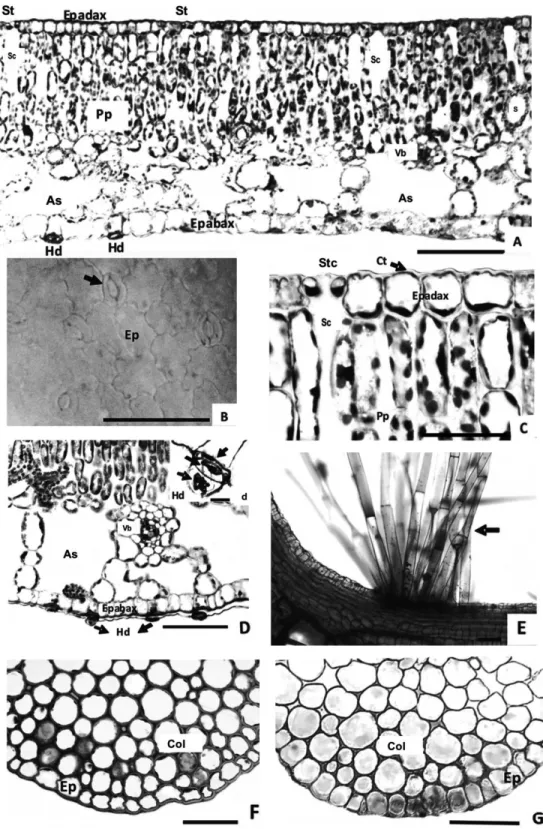
Hydropoten (Hd) occur in the epidermis of the aba-xial surface - Epabax - (Figure 1A) in all species, along the leaf, including the midrib. They consist of three cells (Figure 1D - arrows): a basal cell, set at the level of the other epidermal cells; a medial cell; and an apical cell, deciduous, with a rounded extremity (Figure 1D - ar-rows).
Nymphaea amazonumfeatures pluricellular, uniseri-ate, non-glandular trichomes (Figure 1E - arrow), evident both at the base of the leaf blade and petiole apex, and it is a consistent character which separates this species from the others.
The mesophyll is dorsiventral in all species (Figu-re1A), with palisade parenchyma (Pp) well differenti-ated, rich in chloroplasts that are distributed homoge-neously and interrupted by the substomatal chambers. There are five chlorenchyma (Pp) layers inN. lingulata
andN. prolifera, two inN. oxypetalaand four in the re-maining species. The midrib features annular collenchy-ma (Cl) subjacent to the abaxial surface epidermis (Ep) of the blade (Figure 1F) inN. amazonum,N. belophylla,N. gardneriana, N. jamesoniana, N. lingulata and N. prolifera, only differing in N. oxypetala (Figure 1G), which features angular collenchymas (Cl).
The spongy tissue cells of this genus are arranged in regular formation, forming columns set between the epi-dermis of the lower surface of the leaf and the palisade (Pp) layer, forming a polygonal chain with very large air chamber (As) meshes (Figure 1A, D), and in the midrib, there are different numbers of air spaces in all species.
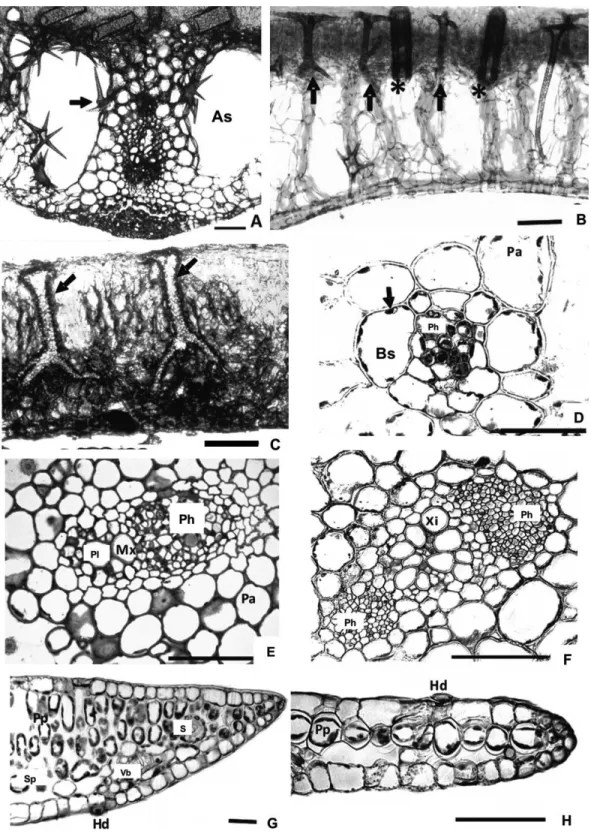
Astrosclereids (arrows) are found in the aerenchyma (Figure 2A) in all species, except inN. oxypetala, and elongated sclereids (arrows) traversing the palisade pa-renchyma (Figure 2B) occur in N. amazonum, N. belophylla,N. gardnerianaandN. jamesoniana. Robust and tubular sclereids (asterisks) are found in the palisade
parenchyma of N. amazonum, N. belophylla, N. gardnerianaandN. jamesoniana(Figure 2B). Columnar sclereids (arrows), which feature terminal branches set-ting parallel to the palisade parenchyma (Pp) and reach-ing both surfaces of the leaf, are present inN. amazonum,
N. belophylla, N. gardneriana andN. prolifera (Figu-re 2C). OnlyN. oxypetaladid not feature any type of sclereid in the blade.
The vascular bundles of the mesophyll are open col-lateral with bundle sheath rich in chloroplasts (Figure 2D - arrow) in all evaluated species. In the smaller bundles, the metaxylem (Mx) has wide vessels interposed by small parenchyma cells (Figure 2E) inN. amazonum, N. gardnerianaandN. prolifera. Protoxylem lacunae (Pl), delimited by parenchyma cells (Pa) arranged in regular formation (Figure 2E), are present in most large vascular units of the species, except in N. jamesoniana. Since leaves do not feature vessel elements, xylem is conducted by tracheids with spiral thickening. Phloem is well devel-oped, but with reversed arrangement inN. belophyllaand
N. jamesoniana (Figure 2A), and N. lingulata (Figu-re 2F). OnlyN. lingulatapresents bicollateral bundles in the midrib (Figure 2F).
The blade margin is patterned similarly for all evalu-ated species, with a layer of regular parenchyma (Rp), without supporting tissue, the absence of palisade paren-chyma (Pp), and the presence of sclereids (S), vascular bundle (Vb), stomata and hydropoten (Hd). The margin has acute shape in N. amazonum, N. belophylla, N. gardneriana, N. jamesoniana, N. lingulata and N. prolifera(Figure 2G), but it is rounded inN. oxypetala
(Figure 2H).
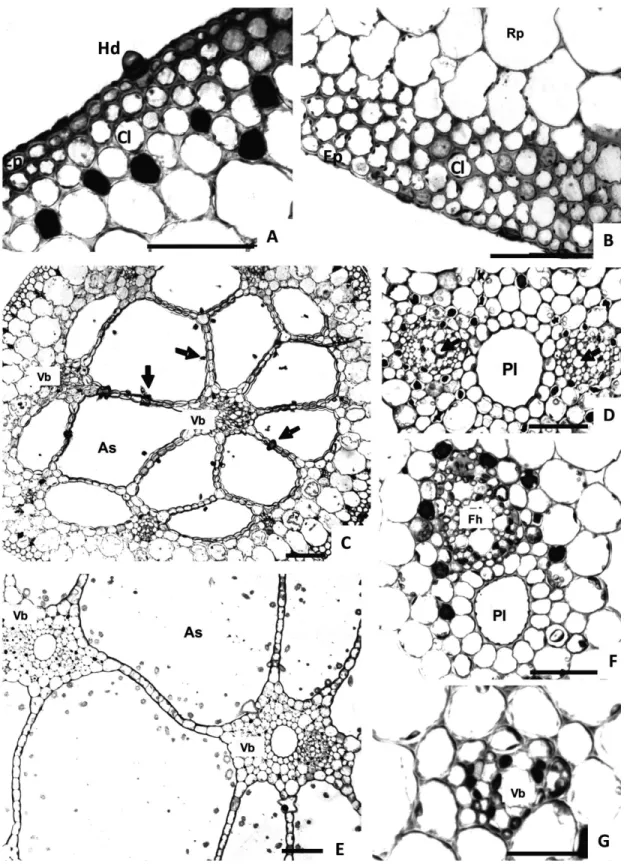
Petiole - The petiole with uniseriate epidermis (Ep) and hydropoten (Hd) set along its length (Figure 3A) oc-curs in all species. Three layers of sub-epidermal annular collenchyma - Cl - (Figure 3B) are found in six of the
spe-Table 1- Anatomical characters different obtained for the sevenNymphaeaspecies of the Brazilian Pantanal. (N.A. – Nymphaea amazonum, N.B. –N. belophylla, N.G. –N. gardneriana, N.J. –N. jamesoniana, N.L. –N. lingulata, N.O. –N. oxypetala, N.P. –N. prolifera); + (presence) – (absence) numbers (quantity).
Characters Species
N.A. N.B. N.G. N.J. N.L. N.O. N.P.
Trichomes on petiole apex + - - -
-Layer of chlorenchyma 4 4 4 4 5 2 5
Type of collenchyma annular annular annular annular annular angular annular
Astrosclereids + + + + + - +
Elongated sclereids - - + - - -
-Tubular sclereids - - + - - -
-Columnar sclereids - - - +
Bundles in midrib 2 2 2 2 3 1 2
Inverted phloem - 1 - 1 1 -
-Bicollateral bundles in the blade - - - - 1 -
cies, exceptN. oxypetala, which features an angular-type layer (Figure 3A).
For all seven species, there is a similarity in the ana-tomical pattern of the midrib mesophyll formed by a parenchymal cortex with vascular bundles arranged in regular formation, with the region inside the cortex con-sisting of regular aerenchyma (As) with sclereids (S - ar-rows) projected on the inside of the lacunae (Figure 3C).
Bicollateral bundles (Figure 3D) occur in six species, exceptN. oxypetala. There are differences in the number of bundles when comparing the species.N. amazonum,
N. gardnerianaandN. proliferahave two central bicol-lateral bundles in opposing positions, with a large central protoxylem lacuna (Figure 3E). Six bicollateral bundles with lacuna (As) are found in N. lingulata, two in N. belophylla, and one inN. jamesoniana. In terms of collat-eral bundles with lacuna (Figure 3F),N. amazonum,N. lingulata and N. jamesoniana feature seven. N. gardnerianahas six,N. proliferahas ten, and three are found inN. belophyllaandN. oxypetala. Six collateral bundles without lacuna (Figure 3G) are present in N. amazonum, seven inN. lingulata, ten inN. belophylla, and four inN. oxypetala.
The anatomical differences in the leaves were suffi-ciently consistent to distinguish the taxa and make it pos-sible to devise an identification key based on the foliar characters easiest to recognise.
3.1. Leaf anatomy identification key for Nymphaea species occurring in the Pantanal
1 Trichomes at petiole apex...N. amazonum
1’Absence of trichomes at petiole apex... 2 Angular collenchyma, two layers of palisade
paren-chyma in mesophyll, one vascular bundle in middle vein of the blade, collateral bundle in petiole ...N. oxypetala
2’ Annular collenchyma, more than two layers of pali-sade parenchyma in mesophyll, more than two vascular bundles in middle vein of the blade, bicol-lateral bundle in petiole... 3 Bicollateral bundle in blade, three vascular
dles in middle vein, six bicollateral vascular bun-dles in petiole...N. lingulata
3’ Collateral bundle in blade, fewer than three vas-cular bundles in middle vein, and fewer than six bicollateral vascular bundles in petiole... 4 Reversed phloem...
5 Petiole with one bicollateral bundle ...N. jamesoniana
5’ Petiole with two bicollateral bundles ...N. belophylla
4’ Non-reversed phloem... 6 Four layers of palisade parenchyma in mesophyll...N. gardneriana
6’ Five layers of palisade parenchyma in mesophyll...N. prolifera
4. Discussion
Leaf blade – All species featured uniseriate epider-mis on both surfaces of the leaf blade, a characteristic cited by Adamowicz (unpublished results) for N. amazonum. The presence of an evident thin cuticle helps repel water from the surface of floating leaves (Gonzalez, 2002), as the stomata are arranged on the adaxial surface, and the presence of water on that surface would obstruct these structures. Fahn (1990) states that stomata help ab-sorb nutrients and exchange gas, but they do not have a protective function against transpiration in these plants, as aquatic species do not face desiccation. Nevertheless, maintaining an intense hydric flow is important for the absorption of nutrients diluted in the water environment (Scremin-Dias, 2009).
The presence of anomocytic stomata on the adaxial epidermis corroborates the description by Mauseth (1988) and Gonzalez (2002) for the genus and that by Solereder (1908) for Nymphaeaceae. Sculthorpe (1967) affirms that stomata are restricted to the adaxial surface of the blade, allowing for water vapor loss and easier ab-sorption of oxygen and carbon dioxide. This author also observed ample substomatal chambers for the genus, cor-roborating our data for the species we evaluated.
The hydropoten in adult leaves illustrated by Gonza-lez (2002) and Metcalfe and Chalk (1979) forNymphaea
species have three cells, which were confirmed in the evaluated species. The abscission of the apical cell of hydropoten in adult leaves of the individuals evaluated corroborates data cited by Carpenter (2006) for Nymphaeaceae. That author denominates hydropoten as unicellular or multicellular trichomes and, based on anal-yses of evolutionary characters, it is affirmed that this trichome is a synapomorphy for Nymphaeales. Hydro-poten are cited by Sculthorpe (1967) and Lavid et al. (2001) as structures that facilitate the transport of water and ions into the plant, subsequently translocated through the vascular system in the mesophyll.
Non-glandular trichomes observed on the apex of the petiole inN. amazonum were also cited by Wiersema (1987) for the species. According to Pott (1998), this ring of trichomes is an important character in identifying this species, and, out of the seven species evaluated in this work, it is present only inN. amazonum.
According to Coan et al. (2002), the presence of highly compartmentalised aerenchyma represents an im-portant adaptation, as it facilitates the storage of a mini-mum quantity of oxygen required in aquatic environ-ments and makes it possible to transport oxygen from the leaves to the root. The large amount of sclereids inside the lacunae offers resistance, as these species do not have supporting tissues (Sculthorpe, 1967).
Astrosclereids in the aerenchyma were reported by Conard (1905) as the most common type in the species of the genus. Sculthorpe (1967) also describes star-shaped sclereids that project into the lacunae of the spongy tissue in members of the family Nymphaeaceae. The inter-preted function of these structures is to provide support for the palisade and spongy tissue of the leaves (Conard, 1905). The several different shapes of sclereids in the mesophyll observed for the studied species ofNymphaea
were also described by Wiersema (1987) for the leaves of the subgenusHydrocallis.
Elongated sclereids found in the mesophyll of some species, according to Evert (2006), consist of immature cells; upon the development of the organ, they will reach both surfaces of the epidermis. However, the completely expanded leaves ofNymphaeaevaluated in this study in-dicate that the cell types observed had already completed ontogenesis and were distributed among the parenchy-mae, not reaching both surfaces of the leaf. The type of tubular sclereid described in this work forN. amazonum,
N. belophylla,N. gardnerianaandN. jamesonianahad already been reported by Wiersema (1987) as acicular sclereids for the genus, except forN. amazonumsubsp.
amazonum.Columnar sclereids, also evidenced in some species, were cited by Sculthorpe (1967) as common for the genus.
These specialised cells provide mechanical support and appear late during organ ontogenesis, when tissues increase in volume (Sculthorpe, 1967). The absence of these structures inN. oxypetala, also confirmed by Wier-sema (1987), may be related to the reduced size of its floating leaves or the reduced thickness of the blade of its submersed leaves, as sclereids provide mechanical sup-port to leaves.
For Sculthorpe (1967), the ample protoxylem lacu-nae observed in the vascular bundles of the seven species may represent the only structure that transports water for many aquatic species. According to that author, several families of aquatic plants do not form metaxylem, but all evaluatedNymphaeaspecies have metaxylem elements, although the number of cells varies. Only tracheids occur in the metaxylem, corroborating the description by Chea-dle (1942) for the family, which indicates an absence of vessel elements for the group.
The existence of reversed vascular bundles in the leaves of several hydrophytes led Arber (1918) to con-clude that there is a “pseudoblade” in leaves with that characteristic, which results from the flattening of the petiole, resembling a phyllode. Although this character-istic is illustrated in some members of Alismataceae and Pontederiaceae, it has not been cited for Nymphaeaceae.
Despite the basal position of Nymphaeaceae, it is be-lieved that the “pseudoblade” does not occur because the species in that family feature phloem with reversed posi-tion only in the midrib, not in the intervein regions, as oc-curs with monocotyledons. Arber considers that only the occurrence of such bundles outside these midribs, and it, may be considered pseudo-lamina. So, we believe in-verted bundles observed inN. lingulata, N. belophylla
andN. jamesonianamidrib not be construed phyllodic cases, because this type of anatomical structure here ob-served might equally well be taken to indicate that the or-gan showing is similar the midrib region of a Eudico-tyledonous leaf, which may also have inverted bundles in midribs.
The composition of the leaf margin described for the species has already been reported by Fahn (1990) for aquatic plants, in general, and forN. amazonumin a work by Gonzalez (2002). Although the structure is similar in all the species evaluated, the shape of the margin was consistent enough to separateN. oxypetalafrom the oth-ers.
Petiole - The petiole having a uniseriate epidermis with hydropoten, as observed in all species, corroborates the description by Gonzalez (2002) for this order. The cortex parenchyma, air spaces, and sub-epidermal col-lenchyma observed in the petiole of Nymphaea were cited by Gonzalez (2002) for the genus. According to Sculthorpe (1967), the peripheral cortex of the petiole is comprised of parenchyma cells, or collenchyma, ar-ranged in a compact formation, and aerenchyma and vas-cular bundles occur in the central cortex, a structure similar to that described in this work.
Conard (1905) notes the variable pattern of air spaces in differentNymphaeaspecies, but our find aerenchyma reticulate in all petioles. The reticulate pattern of the air spaces was observed by Scremin-Dias (unpublished re-sults) in the petiole of Ludwigia sedoides (Humb. & Bonpl.) Hara and by Bona and Alquini (1995 a,b) in the petiole ofHydrocleys nymphoides(Humb. & Bonpl. ex Willd.) Buchenau andLimnobium laevigatum(Humb. & Bonpl. ex Willd.) Heine, indicating that this arrangement is common in the aerenchyma of aquatic plants.
With the exception ofN. oxypetala, the six species have a bicollateral bundle, a characteristic cited by Sculthorpe (1967) for the petiole of this genus. The sepa-rate and reduced bundles, with various arrangements among the species of the genus, are cited by Metcalfe and Chalk (1979) as being opposite to each another with the xylem facing one another, similar to the pattern observed for the petioles evaluated in our work.
Acknowledgments
We thank Vali Joana Pott for plant identification; the National Counsel of Technological and Scientific Devel-opment (CNPq); and the Office of the Research and Graduate Provost (PROPP) at the Universidade Federal de Mato Grosso do Sul.
References
ADAMOWICZ, RAG., 2007.Estrutura, desenvolvimento, his-toquímica e atividade antioxidante dos órgãos vege-tativos de Nymphaea amazonum Mart & Zucc. (Nymphaeaceae) procedente do Pantanal/MS, Brasil. Campo Grande: Universidade Federal de Mato Grosso do Sul. 62 p. Tese de Doutorado.
ARBER, A., 1918. The phyllode theory of the monocotyledon-ous leaf, with especial reference to anatomical evidence.
Annals of botany, vol. 32, p. 465-501.
BONA, C. and ALQUIMI, Y., 1995a. Alguns aspectos estru-turais da folha de Hydrocleis nymphoides (Humb. & Bonpl. ex Willd.) Buchenau (Limnocharitaceae). Ar-chives of biology and technology, vol. 38, p. 869-877. BONA, C. and ALQUIMI, Y., 1995b. Alguns aspectos
estruturais da folha deLimnobium laevigatum(Humb. & Bonpl. ex Willd.) Heine (Hydrocharitaceae).Archives of biology and technology, vol. 38, p. 1045-1052. CARPENTER, KJ., 2006. Specialized strutures in the leaf
epi-dermis of Basal Angiosperms: morphology, distribution and homology.American Journal of Botany, vol. 93, no. 5, p. 665-681.
CHEADLE, VI., 1942. The occurrence and types of vessels in various organs of the plant in the Monocotyledoneae. American Journal of Botany, vol. 29, p. 441-450. COAN, AI., SCATENA, VL. and GIULIETTI, AM., 2002.
Anatomia de algumas espécies aquáticas de Eriocaula-ceae brasileiras. Acta Botanica Brasilica, vol. 16, no. 4, p. 371-384.
CONARD, HS., 1905.A Monograph of the Genus Nymphaea. Washington: Carnegie Institution. 279 p.
CRONK, JK. and FENNESSY, MS., 2001.Wetland plants: bi-ology and ecbi-ology. Washington, New York: Lewis Pub-lishers. 462 p.
EVERT, RF., 2006.Esau’s Plant Anatomy, Meristems, Cells, and Tissues of the Plant Body: their Structure, Function, and Development. New Jersey: John Wiley & Sons. 601 p. FAHN, A., 1990.Plant Anatomy. Oxford: Pergamon Press. 588
p.
GONZALEZ, AM., 2002. Anatomia del vástago em especies selectas de plantas hidrófilas. In ARBO, MM. and TRES-SENS, SG. (Eds.).Flora del Iberá. Corrientes: EUDENE. 613 p.
HAMILTON, SK., 1993. Características limnológicas de im-portância para as plantas aquáticas no Pantanal. In Resu-mos do II Encontro de Botânicos do Centro Oeste. Brasília: SBB; Corumbá: UFMS/CEUC. 14 p.
IRGANG, BE., PEDRALLI, E. and WAECHTER, JI., 1984. Macrófitos aquáticos da Estação Ecológica do Taim, Rio Grande do Sul, Brasil. Roessléria, vol. 6, p. 395-404. JUNK, WJ., BAYLEY, PB. and SPARKS, RE., 1989. The flood
pulse concept in river floodplains.Canadian Special Pub-lication of Fisheries and Aquatic Sciences, vol. 106, p. 110-127.
KOEPPEN, W., 1948. Climatologia: com un estudio de los climas de la Terra. Ciudad de México: FCE. 87 p. KRAUS, JE. and ARDUIM, M., 1997.Manual básico de
méto-dos em morfologia vegetal.Universidade Federal Rural do Rio de Janeiro: Seropédica. 198 p.
LAVID, N., BARKAY, Z. and TEL-OR, E., 2001. Accumula-tion of heavy metals in epidermal glands of the waterlily (Nymphaeaceae).Planta, vol. 212, p. 313-322. LOHNE, C., WIERSEMA, JH. and BORSCH, T., 2009. The
un-usualOndinea, actually just another Australian water-lily ofNymphaeasubg.Anecphya(Nymphaeaceae). Willde-nowia, vol. 39, no. 1, p. 55-58.
MAUSETH, JD., 1988.Plant Anatomy. Menlo Park: Benja-min/Cummings. 560 p.
METCALF, CR. and CHALK, L., 1979.Anatomy of the Dicoty-ledons. vol. I. Oxford: Clarendon Press. 276 p.
POTT, VJ., BUENO, NC., PEREIRA, RAC., SALIS, SM. and VIEIRA, NL., 1989. Distribuição de macrófitas aquáticas numa lagoa na fazenda Nhumirim, Nhecolândia, Panta-nal, MS.Acta Botanica Brasilica,vol. 3, no. 2, p. 153-168.
POTT, A. and POTT, VJ., 1994.Plantas do Pantanal.Brasília: Embrapa. 320 p.
POTT, VJ., 1998. A família Nymphaeaceae no Pantanal, Mato Grosso e Mato Grosso do Sul, Brasil. Acta Botanica Brasilica, vol. 12, no. 2, p. 183-194.
POZER, CG. and NOGUEIRA, F., 2004. Pastagens nativas inundáveis da região norte do Pantanal de Mato Grosso: variações de biomassa e de produtividade primária. Bra-zilian Journal of Biology, vol. 64, no. 4, p. 859-866. SCREMIN-DIAS, E., 1992. Morfoanatomia dos órgãos
vege-tativos de Ludwigia sedoides (Humb. & Bonpl.) Hara (Onagraceae) ocorrente no Pantanal Sul-Mato-Grossense. (unpublished results). Curitiba: Universidade Federal do Paraná. Dissertação de mestrado.
SCREMIN-DIAS, E., 2009. Tropical aquatic Plants: morpho-anatomical adaptations. In Del-Claro, K. and Rico-Gray (Eds.).Encyclopedia of Tropical Biology and Conserva-tion Management. Paris: UNESCO/EOLSS. p. 84-132. SCULTHORPE, CD., 1967.The Biology of aquatic vascular
plants.London: Eduard Arnold. 610 p.
SEAGO-JR, JL., PETERSON, CA., KINSLEY, LJ. and BRO-DERICK, J. 2000. Development and structure of the root cortex inCaltha palustrisL. andNymphaea odorataAit.
Annals of Botany, v. 86, p. 631-640.
SOLEREDER, H., 1908.Sistematic Anatomy of the dicotyle-dons. vol. I. Oxford: Clarendon Press. 643 p.
SORIANO, BMA., CLARKE, RT. and CATELLA, AC., 2001. Evolução da erosividade das cheias na bacia do rio Taquari. Boletim de Pesquisa, vol. 25, p. 18.
WIERSEMA, JH., 1987. A monograph ofNymphaeasubgenus