Clinical significance of serum and urinary HER2/neu protein
levels in primary non-muscle invasive bladder cancer
_______________________________________________
Ozgur Arikan
1, Asýf Yýldýrým
2, Banu Ýsbilen
3, Cengiz Canakci
2, Gokhan Atýs
2, Cenk Gurbuz
2, Bulent
Erol
2, Ferruh Kemal Ýsman
3, Seyma Ozkanli
4, Turhan Caskurlu
21 Department of Urology, Nigde Bor State Hospital, Bor Nigde, Ýstanbul, Turkey; 2 Department of Urology,
Istanbul Medeniyet University Goztepe Research and Training Hospital, Istanbul, Turkey; 3 Department of
Biochemistry, Istanbul Medeniyet University Goztepe Research and Training Hospital, Istanbul, Turkey;
4 Department of Pathology, Istanbul Medeniyet University Goztepe Research and Training Hospital,
Istanbul, Turkey
ABSTRACT
ARTICLE
INFO
______________________________________________________________ ______________________ Objective: We aimed to compare serum and urinary HER2/neu levels between healthy
control group and patients with non-muscle invasive bladder cancer. Additionally, we evaluated relationship of HER2/neu levels with tumor stage, grade, recurrence and progression.
Materials and Methods: Fourty-four patients with primary non-muscle invasive blad-der tumors (Group 2) and 40 healthy control group (Group 1) were included the study. Blood and urinary samples were collected from all patients and HER2/neu levels were measured by ELISA method. Blood and urinary HER2/neu levels and additionally, ratio of urinary HER2/neu levels to urinary creatinine levels were recorded. Demographic data and tumor characteristics were recorded.
Results: Mean serum HER2/neu levels were similar between two groups and statisti-cally significant difference wasn’t observed. Urinary HER2/neu levels were significan-tly higher in group 2 than group 1. Ratio of urinary HER2/neu to urinary creatinine was significantly higher in group 2 than group 1, (p=0,021). Serum and urinary HER2/ neu levels were not associated with tumor stage, grade, recurrence and progression while ratio of urinary HER2/neu to urinary creatinin levels were significantly higher in high-grade tumors. HER2/neu, the sensitivity of the test was found to be 20.5%, and the specificity was 97.5%, also for the urinary HER2/neu/urinary creatinine ratio, the sensitivity and specificity of the test were found to be 31.8% and 87.5%, respectively.
Conclusions: Urinary HER2/neu and ratio of urinary creatinine urine were significantly higher in patients with bladder cancer compared to healthy subjects. Large series and controlled studies are needed for use as a tumor marker.
Key words:
HER2-neu-derived peptide (654-662) [Supplementary Concept]; Serum; Urinary Bladder Neoplasms
Int Braz J Urol. 2015; 41: 1080-7
_____________________
Submitted for publication: December 04, 2014
_____________________
Accepted after revision: June 09, 2015
INTRODUCTION
Bladder cancer is the second most fre-quently diagnosed genitourinary malignancy after prostate cancer. Approximately 70,000 new cases
for up to 95% of all bladder cancers (3).
Because of the invasive and uncomforta-ble nature of cystoscopy, new methods are being investigated for diagnosing bladder cancer and identifying the risks of recurrence and progres-sion. Urinary cytology is a non-invasive method that has been used for many years. The sensitivi-ty of urinary cytology is poor (20-60%), however, its specificity, which is dependent on the tumor grade, surpasses 90%, particularly in high-grade tumors (4-6). The low sensitivity and grade-de-pendent specificity of urinary cytology as well as the significant role of the pathologist’s experience in determining accuracy have necessitated rese-arch for new tumor markers to diagnose bladder cancer. Because tumor suppressor genes and on-cogenes have been reported to be associated with bladder cancer and may have the potential for de-velopments in technology and molecular biology, these new molecules are perceived to contain tu-mor markers for bladder cancer.
The HER2/neu (C-erbB-2) is a member of the epidermal growth factor receptor (EGFR) fami-ly and is responsible for cell growth and prolife-ration by activating the tyrosine kinase pathway. HER2/neu (C-erbB-2) has been shown to exhibit over-expression in tumor tissues of breast, colon, gastric, lung and bladder cancer (7-11). The ex-pression of HER2/neu can be determined using different methods, such as immunohistochemistry (IHC), enzyme-linked immunosorbent assay (ELI-SA), fluorescent in situ hybridization (FISH), and polymerase chain reaction (PCR) (12). Many sdies have investigated HER2/neu expression in tu-mor tissues in patients with bladder cancer. Howe-ver, according to the literature review conducted in the present study, only one study has evaluated the HER2/neu protein level in serum and urinary samples (13).
The present study aimed to compare the HER2/neu protein levels in serum and urine sam-ples of the patients with non-muscle invasive bla-dder cancer (NMIBC) and the same levels in the healthy control subjects in similar age groups.
Urinary HER2/neu concentrations were normalized to the concentrations of urinary cre-atinine because of the concentration of the urine itself may affect the interpretation of a urinary
biomarker and to reduce the variations due to di-lution (14). Additionally, we aimed to analyze the correlation of HER2/neu protein levels with the stage, grade, recurrence and progression of tu-mors.
MATERIALS AND METHODS
quantitative data were analyzed using the chi-squa-red test, and when the conditions of the chi-squachi-squa-red test were not fulfilled, the analyses were conducted using Fisher’s exact test. The correlation was checked using Spearman’s correlation analysis. The receiver operating characteristics (ROC) curve was analyzed to calculate the predictive values, whereas the Kappa statistic was used to determine sensitivity and spe-cificity. A p<0.05 was considered to be statistically significant. The analyses were conducted using the SPSS 21.0 (SPSS Inc., Chicago, IL, USA).
RESULTS
The mean ages of the patients were 62±9.6 years (range, 34-80 years) in Group-1 and 63.9±11.1 years (range, 43-84 years) in Group-2 (p=0.488). Group-1 was composed of 15 females (37.5%) and 25 males (62.5%), and Group-2 was composed of 14 females (31.8%) and 30 males (68.2%) (p=0.256). The history of smoking variable
was significantly higher in patients with bladder cancer (88.6-62.5%; p=0.005). BMI was similar in both groups (p=0.345); BMI was 26.5±2.6kg/m2
(range, 21-32kg/m2) in Group-1 and 27.2±4.3kg/
m2 (range, 21-42kg/m2) in Group-2 (p=0.345).
The characteristics of the patients who were diagnosed with bladder cancer are summari-zed in Table-1.
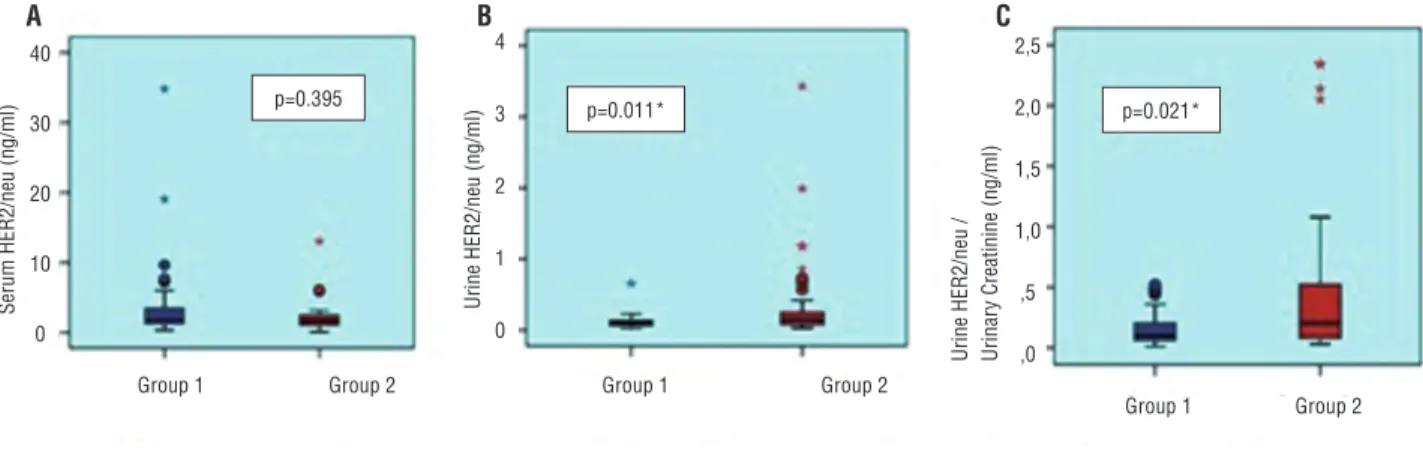
Between both groups, there was no signi-ficant difference in their serum HER2/neu levels (p=0.395) (Figure-1A). The urinary HER2/neu le-vels and the ratio of the urinary HER2/neu to cre-atinine were significantly higher in patients with bladder cancer (p=0.011, p=0.021, respectively) (Figures 1B and 1C) (Table-2).
The serum HER2/neu level, urinary HER2/ neu level, and urine HER2/neu/urinary creatinine ratio according to smoking status were evaluated. Nevertheless, similar levels were observed both for smokers and non-smokers (p=0.306, p=0.732, p=0.535, respectively). The urinary HER2/neu
le-Table 1 - Characteristics of the patients with bladder cancer.
Median Range Mean±SD
Follow-up duration (month) 11 9-17 11.6±2.5
Size of tumor(mm) 30 7-80 35.0±17.7
Number of tumor 2 1-10 2.4±2.0
n %
Tumor stage Ta 13 29.5
T1 31 70.5
Grade Low grade 25 56.8
High grade 19 43.2
CIS Present 38 86.4
Not present 6 13.6
NMP 22 Negative 22 50.0
Positive 22 50.0
Cytology Benign 24 54.5
Malignant 20 44.5
Recurrence No 28 63.7
Yes 16 36.3
Progression No 41 93.2
vels, urinary HER2/neu/creatinine ratio, and se-rum HER2/neu levels did not show any significant difference between Ta and T1 (p=0.877, p=0.857, p=0.857, respectively). Although no significant di-fference was observed between high-and low-grade cancer in the urinary and serum HER2/neu levels (p=0.162, p=0.297, respectively), high-grade cancer was found to have a significantly higher urinary HER2/neu/urinary creatinine ratio compared with low-grade cancer (p=0.035). The urinary and se-rum HER2/neu levels and urinary HER2/neu/urinary creatinine ratio were found to be similar in patients with tumor recurrence and progression and in pa-tients who did not have recurrence and progres-sion. Although there was no relationship between the cytology results and the HER2/neu levels in patients with bladder cancer, those with positive NMP22 were found to have a significantly hi-gher urinary HER2/neu/urinary creatinine ratio (0.55±0.63, 0.35±0.61, p=0.038) and significantly lower serum HER2/neu levels (10.05±24.95ng/mL, 1.63±1.25ng/mL, p=0.015) (Table-3).
The HER2/neu levels were not correlated with age, BMI, and the size and number of tumors (Table-4).
Using the cut-off value of 0.4ng/mL for urinary HER2/neu, the sensitivity of the test was found to be 20.5%, and the specificity was 97.5%. Using the cut-off value of 0.4ng/mL for the urinary HER2/neu/urinary creatinine ratio, the sensitivity and specificity of the test were found to be 31.8% and 87.5%, respectively. The positive predictive values were calculated to be 90% and 73.7%, respectively, for the urinary HER2/neu level and urinary HER2/neu/urinary creatinine ratio (Figure-2).
DISCUSSION
Studies of tumor markers for the diagno-sis and follow-up of patients with bladder can-cer have been ongoing for years. The ideal tumor marker is expected to be easy to administer and interpret, to be cost-effective, and to have high Figure 1 - Comparison of patients and controls: a) Serum HER2/ner; b) Urine HER2/neu levels and c) Urine HER2/neu/Urinary creatinine ratio.
A B C
Table 2 - Comparison of HER2/neu protein levels of patients and controls.
Control group (n=40) Bladder cancer group (n=44) p Mean±SD Range Mean±SD Range
Urine Her2/neu (ng/mL) 0.12±0.10 0.0-0.7 0.35±0.61 0.0-3.4 0.011
Urine Her2/neu / Urine creatinine (ng/mg) 0.16±0.15 0.0-0.5 0.45±0.62 0.0-2.4 0.021 Serum Her2/neu (ng/mL) 3.87±6.08 0.3-34.8 5.84±17.97 0.1-106 0.395
Mann-Whitney U test
Group 1 Group 1
Serum HER2/neu (ng/ml)
Urine HER2/neu / Urinar
y Creatinine (ng/ml)
Group 1 p=0.021*
p=0.395 p=0.011*
Group 2
2,5
2,0
1,5
1,0
,5
,0 4
3
2
1
0 40
30
20
10
0
Group 2
Group 2
Table 3 - Comparison of HER2/neu levels according to the groups with bladder cancer.
Urine HER2/ neu (ng/mL)
Urine HER2/neu/ urine Creatinine
(ng/mg)
Serum HER2/ neu (ng/mL)
Mean ± SD p Mean ± SD p Mean ± SD p
Smoking smokers 0.19±0.27 0.732 0.34±0.46 0.535 2.95±2.45 0.306
Non-smokers 0.26±0.51 0.31±0.49 5.51±15.53
Tumor stage Ta 0.33±0.53 0.877 0.44±0.61 0.857 9.52±28.98 0.857
T1 0.36±0.65 0.46±0.64 4.30±10.88
Grade Low 0.27±0.43 0.162 0.31±0.49 0.035 8.25±23.63 0.297
High 0.46±0.78 0.64±0.74 2.67±2.81
NMP22 Negative 0.26±0.44 0.160 0.35±0.63 0.038 10.05±24.95 0.015
Positive 0.45±0.74 0.55±0.61 1.63±1.25
Cytology Benign 0.26±0.41 0.579 0.39±0.60 0.333 8.69±0.60 0.651
Malignant 0.47±0.78 0.53±0.65 2.43±0.65
Recurrence No 0.34±0.66 0.634 0.39±0.57 0.420 7.85±22.32 0.575
Yes 0.38±0.53 0.57±0.71 2.33±2.91
Progression No 0.37±0.63 0.596 0.47±0.64 0.895 5.86±18.57 0.969
Yes 0.17±0.03 0.24±0.16 5.55±6.51
Kruskal-Wallis/Mann-Whitney U test
Table 4 - Correlation of HER2/neu levels to age, BMI and the size and number of tumors.
Age (year) BMI (kg/m2) Size of Tumor
(mm)
Number of Tumor
Urine HER2/neu r -0.014 -0.022 0.277 -0.057
p 0.897 0.843 0.068 0.711
Urinary HER2/neu/ Urinary Creatinine r 0.178 0.122 0.108 -0.070 p 0.105 0.269 0.483 0.649
Serum HER2/neu r -0.073 -0.102 -0.056 0.172
p 0.512 0.363 0.722 0.277
Spearman’s rank correlation
specificity to avoid false positive results and high sensitivity to avoid undetected tumors (16). Ho-wever, to date, no alternative tumor marker has been discovered for the diagnosis and follow-up of bladder cancer that can replace cystoscopy and cytology. In this study, although the serum HER2/ neu levels of the patients with NMIBC were noted to be similar to those of the control group, the urinary HER2/neu levels and urinary HER2/neu
HER2/neu levels between the cancer patients and the control group. However, they did not perform a subgroup analysis, which involved only patients with muscle invasive bladder cancer (13).
In the present study, the ELISA method was preferred for measuring the HER2/neu levels. In addition to ELISA, the FISH, IHA and PCR me-thods can be utilized to determine the HER2/neu level. There is no precise information regarding the superiority of any of these methods. Where-as FISH and IHA methods meWhere-asure the HER2/neu level in tumor tissue, ELISA is capable of mea-suring the HER2/neu level in body fluids. There are no available data concerning ELISA, FISH and IHA, evaluated on the resected tissues from the same neoplastic cases. Several studies have indi-cated over-expression of the HER2/neu protein and gene amplification in bladder cancer. Though over-expression of the HER2/neu protein reaches 81%, gene amplification is found in approximately 60% of the patients with bladder cancer (15). Ecke et al. evaluated the urinary HER2/neu level using
the ELISA method and obtained significantly high values in patients with bladder cancer (12). When Kim et al. applied the ELISA method to analyze the HER2/neu levels in serum and urine samples, they did not observe a significant difference in the serum HER2/neu levels; however, they reported a significant difference in the urinary HER2/neu levels. Moreover, the urinary HER2/neu/urinary creatinine ratio was analyzed in this study, and a significantly higher ratio was obtained in the patients with bladder cancer (13).
Although there was no correlation betwe-en the urinary and serum HER2/neu levels and the stage and grade of tumors, the HER2/neu/urinary creatinine ratio was observed to be significantly higher in patients with high-grade tumor. Althou-gh Lönn et al. reported a correlation between the HER2/neu levels and NMIBC, Kim et al. did not find any relationship between HER2/neu levels and tumor grade (13, 17). In the present study, no correlation was observed between HER2/neu le-vels and the recurrence and progression of tumor. Skagias et al. used the IHC method to analyze the pathologies of 80 patients diagnosed with blad-der cancer, and they identified HER2/neu over--expression in 52% of the patients. In the same study, although the HER2/neu expression was found to be correlated with tumor grade, cancer--specific survival, and overall survival, the HER2/ neu expression did not show any correlation with recurrence (16). When Rink et al. examined the tumor cells circulating in the serum samples of the patients scheduled for radical cystectomy, they observed high HER2/neu levels in 23% of the pa-tients and emphasized the correlation between the high HER2/neu levels observed in recurrence and survival (18).
After examining the specimens using the FISH method, Fleischmann et al. reported that HER2/neu positivity was more frequently obser-ved in patients with lymph node metastasis (19). Kim et al. identified the correlation between po-sitive cytology and high urinary HER2/neu level. However, the urinary HER2/neu level was corre-lated with the cytological findings in the current study, and the urinary HER2/neu/urinary creati-nine ratio was found to be significantly higher in NMP22 positive patients. Similarly, this study did Figure 2 - ROC curve for urinary HER2/neu level urinary
HER2/neu/creatinine ratio.
1 - Specificity
Urinary HER2/neu
Urinary HER2/neu/Urinary Creatinine Referece line
Sensitivity
1,0
0,8
0,6
0,4
0,2
0,0
not find any correlation between the HER2/neu levels and the size and number of tumors, and the age and BMI of the patients (13).
The number of smokers was higher in the group of patients with bladder cancer com-pared with the control group. Although smoking is known to increase the risk of bladder cancer by 3-fold, no relationship was detected between smoking and the HER2/neu levels in this study. Additionally, no HER2/neu mutation was observed in the study of Li et al., who genetically examined a patient group comprising 230 smokers (20).
In two different studies analyzing the uri-nary HER2/neu levels as potential tumor markers, the sensitivity of the test varied between 71.1% and 88.9%, whereas the specificity varied between 62.5% and 84% (12, 13). Compared with other re-levant studies, the sensitivity of the urinary HER2/ neu level was lower and the specificity was higher in the present study. In addition to the serum and urinary HER2/neu levels, the urinary HER2/neu urinary creatinine ratio was analyzed in this stu-dy, the findings were considered to be similar to the results relative to the urinary HER2/neu level, which may be attributable to the use of different kits for the tests. There is neither a specified and commonly accepted predictive value for urinary HER2/neu nor an accepted technique for measu-ring the HER2/neu level. Cytology, a tumor ma-rker with high specificity, has been used for years. Although its specificity exceeds 90%, particular-ly in patients with high-grade bladder tumor, its sensitivity reaches 60% (16). Because of the high specificity, guidelines recommend that cytology be used along with cystoscopy, especially in the follow-up of high-risk patients. Although the spe-cificity of urinary HER2/neu was observed to be 97.5% in both high and low-grade cancer patients in the present study, considerably low sensitivity was obtained in the HER2/neu tests. Because the specificity of urinary HER2/neu level is high and not dependent on the tumor grade, urinary HER2/ neu may be a new alternative to cytology.
Excluding the studies conducted in search of tumor markers, there are several studies that evaluate the potential therapeutic use of the mo-noclonal antibody trastuzumab and EGFR-HER2 inhibitor lapatinip in bladder cancer (15, 21).
Ho-wever, there is currently insufficient information in the literature regarding the benefit of these agents for the treatment of bladder cancer. Ne-vertheless, measuring the HER2/neu levels before and after treatment may be important, as in breast cancer, when these agents are administered to tre-at bladder cancer. Larger, randomized, controlled trials may shed light on this issue in the near fu-ture.
Several limitations of our study should be noted. These limitations include the following: the small sample size, the inclusion of only non-mus-cle invasive bladder cancer, a single center study, no standard measurement technique of HER2/neu protein and, finally, the short follow-up. The ELI-SA method and commercial kits were employed to determine the HER2/neu levels. There is no stan-dardization on this subject, and the method used to ensure more accurate results should be identi-fied. Enriching the study with immunohistoche-mical tissue examinations and genetic methods, in addition to the ELISA method, might have cla-rified the uncertainty.
CONCLUSIONS
Although the urinary HER2/neu level and the ratio of urinary HER2/neu level to urinary cre-atinine level using the ELISA method were signi-ficantly higher in patients with NMIBC compared with the healthy patient group, the serum HER2/ neu levels were similar in both groups. Although no correlation was observed between the urina-ry HER2/neu level and tumor grade, tumor stage, cytology, and NMP22 results, the urinary HER2/ neu/urinary creatinine ratio was found to be cor-related with the tumor grade and NMP22 positivi-ty. The urinary HER2/neu test was found to have high specificity but low sensitivity for patients with non-muscle invasive bladder cancer. Addi-tional studies are necessary to better understand the clinical importance of HER2/neu protein in patients with bladder cancer.
CONFLICT OF INTEREST
REFERENCES
1. Siegel R, Naishadham D, Jemal A. Cancer statistics, 2012. CA Cancer J Clin. 2012; 62:10-29.
2. Millán-Rodríguez F, Chéchile-Toniolo G, Salvador-Bayarri J, Palou J, Algaba F, Vicente-Rodríguez J. Primary superficial bladder cancer risk groups according to progression, mortality and recurrence. J Urol. 2000; 164:680-4.
3. Kaufman DS, Shipley WU, Feldman AS. Bladder cancer. Lancet. 2009; 374:239-49.
4. Goodison S, Rosser CJ, Urquidi V. Bladder cancer detection and monitoring: assessment of urine- and blood-based marker tests. Mol Diagn Ther. 2013; 17:71-84.
5. Nakamura K, Kasraeian A, Iczkowski KA, Chang M, Pendleton J, Anai S, et al. Utility of serial urinary cytology in the initial evaluation of the patient with microscopic hematuria. BMC Urol. 2009; 9:12.
6. Kumar A, Kumar R, Gupta NP. Comparison of NMP22 BladderChek test and urine cytology for the detection of recurrent bladder cancer. Jpn J Clin Oncol. 2006; 36:172-5. 7. Andersen TI, Paus E, Nesland JM, McKenzie SJ, Børresen
AL. Detection of c-erbB-2 related protein in sera from breast cancer patients. Relationship to ERBB2 gene amplification and c-erbB-2 protein overexpression in tumour. Acta Oncol. 1995; 34:499-504.
8. Osaki T, Mitsudomi T, Oyama T, Nakanishi R, Yasumoto K. Serum level and tissue expression of c-erbB-2 protein in lung adenocarcinoma. Chest. 1995; 108:157-62.
9. Tsigris C, Karayiannakis AJ, Zbar A, Syrigos KN, Baibas N, Diamantis T, et al. Clinical significance of serum and urinary c-erbB-2 levels in colorectal cancer. Cancer Lett. 2002; 184:215-22.
10. Kono K, Naganuma H, Sekikawa T, Amemiya H, Takahashi A, Iizuka H, et al. Serum level of HER-2/neu in patients with gastric cancer: correlation with HER-2/neu overexpression in gastric carcinoma tissue. Tumour Biol. 2000; 21:139-44. 11. Jalali Nadoushan MR, Taheri T, Jouian N, Zaeri F.
Overexpression of HER-2/neu oncogene and transitional cell carcinoma of bladder. Urol J. 2007; 4:151-4.
12. Ecke TH, Schlechte HH, Schulze G, Lenk SV, Loening SA. Four tumour markers for urinary bladder cancer--tissue polypeptide antigen (TPA), HER-2/neu (ERB B2), urokinase-type plasminogen activator receptor (uPAR) and TP53 mutation. Anticancer Res. 2005; 25:635-41.
13. Kim TS, Rhew HY, Hwang HY. Pilot study of the clinical significance of sérum and urinary her-2/neu protein in bladder cancer patients. Korean J Urol. 2011; 52:815-8.
14. Pinches MD, Betts CJ, Bickerton SJ, Beattie L, Burdett LD, Thomas HT, et al. Evaluation of novel urinary renal biomarkers: biological variation and reference change values. Toxicol Pathol. 2012; 40:541-9.
15. Hussain MH, MacVicar GR, Petrylak DP, Dunn RL, Vaishampayan U, Lara PN Jr, et al. Trastuzumab, paclitaxel, carboplatin, and gemcitabine in advanced human epidermal growth factor receptor-2/neu-positive urothelial carcinoma: results of a multicenter phase II National Cancer Institute trial. J Clin Oncol. 2007; 25:2218-24. Erratum in: J Clin Oncol. 2008; 26: 3295.
16. Babjuk M, Burger M, Zigeuner R, Shariat SF, van Rhijn BW, Compérat E, et. al EAU guidelines on non-muscle-invasive urothelial carcinoma of the bladder: update 2013. Eur Urol. 2013; 64:639-53.
17. Lönn U, Lönn S, Friberg S, Nilsson B, Silfverswärd C, Stenkvist B. Prognostic value of amplification of c-erb-B2 in bladder carcinoma. Clin Cancer Res. 1995; 1:1189-94. 18. Rink M, Chun FK, Dahlem R, Soave A, Minner S, Hansen
J, et al. Prognostic role and HER2 expression of circulating tumor cells in peripheral blood of patients prior to radical cystectomy: a prospective study. Eur Urol. 2012; 61:810-7. 19. Fleischmann A, Rotzer D, Seiler R, Studer UE, Thalmann GN.
Her2 amplification is significantly more frequent in lymph node metastases from urothelial bladder cancer than in the primary tumours. Eur Urol. 2011; 60:350-7.
20. Li H, Pan Y, Li Y, Li C, Wang R, Hu H, et al. Frequency of well-identified oncogenic driver mutations in lung adenocarcinoma of smokers varies with histological subtypes and graduated smoking dose. Lung Cancer. 2013; 79:8-13.
21. Wülfing C, Machiels JP, Richel DJ, Grimm MO, Treiber U, De Groot MR, et al. A single-arm, multicenter, open-label phase 2 study of lapatinib as the second-line treatment of patients with locally advanced or metastatic transitional cell carcinoma. Cancer. 2009; 115:2881-90.
_______________________ Correspondence address: Asif Yildirim, MD Department of Urology,