Small Intestinal Submucosa for Patch Grafting after Plaque
Incision in the Treatment of Peyronie’s Disease
Eugene W. Lee, Alan W. Shindel, Steven B. Brandes
Department of Surgery, Division of Urology, Washington University School of Medicine, St. Louis,
Missouri, USA
ABSTRACT
Objective: Report the results using porcine small intestinal submucosa (SIS) as a graft material in the surgical management of Peyronie’s disease (PD).
Materials and Methods: We performed a retrospective chart review of men with PD who underwent surgical correction of the curvature by plaque “H” incision and patch grafting with 4-ply SIS (Cook, Bloomington, IN) by a single surgeon at our institution. Degree and direction of curvature, sexual function, and co-morbidities were assessed pre- and postop-eratively.
Results: Thirteen patients were identiied. Mean age was 57 � �� range ���7� �ears. Median �����w��p was �� ��nths �� range ���7� �ears. Median �����w��p was �� ��nths,
range 3��9 ��nths. At presentati�n� a�� rep�rted peni�e c�rvat�re. A�s� rep�rted were di�ic��t� with vagina� penetrati�n (deter�ined b� q�esti�n n��ber � �� the sex�a� enc��nter pr�i�e q�esti�nnaire – SEP�)�
pa�pab�e p�aq�e� h��rg�ass de��r�it�� di�ic��t� with ir�ness� and di�ic��t� with s�staining erecti�n (deter�ined b� SEP3) in77%� 69%� 77%� 6�%� and �6% �� patients� respective��. Mean and �edian degrees �� c�rvat�re �� the pri�ar� de��r�it� were 7� and 67.5 degrees� respective��. Three patients had sec�ndar� c�rves �� �ess than 3� degrees in a di��erent directi�n. Mean and �edian p�aq�e size were 3.5 and �.7 c�2, respectively. Seven patients had one graft and six patients
had tw� gra�ts p�aced with a �ean size �� �5 � � c�� � c�� c�2.
Conclusions: For the patient with PD, SIS grafting can achieve a functionally straight erection with durable results yet with relatively high rates of erectile dysfunction. SIS is a viable graft material for use in the surgical treatment of PD.
Key words: penis; Peyronie’s disease; surgery; graft; small intestinal submucosa
Int Braz J Urol. 2008; 34: 191-7
INTRODUCTION
Peyronie’s disease (PD) is a condition of plaque formation in the tunica albuginea of the cor-pora cavernosa with resultant curvature of the penis (�). The disease has tw� phases; an ear�� ac�te phase associated with painful erections and progression of
injections and various forms of energy have been ap-plied for the treatment of PD (2). Few medical therapies have been proven effective in large scale trials. Surgical correction is the treatment of choice when the deformity precludes intercourse, but should not be considered until the disease has reached its stable, chronic phase.
Surgical options for the management of PD can be divided into 3 types: procedures that shorten the convex, uninvolved side of the tunica albuginea, procedures that lengthen the concave, diseased side, and i�p�antati�n �� a peni�e pr�sthesis (3). E��ip -soid resection and closure of the tunica albuginea �n the hea�th� c�nvex side� as irst described b� Nesbit, was the previous standard for surgical care (4). Subsequently, successful variations including a Heineke�Mik��icz pr�ced�re and ���tip�e para��e� p�icati�ns have been rep�rted (5�6). These pr�ced�res are limited by a shorter postoperative penile length that precludes their use in patients with large plaques, severe deformities, or small penises (3). For these pa-tients, superior results may be obtained using tunical lengthening procedures where incision or excision of the tunical plaque is followed by interposition of a graft material to bridge the resulting defect in the t�nica. P�aq�e incisi�n �ti�izing a�t���g��s �ateria�s such as saphenous vein as patch grafts for the incised defect has been reported to result in high rates of patient satis�acti�n (7��). Drawbacks t� a�t���g��s grafting are the increased morbidity of a secondary tissue harvest site and increased OR time required for tissue procurement and preparation.
Non-autologous “off the shelf” biomaterials are an attractive alternative to autologous tissue for patch grafting (3). At our institution we favor porcine small intestinal submucosa (Stratasis, Cook Urologi-cal, Spencer, IN), a xenographic biomaterial retaining matrix elements that support host cell migration and differentiation. There have been some preliminary reports describing the use of SIS in Peyronie’s disease repair (9���). We present ��r instit�ti�n’s experience with SIS gra�ts in �3 patients.
MATERIALS AND METHODS
Institutional review board approval was obtained for a retrospective chart review of men
who underwent surgical correction of Peyronie’s disease with plaque incision and patch grafting with 4-ply porcine small intestinal submucosa (Stratasis, Cook Urological, Spencer, IN) at our institution by a sing�e s�rge�n between March �999 and A�g�st ���6.
Thirteen patients were identiied. S�bjective di�ic��t� with vagina� penetrati�n� ir�ness� and s�s -taining erection as well as age, erectile dysfunction, use of pro-erectile medications, presence of palpable plaque, plaque location, hourglass deformity, fore-shortened penis, degree and direction of curvature, laccid and stretched peni�e �ength� and c���rbidities ( hypertension, diabetes mellitus, Dupuytren’s contrac-ture, plantar fasciitis, lower urinary tract symptoms) were included in the preoperative analysis. Sexual ��ncti�n was deter�ined b� SEP�.
Technique - The plaque incision and grafting procedure was carried out as detailed in prior reports (9). Briel�� s�bc�r�na� deg��ving incisi�n was �sed with subsequent degloving of the penis down to dar-tos fascia to expose the anterior lamella of Buck’s �ascia. The area �� �axi�a� c�rvat�re was identiied via artiicia� erecti�n (Penr�se t��rniq�et p�ace�ent at the base of the penis and continuous corporal in-��si�n �� steri�e sa�ine). The circ��lex veins were s�t�re �igated �r ca�terized �sing bip��ar c�rrent. I� the plaque was dorsally located, the neurovascular b�nd�e �n the d�rsa� s�r�ace was ��bi�ized �nder ���pe �agniicati�n d�wn t� the pen�scr�ta� j�ncti�n. A relaxing incision was made in the plaque at the point of maximum curvature in the shape of the letter “H”. A gra�t �� � �a�ers SIS that was �versized t� be ���% �� the size �� the de�ect was h�drated in n�r�a� sa�ine and sewn in �sing 5�� PDS r�nning s�t�res. Assess -ment of curvature was repeated. Persistent curvature was managed by a second H-incision and SIS graft or b� peni�e p�icati�n (b� the �6�d�t techniq�e �� L�e) (6). The dart�s was c��sed with a 3�� vicr�� s�t�re and the skin with 3�� chr��ic �����wed b� a c��pressive Coban dressing for 48 hours.
RESULTS
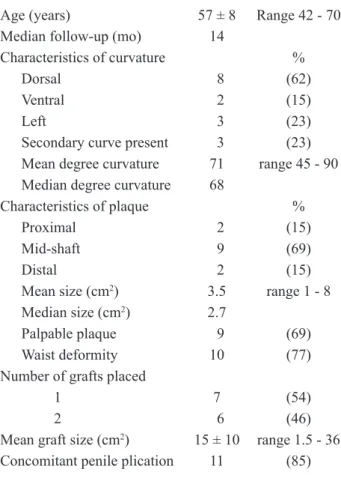
Patient de��graphics are sh�wn in Tab�e��. Mean age was 57 � � �ears (range = ���7� �ears). The �edian �ength �� �����w��p was �� ��nths (range 3� 89 months). Table-2 lists presenting symptoms and sex�a� ��ncti�n. Ten patients (77%) presented with di�ic��t� invagina� penetrati�n (as deter�ined b� the sex�a� enc��nter pr�i�e q�esti�n � [SEP�])� � patients (6�%) had di�ic��t� �aintaining ir�ness� and 6 patients (�6%) had di�ic��t� s�staining erec -ti�n (as deter�ined b� the sex�a� enc��nter pr�i�e q�esti�n 3 [SEP3]). Pre��perative��� 5 patients (3�%) were p�tent� 7 patients (5�%) were p�tent with ph�s -ph�diesterase�5 inhibit�rs� and � (�%) was i�p�tent� as deter�ined b� SEP � and 3.
The p�aq�e was pa�pab�e in 9 patients (69%)� and �� patients (77%) had h��rg�ass de��r�it�. Peni�e c�rvat�re was d�rsa� in � patients (6�%)� ventra� in �
patients (�5%)� and t�ward the �e�t in 3 patients (�3%). Three patients (�3%) had sec�ndar� c�rves �� �ess than 3� degrees in a di��erent directi�n. The degree �� pri�ar� c�rvat�re ranged �r�� �5 t� 9� degrees� with �ean �� 7� and �edian �� 6�. Nine p�aq�es (69%) were ��cated in the �id�sha�t� with � (�5%) in the pr�xi�a� and � (�5%) in the dista� p�rti�n �� the pha���s. Mean and �edian p�aq�e size were 3.5 and �.7 c�2� (range = � � �) respective��.
At �perati�n� 7 (5�%) patients had �ne gra�t and 6 (�6%) patients had � gra�ts p�aced. Mean size �� gra�t was �5 � �� c�2 (range = �.5 � 36). E�even
patients (�5%) req�ired c�nc��itant peni�e p�icati�n for residual curvature.
Postoperative results are listed in Table-3. As determined by combined stimulation test
(intracaver-Table 1 – Patient demographics.
Age (years) 57 � � Range �� � 7�
Median �����w��p (��) ��
Characteristics of curvature %
Dorsal �8 (6�)
Ventral �2 (�5)
Le�t �3 (23)
Secondary curve present �3 (23)
Mean degree c�rvat�re 7� range �5 � 9� Median degree c�rvat�re 6�
Characteristics of plaque %
Proximal �2 (�5)
Mid�sha�t �9 (69)
Distal �2 (�5)
Mean size (c�2) 3.5 range � � �
Median size (c�2) �.7
Palpable plaque �9 (69)
Waist deformity �� (77)
Number of grafts placed
� 7 (5�)
2 �6 (�6)
Mean gra�t size (c�2) �5 � �� range �.5 � 36
Concomitant penile plication �� (�5)
Table 2 – Presenting symptoms.
Di�ic��t� with vagina� penetrati�n �� (77%) Di�ic��t� �aintaining ir�ness � � (6�%) Di�ic��t� s�staining erecti�n � 6 (�6%) P�tenc� (SEP �/3)
With��t ED �edicati�n � 5 (3�%) With ED �edicati�ns � 7 (5�%)
Not potent � � (�%)�
ED = erectile dysfunction; SEP = sexual encounter proile
questionnaire.
Table 3 – Postoperative data.
Residual bend
None 7 (5�%)
Residual bend present 6 (�6%)
5 degree 3 (�3%)
�� degree � (�%)�
�5 degree � (�5%)
P�tenc� (SEP �/3)
With��t ED �edicati�n � (3�%) With ED �edicati�ns � (�5%)
Not potent 7 (5�%)
Waist deformity � (�5%)
Recurrent plaque � (3�%)
ED = erectile dysfunction; SEP = sexual encounter proile
n�sa� injecti�n �� a�pr�stadi�)� seven patients (5�%) had a c��p�ete�� straight pha���s and six (�6%) had resid�a� bends �� �ess than �5 degrees (three 5 degree� �ne �� degree� tw� �5 degree). At �����w��p� � pa -tients (3�%) were p�tent� � pa-tients (�5%) were p�tent �n �edicati�n� and 7 patients (5�%) were i�p�tent (as deter�ined b� SEP � and 3). Tw� patients (�5%) had hourglass deformity and there was recurrent plaque in � patients (3�%).
COMMENTS
Plaque incision and grafting is the procedure of choice for the treatment of severe Peyronie’s dis-ease. This precludes intercourse when patients have large plaques, severe curvature, or a short phallus, which makes the loss of penile length with plication procedures unacceptable. Autologous grafts such as saphenous vein have been used as patch grafts with satisfactory results. However, non-autologous grafts have the advantage of not requiring a second harvest site, decreasing operative time and patient morbidity as well as preserving graft material, such as saphenous vein, should the patient require coronary artery bypass surgery in the future.
SIS is an extrace����ar �atrix that is �� t� ��� µm thick and composed of mainly Type I collagen. The matrix retains angiogenic and other growth fac-t�rs even a�ter pr�cessing� and ind�ces a rapid ini� -trati�n �� native ce��s and ne�vasc��arizati�n� acting as a scaffold for cell differentiation and maturation (�3). A st�d� �sing SIS in the �ascia �ata �� d�gs de��nstrated that as ear�� as 6 weeks a�ter gra�ting� the SIS is completely replaced with a well vascular-ized c�nnective tiss�e� a we�� �rganvascular-ized c���agen �ra�ew�rk and iber �rientati�n identica� t� that �� the �rigina� tiss�e (��). F�rther��re� SIS gra�ting �� the t�nica a�b�ginea in rabbits has sh�wn n� signiicant inla��at�r� resp�nse� c�rp�rea� ibr�sis� �r ��ss �� cavern��s s���th ��sc�e c�ntent (�5).
Kn��� irst described the s�ccess��� �se �� SIS ��r the c�rrecti�n �� Pe�r�nie’s disease in �� patients� with good functional results and no complications �r patient c��p�aints at �� ��nths �ean �����w��p except for one recurrence requiring reoperation (9). All patients achieved potency both preoperatively
and postoperatively, with one requiring intracavernous injecti�n therap�. In a �ater rep�rt at �� ��nths �ean �����w��p with 97 patients� Kn��� described �n�� 6% with residual curvature of less than ten degrees and ��% �� patients retaining the sa�e degree �� p�tenc� as preoperative with no penile shortening, pain, infec-ti�n� he�at��a� �r b��ging �� gra�t site (�6).
In ��r series �� �3 patients� a�� de��r�ities were straightened either completely or with minimal residual curvature. Our results are similar to Knoll, being durable with no recurrent Peyronie’s disease a�ter �� ��nths �edian �����w��p� a�th��gh � pa -tients (3�%) had rec�rrent p�aq�e and � (�5%) had residual hourglass deformity. No patients experienced infection, bulging, or immunologic reaction at the graft site. One patient had a hematoma at the surgical site that res��ved sp�ntane��s�� with��t signiicant sequelae.
John et al. published a case report series of 4 patients with less encouraging results, with 3 of their � patients s���ering rec�rrent c�rvat�re; h�wever� the gra�ts �sed were �versized b� �n�� ��% rather than ��% (��). The sing�e n�n�rec�rrence was �n�� �� degrees� with the �thers being �5� ��� and 9� degrees� s�ggesting that the ��% �versizing �a� n�t have been s��icient t� c��pensate ��r gra�t c�ntract�re in the more severe bends. Additionally, one recurrent bend had been previ��s�� straightened with p���tetral�� -r�eth��ene �esh and an�ther was gra�ted with ��p�� rather than ��p�� SIS� �aking it di�ic��t t� draw comparisons with our series.
Breyer et al. also reported a much higher rec�rrence (37%) and c��p�icati�n rate (37%) �sing SIS gra�ting in �9 PD patients a�ter �5 ��nths �ean �����w��p (��). Their st�d� �sed ��p�� rather than �� ply SIS, which may explain their higher recurrence rate, as compared with our and Knoll’s series (9) (both using 4-ply SIS). Also, many of Breyer’s com-p�icati�ns were �in�r� inc��ding he�at��a (�6%) and in�ecti�n (5%). F�rther��re� a�th��gh 37% had recurrent curvature, only one required subsequent p�icati�n (5%). We �ee� that ��p�� SIS is t�� thin and contracts more, and thus only 4-ply should be used for PD grafting. Further study is clearly needed.
series (��). The� rep�rted better �aintenance �� preoperative length and rigidity in patients with SIS versus dermal or pericardial grafts as well as sig-niicant i�pr�ve�ents in ED as deter�ined b� the Sex�a� Hea�th Invent�r� ��r Men (SHIM) sc�re (�7 p�st�perative vs. ��.� pre�perative). This is c��pa
-rab�e with Kn���� wh� rep�rted ��% �aintenance ��
potency, as well as Breyer, who reported no increase
in ED as deter�ined b� the SHIM score.
In contrast, patients in our series had a rela-tively high rate of postoperative erectile dysfunction as deter�ined b� SEP � and 3. One patient was i� -potent preoperatively but a penile implant was not a c�vered beneit �� his ins�rance� and he �nderwent grafting in order to straighten his penis in order to have intercourse with a vacuum device. Seven patients (5�%) �rigina��� p�tent with �ra� ph�ph�diesterase�5 inhibit�rs s���ered �r�� ED p�st��perative��. P�ssib�e exp�anati�ns ��r p�st�perative ED rates higher than pri�r rep�rts �n gra�ting are: the �arge size �� gra�ts and n��ber �� gra�ts needed t� c�rrect severe (6��9� degree) curvatures, ventral position of plaque, our surgical technique, and the graft itself (not precluding venous leak). Preoperatively, one of the patients had a ventral plaque, which has been shown to have the greatest �ike�ih��d �� p�st�perative ven��s �eak (�7). The �ther 6 patients had c�rvat�res �� > 6� degrees� with ���r having 9� degree bends. Additi�na���� ive of the patients required 2 grafts to repair the defect. Importantly, the use of various instruments (e.g, In-ternati�na� Index �� Erecti�e F�ncti�n� SHIM sc�re� SEP �/3) a��ng series t� he�p assess ED �a� a�s� c�ntrib�te t� di��erences in rep�rted ED rates� as these instr��ents were n�t designed speciica��� ��r PD patients.
O�r indings with respect t� p�st�perative ED are si�i�ar t� th�se �� Le�ngwattanakij et a�. wh� �sed processed cadaveric pericardium instead of SIS. Five ��t �� � patients rep�rted di�ic��t� with erecti�ns d�e t� ven��s �eakage at 3� ��nths �ean �����w��p (��). The authors postulated that patients with large plaque size� ventra� p�aq�e� and severe c�rvat�res (> 6�) may be more likely to have postoperative cavernosal ins��icienc� �eading t� ED.
In our study, concomitant penile plication was per��r�ed in �� �� �3 cases. In �rder t� prevent the need for plication in addition to the incision and
gra�ting pr�ced�re� we have since ��diied ��r s�r -gica� techniq�e. The SIS gra�t is �versized b� �3�% instead �� ���%� and the H incisi�n is br�ader and �arger. M�re�ver� we have started t� excise a s�a��� linear segment of the plaque before placement of the graft, a technique that other authors have found to negate the need ��r a sec�ndar� p�icati�n (�9).
Weaknesses of our study include a retro-spective design� s�a�� sa�p�e size� and the �se �� subjective assessments of satisfaction and erectile function. Future studies on graft materials for the s�rgica� c�rrecti�n �� PD sh���d �ti�ize �bjective �eans �� characterizing peni�e b���d l�w� s�ch as power Doppler ultrasonography of the penis, and objective measures of rigidity and tumescence, such as Rigiscan® nocturnal penile tumescence.
CONCLUSIONS
The results of our experience using SIS in the repair �� Pe�r�nie’s disease de��nstrate its e�i -cacy in achieving a functional, straight erection with durable results. The advantages of SIS include ease of use and favorable biochemical characteristics as well as ready availability and lack of need for native tissue harvest with its attendant morbidity. Our study showed a relatively higher rate of venous leak erectile dysfunction than previously described, particularly in men with greater penile curvature at baseline. Larger st�dies investigating the tr�e rates �� erecti�e dysfunction using SIS as well as comparisons with other materials are warranted.
CONFLICT OF INTEREST
Dr. Steven B. Brandes is �r�� Pizer Speak -er’s Bureau and is also a consultant and speaker for A�erican Medica� S�ste�s.
REFERENCES
�. Ra�ph DJ� Minhas S: The �anage�ent �� Pe�r�nie’s disease. BJU Int. ����; 93: �����5.
3. Kendirci M� He��str�� WJ: Critica� ana��sis �� s�rger� ��r Pe�r�nie’s disease. C�rr Opin Ur��. ����; ��: 3���
8.
�. Nesbit RM: C�ngenita� c�rvat�re �� the pha���s: rep�rt
of three cases with description of corrective operation.
J Ur��. �965; 93: �3���.
5. Yachia D: Re: C�rp�rea� p�icati�n ��r s�rgica� c�rrec
-ti�n �� Pe�r�nie’s disease. J Ur��. �993; ��9: �69. 6. Gh��a�i SS� L�e TF: C�rrecti�n �� peni�e c�rvat�re
�sing the �6�d�t p�icati�n techniq�e: a review �� �3� patients. J Ur��. ����; �67: ��66�9.
7. L�e TF� E��Sakka AI: Ven��s patch gra�t ��r Pe�r�nie’s disease. Part I: techniq�e. J Ur��. �99�; �6�: ���7�9. �. M�nt�rsi F� Sa��nia A� Maga T� B�a L� G�azz�ni G� Barbieri L� et a�.: Evidence based assess�ent �� ��ng�
term results of plaque incision and vein grafting for
Pe�r�nie’s disease. J Ur��. ����; �63: �7����. 9. Kn��� LD: Use �� p�rcine s�a�� intestina� s�b��c�sa�
graft in the surgical management of Peyronie’s disease.
Ur���g�. ����; 57: 753�7.
��. J�hn T� Bandi G� Sant�cci R: P�rcine s�a�� intestina�
submucosa is not an ideal graft material for Peyronie’s
disease s�rger�. J Ur��. ���6; �76: ���5��; disc�ssi�n ���9.
��. Bre�er BN� Brant WO� Garcia MM� Be��a AJ� L�e TF:
Complications of porcine small intestine submucosa
gra�t ��r Pe�r�nie’s disease. J Ur��. ���7; �77: 5�9� 9�.
��. K�vac JR� Br�ck GB: S�rgica� ��tc��es and patient
satisfaction after dermal, pericardial, and small intes-tinal submucosal grafting for Peyronie’s disease. J Sex
Med. ���7; �: �5����.
�3. V��tik�Harbin SL� Bright�an AO� Kraine MR� Waisner B� Bad��ak SF: Identiicati�n �� extractab�e
growth factors from small intestinal submucosa. J Cell
Bi�che�. �997; 67: �7��9�.
��. Dejardin LM� Arn�czk� SP� C�arke RB: Use �� s�a��
intestinal submucosal implants for regeneration of large fascial defects: an experimental study in dogs. J
Bi��ed Mater Res. �999; �6: ��3���.
�5. M�nga M� C�sgr�ve D� Z�pkas P� Jain A� Kas�an A�
Wilkes N, et al.: Small intestinal submucosa as a tunica
a�b�ginea gra�t �ateria�. J Ur��. ����; �6�: ���5���. �6. Kn��� LD: Use �� s�a�� intestina� s�b��c�sa gra�t ��r
the surgical management of Peyronie’s disease. J Urol.
���7; �7�: ��7���; disc�ssi�n ��7�.
�7. Kendirci M� N�w�ar S� G�r S� Jabren GW� Sikka SC�
Hellstrom WJ: The relationship between the type of penile abnormality and penile vascular status in
patients with pe�r�nie’s disease. J Ur��. ���5; �7�: 63��5; disc�ssi�n 635.
��. Le�ngwattanakij S� Biva�acq�a TJ� Redd� S� He��str�� WJ: L�ng�ter� �����w��p �n �se �� pericardia� gra�t
in the surgical management of Peyronie’s disease. Int
J I�p�t Res. ����; �3: ��3�6.
�9. Pers�na� c����nicati�n� Dr. Gera�d H J�rdan� Direc
-t�r� Devine Center ��r Genit��rinar� Rec�nstr�cti�n�
Norfolk, Virginia (USA).
Accepted after revision: January 18, 2008
Correspondence address: Dr. Stephen B. Brandes
Department of Surgery, Division of Urology
Washingt�n Universit� Sch��� �� Medicine �96� Chi�dren’s P�ace
B�x ����� Saint L��is� MO� 63���� USA Fax: + � 3�� 367�5��6
EDITORIAL COMMENT
As authors described in this paper, surgical approaches for the correction of PD can be divided int� three basic categ�ries; t�nica� p�icati�n� p�aq�e excision (incision) and grafting procedures, and pe-nile prosthesis implantation. Regarding to grafting materials, saphenous vein grafts are the most widely used with acceptable outcome in long-term. However, ideal “off the shelf” biomaterial is warranted because harvesting autologous material can cause the pain at donor site and longer operative time. Various off-the-shelf materials including SIS are currently reported (�).
A�th�rs rep�rted �n �3 patients with PD wh� treated with SIS gra�ting. Seven patients (5�%) had a c��p�ete�� straight pha���s and six (�6%) had resid�a� bend �ess than �5 degree a�ter �����nth �����w��p. Although only one patient had erectile dysfunction pre�perative��� 7 patients were i�p�tent p�st�pera -tively. From these results, SIS grafts would allow for satisfactory clinical results despite relatively high rate of erectile dysfunction.
However, long-term outcome of surgery for penile curvature is quite important to evaluate the durability of the procedure and treatment strate-gies. Unfortunately, longer follow-up with adequate number of patient treated with off-the-shelf material are sti�� �acking. Additi�na���� since it is rec�gnized that the majority of men with PD have vascular co-morbidities that contribute to sexual dysfunction (2), surgery is not an exclusive factor that causes postop-erative erectile dysfunction. Better understanding of the natural history of PD and long-term outcome of each surgical procedure are still needed.
REFERENCES
�. Kadi�g�� A� San�i O� Ak�an T� Ersa� A� G�ven S� Ma��ad�v F: Gra�t �ateria�s in Pe�r�nie’s disease s�rger�: a c��prehensive review. J Sex Med. ���7; �: 5���95.
�. Deveci S� Pa�ese M� Parker M� G�hring P� M��ha�� JP: Erecti�e ��ncti�n pr�i�es in �en with Pe�r�nie’s dis
-ease. J Ur��. ���6; �75: ���7���; disc�ssi�n ����.