NPGD
2, 361–398, 2015Earthquake sequencing
K. Vasudevan et al.
Title Page
Abstract Introduction
Conclusions References
Tables Figures
◭ ◮
◭ ◮
Back Close
Full Screen / Esc
Printer-friendly Version Interactive Discussion
Discussion
P
a
per
|
Discussion
P
a
per
|
Discussion
P
a
per
|
Discussion
P
a
per
|
Nonlin. Processes Geophys. Discuss., 2, 361–398, 2015 www.nonlin-processes-geophys-discuss.net/2/361/2015/ doi:10.5194/npgd-2-361-2015
© Author(s) 2015. CC Attribution 3.0 License.
This discussion paper is/has been under review for the journal Nonlinear Processes in Geophysics (NPG). Please refer to the corresponding final paper in NPG if available.
Earthquake sequencing: Chimera states
with Kuramoto model dynamics on
directed graphs
K. Vasudevan, M. Cavers, and A. Ware
Department of Mathematics and Statistics, University of Calgary, Calgary, Alberta T2N 1N4, Canada
Received: 26 January 2015 – Accepted: 1 February 2015 – Published: 20 February 2015
Correspondence to: K. Vasudevan ([email protected])
NPGD
2, 361–398, 2015Earthquake sequencing
K. Vasudevan et al.
Title Page
Abstract Introduction
Conclusions References
Tables Figures
◭ ◮
◭ ◮
Back Close
Full Screen / Esc
Printer-friendly Version Interactive Discussion
Discussion
P
a
per
|
Discussion
P
a
per
|
Discussion
P
a
per
|
Discussion
P
a
per
|
Abstract
Earthquake sequencing studies allow us to investigate empirical relationships among spatio-temporal parameters describing the complexity of earthquake properties. We have recently studied the relevance of Markov chain models to draw information from global earthquake catalogues. In these studies, we considered directed graphs as 5
graph theoretic representations of the Markov chain model, and analyzed their prop-erties. Here, we look at earthquake sequencing itself as a directed graph. In gen-eral, earthquakes are occurrences resulting from significant stress-interactions among faults. As a result, stress-field fluctuations evolve continuously. We propose that they are akin to the dynamics of the collective behaviour of weakly-coupled non-linear os-10
cillators. Since mapping of global stress-field fluctuations in real time at all scales is an impossible task, we consider an earthquake zone as a proxy for a collection of weakly-coupled oscillators, the dynamics of which would be appropriate for the ubiq-uitous Kuramoto model. In the present work, we apply the Kuramoto model to the non-linear dynamics on a directed graph of a sequence of earthquakes. For directed 15
graphs with certain properties, the Kuramoto model yields synchronization, and inclu-sion of non-local effects evokes the occurrence of chimera states or the co-existence of synchronous and asynchronous behaviour of oscillators. In this paper, we show how we build the directed graphs derived from global seismicity data. Then, we present con-ditions under which chimera states could occur and subsequently, point out the role 20
of Kuramoto model in understanding the evolution of synchronous and asynchronous regions.
1 Introduction
Earthquakes of differing magnitudes occur at different locations and depths in many tectonically active regions of the earth. The magnitude is the most widely used and 25
NPGD
2, 361–398, 2015Earthquake sequencing
K. Vasudevan et al.
Title Page
Abstract Introduction
Conclusions References
Tables Figures
◭ ◮
◭ ◮
Back Close
Full Screen / Esc
Printer-friendly Version Interactive Discussion
Discussion
P
a
per
|
Discussion
P
a
per
|
Discussion
P
a
per
|
Discussion
P
a
per
|
and Kanamori, 1979). The moment magnitude scale,MW, provides an estimate for all
medium to large earthquake magnitudes. Continuous recording and analysis of earth-quakes that occur in different regions of the earth has led to earthquake catalogues. These catalogues carry information about the epicenter and the estimated hypocen-ter, the time and the magnitude of the earthquakes, leading to a set of empirical rules 5
for different earthquake regions and the global seismicity (Omori, 1895; Gutenberg and Richter, 1954; Bath, 1965; Bufe and Varnes, 1993; Utsu et al., 1995; Ogata, 2011). The empirical rules allow us to understand and expand on the inter-relationships between the earthquake magnitude and the frequency of occurrence of events, and the main shocks and their aftershocks in space and in time.
10
The earthquake catalogues have recently become the basis for Markov chain models of earthquake sequencing to explore probabilistic forecasting from the point of view of seismic hazard analysis (Nava et al., 2005; Cavers and Vasudevan, 2015). Cavers and Vasudevan (2015) have incorporated the spatio-temporal complexity of the earthquake recurrences (Davidsen et al., 2008; Vasudevan et al., 2010) into their Markov chain 15
model.
Intrinsic to earthquake sequencing studies is the observation made on scaling be-havior and earthquake cycles (Turcotte, 1997; Rundle et al., 2002, 2003). In this regard, fractal and fractal-rate stochastic point processes were found to be useful (Thurner et al., 1997). Telesca et al. (2011) applied such models to earthquake sequencing. 20
Vasudevan and Cavers (2013) have recently extended the application of this model to study time-correlative behavior in earthquake sequencing by carrying out Fano fac-tor and Allan facfac-tor analysis to a time-series of state-to-state transition frequencies of a Markov chain.
One aspect of earthquake sequencing that requires a close look is a model for the 25
NPGD
2, 361–398, 2015Earthquake sequencing
K. Vasudevan et al.
Title Page
Abstract Introduction
Conclusions References
Tables Figures
◭ ◮
◭ ◮
Back Close
Full Screen / Esc
Printer-friendly Version Interactive Discussion
Discussion
P
a
per
|
Discussion
P
a
per
|
Discussion
P
a
per
|
Discussion
P
a
per
|
1995; Rundle et al., 2003; Osorio et al., 2010; Chialvo, 2010). A growing interest in understanding the behavior of earthquakes and epileptic seizures with a view to ex-ploring possible forecasting methods is one reason for the present study. In the case of epileptic seizures, the non-linear dynamics of pulse-coupled neuronal oscillations in the sense of Kuramoto model are under close scrutiny (Rothkegel and Lehnertz, 5
2014). To our knowledge, such a Kuramoto model or a modification of it has not been worked out for earthquake sequencing studies. Mirollo and Strogatz (1990), Kuramoto (1991) and Rothkegel and Lehnertz (2014) considered the synchronization of pulse-coupled oscillators in which single oscillators release energy rapidly when they reach a trigger threshold and become quiescent for some time until they reach the trigger 10
threshold again. Examples falling into this category are earthquakes and spiking neu-ronal activities (Herz and Hopfield, 1995; Beggs and Plenz, 2002; Rundle et al., 2002, 2003; Scholz, 2010; Karsai et al., 2012; Rothkegel and Lehnertz, 2014). Herz and Hop-field (1995) studied the collective oscillations with pulse-coupled threshold elements on a fault system to capture the earthquake processes. There are two time scales: the first 15
is given by the fault dynamics defining the duration of the earthquake, and the second time scale is given by the recurrence time between “characteristic events”, the largest earthquakes on a fault. The known recurrence times on several fault systems are 6 to 8 orders of magnitude longer than the duration of single events. Rundle et al. (2002) examined the self-organization in “leaky” threshold systems such as networks of earth-20
quake faults. In their paper, they argued that on the “macroscopic” scale of regional earthquake fault systems, self-organization leads to the appearance of phase dynam-ics and a state vector whose rotations would characterize the evolution of earthquake activity in the system. Scholz (2010) invoked the Kuramoto model to represent the fault interactions, although no numerical synchronization-simulation results were pre-25
NPGD
2, 361–398, 2015Earthquake sequencing
K. Vasudevan et al.
Title Page
Abstract Introduction
Conclusions References
Tables Figures
◭ ◮
◭ ◮
Back Close
Full Screen / Esc
Printer-friendly Version Interactive Discussion
Discussion
P
a
per
|
Discussion
P
a
per
|
Discussion
P
a
per
|
Discussion
P
a
per
|
fault-fault interactions on a global scale involving all the networks of earthquake faults is formidable and nearly impossible. In this paper, we propose a simple non-linear mathe-matical model, the Kuramoto model, for the sequencing of global earthquake data that incorporates threshold-coupled oscillators where each oscillator is a proxy for a fault system that “integrated and fired”. We show that the solutions to the Kuramoto model 5
with non-local coupling effects reveal the co-existence of synchronized and asynchro-nized states or chimera states.
2 Mathematical model of the earthquake sequencing
The Kuramoto model (1975) for a large number of weakly-coupled oscillators has be-come a standard template in non-linear dynamical studies, pertinent to synchronization 10
behavior, following the ground-breaking study of Winfree (1967). To apply this model to earthquake sequencing studies, we need to make a few justifiable assumptions and incorporate certain essential features of earthquakes that we have come to know. For example, plate motions and, hence, plate tectonics (Stein, 1993; Kagan et al., 2010; DeMets, 2011) suggest that most of the earthquakes occur in and around plate bound-15
aries because of the varying plate motions of the plates that uniquely encompass the earth’s crust. In particular, different plates move at different rates and along different orientations resulting in field changes at the plate boundaries. When stress-field accumulation reaches, at a particular location, a certain critical threshold, en-ergy is released in the form of an earthquake. The relaxed system goes through the 20
stress-build-up process again, a similar mechanism being operative in neuronal com-munication dynamics. We assume that there is a uniform stress increase during the quiescent period. Collective synchronization of threshold-coupled or pulse-coupled os-cillators would be a candidate for such a study (Mirollo and Strogatz, 1990; Kuramoto, 1991; Rothkegel and Lehnertz, 2014). Since the quiescence period is 6 to 8 orders of 25
NPGD
2, 361–398, 2015Earthquake sequencing
K. Vasudevan et al.
Title Page
Abstract Introduction
Conclusions References
Tables Figures
◭ ◮
◭ ◮
Back Close
Full Screen / Esc
Printer-friendly Version Interactive Discussion
Discussion
P
a
per
|
Discussion
P
a
per
|
Discussion
P
a
per
|
Discussion
P
a
per
|
earthquake sequencing does not lend support, however, to a full synchronization or full asynchronization as a stable solution to this non-dynamics problem. In this regard, a modification of the pulse-coupled or threshold-coupled oscillator model (Mirollo and Strogatz, 1990; Kuramoto, 1991) would be ideal. One proven modification is the inclu-sion of non-local effects of the geometry of the system that has been shown to lead to 5
a co-existence of partially synchronized and partially asynchronized states of oscilla-tors as a stable solution. Such states, addressed as chimera states, are the subject of recent theoretical and experimental studies (Kuramoto and Battogtokh, 2002; Abrams and Strogatz, 2004; Abrams et al., 2008; Ko and Ermentrout, 2008; Omel’chenko et al., 2008; Sethia et al., 2008; Sheeba et al., 2009; Laing, 2009a, b; Laing et al., 2012; 10
Martens et al., 2013; Yao et al., 2013; Rothkegel and Lehnertz, 2014; Kapitaniak et al., 2014; Pazó and Montbrió, 2014; Panaggio and Abrams, 2014; Zhu et al., 2014; Gupta et al., 2014; Vasudevan and Cavers, 2014a, b). We target our present study to defin-ing a pulse-coupled or threshold-coupled oscillator model that would accommodate the existence of chimera states. The Kuramoto model has been extensively studied for 15
a system made up of a large number of weakly-coupled oscillators, where most of the physical problems are finite and can be described as non-linear dynamics on complex networks (Acebrón, 2005; Arenas et al., 2008). In the realm of graph theory, complex networks can be cast as either undirected or directed graphs. In our studies on earth-quake sequencing, we consider a directed graph as a representation of an earthearth-quake 20
complex network. The occurrence of chimera states as stable solutions to non-linear dynamics on both undirected and directed graphs has recently been investigated (Zhu et al., 2014; Vasudevan and Cavers, 2014a). As a precursor to studying earthquake sequencing with real data from the earthquake catalogues, we investigated the Ku-ramoto model on synthetic networks that mimic Erdös–Rényi random networks, small-25
NPGD
2, 361–398, 2015Earthquake sequencing
K. Vasudevan et al.
Title Page
Abstract Introduction
Conclusions References
Tables Figures
◭ ◮
◭ ◮
Back Close
Full Screen / Esc
Printer-friendly Version Interactive Discussion
Discussion
P
a
per
|
Discussion
P
a
per
|
Discussion
P
a
per
|
Discussion
P
a
per
|
effects terms added explicitly:
˙
θi =ωi− 1
N N
X
j=1
Gi jsin(θi−θj+α) (1)
Here, ˙θi is the time-derivative of the phase of theith oscillator. The angle α (0≤α≤ π/2) corresponds to the phase lag between oscillators i and j. Gi j is the non-local coupling function that depends on the shortest path length,di j, between oscillatorsi
5
andj in the complex network:
Gi j=Ae−κdij (2)
Ais the global coupling strength and κ is the strength of the non-local coupling. For convenience, we use a constant natural frequency for all the oscillators, i.e., homo-geneous case, and thus, we could use ωi =0 for i=1,. . .,N. Although we have not
10
investigated the influence of the global coupling strength on the stable solution of the Kuramoto model, we treat this term to be constant, e.g.,A=1, based on observations made by Zhu et al. (2014).
Furthermore, we construct a directed graph of earthquake events from the Incor-porated Institutions for Seismology (IRIS) earthquake catalogue for the time period 15
between 1970 and 2014. We consider earthquake events with magnitudes exceeding or equal toMW 5.5 observed to a depth of 70 kilometers. We partition the general
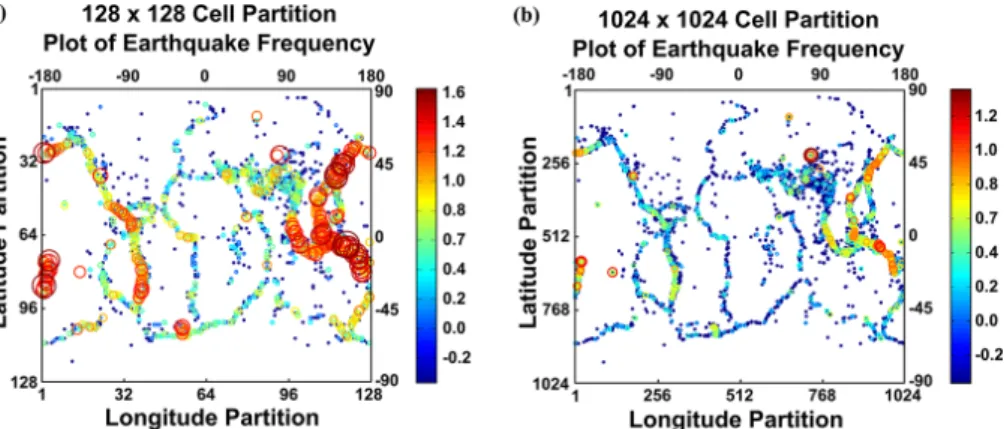
lat-itude/longitude map of the earthquake events into a grid. We show two maps of such grid matrices (Fig. 1). A cell in a smaller grid (128×128) could have higher multiplicity of earthquake events than that in a large grid (1024×1024). We consider the coordinates 20
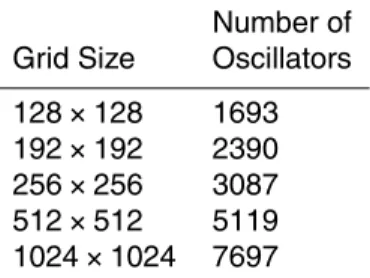
of the topological centre of each cell to represent the coordinates of the earthquake events that fall into that cell. Thus, we explore the effect of hubs and community effects by looking at transition probability matrices generated from grids of different orders such as 128, 192, 256, 512, and 1024 representing the seismicity map on a global longitude–latitude grid. We compute the transition probability matrix and the shortest-25
NPGD
2, 361–398, 2015Earthquake sequencing
K. Vasudevan et al.
Title Page
Abstract Introduction
Conclusions References
Tables Figures
◭ ◮
◭ ◮
Back Close
Full Screen / Esc
Printer-friendly Version Interactive Discussion
Discussion
P
a
per
|
Discussion
P
a
per
|
Discussion
P
a
per
|
Discussion
P
a
per
|
keep the Kuramoto model simple, we assume a constant time-delay in the phase of the ensemble of oscillators. We relax this condition in subsequent simulations. The most difficult parameter to deal with here is the period of quiescence after the energy release following a certain stress threshold. We incorporate the build-up of the threshold effect indirectly by positing the inclusion of earthquake recurrences in transition probability 5
matrices. Here, we use the spatio-temporal recurrences based on the record-breaking model of Davidsen et al. (2008). In all our initial simulations, we ignore the influence of amplitude effects on the stability of the chimera states. We carry out simulations on the Kuramoto model for 8000 time-steps for the 128×128 oscillator grid matrices and for the 1024×1024 oscillator grid matrices. We report here the preliminary results of our 10
simulations.
3 Results
We report the Kuramoto model experimental results for oscillators resulting from 128× 128, 192×192, 256×256, 512×512, and 1024×1024 grids of the latitude–longitude map of the earthquakes. We consider a total of 13 190 earthquakes. We construct 15
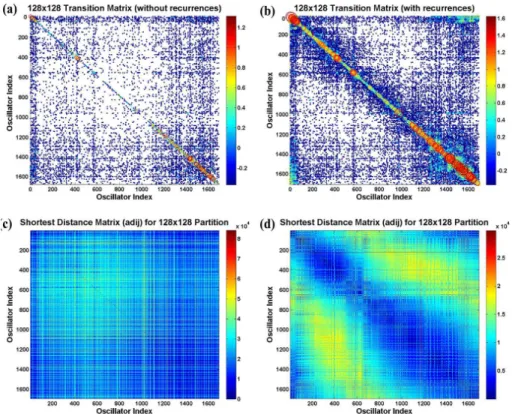
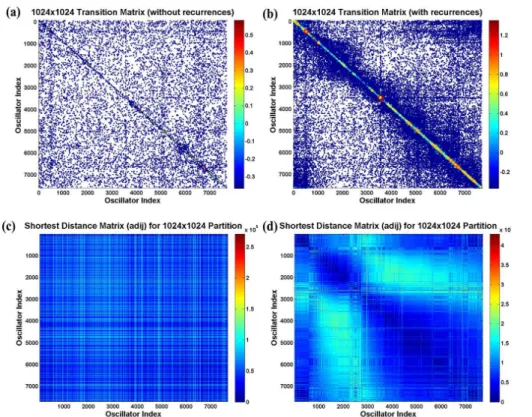
the transition probability and the shortest-path distance matrices for the grids without (“non-recurrence” results) and with the consideration of the spatio-temporally complex recurrences (“recurrence” results), as shown in Figs. 2 and 3.
To represent the results, we use snapshots of three attributes (Zhu et al., 2014): (i) the phase profile, (ii) the effective angular velocities of oscillators and (iii) the fluctuation 20
of the instantaneous angular velocity of oscillators. The effective angular velocity of oscillatori is defined as
hωii=limT→∞1
T t0+T
Z
t0
˙
NPGD
2, 361–398, 2015Earthquake sequencing
K. Vasudevan et al.
Title Page
Abstract Introduction
Conclusions References
Tables Figures
◭ ◮
◭ ◮
Back Close
Full Screen / Esc
Printer-friendly Version Interactive Discussion
Discussion
P
a
per
|
Discussion
P
a
per
|
Discussion
P
a
per
|
Discussion
P
a
per
|
Here, we take T =1000 so that the effective angular velocities of the oscillators are averaged over the last 1000 time-steps. We taket0=7001 for the 128×128 grid and
for the 1024×1024 grid.
The fluctuation of the instantaneous angular velocity,σi, of an oscillatori around its
effective velocity is defined as 5
σ2
i =limT→∞
1
T t0+T
Z
t0
˙
θi− hωii2
dt (4)
If σi=0 then oscillator i rotates at a constant angular velocity. We show the
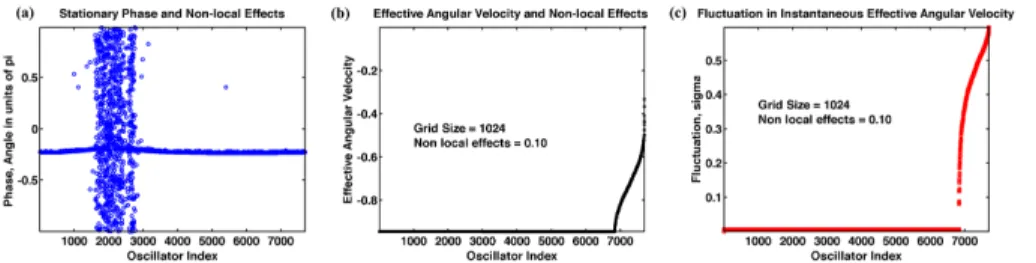
non-recurrence and non-recurrence results obtained from the behavior of the last 1000 time-steps of the simulations involving 8000 time-time-steps. We present the results for the 128×128 grid without and with recurrences in Figs. 4 and 5 for the three attributes using 10
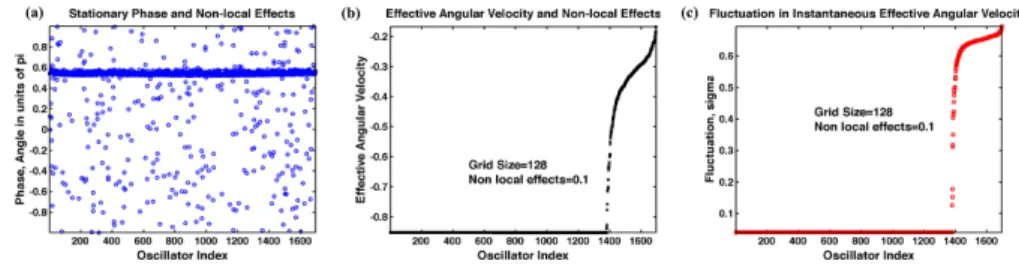
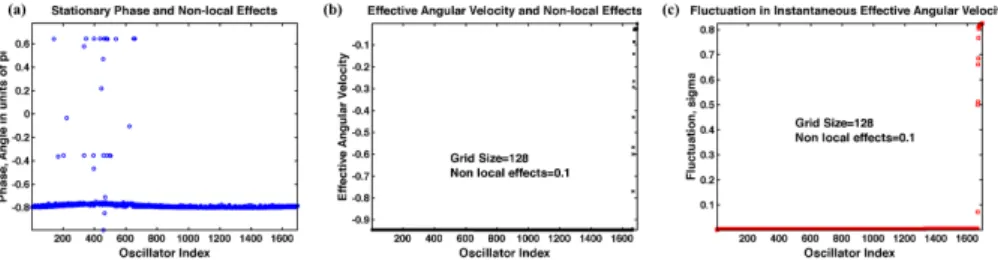
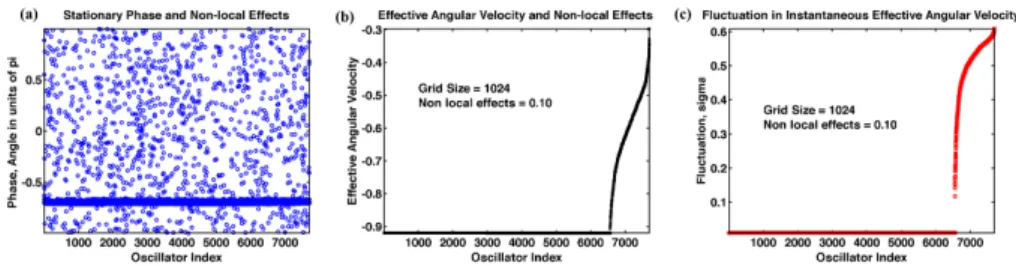
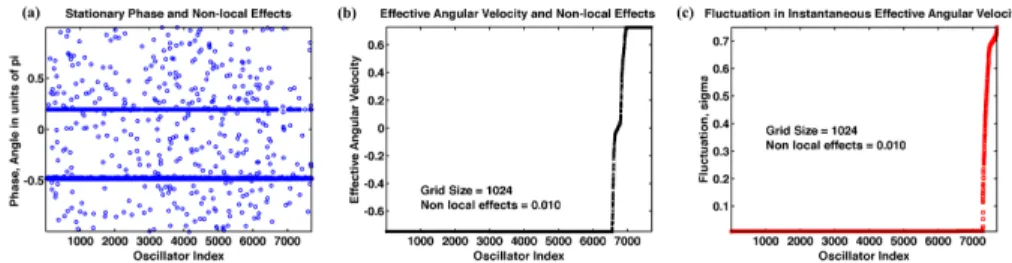
κ=0.10. Figures 6 and 7 show these attributes for the 1024×1024 grid without recur-rences for κ=0.1 andκ=0.01. Figure 8 shows these attributes for the 1024×1024 grid with recurrences forκ=0.1.
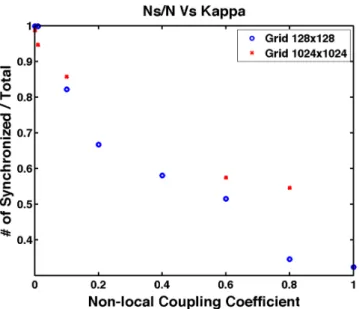
We investigate the influence of the non-local coupling coefficient,κ, on the ratio of the number of coherent or synchronous oscillators to the total number of oscillators for 15
each grid and summarize our results in Fig. 9.
4 Discussion
4.1 Building the directed graph
Earthquake sequencing is a well-studied problem in earthquake seismological commu-nities around the globe, and yet, it hides a suite of phenomenological mysteries that 20
NPGD
2, 361–398, 2015Earthquake sequencing
K. Vasudevan et al.
Title Page
Abstract Introduction
Conclusions References
Tables Figures
◭ ◮
◭ ◮
Back Close
Full Screen / Esc
Printer-friendly Version Interactive Discussion
Discussion
P
a
per
|
Discussion
P
a
per
|
Discussion
P
a
per
|
Discussion
P
a
per
|
the associated catalogue. In Fig. 1a and b, we summarize the cumulative results of the catalogue for magnitudes of earthquakes exceedingMW5.5 and the depths of
oc-currence not exceeding 70 km, recorded between January 1970 and September 2014. One difference in the two figures lies in the coarseness of the gridding with the first one being coarser than the second. A cursory glance at the figures immediately sug-5
gests the relevance of plate tectonics in that most earthquakes seem to occur at and around plate boundaries. A broad classification of these earthquakes could consist of the following categories: strike-slip earthquakes, subduction-zone seismicity, oceanic earthquakes, continental extensional regimes, intraplate earthquakes, and slow earth-quakes (Scholz, 2002). The interplay between these remains a topic of research among 10
seismologists. In general, fault systems play an important role in understanding the cause and recurrence of earthquakes. Scholz (2002) provides an excellent account of the mechanics of earthquakes and faulting. Ben-Zion and Sammis (2003) exam-ined the continuum-Euclidean, the granular, and the fractal views of the geometrical, mechanical, and mathematical nature of faults and concluded that many aspects of 15
the observed spatio-temporal complexity of earthquakes and faults might be explained using the continuum-Euclidean model. They contended that a continuum-based de-scription would provide a long-term attractor for structural evolution of fault zones at all scales. The underpinning point in these works is the importance of the faulting in earthquake processes. Earthquakes are known to occur at different depths. Excepting 20
in instances where there are surface ruptures as a result of earthquakes, fault zones at seismogenic depths in kilometres cannot be directly observed (Ben-Zion and Sammis, 2003). Continued geological mapping and high-resolution geophysical measurements afford a mechanism to improve our understanding of the fault zones.
Rundle et al. (2003) took a statistical physics approach in emphasizing the signifi-25
NPGD
2, 361–398, 2015Earthquake sequencing
K. Vasudevan et al.
Title Page
Abstract Introduction
Conclusions References
Tables Figures
◭ ◮
◭ ◮
Back Close
Full Screen / Esc
Printer-friendly Version Interactive Discussion
Discussion
P
a
per
|
Discussion
P
a
per
|
Discussion
P
a
per
|
Discussion
P
a
per
|
the coupling between different space and time scales to comprehend the non-linear dynamics of the fault systems is not an easy problem. In this regard, any attempt to explore the possibilities that accrue from non-linear dynamics studies is welcome.
In earlier studies on model and theoretical seismicity (Burridge and Knopoff, 1967; Vieira, 1999), special attention was paid to finding out if chaos was present in the 5
symmetric non-linear two-block Burridge–Knopffmodel for earthquakes. Viera (1999) demonstrated with a three-block system the appearance of synchronized chaos. A con-sequence of this study was the speculation that earthquake faults, which are generally coupled through the elastic media in the earth’s crust, could in principle synchronize even when they have an irregular chaotic dynamics (Viera, 1999). Going one step fur-10
ther would be to suggest that the occurrence of earthquakes and the space–time scale patterns they leave behind is a sound proxy for modeling and theoretical studies of the fault systems. It is this point that is pursued in this work.
In this study, we focus on the non-linear dynamics of weakly-coupled oscillators. Each oscillator (corresponding to the occurrence of an earthquake) is a proxy for a fault 15
system or network with known information on its location, the time when the earthquake event occurred, and magnitude. This defines an element in the earthquake sequence. A continued sequence of events is represented as a directed graph (Vasudevan et al., 2010; Cavers and Vasudevan, 2015; Vasudevan and Cavers, 2014b) with the vertices representing the earthquakes (and their attributes) and the arcs the connecting links 20
between neighbours in a sequence. Figures 2a and 3a show the transition matrices for the directed graphs of the two grids, 128×128 and 1024×1024 grids. The oscillator index is determined by the grid partition with non-zero cells labelled in row-by-row order. A log(log)) display scale is used to highlight the “clustering”. The level of clustering along the first leading off-diagonal elements of the transition matrix is highlighted and 25
NPGD
2, 361–398, 2015Earthquake sequencing
K. Vasudevan et al.
Title Page
Abstract Introduction
Conclusions References
Tables Figures
◭ ◮
◭ ◮
Back Close
Full Screen / Esc
Printer-friendly Version Interactive Discussion
Discussion
P
a
per
|
Discussion
P
a
per
|
Discussion
P
a
per
|
Discussion
P
a
per
|
intra-cell transitions populate the transition matrices. These transition matrices are not symmetric. The non-linear dynamics of weakly-coupled oscillators on such matrices has not been fully understood.
The quiescence period between earthquakes in an earthquake zone is what we interpret here as recurrence period. Studies on plate-boundary motions (Bird, 2002; 5
DeMets, 2010; Stein, 1993) will provide an insight into the recurrence period for earth-quakes in certain major fault zones. Even in instances where knowledge of the recur-rence periods is known, it is usually punctuated by random fluctuations, the statistics of which are not unknown. The quiescence period is analogous to the process in hu-man brains that precedes epileptic seizures (Berg et al., 2006; Rothkegel and Lehnertz, 10
2014), the structure of which has been modeled using pulse-coupled phase-oscillators. Such pulse-coupling or threshold-coupling remains to be quantified for earthquakes. Furthermore, the historical seismicity data set is short and, therefore, any information to be drawn from global records will be insufficient. However, the recurrence model introduced by Davidsen et al. (2008) offers a simple remedy to the problem. It rests 15
in identifying the earthquakes occurring in close proximity to any occurred event in the record-breaking sequence. Incorporating this feature into the transition matrices results in modified transition matrices, as shown in Figs. 2b and 3b. We propose that account-ing for the quiescence period in this manner opens additional options such as feedback effects on the non-linear dynamics of weakly-coupled oscillators.
20
4.2 Synchronization
NPGD
2, 361–398, 2015Earthquake sequencing
K. Vasudevan et al.
Title Page
Abstract Introduction
Conclusions References
Tables Figures
◭ ◮
◭ ◮
Back Close
Full Screen / Esc
Printer-friendly Version Interactive Discussion
Discussion
P
a
per
|
Discussion
P
a
per
|
Discussion
P
a
per
|
Discussion
P
a
per
|
following equations for each oscillator in the system:
˙
θi =ωi+ Ki N
N
X
j=1
sin
θj(t)−θi(t) (i =1,. . .,N) (5)
whereθi is the phase of theith oscillator, ˙θi(t) is the first derivative of the phase of the
ith oscillator with time,ωi is the natural frequency of the oscillator, Ki is the strength of coupling of theith oscillator to other oscillators andN is the size of the population 5
of the oscillators. The frequenciesωi are chosen from a uniform distribution. Kuramoto (1975) demonstrated that synchronization was accomplished in the case of mean-field coupling with
Ki = K
N >0 (i =1,. . .,N) (6)
in the above equation. We can describe the Kuramoto model in a simpler form by 10
introducing the complex-valued order parameterr(t):
Z=r(t)ei ψ(t)
= 1
N N
X
j=1
ei θj(t) (7)
whereΨ(t) is the average phase andr(t) honours 0≤r(t)≤1. The expression of the Kuramoto model becomes:
˙
θi(t)=ωi+K rsin[ψ−θi(t)] (i =1,. . .,N) (8)
15
NPGD
2, 361–398, 2015Earthquake sequencing
K. Vasudevan et al.
Title Page
Abstract Introduction
Conclusions References
Tables Figures
◭ ◮
◭ ◮
Back Close
Full Screen / Esc
Printer-friendly Version Interactive Discussion
Discussion
P
a
per
|
Discussion
P
a
per
|
Discussion
P
a
per
|
Discussion
P
a
per
|
to total incoherence, i.e., no phase locking of the phases of the oscillators; a value of “1” forr corresponds to full coherence, i.e., phase locking of all the phases of the oscil-lators. The time evolution of the Kuramoto model can be monitored either by looking at the polar plots of the phases on a unit circle (Kuramoto, 1975) or by following the plot of the order parameter,r, as a function of the coupling strength,K. Acebrón et al. (2005) 5
have provided a comprehensive review of the Kuramoto model.
For the stability of the solution from the Kuramoto model, use of a large population of oscillators for calculability in the thermodynamic limit is a pre-requisite. Over the last decade, efforts have gone into considering a finite number of oscillators satisfying the original conditions of the Kuramoto model. Easing the restrictions on the interaction 10
model can be cast as an investigation of synchronization on complex networks. This would allow one to relate the complex topology and the heterogeneity of the network to the synchronization behavior.
We rewrite the original Kuramoto model for a complex network corresponding to undirected and directed graphs as
15
˙
θi(t)=ωi+ N
X
j=1
σi jai jsin[θj(t)−θi(t)] (i=1,. . .,N) (9)
where σi j is the coupling strength between pairs of connected oscillators and ai j
refers to the elements of the adjacency or connectivity matrix. Much effort has gone into understanding the role of the coupling strength (Hong et al., 2002; Arenas et al., 2008; Dörfler et al., 2013) in the synchronization behavior of small-world and scale-free 20
graphs. Here, we leave the coupling strength term a constant, unlike in the model un-der the thermodynamic limit where the size of the population,N, enters explicitly in the coupling strength term as a divisor. The structure of the adjacency matrix decides es-sentially the nature of the interaction term made up of the sine coupling of the phases. Vasudevan and Cavers (2014a) have investigated the synchronization behaviour of 25
NPGD
2, 361–398, 2015Earthquake sequencing
K. Vasudevan et al.
Title Page
Abstract Introduction
Conclusions References
Tables Figures
◭ ◮
◭ ◮
Back Close
Full Screen / Esc
Printer-friendly Version Interactive Discussion
Discussion
P
a
per
|
Discussion
P
a
per
|
Discussion
P
a
per
|
Discussion
P
a
per
|
of clustering on the synchronization. In this regard, the work of McGraw and Menzinger (2005) is quite appealing. They conclude that for random networks and scale-free net-works, increased clustering promotes the synchronization of the most connected nodes (hubs) even though it inhibits global synchronization. We see the role of the effect of clustering on the nature of synchronization behaviour in earthquake sequencing stud-5
ies and will constitute a separate study. Whether or not we reach similar conclusions for directed graphs, we have recently investigated synthetic networks that mimic real data structures (Vasudevan and Cavers, 2014a).
4.3 Chimera states
While the synchronization and asynchronization studies on earthquake sequencing 10
are important in terms of the Kuramoto model given in Eq. (9), very little attention has been paid to the co-existence of synchronized and asynchronized states or the chimera states. Kuramoto and Battogtokh (2002) and Abrams and Strogatz (2004) paved the way for such a study by including the non-local effects into the Kuramoto model, as expressed in Eqs. (1) and (2). Non-local effects mean simply the inclusion of geom-15
etry effects. For the global seismicity map considered in this study, we generated the shortest-path distance matrices with and without the inclusion of recurrences (Figs. 2c and d, 3c and d). The shortest-path algorithm encapsulates both the cascading effects of earthquakes and the negation of long-range distance effects. In this study, we kept the global coupling strength constant and allowed the non-local coupling strength,κ, to 20
vary from one simulation to the next one, similar to what was done in the recent work of Zhu et al. (2014).
The model in Eq. (1) contains a time-delay term (Kuramoto and Battogtokh, 2002; Abrams and Strogatz, 2004; Sethia et al., 2008; Yao et al., 2013; Zhu et al., 2014; Pannagio and Abrams, 2014; Vasudevan and Cavers, 2014b). Symmetry breaking 25
observa-NPGD
2, 361–398, 2015Earthquake sequencing
K. Vasudevan et al.
Title Page
Abstract Introduction
Conclusions References
Tables Figures
◭ ◮
◭ ◮
Back Close
Full Screen / Esc
Printer-friendly Version Interactive Discussion
Discussion
P
a
per
|
Discussion
P
a
per
|
Discussion
P
a
per
|
Discussion
P
a
per
|
tion to oscillators with heterogeneous frequencies. Also interesting to observe in this regard is that these heterogeneities can lead to new bifurcations allowing for alternat-ing synchrony between the distinct populations over time. Ko and Ermentrout (2008) demonstrated the presence of chimera-like states when the coupling strengths were heterogeneous. Although there is overwhelming evidence for the existence of chimera 5
states in the presence of time delay, all of our initial Kuramoto model simulations on the directed graph transition matrices and the associated shortest-path distance matrices included a constant time-delay term only. Work is in progress in the use of a distribution ofτij instead of a constant delay term.
4.4 Simulation results and analysis
10
The Kuramoto model simulation with non-local coupling effects (κ=0.10) with a time-delay term, as expressed in Eq. (1) for a 128×128 grid transition probability, and the corresponding shortest-path distance matrices, lead to snapshots of three attributes: (1) the phase profile; (ii) the effective angular velocities of oscillators, and (iii) the fluc-tuation of the instantaneous angular velocity of oscillators. Panels (a), (b), and (c) in 15
Fig. 4 show that, for a case of no recurrences, there exists a chimera state. The en-semble averages from the last 1000 time steps of the 8000 time steps in the numerical simulations reveal the co-existence of synchronous and asynchronous oscillators. This means that some of the cells in the grid strike a synchronous behavior and some others do not. In this particular case of no recurrences (Fig. 4), the number of synchronous 20
oscillators to the number of asynchronous oscillators is large. In the case of recur-rences, as shown in Fig. 5, this ratio is much larger. Also, the chimera pattern of the synchronized and asynchronized components of the oscillators is similar to what was observed by Abrams and Strogatz (2004). Figures 4a and 5a are the first evidence of the possible existence of a chimera state in earthquake sequencing. Figures 4b and c, 25
5b and c confirm this.
NPGD
2, 361–398, 2015Earthquake sequencing
K. Vasudevan et al.
Title Page
Abstract Introduction
Conclusions References
Tables Figures
◭ ◮
◭ ◮
Back Close
Full Screen / Esc
Printer-friendly Version Interactive Discussion
Discussion
P
a
per
|
Discussion
P
a
per
|
Discussion
P
a
per
|
Discussion
P
a
per
|
1693 vs. 7697. Figures 6 and 7 reveal the chimera state as the steady-state solution to the non-linear dynamics on weakly-coupled oscillators without and with recurrences for two different values of the non-local coupling coefficients,κ=0.1 andκ=0.01, respec-tively. While the observation made withκ=0.1 (Fig. 6) is the same as that made with
κ=0.01 (Fig. 7), the latter reveals a multi-chimera state. We define a multi-chimera 5
state as being one with two or more clusters of oscillators synchronizing at around two different phase angles with the asynchronized oscillators spanning different phases between−πand+π. This result was observed with a homogeneous set of oscillators, a constant time-delay and a constant non-local coupling coefficient for all the oscilla-tors. We repeated the simulation experiment with the effect of recurrences included in 10
the 1024×1024 grid. Figure 8 shows the presence of a chimera state. Similar to what was observed with the 128×128 grid, we have the asynchronous region over a se-lected set of oscillators coexisting with the synchronous region. For other oscillators, only the synchronous region exists. Both of the observations in Figs. 5 and 8 need further investigation.
15
We looked at the influence of the non-local coupling coefficient,κ, on the ratio of the number of coherent oscillators to the total number of oscillators for both the 128×128 and 1024×1024 grids without recurrences in Fig. 9. A similar observation is made for the case of recurrences. As the non-local coupling coefficient,κ, increases from 0.001 to 1.0, the ratio decreases. For values of κ approaching 0, the non-local Kuramoto 20
model acts as a simple Kuramoto model in that there is full synchronization for the global coupling parameter, A, (or used as K in literature) of 1.0. What is surprising to begin with is that, as κ approaches 1, the steady state solution becomes more asynchronized. Investigations on the effect of the non-local coupling effect parameter,
κ, on the steady-state solution of the phase angle distribution in the chimera state 25
NPGD
2, 361–398, 2015Earthquake sequencing
K. Vasudevan et al.
Title Page
Abstract Introduction
Conclusions References
Tables Figures
◭ ◮
◭ ◮
Back Close
Full Screen / Esc
Printer-friendly Version Interactive Discussion
Discussion
P
a
per
|
Discussion
P
a
per
|
Discussion
P
a
per
|
Discussion
P
a
per
|
The outcome of each one of the simulations described for both the non-recurrence and recurrence cases contains synchronous and asynchronous vectors. Mapping these vectors on the respective grids (128×128 or 1024×1024 grids) should reveal the “non-readiness or readiness” cells or zones for earthquakes. One such map for a 128×128 grid without recurrences for κ=0.10 is shown in Fig. 12. This qualita-5
tive description of the evolutionary dynamics of the earthquake sequencing is highly instructive.
5 Conclusions and future work
Earthquake sequencing is an intriguing research topic. The dynamics involved in the evolution of earthquake sequencing are complex. Very much has been understood, and 10
yet, the evolving picture is incomplete. In this regard, the work of Scholz (2010) acted as a catalyst in us investigating the synchronization aspect of earthquakes using the Kuramoto model. To name a few, the works of Vieira (1999), Rundle et al. (2002, 2003), Kuramoto and Battogtokh (2002), Abrams and Strogatz (2004), and Laing (2009a, b) have helped us take this step forward with this work. We summarize below the main 15
points of this paper and also, point out the direction in which we are going:
1. Earthquake sequencing from the IRIS earthquake catalogue browser can be expressed as a transition matrix of a directed graph. Partitioning of the lati-tude/longitude grid of the globe into grids of finite dimensions such as 128×128, 192×192, 256×256, 512×512, and 1024×1024 grids result in differing dimen-20
sions of transition matrices of oscillators in increasing order. Short-path distance matrices for the latter are generated concurrently to study the non-local effects used in the Kuramoto model.
2. Inclusion of the non-local effects in the Kuramoto model of the directed graphs is tested for different values of the non-local coupling coefficient,κ.
NPGD
2, 361–398, 2015Earthquake sequencing
K. Vasudevan et al.
Title Page
Abstract Introduction
Conclusions References
Tables Figures
◭ ◮
◭ ◮
Back Close
Full Screen / Esc
Printer-friendly Version Interactive Discussion
Discussion
P
a
per
|
Discussion
P
a
per
|
Discussion
P
a
per
|
Discussion
P
a
per
|
3. For a non-local coupling strength,κ, of 0.10, the Kuramoto model yields chimera states as stable solution, i.e., co-existence of synchronized and asynchronized states. This is true for all the grid sizes considered. Differences exist in the ratio of the number of coherent oscillators to the number of incoherent oscillators.
4. As the non-local coupling strength,κ, is lowered from 1.0 to 0.001, there is a gen-5
eral tendency towards an increase in synchronization, as is expected. While this general trend is observed for directed graphs generated from grids of dimensions 128, 192, 256, and 512, the graph from 1024×1024 grid reveals not only the persistence of the chimera state but also the multiplicity of the chimera state for a non-local coupling strength of 0.01. This surprising result needs to be under-10
stood.
5. As the non-local coupling strength is increased from 0.1 to 1.0, there is a steady increase in the asynchronous behavior.
6. The recurrence results support the presence of chimera states for both 128×128 and 1024×1024 grids. However, it is quite intriguing to find out that the asyn-15
chronous oscillators come from a sub-set of the oscillators in both cases.
7. There is still a nagging question about which non-local coupling coefficient would be an ideal candidate for understanding the global stress-field fluctuations. Fig-ure 12 illustrates an example of how a chimera state could be displayed on the map grid. Imposing geophysical and geodetic constraints on the earthquake 20
zones in terms of heterogeneity of the natural frequencies would provide a quan-titative answer to the above question.
8. In general, the hypothesis that all networks of earthquake faults around the globe go through full synchronization still needs to be strongly tested. On the other hand, the prevalence of chimera states or multi-chimera states is an attractive option to 25
NPGD
2, 361–398, 2015Earthquake sequencing
K. Vasudevan et al.
Title Page
Abstract Introduction
Conclusions References
Tables Figures
◭ ◮
◭ ◮
Back Close
Full Screen / Esc
Printer-friendly Version Interactive Discussion
Discussion
P
a
per
|
Discussion
P
a
per
|
Discussion
P
a
per
|
Discussion
P
a
per
|
9. We believe that there is, now, a mechanism available to us to explore and seek an answer to the non-linear dynamics of earthquake oscillations.
Needless to say, the role of the parameters such as the heterogeneity of the oscil-lators as expressed in the natural frequency of the osciloscil-lators, the variability of the time-delay corrections instead of a constant time-delay, and the heterogeneity of the 5
non-local coupling strength and the global coupling strength in the present Kuramoto model remains to be investigated. Work is currently in progress. We surmise that the earthquake sequencing is embedded in a multi-chimera state where the “true” multiplic-ity would stress the importance of hubs or clusters of events in seismogenic zones and the inter-connectivity of hubs. The Kuramoto model honours the validity of the empiri-10
cal rules that apply to the seismicity data and of the scaling behavior of the attributes drawn from the data. It is the chaotic dynamics resulting in certain patterns that we begin to see in the sequence of seismic events with a very simple model.
Acknowledgements. We would like to express deep gratitude to the department of Mathemat-ics and StatistMathemat-ics for support and computing time and to the generosity and hospitality shown 15
at the Max Planck Institute of the Physics of Complex Systems at Dresden, Germany during KV’s short-visit to the institute last summer. We express deep gratitude to the combinatorics and discrete geometry group and the faculty and staffof the department of Mathematics and Statistics of the University of Calgary for helpful discussions. We thank Incorporated Institu-tions for Seismology (IRIS) for the information on global earthquake catalogue and the high 20
performance computing at the university of Calgary.
References
Abrams, D. M. and Strogatz, S. H.: Chimera states for coupled oscillators, Phys. Rev. Lett., 93, 174102, doi:10.1103/PhysRevLett.93.174102, 2004.
Abrams, D. M., Mirollo, R., Strogatz, S. H., and Wiley, D. A.: Solvable model for chimera states 25
NPGD
2, 361–398, 2015Earthquake sequencing
K. Vasudevan et al.
Title Page
Abstract Introduction
Conclusions References
Tables Figures
◭ ◮
◭ ◮
Back Close
Full Screen / Esc
Printer-friendly Version Interactive Discussion
Discussion
P
a
per
|
Discussion
P
a
per
|
Discussion
P
a
per
|
Discussion
P
a
per
|
Acebrón, J. A., Bonila, L. L., Vicente, C. J. P., Ritort, F., and Spigler, R.: The Kuramoto model: a simple paradigm for synchronization phenomena, Rev. Mod. Phys., 77, 137–185, 2005. Arenas, A., Diaz-Guilera, A., Kurths, J., Moreno, Y., and Zhou, C.: Synchronization in complex
networks, Phys. Rep., 469, 93–153, 2008.
Bath, M.: Lateral inhomogeneities of the upper mantle, Tectonophysics, 2, 483–514, 1965. 5
Beggs, J. M. and Plenz, D.: Neuronal avalanches in neocortical circuits, J. Neurosci., 23, 11167–11177, 2003.
Ben-Zion, Y. and Sammis, C. G.: Characterization of fault zones, Pure Appl. Geophys., 160, 677–715, 2002.
Berg, A. T., Vickrey, B. G., Testa, F. M., Levy, S. R., Shinnar, S., DiMario, F., and Smith, S.: 10
How long does it take for epilepsy to become intractable? A prospective investigation, Ann. Neurol., 60, 73–79, 2006.
Bird, P.: An updated digital model of plate boundaries, Geochem. Geophy. Geosy., 4, 1027, doi:10.1029/2001GC00025, 2003.
Bufe, C. G. and Varnes, D. J.: Predictive modeling of the seismic cycle of the greater San 15
Francisco Bay region, J. Geophys. Res., 98, 9871–9883, 1993.
Burridge, R. and Knopoff, L.: Model and theoretical seismicity, B. Seismol. Soc. Am., 57, 341– 371, 1967.
Cavers, M. and Vasudevan, K.: Spatio-temporal complex Markov Chain (SCMC) model using directed graphs: earthquake sequencing, Pure Appl. Geophys., 172, 225–241, 20
doi:10.1007/s00024-014-0850-7, 2015.
Chialvo, D. R.: Emergent complex neural dynamics, Nat. Phys., 6, 744–750, 2010.
Davidsen, J., Grassberger, P., and Paczuski, M.: Networks of recurrent events, a theory of records, and an application to finding causal signatures in seismicity, Phys. Rev. E, 77, 66– 104, 2008.
25
DeMets, C., Gordon, R. G., and Argus, D. F.: Geologically current plate motions, Geophys. J. Int., 181, 1–80, 2010.
Dörfler, F., Chertkov, M., and Bullo, F.: Synchronization in complex oscillator networks and smart grids, P. Natl. Acad. Sci. USA, 110, 2005–2010, 2013.
Gupta, S., Campa, A., and Ruffo, S.: Kuramoto model of synchronization: equilibrium 30
NPGD
2, 361–398, 2015Earthquake sequencing
K. Vasudevan et al.
Title Page
Abstract Introduction
Conclusions References
Tables Figures
◭ ◮
◭ ◮
Back Close
Full Screen / Esc
Printer-friendly Version Interactive Discussion
Discussion
P
a
per
|
Discussion
P
a
per
|
Discussion
P
a
per
|
Discussion
P
a
per
|
Gutenberg, M. B. and Richter, C. F.: Seismicity of the Earth and Associated Phenomena, Princeton University Press, 310 pp., 1954.
Hanks, T. C. and Kanamori, H.: A moment magnitude scale, J. Geophys. Res.-Sol. Ea., 84, 2348–2350, 1979.
Herz., A. V. M. and Hopfield, J. J.: Earthquake cycles and natural reverberations: collective 5
oscillations in systems with pulse-coupled threshold elements, Phys. Rev. Lett., 75, 1222– 1225, 1995.
Hong, H., Chou, M. Y., and Kim, B. J.: Synchronization on small-world networks, Phys. Rev. E, 65, 026139, doi:10.1103/PhysRevE.65.026139, 2002.
Kagan, Y. Y., Bird, P., and Jackson, D. D.: Earthquake patterns in diverse tectonic zones of the 10
globe, Pure Appl. Geophys., 167, 721–741, 2010.
Kanamori, H. and Anderson, D. L.: Theoretical basis of some empirical relations in seismology, B. Seismol. Soc. Am., 65, 1073–1095, 1975.
Kapitaniak, T., Kuzma, P., Wojewada, J., Czolczynski, K., and Maistrenko, Y.: Imperfect chimera states for coupled pendula, Sci. Rep., 4, 6379, 1–4, 2014.
15
Karsai, M., Kaski, K., Barabási, A.-L., and Kertész, J.: Universal features of correlated bursty behavior, Sci. Rep., 2, 397, doi:10.1038/srep00397, 2012.
Ko, T. W. and Ermentrout, G. B.: Partially locked states in coupled oscillators due to inhomoge-neous coupling, Phys. Rev. E, 78, 016203, doi:10.1103/PhysRevE.78.016203, 2008. Kuramoto, Y.: Self-entrainment of a population of coupled non-linear oscillators, in: International 20
Symposium in Mathematical Problems on Theoretical Physics, edited by: H. Araki, Lecture Notes in Physics, Vol. 39, Springer, Berlin, Heidelberg, 420–422, 1975.
Kuramoto, Y.: Collective synchronization of pulse-coupled oscillators and excitable units, Phys-ica D, 50, 15–30, 1991.
Kuramoto, Y. and Battogtokh, D.: Coexistence of coherence and incoherence in non-locally 25
coupled phase oscillators, Nonl. Phen. Compl. Syst., 5, 380–385, 2002.
Laing, C. R.: Chimera states in heterogeneous networks, Chaos, 19, 013113, doi:10.1063/1.3068353, 2009a.
Laing, C. R.: The dynamics of chimera states in heterogeneous Kuramoto networks, Physica D, 238, 1569, doi:10.1016/j.physd.2009.04.012, 2009b.
30
NPGD
2, 361–398, 2015Earthquake sequencing
K. Vasudevan et al.
Title Page
Abstract Introduction
Conclusions References
Tables Figures
◭ ◮
◭ ◮
Back Close
Full Screen / Esc
Printer-friendly Version Interactive Discussion
Discussion
P
a
per
|
Discussion
P
a
per
|
Discussion
P
a
per
|
Discussion
P
a
per
|
Martens, E. A., Thutupalli, S., Fourriére, A., and Hallatschek, O.: Chimera states in mechanical oscillator networks, P. Natl. Acad. Sci. USA, 110, 10563–10567, 2013.
McGraw, P. N. and Menzinger, M.: Clustering and the synchronization of oscillator networks, Phys. Rev. E, 72, 015101, doi:10.1103/PhysRevE.72.015101, 2005.
Mirollo, R. E. and Strogatz, S. H.: Synchronization of pulse-coupled biological oscillators, 5
SIAM J. Appl. Math., 50, 1645–1662, 1990.
Montbrió, E., Kurths, J., and Blasius, B.: Synchronization of two interacting populations of os-cillators, Phys. Rev. E, 70, 056125, doi:10.1103/PhysRevE.70.056125, 2004.
Nava, F. A., Herrera, C., Frez, J., and Glowacka, E.: Seismic hazard evaluation using Markov chains: application to the Japan area, Pure Appl. Geophys., 162, 1347–1366, 2005.
10
Ogata, Y.: Significant improvements of the space–time ETAS model for forecasting of accurate baseline seismicity, Earth Planets Space, 63, 217–229, 2011.
Omel’chenko, O. E., Maistrenko. Y. L., and Tass, P. A.: Chimera states: the nat-ural link between coherence and incoherence, Phys. Rev. Lett., 100, 044105, doi:10.1103/PhysRevLett.100.044105, 2008.
15
Omori, F.: On the aftershocks of earthquakes, J. Coll. Soc. Imper. Univ. Tokyo, 7, 111–200, 1895.
Osorio, I., Frei, M. G., Sornette, D., Milton, J., and Lai, Y.-C.: Epileptic seizures: quakes of the brain?, Phys. Rev. E, 82, 021919, doi:10.1103/PhysRevE.82.021919, 2010.
Panaggio, M. J. and Abrams, D. M.: Chimera states: coexistence of coherence and incoherence 20
in networks of coupled oscillators, Nonlinear sciences: chaotic dynamics, arXiv:1403.6204v2, 12 May, 2014.
Pazó, D. and Montbrió, E.: Low-dimensional dynamics of populations of pulse-coupled oscilla-tors, Phys. Rev. X, 4, 011009, doi:10.1103/PhysRevX.4.011009, 2014.
Pikovsky, A., Rosenblum, M., and Kurths, J.: Synchronization: a Universal Concept in Nonlinear 25
Sciences, vol. 12, Cambridge University Press, 2003.
Rothkegel, A. and Lehnertz, K., Irregular macroscopic dynamics due to chimera states in small-world networks of pulse-coupled oscillators, New J. Phys., 16, 055006, doi:10.1088/1367-2630/16/5/055006, 2014.
Rundle, J. B., Tiampo, K. F., Klein, W., and Sa Martins, J. S.: Self-organization in leaky threshold 30
NPGD
2, 361–398, 2015Earthquake sequencing
K. Vasudevan et al.
Title Page
Abstract Introduction
Conclusions References
Tables Figures
◭ ◮
◭ ◮
Back Close
Full Screen / Esc
Printer-friendly Version Interactive Discussion
Discussion
P
a
per
|
Discussion
P
a
per
|
Discussion
P
a
per
|
Discussion
P
a
per
|
Rundle, J. B., Turcotte, D. L., Shcherbakov, R., Klein, W., and Sammis, C.: Statistical physics approach to understanding the multiscale dynamics of earthquake fault systems, Rev. Geo-phys., 41, 1019, doi:10.1029/2003RG000135, 2003.
Scholz, C. H.: The Mechanics of Earthquakes and Faulting, 2nd edn., Cambridge Univ. Press, New York, 2002.
5
Scholz, C. H.: Large earthquake triggering, clustering, and the synchronization of faults, B. Seismol. Soc. Am., 100, 901–909, 2010.
Sethia, G. C., Sen, A., and Atay, F. M.: Clustered chimera states in delay-coupled oscillator systems, Phys. Rev. Lett., 100, 144102, doi:10.1103/PhysRevLett.100.144102, 2008. Sheeba, J. H., Chandrasekar, V. K., and Lakshmanan, M.: Globally clustered chimera states 10
in delay-coupled populations, Phys. Rev. E, 79, 055203, doi:10.1103/PhysRevE.79.055203, 2009.
Stein, S.: Space geodesy and plate motions, in: Contributions of Space Geodesy to Geody-namics: Crustal Dynamics, edited by: Smith, D. E. and Turcotte, D. L., Geodynamics Series, 23, 5–20, American Geophysical Union ,John Wiley & Sons, Inc., doi:10.1029.GD023, 1993. 15
Strogatz, S. H.: From Kuramoto to Crawford: exploring the onset of synchronization in popula-tions of coupled oscillators, Physica D, 143, 1–20, 2000.
Telesca, L., Cherkaoui, T.-E., and Rouai, M.: Revealing scaling and cycles in earthquake se-quences, Int. J. Nonlinear Sci., 11, 137–142, 2011.
Thurner, S., Lowen, S. B., Feurstein, M. C., Heneghan, C., Feichtinger, H. G., and Teich, M. C.: 20
Analysis, synthesis, and estimation of fractal-rate stochastic point processes, Fractals, 5, 565–596, 1997.
Turcotte, D. L.: Fractals and Chaos in Geology and Geophysics, 2nd Edn., Cambridge Univ. Press, New York, 1997.
Utsu, T., Ogata, Y., and Matsu’ura, R. D.: The centenary of the Omori formula for a decay law 25
of aftershock activity, J. Phys. Earth, 43, 1–33, 1995.
Vasudevan, K. and Cavers, M.: Insight into earthquake sequencing: analysis and interpreta-tion of the time-series of the Markov chain model, Presented at the American Geophysical Union’s Fall Meeting, San Francisco, California, 9–13 December, Poster ID: NG24A-06 1574, 2013.
30
NPGD
2, 361–398, 2015Earthquake sequencing
K. Vasudevan et al.
Title Page
Abstract Introduction
Conclusions References
Tables Figures
◭ ◮
◭ ◮
Back Close
Full Screen / Esc
Printer-friendly Version Interactive Discussion
Discussion
P
a
per
|
Discussion
P
a
per
|
Discussion
P
a
per
|
Discussion
P
a
per
|
Vasudevan, K. and Cavers, M.: Earthquake sequencing: significance of Kuramoto model dy-namics on directed graphs, Presented at the American Geophysical Union’s Fall Meeting, San Francisco, California, 15–19 December, Poster ID: NG43A-3758, 2014b.
Vasudevan, K., Eaton, D. W., and Davidsen, J.: Intraplate seismicity in Canada: a graph theo-retic approach to data analysis and interpretation, Nonlin. Processes Geophys., 17, 513–527, 5
doi:10.5194/npg-17-513-2010, 2010.
Vieira, M. D.: Chaos and synchronized chaos in an earthquake model, Phys. Rev. Lett., 82, 201–204, 1999.
Winfree, A. T.: Biological rhythms and the behavior of populations of coupled oscillators, J. Theor. Biol., 16, 15–42, 1967.
10
Yao, N., Huang, Z.-G., Lai, Y.-C., and Zheng, Z.-G.: Robustness of chimera states in complex dynamical systems, Scientific Rep., 3, 3522, doi:10.1038/srep03522, 2013.
NPGD
2, 361–398, 2015Earthquake sequencing
K. Vasudevan et al.
Title Page
Abstract Introduction
Conclusions References
Tables Figures
◭ ◮
◭ ◮
Back Close
Full Screen / Esc
Printer-friendly Version Interactive Discussion
Discussion
P
a
per
|
Discussion
P
a
per
|
Discussion
P
a
per
|
Discussion
P
a
per
|
Table 1.Grid sizes and the number of oscillators corresponding to non-zero cells.
Number of Grid Size Oscillators
NPGD
2, 361–398, 2015Earthquake sequencing
K. Vasudevan et al.
Title Page
Abstract Introduction
Conclusions References
Tables Figures
◭ ◮
◭ ◮
Back Close
Full Screen / Esc
Printer-friendly Version Interactive Discussion
Discussion
P
a
per
|
Discussion
P
a
per
|
Discussion
P
a
per
|
Discussion
P
a
per
|
Figure 1. Partitioning of the global seismicity map: (a) 128×128 gridding of the latitude– longitude map.(b)1024×1024 gridding of the latitude–longitude map. Earthquakes of magni-tudes exceeding or equal toMW5.5 and location depth not exceeding 70 km for the time period
NPGD
2, 361–398, 2015Earthquake sequencing
K. Vasudevan et al.
Title Page
Abstract Introduction
Conclusions References
Tables Figures
◭ ◮
◭ ◮
Back Close
Full Screen / Esc
Printer-friendly Version Interactive Discussion
Discussion
P
a
per
|
Discussion
P
a
per
|
Discussion
P
a
per
|
Discussion
P
a
per
|
Figure 2.128×128 gridded map:(a)Transition probability matrix without recurrences.(b) Tran-sition probability matrix with recurrences.(c)Shortest-path distance matrix without recurrences.
NPGD
2, 361–398, 2015Earthquake sequencing
K. Vasudevan et al.
Title Page
Abstract Introduction
Conclusions References
Tables Figures
◭ ◮
◭ ◮
Back Close
Full Screen / Esc
Printer-friendly Version Interactive Discussion
Discussion
P
a
per
|
Discussion
P
a
per
|
Discussion
P
a
per
|
Discussion
P
a
per
|
Figure 3.A 1024×1024 gridded map: (a) Transition probability matrix without recurrences.
NPGD
2, 361–398, 2015Earthquake sequencing
K. Vasudevan et al.
Title Page
Abstract Introduction
Conclusions References
Tables Figures
◭ ◮
◭ ◮
Back Close
Full Screen / Esc
Printer-friendly Version Interactive Discussion
Discussion
P
a
per
|
Discussion
P
a
per
|
Discussion
P
a
per
|
Discussion
P
a
per
|
Figure 4.Three attributes of a chimera state of the 1693 oscillators for a 128×128 gridded map withoutrecurrences usingκ=0.10.(a)Stationary phase angle.(b)Effective angular velocity.
NPGD
2, 361–398, 2015Earthquake sequencing
K. Vasudevan et al.
Title Page
Abstract Introduction
Conclusions References
Tables Figures
◭ ◮
◭ ◮
Back Close
Full Screen / Esc
Printer-friendly Version Interactive Discussion
Discussion
P
a
per
|
Discussion
P
a
per
|
Discussion
P
a
per
|
Discussion
P
a
per
|
Figure 5.Three attributes of a chimera state of the 1693 oscillators for a 128×128 gridded mapwithrecurrences usingκ=0.10.(a)Stationary phase angle.(b)Effective angular velocity.
NPGD
2, 361–398, 2015Earthquake sequencing
K. Vasudevan et al.
Title Page
Abstract Introduction
Conclusions References
Tables Figures
◭ ◮
◭ ◮
Back Close
Full Screen / Esc
Printer-friendly Version Interactive Discussion
Discussion
P
a
per
|
Discussion
P
a
per
|
Discussion
P
a
per
|
Discussion
P
a
per
|
NPGD
2, 361–398, 2015Earthquake sequencing
K. Vasudevan et al.
Title Page
Abstract Introduction
Conclusions References
Tables Figures
◭ ◮
◭ ◮
Back Close
Full Screen / Esc
Printer-friendly Version Interactive Discussion
Discussion
P
a
per
|
Discussion
P
a
per
|
Discussion
P
a
per
|
Discussion
P
a
per
|
NPGD
2, 361–398, 2015Earthquake sequencing
K. Vasudevan et al.
Title Page
Abstract Introduction
Conclusions References
Tables Figures
◭ ◮
◭ ◮
Back Close
Full Screen / Esc
Printer-friendly Version Interactive Discussion
Discussion
P
a
per
|
Discussion
P
a
per
|
Discussion
P
a
per
|
Discussion
P
a
per
|
Figure 8.Three attributes of a chimera state of the 7697 oscillators for a 1024×1024 gridded mapwithrecurrences usingκ=0.10.(a)Stationary phase angle.(b)Effective angular velocity.
NPGD
2, 361–398, 2015Earthquake sequencing
K. Vasudevan et al.
Title Page
Abstract Introduction
Conclusions References
Tables Figures
◭ ◮
◭ ◮
Back Close
Full Screen / Esc
Printer-friendly Version Interactive Discussion
Discussion
P
a
per
|
Discussion
P
a
per
|
Discussion
P
a
per
|
Discussion
P
a
per
|
NPGD
2, 361–398, 2015Earthquake sequencing
K. Vasudevan et al.
Title Page
Abstract Introduction
Conclusions References
Tables Figures
◭ ◮
◭ ◮
Back Close
Full Screen / Esc
Printer-friendly Version Interactive Discussion
Discussion
P
a
per
|
Discussion
P
a
per
|
Discussion
P
a
per
|
Discussion
P
a
per
|
Figure 10.Effect of the non-local coupling coefficient parameter, κ, on evolution and disap-pearance of the Chimera states for the 128×128 gridwithrecurrence. Stationary phase angle as a function of the oscillator index:(a)kappa,κ=5.0;(b)kappa,κ=2.0;(c)kappa,κ=0.5;
NPGD
2, 361–398, 2015Earthquake sequencing
K. Vasudevan et al.
Title Page
Abstract Introduction
Conclusions References
Tables Figures
◭ ◮
◭ ◮
Back Close
Full Screen / Esc
Printer-friendly Version Interactive Discussion
Discussion
P
a
per
|
Discussion
P
a
per
|
Discussion
P
a
per
|
Discussion
P
a
per
|
Figure 11.Effect of the non-local coupling coefficient parameter,κ, on evolution and disappear-ance of the Chimera states for the 1024×1024 grid withrecurrence. Stationary phase angle as a function of the oscillator index:(a)kappa,κ=5.0;(b)kappa,κ=2.0;(c)kappa,κ=0.5;
NPGD
2, 361–398, 2015Earthquake sequencing
K. Vasudevan et al.
Title Page
Abstract Introduction
Conclusions References
Tables Figures
◭ ◮
◭ ◮
Back Close
Full Screen / Esc
Printer-friendly Version Interactive Discussion
Discussion
P
a
per
|
Discussion
P
a
per
|
Discussion
P
a
per
|
Discussion
P
a
per
|