Brazilian Journal of Physics, vol. 29, no. 4, December, 1999 639
Spin Depolarization in Quantum Dots
A.S. Sachrajda1
, C.Gould 1;2
, P.Hawrylak 1
, Y. Feng,
1
P.Zawadzki, 1
and Z. Wasilewski, 1 1Institute for Microstructural Sciences,
National Research Council of Canada, Ottawa, Canada K1A0R6
2 Departement de Physique and CRPS,
Universite de Sherbrooke, Sherbrooke, Canada J1K 2R1
Received 27 May, 1999
We have performed single electron spectroscopy experiments on single lateral quantum dots. We demonstrate that the lateral nature of the tunneling as well as the properties of the 2DEG leads can be used to extract new information in the 'spin-ip' regime. Calculations conrm that one needs to go beyond the Hartree-Fock approximation and include correlation eects to explain the experi-mental observations. The results are found to be consistent with the presence of spin depolarization events at the 'spin-ips'.
Quantum dots are often referred to as `articial atoms' [1]. This comparison originates from many analogies that exist between the two, e.g. in quantum dots the nucleus is replaced by the conning poten-tial, the ionization energy by the charging energy, etc... Unlike real atoms, however, these parameters are not xed in dots but may be controllably varied. Perform-ing spectroscopy on these dots is therefore of great fun-damental importance and interest. In particular it is important to understand how the properties of quan-tum dots dier from those of a simple non-interacting puddle of electrons and to understand the inuence of the dots geometry and environment. It should also be remembered that what is experimentally observed is dependent not only on the properties of the quan-tum dot but is also perturbed by the measuring tech-nique. In optical techniques a second carrier species is introduced while in transport techniques the 'leads' play an important role. In this paper we review some experiments and calculations in which transport spec-troscopy has been performed on individual few electron lateral quantum dots. We concentrate in particular on the spin-ip regime. The experimental results indicate that one must go beyond even the Hartree-Fock model to explain the results. The results are consistent, how-ever, with exact diagonalization calculations which re-veal that as a result of correlations there exist sequences of spin depolarization events at each "spin ip".
infor-640 A.S.Sachrajdaet al.
mation regarding the number of electrons in the dot), the question of what additional information lateral dots can potentially provide needs to be answered. The four most signicant advantages of lateral devices are: (1) lateral devices provide direct spatial information, since the electron is tunneling from the edge of the disk-like quantum dot, (2) the electron reservoirs in this case are 2DEG's or more precisely the 2DEG edge - this can be made use (cf. below) to inject only a single spin species, (3) the measurements are also sensitive to the chemical potential of the leads (i.e. the quantum dot can itself be used a local probe of the 2DEG edge) and (4) electron-hole asymmetries can be studied in detail in excitation level spectroscopy since electrons can only be added to the edge but can be removed from the center. In this paper we make use of points (1) and (2) to study the spin-ip regime. The consequences and applications of (3) and (4) will be described elsewhere.
The lithographic shape of the dot is triangular. The degeneracies which result in the shell structure of real atoms is related to symmetries which are absent in a hard wall triangular geometry. In the open dot regime i.e. where the dot barriers have a conductance >2e
2/h
and screening eects are weak we have indeed found evidence that the shell structure is modied. Detailed results in this regime have been submitted elsewhere [5].
Fig. 1 illustrates the `amplitudes' of several Coulomb peaks (in the 10 to 20 electron regime) from zero magnetic eld (B=0) up to the eld at which lling factor 2 is reached in the dot (i.e. the spin unpolarized quantum dot). Remarkably we nd more qualitative in-formation in these amplitude plots than from the more usual peak position spectroscopy. It is clear froma com-parison with the peak position data that the Coulomb blockade peak amplitude changes reect ground state level crossings. For the purpose of this paper we note that close to the =2 transition the amplitude of the
levels with a 'horizontal' tendency (marked `H' and `L')alternate between neighbouring peaks. These cor-respond to levels which will condense to the lowest two spin resolved Landau levels. The origin of this remark-able amplitude modulation lies in the 2DEG leads. The dot barriers form edges in the 2DEG. As spin becomes resolved in the 2DEG only the edge state closest to the dot provide electrons for tunneling. Since this is lowest Landau spin down level only spin down elec-trons are available for tunneling. Thus we observe a 'spin-blockade' eect in which the tunneling amplitude
is dramaticallyreduced for spin-up levels in the dot. We stress that this amplitude modulation is a consequence of the lateral nature of the measurements. The same amplitude modulation occurs in the spin ip regime (i.e. in the transition from a spin unpolarized to a spin polarized quantum dot). At higher magnetic elds in this regime a second amplitude modulation mechanism is also active. Once the magnetic eld is raised so that the dot is partially spin polarized the spin up orbitals are near the center of the dot whereas the relevant spin down orbitals are near the edge. Since the tunneling into the dot takes place at the edge this feature also works to reduce the current amplitude for spin up lev-els. However it is important to note that amplitude modulation is present throughout the spin-ip regime as mentioned above. We can therefore identify the num-ber of electrons in the dot by counting the numnum-ber of spin ips i.e.by counting the number of amplitude mod-ulation events. We have conrmed that as expected the number of spin ips changes by one for every two levels in our electron number regime. Using this tech-nique we have found that we are able to study dots with fewer than 10 electrons. We also nd that based on this electron number allocation, the gate voltage low eld spectrum from B=0 to=2 is in close agreement
with the published vertical circular dot spectrum (nb. if electron-electron interactions and geometry are im-portant then we should not expect exact agreement).
Figure 1. The amplitude of seven peaks versus magnetic eld in the low eld region. The peaks are in the 10 to 20 electron range. The long arrow marks =2 transition
to a spin unpolarized dot. An alternating high/low (H/L) amplitude sequence can be seen in the amplitude near this transition (see text for details).
mag-Brazilian Journal of Physics, vol. 29, no. 4, December, 1999 641 netic elds. The middle curves illustrate the CB gate
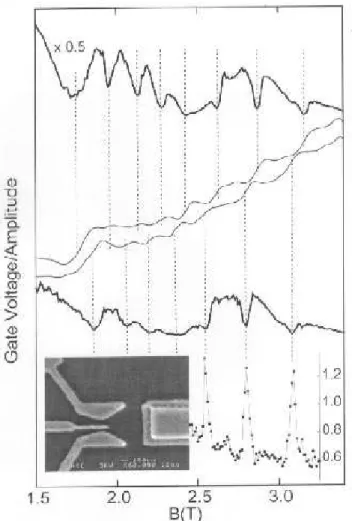
voltage positions (shifted together for clarity) for a dot containing 15-16(lower curve) and 16-17(upper curve) electrons. The amplitude of the peaks is also plotted. It is seen that the amplitude is reduced between the upward and downward cusps. This is the eld regime where qualitatively for all models, there exists a dier-ence in the number of spin up electrons between the two relevant ground states associated with that partic-ular Coulomb blockade peak (the CB peaks mark the transition between an N and N+1 electron dot). It is crucial to note that if only the bare Zeeman energy is assumed to drive the spin ips they would occur at much higher magnetic elds. Klein et al. [6] demon-strated that to account for this as well as the spacing sequence between spin ip events one needs to go to models evoking the Hartree-Fock approximation. The spin ips are in fact driven by electron-electron inter-action eects. As the magnetic eld is increased the dot eectively shrinks. To counteract the resultant in-crease in Coulomb energy the dot needs to grow. This is achieved through the spin ip events during which the spin up electrons near the center of the dot move to empty spin down orbitals near the edge of the dot. While the Hartree-Fock model explains the eld posi-tion of the spin ips a careful examinaposi-tion of Fig. 2 indicates that we need to go beyond this level of ap-proximation. The right insert of the gure presents the temperature dependence of the amplitude of the peaks. It is found experimentally that the amplitude modula-tion diminishes very rapidly as the temperature is in-creased and has virtually disappeared by only 200mK,a temperature several times lower than even the bare Zee-man energy for these elds. The lower curve in Fig. 2 plots the ratio of the amplitude of the CB peaks at base temperature and 200mK. It can be seen that the peaks even grow (i.e. the ratio>1) in the amplitude reduced
regions whereas elsewhere they shrink as expected [7]. We note, however, that by invoking exchange the gap, for ipping a spin, is no longer the bare Zeeman gap but is dramatically enhanced. In fact, one would expect the amplitude modulation to persist up to several Kelvin in sharp contrast to the experimental observation. It is in-teresting to note that in larger dots containing around 50 electrons [3] the experimental observations is sim-ilar although a comparison with exact calculations is impossible for such large dots.
Figure 2. Spin Flips (Experiment): The two curves in the center represent are the gate voltage positions of two Coulomb blockade peaks. They have been shifted together for clarity. They span the 15 to 17 electron quantum dot regime. The bold curves below and above reveal the peak amplitudes. Insets:(1) A SEM of a device similar to one of the two designs used. (2) The ratio of the peak amplitudes taken at 200mK and 50mK. A value >1 indicates that the
peak grows as the temperature is raised.
642 A.S.Sachrajdaet al.
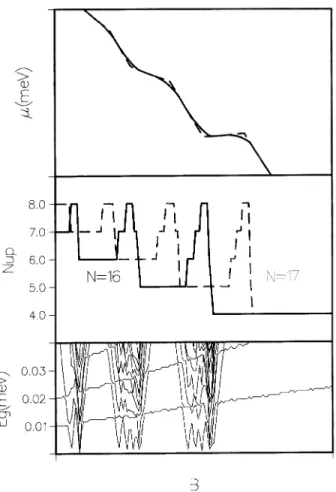
electrons monotonicallyreduces to zero as the eld is in-creased. In the exact scenario, by contrast, whilst the number of spin up electrons does go down after each spin ip event is completed, dramatic spin depolariza-tion events accompany each spin ip. In eect it is seen that a spin ip process is more intricate than the mere removal of a spin up electron near the center of the dot and its replacement as a spin down electron near the
Figure 3. Spin Flips (Theory): Top - Exact(solid) and HF(dashed) chemical potential of the 16 electron dot un-dergoing spin ips as a function of B. Middle - The number of spin up electrons in the 16(solid) and 17(dashed) electron droplet. Bottom - Excited states of the initial droplet.
edge. The interactions of this spin up electron with the background of spin down electrons away from the center and near the edge needs to be considered. How can we experimentally observe these dramatic spin texture ef-fects? In the top graph of Fig. 3 the chemical potential of the dot is plotted against magnetic eld. It is found that the only dierence between the Hartree-Fock and the exact results which include correlation eects is a
slight curving at the cusps. Realistically this conrms that the gate voltage position of the Coulomb blockade peaks cannot be easily used to search for correlation eects. In lateral devices, however, we also have ampli-tude modulation eects as described above. The lower graph in Fig. 3 shows the excitation spectrum of the dot. By including these correlation eects we have not only recovered the Zeeman gap but have also found ex-cited levels related to the spin textures. These occur at a lower energy than even the bare Zeeman gap. Thus the observation of the quenching of the amplitude mod-ulation in Fig. 2 at very low temperatures is a direct consequence of the presence of the spin textures. Re-sults of excitation level spectroscopy in the same regime will be published elsewhere.
In summary we have studied spin ips in few elec-tron lateral quantum dots. We have compared our ex-perimental results with exact calculations which take correlations into account. In particular it is found that the temperature dependence of the amplitude modula-tion at spin ip events provides direct evidence of the existence of spin textures in quantum dots.
We wish to acknowledge useful conversations with Allan MacDonald, Guy Austing, J.J.Palacios and Igor Zozoulenko.
References
[1] P.L. McEuen Science78, 1729 (1997).
[2] P. Hawrylak, C. Gould, A. Sachrajda, Y. Feng and Z. Wasilewski Phys. Rev.65, 2801 (1999).
[3] P.L. McEuen, E.B. Foxman, U. Meirav, M.A. Kastner, Y. Meir, N.S. Wingreen and S.J. Wind, Phys. Rev. Lett. 66, 1926 (1991); P.L. McEuen, E.B. Foxman,
J.M. Kinaret, U. Meirav, M.A. Kastner, N.S. Wingreen and S.J. Wind, Phys. Rev. B4511419 (1992).
[4] S. Tarucha, D.G. Austing, T. Honda, R.J.van der Hage, L.P. Kouwenhoven, Phys. Rev. Lett.77, 3613 (1996).
[5] I.V. Zozoulenko, A.S. Sachrajda, C. Gould, K.-F. Berggren, P. Zawadzki, Y. Feng and Z. Wasilewski, submitted to Phys. Rev. Lett.
[6] O. Klein, C.de C. Chamon, D. Tang, D.M. Abusch-Magder, U. Meirav, X.-G. Wen, M.A. Kastner and S.J. Wind, Phys. Rev. Lett. 74, 785 (1995); O. Klein, D.
Goldhaber-Gordon, C.de C. Chamon, M.A. Kastner, Phys. Rev. B53, R4221 (1996).