The Threshold Condition for Stochastic Diusion of
Energetic Ions due to Lower Hybrid Waves
L. F.Zieb ell
and L. M.Tozawa y
InstitutodeFsica
UniversidadeFederaldoRioGrandedoSul
CaixaPostal15051-CEP:91501-970,PortoAlegre,RS,Brazil
Received22May,1998
In the present paper we consider the interaction between energetic ions and lower hybrid waves in tokamak plasmas and study the parametric dependence of the threshold condition for stochastic ion diusion. It is shown that the threshold condition as obtained in the work by Karney [C. F. F. Karney, Phys. Fluids22, 2188 (1979)] may be not easily satised in present day large tokamaks, but can attained in small tokamaks with relatively modest levels of wave power.
I Introduction
In a series of two papers published in 1978 and 1979, it has been shown that the movement of an ion in a uniform magnetic eld becomes stochastic in the pres-ence of a perpendicularly propagating coherent electro-static wave, if the wave amplitude exceeds a threshold [1, 2]. Due to the stochasticity the ion diuses in ve-locity space, and this diusion may be described by a diusion equation which also applies to the case of lower hybrid waves in the slow mode (non-vanishing k
k << k
?), propagating in a weakly inhomogeneous magnetic eld [2]. The possibility of this diusion mechanism raised important questions related to the eciency of proposed RF current drive schemes using lower hybrid (LH) waves [3, 4, 5]. In particular, it has been argued that in fusion reactors the presence of particles originated from fusion reactions would con-tribute to decrease the eciency of the lower hybrid current drive, since part of the energy of the LH waves would be absorbed by theparticles [1]. The potential importance of this interaction between LH waves and particles has motivated subsequent investigations, and many examples may be found in the recent literature [6, 7, 8, 9, 10, 11, 12, 13]. Investigations have also been
made by considering other kind of possible interactions, as the interaction between LH waves and a population of energetic ions generated by neutral beam injection [14, 15, 16, 17], and the interaction between LH waves and fast ions generated by IC waves utilized for ion heating. Some experimental results on this subject are available, as those originated from relatively recent ex-periments conducted in the JET tokamak (Joint Euro-pean Torus) [18, 19]. The results of these experiments provide evidence of signicant absorption of LH waves by fast ions, and therefore conrm the convenience of further investigations on this important issue concern-ing the dynamics ofparticles or other energetic ions in the environment of a reactor, and the eciency of the LH waves for radio frequency current drive.
In the present paper we study particular features of the subject, considering the threshold condition for stochastic diusion of energetic ions, in a tokamak en-vironment modelated by a plasma slab. We utilize the formalism proposed by Karney [2], discussing the de-pendence of the threshold condition on some wave and plasma parameters, for large present day tokamaks and for small scale tokamaks, and compare the value of the electric eld predicted by the threshold condition with the wave electric eld inside the tokamak.
The plan of the paper is the following. In Sec. II it is presented a short summary about the equation de-scribing stochastic ion diusion, as proposed by Karney [1, 2], and it is introduced the threshold condition for the occurrence of this process. In Sec. III we describe the model to be utilized for the tokamak and for the lower hybrid wave packet. Using the model, in Sec. IV we discuss the dependence of the threshold condition on plasma and wave parameters, and present results of comparisons between the wave amplitude required by the threshold condition and the wave electric eld which shall be present in situations typical of experi-ments conducted in large present day tokamaks and in small tokamaks. Finally, in Sec. V we summarize the main results of the paper, and comment on possible
future developments of this investigation.
II The threshold condition for
stochastic ion diusion
According to the formalism developed by Karney [2], the diusion in velocity space produced by a lower hy-brid wave with angular frequency ! and components of the wave number N? and Nk may be described by the following equation, in normalized form,
(@ if
i) lh= 1u
? @u
?(u ?Dlh@u
?f
i); (1)
where the ion thermal velocity is used for velocity nor-malization (u v=v
i), fi is the ion distribution func-tion, and where
c
Dlh(u?) = 8 > > > > > > > > > <
> > > > > > > > > :
4
E 2 0 c
2 B
2 0
2 i N
2 ? u
2 ?
i i
jH (1)0
()
j 2
g2(
A); for u ?
u
ph; Dlh(uph); for uph
,u tr
u
? < uph; Dlh(uph)[u?
,(u ph
,2u tr)]
2
; for uph ,2u
tr
u
?< uph ,u
tr; 0; for u?< uph
,2u tr:
(2)
d Moreover,
uph= !=(k?vi); utr = (qiE0=mik?) 1=2
=vi;
A= rjH (1)0
()
j; (3)
with the introduction of the following denitions = !=i; r = k?v?=i; and
= E0 B0
k? i
= E0 B0
N? c ;
where N? = ck?=!. The quantity k? is the perpen-dicular component of the wave vector k,
i is the ion cyclotron frequency, E0 is the amplitude of the wave electric eld, and B0 is the ambient magnetic eld. We have also dened i = mic
2=T
i. The quantities H (1) and H(1)0
are respectively the Hankel function of rst kind and its derivative, given by
jH (1) (r)
j'(2=) 1=2
(r2 ,
2) ,1=4
;
jH (1)0 (r)
j'(2=) 1=2
(r2 ,
2) 1=4
=r; for r + (=2)
1=3
[2]; for r < + (=2)1=3
, it is used
jH (1) (r)
j'jH (1)
( + (=2) 1=3
)j;
jH (1)0 (r)
j'jH (1)0
( + (=2) 1=3
)j:
In Eq. (2) the threshold condition is expressed by the quantity g(A). This quantity is zero forAsmaller thanA
sand grows fast to g(
A) = 1 for Alarger than A
s[2],
g(A) = max
1,A 2 s=
A 2;0
: (4)
The stochasticity condition denes the situation in which a stochastic layer occupies a substantial fraction of the phase space, and therefore the diusion becomes eective. This condition does not allow a precise def-inition of A
A = A
s the phase change suered by a particle in the wave-particle resonance would be equal to =2, and therefore assumes thatA
s= 0
:25 [2]. The same condi-tion is assumed for most of the present work.
Another quantity appearing in Eq. (2) is the frac-tion of time in which the particles remain under the ef-fect of the lower hybrid waves, denoted by[2], which is a quantity dependent on the existence of models for the tokamak and the wave packet.
III Models of the wave packet
and of the tokamak
In order to atribute to the quantities which have been dened a numerical value at a given position in the tokamak, it is necessary to have a picture about wave propagation and energy deposition of the wave. Accu-rate description of these processes is dicult to achieve, and therefore we assume a simplifying model which is intended to be useful providing an estimate about the feasibility of the stochastic diusion, as a function of wave and plasma parameters.
For these purposes a model tokamak described by a slab of plasma shall be satisfactory. We assume the following simple proles
n (
x) =n (0) 1, x 2 a 2 T (
x) =T (0) 1, x 2 a 2 2 (5) B 0(
x) =B 0(0)
1 + x
R
,1 ;
whereais the minor radius,Ris the major radius, and xis the radial coordinate in the equatorial plane, with the origin in the center of the plasma column. n
(0), T
(0), and B
0(0) are respectively the density and elec-tron temperature of speciesand the ambient toroidal magnetic eld, at the center of the plasma.
Regarding the lower hybrid waves, let us assume a gaussian packet propagating in the tokamak, with spectral distribution centered at N
k = N
k, and with half-width given by N
k, S(N
k) = S 0 e ,(N k ,N k ) 2 =(N k ) 2 p (N k) ; (6) where R dN k S(N
k) = S
0, the local wave intensity. The local amplitude of the electric eld, which is necessary to evaluate the threshold condition, may be given by the following [20]
E 0(
N k) =
16 (4 0)
c jBj j@D =@Nj
S(N k) 1=2 : (7) where c
B=D 11 D 22 ,jD 12 j 2+ D 11 D 33 ,jD 13 j 2+ D 22 D 33 ,jD 23 j 2 ; (8) D= 11 N 4 ?+ N 2 ?( N 2 k( 11+ 33) , 2 11 , 2 12 , 11 33) +
33[( 11 ,N 2 k) 2+ 2 12] = 0
; (9)
d and the D
ij are dened as D ij = N i N j ,N 2 ij+ ij, where theN
i are the components of ~ N =c
~
k =!and the
ij are the components of the dielectric tensor obtained in the cold plasma approximation. The expression de-ned asD is the dispersion relation for LH waves.
Regarding the energy deposition, we consider the following: the wave packet propagating with half-width N
k has a spatial half-width
z = 2c=(!(N k)). If we assume a poloidal width for the wave packet, the area aected by the wave in a magnetic surface of
radius r will be given by S
! = 2(
z)()r, while the area of the magnetic surface itself will be S = 4
2 r R. If the wave power is given byW
0, the local intensity S
0 is given byS
0= W
0 =S
!.
This rather rough estimate of wave intensity tends to very large values near the center of the tokamak, and indeed diverges for r !0, since S
!
set a minimum value forS
!and a corresponding maxi-mum value forS
0, chosen as the values of S
! and S
0at r= 2 cm. Even with this cut-o value which avoids the divergence at r !0, it is possible that this simplied model is super-estimating the local magnitude of the wave electric eld, for the central regions.
IV Parametric dependences of
the threshold condition
The model introduced in the previous section may be used to evaluate the amplitude of the wave electric eld, for each component of the wave packet, since the ampli-tudeE
0depends on S(N
k), according to Eq. (7). If the wave packet is suciently narrow, we may assume that only the central ray of te packet is signicant, and that the diusion coecient as given by Eq. (2), derived for a single wave, is a good approximation to be em-ployed in the analysis of ion diusion in velocity space. Therefore, it is interesting to know the parametric de-pendence of the threshold condition for the occurence of the stochastic diusion, and compare the threshold value with the wave electric eld, for parameters typical of present day experiments.
Using the denition ofA given by Eq. (3) and the condition A > A
s, the threshold value of the electric eld amplitude at a given plasma position is given by the following condition
(E 0)
t=
A s
r
N ?
2
jH (1)0
(
r)j B
0
c: (10)
For some numerical estimates on this quantity, let us initially consider the case of a large tokamak, with parameters corresponding to those of the JET (Joint European Torus): n
e(0) = 3 :510
19 m,3, T
e(0) = 5 :0 keV, equal ion and electron densities and temperatures, and B
0(0) = 3
:0 T (geometrical factors like the mi-nor radius and the major radius will not be necessary for the determination of the threshold condition or the wave amplitude, according to the model which we have utilized). For the lower hybrid waves the relevant pa-rameters are !,N
k, N
k, and W
0. Another necessary parameter is , which will be assumed as = =4 [2]. For given values of ! and N
k, the dispersion rela-tion is solved andN
? is determined.
Initially, let us choose the positionx = 0 cm and != 1:5!
lh, where !
lhis the local lower hybrid angular frequency, N
k= 0
:2, and four values ofN
k, chosen in order to be resonant with electrons of 3, 4, 5 and 6 local
electron thermal velocities. For JET-like parameters, these correspond respectively to N
k = 3
:37;2:53;2:02, and 1:68. These values ofN
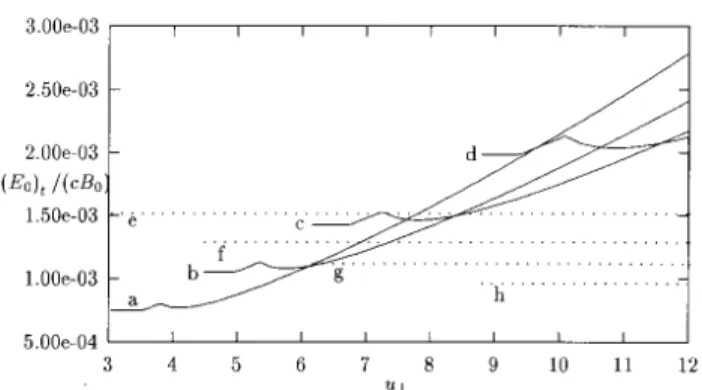
kall satisfy the acessibility condition to the center of the tokamak [18]. For these parameters, in Fig. 1 we show the normalized threshold amplitude (E
0)t =(cB
0) at
x= 0 cm, evaluated accord-ing to Eq. (10). The threshold amplitude is shown as a function ofu
?, the perpendicular ion velocity normal-ized to local ion thermal velocity, foru
?above perpen-dicular phase velocity for the central ray of the wave packet, ! =k
?( N
k
;!). The gure also shows the nor-malized amplitude of the central ray of the wave packet, E
0( N
k) =(cB
0), as a function of u
?, for W
0 = 2 :0 MW and the same values ofN
k, for the whole range where the diusion coecient may be non-vanishing. This amplitude, of course, has been evaluated with the use of Eq. (7) applied to the case ofN
k = N
k, the value of N
kat the center of the wave packet.
Figure 1. Normalized threshold amplitude (E0) t
=(cB0) as a function of u
?, for
! = 1:5 ! lh,
N k = 0
:2, for x= 0 cm and parameters similar to those of the JET tokamak. (a) N
k=3.37; (b) N
k=2.53; (c) N
k=2.02; (d) N
k= 1 :68 (vr es= 3;4;5;and 6ve, respectively)). The dotted straight lines (e), (f), (g), and (h) represent the normalized ampli-tude of the electric eld for the central ray,E0(N
k) =(cB0), as a function ofu
?, for W
0= 2
:0 MW and the same values ofN
k, respectively.
It is seen that for the parameters utilized the thresh-old condition is satised by the wave at the center of the packet only ifN
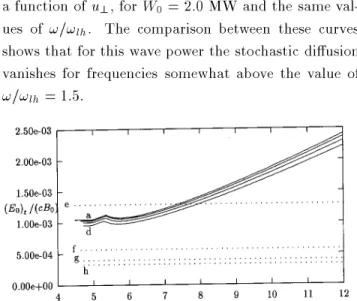
Figure 2. Normalized threshold amplitude (E 0)
t =(cB
0) as a function ofu?, for N
k= 0 :2,N
k= 2
:53 (vr es= 4ve), for x = 0 cm, for parameters as those of the JET toka-mak. (a)! =!lh = 1:5; (b) ! =!lh = 2:0; (c)! =!lh = 2:5. The dotted straight lines (d), (e), and (f) represent the nor-malized amplitude of the electric eld for the central ray, E0(N
k)
=(cB0), as a function ofu?, forW0 = 2:0 MW and the same values of! =!
lh, respectively.
Fig. 2 displays the normalized threshold amplitude (E
0)t =(cB
0) at
x = 0 cm, for N k = 2
:53, for several values of the ratio! =!
lh, and other parameters as in Fig. 1. It is also seen the quantity E
0( N
k) =(cB
0), as a function ofu
?, for W
0 = 2
:0 MW and the same val-ues of ! =!
lh. The comparison between these curves shows that for this wave power the stochastic diusion vanishes for frequencies somewhat above the value of ! =!
lh= 1 :5.
Figure 3. Normalized threshold amplitude (E 0)
t =(cB
0) as a function ofu?, for N
k= 0 :2,N
k= 2
:53 (vr es= 4ve), ! =!lh = 1:5, for parameters as those of the JET tokamak. (a) x= 0 m; (d) x = 0:30 m; between these two curves, there are two corresponding to x= 0:10 and 0:20 m. The dotted straight lines (e), (f), (g), and (h) represent the nor-malized amplitude of the electric eld for the central ray, E0(N
k)
=(cB0), as a function ofu?, forW0 = 2:0 MW and the same values ofx, respectively.
In Fig. 3 the quantity (E 0)t
=(cB
0) appears for N
k = 2
:53 and ! =! lh = 1
:5, and other parameters also as in Fig. 1, for several values of x (x = 0:00, 0:10, 0:20, and 0:30 m). The curves depict the weak dependence of the threshold amplitude on the position,
according to the model utilized. On the other hand, the amplitude of the central ray of the wave packet is more strongly dependent on position, as seen from the curves for E
0( N
k) =(cB
0), as a function of u
?, for W
0 = 2 :0 MW and the same values of x, also appearing in Fig. 3. For this wave power, it is seem that the stochastic diusion is eective only in the central region of the tokamak, for the model utilized.
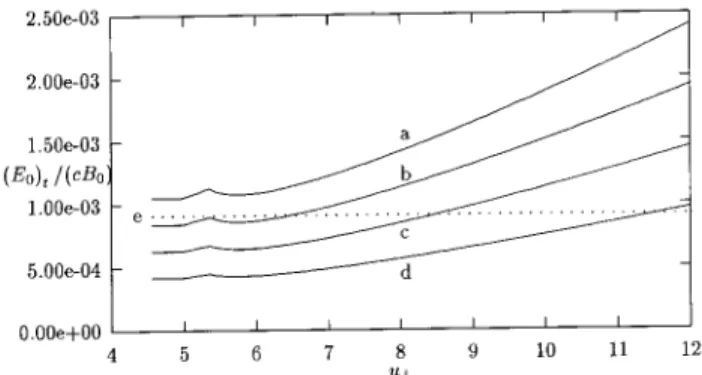
Figure 4. Normalized amplitude of the electric eld for the central ray, E0(N
k)
=(cB0) as a function of u?, for N
k = 2
:53 (vr es = 4ve) and the other parameters as in Fig. IV, and several values ofW0 ((d)W0 = 1:0 MW; (c) W0 = 1:5 MW; (b) W0 = 2:0 MW; (a) W0 = 2:5 MW). The dotted curve (e) represents the normalized threshold amplitude (E0)
t
=(cB0), forN k= 2
:53.
In Fig. 4 we show E 0(
N k)
=(cB
0) as a function of u
?, for N
k= 2
:53 and the other parameters as in Fig. 1, and several values ofW
0(1
:0, 1:5, 2:0, and 2:5 MW). For comparison it is also shown in this gure the curve for (E
0)t =(cB
0) for N
k = 2
:53. These results show that the threshold condition is only satised for wave powers somewhat close to 1:5 MW and above.
In order to illustrate the dependence of threshold amplitude and wave amplitude on dierent plasma con-ditions, we also consider a small tokamak, with the fol-lowing parameters: n
e(0) = 1 :010
19m,3, T
e(0) = 0 :5 keV, equal ion and electron densities and temperatures, B
0(0) = 1
:5 T, a = 0:2 m, and R = 1:0 m. As in the case of the JET-like tokamak, we choose the po-sition x = 0 cm and ! = 1:5 !
lh, N
k = 0 :2, and four values ofN
k, in order that the center of the wave packet is resonant with electrons of 3, 4, 5 and 6 elec-tron thermal velocities. For the parameters assumed for the small tokamak, these correspond respectively to N
k = 10
:6;7:99;6:39, and 5:33. For these parameters, in Fig. 5 we show the normalized threshold amplitude (E
0)t =(cB
0) at
x = 0 cm, as a function of u
comparison with the wave amplitudes which appear in the same gure for the same values of N
k shows that for these parameters of a small tokamak the threshold condition is satised for the wave at the center of the packet up to resonant velocities near 6v
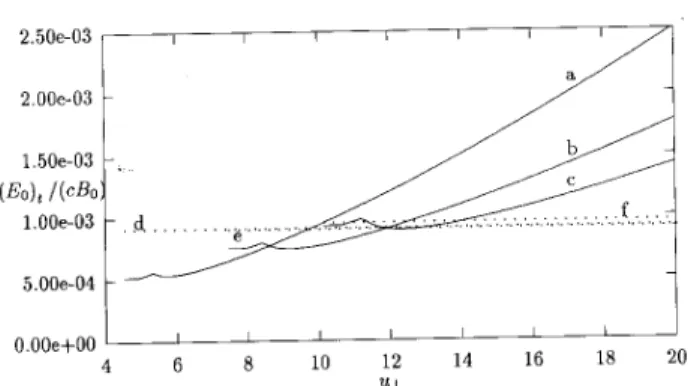
e. In Fig. 6 we show E
0( N
k) =(cB
0) as a function of u
?, for N
k= 7
:99 and the other parameters as in Fig. 5, and several values ofW
0(25, 50, 75, and 100 kW). It is also seen in this gure the curve for (E
0)t =(cB
0) for N
k= 7
:99. The gure shows that for these parameters even the wave power of 25 kW is sucient to satisfy the threshold condition and cause stochastic diusion.
Figure 5. Normalized threshold amplitude (E 0)
t =(cB
0) as a function ofu?, for!= 1:5!lh, N
k= 0
:2,x= 0 cm and parameters typical of a small tokamak (ne(0) = 1:010
19 m,3,
T e(0) = 0
:5 keV, equal ion and electron densities and temperatures, B0(0) = 1:5 T,a= 0:2 m, andR= 1:0 m). (a)N
k= 3.37; (b) N
k= 2.53; (c) N
k= 2.02; (d) N
k= 1 :68 (vr es = 3;4;5;and 6ve, respecively). The dotted straight lines (e), (f), (g), and (h) represent the normalized ampli-tude of the electric eld for the central ray,E
0( N
k) =(cB
0), as a function of u?, forW0 = 50 kW and the same values ofN
k, respectively.
Figure 6. Normalized amplitude of the electric eld for the central ray, E0(N
k)
=(cB0) as a function of u?, for N
k= 7
:99 (vr es= 4ve) and the other parameters as in Fig. IV, and several values ofW
0 ((a) 25 kW; (b) 50 kW; (c) 75 kW; (d) 100 kW). The dotted curve (e) represents the nor-malized threshold amplitude (E
0) t
=(cB 0), for
N k = 7
:99.
We now consider the eect of the parameterA s on the threshold condition. The motivation for this is the reasoning that the simultaneous presence of more than one LH wave should contribute to the increase of the stochastic layer in phase space, as compared to the case where only one LH wave is interacting with the ions, as considered in the formulation employed in the present work. Therefore diusion in velocity space should be made easier by the presence of a group or spectrum of LH waves, which could appear as a reduced threshold requirement, or reduced value ofA
s. An interesting and more rigorous line of investigation would be to follow similar procedures as those employed by Karney, but considering the existence of more than one LH wave, and verify the modication in the threshold condition, as a function of the number of waves or spectral width. Such an investigation is beyond of the objectives of the present work, and is one of the possibilities oered to continue our research on the subject of interaction be-tween LH waves and energetic ions. The present inter-est rinter-ests only on the observation of the eects of the value of A
s on the threshold condition, as a function of some important parameters. Therefore, in Fig. 7 we showE
0( N
k) =(cB
0) as a function of u
?, for N
k= 2 :53 andW
0= 1
:0 MW, other parameters as in Fig. 1, and several values of A
s, starting from the value used in the work by Karney,A
s=0.25 [2]. It is seen that, while the original threshold condition would not be satised forW
0 = 1
:0 MW, it is already satised over a limited range ofu
? for A
s = 0
:2, and is well satised over a large range ofu
?for A
s= 0 :1.
Figure 7. Normalized threshold amplitude (E0) t
=(cB0) as a function ofu
?, for
!= 1:5! lh,
N k= 2
:53 (v r es = 4
v e), N
k = 0
:2, x = 0 cm, and parameters as those of the JET tokamak. (a)A
s=0.25; (b) A
s=0.20; (c) A
s=0.15; (d) A
s= 0.10. The dotted straight line (e) represents the nor-malized amplitude of the electric eld for the central ray, E0(N
k)
Finally, in Fig. 8 we show the normalized threshold amplitude (E
0)t =(cB
0) at
x= 0 cm, forN k= 2
:53 and A
s= 0.125, for several values of the ratio ! =!
lh, and other parameters as in Fig. 1. It is also seen the quan-tity E
0( N
k) =(cB
0), as a function of u
?, for W
0 = 1 :0 MW and the same values of! =!
lh. We see the thresh-old condition still satised over a small range of values ofu
?, even for ! =!
lh = 2
:5, while Fig. (2) shows that for this frequency the threshold was not attained even by consideringW
0= 2
:0 MW.
Figure 8. Normalized threshold amplitude (E 0)
t =(cB
0) as a function of u?, at x = 0 cm, for N
k = 2
:53 (vr es = 4 v
e), N
k= 0
:2, andA
s=0.125, for parameters as those of the JET tokamak. (a)! =!lh = 1:5; (b) ! =!lh = 2:0; (c) ! =!
lh= 2
:5. The dotted straight lines (d), (e), and (f) rep-resent the normalized amplitude of the electric eld for the central ray,E0(N
k)
=(cB0), as a function ofu?, forW0= 1:0 MW and the same values of! =!
lh, respectively.
V Summary and conclusions
In the present paper we have carried out an analysis of the threshold condition for stochastic diusion of en-ergetic ions in a tokamak, due to the interaction with lower hybrid waves of suciently high intensity. The tokamak plasma and the lower hybrid wave have been described by a simple model which is intended to con-tribute for the understanding of basic features related to the stochastic diusion and its theoretical descrip-tion.
In the description of the lower hybrid waves we have considered the presence of a spectrum of waves, which has allowed us to evaluate at each position the ampli-tude of the wave electric eld, for a given wave power. However, we have assumed that for a narrow spectra it
is possible for certain purposes to describe it approx-imately as a single wave, and based on this assump-tion we have analyzed the dependence of the thresh-old condition on some plasma and wave parameters. We have concluded that, although the stochastic diu-sion is possible for present day large tokamaks and for reasonable LH wave power, the threshold condition is not always satised in the range of frequency and wave power where it has been observed in some recent experi-ments. The fact that the lower hybrid induced diusion has been observed under conditions which do not sat-isfy the stochastic condition for the individual waves of the wave packet, may be related to the presence of a spectrum of waves instead of a single wave as assumed in the theoretical description which has been utilized, based on the work by Karney [2]. It is indeed con-ceivable that the eect of the simultaneous presence of waves with dierent wave numbers would increase the eciency of the diusion process. We intend to verify the validity of this conjecture and a possible modi-cation of the threshold condition in our forthcoming investigations on the subject, but we have nevertheless evaluated the threshold value of the wave electric eld, for dierent values of the parameter which controls the threshold condition, as a function of dierent parame-ters.
The model developed for the spectrum of LH waves propagating in a tokamak can be utilized to evaluate a diusion coecient for stochastic diusion of ener-getic ions, to be employed in a quasilinear description of the time evolution of the ion distribution function. We are investigating the subject and intend to publish our ndings in a forthcoming publication.
Acknowledgments
and R.S.Schneider.
References
[1] C. F. F. Karney, Phys. Fluids21, 1584 (1978). [2] C. F. F. Karney, Phys. Fluids22, 2188 (1979). [3] N. J. Fisch, Phys. Rev. Lett.41, 873 (1978).
[4] C. F. F. Karney and N. J. Fisch, Phys. Fluids22, 1817 (1979).
[5] N. J. Fisch, Rev. Modern Phys.59, 175 (1987). [6] E. Barbato and F. Santini, Nucl. Fusion31, 673 (1991). [7] M. Spada, M. Bornatici, and F. Engelmann, Nucl.
Fu-sion 31, 447 (1991).
[8] D. Anderson, V. S. Belikov, Y. I. Kolesnichenko, and M. Lisak, Phys. Fluids B3, 3125 (1991).
[9] N. J. Fisch and J. Rax, Phys. Rev. Lett.69, 612 (1992).
[10] N. J. Fisch and J. Rax, Nucl. Fusion , 549 (1992). [11] J. A. Heikkinen and S. K. Sipila, Nucl. Fusion36, 1345
(1996).
[12] J. A. Heikkinenetal., Plasma Phys. Contr. Fusion38, 2063 (1996).
[13] J. A. Heikkinen and T. P. Kiviniemi, Phys. Lett. A 214, 53 (1996).
[14] A. H. Kritzetal., Nuclear Fusion 18, 835 (1978). [15] K. Ushigusaetal., Nuclear Fusion29, 265 (1989). [16] T. Imaietal., Nuclear Fusion30, 161 (1990). [17] M. Nemotoetal., Phys. Rev. Lett.67, 70 (1991). [18] M. C. R. de Andrade, M. Brusati, and the JET team,
Plasma Phys. Contr. Fusion36, 1171 (1994).
[19] M. C. R. de Andrade, PhD thesis, USP, Curso de Pos-Graduac~ao em Fsica, 1994.