Mycobacteriosis in patients with breast implants: a
case review from the Ivo Pitanguy Institute
Micobacteriose em implantes mamários: revisão da casuística do Instituto Ivo
Pitanguy
Study conducted at the Plastic Surgery Service of Professor Ivo Pitanguy, Santa Casa da Misericórdia do Rio de Janeiro, Rio de Janeiro, RJ, Brazil.
Submitted to SGP (Sistema de Gestão de Publicações/Manager Publications System) of RBCP (Revista Brasileira de Cirurgia Plástica/Brazilian Journal of Plastic Surgery).
Received: July 18, 2011 Accepted: August 30, 2011
1. Plastic Surgeon, Postgraduate at Instituto Ivo Pitanguy, Rio de Janeiro, RJ, Brazil. 2. General Surgeon, Postgraduate Student at Instituto Ivo Pitanguy, Rio de Janeiro, RJ, Brazil.
3. Plastic Surgeon, Full Member of the Brazilian Society for Plastic Surgery (BSPS), Assistant Professor of the Postgraduate Medical School In Plastic Surgery at Pontifícia Universidade Católica do Rio de Janeiro (PUC-RJ) and at Instituto de Pós-Graduação Médica Carlos Chagas, Rio de Janeiro, RJ, Brazil. 4. Patron of BSPS, Member of the Academia Nacional de Medicina e Academia Brasileira de Letras, Full Professor of the Medical Postgraduate School of
Plas-tic Surgery at PUC-RJ and at Instituto de Pós-Graduação Médica Carlos Chagas, Rio de Janeiro, RJ, Brazil.
GABRIELLE BESSA WAJNBERG1 VINICIUS VOLPE D’ANGIERI BASILE2 LUÍS GUSTAVO MORAES PRADO2 JOSÉDE FARIA3 HENRIQUE N. RADWANSKI3 IVO PITANGUY4
ABSTRACT
Introduction: Reports of infections caused by rapidly growing mycobacteria during plastic surgery have increased in recent years despite improvements in techniques of asepsis/ anti-sepsis and antibiotic prophylaxis. Infections occurring after the insertion of breast implants
are a cause of patient morbidity and a signiicant problem for the surgeon. Methods: Breast
implant surgery cases complicated by mycobacterial infections at the Inirmary ward 38th of the Santa Casa da Misericórdia, Rio de Janeiro were retrospectively reviewed. A description of the current guidelines for the prevention and treatment of mycobacteriosis is included.
Labo-ratory conirmed and clinically suspected cases were included in this study. Results: Of 483 augmentation mammaplasty cases, 3 patients developed mycobacterial infections in the last
3 years. In 2 patients, there was a suspicion of infection that was not conirmed by laboratory
data. Conclusions: Prophylaxis is fundamental for reducing the incidence of
mycobacterio-sis during plastic surgery procedures. However, the identiication, diagnomycobacterio-sis, and treatment
of mycobacterial diseases are important to minimize the morbidity of this type of infection.
Keywords: Mycobacteria, atypical. Mycobacterium. Breast implantation. Mammaplasty/ adverse effects. Infection.
RESUMO
Introdução: Nos últimos anos, foram crescentes os registros de infecções por micobactéria de crescimento rápido em cirurgia plástica, mesmo com a melhoria dos métodos de assepsia/
antissepsia e da antibioticoproilaxia. A infecção após inclusão de implantes mamários causa
grande morbidade às pacientes e transtorno ao cirurgião. Método: Estudo retrospectivo dos
casos de infecção por micobactéria de crescimento rápido da 38ª Enfermaria da Santa Casa da Misericórdia do Rio de Janeiro, após inclusão de implantes mamários, em que são apre-sentadas propostas de prevenção e tratamento da micobacteriose. Foram incluídos os casos
conirmados laboratorialmente e os clinicamente suspeitos. Resultados: Até o presente
mo-mento foram conirmados 3 casos de infecção por micobactéria, num total de 483 mamaplastia
de aumento no decorrer de 3 anos. Em 2 pacientes, houve suspeita de infecção, porém sem
conirmação laboratorial. Conclusões: A proilaxia é o pilar fundamental para a redução do
impacto da micobacteriose em procedimentos de cirurgia plástica. Entretanto, saber identiicar,
diagnosticar e tratar corretamente a micobacteriose é de suma importância para minimizar a morbidade da paciente.
INTRODUCTION
Infection is one of the most feared complications of breast implant surgery, occurring in 1% to 2% of surgery cases1.
The most common causative agents are Staphylococcus
aureus and coagulase-negative Staphylococcus. Although uncommon, postoperative infection in breast implant surgery
is associated with signiicant morbidity. In most cases, these
patients require additional operations and prolonged anti-biotic treatment, which may compromise the result of the original surgery. In addition to implant removal, implant re-insertion surgery can be delayed for months or even years2.
Reports of mycobacterial infections after cosmetic surgery have been increasing in recent years, particularly those in
association with liposuction and augmentation mastoplasty3.
This may be due to the contamination of surgical instruments, immunosuppression of the host, or establishment of new
laboratory methods of diagnosis2.
Mycobacteria, which are abundant in the environment,
were irst described by Hansen in 18683. These organisms have peculiarities related to the amount and types of complex lipids in their cell walls. This unique cell wall, rich in lipids,
is an eficient and impermeable barrier, and it increases the
antibiotic resistance of mycobacteria in comparison to other bacteria.
The rapidly growing mycobacteria Mycobacterium
fortuitum, M. chelonae, and M. abscessus areopportunistic microorganisms, normally found in soil, dust, and water pipes. They rarely cause diseases in humans, unless they are inoculated directly into the body through wounds or conta-minated surgical equipment.
The largest group of atypical mycobacteria of clinical
importance, according to the classiication of Runyon, is the
group of fast-growing bacteria or group 4. Often involved in skin and soft tissue infections, they have been associated with infections caused by intravenous and peritoneal catheters, abscesses after injections, surgical site infections, mastoplas-ties, and ophthalmic surgeries3.
Mycobacterial infections can have a presentation similar to that of other microbial agents commonly associated with implant surgery, except that they are characterized by a later
onset, approximately 4 to 6 weeks after surgery. The clinical
presentation of mycobacterial infection includes an odorless and colorless secretion in the surgical wound, and it may be accompanied by systemic signs such as fever and asthenia.
The diagnosis of mycobacterial disease requires a posi-tive culture for this organism. Aspirated material should be Gram stained; tested for acid-alcohol resistant bacillus (BAAR); and cultured for aerobic and anaerobic bacteria, fungi, and mycobacteria4. The determination of the myco-bacterial subtype is extremely important to determine the
speciic antibiotic therapy. To this end, 2 biochemical tests are
commonly used: tolerance to sodium chloride and to citrate, and the polymerase chain reaction (PCR).
The present study is an analysis of the prognosis and treatment of mycobacterial infection based on a review of the incidence, diagnostic methods, progression, and treatment of mycobacterial infection patients in the Ivo Pitanguy Plastic
Surgery Institute at Inirmary ward 38 of the Santa Casa da
Misericordia, Rio de Janeiro.
METHODS
The medical records of patients who developed infections caused by rapidly growing mycobacteria after breast implant
surgery were reviewed. Only infections conirmed by labo -ratory data during 2008, 2009, and 2010 were included. Two
cases of suspected infection without laboratory conirmation
that were treated for mycobacteriosis were also reviewed. This study was approved by the Ethics Committee of the Ivo Pitanguy Plastic Surgery Institute.
RESULTS
Reports of Conirmed Cases
First case –A 23-year-old woman underwent surgery for the insertion of round silicone breast implants with polyure-thane coating, 285 ml in the right and 195 ml in the left breast through a lower periareolar incision at the retroglandular location on March 3, 2008. On the 22nd day after surgery, the patient complained of weight in the right breast, without local
and/or systemic signs of inlammation. An ultrasonongaphy was obtained, and it evidenced an infected luid collection. On postoperative day 36, a spontaneous serous drainage was
detected at the right breast incision site, and the drainage was sent for culture and sensitivity tests. Antibiotic therapy with
ciproloxacin (500 mg every 12 hours) was started.
The culture was positive for M. abscessus. The breast implants were removed, and the patient was referred to an infectious diseases specialist. After the removal of the implants, the patient did not comply with the follow-up recommendations.
Second case – A 31-year-old woman underwent
sili-cone breast implant surgery, with round, textured, 260-ml
implants inserted through a lower periareolar incision at the retroglandular location on February 4, 2009. On day 15 day after surgery, there was a purulent discharge from the right breast incision site. The cultures of the discharge were sent
for analysis, and the patient was treated with ciproloxacin
The culture result was again negative for mycobacterial disease, but the tissue sample analyzed showed alterations consistent with infection by rapidly growing mycobacteria:
chronic granulomatous inlammatory process and necro -tizing granulomas with the presence of epithelioid cells, histiocytes, and giant cells (Figure 1).
The patient was treated for rapidly growing mycobac-teria with clarithromycin (500 mg orally every 12 hours for 4 months). On August 4, 2009, breast implant surgery was performed again using a similar size and shape of implant and the same surgical scars at the retroglandular position, with no reported complications to date.
Third case – A 34-year-old woman underwent
inser-tion of round, textured, 305-ml silicone breast implants through a lower periareolar incision at the retroglandular location on July 15, 2010. On day 13 after surgery, she presented with hematoma in both breasts. Drainage of the hematoma was performed in the operating room, and after irrigation of the undermined areas, the implants were re-inserted through the same incision. Drainage tubes were left in place for 2 days. The patient was maintained on antibiotic therapy with ciprofloxacin (500 mg every 12 hours) for 15 days.
On day 28 after surgery, the patient presented with an increased volume of the right breast and asthenia. The
ultraso-nography revealed luid collection posterior to the implant in
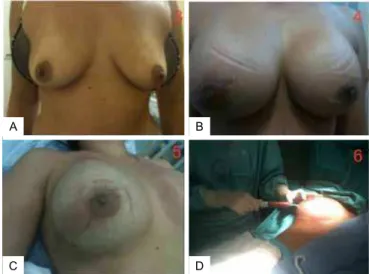
the right breast, and the blood count was normal. The material was aspirated with a Klein needle and sent for culture and sensitivity tests (Figure 2). The patient was hospitalized with
fever and signs of inlammation around the area of puncture,
and was started on intravenous antibiotic therapy. As there was no improvement in her clinical condition, her breast implants were removed and culture of the collected material was requested.
The patient recovered well in the irst 48 hours of cipro
-loxacin use. Three days later, there was a positive result for
BAAR in all samples and clarithromycin 500 mg was given every 12 hours orally. After 3 weeks, samples tested posi-tive for mycobacterial disease. The patient was kept on oral
antibiotics with ciproloxacin and clarithromycin, awaiting
the completion of the antibiotic therapy for re-insertion of new implants.
Reports of Suspected Cases
First case – A 23-year-old woman underwent surgery for insertion of round, textured, 325-ml silicone breast implants through a lower periareolar incision at the retroglandular
location on September 1, 2009. On postoperative day 60, the
patient presented with a purulent discharge at the scar. The
patient was treated with ciproloxacin (500 mg every 12 hours
for 10 days), and a dry dressing was applied to the wound. After 9 days, the patient presented with partial exposure of the right breast implant, requiring removal of the implant; cultures were obtained for anatomopathological examina-tion of the tissue sample. All tests gave negative results for mycobacterial disease. Considering the clinical condition compatible with this disease, the patient was placed on
antibiotic therapy with ciproloxacin and clarithromycin for 6 months. On April 16, 2010, the implants were reinserted
without complications.
Second case –A 24-year-old woman underwent insertion of round, textured, 235-ml silicone breast implants through a lower periareolar incision at the retroglandular location on May 24, 2007. After 15 months, the patient underwent removal of the right breast implant due to seroma. During surgery, no sign of infection was detected. Tissue samples
Figure 1 – Micrograph of cutaneous granuloma caused by mycobacteriosis.
Figure 2 – A: Preoperative. B: Volume enlargement of the right breast. C: Area of hyperemia of the right breast.
D, Right breast secretion.
A B
were sent for culturing and anatomopathological examina-tion, and a new implant was inserted. All tests were negative for mycobacteria.
After 6 months, the patient was hospitalized for removal
of both implants because they were partially exposed. The cultures again tested negative for mycobacteria. Due to the clinical condition compatible with mycobacterial disease, the
patient was placed on antibiotic therapy with ciproloxacin and clarithromycin for 6 months. On November 3, 2009, the
implants were reinserted.
DISCUSSION
The initial treatment for infection involving breast implants includes empirical antimicrobial therapy2, 3. If antibiotic treatment is not effective, the presence of infection at the implant area is suspected, and our recom-mendation is to remove the implant with debridement of the undermined spaces and placement of drains. If the condition of the patient improves after the removal of the implants and antibiotic therapy, the treatment should be continued until the cultures test negative for mycobacteria. However, if the patient does not show improvement in the systemic signs or if the symptoms worsen, mycobacterial infection should be suspected and intravenous therapy with amikacin and cephalothin in standard doses should be administered. The microbial sensitivity test results may
be used for dose adjustment2.
Antimicrobial therapy with 2 different types of
antibio-tics during a period of 3 to 6 months, together with implant
removal and debridement of the granulation tissue is the recommended treatment strategy. Capsulectomy for the total eradication of mycobacterial disease is imperative.
Mycobacteria form bioilms in these implants, making their removal very dificult. Reinsertion of the implants should not be attempted before a 6-month antibiotics course is
completed2.
In mild to moderate infections, which occur in majority of the cases, treatment can be carried out with oral
adminis-tration of clarithromycin and ciproloxacin,
trimethoprim-sulfamethoxazole, or tetracycline.
For the treatment of M. fortuitum, clarithromycin (500
mg twice per day, orally), and ciproloxacin (500 mg twice
per day, orally) should be administered in combination for
a period of 4 to 6 months. Other possible drugs include
amikacin, sulfonamides, imipenem, doxycycline, and cefo-xitin.
For the treatment of M. abscessus and M. chelonae
infections, which are characterized by extensive cuta-neous or non-responsive forms, clarithromycin (500 mg twice per day, orally or 1,000 mg twice per day) should
be administered for 4 to 6 months, and amikacin (250 mg
thrice per week for 90 days or 750 mg thrice per week, intramuscularly or intravenously) should be administered for 30 days.
An exacerbation of the symptoms may be observed during treatment in association with an intense immune response, which shows clinical symptoms similar to those caused by the infectious agent but with increased intensity. In such cases, treatment should be extended for 12 months and a sensitivity test should be performed to guide therapy and optimize drug combinations4 (Figure 3).
The increasing incidence of mycobacterial infections in recent years, especially in minimally invasive procedures like plastic surgery, indicate that the plastic surgeon should remain informed and very alert to this disease.
Mycobacteriosis has a mild presentation in most cases, but carries very deleterious consequences. Myco-bacteriosis is associated with a wide variety of organisms, and certain strains have stood out for their virulence,
such as M. massiliense. However, there is no common
treatment for all the representatives of this group, and this can complicate and delay the correct treatment in many cases.
The spread of the infection is restricted by the forma-tion of a biofilm, which compromises the aesthetic results of surgery, as it may require capsulectomy and removal of implants.
Plastic surgery may beneit from genetic research to
provide information on the types of mycobacteria and the
virulence of speciic strains; this would help reveal the susceptibility of each strain to speciic antibiotic therapies.
This may also facilitate the development of preventive
measures such as the identiication of appropriate sterilizing
agents for the safe elimination of these organisms from the surgical environment.
Genetic research may enable the development of
drugs to prevent the synthesis and/or release of quorum
sensing, which is crucial for the formation of biofilms and guarantees an infection with difficult eradication, or even the development of vaccines against the proteins involved in biofilm formation and drugs that act directly on its elimination.
This never before seen increase in the incidence of mycobacteriosis in plastic surgery services worldwide leads us to believe that diseases are evolving together with the best surgical techniques and antisepsis. Thus, the search for more effective methods to prevent infection is active, and it involves many medical resources that are necessary
to ight these organisms capable of evolution and growth
through mutation, as seen in the case of recent outbreaks of mycobacteriosis.
sterilization process of medical products5-9. In most of the health services investigated, the surgical instruments were subjected only to the disinfection process and not to the
sterilization process, as deined by the Resolution of the
National Health Surveillance Agency (ANVISA) - RE no
2606/06. Evidence of the resistance of M.massiliense strain to 2% glutaraldehyde, which until recently was widely used
by many health services as a disinfecting agent for surgical instruments, led ANVISA to issue a resolution on August 8, 2008 that mandates the sterilization of critical surgical equipment with other available methods.
In the cases diagnosed in the Infirmary ward 38 of the Santa Casa da Misericordia do Rio de Janeiro, prompt diagnosis and initiation of appropriate treatment for
Figure 3 – Therapeutic algorithm.
Clinical signs of breast infection after insertion of silicone implants (edema, erythema, and drainage of secretions)
Start
Cefazolin 1 gEV Q8h empirical antimicrobial therapy
(to target most common organisms: S. aureus, S. epidermidis)
No improvement in symptoms Improvement and resolution of symptoms
Infection in the implant cavity Breast tissue infection without implant cavity impairment
Removal of implants, capsulectomy with cavi-ty debridement, and culture of the material
Complete antimicrobial therapy
1. Gram staining 2. BAAR
3. Aerobic-anaerobic culture 4. Micro-bacteria culture 5. Fungal culture
Suspected MCR* with systemic symptoms
Suspected MCR* without systemic symptoms or suspected low MCR*
1. Consult an infectologist 1.Continue initial antibiotics 2. Start empirical therapy: 2. Await culture and antibiogram
results and
Amikacin 400 mg EV Q12h** adjust dose and antibiotics Cephalothin 12 g EV/day***
Positive micro-bacteria culture and antibiogram Start oral therapy with two antibiotics of choice:
1. Doxycycline 100 mg 2. Sulfamethoxazole 1 g
3. Ciproloxacin 500 mg
4. Any other antibiotic that was found to be sensitive
Continue the antimicrobial therapy for 3–6 months without reinserting the implants before 6 months
*No organism visualized in the GRAN , intraoperative indings of purulent secretions and exuberant granulation
tissue, conventional antibiotic therapy course without symptom resolution ** Monitoring white globules for leukemic anemia
mycobacteriosis resulted in the successful detection and eradication of the infection, enabling the insertion of new implants. The sporadic occurrence and lack of outbreaks of this disease at our institute is probably due to the fact that we have followed the recommendations of the competent authorities with regard to proper handling and sterilization of surgical instruments, which were implemented in this service before the occurrence of outbreaks were reported in Brazil.
CONCLUSIONS
As in the other areas of medicine, prophylaxis is essen-tial for reducing the effect of mycobacterial infections associated with plastic surgery procedures. Following the
mandates of the competent auhorities10 responsible for
proper handling and sterilization of surgical instruments, and adherence to rigorous methods of antisepsis in the preoperative period are the best methods for the prevention of this infection.
However, knowing how to identify and properly treat mycobacterial disease is critical to solve each individual
case and to ind the infectious source, while optimization
of treatment regimens is essential to control infection and reduce morbidity.
REFERENCES
1. Haiavy J, Tobin H. Mycobacterium fortuitum infection in prosthetic
breast implants. Plast Reconstr Surg. 2002;109(6):2124-8.
2. Macadam SA, Mehling BM, Fanning A, Dufton JA, Kowalewska-Grochowska KT, Lennox P, et al. Nontuberculous mycobacterial breast implant infections. Plast Reconstr Surg. 2007;119(1):337-44. 3. Macedo JLS, Henriques CMP. Infecções pós-operatórias por
mi-cobactérias de crescimento rápido no Brasil. Rev Bras Cir Plást. 2009;24(4):544-51.
4. Secretaria de Estado da Saúde de São Paulo. Centro de Vigilância Epi-demiológica “Prof. Alexandre Vranjac”. Orientações para investigação clínica e tratamento de infecções por Mycobacterium spp em procedi-mentos estéticos. Disponívelnem: http://www.cve.saude.sp.gov.br 5. Brickman M, Parsa AA, Parsa FD. Mycobacterium chelonae infection
after breast augmentation. Aesthetic Plast Surg. 2005;29(2):116-8. 6. Douglas SR, Cook T, Shorr N. Lumps and bumps: late postsur
-gical inlammatory and infectious lesions. Plast Reconstr Surg.
2003;112(7):1923-8.
7. Kalita JB, Rahman H, Baruah KC. Delayed post-operative wound infections due to non-tuberculous Mycobacterium. Indian J Med Res.
2005;122(6):535-9.
8. Nadell CD, Xavier JB, Levin SA, Foster KR. The evolution of quorum
sensing in bacterial bioilms. PLoS Biol. 2008;6(1):e14.
9. Timpe A, Runyon EH. The relationship of atypical acid-fast bacteria to human disease: preliminary report. J Lab Clin Med. 1954;44(2):202-9. 10. Brasil. Agência Nacional de Vigilância Sanitária. RE nº 75, de 23 de
outubro de 2008, que dispõe sobre a comprovação de eicácia de este -rilizantes e desinfetantes hospitalares para artigos semi-críticos frente às micobactérias “Mycobacterium abscessus” e “Mycobacterium mas-siliense” e dá outras providências. Disponível em: http://www.anvisa. gov.br/e-legis/
Correspondence to: Vinícius Volpe D’Angieri Basile