Artigo
*e-mail: [email protected]
POISONING AND REGENERATION OF Pt-Pd/WO3-ZrO2 SHORT PARAFFIN ISOMERIZATION CATALYSTS
Sergio Canavese, Zunilda Finelli, Mariana Busto, Viviana M. Benitez, Carlos R. Vera e Juan C. Yori*
Instituto de Investigaciones en Catálisis y Petroquímica, INCAPE (FIQ-UNL, CONICET). Santiago del Estero 2654, S3000AOJ Santa Fe, Argentina
Recebido em 13/11/08; aceito em 4/9/09; publicado na web em 12/2/10
WO3-ZrO2 catalysts promoted with Pt and Pd were tested as parafin isomerization catalysts using n-hexane as model compound. Sulfur and amine poisoning and regeneration tests were used to assess the impact of the addition of Pt and Pd on the deactivation resistance and regenerability. Pt and PtPd catalysts were the most active for n-hexane isomerization. The low activity of the Pd catalyst was attributed to poor Pd metal properties when supported over WO3-ZrO2 and to a decrease of the number of Br nsted acid sites. PtPd was the only catalyst capable of full regeneration after S poisoning. Amine poisoning completely supressed the isomerization activity and the original activity could only be restored by calcination and reduction.
Keywords:poisoning; isomerization; WO3-ZrO2.
INTRODUCTION
Growing environmental awareness has led to substantial res-trictions on the content of aromatics of gasoline fuels worldwide. A reduction of the content of oleins, aromatics and especially benzene has a negative impact on the octane number of gasolines. The RON (Research Octane Number) is a measure of the resistance of gasoline and other fuels to detonation in spark-ignition internal combustion en-gines. This loss of octane points must be counterbalanced by reiners by the addition of other octane suppliers. For some time the solution of choice was the addition of MTBE. This additive has been howe-ver banned lately due to its contamination of underground waters. Other oxygenates like ethanol have no widespread use. The use of alkylate (isooctane) has also its limitations due to the inite supply of isobutylene by FCC units. The attention of the reiners has thus been drawn to the use of branched short parafins as a source of octane in modern reineries. The isomerizate is a reinery cut with practically no environmental threat and feedstocks for its manufacture are becoming increasingly available. C5-C8 normal alkanes are directly available from the atmospheric distillation column. Hydrocracking units can produce additional feedstocks by the cracking of longer parafins and alkylaromatic compounds present in atmospheric and vacuum gasoils. An increasingly popular and less common feedstock is that comprised by Fischer-Tropsch waxes, a product of coal-to-liquids and gas-to-liquids plants. These are sulfur free, highly parafinic feedstocks that can be converted to gasoline by size reduction and branching. These operations are usually done in a single step of reaction that makes use of bifunctional metal-acid catalysts very similar to those used in the isomerization of short parafins.
C5-6 straight run naphtha isomerization units have traditionally used catalysts of Pt supported on chlorided alumina, e.g. those of the Penex process. Though the units using these catalysts supply almost the highest octane gain per pass, they suffer from some liabilities. Iso-merization sites in the Penex process catalyst are AlCl3 strong Lewis acid sites. These species decompose thermally or in the presence of water and they cannot be regenerated again by simple in situ chlorine injection as in the case of other Pt/Cl-Al2O3 catalysts, e.g. those of the naphtha reforming process. The catalyst is therefore not robust and is very sensitive to water and oxygenates, temperature runaways and
hydrogen upsets. These factors demand a relatively high investment in pretreatment units and control.
Pt promoted acid zeolites are more thermally and chemically stable but their lower acidity demands a higher reaction temperature. An increase in the reaction temperature thermodynamically disfavors the production of isoparafins and it simultaneously accelerates unde-sired cracking reactions. These factors lower the RON achievable in a single reactor pass and demand recycling schemes. The increased cracking decreases the liquid yield and increases the production of low value light gases (C1-C3).
The latest generation of isomerization catalysts is that of oxoanion promoted zirconia catalysts, Pt/SO42--ZrO
2 (Pt/SZ) and Pt/WO3-ZrO2
(Pt/WZ).1-6 Currently Pt/SO
42−–ZrO2 and Pt/WO3–ZrO2 are the basis
of commercial C5–C6 virgin naphtha isomerization process like the Par-Isom (Universal Oil Products) and EMICT (Exxon-Mobil Isomerization Catalyst) ones. Pt/SZ has a high acid activity and can be operated at lower temperatures than zeolites. Its cracking acti-vity is much lower than that of zeolites and thus provides a higher isomerizate yield. Pt/WZ has a lower activity than Pt/SZ but this is compensated by some other advantages. Though it must be operated at higher temperatures than Pt/SZ, Pt/WZ has a higher selectivity to isoparafins and a lower cracking activity. It has also a lower coking activity and can thus be operated at lower H2/hydrocarbon ratios with great savings in hydrogen recompression costs. Pt/SZ is only thermally stable up to 650 ºC, then it decomposes with loss of sulfur and sintering. If the temperature runaway occurs in the presence of hydrogen, sulfur is decomposed at temperatures as low as 400 ºC. Pt/WZ is both thermally and chemically stable.
A great body of literature has been published in the last years on the preparation and characterization of Pt/WO3-ZrO2 catalysts. Ho-wever reports on the sensitivity to poisons is scarce. It is known that basic molecules adsorb over acid sites of acid catalysts and preclude formation of carbenium ions, a crucial step in the reaction chain of isomerization. Sulfur compounds are known poisons of noble metals and inhibit the sites to dissociate H2, de/hydrogenate intermediate and hydrogenate coke precursors. Larsen and Petkovic3 studied the
The objective of this work was to study the inluence of poisons containing sulfur (CS2) and nitrogen (n-butyl amine) over the activi-ty and selectiviactivi-ty of parafin isomerization WZ catalysts promoted with Pt and Pd. Pd is a known sulfur resistant noble metal that can sustain metal-catalyzed transformations of hydrocarbons contained in sulfur contaminated feedstocks. Pt and Pd containing catalysts were comparatively assessed in the isomerization of parafins, using pure n-hexane as model molecule.
EXPERIMENTAL
Catalysts preparation
Zirconium hydroxide was prepared from a solution containing 14% zirconium oxychloride. Ammonium hydroxide was added dropwise under constant stirring until a pH value of 10. The hydrated hydroxide gel was washed to eliminate chloride ions. It was then dried at 110 ºC to obtain a xerogel that was ground and sieved to 35-80 mesh. Tungsten addition was performed by impregnation with a solution of ammonium metatungstate by incipient wetness.6 The concentration and volume of
the solution were adjusted in order to have a inal catalyst with 15% w/w W. The gel was then calcined at 700 ºC to yield a tungstated zirconia support (700 °C) with adequate crystalline structure and porosity. Platinum addition was also performed by incipient wetness impregnation this time using a solution of hexachloroplatinic acid. The concentration of the solution was adjusted to have a Pt inal content of 0.5%. The support was then calcined in air at 500 ºC and reduced in hydrogen at 250 °C for 1 h. The material thus obtained was named Pt/WZ. A bimetallic PtPd/WZ catalyst was prepared by impregnating the support with a solution of palladium nitrate immediatly after the impregnation of the Pt salt. Then it was calcined in the same way as the Pt/WZ catalyst. The concentation of the Pd solution was regulated in order to obtain an atomic ratio Pt:Pd=1:1. A monometallic Pd /WZ was prepared using the same technique used for Pt/WZ. The Pd content of this catalyst was adjusted to 0.5%.
Catalysts characterization
The Pt and Pd content of the catalysts was determined by atomic emission spectroscopy (ICP-AES) in an ARL model 3410 equipment, after digesting the samples in an acid solution. The W content was determined by X-ray luorescence.
X-ray diffraction spectra (XRD) were measured in a Shimadzu XD-1 equipment using CuKa radiation iltered with Ni. The spectra were recorded in the 20-65° 2q range and with a scanning rate of 1.2 °min-1. The percentage of tetragonal phase of the samples was calculated
as described elsewhere.7 The quantiication of each crystalline phase
and amorphous matter was made by Rietveld Quantitative Analysis (RQA). From these values the crystallinity percentage was calculated. Calibration constants were computed from reliable structural data.
The speciic surface area of the catalysts was measured by ni-trogen adsorption in a Micromeritics 2100E equipment. The speciic surface area (Sg) was measured by the BET method and the pore distribution by the D–H (Dollimore and Heal) method.
The reducibility of the samples was analyzed by means of tempe-rature programmed reduction (TPR) in an Ohkura TP2002 apparatus equipped with a thermal conductivity detector. The samples were calci-ned in air for 1 h at 450 ºC, cooled and stabilized in Ar at 25 °C and then heated to 900 °C at a rate of 10 °C min-1 in a stream of 4.8% H
2 in Ar.
The amount and strength of the acid sites were assessed by means of temperature programmed desorption of a basic probe molecule. Pyridine (Merck, >98%) was used to test both Brönsted and Lewis acid sites. Trimethyl pyridine (Merck, 99%) was used to probe the Brönsted
acid sites and to calculate the Brönsted/Lewis ratio. The samples were irst calcined for 1 h at 450 ºC and then they were cooled in dry nitrogen to room temperature and immersed in a vial containing pyridine. The vial was closed and left for 6 h. Then it was opened and the samples were iltered and dried in air at room temperature. The samples were then placed in a quartz microreactor and stabilized in N2 for 1 h at 100 °C. After that they were heated to 650 °C at 10 °C min-1. The desorbed
products were continuously analyzed in a lame ionization detector and the signal recorded in a computer connected on-line.
Catalytic tests
All samples were pre-treated in situ before the catalytic test. First they were calcined in air (3 h, 500 ºC) and then in H2 (1 h, 250 ºC). At the pressure, temperature and low rate conditions chosen for the three reactions, internal and external mass transfer limitations were considered negligible, as conirmed by the calculation of the Weisz-Prater modulus (F < 0.01) and the Damköhler number (Da ~ 0). No equilibrium limitations were observed either.
Cyclohexane dehydrogenation
It was performed at 0.1 MPa, 300 °C, weight hourly space velocity (WHSV)=12.6, molar ratio (H2/HC)=1.4 and with a catalyst mass of 0.1 g. The products were analyzed in a gas chromatograph (GC) with a 2 m long, 1/8” diameter copper column, packed with polyethylene glycol 2-nitroterephthalate supported on Chromosorb P.
Hydroisomerization of n-hexane
This reaction was performed in a stainless steel ixed bed reactor loaded with 0.25 g of the catalyst. The reaction was carried out at 0.6 MPa, 200 °C, WHSV=4 h-1 and a molar ratio H
2/n-C6=6. The products were
analyzed in a GC equipment using a squalane coated capillary column. In all cases the reaction products were analyzed in a Shimadzu 4A gas chromatograph equipped with a lame ionization detector. From these GC data total conversion (X) and yield to the each different reaction products (Yi) were calculated on a carbon basis. The RON of the product mixture was calculated solely from compositional chromatographic data using a simple non-linear method described elsewhere.8 The percentage of light gases was calculated as the weight
fraction of the C1-4 reaction products.
Poisoning test
After 100 min of the n-hexane reaction a pulse of poison (8 mL of n-butil amine or 1.7 mL of carbon disulide) was injected to the reactor. Then the reaction was continued until a new steady-state of approximately constant conversion was achieved. Then the low of n-hexane was stopped. The low of hydrogen was kept unaltered for 1 h in order to see if the poison could be desorbed. Then the injection of n-hexane was restarted at the same original lowrate in order to see if the catalytic activity was recovered.
Regeneration test
After the poisoning test the catalyst was regenerated by heating in air at 2 ºC min-1 to 500 ºC and holding this temperature for 180
min. Finally the catalyst was cooled down to 200 °C (reaction tem-perature) and reduced in hydrogen for 60 min. After the regeneration the catalytic activity in n-hexane isomerization was assessed using the same reaction conditions described above.
RESULTS AND DISCUSSION
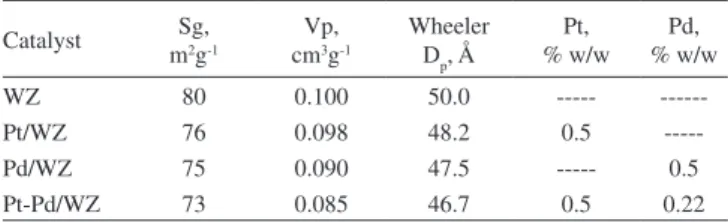
calcined support had a 16% W and that the Pt/WZ catalyst had 0.5% Pt. The PtPd/WZ catalyst had 0.5% Pt and 0.22% Pd. Pd/WZ had 0.5% Pd.
WZ calcined at 700 °C had a speciic surface area of 80 m2 g-1 and
a pore volume of 0.1 cm3 g-1. The pore size distribution obtained from
the nitrogen desorption experiment was monomodal and spanned the 20-100 Å range. It was centered at 15-20 Å (pore radius) with a tail in the macropore region. The presence of Pt, Pd or Pt+Pd in the catalysts did not affect the textural properties. All samples had practically the same values as the WZ one. The value of the Wheeler’s pore diameter, 50 , indicates that the pore structure shows no difussional problems to reactants or products.
Inspection of the XRD spectra (Figure 1) showed that the crys-talline structure of WZ was fully tetragonal and with a high percentage of crystallinity (88%). The peaks located at 2q=28° and 2q=31° were attributed to the monoclinic phase of zirconia and those located at 2q=30° to the tetragonal phase. The peaks located at 2q=23-25° were attributed to WO3 crystals. There was no evidence of segregation of tungsten oxides into bulk WO3 crystals. These should be detected from their XRD signature overimposed on the zirconia spectrum. These results are consistent with the statement of Barton et al.9 who considered that segregated WO3 crystals are formed at loadings equal or higher than 1.5 monolayers (9 atoms nm-2). The W load was 5.3
atoms nm-2 in our case. This value is somewhat lower than the 6.25 W
nm-2 monolayer value reported for WO
3-ZrO2 elsewhere.10 No XRD
signals corresponding to metallic Pt and Pd crystals were detected in any of the samples. This is due to the low content and the relatively low range of detection of the XRD tecnhnique. Particles with at least 10 stacked atomic planes are needed to produce a non-negligible signal. The stabilization of the tetragonal structure of zirconia by W surface doping coincides with the reports of Arata and Hino and Vaudagna et al..2,11 The nature of the phase stabilization phenomenon is still
controversial. Some authors attribute it to a small size of the crystals and the higher surface energy of the monoclinic phase in comparison to the tetragonal one. Others attribute it to the stabilization of anionic vacancies that lower the coordination of the Zr cations.12
Figure 2 displays the TPR proiles of the noble metal containing catalysts. The TPR trace of the zirconia support without Pt, Pd or W had no detectable peaks of hydrogen consumption. In the case of the
Pt/WZ sample a peak at 80-130 °C was attributed to the reduction of PtO2. Peaks at higher temperatures are due to the reduction of tungsten species. The ability of tungsten to form multiple oxide species of different oxidation degree and also many stable substoichiometric phases of variable oxygen content makes the interpretation of the TPR traces dificult. According to Barton et al.9 three main reduction
peaks are found that correspond to successively reducing tungsten oxide species: 300-500 °C (WO3→ WO2.9), 550-700 °C (WO2.9→ WO2) and 750-850 °C (WO2→ W). A fourth peak at about 900-950 °C would correspond to the reduction of WOx species strongly bon-ded to the support. These WOx species reduce at higher temperatures because they contain refractory bonds between W and the support.
The Pd/WZ trace had a little reduction peak at around 90-120 °C that was attributed to the reduction of PdO.13 In the case of the
trace of the PtPd/WZ catalyst a pattern developed that corresponded to the reduction of both Pt and Pd species and to the different stages of WO3 or WOx reduction. Pd and Pt reduction produced a short and broad reduction peak at 100-160 °C. This peak was not the sum of the peaks of the traces of the monometallic catalysts. This fact indicates that Pt and Pd are not reduced independently but in interaction with each other. Similar reports have been previously published.14 Since the
mass percentage of Pt (0.5%) is twice higher than that of Pd (0.22%) the decrease in hydrogen consumption associated to PtO2 reduction must be due to the presence of PdO.
Peaks at temperatures higher than 200 ºC in all catalysts are due to WOx reduction. The peak at 300-350 ºC is very small and could be assigned to the irst step of reduction of WO3 crystallites into substoichiometric WO2.9 suboxides. The presence of these crystallites was not conirmed by the XRD measurements. The second peak with a maximum at about 700 °C could be attributed to the transition from the suboxide to WO2. The peaks at about 870 °C could correspond to the inal reduction to the zerovalent metal state. In some papers the isomerizing activity of WZ catalysts is associated to the presence of WOx species that are reduced in the WO2.9→ WO2 step.6,15
Results of temperature programmed desorption of pyridine (Py) are included in Table 2. The total acidity was calculated as the total area under the TPD curve. The registered value of 97.1 μmol g-1 (0.56 at Py
nm-2) in the case of the WZ catalyst is approximately one tenth of the
density of W atoms on the surface of the catalyst. The W surface density was calculated as 5.3 at W nm-2, considering that there is no segregation
of W in structures with a thickness greater than the monolayer value. As an average one acid site is formed for 10 W atoms incorporated, it can be supposed from this low value of adsorption stoichiometry that W is not perfectly dispersed on the surface of the catalyst.
Figure 1. XRD spectrum of the tungsten-zirconia (WZ) catalyst
Figure 2. Traces of temperature programmed reduction of the noble metal
loaded catalysts Table 1. Catalyst textural and chemical properties
Catalyst mSg,2g-1
Vp, cm3g-1
Wheeler Dp, Å
Pt, % w/w
Pd, % w/w
WZ 80 0.100 50.0 ---
---Pt/WZ 76 0.098 48.2 0.5
---Pd/WZ 75 0.090 47.5 --- 0.5
Pt and Pd addition distort the distribution of acid strength of the original WZ catalyst. The relative population of sites of weak, medium and strong acid strength are changed. Pd addition has a greater effect on the distribution than Pt addition. In general Pt increases the total amount of acid sites while Pd decreases it.
The Brönsted/Lewis acid ratio was calculated from parallel measurements of acidity by desorption of trimethyl pyridine. The results indicate that Pd or Pt addition modiies the concentration of Lewis and Brönsted acid sites. It has been extensively reported that the Brönsted/Lewis ratio of WZ is much higher than that of zirconia alone.16-18 Pt addition results in an increase of the concentration of
Brönsted acid sites and the Brönsted/Lewis acid ratio. The results of Table 2 indicate that Pt addition increases the amount of Brönsted acid sites while Lewis sites are increased by a lower amount, resulting in an enhanced Brönsted/Lewis ratio. The Brönsted/Lewis acid ratio is decreased by the addition of Pd. Pt/WZ has a value of 1.7 and Pd/ WZ a value of 0.39. For PtPd/WZ the ratio is further lowered to 0.31. Table 3 contains the data related to the characterization of the metal function of the catalysts. The H/Pt ratio results indicate that the catalysts have a low dispersion or that the Pt surface atoms have an inhibited capacity for chemisorbing hydrogen at room temperature. It is a known fact that noble metals supported on oxoanion promoted zirconia catalysts have a great interaction with the support and lose part of their chemisorption capacity and their ability for de/hydro-genation of hydrocarbons.19,20
The cyclohexane dehydrogenation tests reveal that both Pt and Pd have weak dehydrogenation properties when supported over tungsten-zirconia. The effect of inhibition seems to be stronger in the case of Pd since Pd/WZ has the lowest dehydrogenation capacity and PtPd/ WZ an intermediate behavior. There is practically no correlation be-tween the H/Pt hydrogen chemisorption results and the cyclohexane dehydrogenation tests. Cyclohexane dehydrogenation is a structure insensitive reaction and its rate is reported to be proportional to the number of available surface sites. This is true for non inhibited noble metal particles such as those present in Pt/silica or Pt/alumina catalysts. However for catalysts with an alloyed metal function or
one with strong interaction with the support the activation energy for hydrogen chemisorption or hydrocarbon reaction may be raised and the correlation between surface metal availability and catalytic activity can be lost. For example Rajeshwer et al.21 reported that the activation
energy for hydrogen chemisorption on Pt-Sn/alumina catalysts was raised in relation to Pt/alumina and that hydrogen chemisorption tests lost usefulness for determining the metal surface availability.
In any case the clear result is that Pd has a much lower capacity for dehydrogenation than Pt when supported over WZ. Pd/Al2O3 is a superb de/hydrogenation catalyst and therefore the much lower capacity displayed by Pd/WZ can only be attributed to the strong inhibiting effect of the WZ support.
It is noteworthy the appearance of methylcyclopentane between the reaction products of the conversion of cyclohexane. This is formed by ring contraction over acid sites. No ring opening products, like n-hexane or its acyclic isomers, are found. Ring opening is a reaction usually catalyzed by the metal function. The inhibited state of the metal function clearly prevents the opening of the ring. The activity in ring contraction is maximum for Pt/WZ and minimum for Pd/WZ, while PtPd/WZ has an intermediate level. These results are in contrast with the acidity results because Pd doped catalysts are those with the highest concentration of strong acid sites. Ring contraction demands acid sites with high strength as reported in the scientiic literature.18
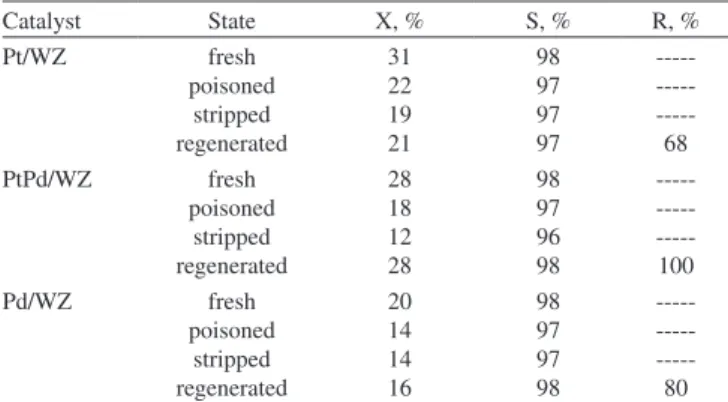
Results of isomerization of n-hexane are depicted in Tables 3 and 4 and in Figure 3. In the case of the fresh catalysts (Table 3) the n-hexane conversion attern follows the trend of cyclohexane dehydro-genation with a relative activity order: Pt/WZ ≈ PtPd/WZ > Pd/WZ. This order is repeated in the case of the sulfur poisoned catalysts. The poisoning effect reduces the activity 30-35% on average.
The main drawback of the noble metal catalysts is their extremely low tolerance to sulfur. It has been proposed that acidic supports can enhance their tolerance, making them electron-deicient and disfavoring the formation of metal-S bonds.22,23 Another alternative is
the promotion of Pt particles by the addition of a second metal (e.g. Pt-Pd). The formation of an alloyed bimetallic function is reported to greatly improve the sulfur resistance. The promotion effect of the alloying metal has been addressed to changes in the electronic properties of the Pt atoms.24
In our case the results indicate that the addition of Pd to Pt/WZ does not substantially improve the catalyst sulfur poisoning resis-tance. All catalyst suffered from extensive deactivation after sulfur doping and did not recover their original levels during hydrogen stripping. A likely explanation is that Pt on WZ is so highly inhibited Table 4. Tests of sulfur poisoning with regeneration
Catalyst State X, % S, % R, %
Pt/WZ fresh poisoned stripped regenerated 31 22 19 21 98 97 97 97 ---68 PtPd/WZ fresh poisoned stripped regenerated 28 18 12 28 98 97 96 98 ---100 Pd/WZ fresh poisoned stripped regenerated 20 14 14 16 98 97 97 98 ---80 X: n-hexane conversion; S: selectivity to branched isomers; R: X / Xfresh; TOS: time-on-stream; fresh: freshly calcined and reduced catalyst, TOS=50 min; poisoned: after poisoning with 1.7 mL CS2 , TOS=150 min; stripped: after treating with H2, TOS=450 min; regenerated: after calcination in air and reduction in H2, TOS=550 min
Table 3. Metal function properties as assessed by hydrogen pulse chemisorp-tion tests and cyclohexane dehydrogenachemisorp-tion (TOS=50 min)
Catalyst H / Pt Benzene yield, %
Pt/WZ 0.37 19.26
PtPd/WZ 0.30 5.49
Pd/WZ 0.21 0.89
Table 2. Acidity of the calcined catalysts as measured by temperature pro-grammed desorption of pyridine and trimethylpyridine
Catalysts
Brönsted (B) and Lewis (L) acidity, mmol Py g-1
Brönsted/ Lewis ratio Total 150-300 °CWeak 300-500 °CMedium 500-650 °CStrong
WZ 60.24 (B) 37.86 (L) 97.1 (B+L) 18.23 (B) 9.33 (L) 35.14 (B) 23.55 (L) 6.87 (B) 4.98 (L) 1.5
Table 5. Tests of amine poisoning with regeneration
Catalyst State X, % S, % R, %
Pt/WZ fresh poisoned
stripped regenerated
30 11 11 24
98 95 95 93
80
PtPd/WZ fresh poisoned
stripped regenerated
30 11 11 19
98 97 95 97
63
Pd/WZ fresh
poisoned stripped regenerated
20 9 9 20
98 95 95 97
100
X: n-hexane conversion; S: selectivity to branched isomers ; R: X / Xfresh
TOS: time-on-stream; fresh: freshly calcined and reduced catalyst, TOS=50 min; poisoned: after poisoning with 8 mL BA, TOS=150 min; stripped: after
treating with H2, TOS=450 min; regenerated: after calcination in air and
reduction in H2, TOS=550 min
Figure 3. Yield of 2,3-DMB during isomerization of n-hexane with intermediate
poisoning, hydrogen stripping and regeneration (calcination in air and reduc-tion in hydrogen). n-Butyl amine poison (). Carbon disulide poison ()
that the further addition of promoters does not result in any further modiication of its electronic properties. In other words no additive effects of Pt-Pd alloying and electronic induction from the support would occur in the case of the Pt-Pd/WZ catalyst. Though the sulfur resistance is not improved a beneicial effect is detected in the case of the Pt-Pd doped catalyst when the results of activity recovery after regeneration are inspected. The pattern of activity obtained for the regenerated catalysts was PtPd/WZ > Pt/WZ > Pd/WZ. Pt-Pd doped catalysts had the highest percentage of recovery (100%). The Pd/WZ catalyst recovered only 80% (20 to 16) and Pt/WZ only 68% (31 to 21). A net beneit of Pd addition is seen in this case because all the original activity can be restored after regeneration.
With respect to the poisoning by n-butyl amine (BA) the results are quite similar for the three catalysts (Table 5). Poisoning reduces the activity by 50-65%. The poisoning effect of BA is stronger than that of
carbon disulide CS2. The activity level is not modiied by hydrogen stripping in any of the catalysts. After regeneration the initial activity level is only fully recovered in the case of the Pd/WZ catalyst.
Figure 3 contains the data related to the production of 2,3-dime-thyl-butane (2,3-DMB) during the activity-poisoning-regeneration tests. This is the most important hexane isomers from the point of view of the RON (Research Octane Number) it supplies. The others isomers are: 2-methyl-pentane (2-MP), 3-methyl-pentane (3-MP) and 2,2-dimethyl-butane (2,2-DMB). n-Hexane (n-C6) has a RON of 31 while its isomers have much higher values: RON2-MP=74, RON3-MP=76,
RON2,2-DMB=94, RON2,3-DMB=105.
The distribution of products was fairly the same in all the tests and with the three different catalysts. As a consequence the yield of 2,3-DMB was also proportional to the conversion level and the global RON of the isomerizate.
The values of the difference in RON value between the feed (pure n-C6) and the product (ΔRON) showed a invariant pattern for all the samples. For example in the case of PtPd/WZ, ΔRON=64-65 during the run. After poisoning with n-butylamine (BA), ΔRON values dro-pped to 57-58. After hydrogen stripping the ΔRON was decreased even further to 54-55. Only after normal regeneration (involving calcinations in air) the ΔRON value was recovered (65-66). In the case of the poisoning with CS2 the results were similar but the RON was not fully recovered (61-62). For all the catalysts tested, in any of the three states (fresh, poisoned, regenerated) the liquid yield (C5+) was higher than 99%.
Figure 3 shows the yield to isomers as a function of time-on-stream for the different catalysts used and in the fresh, stripped and regenerated state. In the case of the Pt/WZ catalyst the original yield of 2,3-DMB (16 micromol h-1 g-1) decreases markedly after the introduction of a
pulse of 8 mL of n-butylamine (BA). The yield is not recovered after the stripping in hydrogen at the reaction temperature for 60 min. The rate of formation of 2,3-DMB recovers about 95% of its original va-lue of the fresh state after calcination in air at 500 ºC and subsequent reduction in hydrogen (14.8 micromol h-1 g-1). This trend mimicks that
of the global activity and indicates that the reaction proceeds on acid sites and that these are affected by the adsorption of the amine base. When the poisoning of Pt/WZ is performed with CS2 the decrease of the yield of 2,3-DMB is more marked. The activity is not recovered after stripping with hydrogen. Standard regeneration, comprising calcination and reduction, recovers the original yield to a 68% (11 micromol h-1 g-1).
regeneration procedure. When the poisoning is performed with CS2, the 2,3-DMB yield drop is smaller than that seen for Pt/WZ. With the standard regeneration procedure PtPd/WZ recovers the yield of 2,3-DMB yield by 98% when the poisoning is CS2 and 86% for BA.
CONCLUSIONS
Pd addition reduces the total number of acid sites, increases the fraction of sites of high acid strength and decreases the Brőnsted/ Lewis ratio of the parent support, either WZ or Pt/WZ.
Pt/WZ and PtPd/WZ are more active catalysts than Pd/WZ for the isomerization of n-hexane. The low activity of the Pd catalyst is partly attributed to the poor metal properties of Pd when supported over WZ thus affecting the metal catalyzed steps of the mechanism, e.g. olein formation and hydrogenation of coke precursors. Additionally Pd addi-tion lowers the Bronsted/Lewis ratio of the acid sites thus decreasing the concentration of the most active sites in n-hexane isomerization.
The addition of Pd to Pt/WZ does not substantially improve the catalyst sulfur poisoning resistance. A likely explanation is that Pt on WZ is so highly inhibited that the further addition of promoters does not result in any further modiication of its electronic properties. In other words no additive effects of Pt-Pd alloying and electronic induction from the support would occur in the case of the Pt-Pd/WZ catalyst. It does have a positive effect on the level of restored acti-vity after regeneration. The Pt-Pd catalyst is the only catalyst fully recovering its original activity after regeneration.
n-Butyl amine in small amounts in the feed drastically supresses the isomerization activity of all catalysts. The original activity can only be restored by a treatment in air at 500 ºC with subsequent reduction in hydrogen at 250 ºC.
ACKNOWLEDGEMENTS
This work was inancially supported by Universidad Nacional del Litoral through the CAI+D 2006 program, Grant 36 / 197.
REFERENCES
1. Holm, V. C. F.; Bailey, G. C.; US Patent 3,032,5991962. 2. Hino, M.; Arata, K.; J. Am. Chem. Soc.1979, 101, 6439. 3. Larsen, G.; Petkovic, L. M.; Appl. Catal. A1996, 148, 155. 4. Arribas, M. A.; Márquez, F.; Martinez, A.; J. Catal.2000, 190, 309. 5. Triwahyono, S.; Yamada, T.; Hattori, H.; Appl. Catal. A2003, 242, 101. 6. Falco, M. G.; Canavese, S.; Comelli, R. A.; Fígoli, N. S.; Appl. Catal. A
2000, 201, 37.
7 Itoh, T. J.; Mater. Sci. Lett.1986, 5, 107.
8 Nikolaou, N.; Papadopoulos, C. E.; Gaglias, I. A.; Pitarakis, K. G.; Fuel 2004, 83, 517.
9. Barton, D. G.; Soled, S. L.; Iglesia, E.; Topics Catal.1998, 6, 87. 10. Boyse, R. A.; Ko, E. I.; J. Catal.1998, 179, 100.
11. Vaudagna, S.; Comelli, R.; Canavese, S.; Fígoli, N.S .; Appl. Catal. A 1998, 168, 93.
12. Vera, C. R.; Shimizu, K.; Pieck, C. L.; Parera, J. M.; Appl. Catal.A 2002, 230, 137.
13. Lietz, G.; Lieske, H.; Splinder, H.; Hanke, W.; Volter, J.; J. Catal.1983, 81, 17.
14. Navarro, R. M.; Pawlec, B.; Trejo, J. M.; Mariscal, R.; Fierro, J. L. G.; J. Catal.2000, 189, 184.
15. Iglesia, E.; Barton, D. G.; Soled, S. L.; Miseo, S.; Baumgartner, J. E.; Gates, W. E.; Fuentes, G. A.; Meitzner, G. D.; Stud. Surf. Sci. Catal. 1996, 101, 533.
16. Busto, M.; Benıtez, V. M.; Vera, C. R.; Grau, J. M.; Yori, J. C.; Appl. Catal. A2008, 347, 117.
17. Benítez, V. M.; Yori, J. C.; Grau, J. M.; Pieck, C. L.; Vera, C. R.; Energy Fuels2006, 20, 422.
18. Yori, J. C.; Gastaldo, R. J.; Benitez, V. M.; Grau, J. M.; Pieck, C. L.; Vera, C. R.; Catal. Today2008, 133, 339.
19. Grau, J. M.; Yori, J. C.; Vera, C. R.; Lovey, F.; Condó, A.; Parera, J. M.; Appl. Catal. A 2004, 265, 142.
20 Shishido, T.; Tanaka, T.; Hattoti, H.; J. Catal.1997, 172, 24.
21. Rajeshwer, D.; Basrur, A. G.; Gokak, D. T.; Krishnamurthy, K. R.; J. Catal.1994, 150, 135.
22. Schatler, W. M. H., Sthakheev, A. Y.; Catal. Today1992, 12, 283. 23. Homeyer, S. T.; Schatler, W. M. H.; Stud. Surf. Sci.Catal. 1989, 49, 975. 24 Pawelec, B.; La Parola, V.; Thomas, S.; Fierro, J. L. G.; J. Mol. Catal. A