52 Brazilian Journal of Physics, vol. 37, no. 1, March, 2007
Contribution from Drell-Yan Processes to the Emission Spectrum in Solar Flares
S. Szpigel1, F. O. Dur˜aes1,2, and F. M. Steffens1
1 Centro de Ciˆencias e Humanidades, Universidade Presbiteriana Mackenzie Rua da Consolac˜ao 930, 01302-907 S˜ao Paulo, Brasil
2Instituto de F´ısica, Universidade de S˜ao Paulo, C.P. 66318, 05389-970 S˜ao Paulo, SP, Brazil
Received on 29 September, 2006
The recent discovery of a new and intense solar flare radiation spectral component with a maximum in the terahertz range has raised a great deal of interest. The origin of this component is still unknown, constituting a problem that goes beyond the application of canonical models used to describe the well-known microwave spectrum. In this work, we present preliminary results on the investigation of a possible contribution from electron-positron pairs produced in a Drell-Yan process to the emission of the terahertz component observed in solar flares.
Keywords: Drell-Yan processes; Solar emission spectrum; Terahertz component
I. INTRODUCTION
Solar flares are sudden and rapid releases of enormous amounts of energy in the solar atmosphere, involving accel-eration of particles, plasma heating and bulk mass motions. It is a general believe that they occur when the energy stored in magnetic loops that have built up in the active regions around sunspots is suddenly released, in a process called magnetic reconnection [1]. During the restructuring of the magnetic fields in such a process both electrons and ions are acceler-ated to high energies and radiation is emitted covering virtu-ally the entire electromagnetic spectrum, from radio-waves to gamma-rays [2].
The recent discovery of a new and intense solar flare ra-diation component with a maximum in the shorter submil-limeter to far infrared range has raised a great deal of inter-est, confirming theoretical suggestions and experimental evi-dences proposed for more than twenty years. This new com-ponent, which in the frequency domain has a peak in the tera-hertz range (0.1-100 THz), was identified by Kaufmann et al. [3] during the observation of the 2003 November 4 large solar flare.
The origin of the terahertz component observed during this solar flare is still unknown, constituting a problem that goes beyond the application of canonical models used to describe the well-known microwave spectrum observed at frequencies below 100 GHz. In such canonical models, the processes of energy generation during the flare impulsive phase are gen-erally attributed to a population of relativistic electrons pro-ducing microwaves by synchrotron emission and X-rays by collisions in denser regions of the solar atmosphere [4].
Nevertheless, a few early models were proposed to explain solar flare radio emission at frequencies higher than 100 GHz considering electrons with energies much larger than the en-ergies assumed to explain the usual microwaves (>10 MeV), such as free-free thermal bremsstrahlung [5] and synchrotron emission by ultra-relativistic electrons [6].
In this work we investigate the contribution from Drell-Yan processes to the emission spectrum in solar flares. We present preliminary results on the calculation of the energy spectrum for electron-positron pairs produced in a Drell-Yan process
from proton-proton collisions in the solar atmosphere and dis-cuss its possible contribution to the terahertz component ob-served in solar flares.
II. THE OBSERVATION OF THE NEW TERAHERTZ
SOLAR FLARE COMPONENT
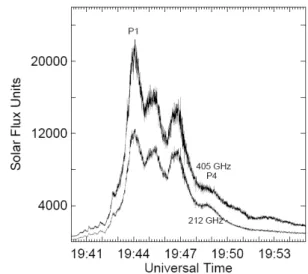
The new terahertz component was detected during the ob-servation of the 2003 November 4 solar flare using the Solar Submillimeter Telescope (SST) at the Leoncito Observatory in Argentina, built to extend the range of solar flare obser-vations to frequencies above 100 GHz [7]. The SST detected this new component with flux increasing between 212 and 405 GHz, along with the well-known microwave component, but distinguished from it. In Fig. 1 (Kaufmann et al. [3]), we show the time profiles of emissions at 212 and 405 GHz, in solar flux units.
FIG. 1: Time profiles of the 2003 November 4 solar flare emissions at 212 GHz and 405 GHz (Kaufmann et al. [3]).
com-S. Szpigel et al. 53
10 100 1000
Frequency [GHz] 10000
Flux Density [s.f.u.]
P1
P4
P1
P4
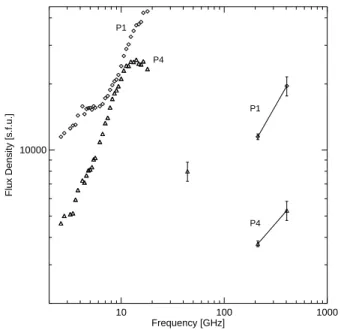
FIG. 2: Spectra for peaks P1 and P4 along with the corresponding microwave components (Kaufmann et al. [3]).
ponents at 15.6 GHz for comparison. As can be seen from the figure, the flux density is much larger at 405 than at 212 GHz for both peaks, indicating a maximum spectral emission lying within the terahertz range.
Recently, Kaufmann and Raulin [8] proposed a mechanism to explain the new terahertz component in which beams of ultrelativistic electrons produce incoherent synchrotron ra-diation (ISR) with maximum in the terahertz range, further un-dergoing density modulations that may generate microbunch-ing instabilities producmicrobunch-ing the intense broadband coherent synchrotron (CSR) observed at microwaves. This process is similar to what happens in laboratory accelerators with high energy electrons beams in storage rings [9].
In another recent work, Sakai et al. [10] proposed an in-terpretation for the terahertz component in terms of a plasma emission mechanism in which Langmuir waves, generated when relativistic electron beams propagate into the high den-sity region corresponding to the solar photosphere, are con-verted in electromagnetic waves.
III. SYNCHROTRON EMISSION FROM POSITRONS IN
SOLAR FLARES
A possibility that has also been considered to explain the terahertz component is the synchrotron emission by high-energy positrons [11], whose presence during solar flares is confirmed by the observation of the 511 keV gamma-ray positron-electron annihilation line [12].
The main mechanism for positron production in solar flares is the decay of pions produced by nuclear interactions of flare-accelerated protons with protons or alpha-particles in the
am-bient solar atmosphere [13], such as in the following mode: p+p(α)→π++X
π+→µ++ν , µ+→e++2ν. (1)
Another contribution is due to the decay of radioactive positron-emitter isotopes such as10C,11C,12N,13Nand15O which are produced in nuclear interactions of flare-accelerated protons and alpha-particles with ambient heavy nuclei [14]. The importance of these processes for positron production de-pends on the cross sections and the assumed elemental and isotopic abundances.
In a comparative study of different emission mechanisms that could explain the terahertz component, Valio et al. [11] estimated the synchrotron emission from 1 to 1000 MeV positrons. A fitting for the observed terahertz spectrum shown in Fig. 2 was calculated using a simplified version of an en-ergy spectrum for positrons produced from pion decay evalu-ated by Murphy et al. [13].
Although a good fit was obtained for the 212 GHz and 405 GHz data points, a total number of positrons had to be as-sumed which was approximately 200 times larger than the 1030 positrons inferred from measurements of the 511 keV annihilation line. This result gives the main motivation of this work. Electron-positron pairs, produced in a Drell-Yan process at high energies, can carry large momenta and, in prin-ciple, could provide an extra contribution to the mechanism of synchrotron emission by positrons in the terahertz range.
IV. SPECTRUM OF POSITRONS PRODUCED IN A
DRELL-YAN PROCESS
The Drell-Yan process is a high-energy reaction in which a dilepton pairl+l−is produced from quark-antiquark annihi-lation in a nucleon-nucleon (nucleus-nucleus) collision [15]. The differential cross-section for dilepton pair production in a Drell-Yan process is a standard calculation in perturbative QCD. In terms of the dilepton pair invariant massM and the Feynman scaling variablexF for thel+l−pair, if one
consid-ers only the lowest order diagram (i.e. quark-antiquark anni-hilation going to a virtual photon which subsequently decays into anl+l−pair), the cross-section for the process at Leading
Order (LO) can be written as: d2σ
dM2dx
F
= κσˆ(M) sNc
Nf
∑
f
³ef e
´2
(x2F+4M2/s)−1/2
×
× £qAf(x1)qBf(x2) +qAf(x1)qBf(x2) ¤
, (2)
whereNc(=3)is the number of colors, ef is the charge of
quark with flavor f (=u,d),sis the square of the total energy in the nucleon-nucleon collision center-of-mass frame, ˆσ(M) is the elementary cross-section for theqqannihilation process andqA
f(x1)( ¯qAf(x1)),qBf(x2)( ¯qBf(x2)) are the quark (antiquark) distribution functions for the nucleonsAandB.
54 Brazilian Journal of Physics, vol. 37, no. 1, March, 2007
follows we shall assumeκ=1 and use the (LO) proton par-ton distribution functions, at a fixed scaleQ2=1 GeV2, taken from [16] (GRV98 LO).
The quantitiesx1andx2are the nucleon momentum frac-tions carried respectively by partons in the projectile and tar-get. They are related toM2andxFby:
M2=s x1x2 ; xF=x1−x2. (3) We consider the production of a positron-electron paire+e−
from a proton-proton collision and integrate over the total longitudinal momentum of the positron-electron pair in the center-of-mass framePz=xF√s/2 for a fixedsto obtain the
e+/e−energy distribution, given by: dne±
dP0e±(P
e±
0 ,s) = 2 σinel
pp (s) dσ dP0
, (4)
whereσinel
pp (s)is the total cross-section for inelastic proton-proton collision which we shall take from Ref. [17],Pe±
0 is the e+/e− energy in the proton-proton collision center-of-mass frame,P0is the total energy of the positron-electron pair and
dσ dP0
= κ 4P0 s3/2Nc
Z √s/2
0
dPzσˆ(M) Nf
∑
f
³ef e
´2
×
×
h
qAf(x1)qBf(x2) +qAf(x1)qBf(x2) i
(x2F+4M2/s)1/2 . (5) In the calculation of the energy distribution we make the as-sumptionP0=2P0e± and take an average value for the total transverse momentum of the positron-electron pair PT such
that
M2=P02−PT2−Pz2≈P02−<PT>2−Pz2 (6)
with<PT >≈0.3−0.5 GeV.
We calculate the spectrum of e+/e− produced in the Drell-Yan process by considering collisions between flare-accelerated protons (projectile) and protons from the ambient solar atmosphere (fixed target) in the laboratory frame:
dNe± dEe± =
Z Emax Emin
dEpF(Ep)
dne± dEe±(E
e±
,Ep), (7)
whereEe±andEpare respectively the kinetic energies of the
e+/e− and the accelerated proton in the laboratory frame,
given by
Ee±= (√sP0e±−2me±mp)/2mp (8)
Ep= (s−4m2p)/2mp (9)
Following Ref. [18] we use a power-law energy distribution function for the accelerated protons given by
F(Ep) =A E−pα, (10)
whereAis a normalization constant picked so that the protons with energies in the rangeEmin≤Ep≤Emaxequals 1 andαis chosen in the interval 2−3.
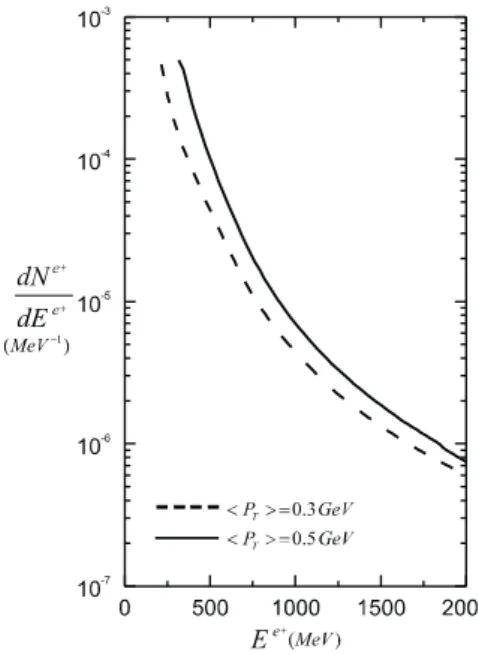
FIG. 3: Energy spectra ofe+produced from Drell-Yan process for
<PT>=0.5 GeV (solid) and<PT>=0.3 GeV (dashed).
FIG. 4: Energy spectra ofe+produced from the pion decay process obtained by Murphy et al. [13] (dashed line) and from the Drell-Yan process (solid line).
V. PRELIMINARY RESULTS AND DISCUSSION
In Fig. 3 we show the energy spectra for positrons pro-duced in a Drell-Yan process obtained using Eq. 7 for two different average values for the total transverse momentum of the positron-electron pair: <PT >=0.5 GeV (solid line)
and<PT >=0.3 GeV (dashed line). In both cases we have
chosenα=2, Emin=1 GeV and Emax=100 GeV. As can
thresh-S. Szpigel et al. 55
old positron kinetic energy (Ee+) and decrease as the energy grows. Such threshold is determined by the condition that the square of the dilepton pair invariant massM2in Eq. 6 must be greater than 4m2e. Thus, for smaller values of<PT >the
energy spectrum starts at lower values ofEe+.
In Fig. 4 we show a comparison between our result for the positron energy spectrum obtained with <PT >=0.5 GeV
(solid line) and the spectrum evaluated by Murphy et al. [13] for positrons produced from pion decay. As can be seen from the figure, for energies above≈0.5 GeV a significant number of positrons can be produced from the Drell-Yan process in comparison to the number of positrons produced from the pion decay process, indicating a possible extra contribution to the synchrotron emission mechanism.
Although preliminary, these results are promising. We are currently refining the numerical calculations and testing for the sensitivity of the results on the parameters α, <PT >,
EminandEmax. Our next step will be the evaluation of the
syn-chrotron emission flux density in solar flares using a positron energy spectrum which takes into account the positrons
pro-duced both from the Drell-Yan process and the pion decay process.
By including the Drell-Yan contribution, we believe that the total number of positrons needed to fit the terahertz spectrum shown in Fig. 2 will be smaller than the number used by Valio et al. [11], yielding a result more compatible with the ex-pected number of positrons inferred from the 511 keV annihi-lation line measurements.
Acknowledgments
The authors wish to thank P. Kaufmann, A. V. R. da Silva and C. G. G. Castro, from Centro de Radio-Astronomia e Astrof´ısica Mackenzie (CRAAM), for the collaboration and fruitful discussions. This work has been supported by CNPq, FAPESP and Instituto Presbiteriano Mackenzie, educational entity for scientific and technological development, through MACKPESQUISA.
[1] M. J. Aschwanden, Space Sci. Rev.101, 1 (2002).
[2] T. S. Bastian, A. O. Benz, and D. E. Gary, Annu. Rev. Astron. Astrophys.36, 131 (1998).
[3] P. Kaufmann, J.-P. Raulin, C. G. Gimenez de Castro, H. Levato, D. E. Gary, J. E. R. Costa, A. Marun, P. Pereyra, A. V. R. Silva, and E. Correia, Ap. J. (Letters)603, L121 (2004).
[4] M. R. Kundu, in Radio Physics of the Sun, IAU Symp. 86, ed. M. R. Kundu and E. Gergely, 157 (1980); G. A. Dulk and B. R. Dennis, Ap. J.260, 875 (1982).
[5] K. Ohki and H. S. Hudson, Sol. Phys43, 405 (1975).
[6] W. A. Stein and E. P. Ney, J. Geophys. Res.68, 65 (1963); J. Shlovsky, Nature202, 275 (1964); P. Kaufmann, E. Correia, J. E. R. Costa, and A. M. Zodi Vaz, A&A157, 11 (1986). [7] P. Kaufmann et al., in Proc. SBMO/IEEE MTT-S Int.
Mi-crowave and Optoelectronics Conf., ed. J. T. Pinho, G. P. San-tos, and L. A. H. G. Oliveira (Piscataway:IEEE), 439 (2001). [8] P. Kaufmann and J.-P. Raulin, Eos. Trans. AGU86 (18), Jt.
Assemb Suppl. Abstract SH54A-06 (2005).
[9] J. M. Byrd, W. P. Leemans, A. Loftsdottir, B. Marcelis, M. C.Martin, W. R. McKinney, F. Sannibale, T. Scarvie, and C. Steier, Phys. Rev. Lett.89, 224801 (2002).
[10] J. I. Sakai, Y. Nagasugi, S. Saito, and P. Kaufmann, A&A preprint doi http://dx.doi.org/10.1051/0004-6361:20065368 (2006).
[11] A. V. R. Silva, C. G. G. Castro, and P. Kaufmann, in Proc. of
the V RHESSI Workshop, v. 1, 10 (2005); A. V. R. Silva, J.E.R. Costa, C. G. Gimenez de Castro, J.-P. Raulin, P. Kaufmann, G. H. Share, and R. J. Murphy, in Proc. of the SCOSTEP’s 11th Quadrennial STP Symposium,1, 1 (2006).
[12] G. H. Share and R. J. Murphy, in Stars as Suns: Activity, Evo-lution and Planets, ASP Conf. Series 219, ed. A. Benz and A. Dupree, 133 (2004); G. H. Share, R. J. Murphy, D. M. Smith, R. A. Schwartz, and R. P. Lin, Ap. J. (Letters)615, L169 (2004). [13] R. J. Murphy, C. D. Dermer, and R. Ramaty, Ap. J.
(Supple-ment)63, 721 (1987).
[14] R. E. Lingenfelter and R. Ramaty, Planet. Space Sci.15, 1303 (1967); R. Ramaty, B. Koslovsky, and R. E. Lingenfelter, Space Science Reviews18, 341 (1975); B. Koslovsky, R. E. Lingen-felter, and R. Ramaty, Ap. J.316, 801-818 (1987).
[15] S. D. Drell and T. M. Yan, Phys. Rev. Lett.25, 316 (1970); C. Crosso-Pilcher and M. J. Shochet, Ann. Rev. Nucl. Part. Sci. 36, 1 (1986).
[16] M. Gl¨uck and E. Reya and A. Vogt, Eur. Phys. J. C5, 461 (1998).
[17] A. Donnachie and P. V. Landshoff, Phys. Lett. B 296, 227 (1992).